Bathroom
20 Tiny Bathroom Ideas That Make a Small Space Feel Complete, Calm and Clever
By Anna Wells · · 21 min read
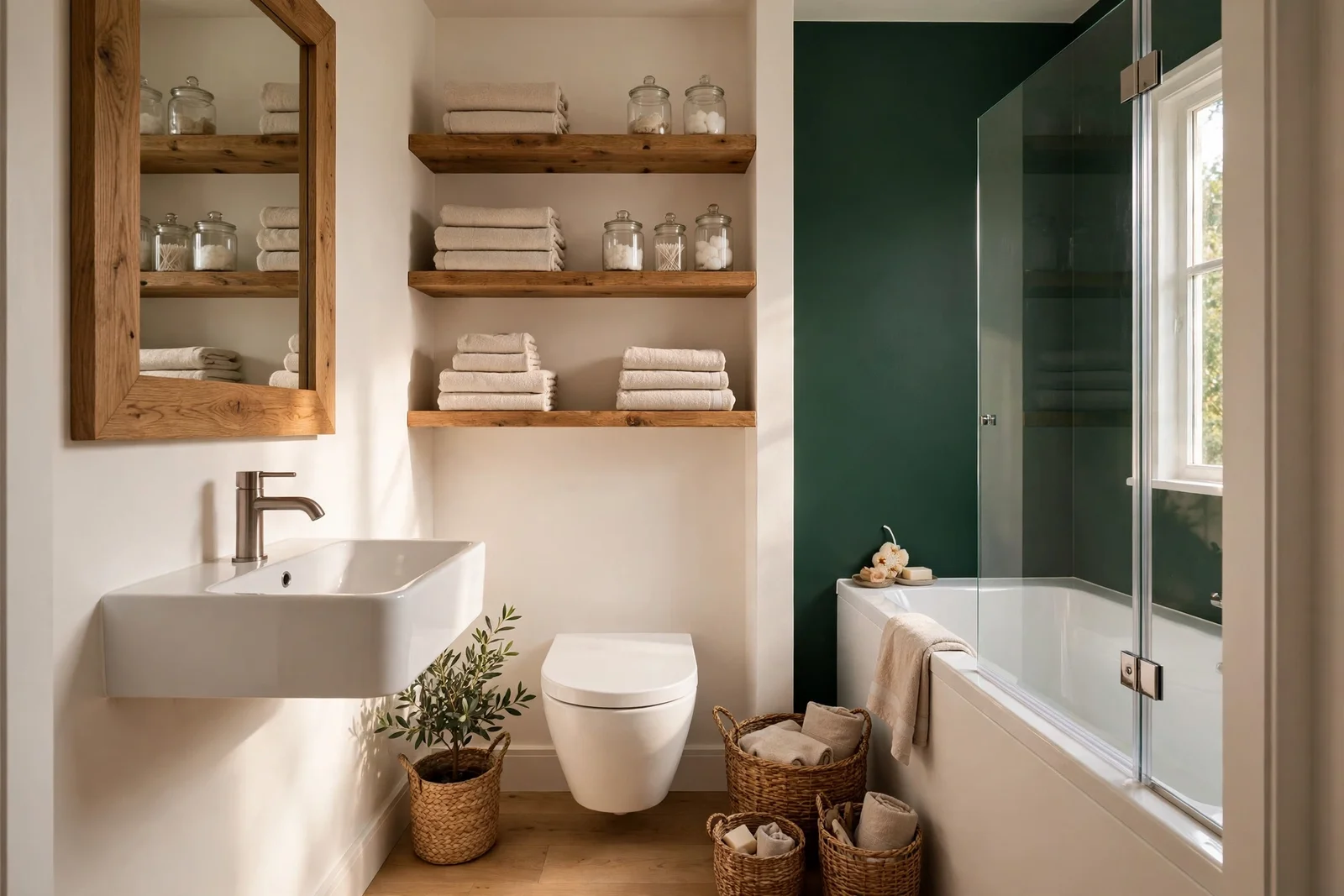
Twenty practical tiny bathroom ideas with measurements, rental safe options and clever storage that make a small full bath feel calm and complete.
Morning light lands on a small bathroom and finds everything in its place: a folded towel, a clear basin, steam lifting from the shower. There is no hunting for soap or knocking over bottles, because the room was planned to hold exactly what a busy morning needs and nothing it does not.
A tiny full bathroom asks for clever thinking, not compromise. It still fits a bath or shower, a toilet and a basin, but every centimetre works twice: the mirror hides a cabinet, the wall above the toilet carries shelves, and the floor stays clear because fixtures hang from the wall.
This guide gathers twenty concrete ideas, each with real measurements, materials and budget notes, plus rental safe options flagged where they matter. They share one aim: a bathroom that feels complete, calm and clever, however small its footprint.
Work through them in any order, try one change at a time, and let the room grow calmer with every small decision.
1. Float a Wall Hung Basin 50 cm Wide to Free the Floor Beneath
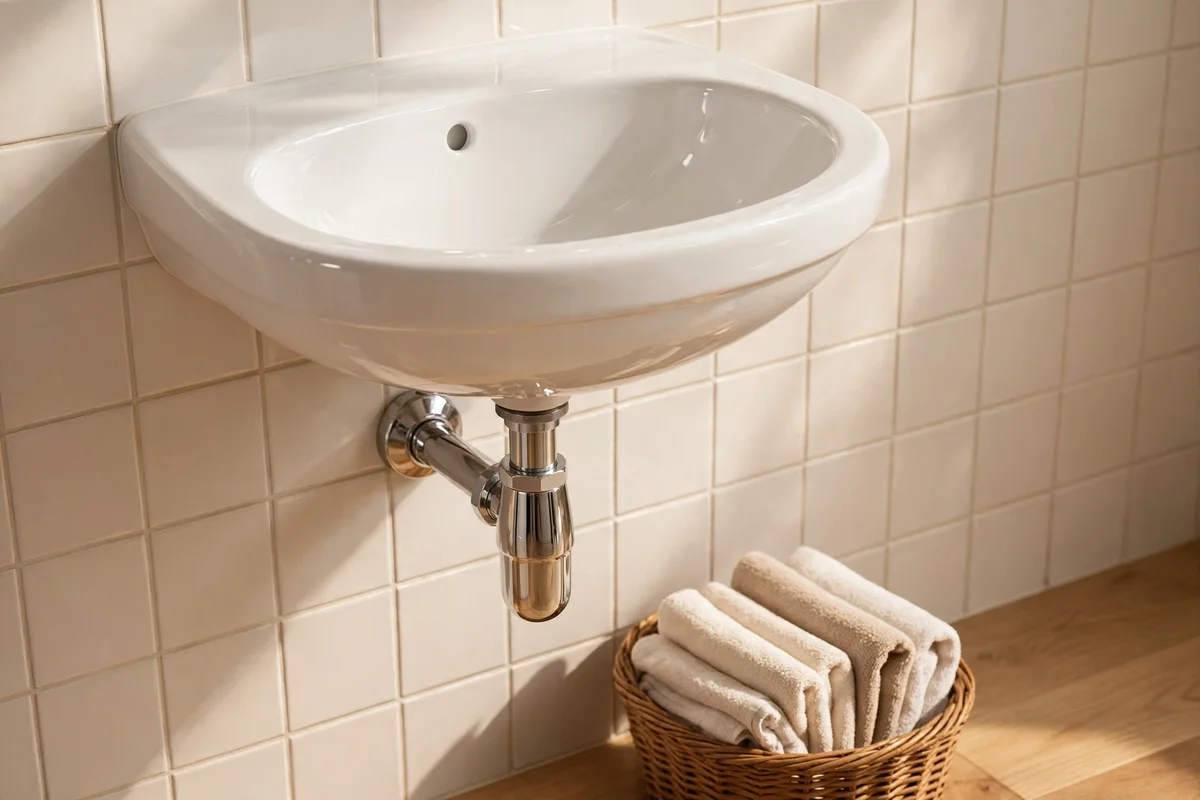
A wall hung basin between 45 and 55 cm wide suits a tiny full bathroom because the floor stays visible beneath it, and that glimpse of clear floor makes the whole room feel larger. Fix the rim 80 to 85 cm from the floor, a comfortable height for most adults. Choose a shallow bowl, 12 to 15 cm deep, so the basin does not jut far into the room. The space below can hold a low basket for spare towels.
Pair the basin with a wall mounted tap if the budget allows, since it frees the deck entirely and makes wiping down take seconds. A compact bottle trap in chrome looks tidy and keeps the underside neat. Budget tip: a basic ceramic wall hung basin costs 60 to 120 pounds or dollars, while a mid range design with a softened square shape runs 150 to 250. The mistake to avoid is fixing it too high; anything above 90 cm strains wrists and splashes more.
2. Hang the Toilet on a Concealed Cistern to Clear Precious Floor Space
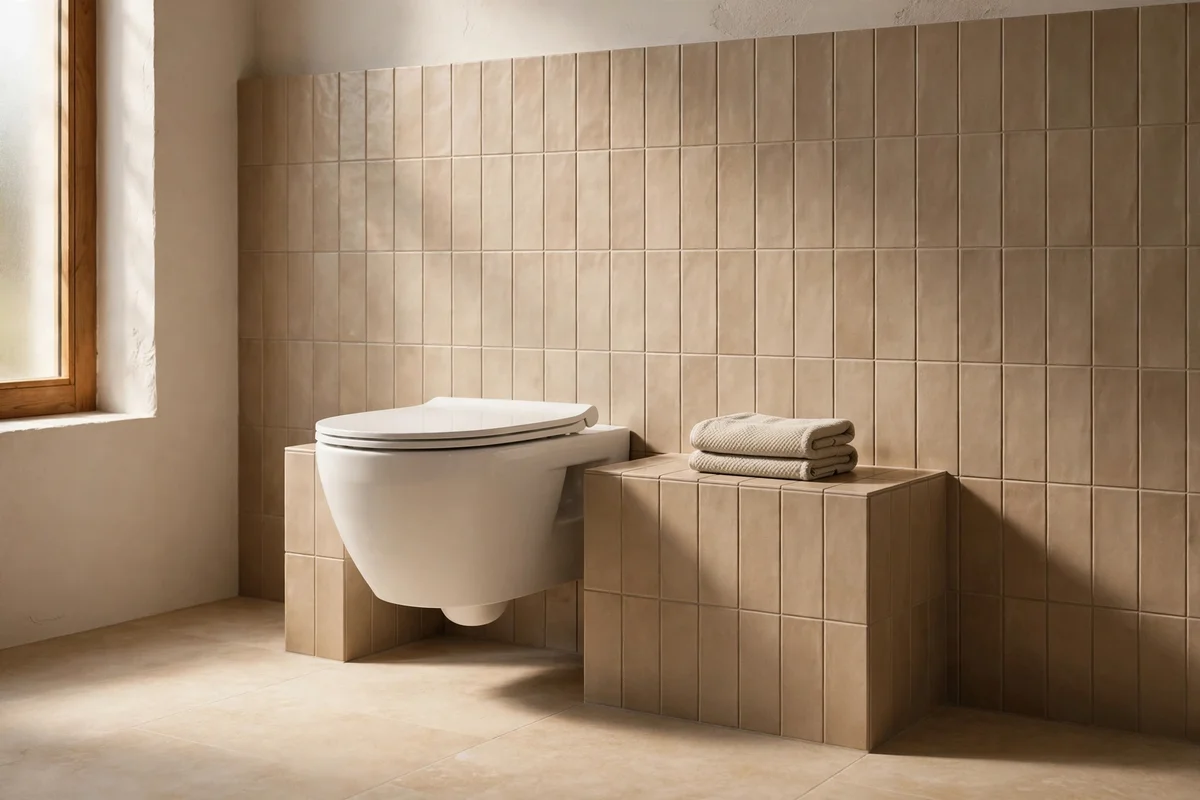
A wall hung toilet with a concealed cistern frees around 20 cm of floor that a standard close coupled pan would occupy, and the room feels calmer for it. The bowl sits 40 to 42 cm from the floor, the standard comfort height, and the cistern hides inside a slim stud wall or a boxed unit only 15 to 20 cm deep. Mopping becomes a quick sweep because nothing touches the floor. Choose a rimless bowl for easier cleaning.
The boxed unit doubles as a shelf for a small tray or a folded towel, so dead space turns useful. Budget tip: a wall hung pan with a concealed frame starts near 200 pounds or dollars at budget level and rises to 500 for mid range. Flag for renters: this one needs permanent plumbing changes, so it suits owned homes only. The mistake to avoid is a shallow box that leaves the flush plate awkwardly high; keep the plate 90 to 100 cm from the floor for easy reach.
3. Stack Two Open Shelves Above the Toilet for Daily Jars and Towels
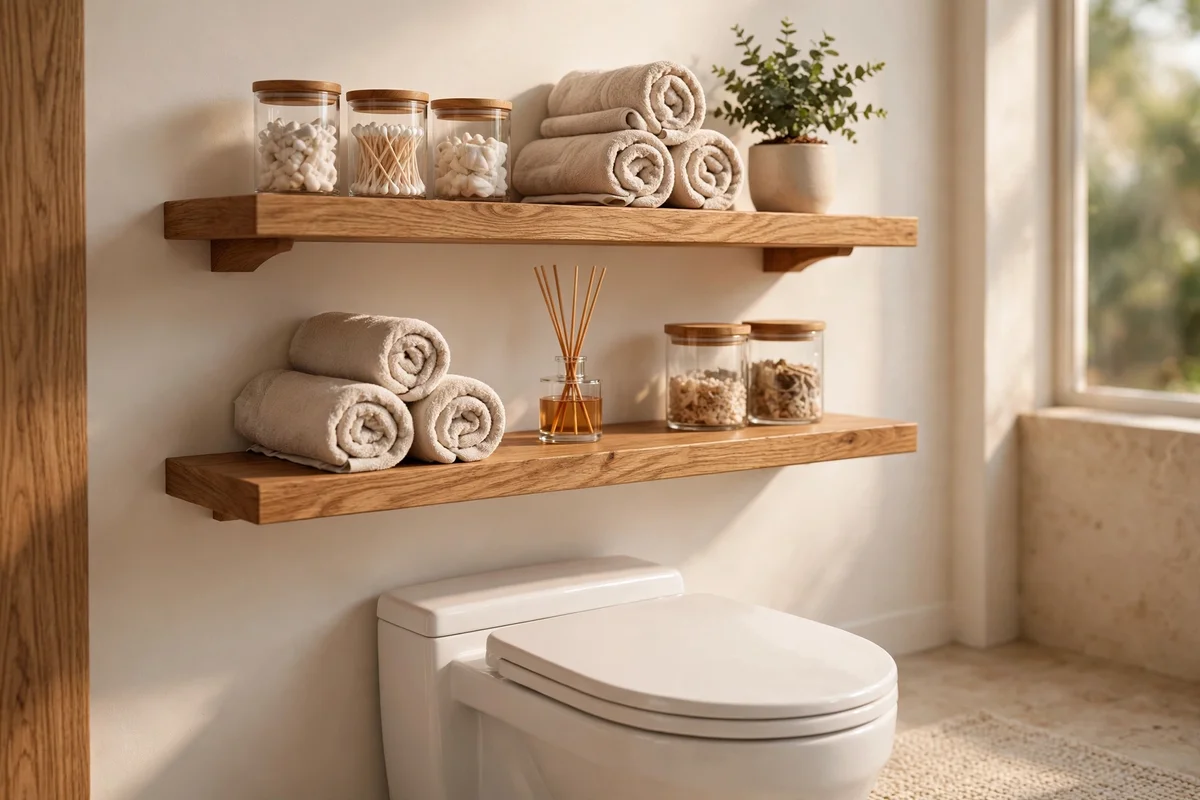
The wall above the toilet, roughly 60 cm wide and 120 cm tall of usable space, is the easiest storage win in a tiny bathroom. Fit two open shelves, each 20 to 25 cm deep, at 40 cm and 75 cm above the cistern lid so everyday items stay within easy reach. Solid oak or moisture sealed pine suits the warm palette, and brackets rated for 10 kg each keep glass jars safe. Roll spare towels into neat cylinders to fit more per shelf.
Style one shelf for display and one for duty: a small trailing plant in a ceramic pot beside folded flannels above, spare toilet rolls and a reed diffuser below. Rental safe flag: use heavy duty adhesive brackets or a freestanding over toilet unit instead of drilling. Budget tip: two timber shelves with brackets usually cost 25 to 50 pounds or dollars. The mistake to avoid is stacking shelves right up to the ceiling; leave 25 cm of breathing room so the wall does not feel crowded.
4. Choose One Oversized Mirror Instead of a Pair of Small Ones
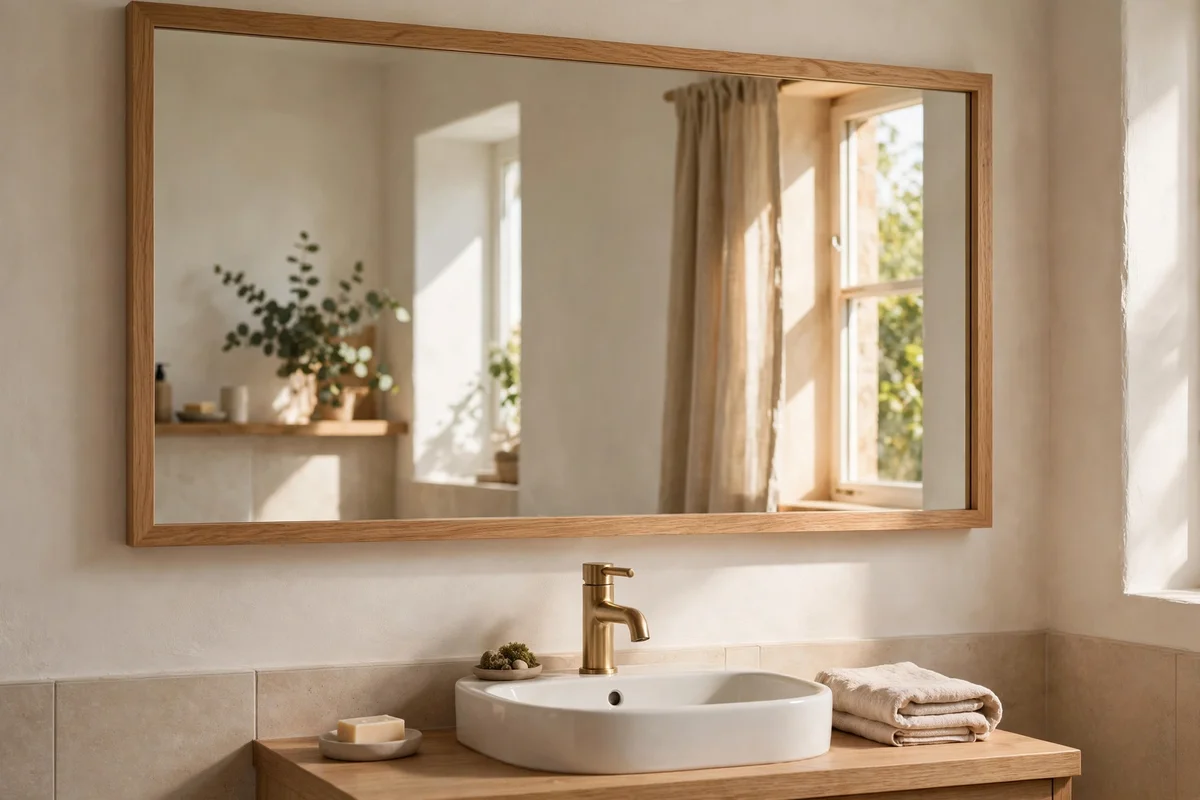
A single mirror 60 to 90 cm wide and 80 to 100 cm tall doubles the sense of space far better than two small ones, because one unbroken reflection stretches the wall. Hang it 10 to 15 cm above the basin rim so splashes stay low and the reflection catches the window light. A slim oak or brushed brass frame adds warmth without visual weight. In a windowless bath, angle the mirror to borrow light from the hallway door.
Consider a mirrored cabinet 15 to 20 cm deep rather than a flat mirror; it stores daily bottles at eye level and keeps the basin surround clear. Choose softened corners and a bevelled edge for a calm, classic look. Budget tip: a large framed mirror costs 40 to 90 pounds or dollars, while a mirrored cabinet runs 80 to 180. The mistake to avoid is a mirror wider than the vanity below it; keep 5 cm of wall visible each side so the arrangement looks balanced.
5. Keep Walls in a Light Warm Palette With One Deeper Accent
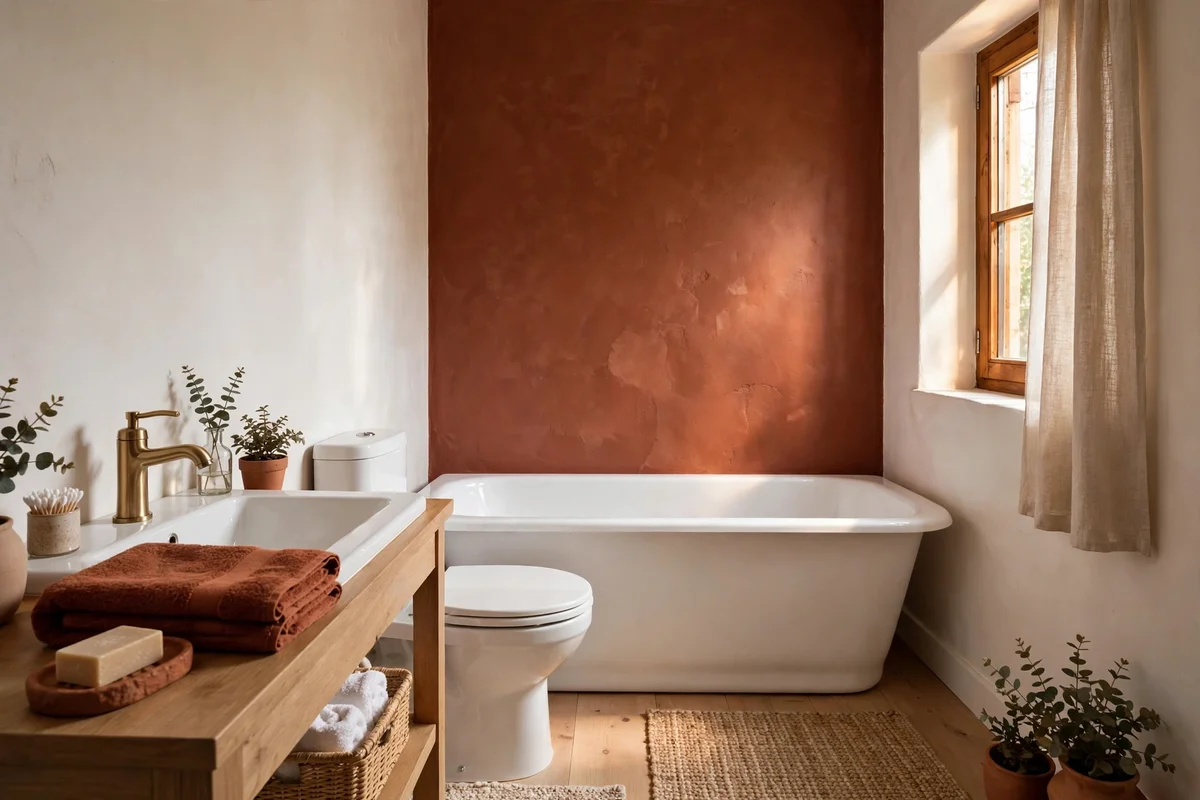
Paint or tile the main walls in a light warm white, warm greige or pale sand, colours that bounce daylight around a small room instead of swallowing it. Then choose one deeper accent, such as forest green, warm terracotta or deep navy, and limit it to a single surface: the wall behind the bath, the vanity front, or a tiled shower niche. The ratio matters, roughly 80 percent light and 20 percent deep, so the room stays calm with one confident note.
Carry the accent colour through in small repeats, a folded towel, a soap dish, the plant pot, so it feels planned rather than random. In matt or eggshell finishes, deep colours absorb less light than gloss, which keeps them cosy rather than gloomy. Rental safe flag: achieve the accent with peel and stick panels or a painted free standing shelf you take with you. The mistake to avoid is two competing accents; one deep tone plus warm neutrals is the whole recipe.
6. Slide a Tall Narrow Storage Cabinet Into an Unused Corner
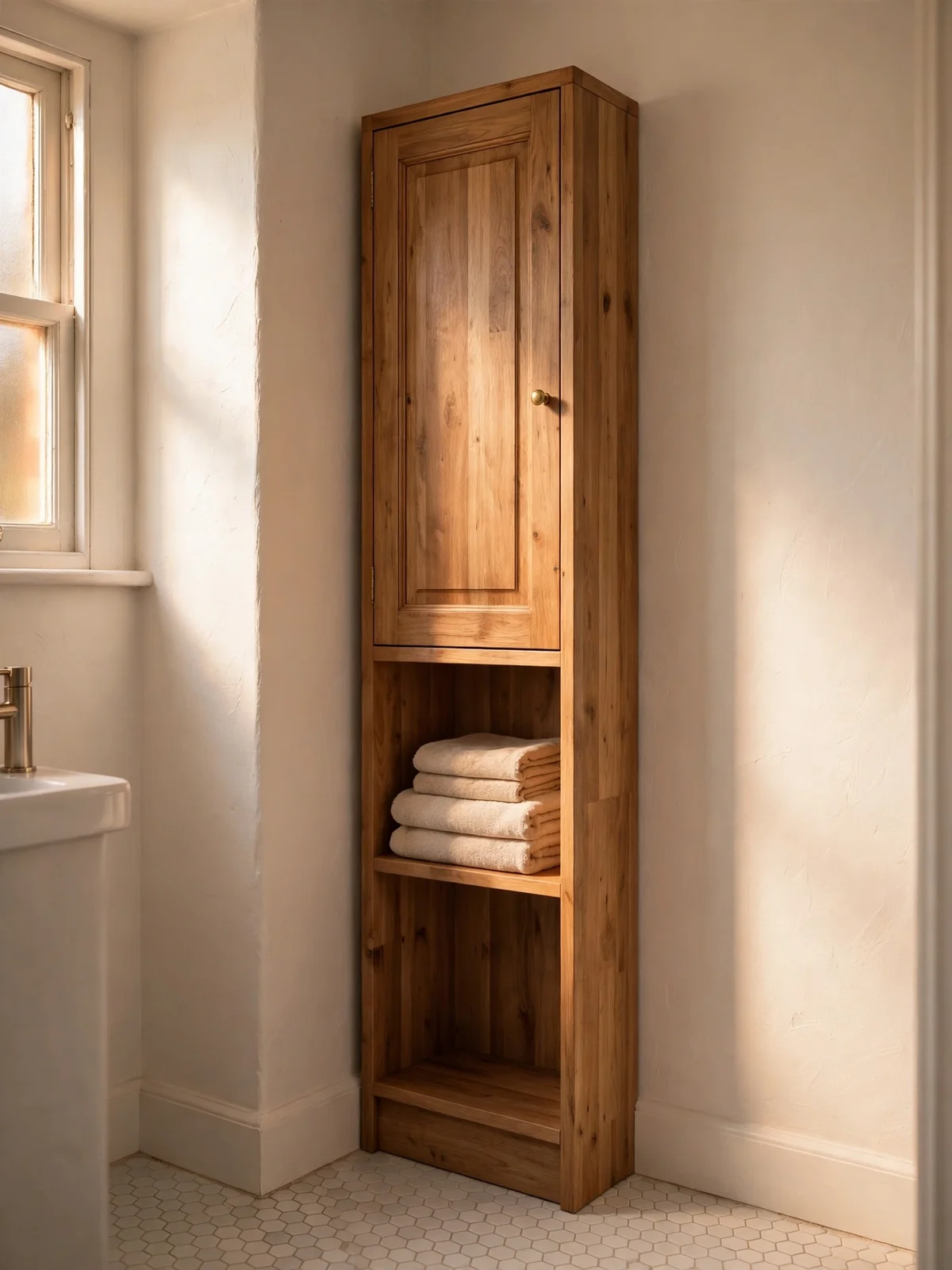
A tall cabinet 30 to 40 cm wide and 150 to 180 cm high turns a forgotten corner into the bathroom’s main store without eating floor space. Choose one with adjustable shelves so tall bottles and folded towels each get the right height. A closed front keeps the room calm, while one open shelf at eye level holds the two or three items used every day. Fix it to the wall with an anti tip bracket, since narrow cabinets wobble on uneven floors.
Warm timber, painted cream or soft sage all suit the light palette, and a cabinet with legs shows a strip of floor beneath for an airier look. Budget tip: a slim bathroom cabinet costs 50 to 110 pounds or dollars, with solid timber at the higher end. The mistake to avoid is a cabinet deeper than 35 cm in a tight corner; it starts to block the swing of the door or the walkway. Measure the swing radius before buying, ideally leaving 60 cm of clear passage.
7. Fix Over Door Hooks for Robes, Towels and Spare Cloths
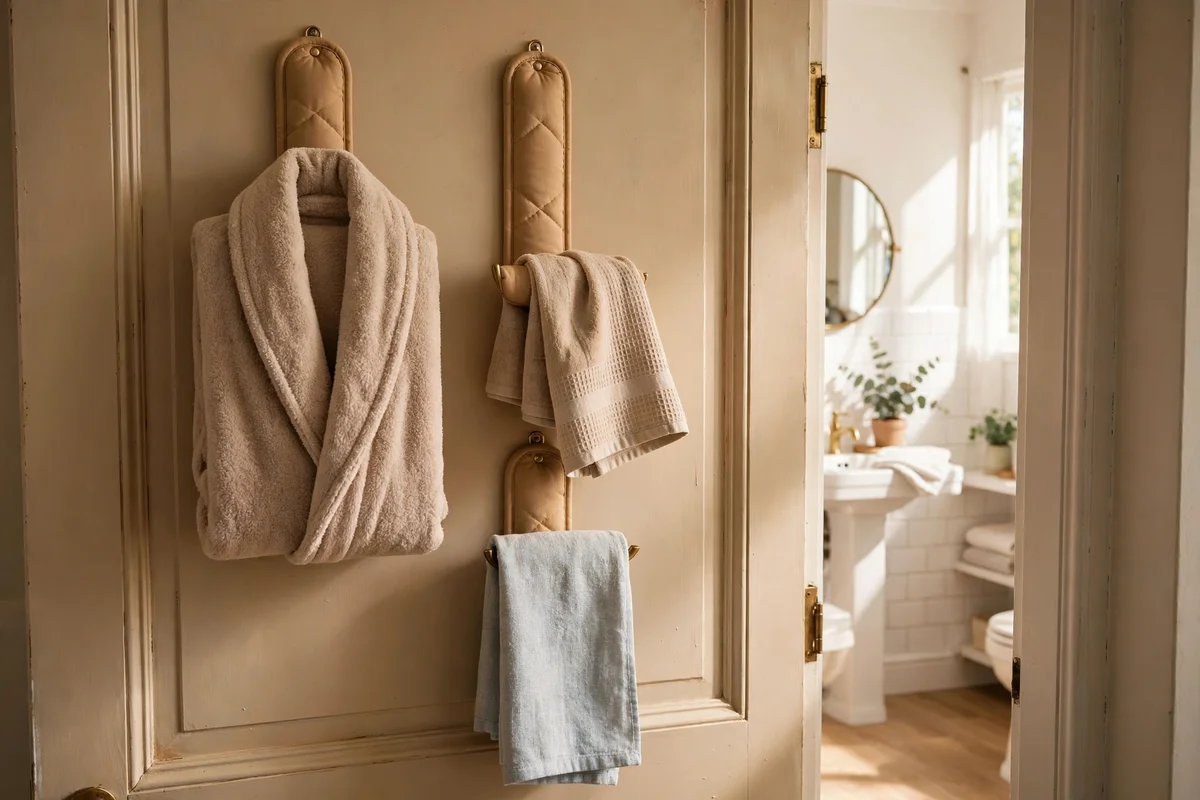
The back of the bathroom door holds 150 cm or more of unused vertical space, perfect for a row of over door hooks. Choose hooks that grip a 35 to 45 mm thick door, the standard range, with soft padding so they never scratch the paint. Assign each hook a job: the bathrobe, the hand towel, the drying cloth for the mirror. This keeps damp fabric off the floor and off the radiator, where it dries stiff.
Two or three individual hooks beat one long rail here, since the door needs to close cleanly against the frame. Look for brushed brass or matte black hooks to echo other fittings, or cream painted timber for a softer feel. Rental safe flag: over door hooks need no screws at all, so they leave the door untouched. Budget tip: a set of three padded hooks costs 8 to 20 pounds or dollars. The mistake to avoid is overloading; each hook holds about 2 kg comfortably, so keep spare towels on the shelves instead.
8. Choose a Compact Vanity With Deep Drawers for Hidden Storage
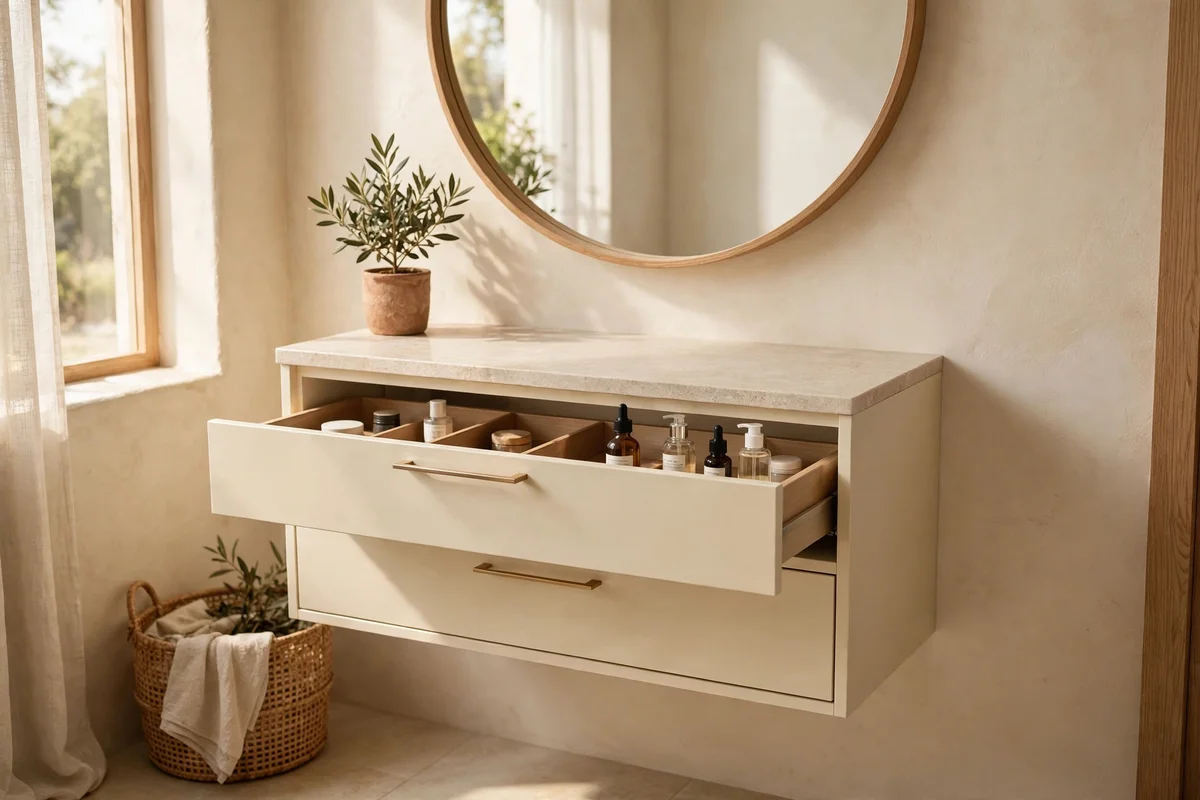
A compact vanity 60 to 75 cm wide with two deep drawers stores more than a cupboard of the same size, because drawers bring every item forward where it can be seen. Choose drawer depths of 25 to 35 cm for bottles and folded towels, with a shallow top drawer, about 10 cm, for small daily items. A wall hung vanity keeps the floor clear underneath, echoing the floating basin and toilet. Soft close runners stop drawers slamming in the small hours.
Oak, walnut veneer or warm cream lacquer all suit the palette, and a stone or solid surface top shrugs off splashes. Use drawer dividers or small trays so bottles stay upright and nothing slides to the back. Budget tip: a compact vanity unit runs 120 to 300 pounds or dollars, with stone tops at the higher end. The mistake to avoid is drawers that collide with the waste pipe; check the plumbing position first, or choose a unit with a shaped cut out in the top drawer.
9. Lay 60 cm Floor Tiles With Slim Grout Lines to Stretch the Room
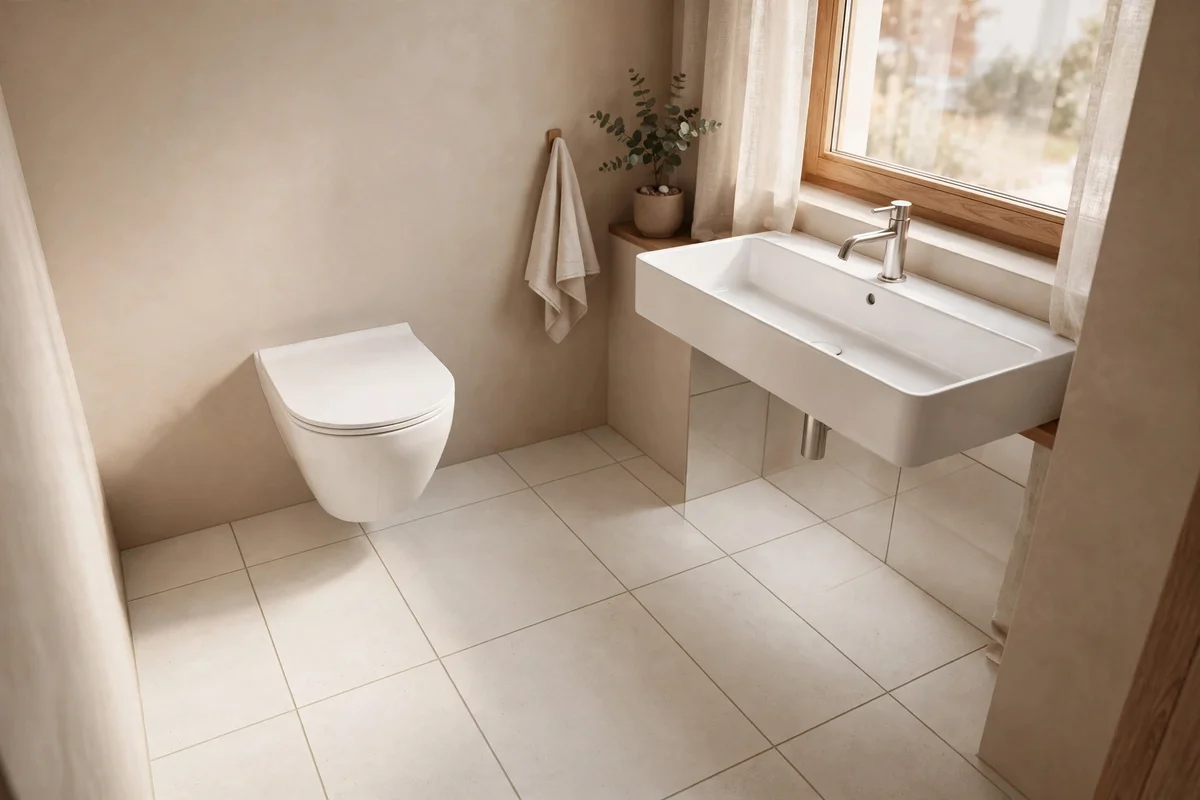
Floor tiles of 60 by 60 cm or 60 by 120 cm make a tiny bathroom floor read as one calm surface, because fewer grout lines mean less visual chopping. Choose grout lines of 2 to 3 mm and a grout colour close to the tile, not a dark contrast, so the floor flows without a grid pattern shouting across it. Lay the tiles in the same direction as the longest wall to stretch the room. Large format porcelain stays practical underfoot and resists stains.
Warm white, pale greige or soft sand tiles suit the light palette, and a matt finish hides water marks better than gloss. If retiling is too big a job, a matching grout pen refreshes old lines for a few pounds. Budget tip: large format porcelain costs 20 to 45 pounds or dollars per square metre, and a tiny floor needs only 3 to 5 square metres. The mistake to avoid is tiny mosaic floors in an already small room; the busy grid shrinks the space visually instead of stretching it.
10. Stack Wall Tiles Vertically to Draw the Eye Upward
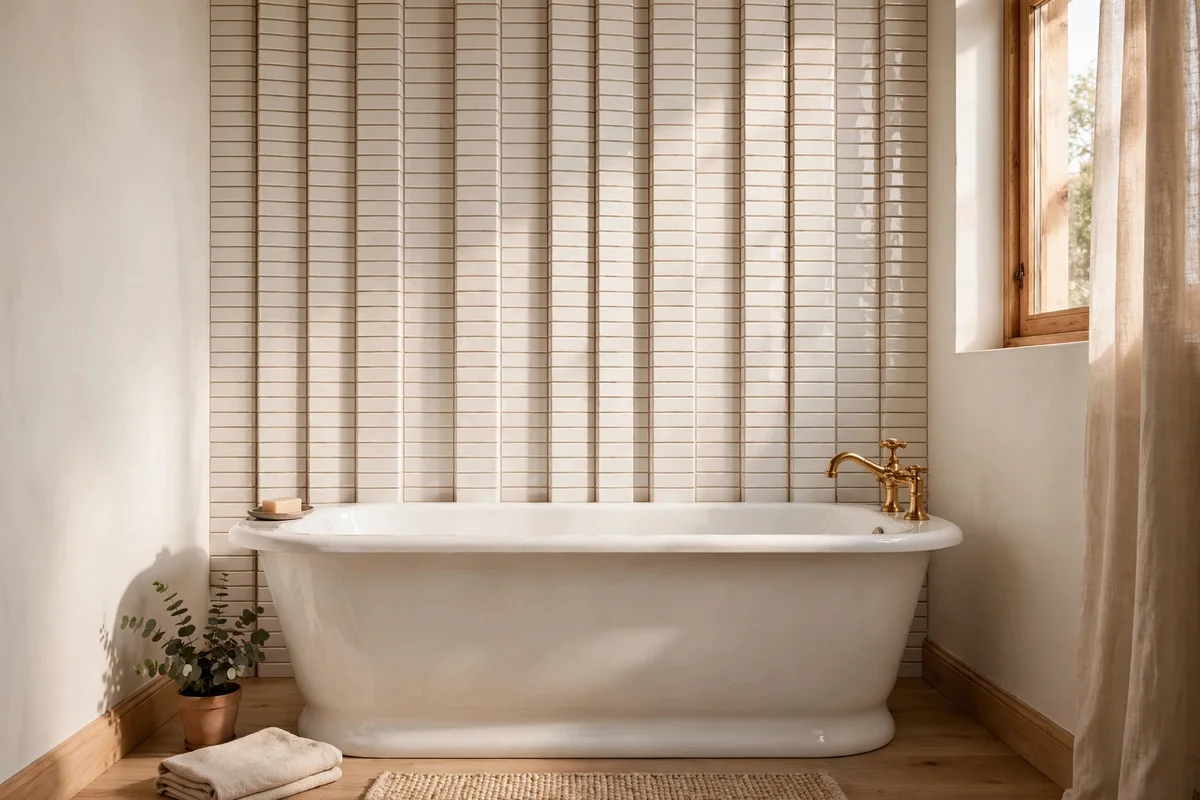
Laying wall tiles in vertical stacks, rather than the usual horizontal brick pattern, pulls the eye upward and makes a low ceiling feel taller. Subway tiles of 7.5 by 15 cm or slim 10 by 30 cm planks both work stacked; keep the vertical grout lines aligned in neat columns for a calm rhythm. Tile one full wall floor to ceiling behind the bath or basin, and keep the other walls painted. The contrast between tile and paint adds depth without clutter.
Warm white or pale sage tiles with a hand finished glaze catch light beautifully and suit the calm palette. Use a grout colour one shade darker than the tile for gentle definition, never a harsh black line. Budget tip: basic ceramic subway tiles cost 15 to 30 pounds or dollars per square metre. The mistake to avoid is mixing two tile sizes on the same wall; the pattern fights itself. Rental safe flag: tile effect adhesive panels mimic the stacked look with no wet work at all.
11. Mount Twin Sconces at Eye Level on Either Side of the Mirror
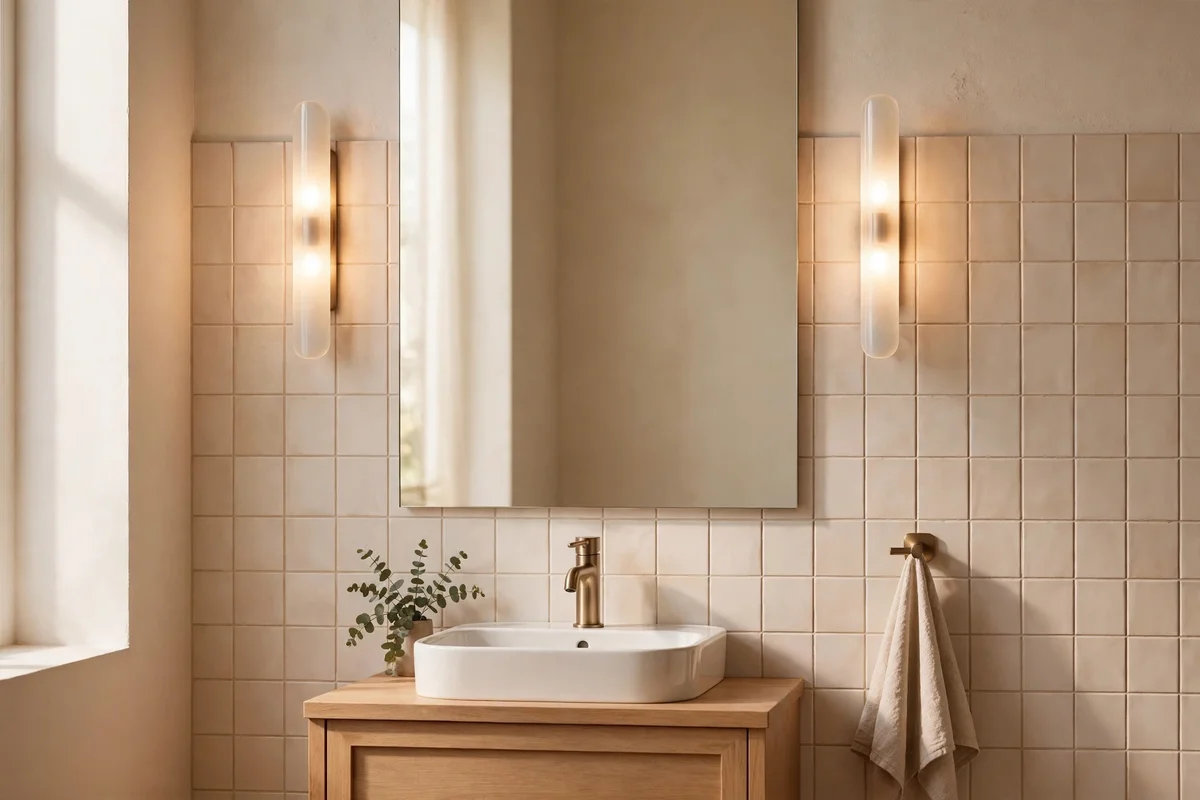
Two small sconces mounted 150 to 165 cm from the floor, one on each side of the mirror, give the most flattering light a small bathroom can have. Front facing light at face height softens shadows far better than a single overhead fitting, which casts harsh lines. Choose shades in opal glass or linen that diffuse a warm 2700 to 3000K bulb. Keep the sconces slim, 8 to 12 cm projection, so they never crowd the walkway.
Brushed brass or aged bronze fittings suit the heritage warmth of the palette, while ceramic sconces keep things softer. Wire them to a separate switch from the ceiling light so mornings can start gently. Budget tip: a pair of simple bathroom rated sconces costs 40 to 100 pounds or dollars. The mistake to avoid is placing one light above the mirror only; top down light hollows the face and makes the room feel stark. Always check the IP44 rating for safe use near water.
12. Layer a Warm Ceiling Light for Soft Overall Glow
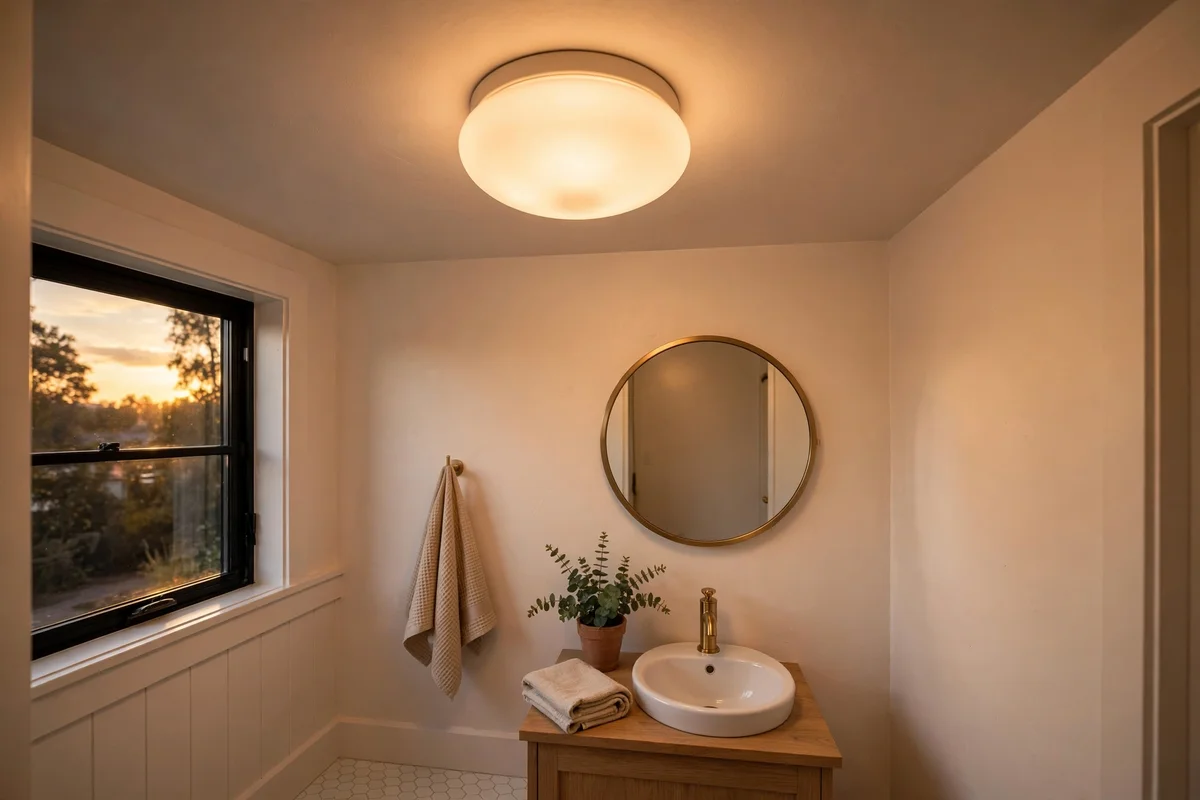
A flush or semi flush ceiling light with an opal diffuser spreads even, shadow free light across a tiny bathroom, which matters when the room has no window. Choose a warm colour temperature of 2700K and a fitting rated IP44 or higher for bathroom safety. A diameter of 25 to 35 cm suits a small ceiling; anything larger overwhelms it. Dimmer switches designed for LED circuits let the same light glow softly for an evening bath.
Cream glass, alabaster effect or simple white ceramic all suit the calm palette and never date. Clean the diffuser every few months; bathroom steam leaves a film that quietly dims the output. Budget tip: a good flush bathroom light costs 25 to 70 pounds or dollars, with dimmer switches adding about 15. The mistake to avoid is cool white bulbs of 4000K or more; they turn warm tiles grey and make the small room feel clinical. Warm light keeps the calm the palette promises.
13. Hang a Two Tier Shower Caddy for Bottles Without Clutter
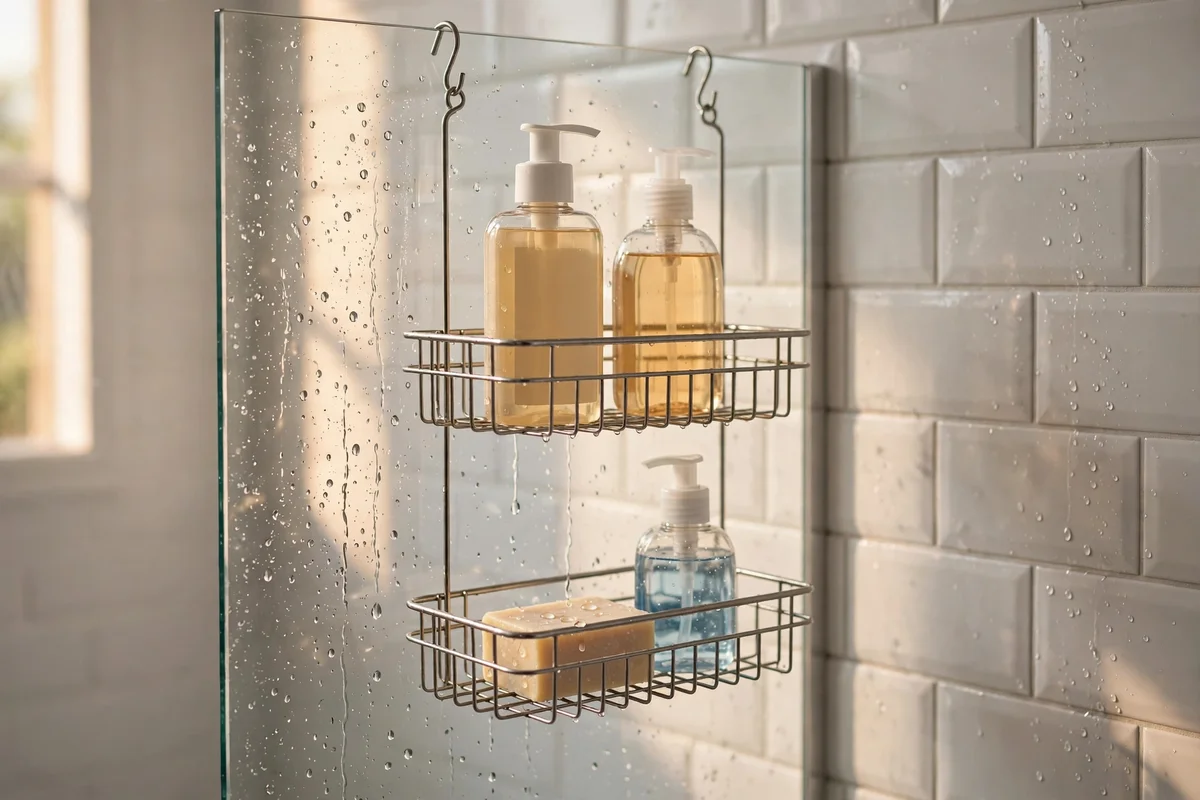
A two tier hanging caddy keeps shampoo, conditioner and soap off the bath edge and the shower floor, where bottles multiply into clutter. Choose a caddy 25 to 30 cm wide with hooks that fit a 6 to 10 mm glass screen or a slim rail fixed with adhesive pads. Wire or teak slatted designs drain freely and dry quickly, which stops soap scum building up. Give each tier a job: daily bottles above, weekly treatments below.
Stainless steel with a brushed finish resists rust far better than chrome plated wire, especially in hard water areas. Rinse the caddy monthly and wipe the hooks so limescale never takes hold. Budget tip: a sturdy two tier caddy costs 12 to 30 pounds or dollars. Rental safe flag: hook over caddies and adhesive rails leave walls untouched. The mistake to avoid is a caddy deeper than 12 cm; it intrudes into elbow room and gets knocked during every shower.
14. Add a Fold Down Seat or Compact Stool Beside the Bath
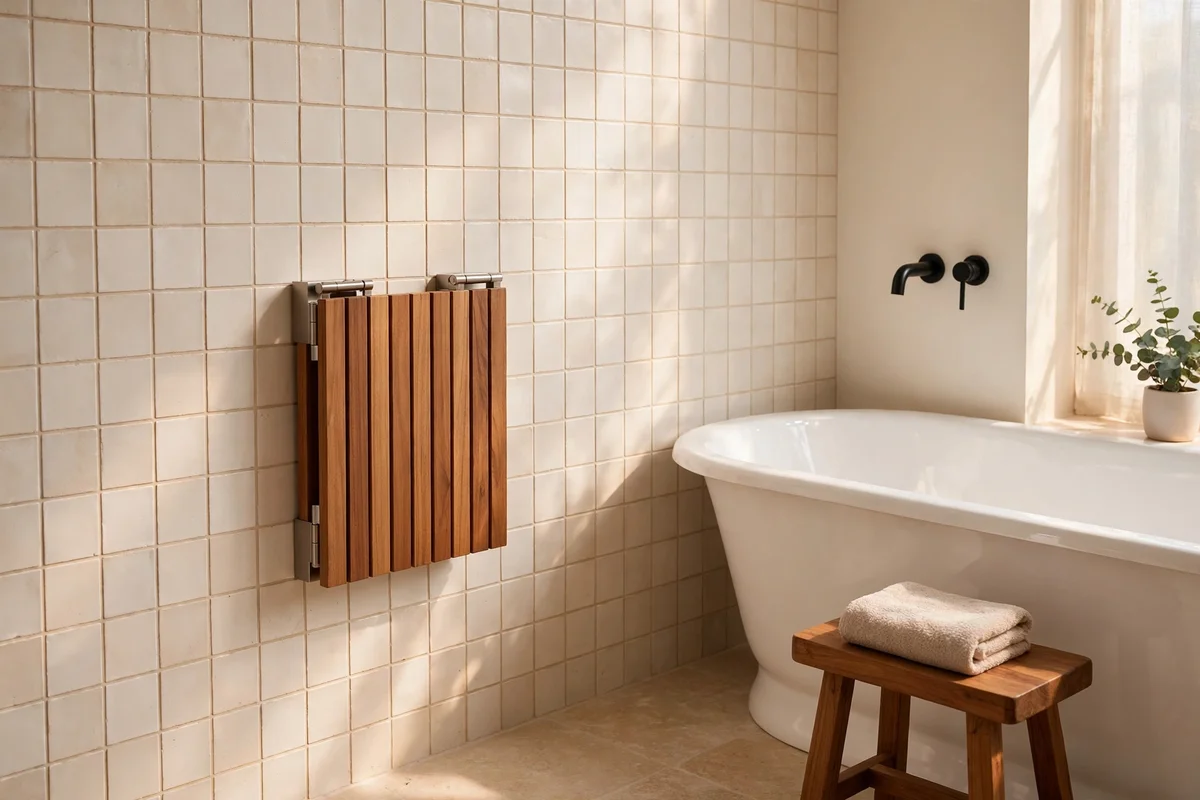
A fold down shower seat or a slim timber stool, about 35 by 35 cm, gives a tiny bathroom a resting spot without stealing permanent floor space. Wall mounted seats fold flat against the wall when not needed and support 100 to 130 kg when open; choose one in teak or a warm composite that suits wet conditions. Place it 45 cm from the floor, standard seat height, where it doubles as a perch for folded towels.
A freestanding stool works for renters and moves wherever it is needed, beside the bath or under the basin. Look for water resistant timber or a washable woven top that fits the calm palette. Budget tip: a simple teak stool costs 25 to 60 pounds or dollars, with wall mounted seats from 80. The mistake to avoid is a bulky chair; anything wider than 40 cm blocks the walkway. Keep the seat clear of daily clutter so it stays genuinely useful.
15. Choose a Tall Slim Heated Towel Rail for Warmth and Storage
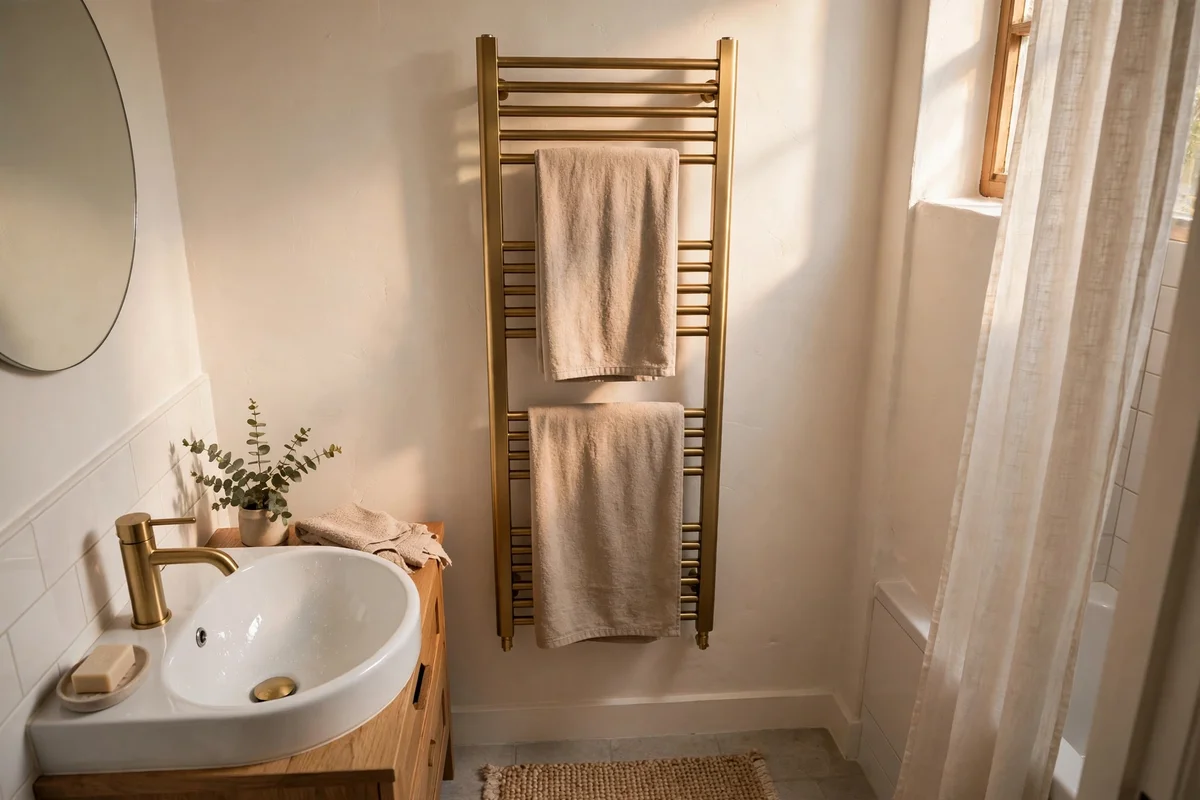
A heated towel rail 40 to 50 cm wide and 120 to 160 cm tall warms towels and the room together while using only a slim strip of wall. Choose a ladder style with 12 to 18 bars so two full size bath towels hang flat without folding, which dries them faster and stops musty smells. Brushed brass, matte black or warm chrome finishes echo the other fittings. Fit it 10 to 15 cm from the wall so air circulates behind.
Electric only models suit homes without central heating loops in the bathroom and cost little to run on a timer, typically 30 to 60 minutes before the morning routine. Hang towels loosely with gaps between bars for the fastest drying. Budget tip: a slim heated rail costs 80 to 220 pounds or dollars depending on finish. The mistake to avoid is mounting it directly above the toilet or basin, where splashes spot the bars; a clear side wall keeps it cleaner.
16. Run a Narrow Ledge Shelf Along the Bath Edge for Daily Items
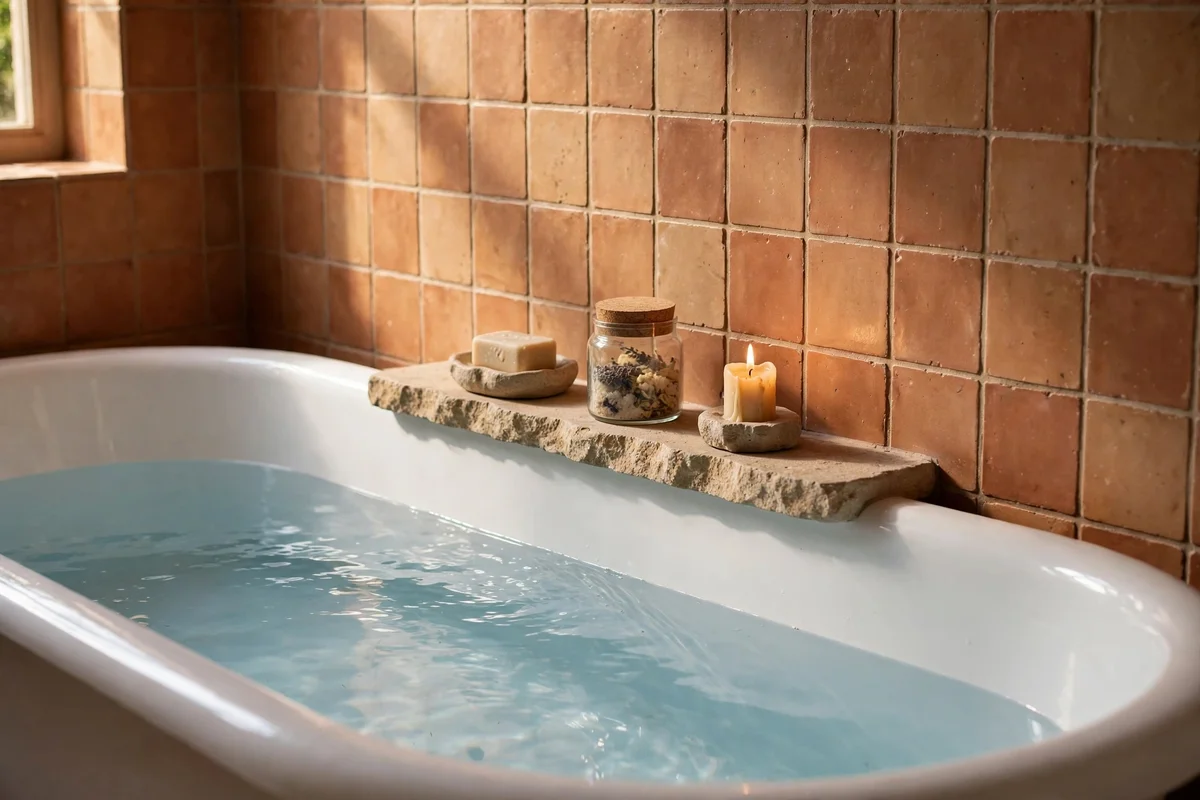
A ledge shelf 8 to 12 cm deep running along the bath edge or the shower wall holds soap, a candle and a small plant within reach without a single bottle on the floor. Stone, sealed oak or a tiled upstand all suit the warm palette and wipe clean in seconds. Fix it 5 to 10 cm below the bath rim or at 90 cm in a shower so items sit above the main splash zone. Slight slope toward the bath lets water drain away.
Style the ledge lightly: a stone soap dish, one lidded jar for cotton pads, and nothing more. Three calm objects beat ten small ones every time. Budget tip: a timber ledge shelf costs 15 to 40 pounds or dollars, while stone runs 40 to 90. Rental safe flag: a bath caddy that spans the tub needs no fixings at all. The mistake to avoid is a ledge wider than 12 cm; it narrows the bathing space and collects standing water at the back.
17. Keep a Clear Glass Bath Screen for Unbroken Sight Lines
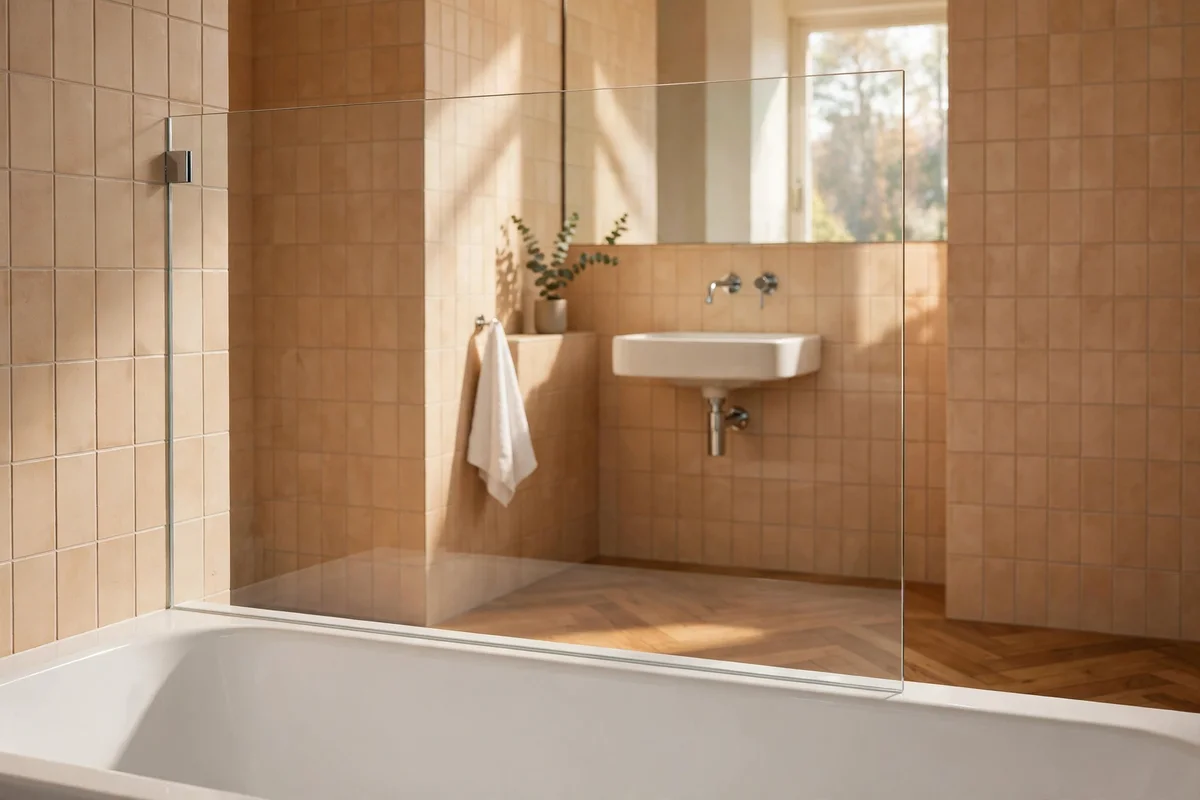
A fixed or folding glass bath screen 80 to 90 cm wide keeps shower spray inside the tub while leaving the sight line across the room completely open. Clear 6 mm toughened glass reads almost invisible, so the bath and the wall beyond form one continuous space instead of two cramped halves. Choose a screen with a slim chrome or brass profile, or frameless with polished edges for the lightest look. Hinges on a folding model should open both ways.
Squeegee the glass after each shower; it takes twenty seconds and stops limescale dulling the clarity that makes the trick work. In hard water areas, a water repellent treatment every three months keeps the glass bright. Budget tip: a glass bath screen costs 60 to 180 pounds or dollars. The mistake to avoid is a patterned or frosted screen; it chops the room visually and defeats the purpose. Keep the glass clear and the profile minimal for the full stretching effect.
18. Refresh Walls With Peel and Stick Tiles for a Rental Safe Update
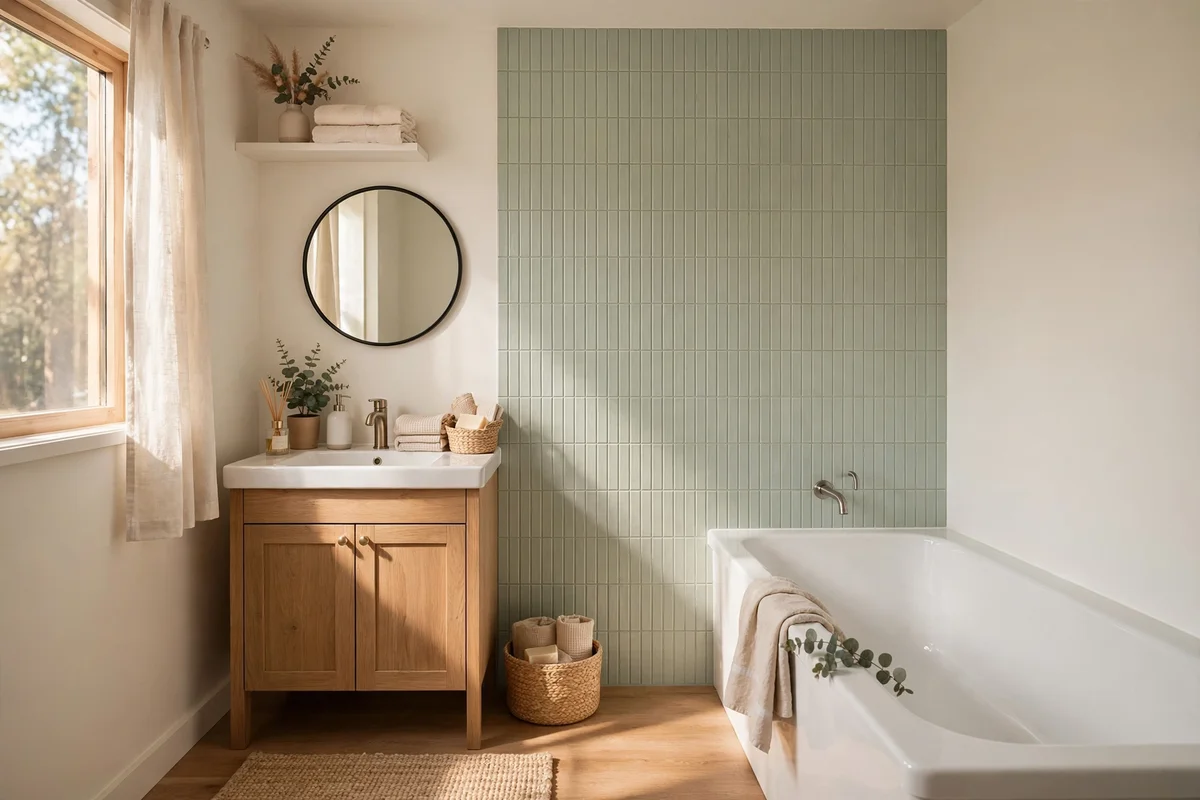
Peel and stick wall tiles give renters the stacked tile look with zero wet work and no landlord drama. Sheets measure about 30 by 30 cm, cost 8 to 15 pounds or dollars each, and press straight onto clean painted walls; a single accent wall needs six to ten sheets. Choose warm white or pale sage with a slight sheen so they read as real ceramic from a step back. Smooth the sheets from the centre outward to push out air bubbles.
They resist steam and splashes well in a ventilated bathroom, and they peel away cleanly when the tenancy ends if the wall beneath was sound. Test one sheet behind the door for a week before committing to a whole wall. Budget tip: a full accent wall usually totals 60 to 120 pounds or dollars. The mistake to avoid is sticking them over flaking paint or textured wallpaper; the adhesive needs a smooth, solid surface. Prep the wall properly and the finish lasts for years.
19. Style Woven Baskets for Laundry, Spares and Cosy Texture
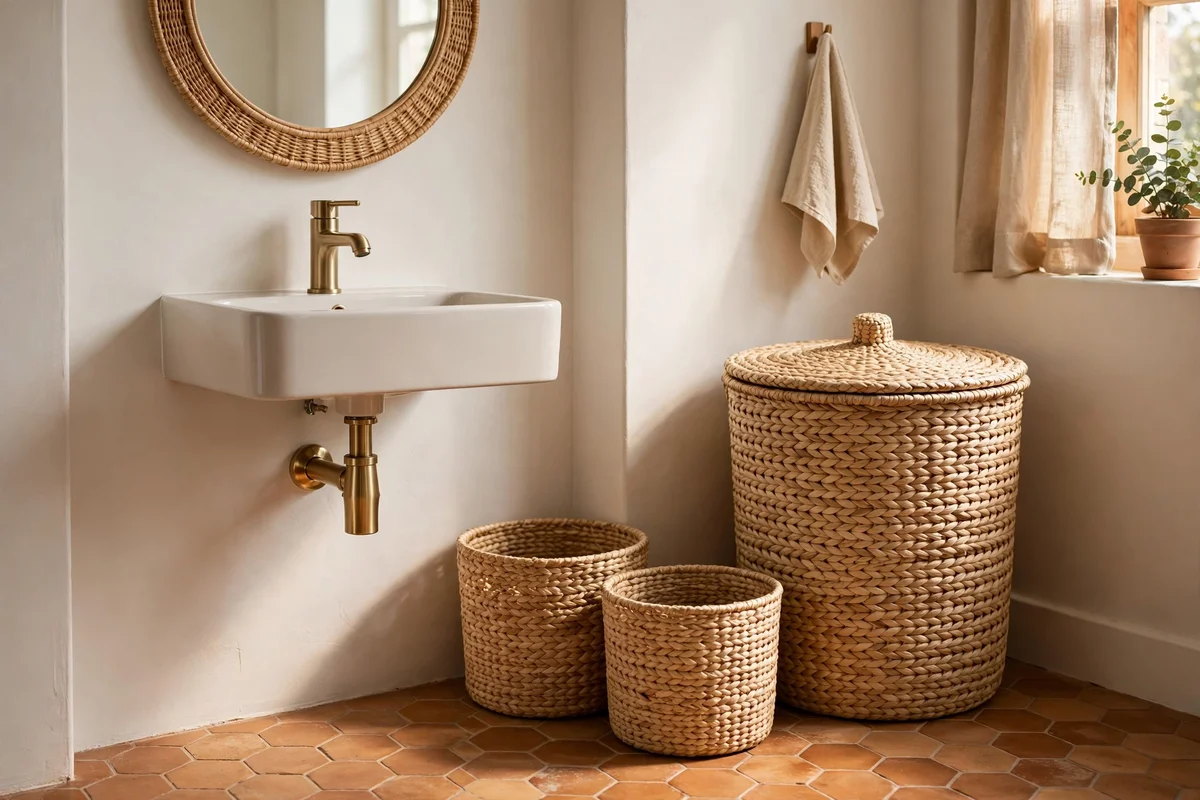
Two or three woven baskets bring natural texture to a tiled room and swallow the clutter that makes small bathrooms feel chaotic. Choose a tall lidded basket, about 50 cm high, for laundry, plus one medium basket for spare towels and a small one for cleaning cloths. Seagrass, water hyacinth or rattan suit the warm palette and handle bathroom humidity well. Line the laundry basket with a washable cotton bag so it empties in seconds.
Tuck baskets under a wall hung basin, beside the tall cabinet or in the gap next to the bath, wherever dead floor space hides. Lids keep everything looking calm, while open tops suit items grabbed daily. Budget tip: good woven baskets cost 10 to 35 pounds or dollars each, with lidded laundry hampers at the higher end. The mistake to avoid is untreated wicker sitting in standing water; keep baskets 5 cm clear of wet zones so the weave never softens or spots.
20. Finish With One Heritage Detail for Timeless Warmth
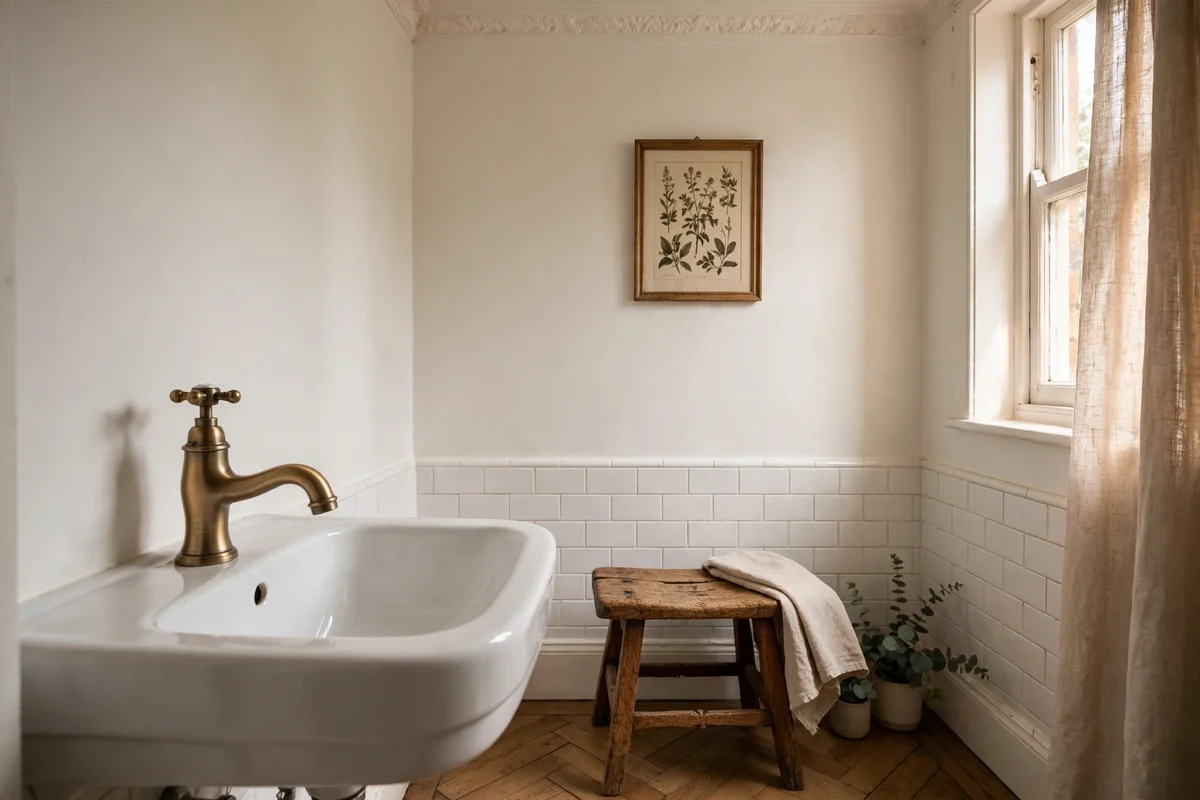
One heritage detail, a brushed brass tap, a small vintage timber stool or a framed botanical print, gives a tiny bathroom a sense of history that plain fittings cannot. Keep it to a single piece so the room stays calm; the detail should feel discovered, not decorated. Brass taps suit warm white tiles beautifully, while an old oak stool adds craft beside a modern vanity. Choose items with honest materials and simple shapes.
Charity shops and salvage yards are the best hunting grounds, with brass taps from 15 pounds or dollars and small framed prints under 10. Seal any vintage timber with a water resistant finish before it meets bathroom steam. Budget tip: one heritage accent rarely costs more than 30 pounds or dollars. The mistake to avoid is adding three or four vintage pieces at once; the room tips from curated to cluttered. One detail, placed with care, finishes the whole story.
A tiny bathroom stops feeling cramped the moment every surface earns its place: fixtures float, storage climbs the walls, and one warm palette holds the whole room together. None of these twenty ideas needs a big budget or a full renovation; most are a weekend project or a single clever purchase. Pick the change that solves your biggest daily frustration first, whether that is the cluttered bath edge, the dark mirror corner or the towels with nowhere to dry.
Start this week with the easiest win of all: hang over door hooks for towels and robes. They cost under twenty pounds or dollars, need no tools, suit renters perfectly, and the effect is instant, because damp fabric finally has a home off the floor. Once the door works harder, the shelves above the toilet and the single large mirror can follow, each one making the small room feel a little more complete.
Frequently Asked Questions
What is the cheapest way to make a tiny bathroom feel bigger?
Start with light and sight lines. Swap a frosted shower curtain for a clear glass screen, hang one large mirror instead of small ones, and paint walls a light warm white; these three changes often cost under 100 pounds or dollars together. Then clear the floor with over door hooks and a basket under the basin. Fewer visual barriers and a visible floor do more than any single purchase.
Can I fit a bath, toilet and basin into a very small bathroom?
Yes, with compact fittings and careful planning. A space saving bath of 150 by 70 cm, a wall hung toilet and a 45 cm wall hung basin can fit into a room as small as 2 by 2.4 metres. Keep the layout along two walls so the third stays clear for movement. Always measure the door swing and leave at least 60 cm of clear passage before committing to any layout.
Which bathroom upgrades are safe for renters?
Over door hooks, freestanding shelves, woven baskets, peel and stick tiles, adhesive shower caddies and a freestanding stool all leave walls and plumbing untouched. Keep every original fitting you remove, such as a toilet roll holder, in a labelled bag for move out day. Avoid drilling tiles, changing taps or touching the cistern. When in doubt, ask the landlord in writing before any work that alters the room.
What size mirror works best above a small basin?
Choose a mirror 60 to 90 cm wide and 80 to 100 cm tall, roughly the width of the vanity or basin below, never wider. Hang it 10 to 15 cm above the basin rim so splashes stay low. One large mirror beats two small ones for stretching the room. If you need storage, pick a mirrored cabinet 15 to 20 cm deep instead; it hides daily bottles and keeps the basin surround clear.
How do I keep a tiny bathroom from looking cluttered?
Give everything a closed home. Use drawers instead of open cupboards, lidded baskets instead of piles, and a mirrored cabinet for daily bottles. Limit open shelves to two or three calm objects and keep the bath edge clear with one narrow ledge. Follow the one in, one out rule for toiletries. A room with clear surfaces and hidden storage always feels larger than one with the same items on display.