Home Improvement
21 Small Entryway Ideas That Make a Tight Hall Feel Bigger and More Welcoming
By Anna Wells · · 19 min read
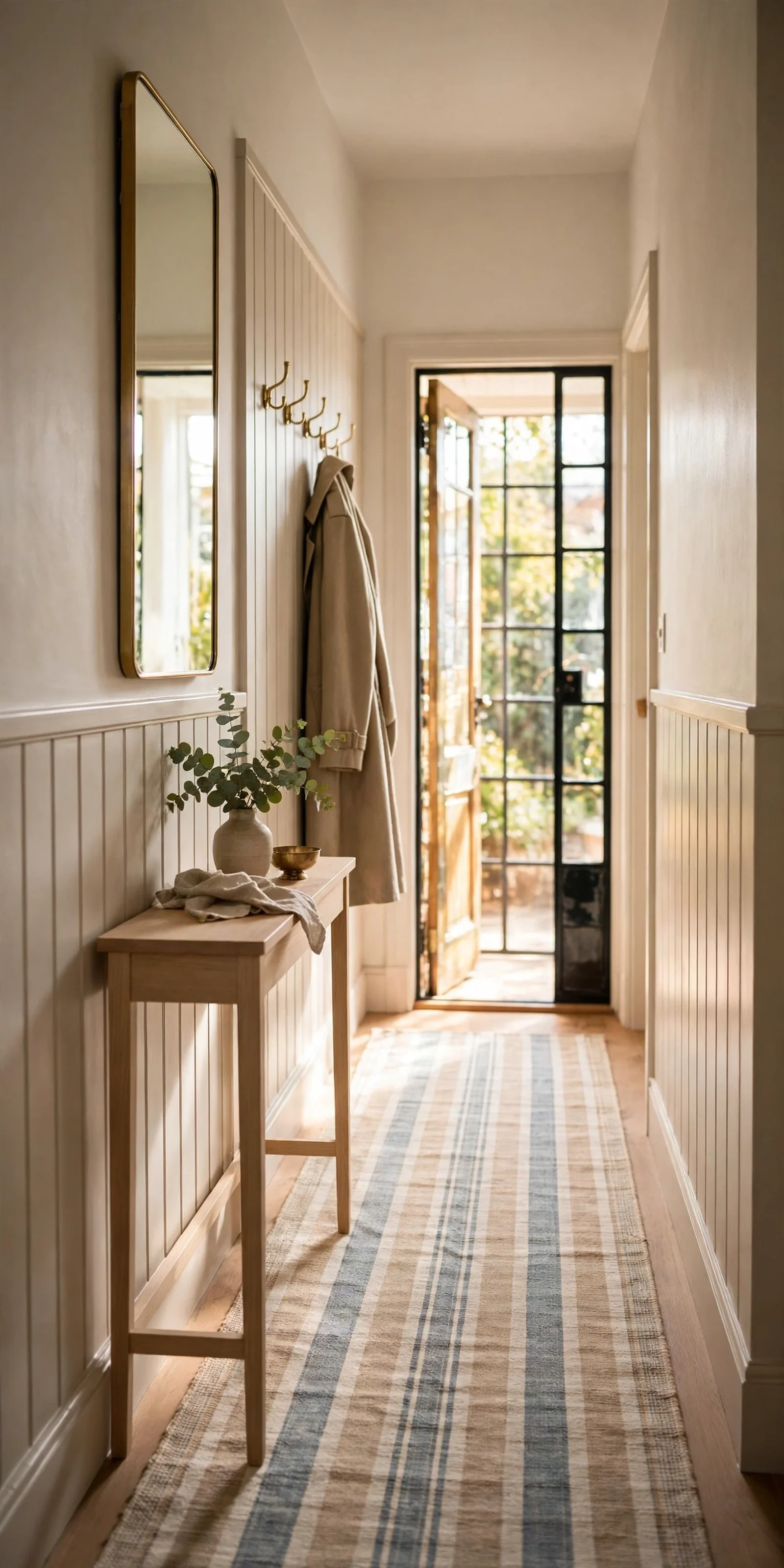
21 practical ideas that make a tight hall feel bigger and brighter: slim storage, mirrors, warm layered lighting and renter-safe options for small entryways.
You open the front door with your arms full of shopping and there it is: a wall of coats, a drift of shoes, and a hall so narrow you turn sideways to pass. It is the first thing you see coming home and the last thing guests see arriving, yet it gets the least decorating love in the whole house.
The good news is that a tiny hall responds fast to small, smart moves. A slim console, a generous mirror and one warm light can make four square metres feel twice as welcoming, and most of the ideas below cost less than a family takeaway on a Friday night.
Below are 21 concrete ideas for small entryways, each with real measurements, honest materials and renter-safe options where they matter. Work through them in order, or cherry pick the three that solve your biggest daily frustration first.
Start with the piece that sets the tone for everything else: the console. From there each idea builds on the last, until the tightest hall feels bigger, calmer and genuinely welcoming.
1. Choose a Console No Deeper Than 25 cm for the Wall Run
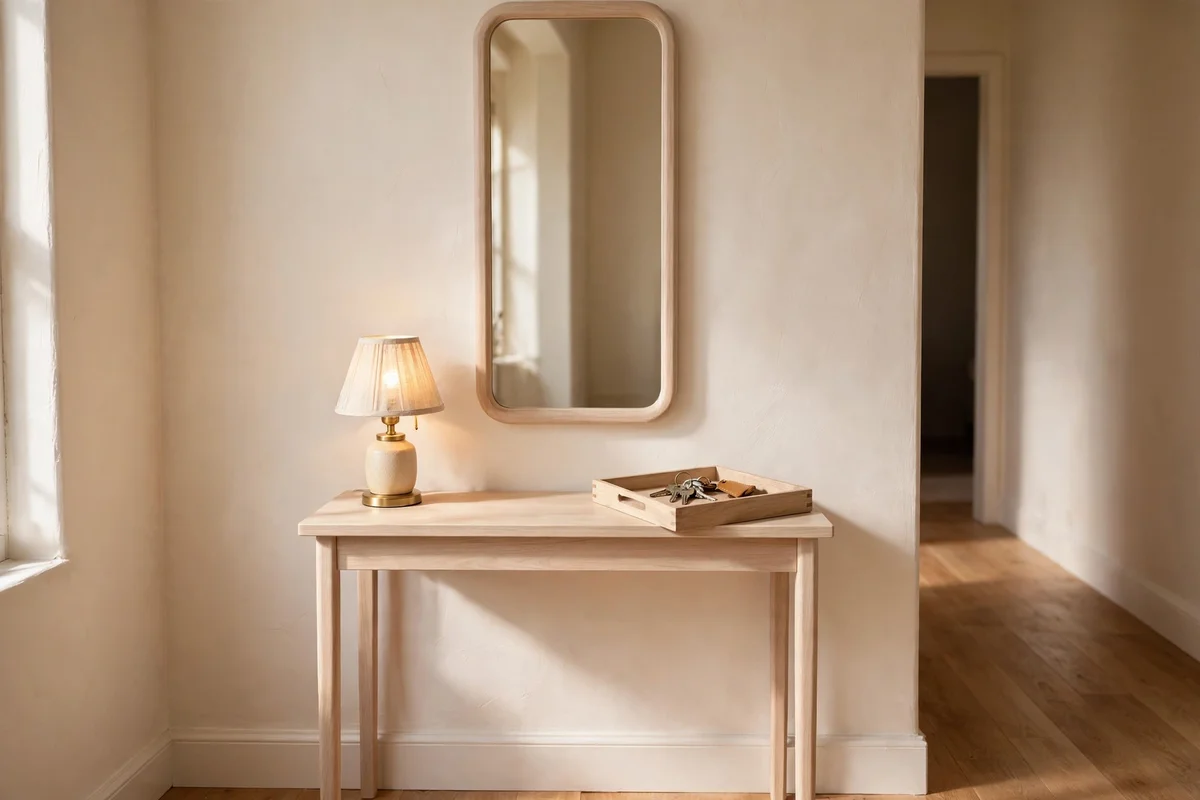
A console between 20 and 25 cm deep hugs the wall while leaving a clear walkway of at least 90 cm in a standard 110 to 120 cm hall. Measure from the skirting board to the door swing before you buy, since even a 30 cm piece can block a door that opens inward. Look for a top around 90 to 110 cm wide so keys, post and a small lamp all fit without spilling over the edges.
Choose solid oak or painted pine in a pale finish so the piece reads as part of the wall rather than an obstacle. The mistake to avoid is picking a console by looks alone and finding it juts into the path. If your hall is narrower than 100 cm, swap the console for a 15 cm floating shelf instead. Budget painted pine consoles run 30 to 60 pounds or dollars, while solid oak is an investment of 120 to 200.
2. Fit Two Floating Shelves Above the Console for Daily Essentials
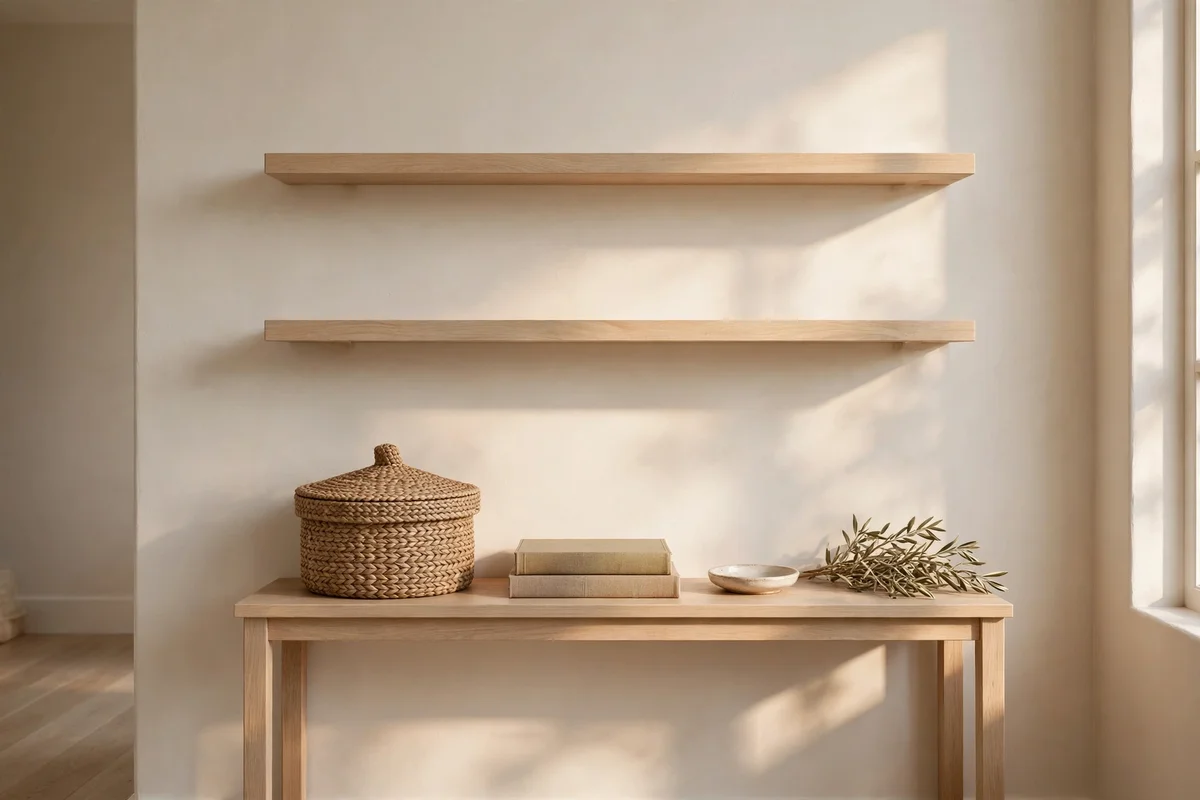
Two shelves, each 60 to 80 cm long and 15 to 18 cm deep, mounted 35 and 60 cm above the console top, create a tidy vertical column of storage. Use hidden brackets rated for at least 10 kg per shelf so they can hold books, a small basket and a trailing plant without sagging over time. Paint the shelves the same colour as the wall so they recede, or choose pale oak for gentle warmth.
Style them by thirds: one basket for sunglasses and gloves, two or three books lying flat, and one small object with a story, like a ceramic dish from a family trip. The common mistake is loading shelves edge to edge, which makes the hall feel crowded again. Leave at least 20 cm of breathing space at each end. A pair of ready-made floating shelves costs 15 to 40 pounds or dollars.
3. Hang a Tall Mirror to Borrow Light From the Nearest Window
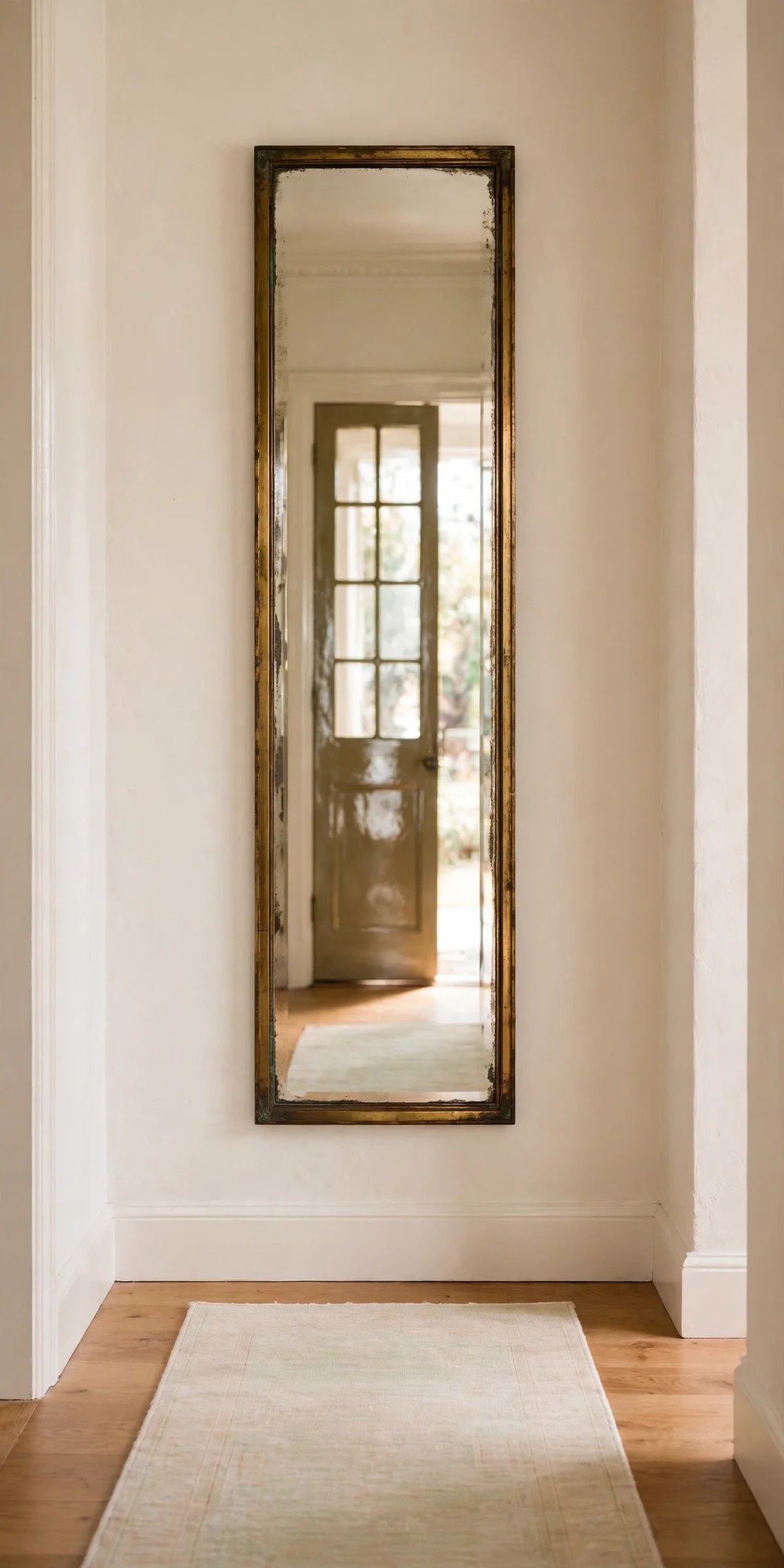
A mirror 120 to 160 cm tall and 40 to 60 cm wide, hung so its centre sits at eye level around 150 cm from the floor, doubles the daylight reaching a windowless hall. Place it on the wall that catches light from the nearest window or glazed door, angled slightly if the layout demands it. A slim frame in aged brass or pale oak keeps the reflection feeling warm rather than stark.
Lean a full-length mirror against the wall as a renter-safe alternative, securing the top with an adhesive bumper or a discreet bracket into the skirting. The mistake to avoid is hanging a small mirror too high, which reflects only ceiling and wastes the light you need at floor level. A generous tall mirror costs 40 to 120 pounds or dollars, and second-hand shops often have solid framed ones under 30.
4. Swap the Bulky Coat Stand for a Row of Sturdy Wall Hooks
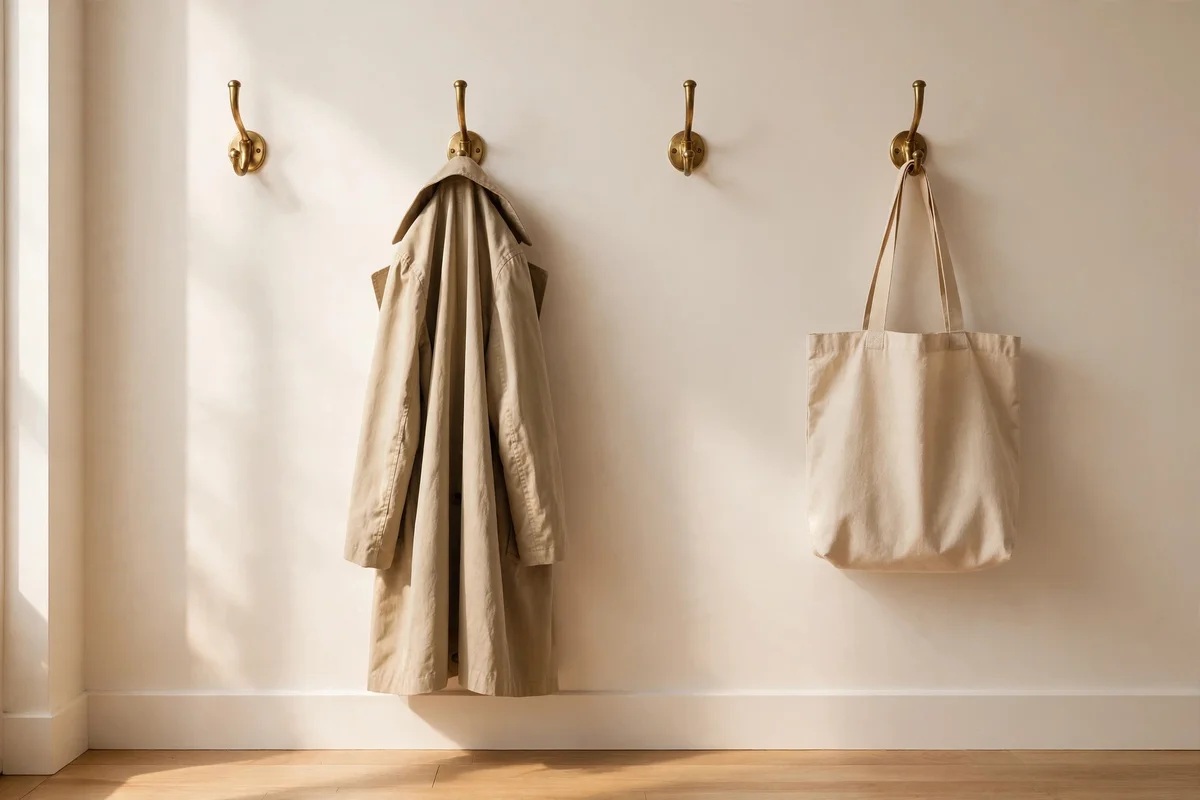
A freestanding coat stand eats nearly 50 cm of floor in every direction, while a row of four wall hooks needs only a 60 cm strip of wall and zero floor. Mount the rail at 160 to 170 cm high so coats hang clear of the skirting and the shoes below. Choose hooks rated for 5 to 7 kg each, in cast iron or solid brass, screwed into studs or proper wall anchors.
Limit each hook to one coat and one bag so the row looks intentional rather than chaotic. The rule that saves small halls is four hooks for a two-person household and five for three, because spare hooks invite clutter. Renters can use heavy-duty adhesive hooks rated for 3 kg for lighter jackets. A four-hook rail costs 15 to 35 pounds or dollars, while solid brass singles run about 8 each.
5. Hide Every Pair of Shoes Inside a Slim Tilting Cupboard
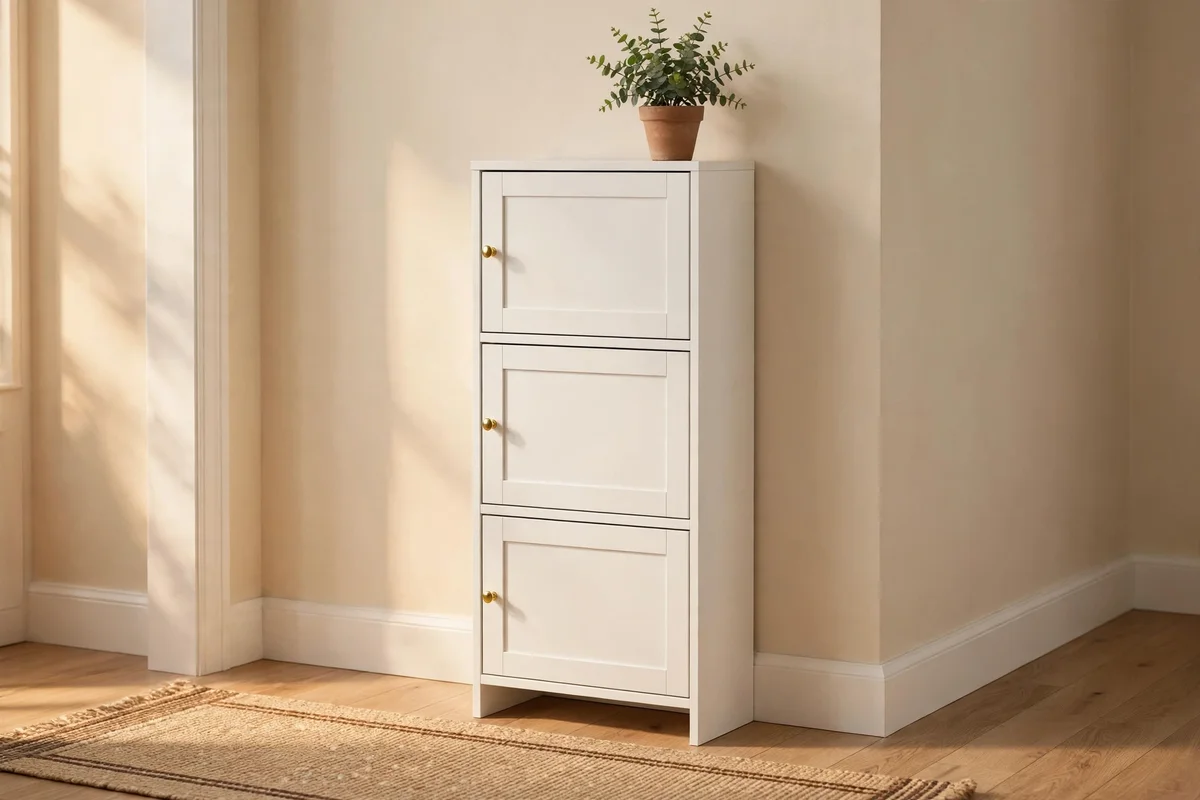
A three-tier tilting shoe cupboard, about 80 cm wide, 25 cm deep and 110 cm tall, swallows 12 to 18 pairs while taking less floor than two pairs left out. Keep everyday shoes on the top tier so you reach them without bending twice, and store off-season pairs at the bottom. Choose a unit with ventilation slots, or leave the back panel slightly ajar, to prevent musty smells building up inside.
The mistake to avoid is a cupboard with doors that swing outward into the walkway. Tilting fronts need no clearance and suit halls under 110 cm wide. Paint a pale pine unit to match the wall so it reads as architecture rather than furniture. Budget tilting cupboards run 35 to 70 pounds or dollars, while solid wood versions are an investment of 120 to 180. Wipe the inside shelves monthly.
6. Lay a Washable Runner to Stretch a Narrow Hall Visually
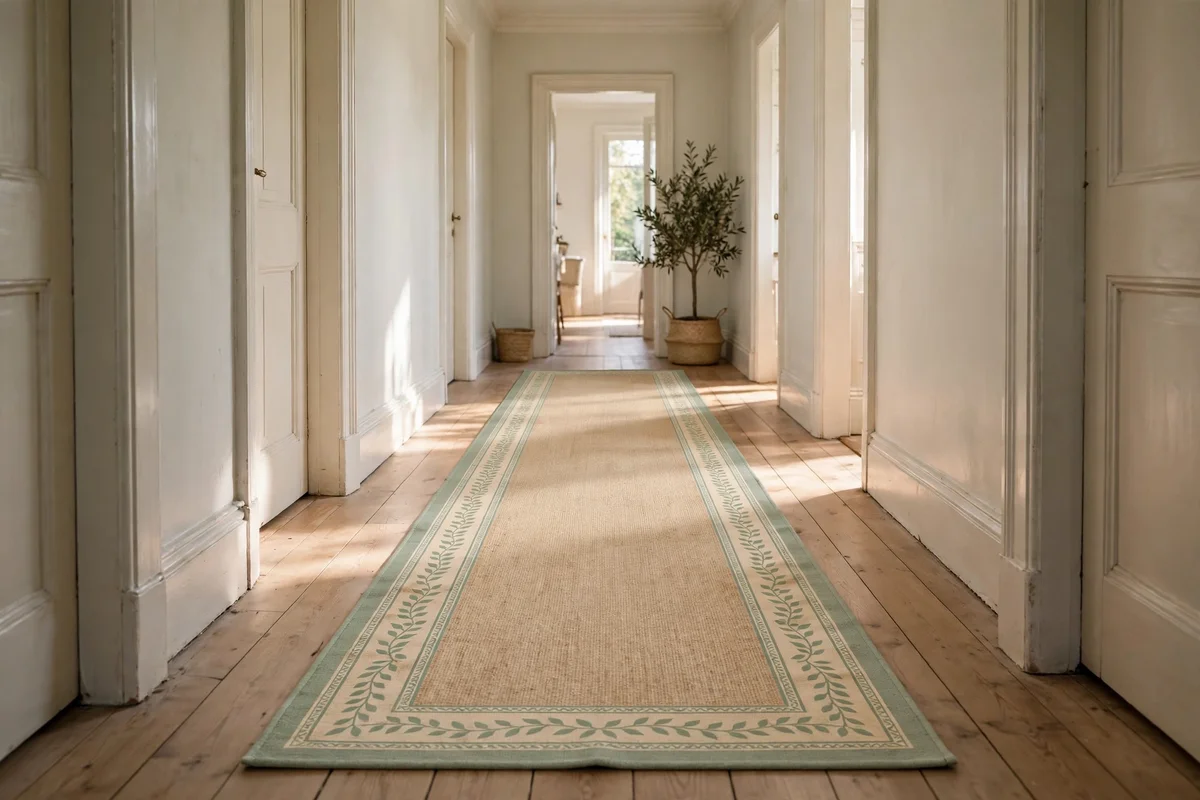
A runner 200 to 300 cm long and 60 to 80 cm wide, laid with 15 to 20 cm of bare floor showing on each side, draws the eye along the hall and makes it feel longer. Choose a low-pile washable cotton or recycled PET rug, 5 to 8 mm thick, so doors swing over it without catching. A simple bordered or striped pattern in sand, sage or soft terracotta adds warmth without shrinking the space.
The mistake to avoid is a runner that reaches wall to wall, which blurs the room edges and makes the hall feel smaller. Machine washable rugs go straight in the machine on a gentle 30-degree cycle every month or two, which suits muddy boots and wet umbrellas. Budget washable runners cost 25 to 60 pounds or dollars for a 250 cm length. Add a thin 2 mm non-slip underlay to stop creeping.
7. Layer a Ceiling Light With One Warm Table Lamp or Sconce
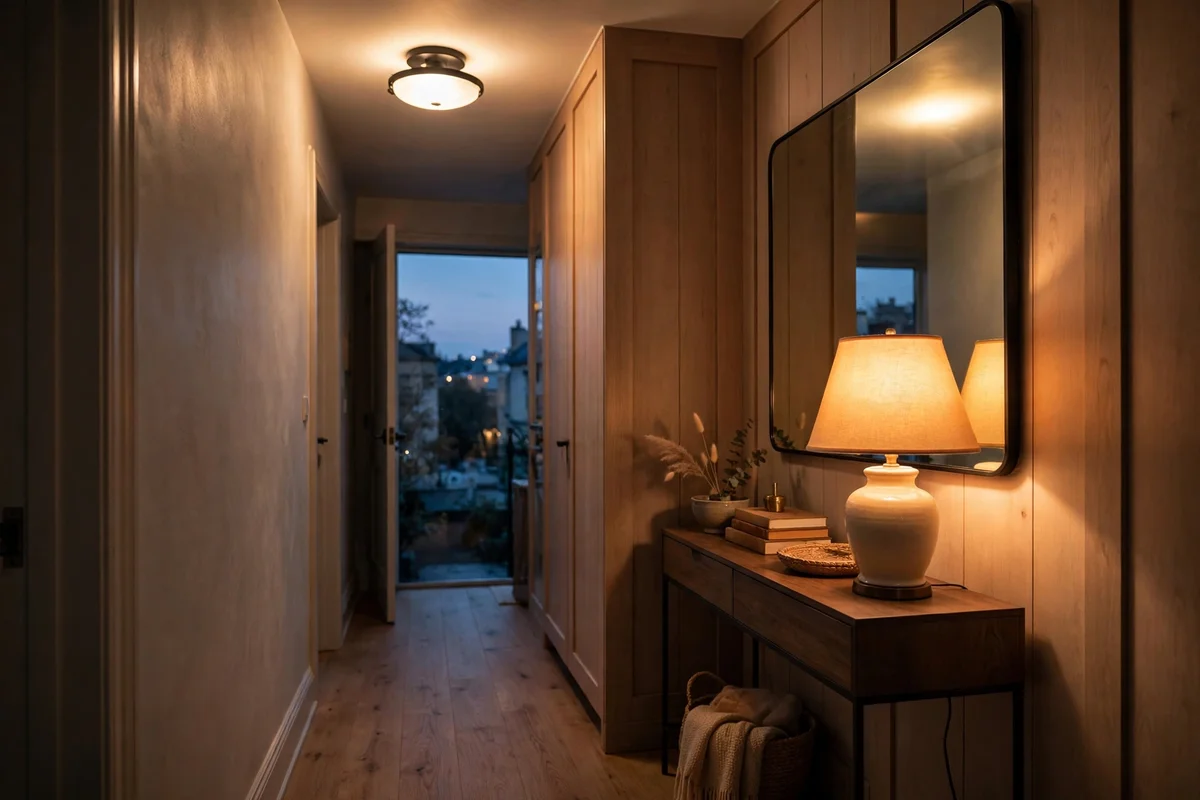
Small halls often rely on a single cold ceiling bulb, which flattens the space and casts hard shadows. Add one warm source at a lower level, a 30 to 40 cm table lamp on the console or a plug-in wall sconce at 160 cm high, and the hall gains real depth. Use 2700K bulbs in both fittings and keep total brightness around 400 to 800 lumens so the small space glows rather than glares.
A plug-in sconce with a fabric cord needs no electrician, which suits renters and budgets under 40 pounds or dollars. The mistake to avoid is mixing colour temperatures, such as a cool 4000K ceiling light with a warm lamp, which makes the walls look patchy. Set the lower light on a timer plug so the hall greets you warmly at dusk. Two matching warm sources usually cost 30 to 80 pounds or dollars.
8. Paint the Walls a Pale Warm White for Instant Breathing Room
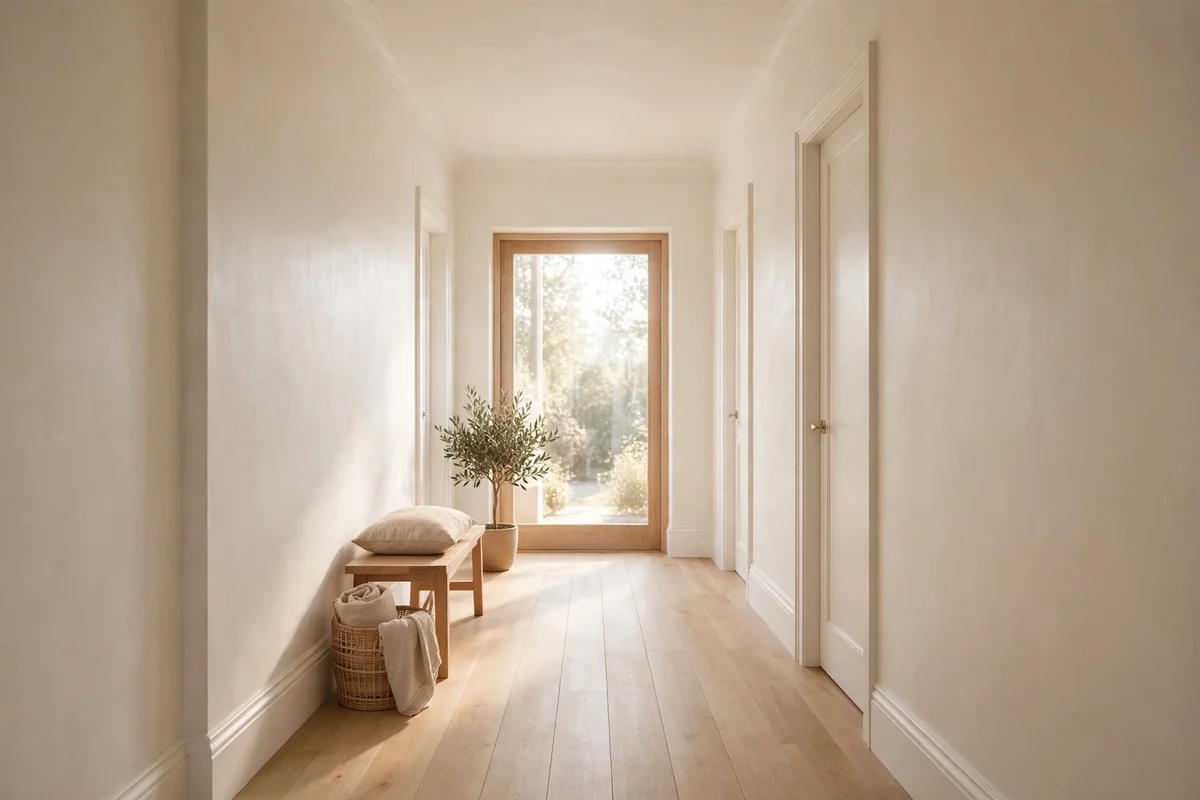
A pale warm white with a hint of cream, in shades often called chalk, bone or warm porcelain, reflects up to 85 percent of available light and pushes the walls visually outward. In a hall under 8 square metres, one 2.5 litre tin covers two coats on roughly 25 square metres, usually enough for walls and ceiling with paint to spare. Choose a durable eggshell or satin finish that wipes clean around the door where hands and bags scuff.
Keep the ceiling the same pale shade to blur the boundary where wall meets ceiling, which lifts a low 240 cm ceiling noticeably. The mistake to avoid is a cool blue-white, which turns shadowy corners grey and makes the hall feel clinical. Renters can get a similar lift with large pale artwork or a light fabric hanging. A tin of quality paint costs 25 to 45 pounds or dollars.
9. Add Exactly One Warm Accent, Like an Ochre Frame or Stool
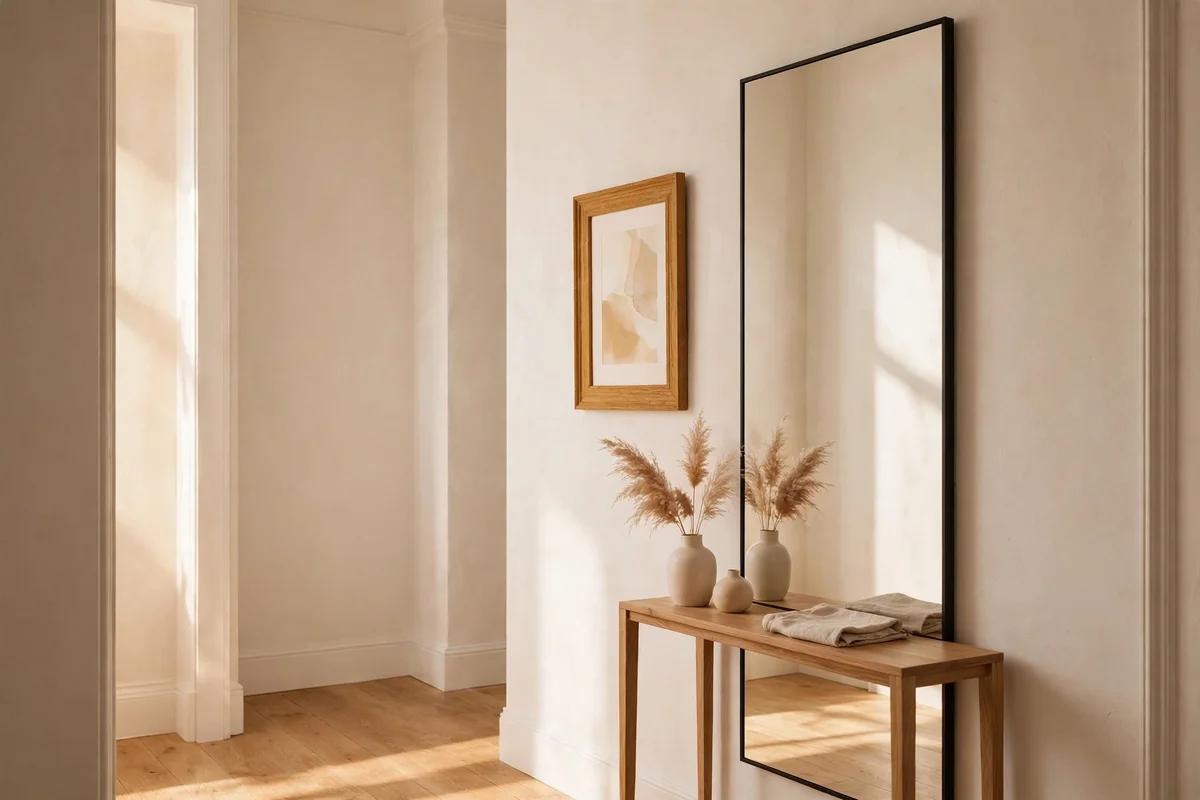
One warm accent, an ochre picture frame, a terracotta stool or a walnut tray, gives a pale hall a heartbeat without crowding it. Keep the accent to a single object between 25 and 45 cm in size, placed where the eye lands first: beside the mirror or on the console. Warm tones like ochre, rust and honey read as welcoming against pale walls in both daylight and lamplight.
The mistake to avoid is adding three or four warm pieces, which turns a calm hall into a busy one. If you love colour, let this one piece carry it and keep everything else pale. A charity shop frame repainted in ochre costs under 10 pounds or dollars, while a small terracotta stool runs 20 to 40. Move the accent with the seasons, a honey-toned tray in winter and a clay pot in spring, to keep the hall feeling fresh.
10. Set a Lipped Tray by the Door for Keys and Post
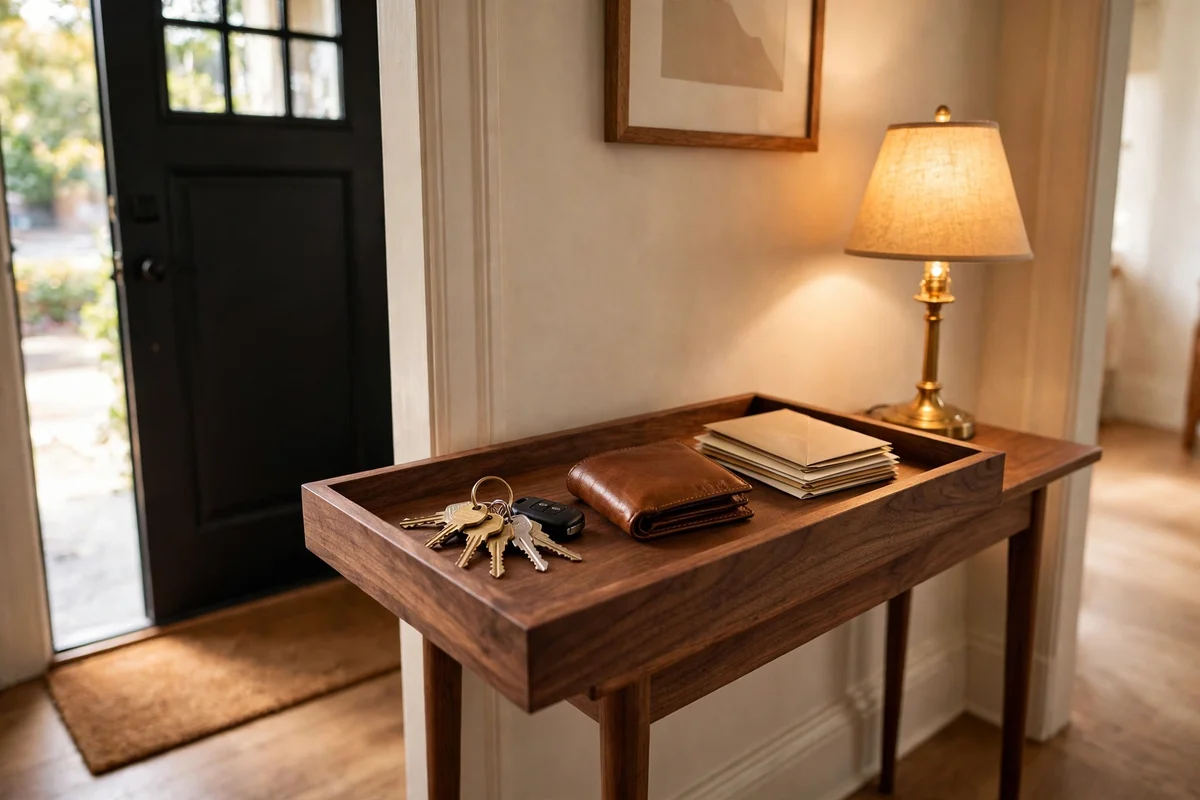
A tray 25 to 35 cm long with a 3 to 4 cm lip, placed within arm’s reach of the door on the console or a shelf, ends the daily hunt for keys. The lip stops post and small items sliding off when the door bangs shut. Choose walnut wood, hammered brass or glazed ceramic, and give every household member one corner of the tray so wallets, keys and phones each have a home.
Empty the tray every Sunday evening, filing the post and returning stray items, so it never becomes a junk pile. The mistake to avoid is a tray under 20 cm, which overflows within a week for a two-person home. A good lipped tray costs 12 to 30 pounds or dollars. For a personal touch, line the base with patterned paper cut neatly to fit.
11. Limit Seasonal Decor to One Hook and One Small Wreath
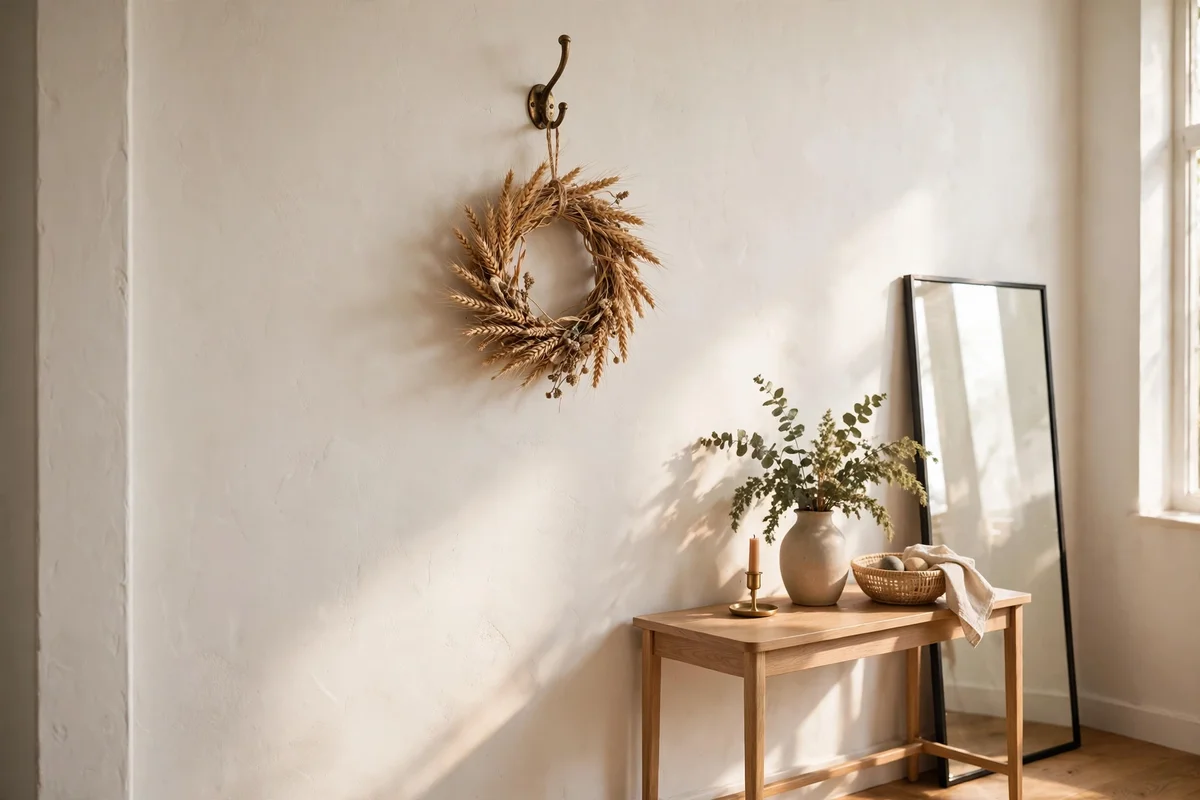
In a tight hall, one seasonal touch carries more charm than five. Dedicate a single hook at 150 cm high for a small wreath, 25 to 35 cm in diameter, and change it with the seasons: dried wheat in autumn, eucalyptus in winter, blossom sprigs in spring. A wreath this size reads clearly from the doorway without stealing wall space needed for coats and bags.
Store the off-season wreath flat in a 40 cm box on top of the shoe cupboard so the swap takes two minutes. The mistake to avoid is draping garlands along the mirror or shelves, which fights the storage the hall needs every single day. One quality dried or faux wreath costs 15 to 30 pounds or dollars and lasts for years. Keep the hook permanent and let the wreath be the only thing that changes.
12. Mount a Fold-Down Shelf as a Renter-Friendly Drop Zone
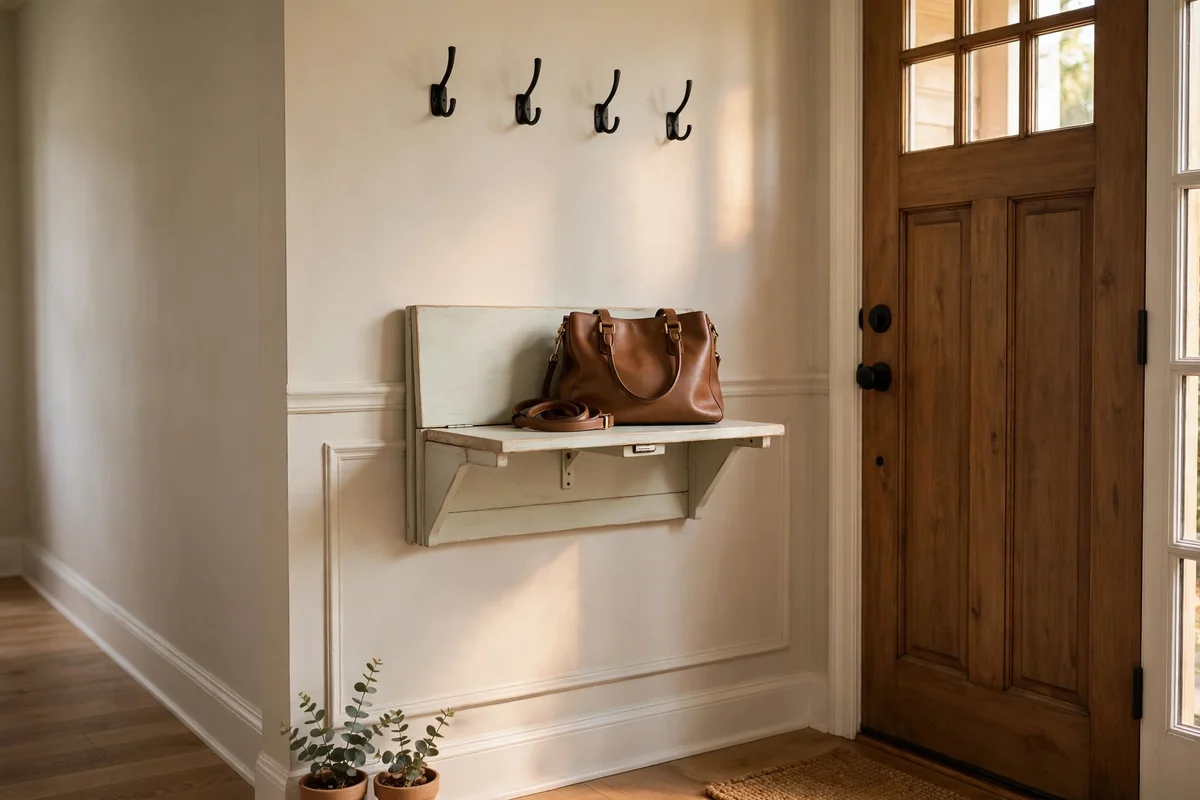
A fold-down shelf, 40 to 50 cm wide and 25 to 30 cm deep, gives you a landing spot for a handbag or shopping bag and folds flat against the wall when not needed. Mount it at 90 to 100 cm high, beside the door on the handle side, using brackets rated for 15 kg. Choose pale painted wood or bamboo so the folded shelf blends into the wall and almost disappears.
For renters, a leaning ladder shelf or a slim over-door hook board gives the same drop zone with no drilling at all. The mistake to avoid is mounting the shelf where the door swings: measure the arc first and leave 10 cm clear. A fold-down bracket pair costs 12 to 25 pounds or dollars, plus a board cut to size. Wipe the surface weekly, since drop zones collect dust fast.
13. Tuck a Storage Bench Against the Wall for Shoes and Sitting
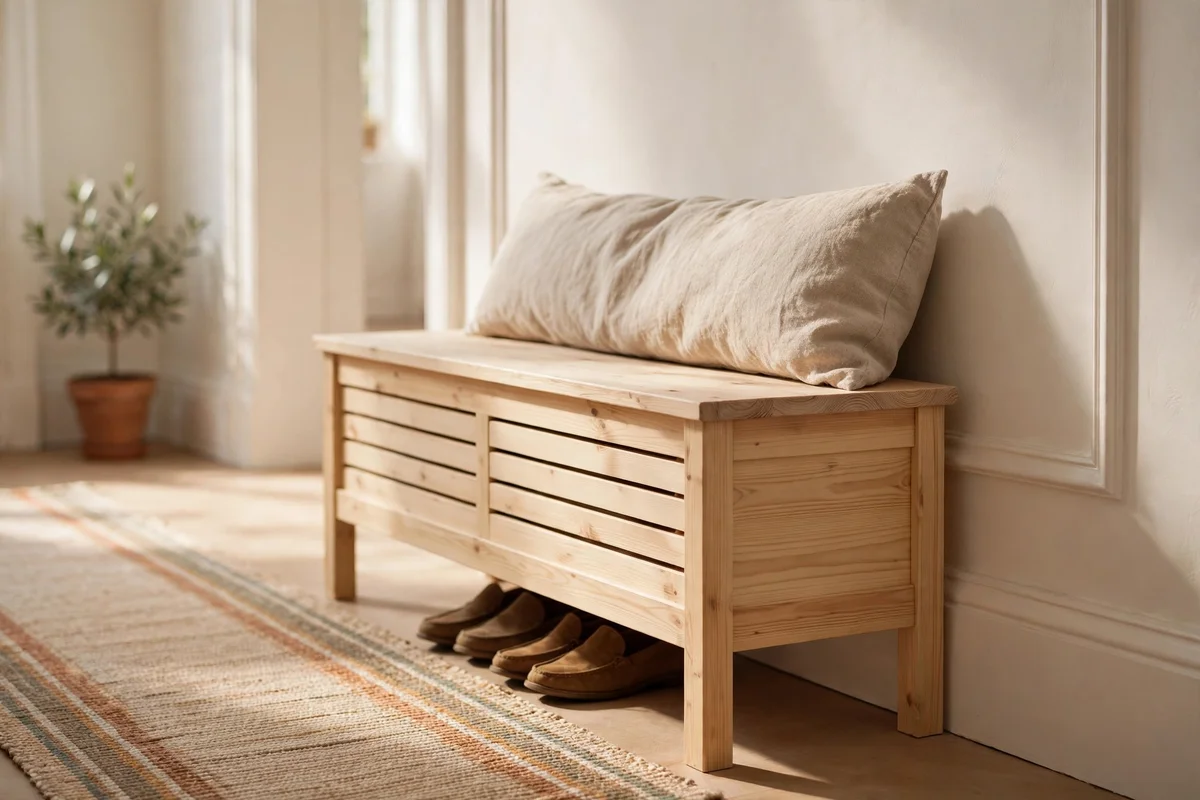
A bench 80 to 100 cm long, 30 to 35 cm deep and 45 cm high offers a seat for pulling on boots and hides two to three pairs of shoes inside. Place it against the longest clear wall, leaving at least 80 cm of walkway in front so nobody has to squeeze past. Choose a hinged lid with a soft-close hinge or an open cubby front, and add a 5 cm foam cushion in washable linen for comfort.
The mistake to avoid is a bench deeper than 40 cm in a hall under 120 cm wide, which turns the walkway into an obstacle course. In very narrow halls, swap the bench for a wall-mounted flip seat only 25 cm deep. A pine storage bench costs 40 to 90 pounds or dollars, while solid oak or upholstered versions run 120 to 200. Keep a small basket inside for laces and shoe polish.
14. Choose a Flush-Mount Ceiling Light That Hugs the Ceiling
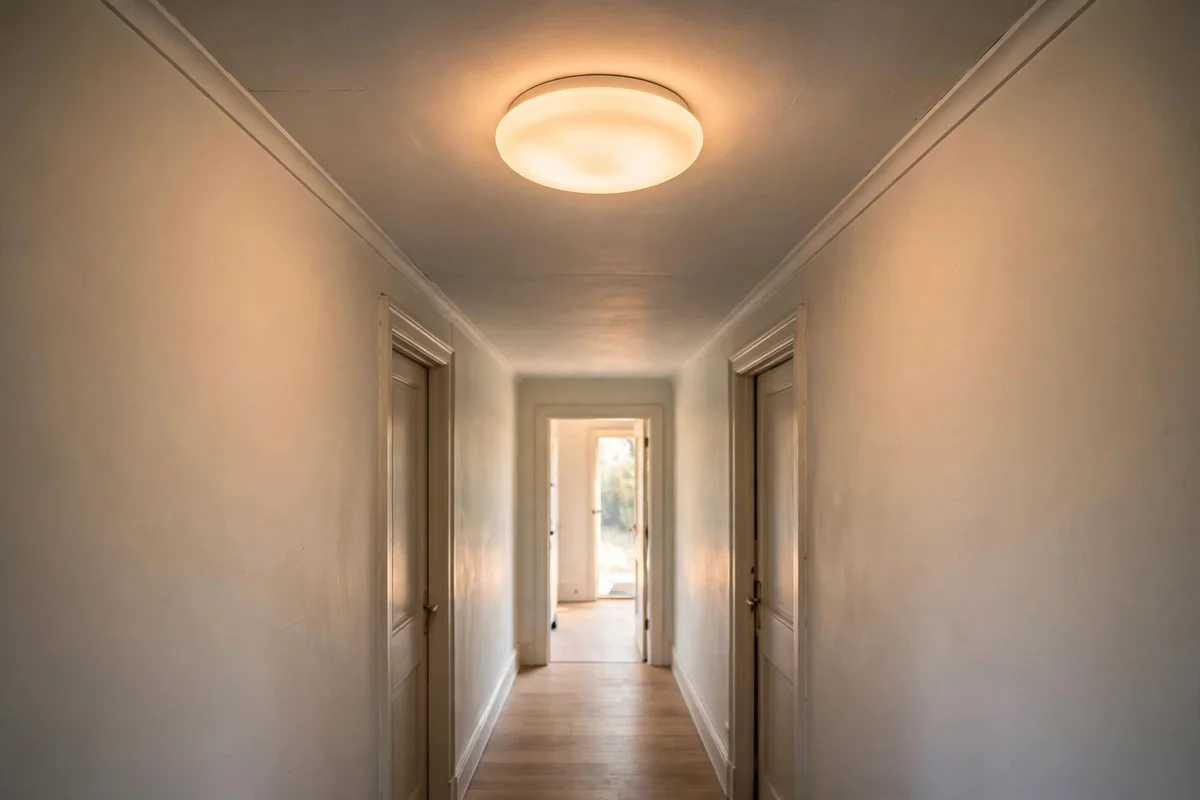
In halls with ceilings of 240 cm or lower, a flush-mount fitting that sits within 10 cm of the ceiling keeps sightlines clear and the space feeling tall. Choose an opal glass or linen drum shade 25 to 35 cm across, which spreads 600 to 800 lumens of 2700K light evenly from end to end. Centre the fitting on the hall’s longest axis so the glow reaches both the door and the far wall.
The mistake to avoid is a pendant that hangs 40 cm down into a low hall, which visually lowers the ceiling and risks a bumped head. Renters can swap a dated shade in minutes and keep the original in a box for move-out day. A quality flush-mount fitting costs 25 to 70 pounds or dollars. Clean the shade every few months, since dust on opal glass can dim the light by a fifth.
15. Corral Odds and Ends in Slim Lidded Baskets
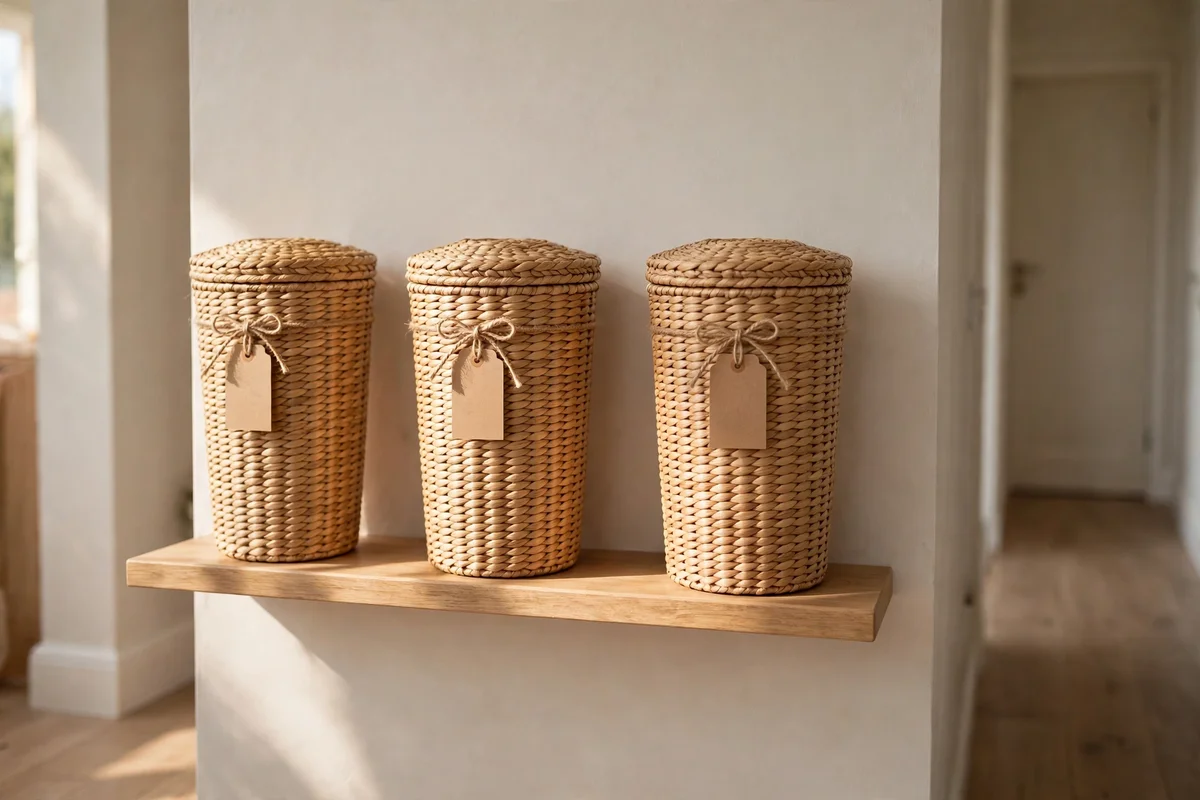
Two or three lidded baskets, each 25 to 35 cm long and 15 to 20 cm deep, turn shelf and bench clutter into calm. Use one for dog leads, one for hats and gloves, and one for the bits that follow children home from school. Seagrass, lidded canvas or pale wood all suit a small hall, and the lids keep the contents looking tidy from every angle.
Label each basket with a small tied tag so family and guests return things to the right place. The mistake to avoid is open baskets in a hallway, where the contents spill visually and double the sense of mess. A set of three lidded baskets costs 20 to 45 pounds or dollars. Shake them out monthly and wipe canvas ones with a damp cloth to keep dust down.
16. Go Damage-Free With Adhesive Hooks and Lean-To Pieces
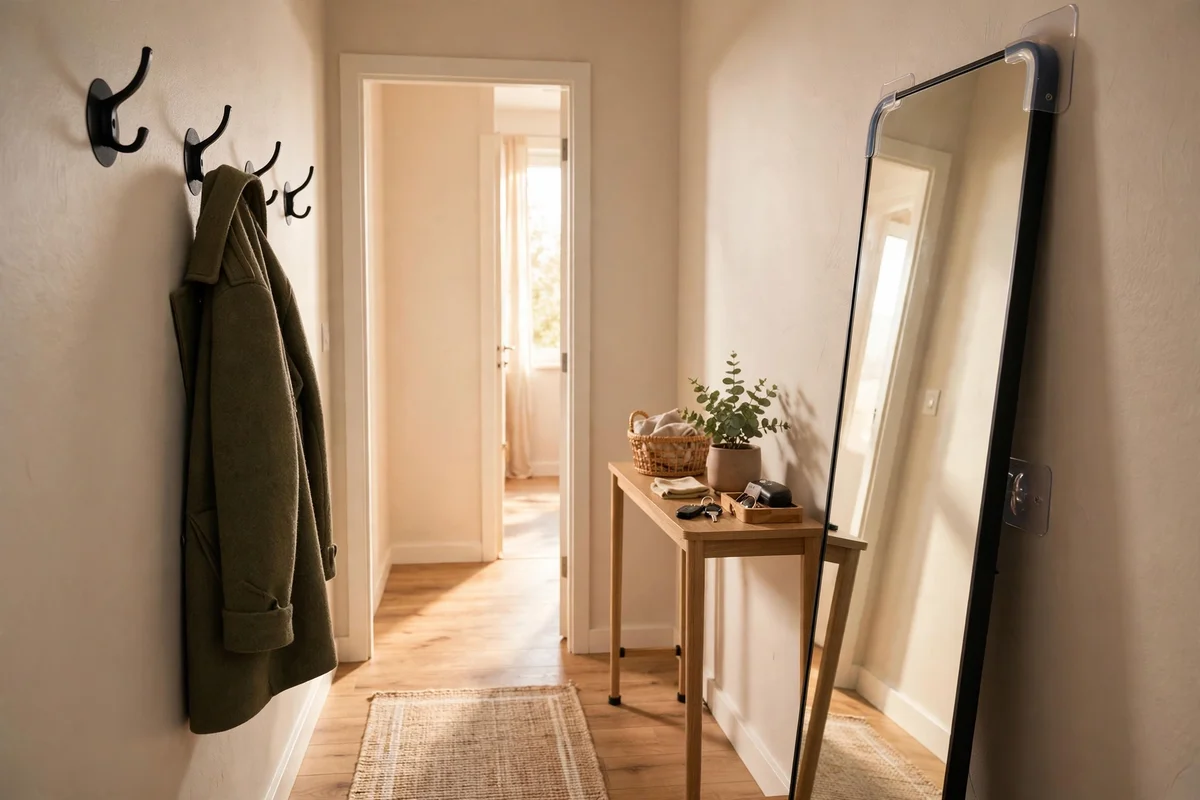
Renters can dress a small hall fully without drilling a single hole. Heavy-duty adhesive hooks rated for 3 to 7 kg hold coats and bags, adhesive picture strips hang mirrors up to 60 cm wide, and a leaning full-length mirror needs only a wall bumper to stay put. Clean the wall with rubbing alcohol first and wait 24 hours before loading the hooks, since patience doubles their holding strength.
Choose lean-to furniture, such as a narrow leaning shelf or a slim console with anti-tip pads, so nothing needs a wall screw. The mistake to avoid is overloading one adhesive hook: spread weight across three or four and check them every few months. Keep every original fixing in a labelled bag for move-out day. A damage-free hall kit of hooks and strips costs 15 to 30 pounds or dollars.
17. Welcome Feet With a Small Round Rug at the Threshold
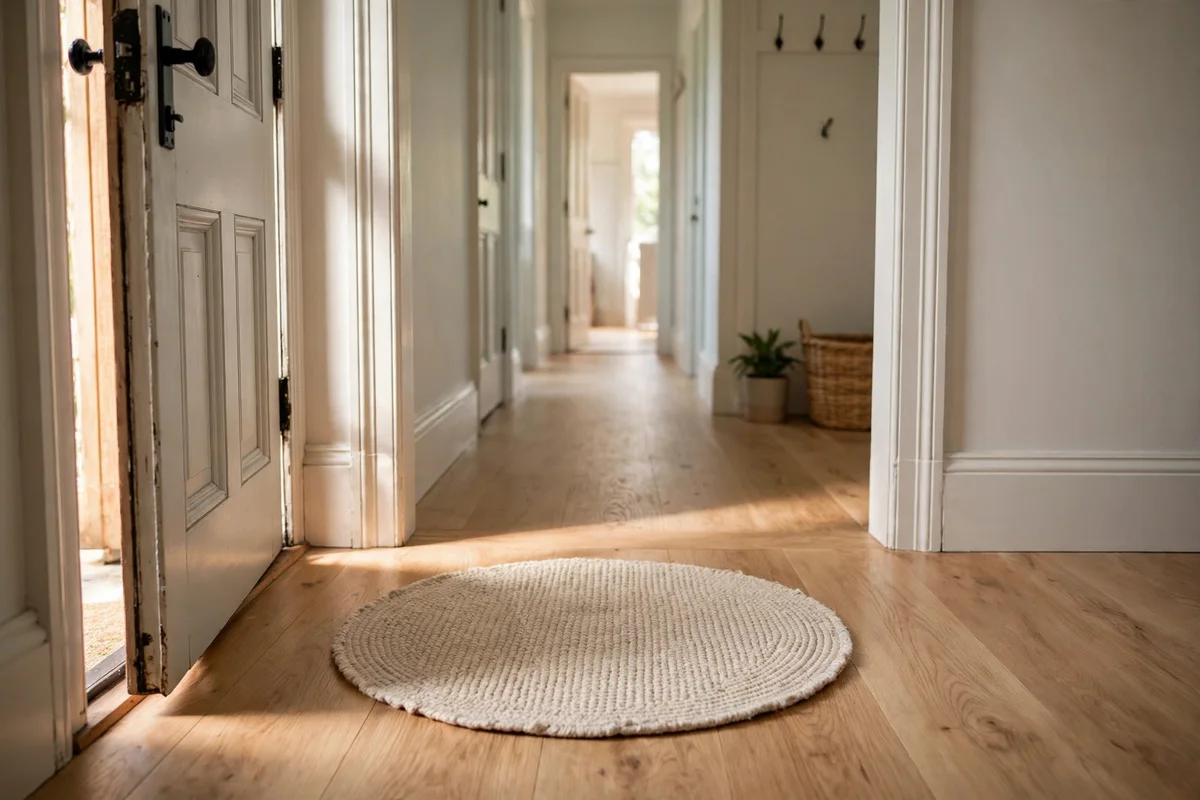
A round rug 80 to 100 cm across, placed just inside the door, softens the first step and catches grit before it travels down the hall. Choose a washable cotton or jute-look rug with a non-slip backing, 6 to 10 mm thick, so the door clears it easily. A round shape breaks up the corridor’s straight lines and makes the entry feel like a small room rather than a passage.
Pair the round rug with a longer runner further down the hall, keeping 30 to 40 cm of bare floor between them so each piece breathes. The mistake to avoid is a rug that slides under the door swing and jams it, so check the clearance before buying. A washable round rug costs 20 to 40 pounds or dollars. Shake it outside weekly and machine wash it monthly.
18. Keep Cupboard Fronts Pale or Frosted So Storage Looks Light
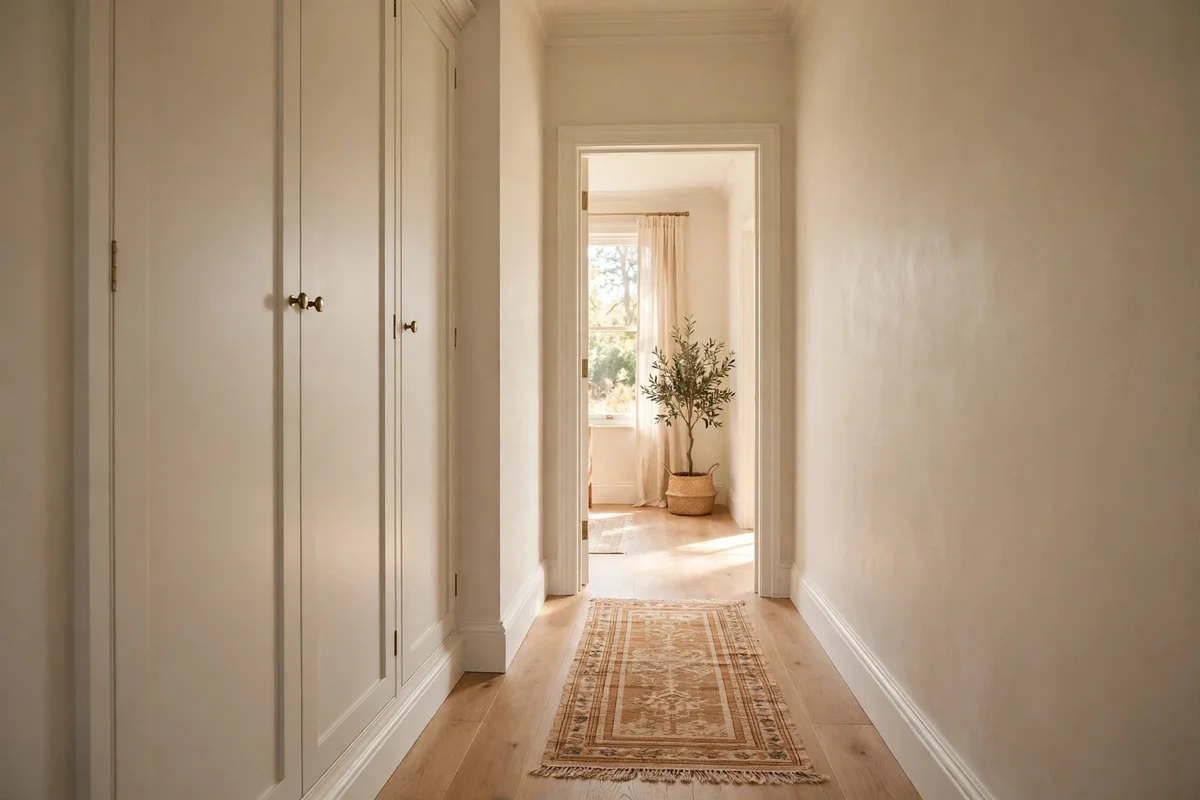
Dark cupboard fronts in a small hall read as heavy blocks, while pale painted or frosted fronts dissolve quietly into the wall. If your shoe cupboard is dark wood, repaint it in the wall colour with a durable satin paint, or apply frosted window film to glass fronts for about 10 pounds or dollars. Keep handles small, with 8 to 10 cm bar pulls or simple round knobs, so nothing juts into the walkway.
The mistake to avoid is mixing three different wood tones across cupboard, bench and shelves, which chops the hall into visual fragments. Choose one pale finish and repeat it on every storage piece for a seamless run. Frosted film also hides shoe clutter behind glass doors while letting light through. A litre of satin paint covers a standard shoe cupboard twice and costs 12 to 20 pounds or dollars.
19. Hang Three Matching Frames in a Tight Vertical Line
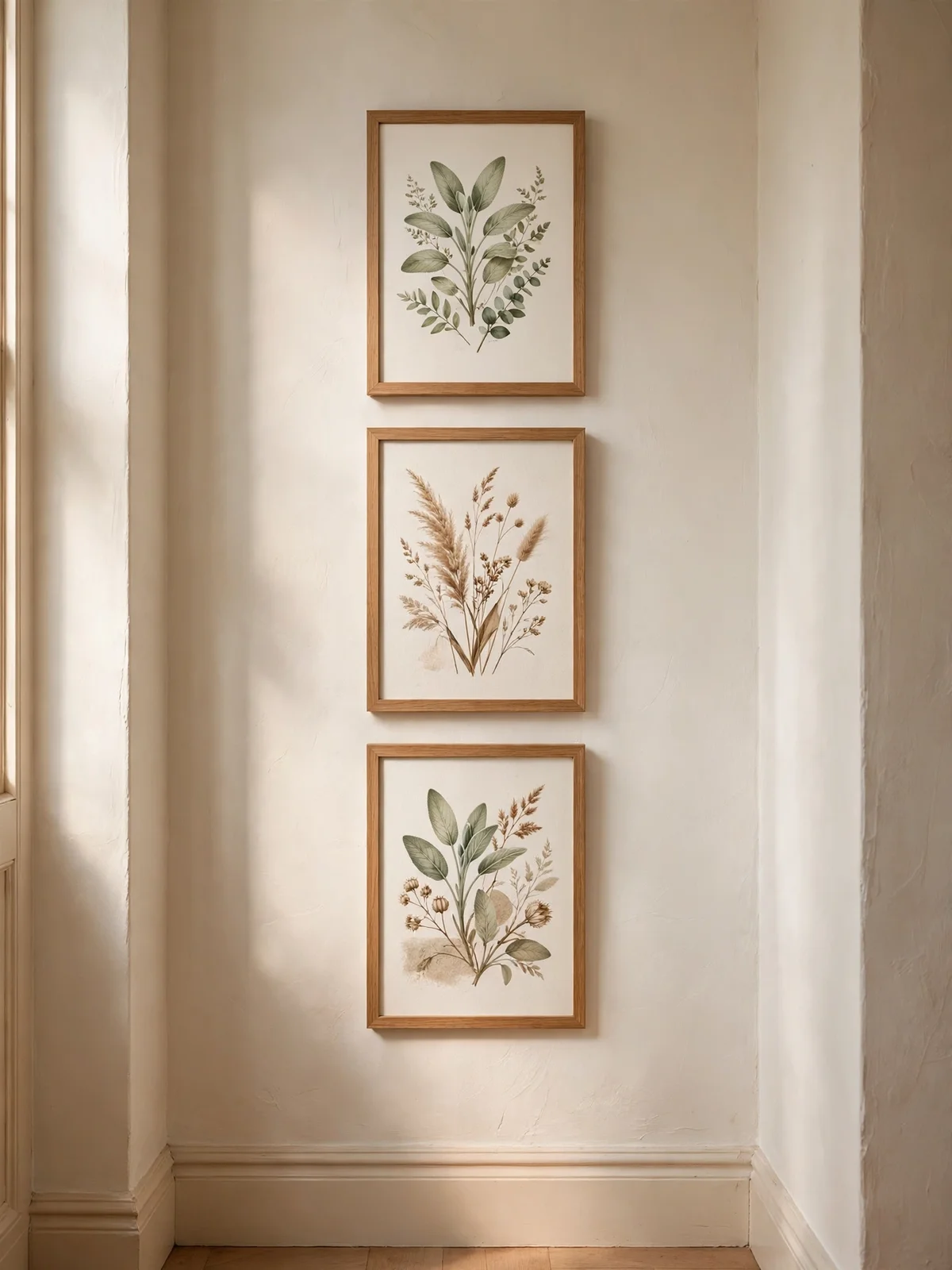
Three matching frames, each 20 by 25 cm with 5 cm gaps between them, hung in a vertical line with the centre at 145 to 160 cm high, add personality without stealing width. Fill them with botanical prints, architectural sketches or pressed leaves in a shared palette of sage, sand and ink. Identical slim frames in oak or matte black keep the column feeling orderly and calm.
The mistake to avoid is a scattered gallery of mixed frames, which makes a narrow wall feel chaotic and smaller. One tight column reads as a single piece of art and suits walls as narrow as 40 cm. Hang the centre frame first, using a removable strip if you rent, then build outward from it. Three ready-made frames plus prints cost 20 to 45 pounds or dollars, while pressing your own leaves costs nothing.
20. Place One Tall Slim Plant in the Brightest Corner
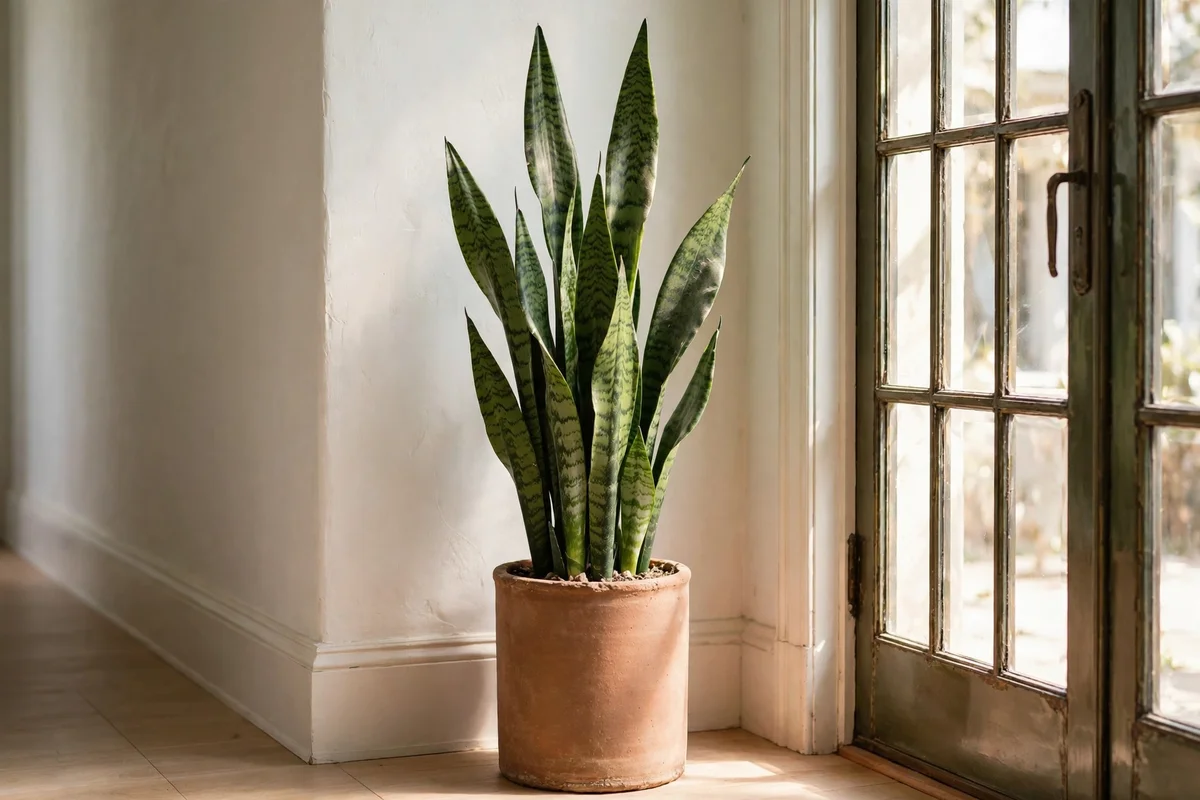
One tall plant, such as a snake plant or a small olive tree in a 25 to 30 cm pot, softens the hardest corner of the hall without needing floor width. Match the plant to the light: snake plants and ZZ plants cope 2 to 3 metres from a window, while olives need a spot within a metre of glass. A cylindrical pot in clay or matte ceramic, 40 to 50 cm tall, lifts the foliage to eye level where it shows best.
The mistake to avoid is three small pots scattered along the hall, which read as clutter and demand more watering. One statement plant needs water only every one to two weeks, and you should check the top 3 cm of soil first. A healthy snake plant in a clay pot costs 20 to 40 pounds or dollars. Dust the leaves monthly with a damp cloth so they catch the light properly.
21. Adopt a Two-Minute Evening Reset to Keep the Hall Clear
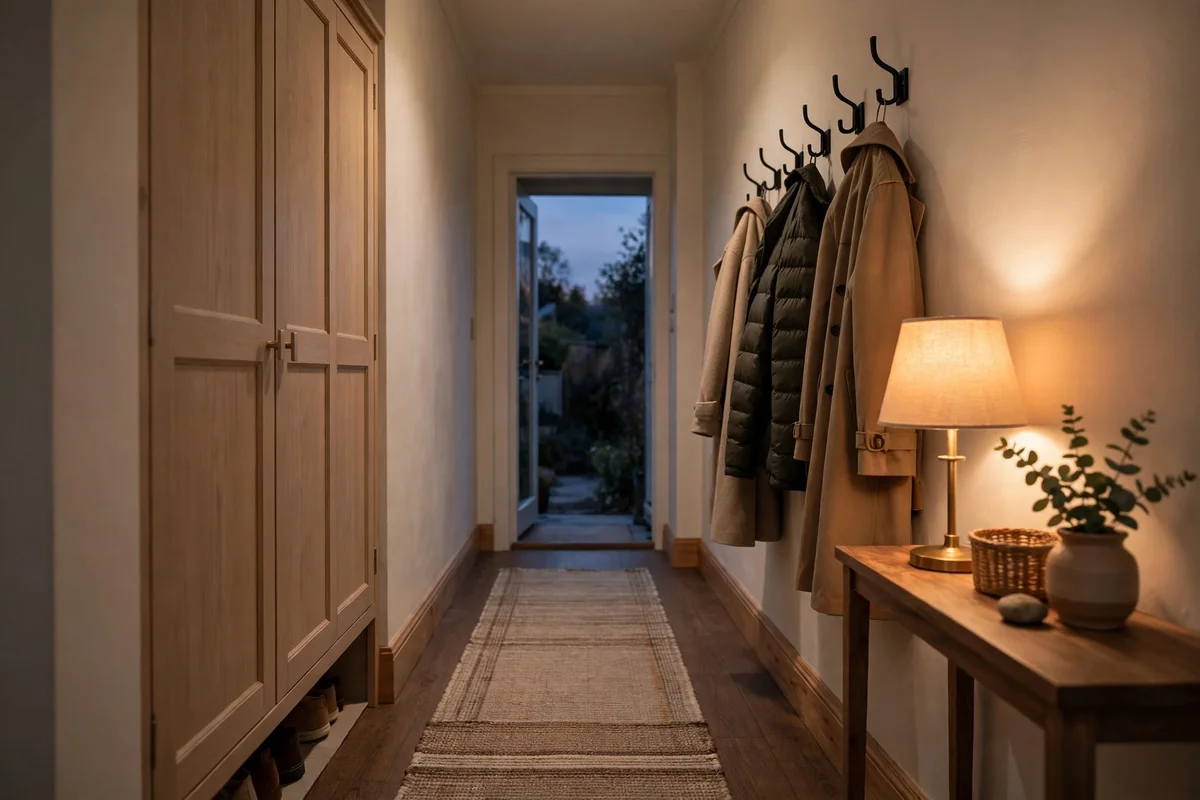
A hall stays welcoming only if it is reset daily, and two minutes each evening does the job. Hang up the coats, return shoes to the cupboard, empty the key tray of stray receipts, and straighten the runner with one firm pull. Do it right after locking the door for the night so it joins the routine, like switching off the lights. A small hall shows every stray item, so this tiny habit pays off fast.
Keep a small lidded bin of 15 to 20 litres inside the shoe cupboard for the odd sock, broken umbrella or outgrown mitten, and empty it once a month. The mistake to avoid is the weekend blitz, which lets clutter build for six days and then takes an hour to fix. Two minutes daily beats one hour weekly every time. Involve the whole household so the reset takes ninety seconds, not ten minutes.
A small hall asks for restraint and rewards it generously. When every piece earns its place, a slim console, a mirror that borrows light, hooks instead of a stand, shoes hidden away, the whole space starts to feel gracious rather than cramped. The ideas above share one principle: keep the floor clear, the walls pale and the light warm, then let a single warm accent do all the talking. Small rooms notice every choice, so make each one calm and deliberate.
This week, try the easiest win first: gather every shoe into one cupboard or basket and lay a runner down the hall. That single afternoon changes how the space feels more than any tin of paint. Then add one warm light at console height and notice how the hall greets you after dark. Tight halls forgive slowly and reward quickly, so begin with the shoes and the runner today.
Frequently Asked Questions
How do I make a narrow hallway look wider without knocking down walls?
Keep the floor as clear as possible, since every object on it narrows the path visually. Paint the walls a pale warm white, hang a tall mirror to bounce daylight, and lay a runner that runs the full length of the hall. Choose furniture no deeper than 25 cm and repeat one pale finish everywhere so the eye travels down the hall without stopping.
What is the best shoe storage for a very small entryway?
A slim tilting shoe cupboard about 25 cm deep holds 12 to 18 pairs with no door swing clearance, which suits halls under 110 cm wide. Keep daily shoes on the top tier and off-season pairs at the bottom. If you rent, or the hall is under 100 cm wide, a bench with lidded baskets underneath works just as well and needs no fixings.
Can I decorate a rented entryway without drilling any holes?
Yes. Heavy-duty adhesive hooks rated for 3 to 7 kg hold coats and bags, adhesive picture strips hang mirrors up to 60 cm wide, and a leaning full-length mirror needs only a wall bumper. Choose lean-to furniture with anti-tip pads so nothing needs a screw, and keep every original fixing in a labelled bag for move-out day.
What colour should I paint a small dark hallway?
A pale warm white with a creamy undertone reflects the most light and stops shadowy corners turning grey. Paint the ceiling the same shade to blur the wall-to-ceiling line, which lifts a low ceiling noticeably. Add one warm accent, like an ochre frame or terracotta pot, so the paleness feels welcoming rather than stark. Avoid cool blue-whites in north-facing halls.
How much does a small entryway makeover realistically cost?
Between 40 and 150 pounds or dollars for a meaningful refresh. A washable runner, a lipped tray and one warm-bulb lamp cover the basics for around 60. Spend more only on pieces you touch daily, like a sturdy shoe cupboard or bench. Buy in stages and live with each change for a week, which usually prevents one or two wrong purchases.