Home Improvement
23 Hidden Storage Ideas for Small Homes That Disappear Into the Decor
By Anna Wells · · 23 min read
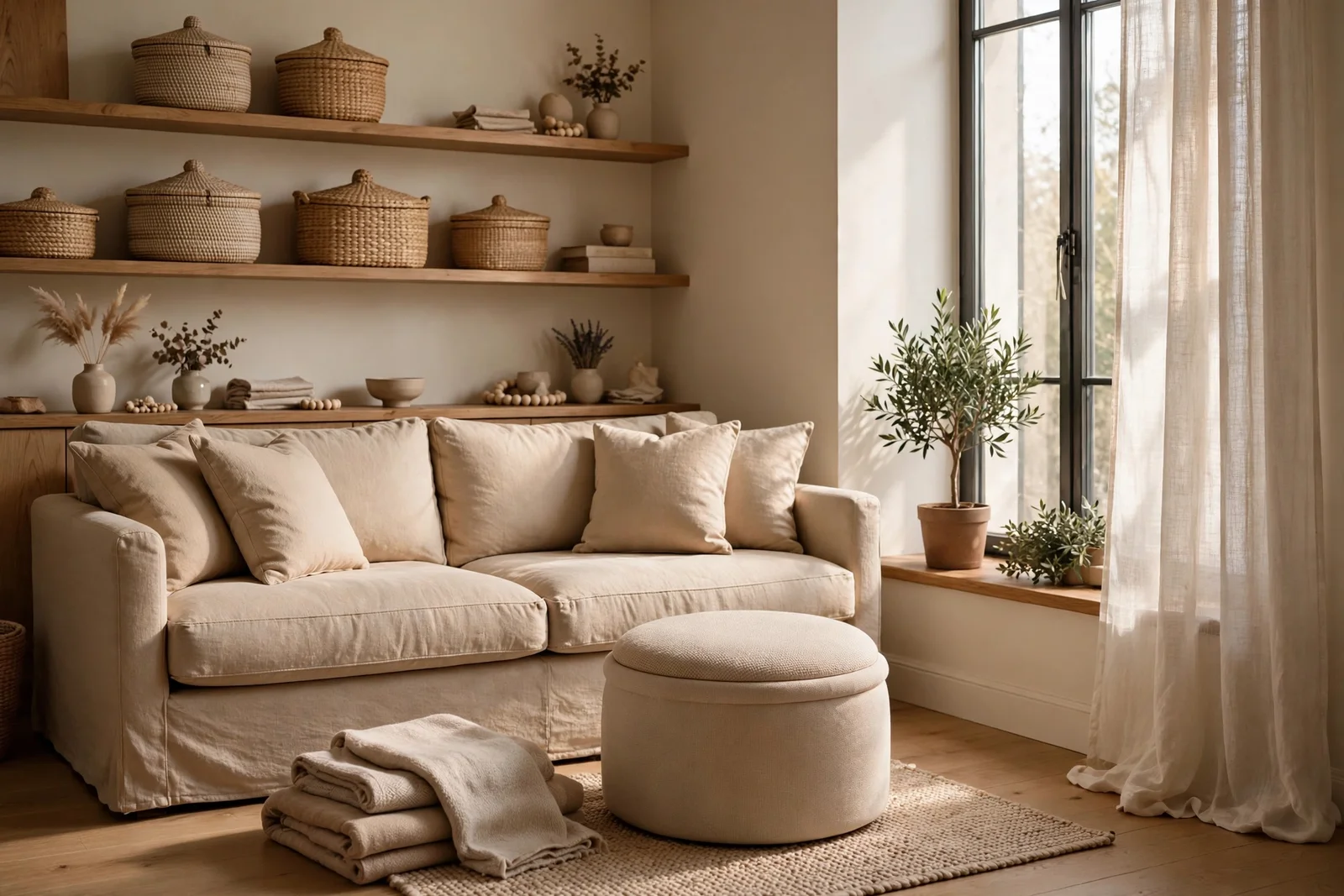
Small homes hide generous storage in plain sight. Here are 23 decor-first ideas that tuck clutter into ottomans, stair drawers, window seats and fold-down desks.
There is a particular tiredness that comes from tidying a small home where every shelf is already full. You fold the spare duvet and it lands on the ironing board; you tuck the board games behind the coats and they slide out by evening. The rooms look neat for an hour, then life spills over again. The problem was never your tidiness. It was that the furniture never agreed to hold anything.
This collection gathers twenty-three ideas that solve exactly that, by making storage disappear into the decor itself. Ottomans that hold throws, stair treads that open into drawers, toe-kick drawers that catch baking trays, window seats with deep hidden boxes, and a desk that folds away into a cabinet at night. Each idea includes honest sizes, realistic capacity notes, and the measuring that matters before you buy or build.
Read through, mark the two or three that fit your home’s trouble spots, and start with the simplest. A calmer home is rarely one big project. It is a series of small, closed lids.
1. Place a Rounded Storage Ottoman at the Foot of the Sofa for Throws and Board Games
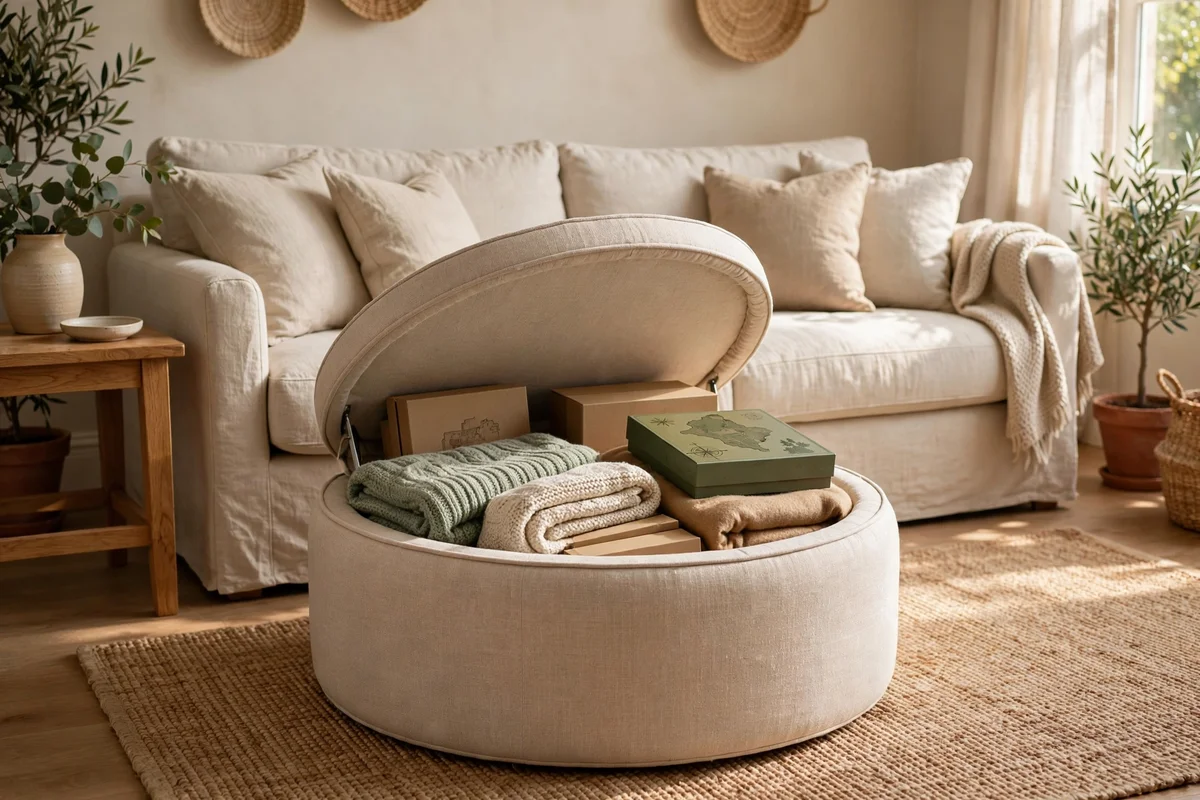
A storage ottoman between 90 and 120 cm wide sits neatly at the foot of most three-seat sofas without crowding the walkway. Inside, the space swallows four to six folded throws, or a stack of board game boxes laid flat with room to spare. Choose a model with a hinged lid and soft-close stays so it shuts gently, which matters in homes with children. Keep the ottoman 40 to 45 cm high so it doubles as a footrest or an extra seat when guests stay late.
Upholster it in a washable weave or a wipeable faux leather that matches the sofa cushions, so it reads as decor first and storage second. A mid-range ottoman usually costs 80 to 150, while charity shops often hide solid wooden ones for under 30 that you can repaint. The mistake to avoid is overstuffing: a lid that will not close flat soon warps its hinges, so leave a finger-width gap at the top and move overflow elsewhere. Vacuum the inside twice a year to keep dust from settling into the fabric.
2. Set a Slatted Lidded Bench Beside the Front Door for Shoes and Scarves
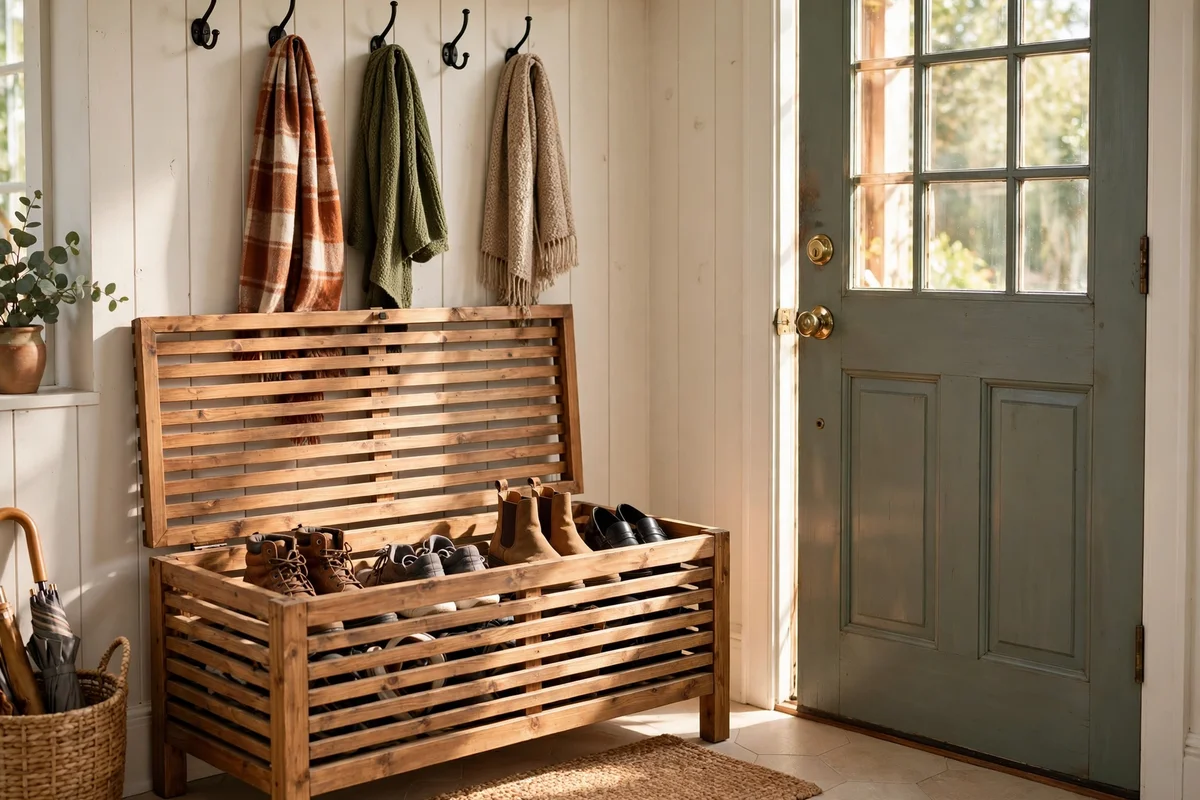
Place a lidded bench 100 to 120 cm long beside the front door, and it swallows four to six pairs of everyday shoes out of sight. Choose a slatted wooden top so air circulates around footwear, which stops that closed-cupboard smell after rainy days. Inside depth of 30 to 35 cm fits most shoe sizes, and a hinged seat lifts easily when you are rushing out. Measure the wall run first, leaving at least 90 cm of clear passage so the bench never blocks the door swing.
Top the bench with a 5 to 8 cm foam cushion in a washable cover, and it becomes the seat you use to tie laces every morning. Fix two or three coat hooks on the wall above for bags and scarves, keeping the floor beneath completely clear. The mistake to avoid is sealing wet umbrellas or soaked trainers inside: hang those on the hooks or a drip tray until dry. A solid pine bench usually costs 70 to 130, and slatted tops stay fresher far longer than solid ones.
3. Slide a Slim Lidded Bench Along the Foot of the Bed for Spare Bedding
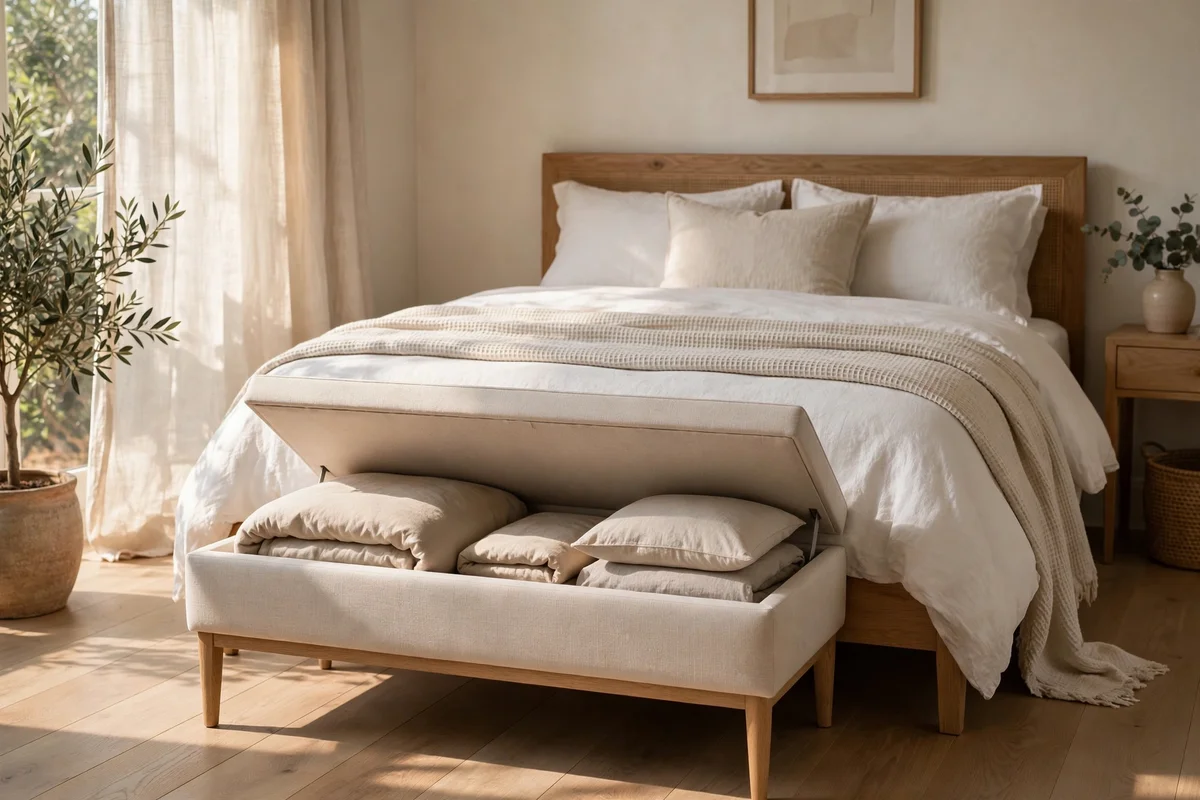
A slim bench 120 to 150 cm long at the foot of the bed hides a full spare bedding set: one duvet, two pillowcases and a folded throw fit comfortably in a 25 to 30 cm deep box. Before buying, measure the gap between bed foot and wall; you need at least 60 cm of walkway left, or the room feels cramped every morning. Choose a height matching the mattress top, around 50 to 55 cm, so the bench doubles as a tidy spot to fold laundry.
Because bedding lives here long term, ventilation matters more than in any other bench in this list. Pick a design with small air slots along the back panel, and never seal the duvet in a plastic bag inside it; trapped air turns cotton musty within months. Tuck in two cedar blocks to keep things fresh. The mistake to avoid is buying before measuring your duvet folded: king-size sets need the full 150 cm length, and a bench just 10 cm short ruins the whole plan.
4. Nest a Small Ottoman Inside a Larger One for Toys That Vanish Fast
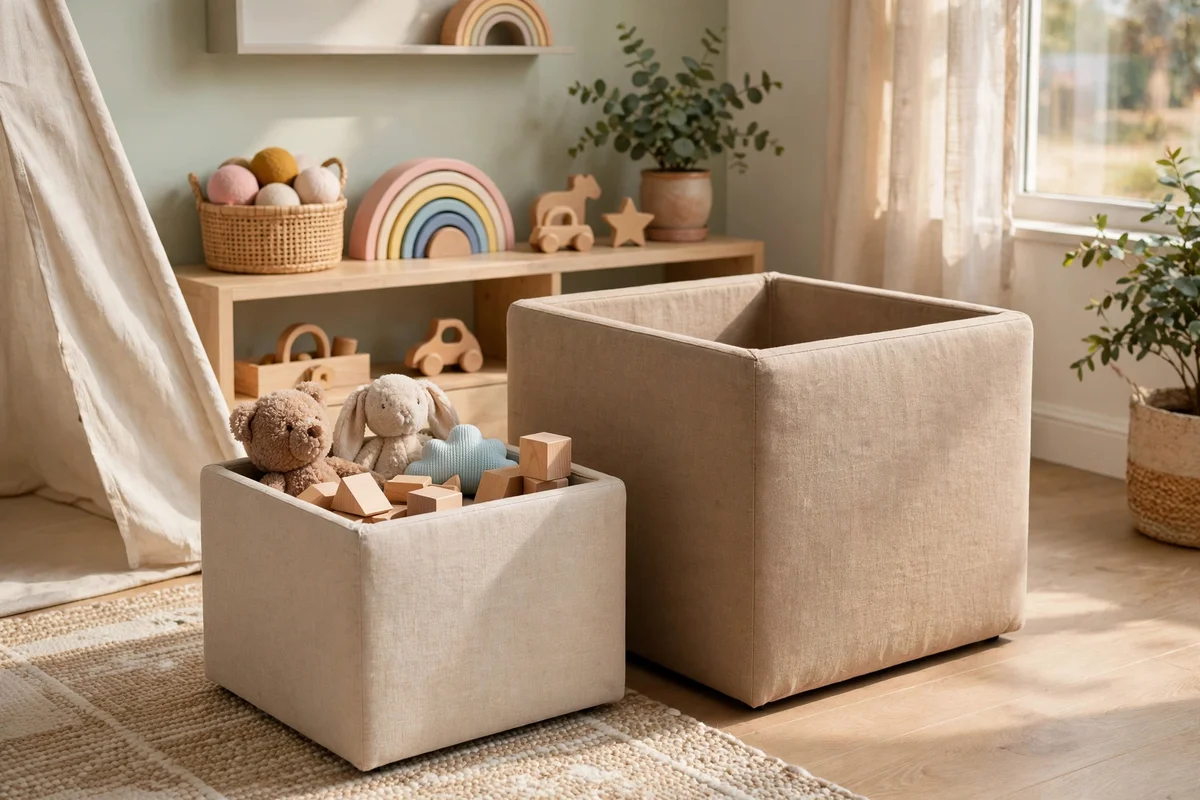
Two cube ottomans that nest, one 40 cm and one 34 cm, give small rooms a toy box that shrinks to a single footprint when guests arrive. The smaller cube slides fully inside the larger, and both lids lift off completely, which is the safest design for young children: no hinges means no trapped fingers. Each cube holds a surprising haul, roughly fifteen soft toys or a full set of wooden blocks. Keep lids under 2 kg so little hands can manage them alone.
Sort by keeping one cube for building toys and one for soft things, and teach the tidy-up as a race against the lid closing. A woven seagrass or cotton pair usually costs 50 to 90, while plain upholstered cubes run cheaper and wipe clean. The mistake to avoid is choosing heavy wooden lids for a toddler’s room: anything over 2 kg can hurt small fingers, so save the solid timber cubes for adult spaces and keep the nursery light. Check stitching monthly for loose threads.
5. Fit Pull Out Drawers Into Stair Treads for Shoes and Dog Leads
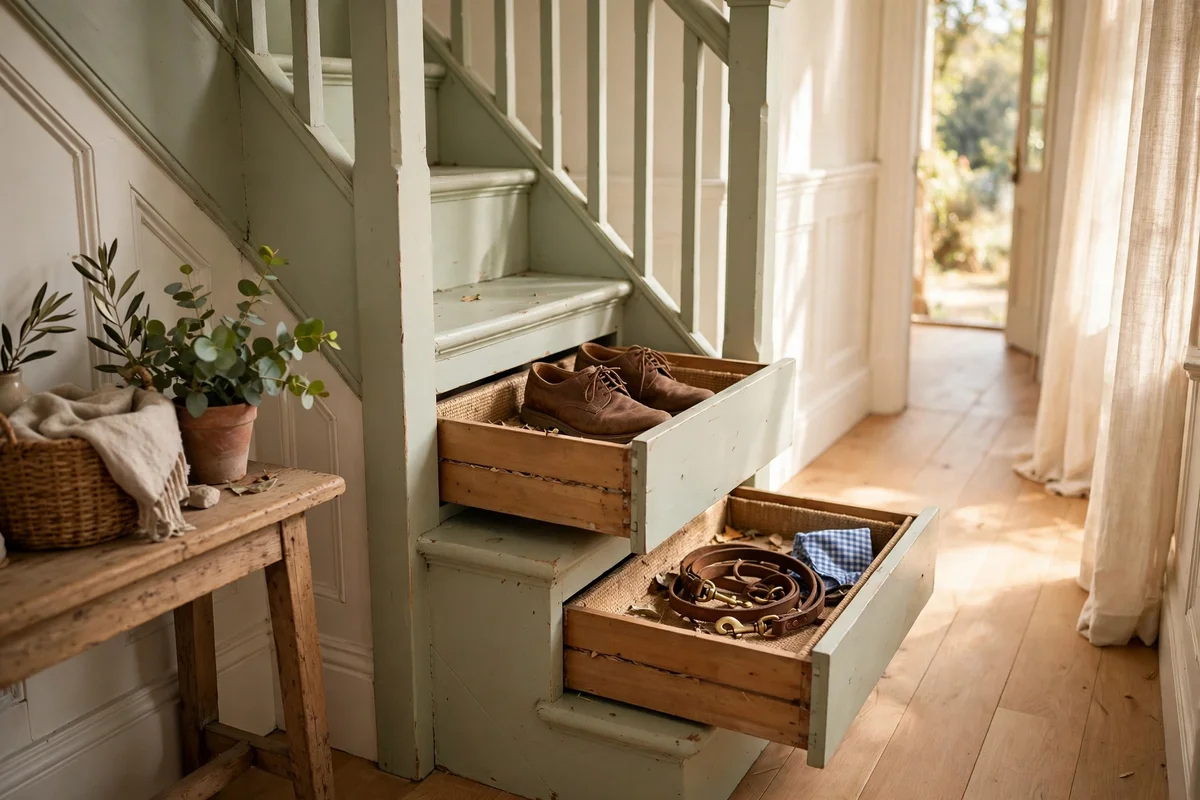
Each stair tread can hide a drawer 60 to 80 cm wide and 20 to 25 cm deep, enough for two to three pairs of shoes or a coiled dog lead and torch. Measure the riser height first: you need at least 17 cm of clear height for a useful drawer box, and solid timber treads take the cutting far better than hollow ones. Push-to-open catches keep the fronts clean of handles, so the staircase still reads as plain painted wood from the hallway.
Fit soft-close runners rated for at least 20 kg, because shoe drawers get heavy fast and cheap runners sag within a year. A joiner typically fits three to five tread drawers in one to two days, costing 300 to 600 depending on finish. The mistake to avoid is overloading beyond the runner rating: wet boots and heavy tools belong elsewhere. Also confirm the staircase structure with a professional first, since winding stairs and floating treads rarely suit this treatment.
6. Hang Shallow Cupboard Doors Under the Stair Slope for Coats and the Vacuum
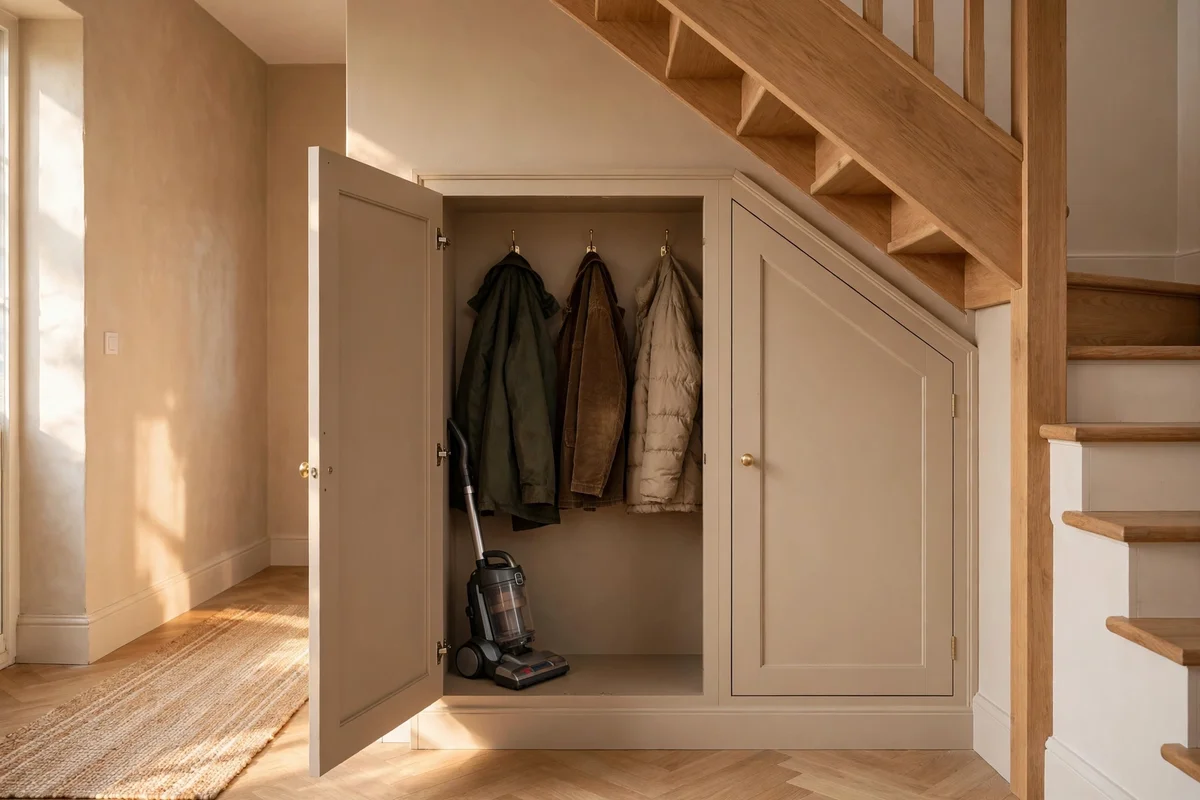
The dead triangle under a staircase, often 80 to 120 cm deep at its tallest point, takes shallow cupboard doors beautifully. Behind them you can stand three to four coats on short hooks, park the vacuum upright, and still keep a shelf for shoe polish and spare bulbs. Before fitting anything, locate the fuse box, meters and any ventilation grilles in that space, and keep every one of them fully accessible with clear opening doors, never sealed behind fixed panels.
Paint the doors the same colour as the hallway wall so the whole run disappears, and use magnetic touch latches for a handle-free face. A carpenter usually builds this in two to three days for 400 to 800, though simple ready-made doors on a timber frame cost far less. The mistake to avoid is blocking airflow: boilers and meters need their vents clear, so leave a 10 cm gap around any vent and check it yearly. Damp mops should dry elsewhere first.
7. Build a Full Height Cupboard at the Tall End of the Stairs for Luggage
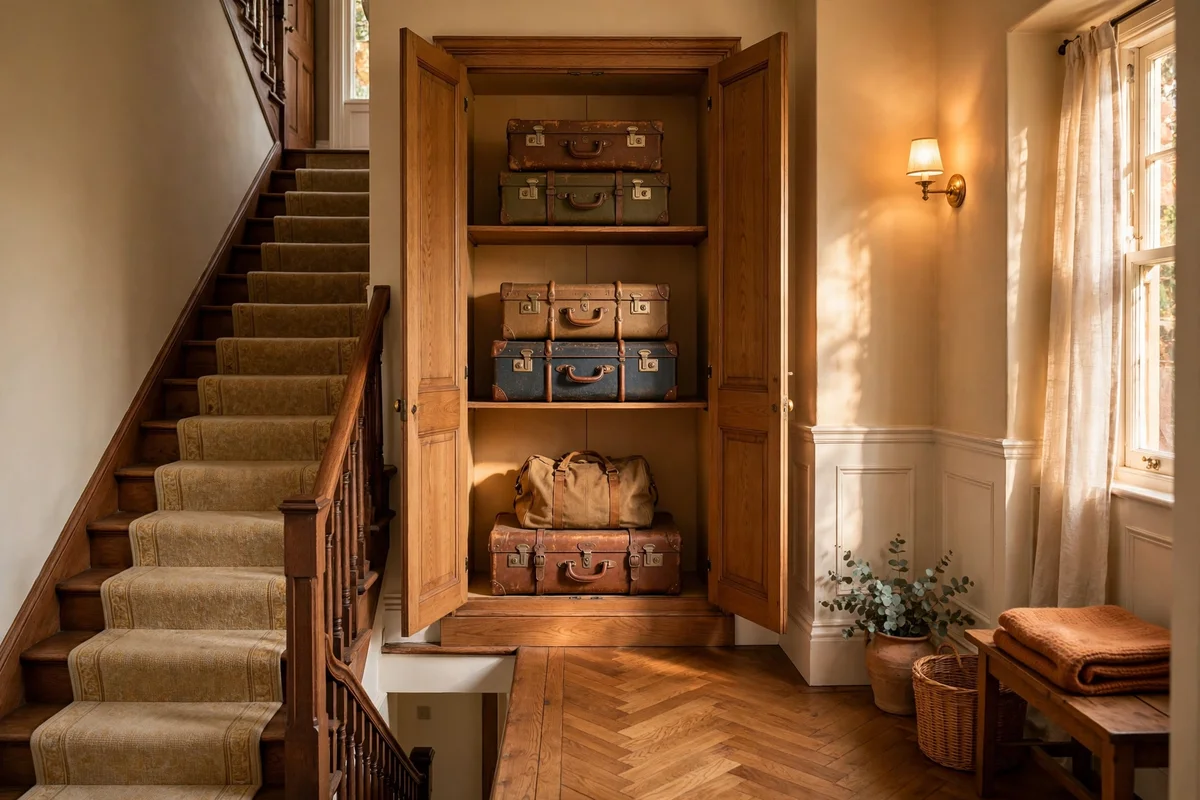
Where the staircase reaches full height, usually 200 cm or more, a floor-to-ceiling cupboard swallows two to three suitcases plus the ironing board without a centimetre wasted. Measure the door swing carefully: an 80 cm door needs 80 cm of clear floor, so consider sliding or bi-fold doors in tight hallways. Fit one deep shelf at 100 cm for cases and a high shelf for the things you touch twice a year, keeping daily items out of this deep zone.
Line the inside with wipeable paint or vinyl so dusty cases do not mark the walls, and add a battery motion light so the back corners stay visible. Keep anything heavy below waist height; a 20 kg case falling from 180 cm is a real injury risk. The mistake to avoid is treating this cupboard as a junk drawer for the whole house: once it fills with unsorted bags, finding the one case you need takes twenty minutes. Label each shelf and review the contents every spring.
8. Fit Toe Kick Drawers Along the Kitchen Plinth for Baking Trays and Linens
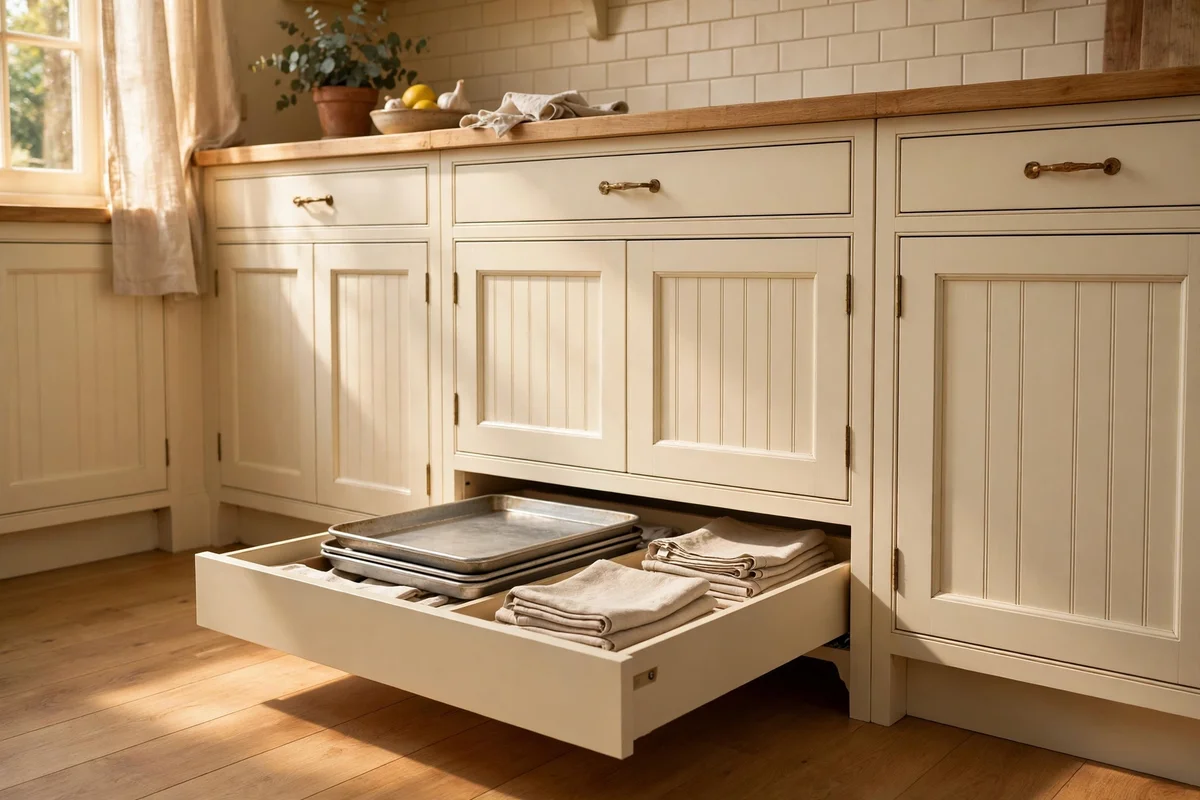
The plinth beneath kitchen cabinets, usually 10 to 15 cm high, hides a drawer 60 to 100 cm wide that is perfect for flat things: baking trays, chopping boards and folded table linens slide in on their sides. Measure the plinth height precisely and subtract 2 cm for the drawer box clearance, since a drawer that scrapes will drive you mad within a week. Keep this drawer away from the oven and dishwasher zones, where heat and steam warp thin boards.
Fit full-extension runners so trays at the back pull fully into reach, and line the base with wipeable shelf liner for easy cleaning. A single retrofitted toe-kick drawer usually costs 60 to 120, with wider runs priced per metre. The mistake to avoid is storing anything near a heat vent: check where the oven vents and the dishwasher releases steam, and leave those bays empty. Also confirm the drawer front matches the plinth colour, or the illusion of a plain kickboard breaks.
9. Add a Narrow Toe Kick Drawer Beside the Cooker for Foil and Baking Paper
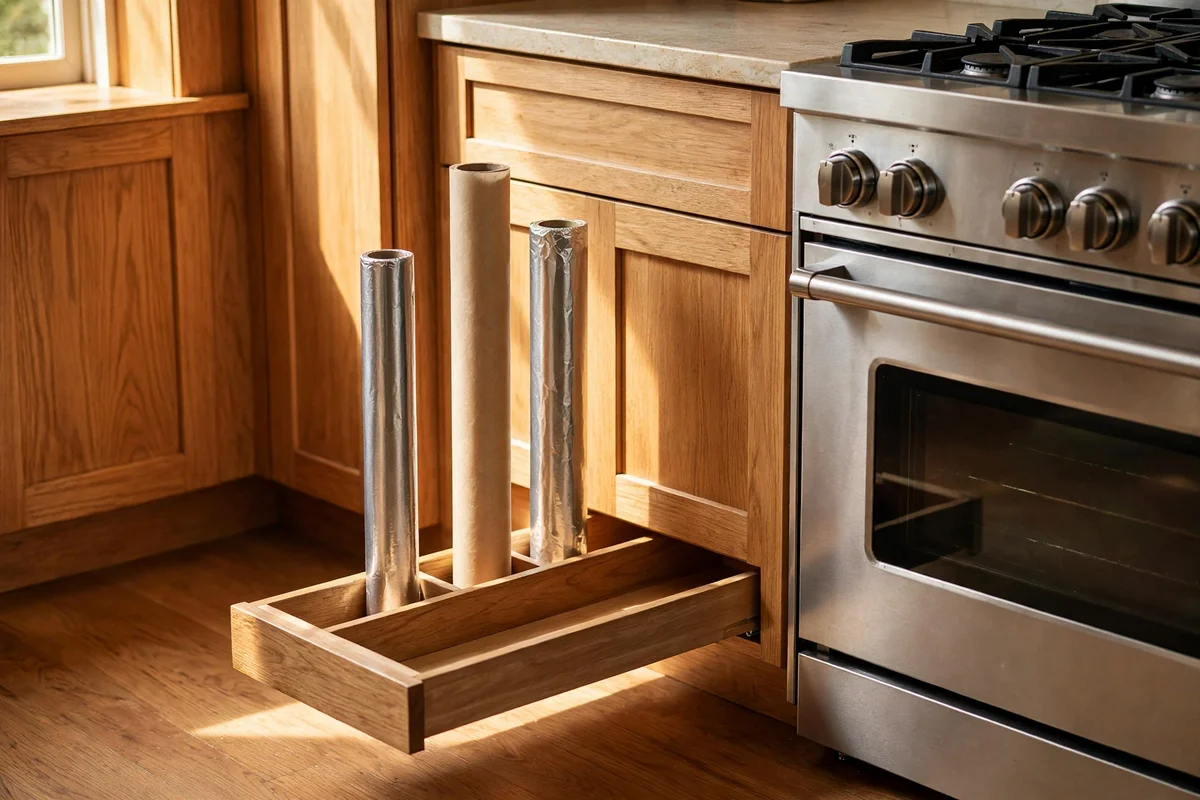
A narrow toe-kick drawer, just 30 to 40 cm wide, beside the cooker keeps foil, cling film and baking paper exactly where you reach for them. The boxes stand on end in a simple wooden divider, so you can see every roll at a glance instead of digging through a junk drawer. Measure the bay width to the millimetre, since these slim fronts must sit flush with the plinth line. This is a fifteen-minute daily time saver disguised as a plain kitchen kickboard.
Keep a safe distance from direct oven heat by choosing a bay at least one cabinet away from the hottest zone, and never store aerosols or spray oils in any toe-kick drawer. The paper and foil rolls themselves are fine at plinth level, where temperatures stay close to room level. The mistake to avoid is letting the drawer become a crumb trap: pull it out and wipe the base monthly, since flour dust drifts down behind every cooker. One drawer is usually enough; two is a luxury.
10. Use a Corner Toe Kick Drawer for the Step Stool and Pet Bowls
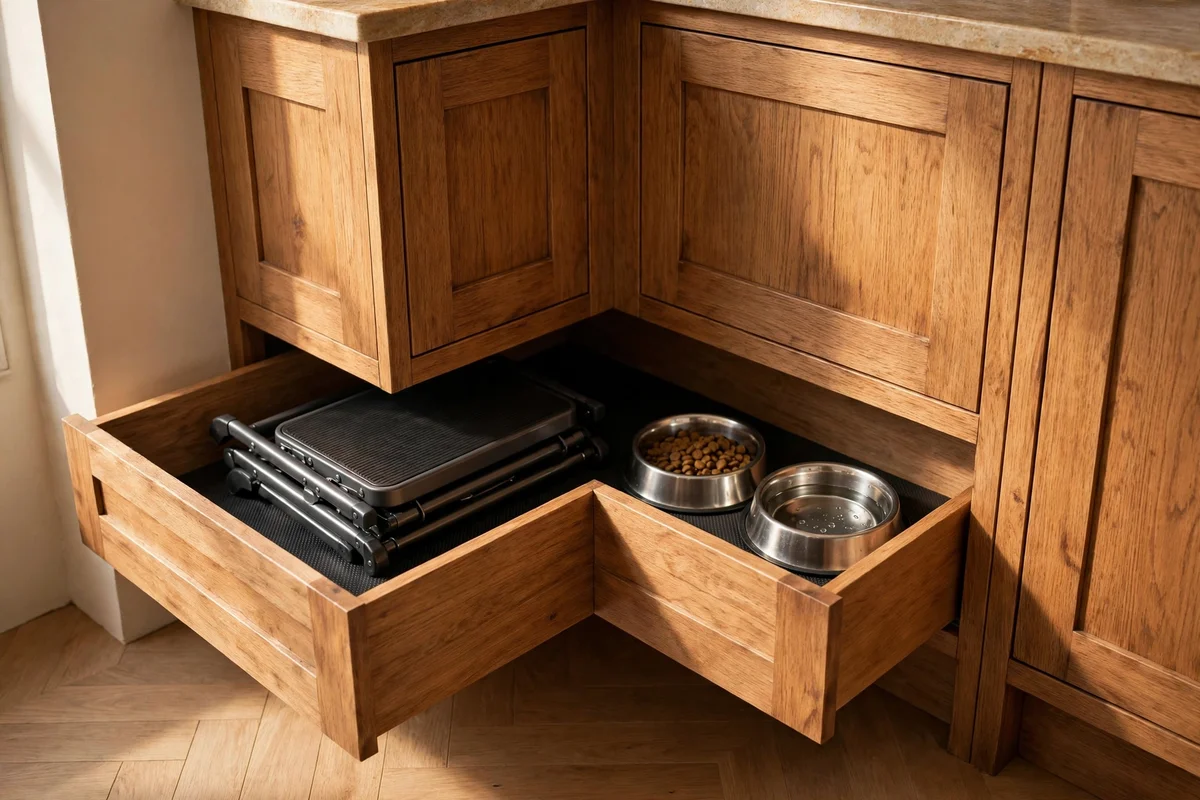
Corner cabinets waste the deepest part of the plinth, which is exactly where an L-shaped toe-kick drawer earns its keep. A folded step stool, two pet bowls and a bag of dry pet food fit comfortably in this awkward bay that nothing else uses. Choose a wipeable plastic liner for the base, since pet bowls drip and crumbs collect fast. Measure both legs of the corner carefully, as these drawers are made to order and returns are rarely possible.
Store pet food in a sealed container inside the drawer rather than loose in the bag, which keeps smells in and pests out. Wash the bowls daily and return them dry, since a damp bowl left overnight in a closed drawer grows stale smells quickly. The mistake to avoid is piling heavy tins on top of the step stool mechanism: keep the stool accessible at the front, and the whole drawer stays a two-second job. A made-to-measure corner drawer usually costs 120 to 200 fitted.
11. Slide Low Boxes on Castors Under the Bed for Off Season Clothes
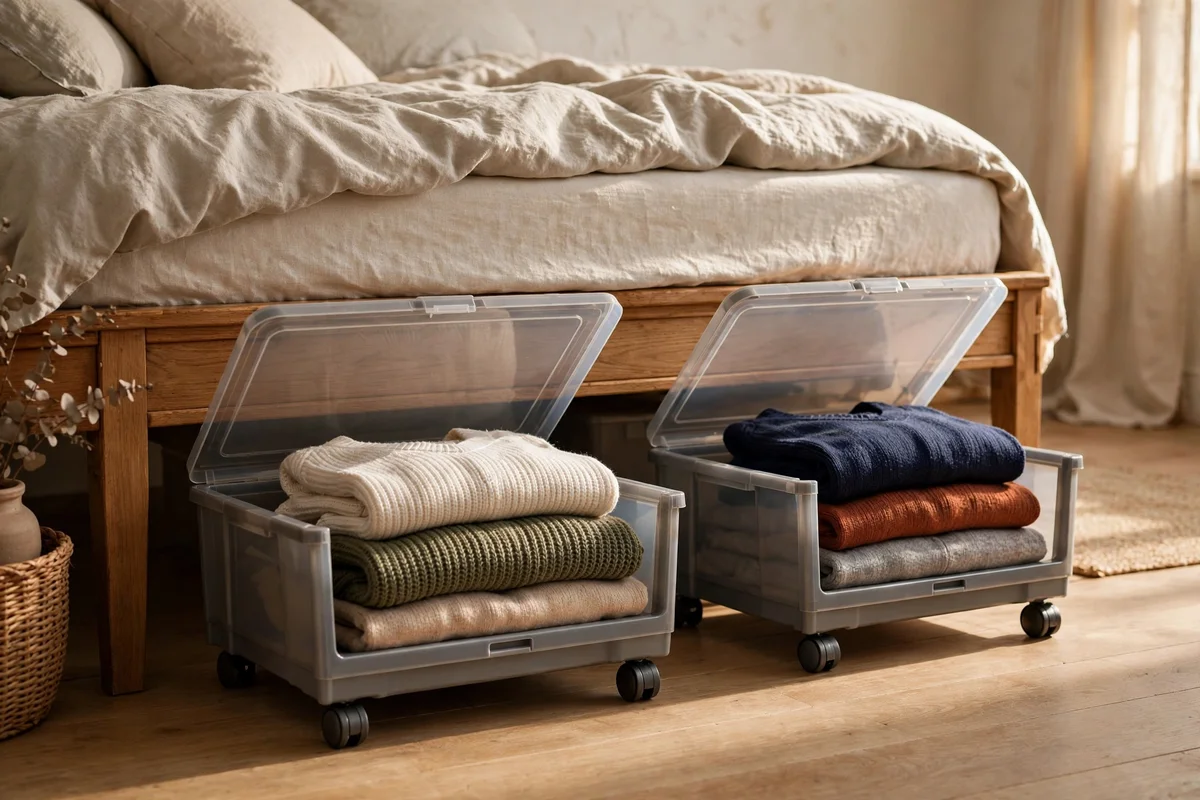
Measure the clearance under your bed first: most frames leave 15 to 25 cm, and your box must sit at least 2 cm lower to roll freely on carpet. A pair of 70 by 50 cm boxes on castors each holds eight to ten folded jumpers or a full set of guest bedding, which is a genuine wardrobe extension for a small bedroom. Choose boxes with lids to keep dust out, and label the short end so you can read it while kneeling.
Pick breathable fabric boxes or drill 2 cm ventilation holes in solid ones, because clothes stored a full season need air to stay fresh. Tuck in cedar blocks and never pack anything damp, or the whole box smells musty by spring. The mistake to avoid is cardboard boxes on a ground floor: they wick moisture from cold floors and collapse within a year. Two good boxes usually cost 30 to 60, far less than a single extra wardrobe.
12. Fit a Hydraulic Lift Ottoman Bed Base for Blankets and Suitcases
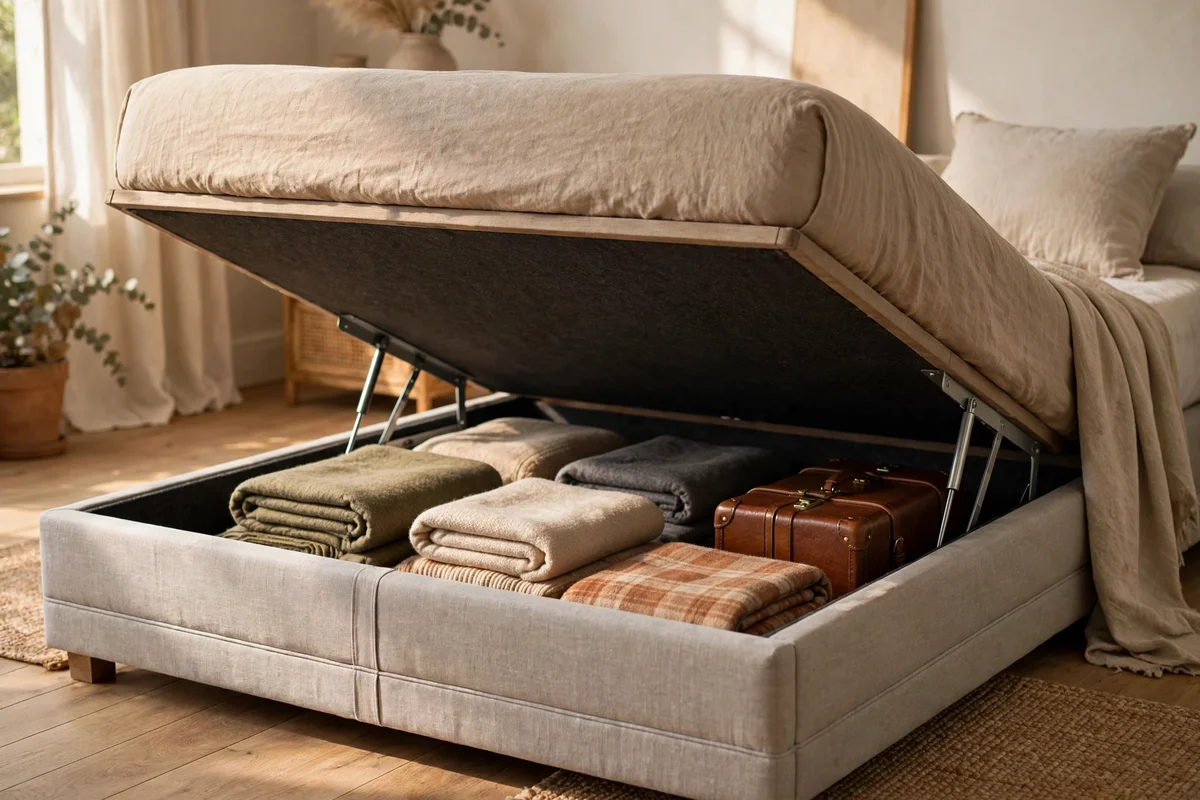
An ottoman bed base lifts the entire mattress on gas struts, revealing a storage well the size of the whole bed: a double holds four folded duvets or two to three suitcases with room to spare. Check the strut rating before buying, since a heavy memory foam mattress plus bedding can exceed cheap mechanisms. The lift should rise with one hand and stay open on its own; if it drifts down, the struts are undersized and the lid becomes a safety hazard.
Keep heavy items low and centred so the base stays balanced, and never let children play with the lifting mechanism. Air the contents twice a year and add lavender sachets, since this huge sealed space can trap stale air. The mistake to avoid is overloading past the rated weight: a base rated for 40 kg that carries 60 will wear its struts out in months. Ottoman bases cost 250 to 600, roughly double a basic divan, but they replace a wardrobe.
13. Hang a Mirror Fronted Cabinet Over the Basin for Everyday Toiletries
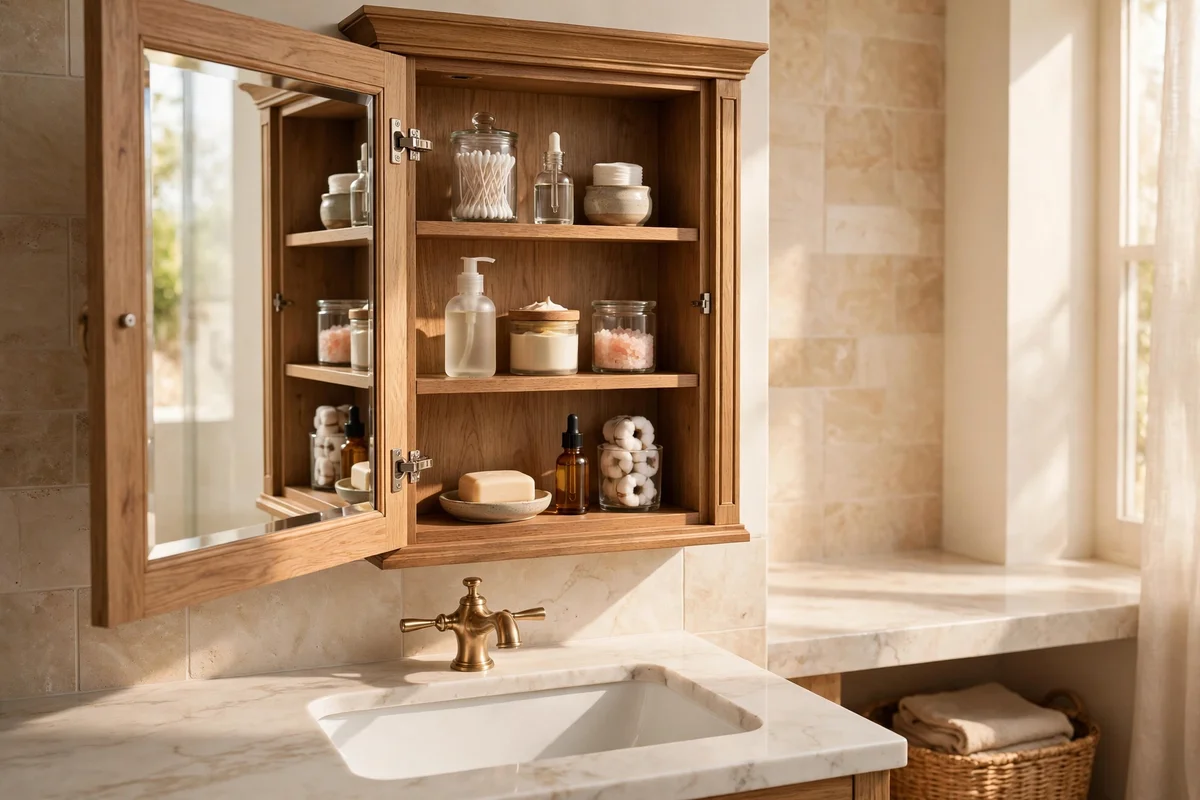
A mirror-fronted cabinet 50 to 70 cm wide and 12 to 15 cm deep doubles your bathroom storage while bouncing light around a small room. Two adjustable shelves hold daily toiletries in rows: cleansers and creams at eye level, spare toothpaste and cotton pads below. Mount it 15 to 20 cm above the basin splash zone so water rarely reaches the frame. Always fix into studs or proper wall anchors, since a loaded cabinet can weigh 10 kg or more.
Choose a cabinet with a soft-close door and a shaver socket inside if your wiring allows, which clears the last cables from the basin edge. Wipe the mirror with a dry microfibre cloth weekly to stop toothpaste spots building up at the edges. The mistake to avoid is sealing the cabinet back directly against a damp wall: leave a 5 mm air gap or use moisture-resistant backing, or the shelves swell within a year. Decent cabinets cost 60 to 140.
14. Recess a Shallow Cabinet Into the Wall Beside the Bath for Clean Towels
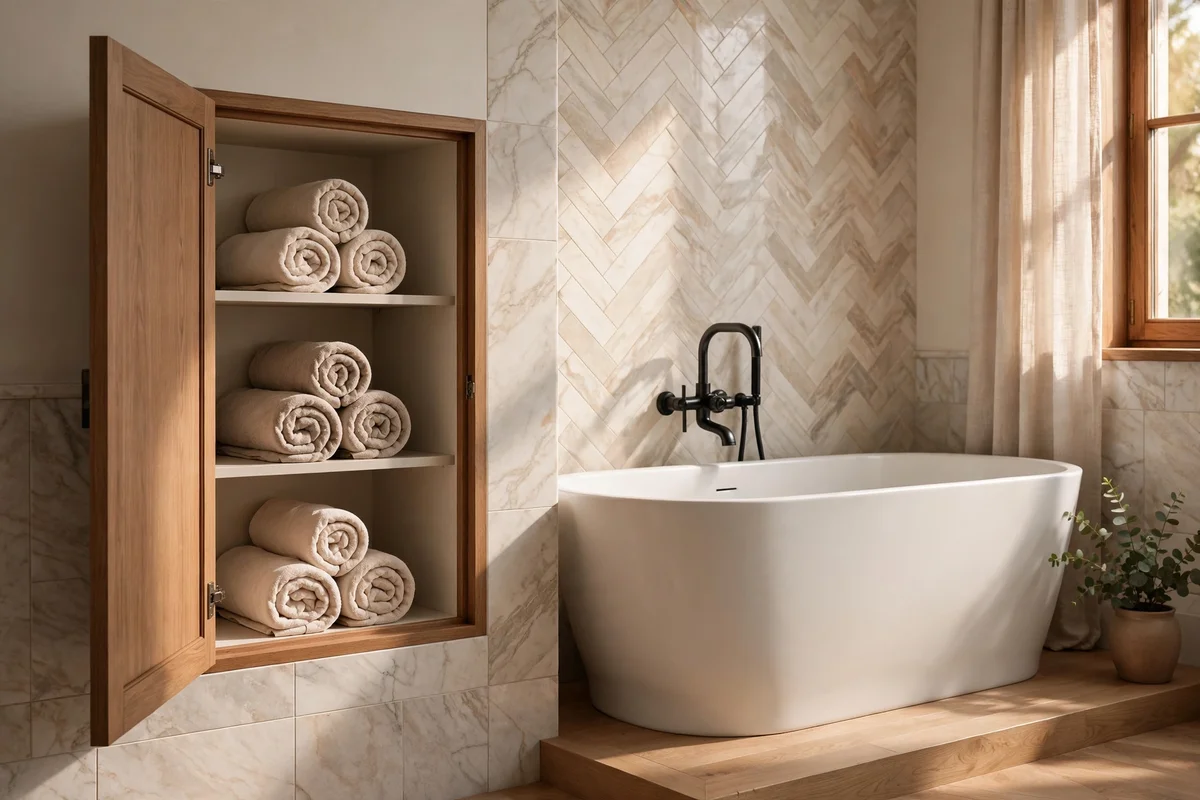
A shallow cabinet recessed 10 cm into the wall beside the bath holds four to six folded towels in a space that used to be plain tile. Recessing works only in stud walls or false panels, so check the wall build-up before cutting, and never cut into a wall carrying pipes or wiring without a professional. Add two ventilation slots top and bottom so warm air circulates, and store only fully dry towels here; this is display storage, not a drying rack.
Finish the recess with moisture-resistant board and tile the reveals to match the bathroom, so the cabinet looks original to the room. Roll towels instead of folding them to fit one extra per shelf and keep the front face neat. The mistake to avoid is storing damp towels in a closed recess: without airflow they smell within days, so anything wet goes on a heated rail first. A simple recessed cabinet costs 80 to 180 fitted, mostly labour.
15. Lift the Window Seat Lid to Reveal a Deep Box for Toys and Cushions
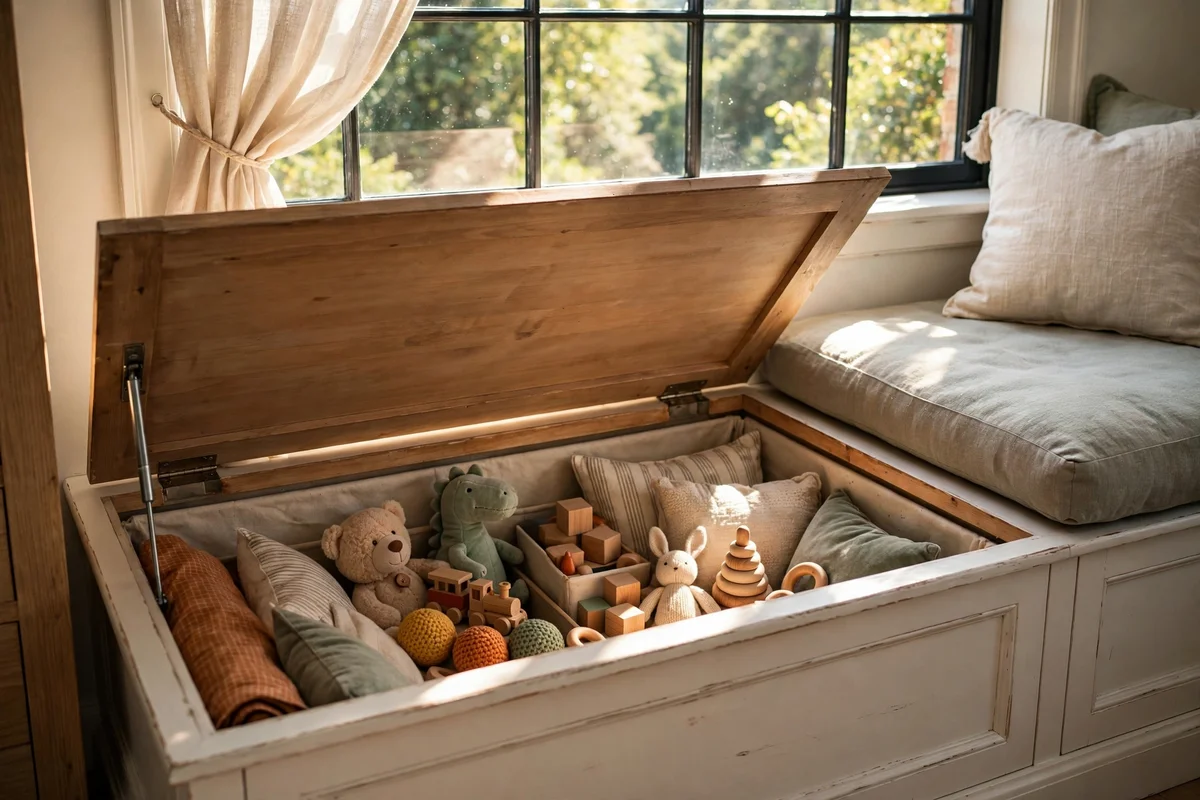
A window seat 120 to 150 cm long with a 40 to 50 cm deep box swallows a toy collection, spare cushions and a folded picnic blanket in one lift of the lid. Fit a full-length piano hinge with two soft-close stays so the heavy lid cannot slam on fingers, and add a finger pull routed into the front edge rather than a handle that catches clothing. Measure the window reveal first so the seat sits level, packing any uneven floor beneath the base frame.
Top it with an 8 to 10 cm foam cushion in outdoor-grade fabric if the window gets condensation, and the seat becomes the favourite reading spot in the house. Sort the inside with two open crates so toys stay grouped and the lid closes without a fight. The mistake to avoid is a lid with no stays: a plain hinged board this size weighs several kilos and will slam. A carpenter builds this seat for 300 to 600, or a sturdy kit costs half.
16. Fit Front Cubby Doors Under the Window Seat for Craft Supplies
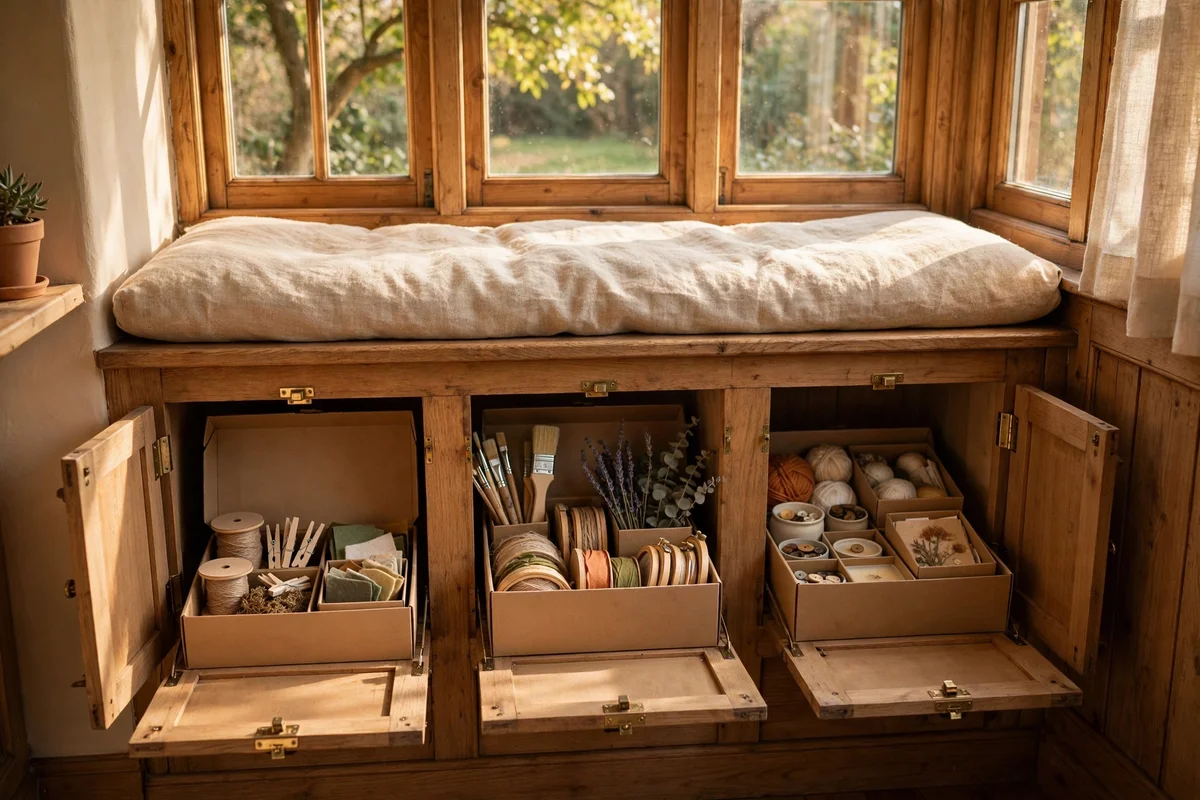
While the lifting lid suits deep, rarely touched storage, hinged cubby doors across the front of the window seat serve the things you reach for daily. Fit two or three 40 cm doors with magnetic catches, and slide labelled boxes of craft supplies, drawing pads and board games onto the 35 cm deep shelf behind them. Keep the heaviest boxes at the ends near the seat legs, where the frame carries the most weight without sagging.
Label each box on its short end in large clear letters so children can find and return things themselves, which keeps the system working without you. A wipeable paint finish inside the cubbies survives glue sticks and paint water far better than raw timber. The mistake to avoid is mixing daily items into the deep lid box above: if craft supplies live in two places, neither stays tidy. Keep daily behind the doors, seasonal under the lid, and the rule holds.
17. Stack Hollow Decorative Boxes on the Bookshelf for Cables and Chargers
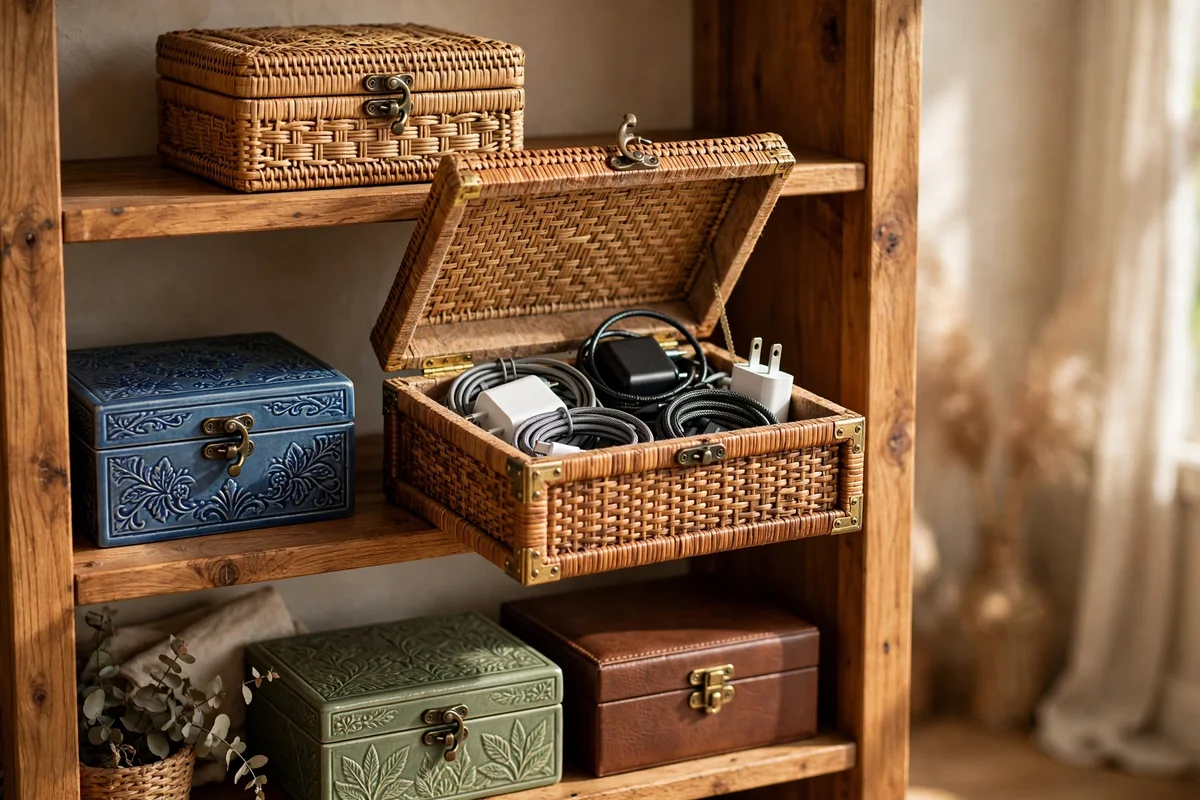
Hollow decorative boxes 20 to 30 cm wide, stacked two or three high on a bookshelf, hide the modern clutter of cables, chargers and remote controls behind vintage-looking faces. Choose boxes with lids that lift off fully rather than hinged ones, so you can grab a charger one-handed. Coil each cable with a simple tie and keep one box per shelf bay, or the boxes themselves become the mess. Match the box finish to your shelf wood for a calm, deliberate look.
Stick a small label inside each lid listing its contents, which saves the open-and-peek routine every time you need the camera charger. A set of three nesting boxes usually costs 25 to 50, and charity shops are full of sturdy ones. The mistake to avoid is charging devices inside a closed box: batteries and chargers generate heat, so plug in on an open shelf and store only unplugged cables inside. Also keep paper manuals out of boxes near any warm adapter.
18. Line the Hallway Shelf With Lidded Baskets for Gloves, Keys and Sunglasses
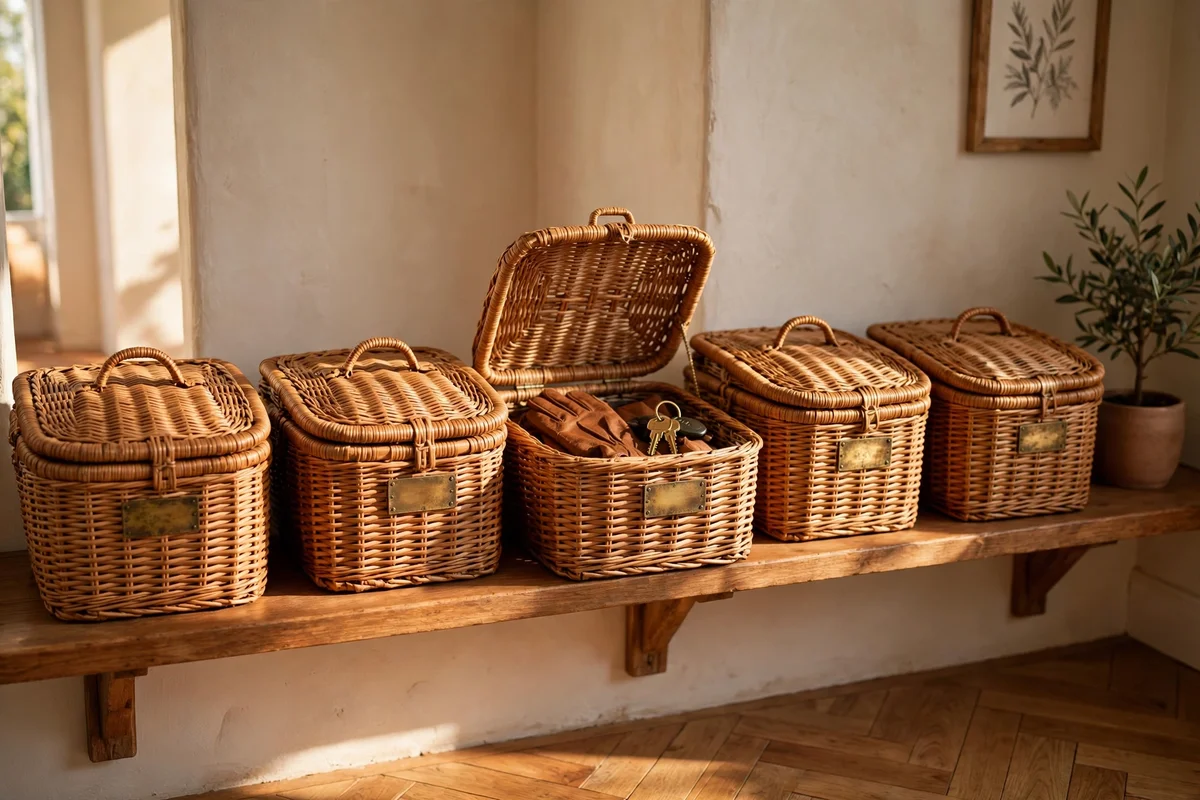
A hallway shelf lined with lidded baskets 25 to 35 cm wide gives every household member one private drop zone for gloves, keys and sunglasses. Place a small ceramic dish inside the first basket as the designated key spot, so the morning search ends for good. Natural woven baskets breathe, which matters for gloves that come in damp from winter walks. Space the baskets with a 2 cm gap so each lifts out without scraping its neighbour.
Label the basket fronts with small brass tags or chalk labels, especially in a busy family hallway where zones blur fast. Wipeable lined baskets suit the glove basket, since damp wool leaves marks on bare weave. The mistake to avoid is sealing wet gloves inside a lidded basket: let them dry on a radiator or hook first, or the whole row smells of damp wool by February. Three good baskets usually cost 30 to 60 and transform the busiest shelf in the house.
19. Display a Lidded Hamper in the Bedroom Corner for Laundry in Disguise
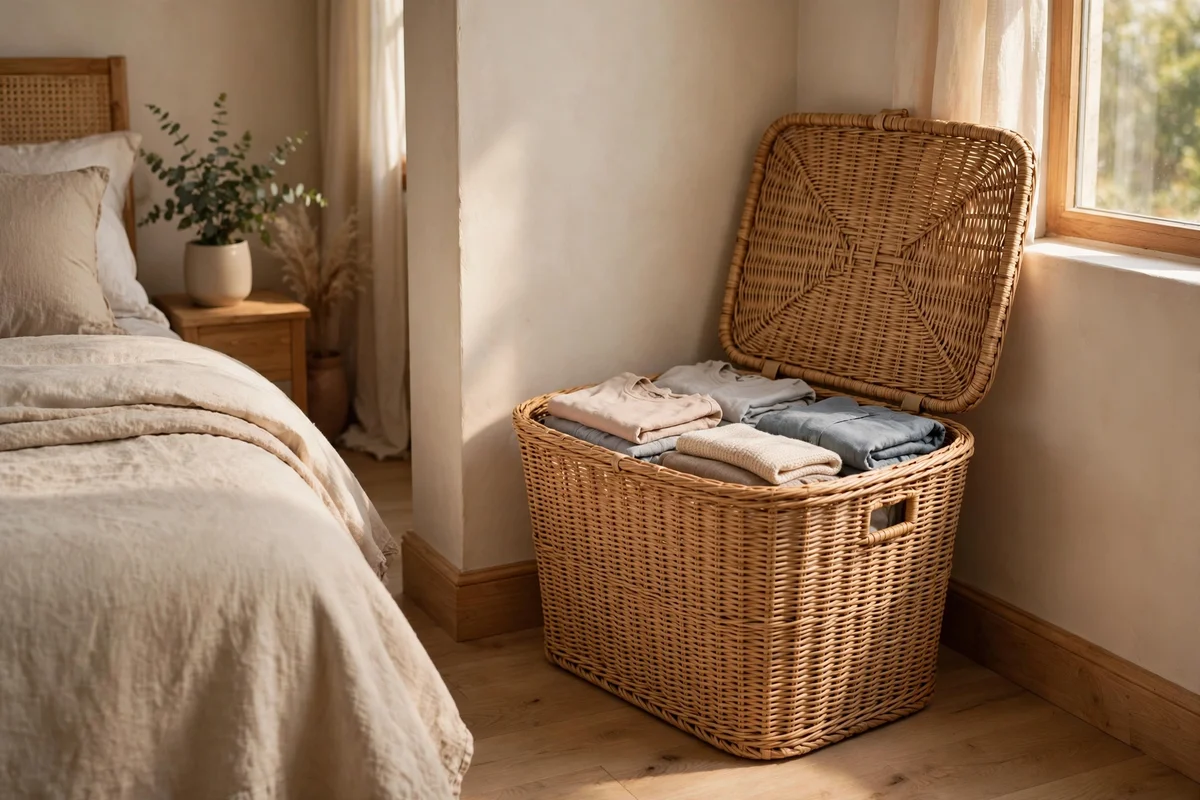
A lidded hamper 40 to 50 cm wide in the bedroom corner holds a full week of laundry for two people while looking like a piece of furniture. Choose one with ventilation holes or a woven body so air moves through the clothes, and use a washable cotton liner that lifts out for laundry day. Place it within two steps of the wardrobe so dirty clothes land inside it, not on the chair beside it, which is where most bedroom clutter begins.
Sort lights and darks with a simple divider inside, which saves a sorting session on laundry day. Empty the hamper at least weekly, and never leave wet towels balled up inside for days, since trapped damp breeds musty smells and mildew fast. The mistake to avoid is a hamper with no airflow: solid plastic bins with tight lids are the worst offenders. A good ventilated hamper costs 35 to 70, and the washable liner is worth every penny.
20. Fold a Wall Desk Down Into a Slim Cabinet When the Workday Ends
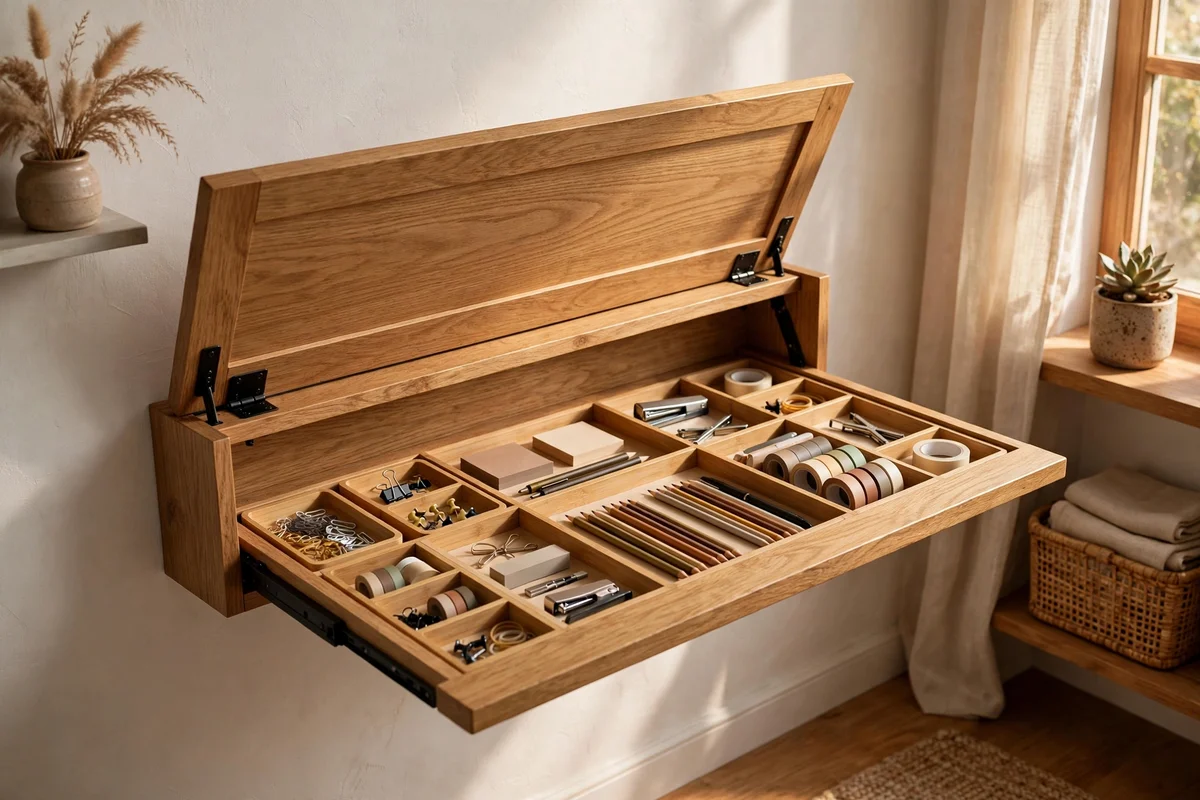
A wall-mounted desk 100 to 120 cm wide folds down for work and closes into a cabinet just 15 to 20 cm deep when the day ends. Inside, shallow trays hold pens, notebooks and a laptop in labelled rows, so closing up takes under a minute. Fix the cabinet into wall studs with heavy-duty brackets, since a loaded desk can pull 30 kg away from the wall. Choose a fold-down leg or a sturdy chain stay rated for the desktop weight plus your elbows.
Paint the closed front to match the wall and hang one small frame above it, and visitors will never guess a workspace hides there. Route one cable channel down to a floor socket so the laptop charges without trailing leads across the room. The mistake to avoid is overloading the inner shelves: if stacked books stop the desk closing flat, the hinges strain and the front warps within months. A good fold-down desk cabinet costs 150 to 350.
21. Hide a Sewing Station Inside a Fold Down Cabinet in the Spare Room
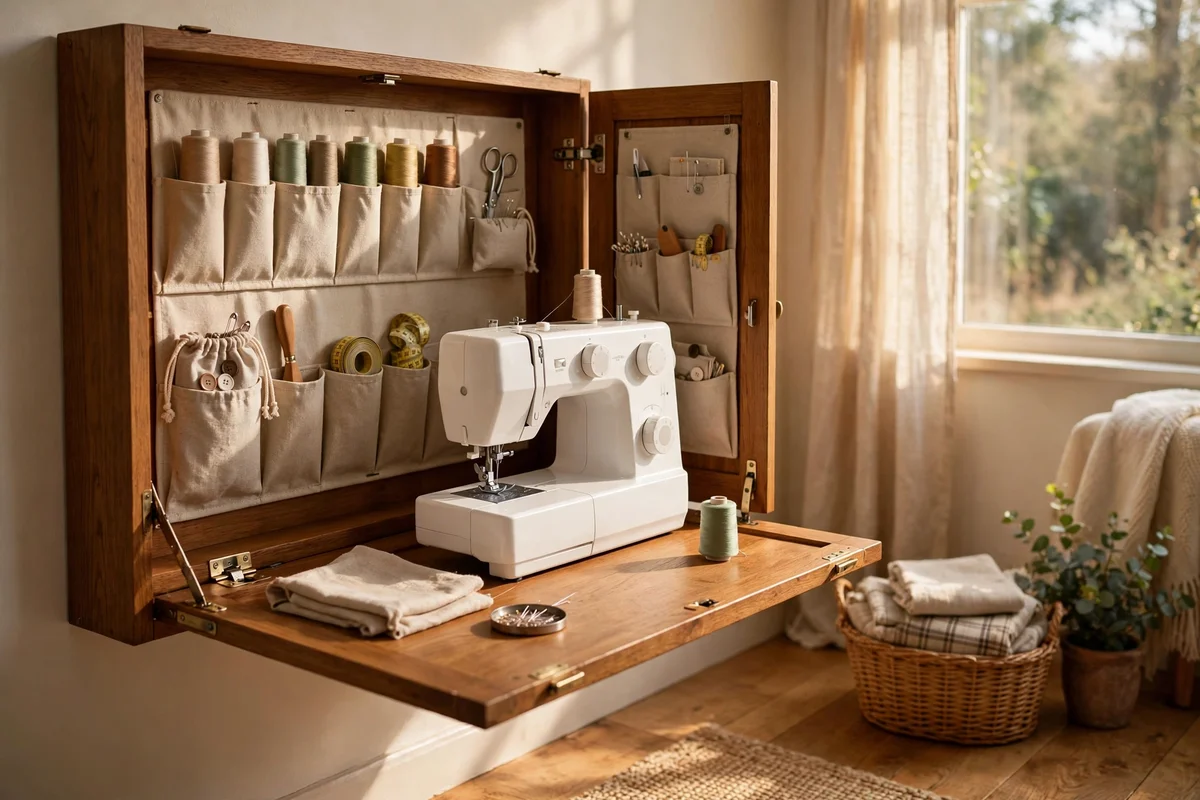
A sewing machine lives happily inside a fold-down cabinet 80 to 100 cm wide, with the machine on a hinged shelf that swings level for stitching and tucks away after. Door pockets hold scissors, bobbins and thread in clear rows, while a shallow top tray takes the iron and patterns. The closed cabinet stands only 25 to 30 cm deep, so it fits a spare room wall without stealing floor space. Anchor it to studs, since a machine plus supplies weighs over 15 kg.
Add a small LED strip inside the cabinet door so you can see thread colours clearly, and keep a magnetic pin dish fixed to the shelf so pins never scatter. Store fabric in the same room but outside the cabinet unless the room stays dry, since fabric absorbs damp in closed spaces. The mistake to avoid is forcing the shelf level with a heavy machine: check the hinge rating first, and the stitching stays smooth. Cabinets cost 120 to 280.
22. Give Stored Linens Air With Ventilation Slots and Breathable Boxes
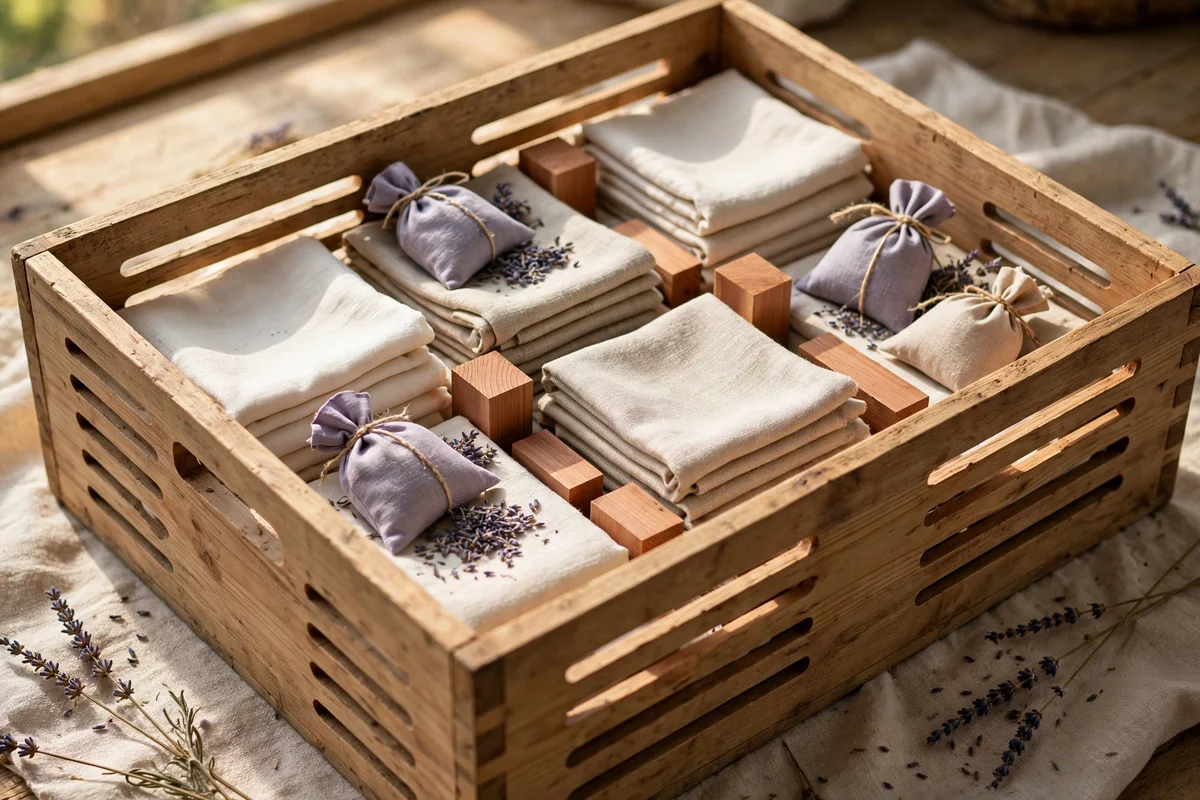
Linens stored long term need moving air, so choose boxes with ventilation slots or a breathable woven body over sealed plastic tubs. Drill three 2 cm holes along the back panel of any solid wooden box, fill it only to eighty percent, and tuck in cedar blocks or dried lavender sachets between the folds. Air the contents in daylight twice a year, refolding as you go, which also reminds you what you actually own. Dryness matters more than darkness for keeping fibres fresh.
Never pack anything even slightly damp: one wet pillowcase can sour a whole box of sheets within weeks, so everything goes in bone dry. Keep storage boxes off cold floors on small feet or a low shelf, since floors wick moisture upward in winter. The mistake to avoid is vacuum-sealing everyday bedding and forgetting it: compressed fibres need a full day to recover their loft. Ventilated boxes cost 20 to 40 each, and the cedar blocks last for years.
23. Keep Daily Items, Papers and Damp Goods Out of Hidden Compartments
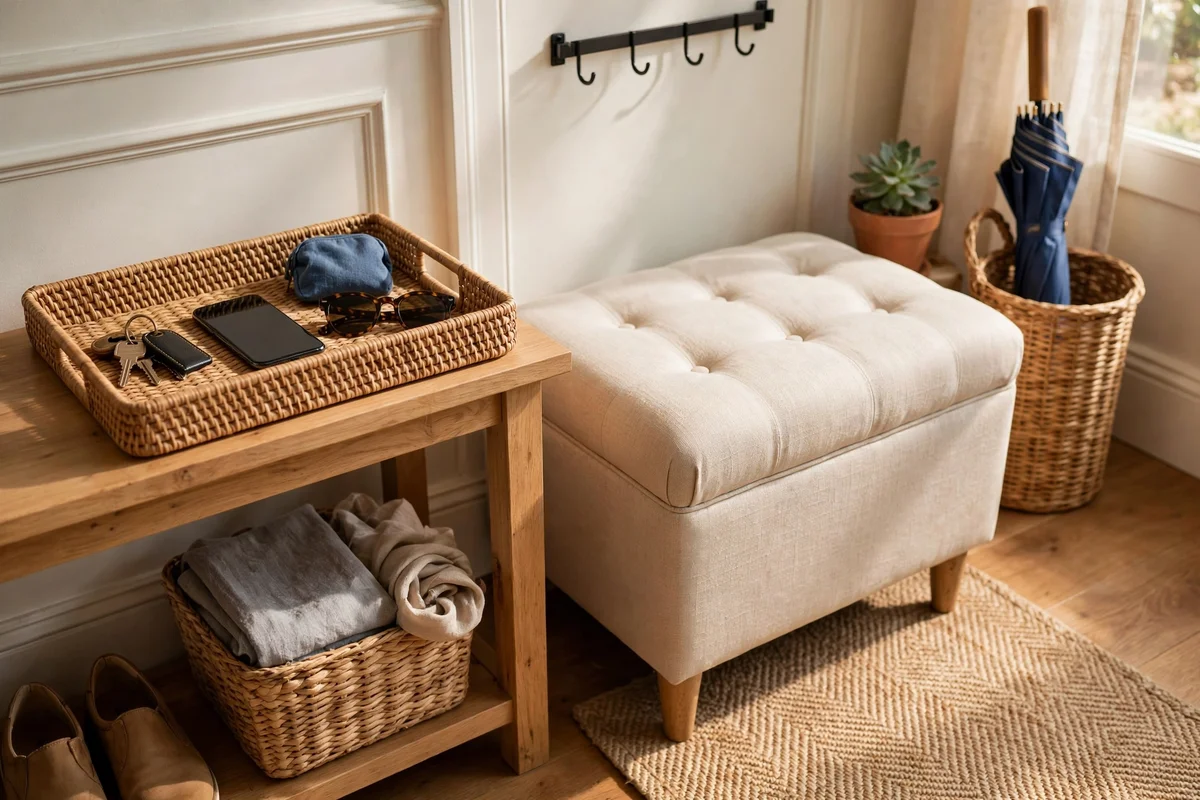
Hidden compartments work best for the seasonal and the occasional, never for the everyday. Keep daily items like keys, phones and chargers in open trays by the door, where one glance finds them. Papers that need air and quick access, such as passports and property deeds, belong in a proper file box on a shelf, not sealed inside furniture. Anything damp, from gym kits to wet umbrellas, must dry fully before it goes near a closed lid.
Never hide cleaning chemicals inside food storage drawers, and never block vents, meters or fuse boxes behind fixed panels; access must stay instant for safety checks. Follow the one-touch rule: if you reach for something more than twice a day, it earns an open home, not a hidden one. The mistake to avoid is hiding the very things that keep a home running smoothly, then wasting mornings hunting for them. Reserve the secret spots for what you touch monthly, not hourly.
The thread running through all twenty-three ideas is simple: let the room stay beautiful and let the furniture do the hiding. You do not need a bigger home or a full renovation, just one hollow ottoman, one deep drawer, or one lidded basket working quietly in each corner. Pick the spots where clutter lands first, usually the entry, the sofa, and the bedroom, and give each a home that closes. Calm rooms are built one closed lid at a time.
This week, start with the easiest win: slide two lidded baskets onto the hallway shelf and give every set of keys, gloves, and sunglasses a labelled home inside them. It costs less than a takeaway dinner, takes twenty minutes, and you will feel the entryway calm down the same evening. Once that habit holds, move on to the bigger builds like stair drawers or a window seat box. Small homes reward small starts, so let this one prove the whole idea.
Frequently Asked Questions
How much should I budget for hidden storage in a small home?
Most rooms can be sorted for 60 to 200 in total. Lidded baskets and under-bed boxes cost 15 to 40 each, while a good storage ottoman runs 80 to 150. Built-ins like stair drawers or toe-kick drawers cost more, usually 150 to 400 fitted, so save those for later. Start with the cheap wins, live with them for a month, then invest only where clutter still escapes. Buying everything at once is the classic overspend.
Are storage ottomans and lidded benches safe around small children?
Yes, if you choose child-safe hardware. Look for soft-close hinges or lid stays that hold the lid open and cannot slam, plus ventilation holes in any bench a child could climb into. Keep lids light enough for small hands to lift, and never store heavy items on top of a lid a toddler might pull down. A quick monthly check of the hinges keeps everything working as it should.
Can I add drawers to my existing stairs, or is that a big renovation?
Retrofitting tread drawers is a moderate carpentry job, not a full renovation. A joiner cuts drawer boxes into the risers of straight, solid-tread stairs, usually completing three to five drawers in a day or two. It suits homeowners rather than renters, since it alters the staircase permanently. Always have a professional check the structure first: winding stairs and floating treads rarely take drawers safely, and the cost reflects the skilled labour.
How do I keep clothes and linens fresh inside closed storage?
Give stored fabrics air and dryness. Choose boxes with ventilation slots or a breathable weave, fill them only to about eighty percent, and add cedar blocks or dried lavender sachets. Never pack anything even slightly damp, and air the contents in sunlight twice a year. Skip airtight plastic for long-term linen storage, since trapped moisture is what turns folded sheets musty within a few months.
What should never go into hidden storage compartments?
Keep out anything you use daily, like keys, phones, and chargers, since hunting for them wastes the time storage should save. Documents that need air and quick access, such as passports and deeds, belong in a proper file box. Never hide damp items, cleaning chemicals, or anything blocking vents, meters, and fuse boxes. Hidden storage works best for the seasonal and the occasional, not the everyday.