Home Improvement
23 Mudroom Ideas That Bring Order to Everyday Chaos
By Anna Wells · · 19 min read
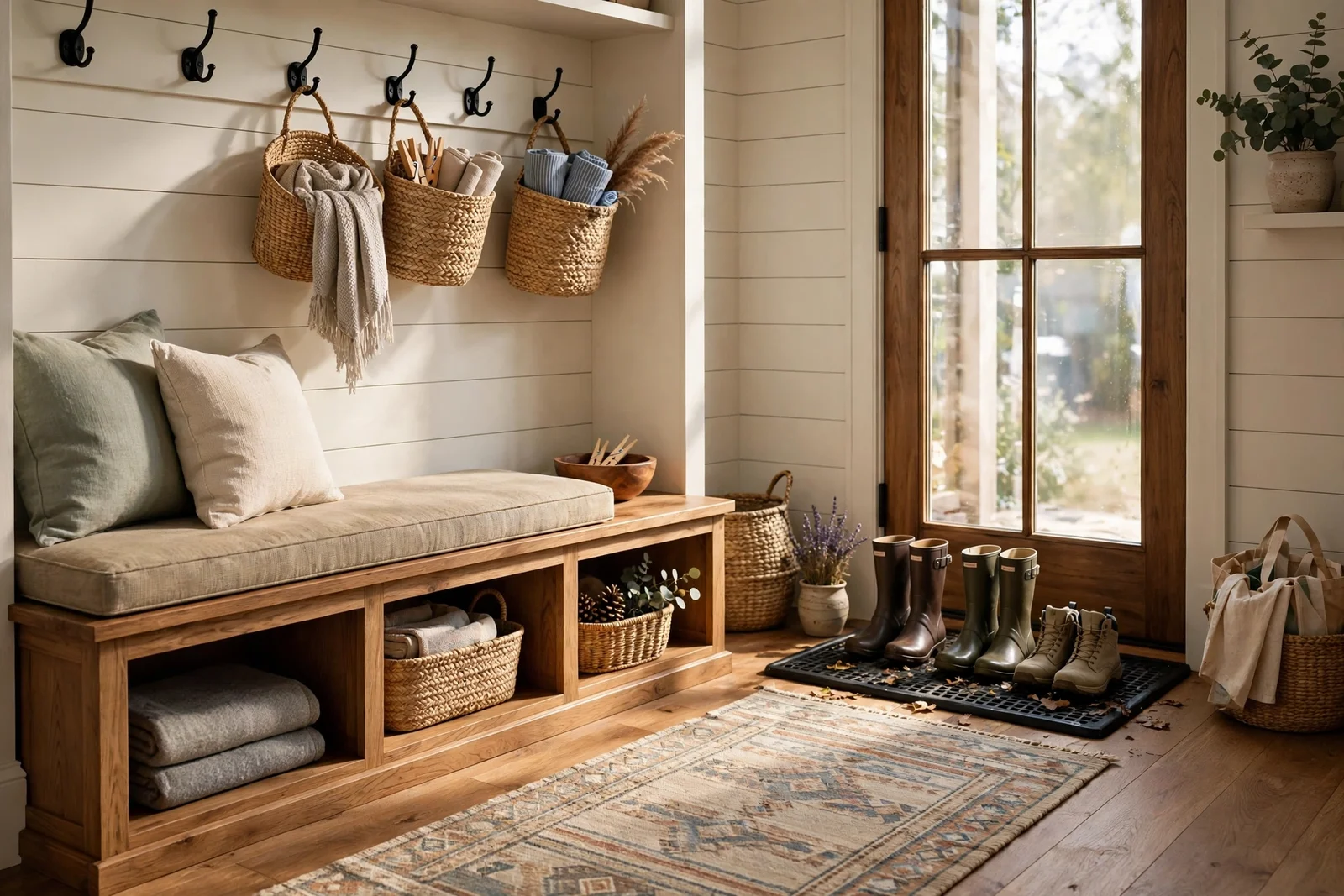
A calm mudroom is not a luxury, it is a working system of trays, hooks and honest flooring. These 23 practical ideas show how one hook and one basket per person, a proper drip zone and seasonal rotation turn the busiest doorway in the house into a place of quiet, lasting order.
Picture the back door on a rainy school morning: boots shedding mud, bags sliding off shoulders, someone hunting for keys while the dog shakes itself dry. Every family knows this doorway, and every family can tame it. The mudroom is the hardest working few square metres in the house, and small, deliberate choices there pay off every single day.
These 23 ideas treat the mudroom as a system rather than a storage cupboard. One hook and one basket per person stops belongings migrating around the house. A boot tray and a proper drip zone contain wet weather at the threshold. Washable runners, honest flooring and a bench with storage inside keep the space comfortable and easy to clean.
Nothing here demands a full renovation or a designer budget. Most ideas cost under 60 pounds, need only basic tools, and can be fitted in a weekend afternoon. Work through them in order, start with the drip zone and the hooks, and by next week the busiest doorway in your home will run itself.
1. Set a Galvanised Boot Tray by the Door as the First Drip Zone
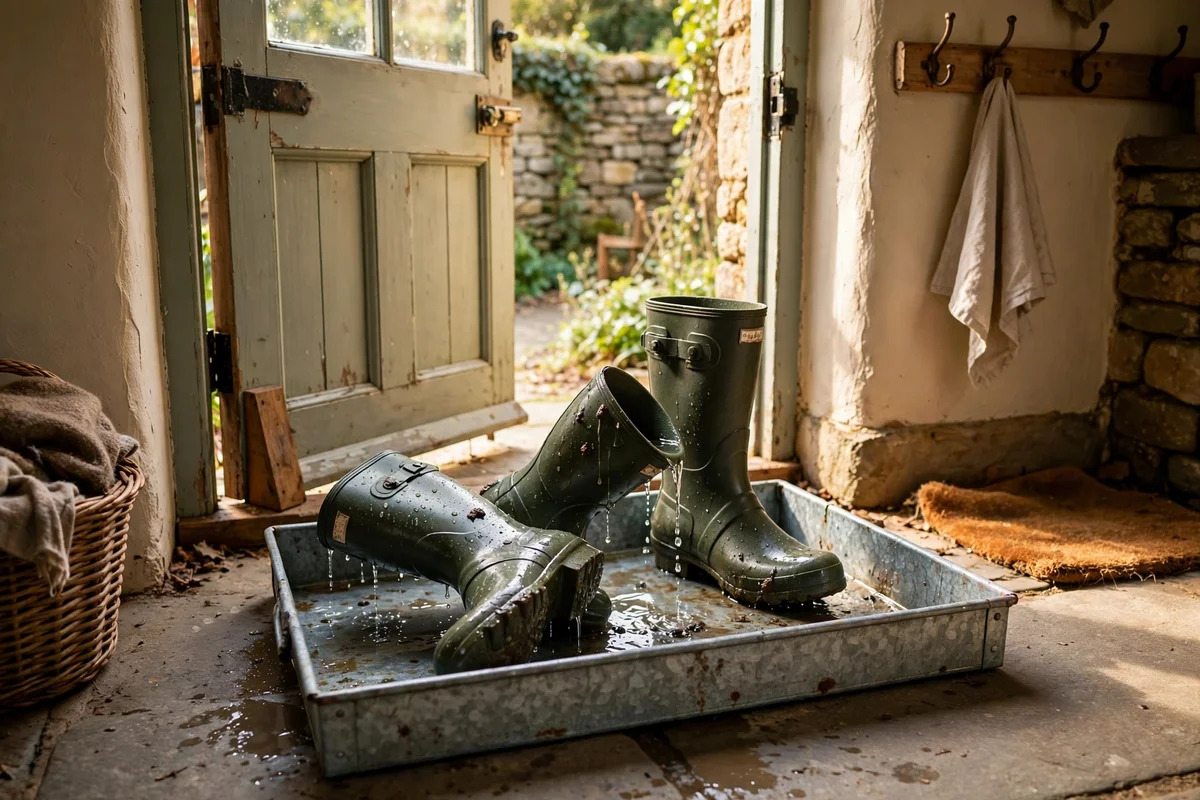
Start every mudroom with a galvanised steel boot tray placed immediately inside the door, where wet shoes land without thinking. A tray measuring 90 by 45 cm holds three to four adult pairs, and a rim of 4 to 5 cm keeps meltwater and muddy drips contained until you can wipe it out. Galvanised metal resists rust far better than plain painted trays, so the piece keeps its looks for years. Two trays side by side comfortably serve a family of four.
Empty and rinse the tray every two to three days in winter, or standing water leaves mineral marks on the finish. The common mistake is buying a tray with no lip, which lets dirty water creep onto the floor beneath it and defeat the whole purpose. Budget trays cost 12 to 20 pounds, while deeper powder-coated steel versions run 35 to 55. A quick towel wipe each evening keeps the whole zone looking cared for.
2. Give Every Family Member One Hook and One Basket
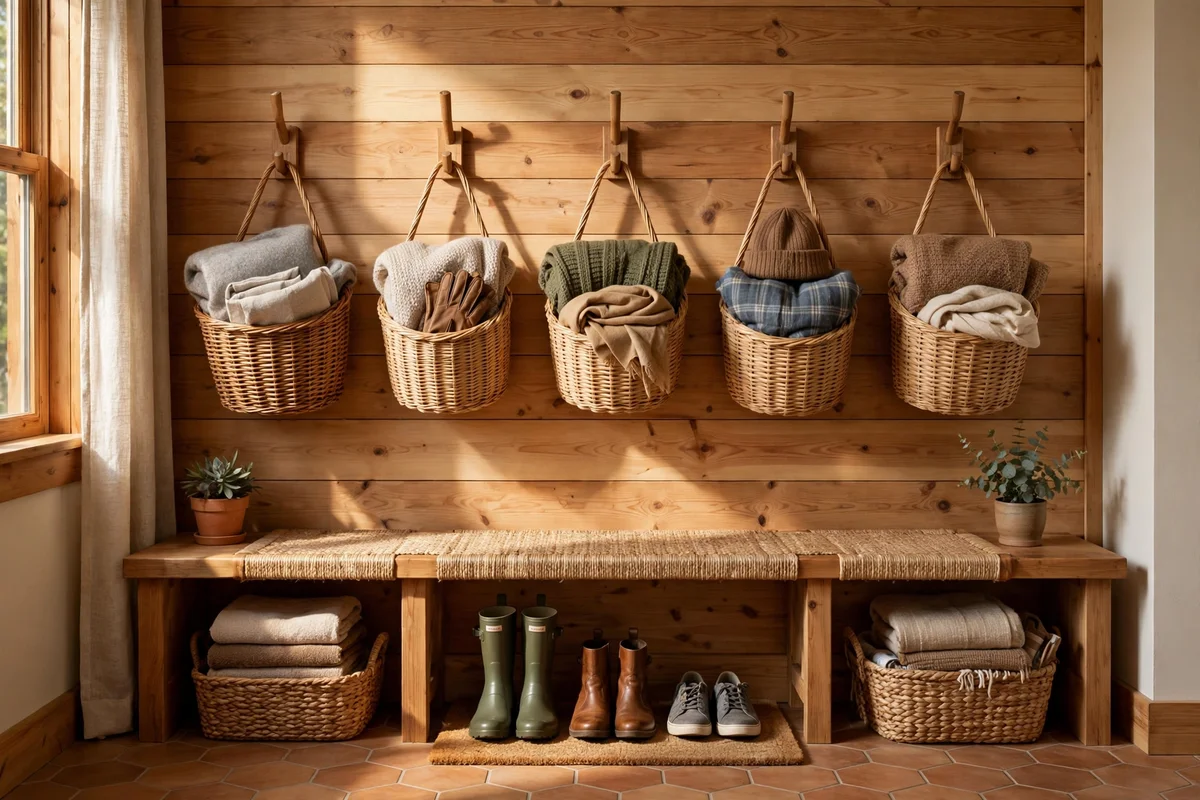
Assign each person exactly one sturdy wall hook and one basket, and the migration of coats and clutter stops almost overnight. Hooks mounted 150 cm high suit adults, while a second row at 90 cm works for children who cannot reach the top row. Choose hooks rated for at least 7 kg so winter coats and school bags stay secure. Baskets of 30 cm square sit on the shelf below, holding hats, gloves and sunglasses for one person only.
The mistake to avoid is adding spare hooks for overflow, because extras invite clutter back in. When a basket fills, it signals time for a clear-out rather than another container. Budget rows of five powder-coated hooks cost 15 to 30 pounds, and matching seagrass baskets run 8 to 14 each. A small engraved tag on each basket helps guests and children respect the system.
3. Fit a Lift-Up Storage Bench Beside the Back Door
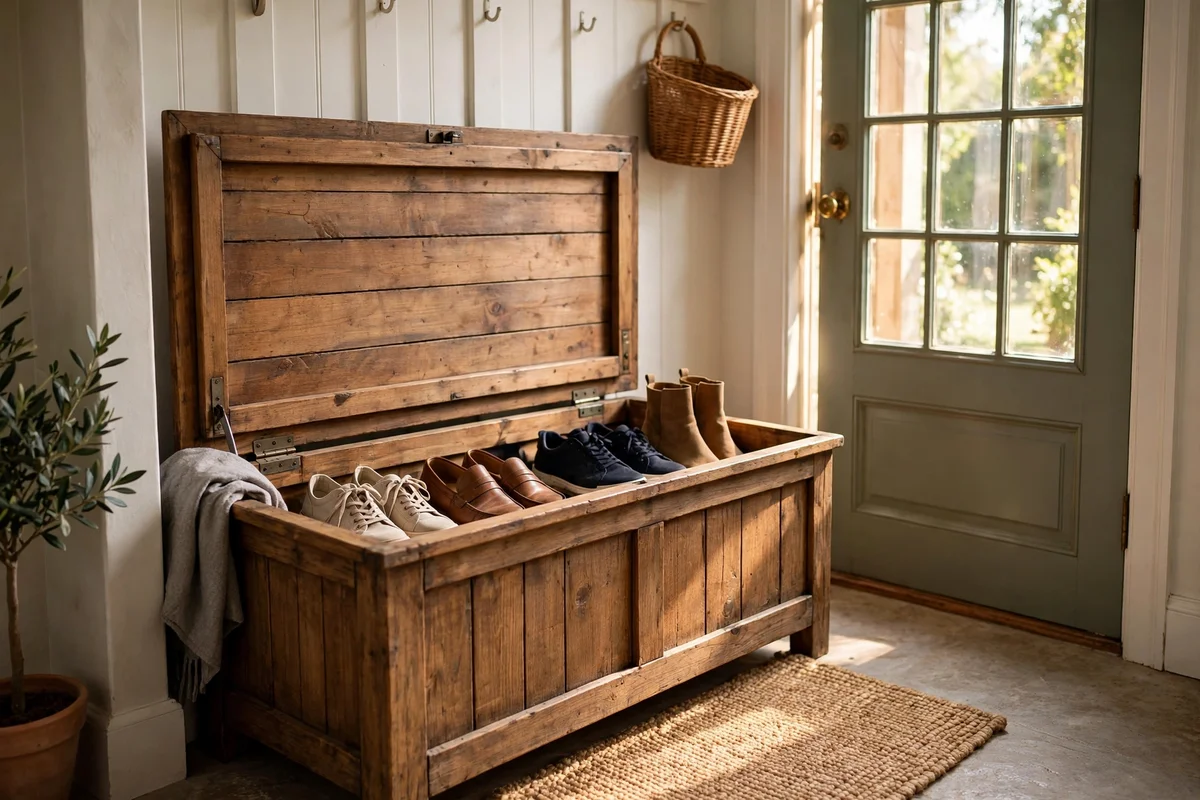
A storage bench of 120 to 150 cm long beside the back door gives the family somewhere to sit and a hidden home for shoes. Choose a bench seat height of 45 cm, which suits both adults and school-age children, and a depth of 35 cm so it does not crowd the walkway. Lift-up lids beat drawers here, because you can drop in odd-shaped items like football boots and pet leads without folding them neatly.
Ventilate the box with two small holes or slatted ends so stored shoes do not trap damp smells. The common mistake is filling the bench to the top, which warps the lid over time; keep it two-thirds full. Solid pine benches cost 80 to 150 pounds, while painted hardwood versions run 180 to 320. Place a washable cushion on top for comfort.
4. Lay a Washable Runner Over the Muddy Path From Door to Hall
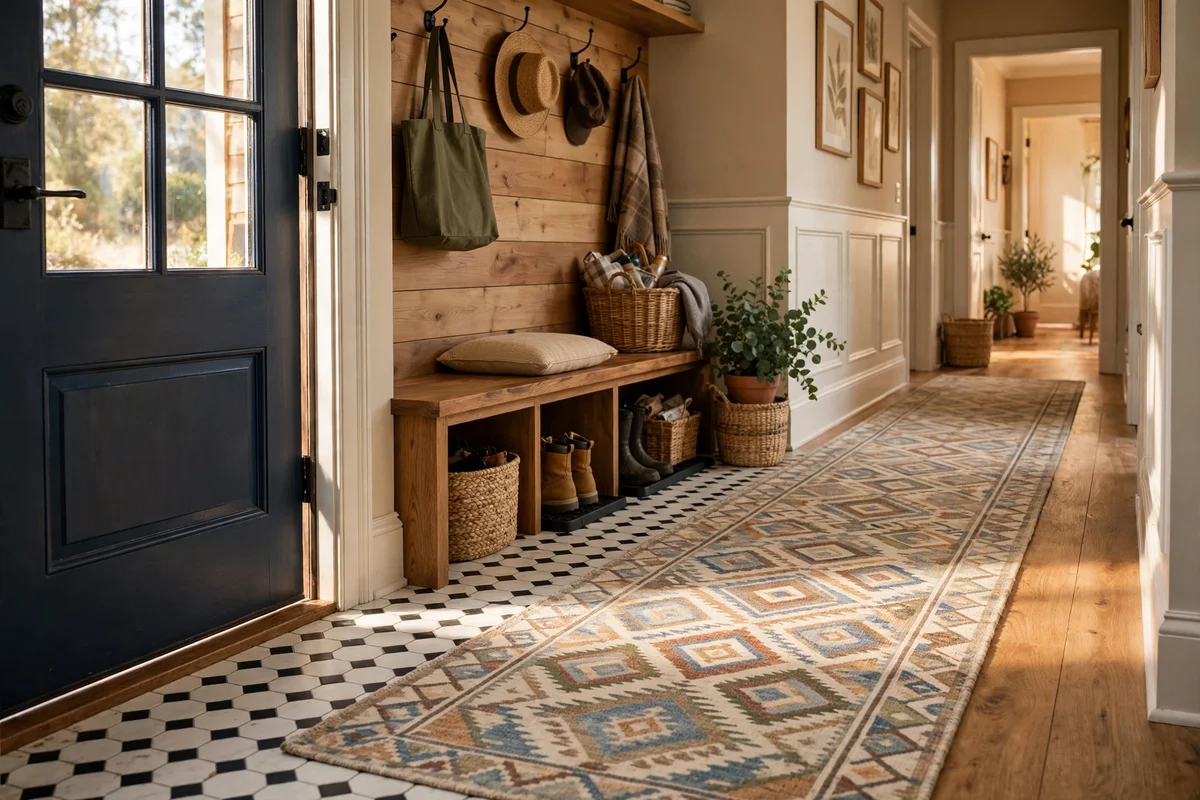
A machine-washable runner laid along the main traffic path protects floors and softens the walk between door and hallway. Choose a runner 200 to 300 cm long and 70 to 90 cm wide, with a low pile that doors can swing over without catching. Patterned designs in warm grey, terracotta or indigo hide real-life dirt far better than plain cream. A rubber or felt underlay of 5 mm stops slipping on hard floors.
Wash the runner every two to four weeks on a cool cycle, and keep a spare so the mudroom never stands bare. The mistake to avoid is choosing a thick shaggy rug, which traps grit and is heavy to clean. Budget washable runners cost 25 to 60 pounds, while larger patterned ones run 70 to 120. Shake the runner outside weekly between washes.
5. Mount a Small Ledge Shelf for Keys and Post Within Arm’s Reach
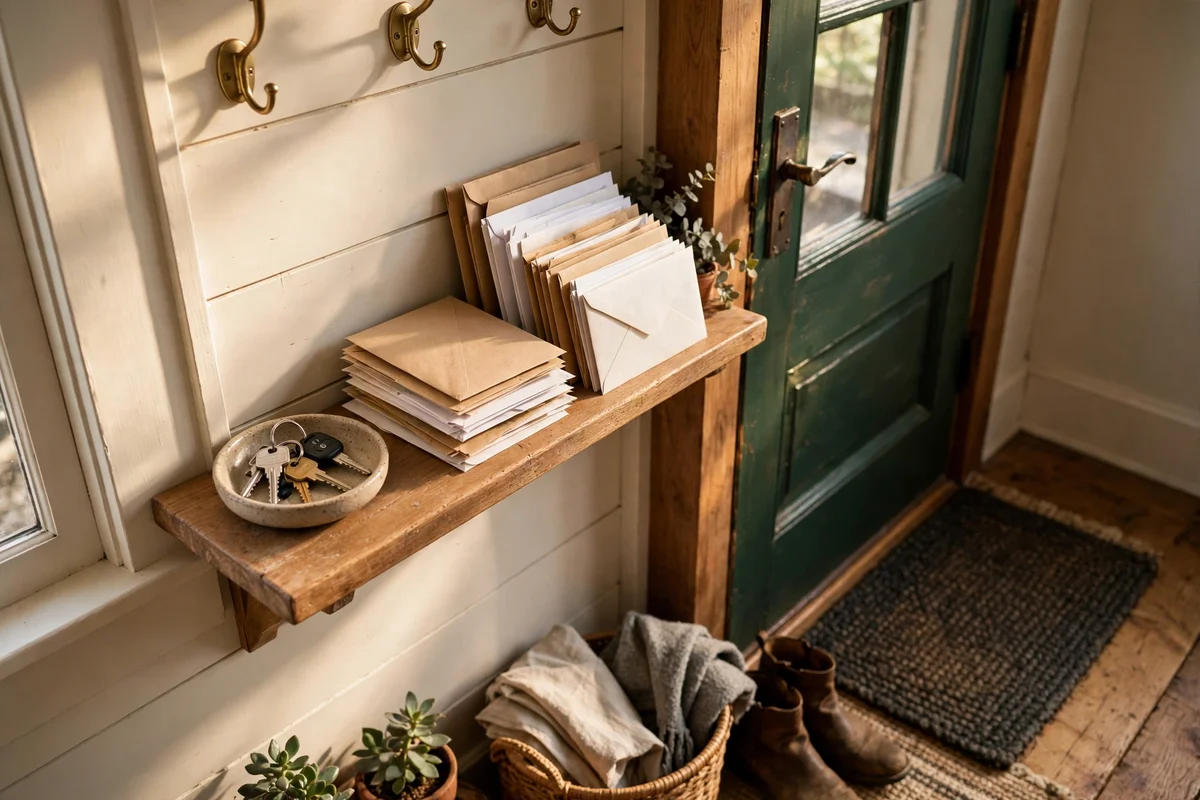
Fix a slim shelf of 60 by 15 cm on the wall within one step of the door for keys, post and sunglasses. Mount it at 120 to 130 cm high so adults can reach it without stretching and children can learn the habit early. A shallow tray or ceramic dish on the shelf stops keys sliding off, and two small hooks beneath hold the dog lead and a spare set. Keep the surface to three items so it never becomes a dumping ground.
The mistake to avoid is letting post pile up for a week, which buries keys and ruins the system. Sort post the same evening and file or recycle it at once. A solid oak ledge shelf costs 20 to 40 pounds, while a simple pine version runs under 15. A small wall-mounted letter rack above handles anything waiting for action.
6. Keep a Lidded Bin for Wet Umbrellas and Dripping Dog Leads
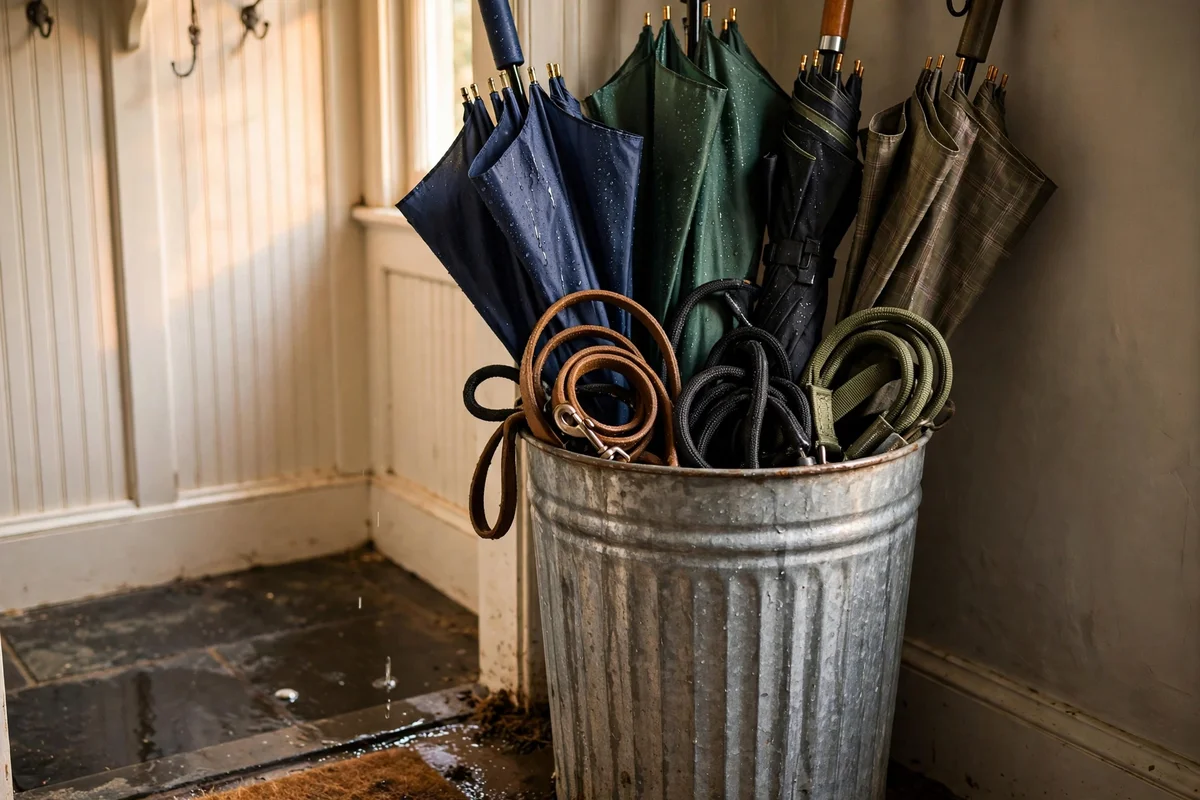
A tall lidded bin of 30 cm diameter stands ready for umbrellas, dripping leads and wet walking sticks. Place it in the corner nearest the door so wet items never travel across the room. Choose a metal or glazed ceramic bin with a removable inner liner, since fabric liners mildew quickly in constant damp. A weighted base stops it tipping when a heavy golf umbrella leans inside.
Empty pooled water from the base every couple of days to prevent sour smells. The common mistake is using an open basket, which lets drips spread across the floor and defeats the purpose. Galvanised bins cost 18 to 35 pounds, while glazed ceramic styles run 40 to 70. Wipe the inside monthly with a vinegar solution to keep it fresh.
7. Hang a Peg Rail at Child Height for Small Coats and School Bags
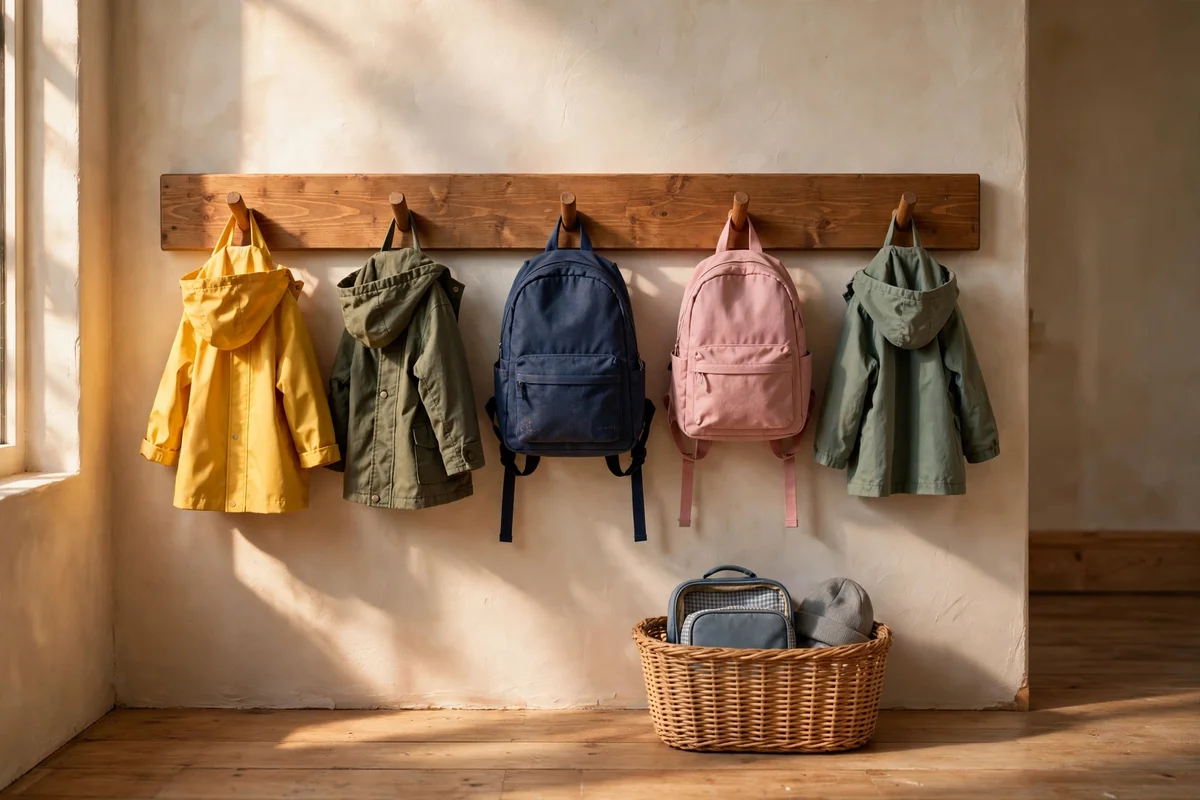
A wooden peg rail fixed at 90 to 100 cm lets small children hang their own coats and bags, building independence fast. Space the pegs 20 cm apart so puffy winter jackets do not crowd each other, and choose chunky pegs of 10 cm projection that hold book bags without slipping. A rail of 120 cm holds four to five sets of small-person kit comfortably. Solid beech or oak rails survive years of rough daily tugging.
Fix the rail into wall studs or use heavy-duty plaster anchors, since four laden school bags can weigh 12 kg or more. The mistake to avoid is mounting it at adult height, which forces children to drop things on the floor instead. Budget pine rails cost 15 to 30 pounds, while hardwood versions run 40 to 70. Add a small step stool nearby for the youngest children.
8. Store Seasonal Kit in Labelled Crates on the Top Shelf
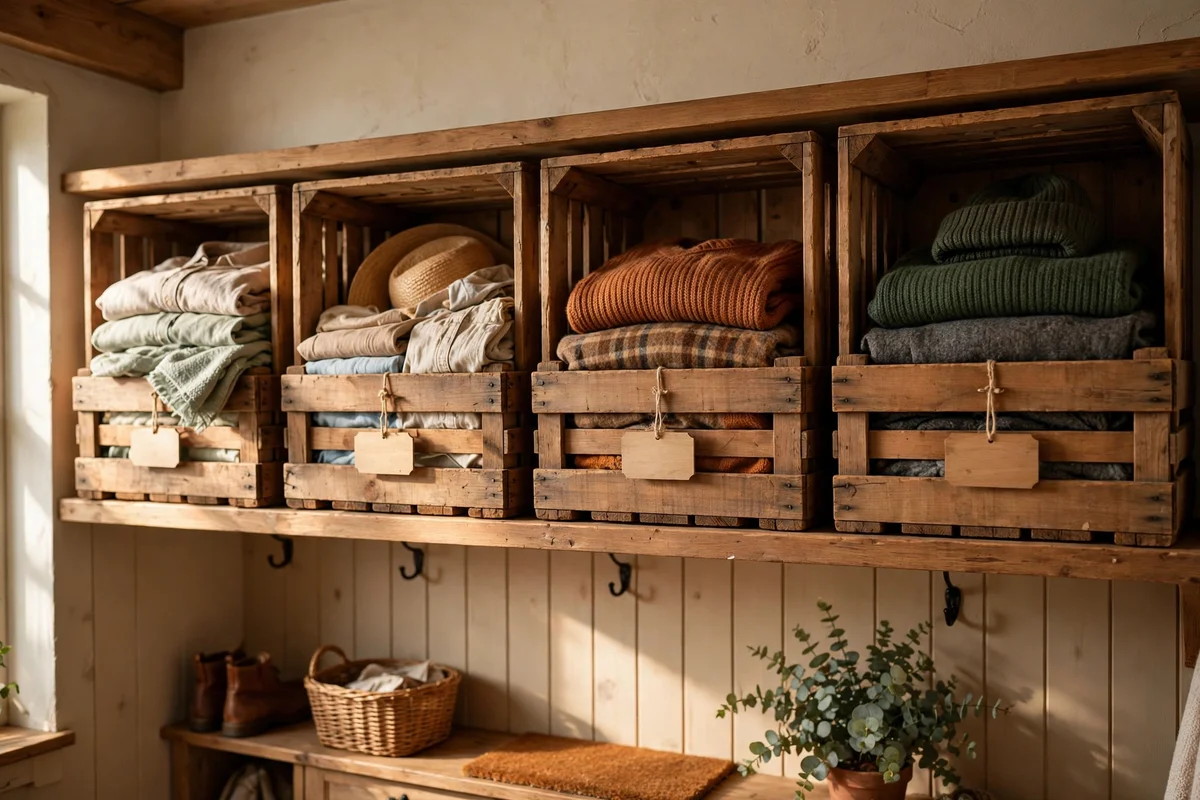
Reserve the top shelf for clearly labelled crates holding out-of-season kit, so winter scarves never crowd summer sandals. Use stackable crates of 40 by 30 cm, one per season per person, with simple paper labels slipped into metal holders. A shelf depth of 35 cm keeps the crates flush with the wall and easy to pull down. This rotation frees the daily hooks for whatever the current weather demands.
Swap the crates twice a year, at the start of autumn and the start of spring, and wash or air the contents before storing. The mistake to avoid is mixing seasons in one crate, which turns every search into a rummage. Sturdy plastic crates cost 6 to 12 pounds each, while lidded wooden ones run 20 to 35. Keep a small step stool nearby for safe reaching.
9. Add a Wall-Mounted Drying Rail for Damp Scarves and Gloves
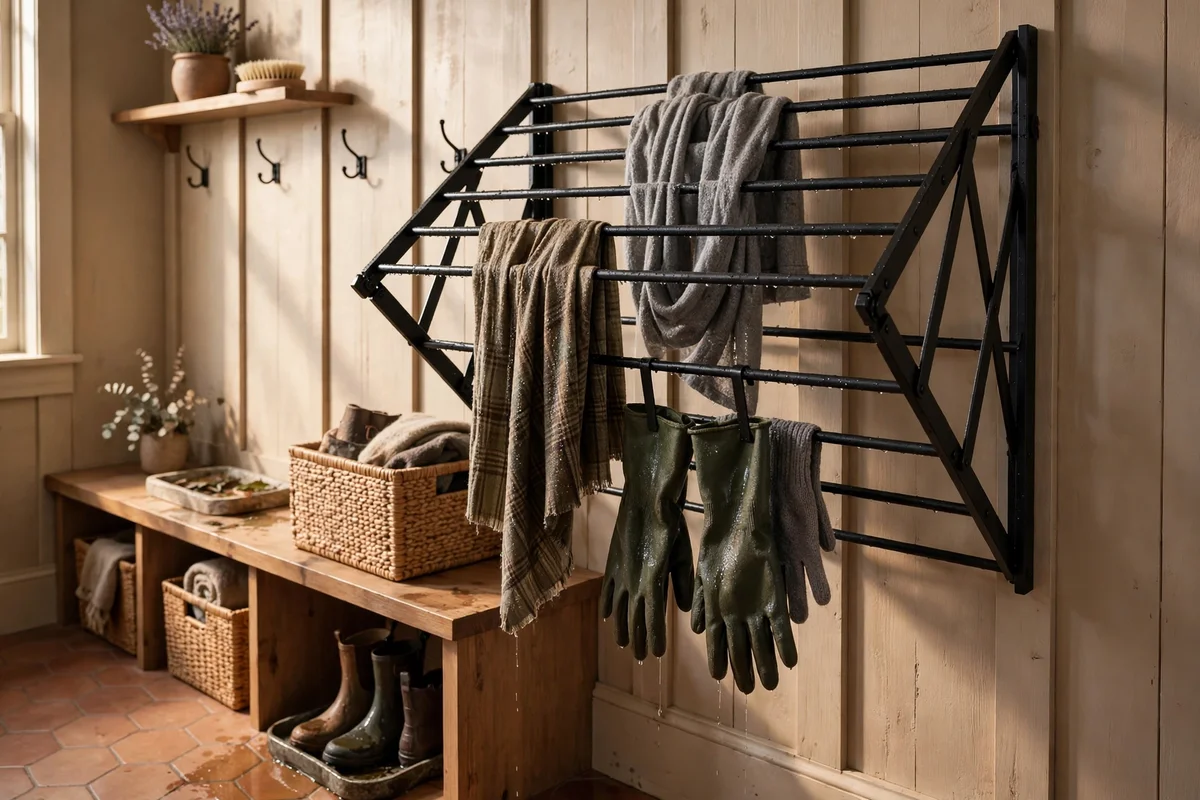
A wall-mounted drying rail gives damp scarves, gloves and hats somewhere to air instead of draping over radiators. Choose a folding rail of 60 to 80 cm that extends 25 cm from the wall, with 8 to 10 rungs spaced 8 cm apart for good airflow. Mount it away from painted walls by at least 15 cm so moisture does not mark the paint. Fold it flat when not needed to free the walkway.
Wipe the rungs monthly, since damp fabric leaves a film that dulls metal over time. The common mistake is hanging soaking items, which should drip in the boot tray zone first for an hour. Budget accordion rails cost 20 to 40 pounds, while brass or stainless versions run 50 to 90. A small fan nearby speeds drying on still winter days.
10. Choose Sealed Stone or Vinyl Plank Flooring That Shrugs Off Mud
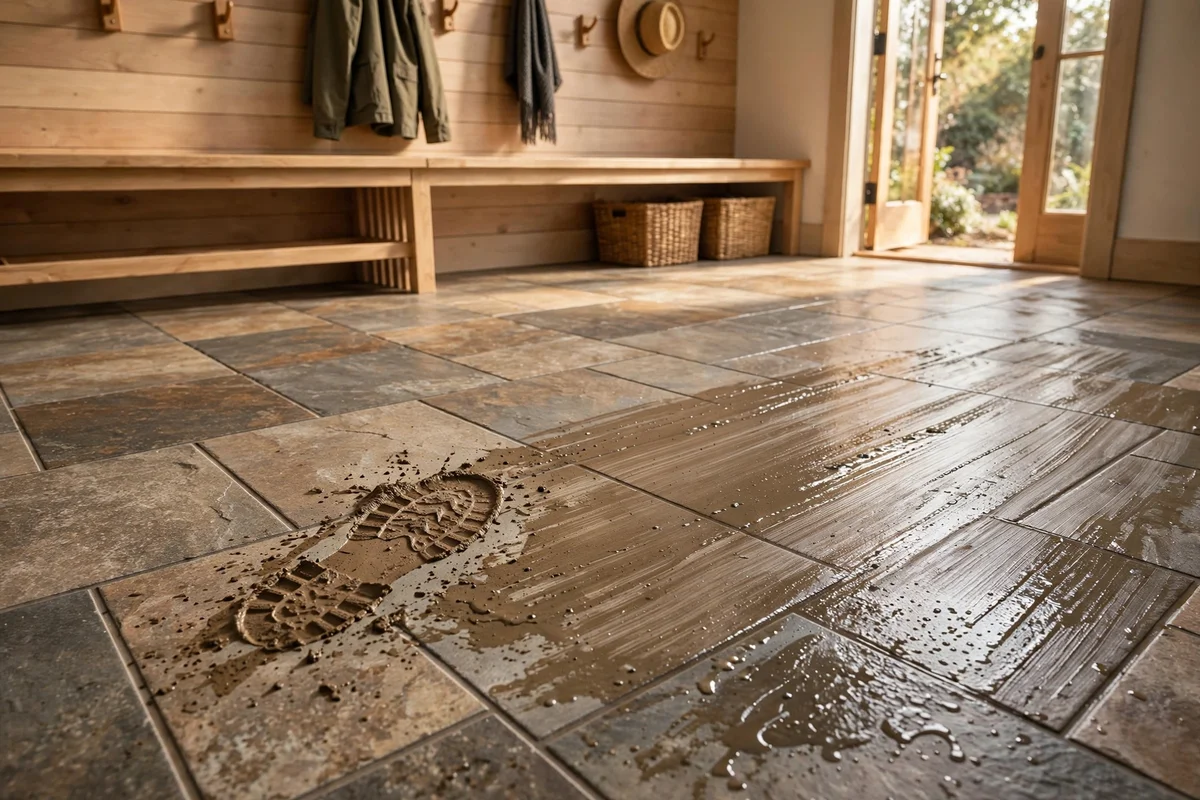
Flooring decides whether a mudroom is easy or exhausting, so choose sealed stone tiles or rigid vinyl plank rated for wet areas. Porcelain tiles of 30 by 60 cm with a textured R10 slip rating handle muddy boots safely, while quality vinyl plank of 5 mm thickness resists scratches from grit. Lay tiles with epoxy or water-resistant grout, and run vinyl planks tight to the skirting so water cannot seep underneath.
Avoid untreated wood and carpet, which stain and swell with repeated soaking; that is the costliest mistake in mudroom design. Budget vinyl plank costs 15 to 30 pounds per square metre fitted, while porcelain tile runs 40 to 80. A dark grout colour hides muddy footprints between cleans far better than white.
11. Fix a Tall Shoe Shelf With Slatted Shelves for Airflow
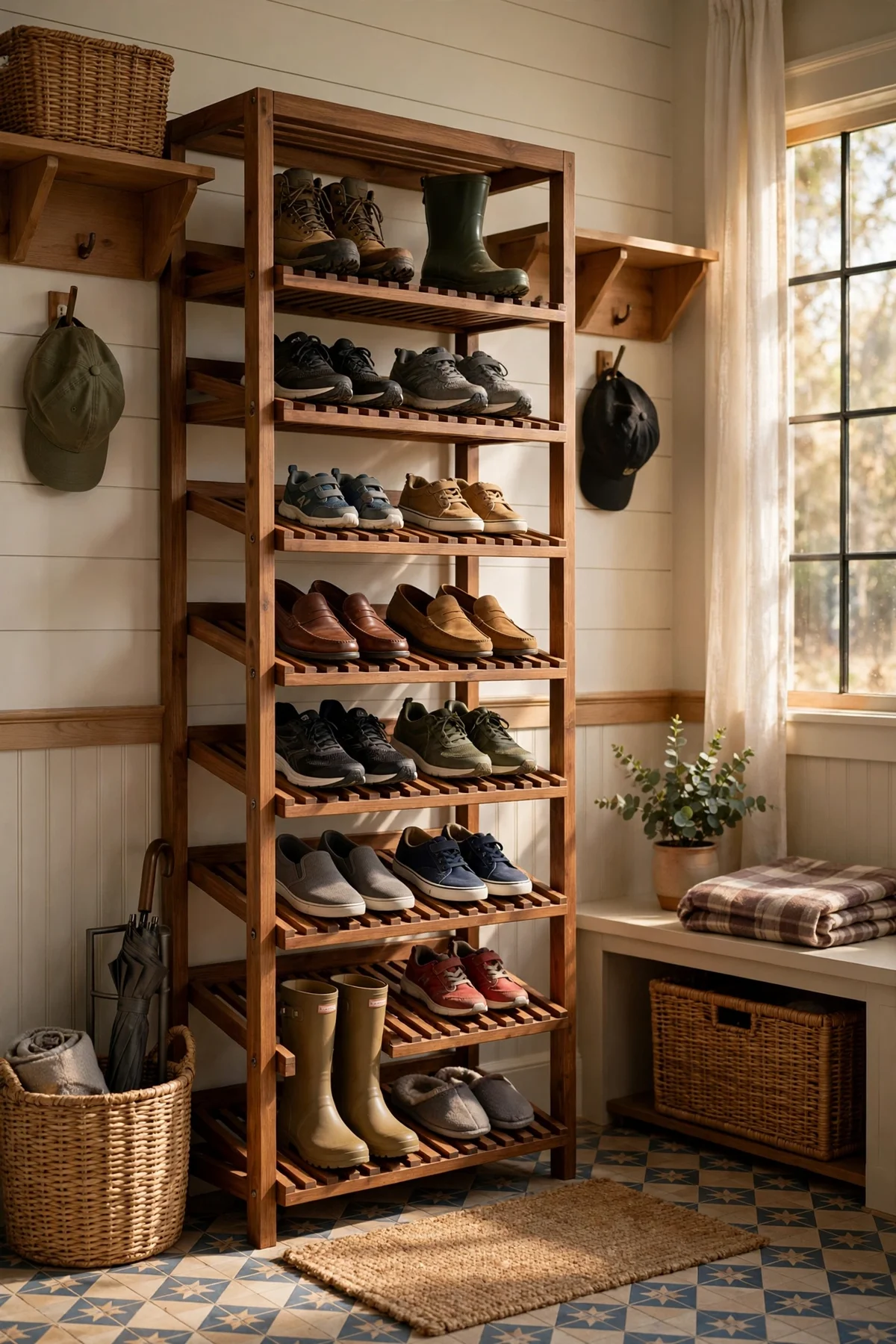
A tall shoe shelf with slatted shelves lets damp footwear breathe instead of stewing in a closed cupboard. Choose a unit 90 to 120 cm high with four slatted tiers, each shelf holding four to six pairs depending on size. Gaps of 2 cm between slats allow air to circulate and mud to fall through onto a wipeable tray below. Position it against a side wall so it does not block the door swing.
Brush dried mud off shoes before shelving them, and wipe the catch tray weekly. The mistake to avoid is stacking shoes two deep, which hides the back row and breeds forgotten pairs. Bamboo slatted shelves cost 40 to 80 pounds, while painted pine versions run 60 to 110. Leave the bottom shelf for the muddiest pairs nearest the door.
12. Place a Woven Laundry Hamper for Muddy Sports Kit by the Bench
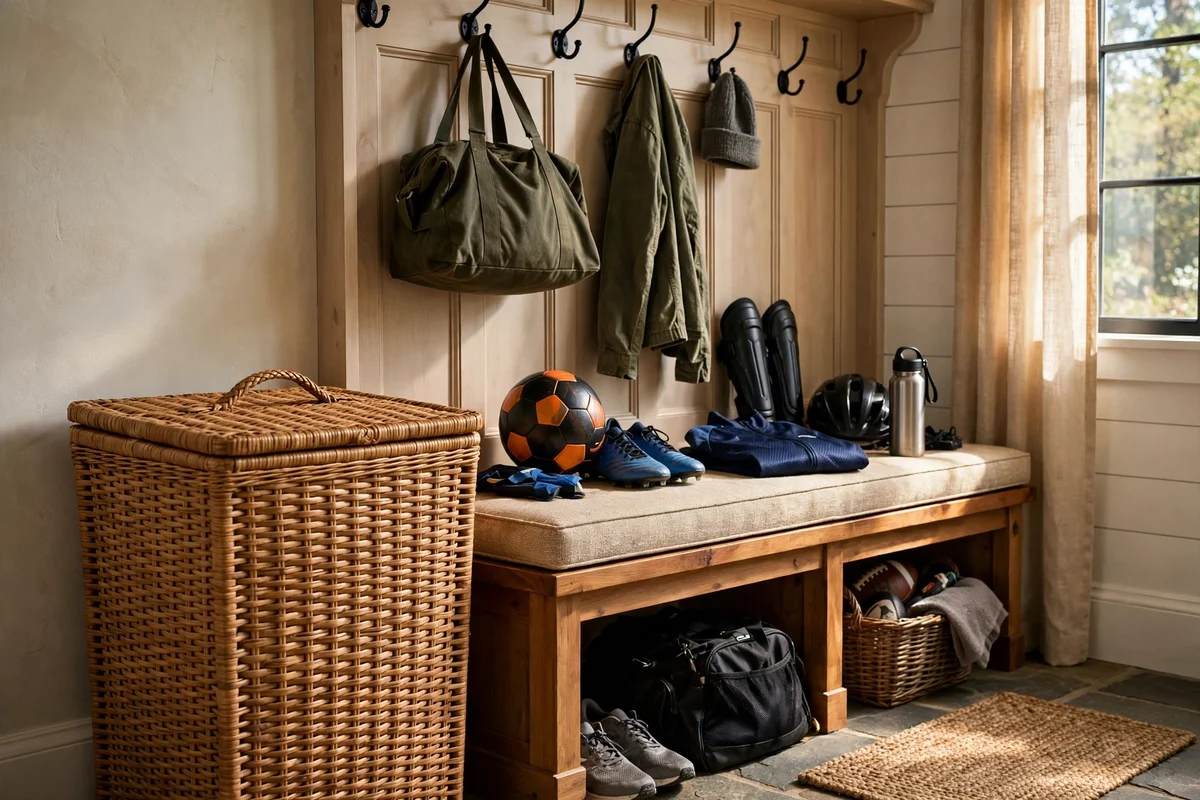
A sturdy woven hamper beside the bench catches muddy sports kit before it reaches the laundry basket or the bedroom floor. Choose a ventilated weave of 45 litres or more, with a removable washable liner that lifts straight into the machine. Keep it within two steps of the door so children drop kit in on arrival rather than carrying it through the house. A lid contains the smell of damp football socks.
Wash the liner every week in sports season, and air the hamper itself monthly to prevent mildew. The common mistake is using a solid plastic bin with no airflow, which turns damp kit sour within a day. Seagrass hampers cost 30 to 55 pounds, while lidded cotton-weave versions run 25 to 45. Mark it clearly so visitors know it is for kit, not rubbish.
13. Add a Wall Mirror With a Slim Ledge Above the Key Shelf
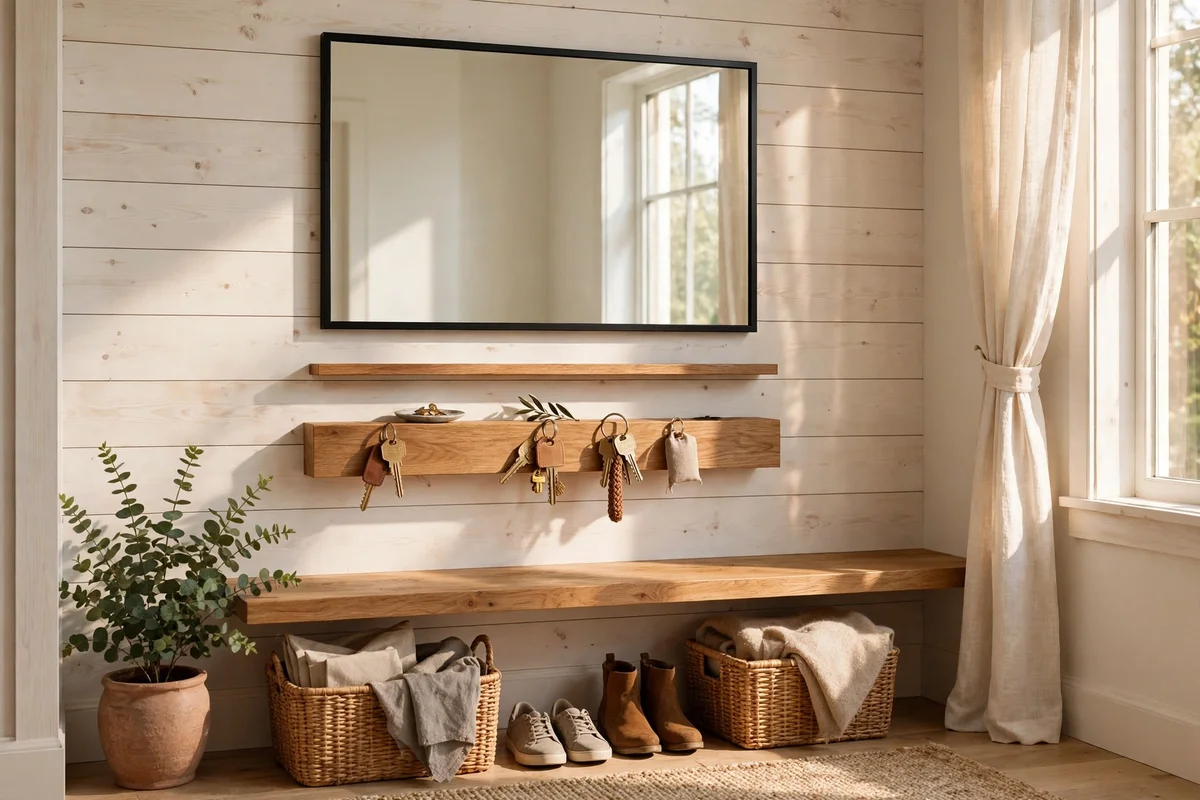
A wall mirror above the key shelf lets the family do a final check before heading out, and it bounces light into narrow mudrooms. Choose a mirror 50 to 70 cm wide with a slim 10 cm ledge along its base for lip balm, a spare hair tie or a small clock. Hang the centre at 150 cm so both adults and older children can use it. A simple oak or black metal frame suits most mudroom palettes.
Fix the mirror with proper wall anchors, since a falling mirror near a busy doorway is dangerous. The mistake to avoid is placing it opposite a window at an angle that glares into eyes at the door. Framed mirrors of this size cost 35 to 75 pounds. Wipe the glass weekly with a damp microfibre cloth to keep it bright.
14. Keep a Brush and Dustpan on a Short Hook Behind the Door
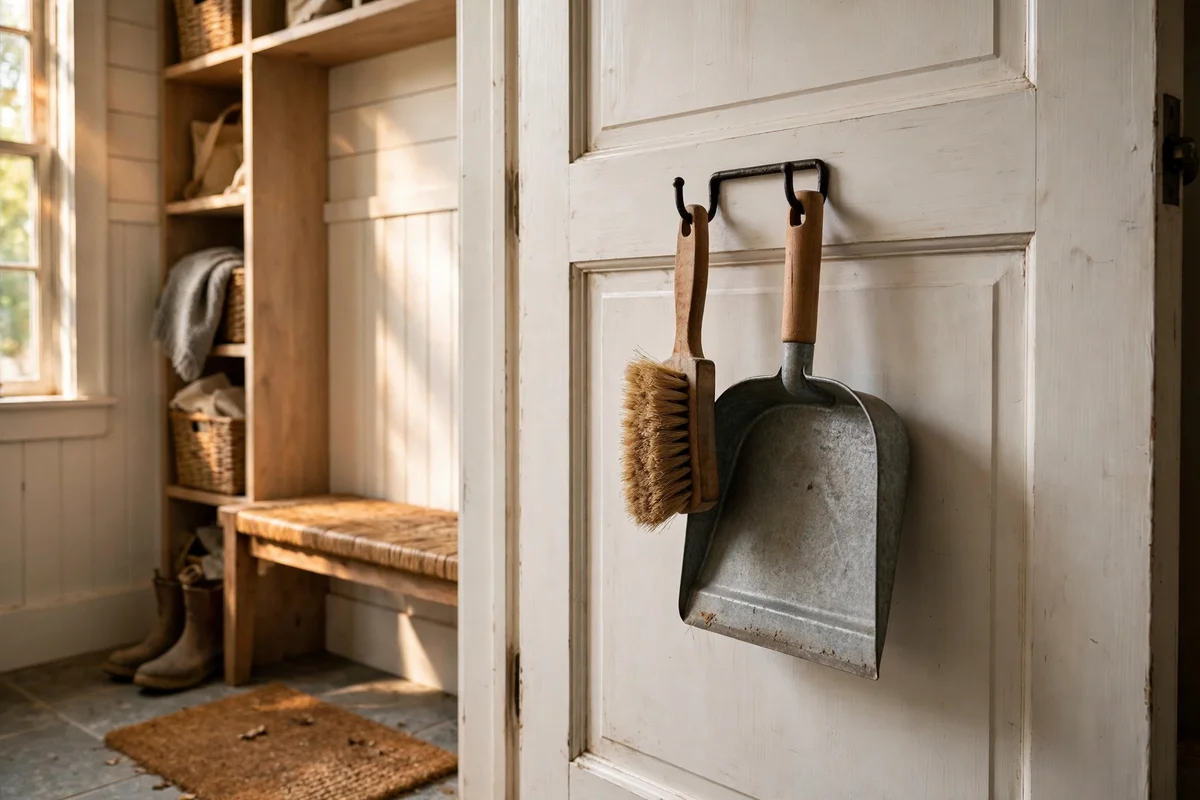
A hand brush and dustpan hung on a short hook behind the door make a two-minute sweep part of the daily rhythm. Choose a stiff-bristled brush of 25 cm that shifts dried mud and grit without scratching floors. Hang it at 120 cm on the back of the door or a side wall, always in the same spot so the habit sticks. A quick sweep each evening stops grit grinding into flooring.
Empty the dustpan into the outside bin rather than the kitchen bin to keep mud out of the house entirely. The common mistake is storing the brush in a cupboard, where it is forgotten and never used. A quality brush and pan set costs 8 to 15 pounds. Replace the brush when bristles splay, usually once a year with daily use.
15. Line the Lower Wall With Beadboard for Splash and Scuff Protection
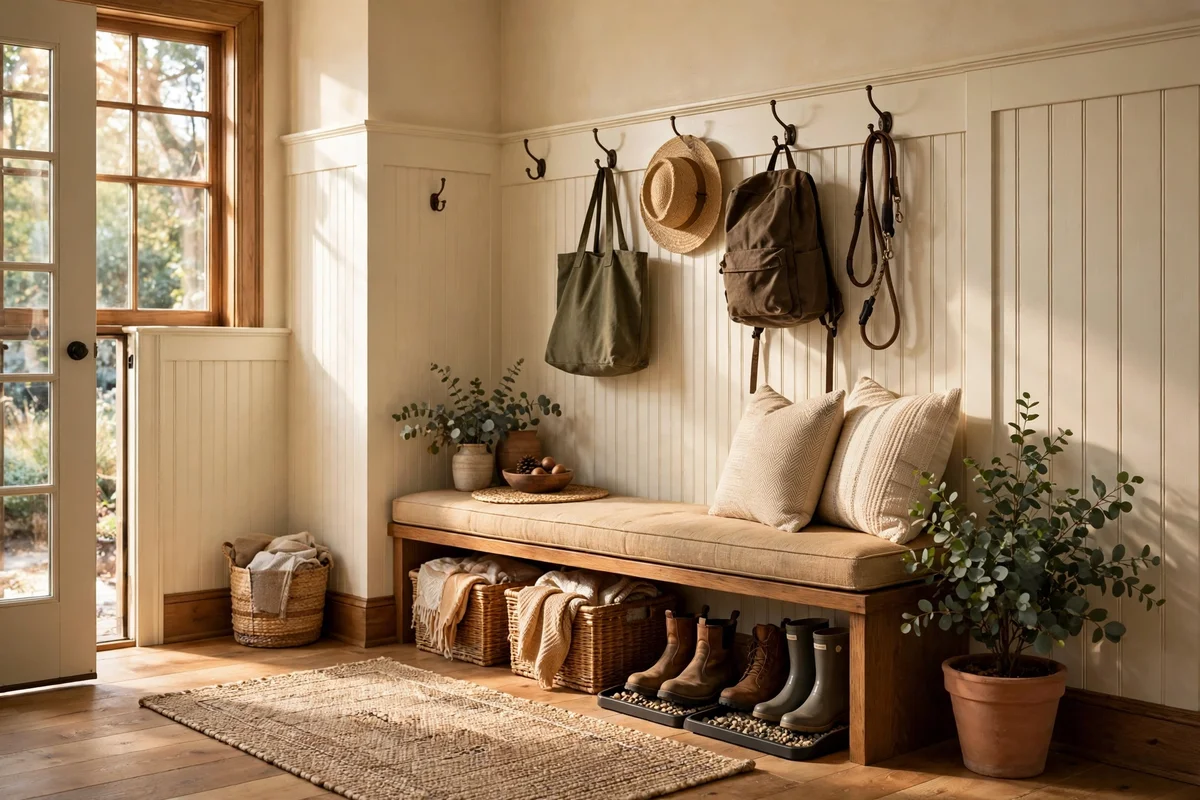
Beadboard panelling on the lower 120 cm of wall shields paint from boot splashes, bag scuffs and muddy paw prints. Choose moisture-resistant MDF or PVC beadboard in a satin finish that wipes clean with a damp cloth. Paint it a warm white or soft sage to keep the space bright, and cap it with a slim chair rail for a finished edge. The panels add heritage charm while taking the daily beating.
Seal all edges with caulk before painting so moisture cannot creep behind the boards. The mistake to avoid is using raw timber panelling, which absorbs damp and warps within a season. Beadboard sheets cost 10 to 20 pounds per square metre, with paint and trim adding 30 to 50. Wipe the panels down monthly with the floor mop.
16. Use a Fold-Down Wall Seat Where Floor Space Is Tight
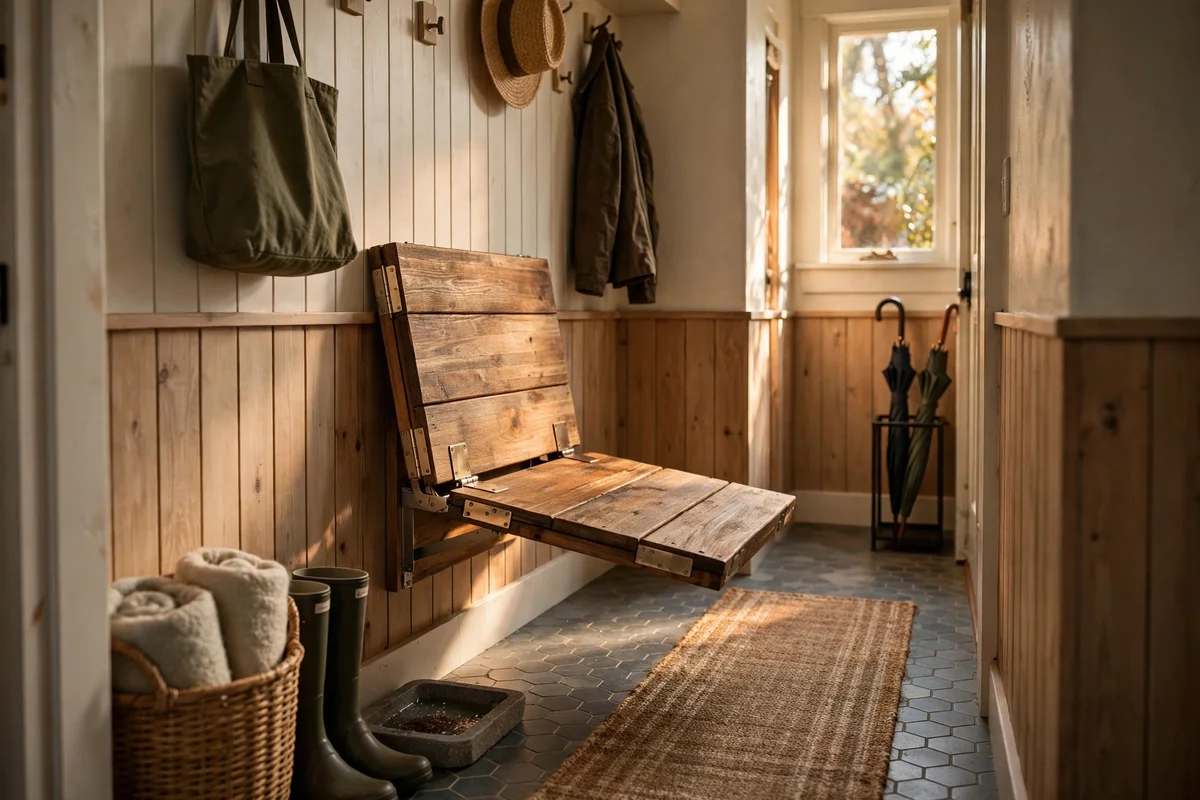
A fold-down wall seat gives small mudrooms a perch for pulling on boots without claiming permanent floor space. Choose a seat of 50 by 35 cm rated for at least 110 kg, mounted at 45 cm high with heavy-duty brackets into studs. Fold it flat against the wall after use to free the walkway completely. A shaped wooden seat feels warmer than bare metal on cold mornings.
Test the locking mechanism monthly, since a seat that drops unexpectedly is a safety risk. The common mistake is fixing it to plasterboard alone, which cannot hold the load safely; always find the studs. Wall-mounted seats cost 60 to 120 pounds. Add a thin washable pad on top for comfort during the winter boot season.
17. Store Clean Towels in a Rolled Stack on the Bench End
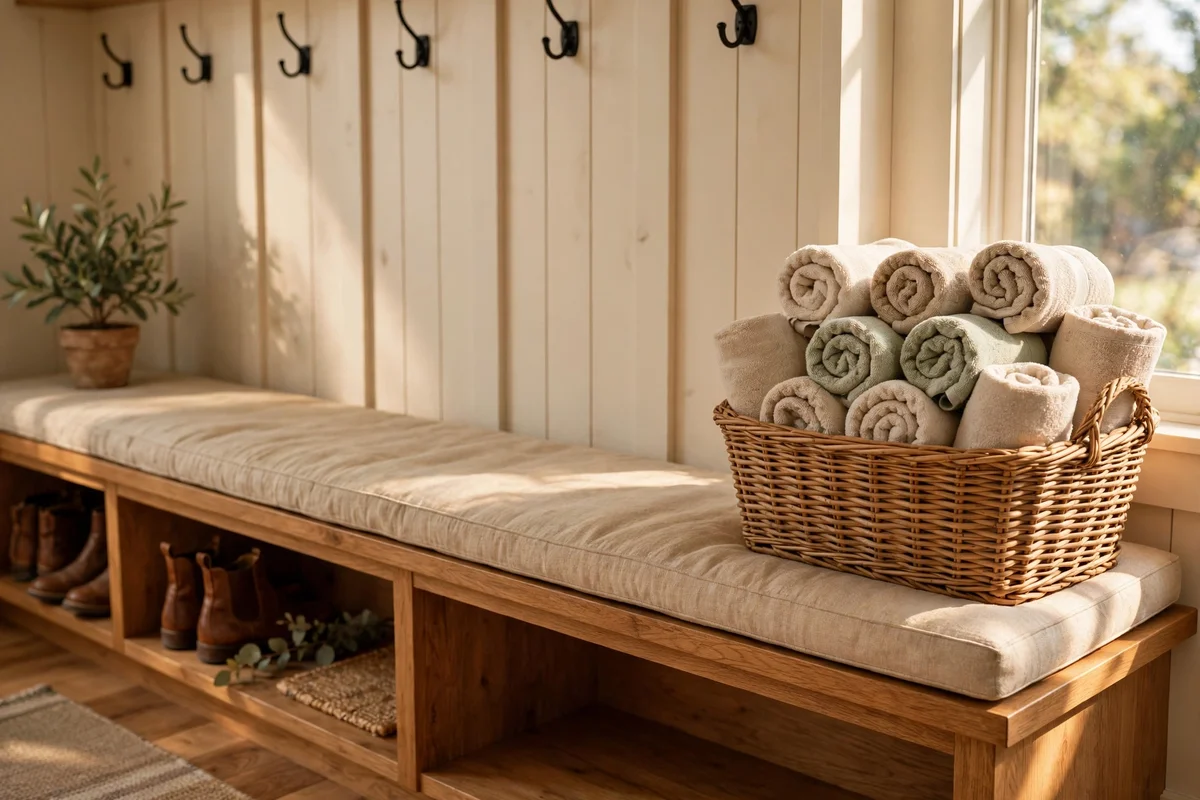
A stack of rolled towels at the end of the bench handles wet hands, muddy paws and dripping parcels all day. Roll six to eight hand towels of 50 by 100 cm tightly so they sit neatly in a 35 cm square basket. Choose washable cotton in mid-tones like oatmeal or sage, which hide light soiling between washes. Keep the stack within arm’s reach of the door for instant use.
Launder the towels weekly on a hot wash, and replace any that thin out or smell musty. The mistake to avoid is using good bathroom towels here, which quickly look shabby and cause arguments. Budget hand towels cost 3 to 6 pounds each. A spare dry towel hung on the nearest hook covers the gap on wash day.
18. Fit Mesh Cubbies Inside the Bench for Pairs of Shoes
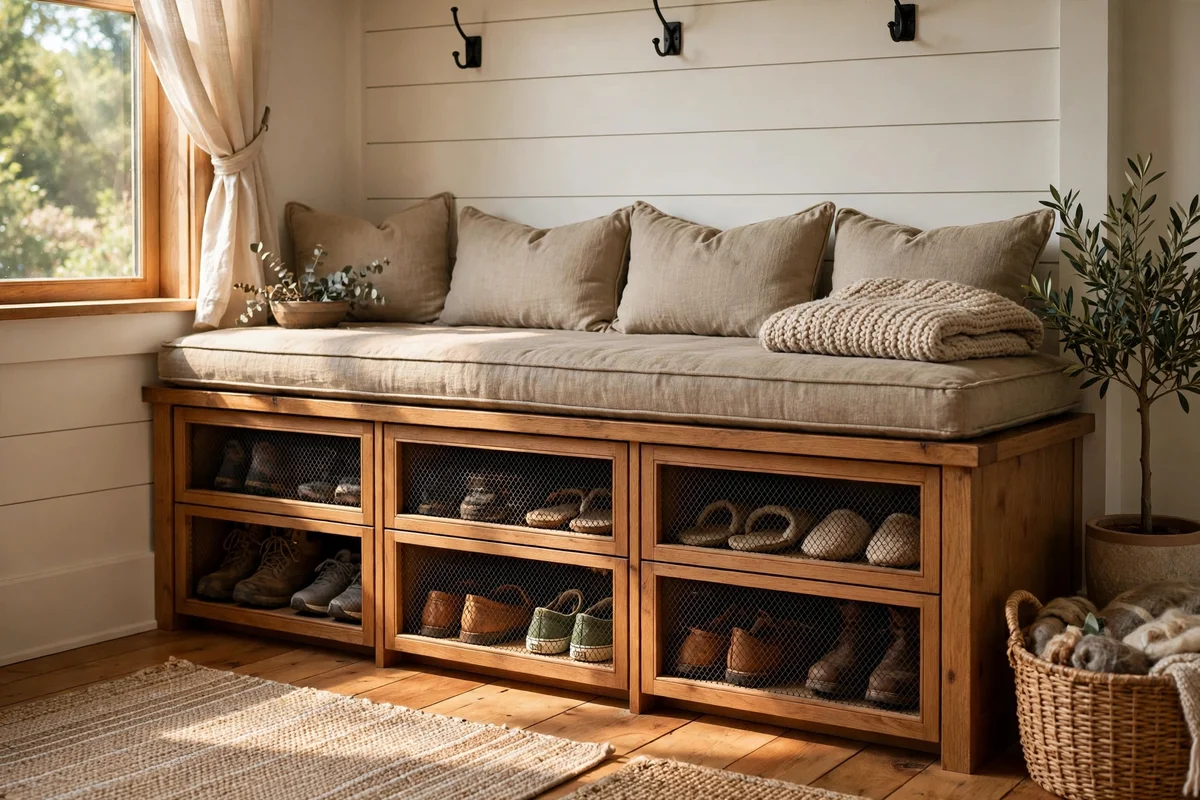
Mesh-fronted cubbies fitted inside the storage bench give every pair of shoes its own airy compartment. Divide the bench interior into cubes of 30 cm square with plywood dividers, and staple fine mesh or wire grille across the front so shoes stay visible and ventilated. Each family member claims one or two cubbies, which ends the pile of mixed footwear. Label the dividers with simple wooden tags.
Leave one empty cubby as a buffer for guests or new purchases, or the system overflows immediately. The common mistake is making cubbies too small for winter boots, so size at least two cubes at 35 cm tall. Plywood, mesh and fixings cost 25 to 45 pounds for a full bench fit. Vacuum the cubbies monthly to clear trapped grit.
19. Add Warm LED Strip Lighting Under the Top Shelf
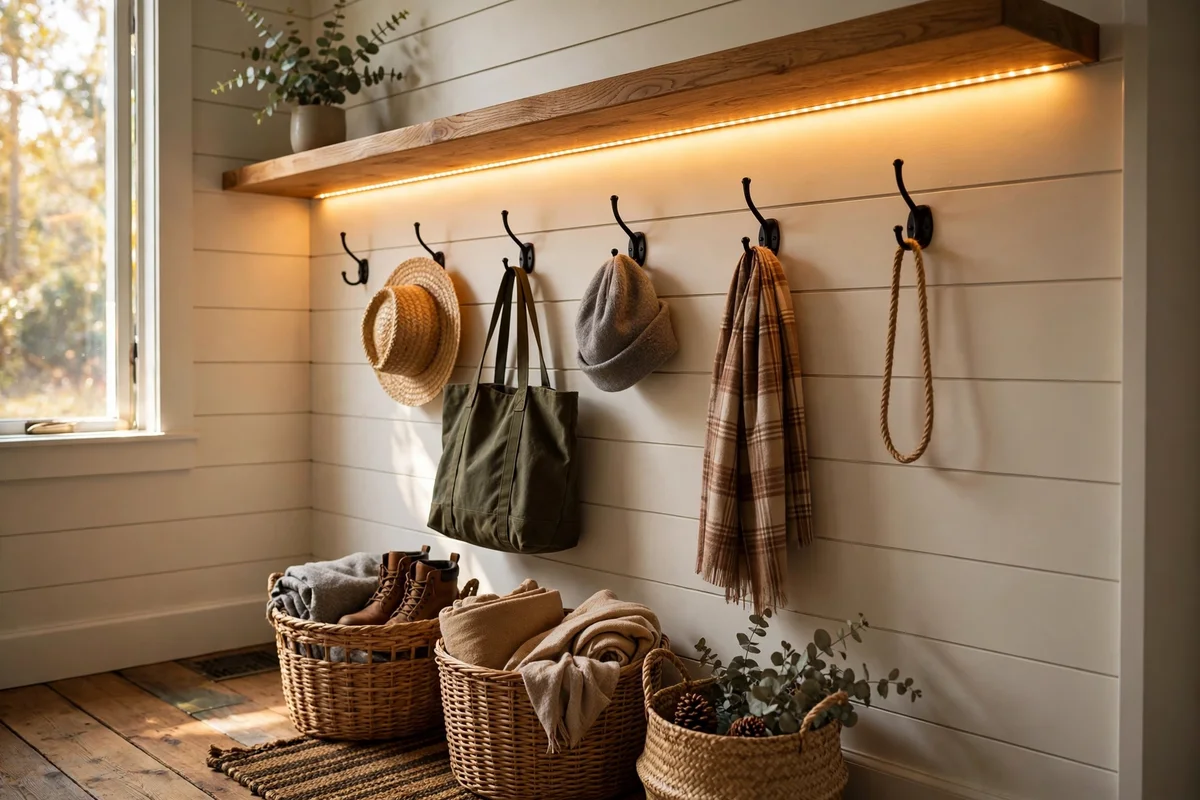
A warm LED strip tucked under the top shelf lights the hooks and baskets below without harsh overhead glare. Choose a 2700K strip of 100 to 150 cm, fixed 3 cm back from the shelf edge so the light washes down the wall. Battery or USB-powered strips avoid wiring work, and a motion sensor switches the light on as hands reach for coats. This small glow makes dark winter mornings feel calmer.
Replace or recharge batteries every two to three months, since dimming strips get ignored and forgotten. The mistake to avoid is cool white 5000K lighting, which makes a mudroom feel clinical rather than welcoming. Quality motion-sensor strips cost 15 to 30 pounds. Wipe the strip monthly, as dust dims the output noticeably over time.
20. Keep a Chalkboard or Letter Board for Out-the-Door Reminders
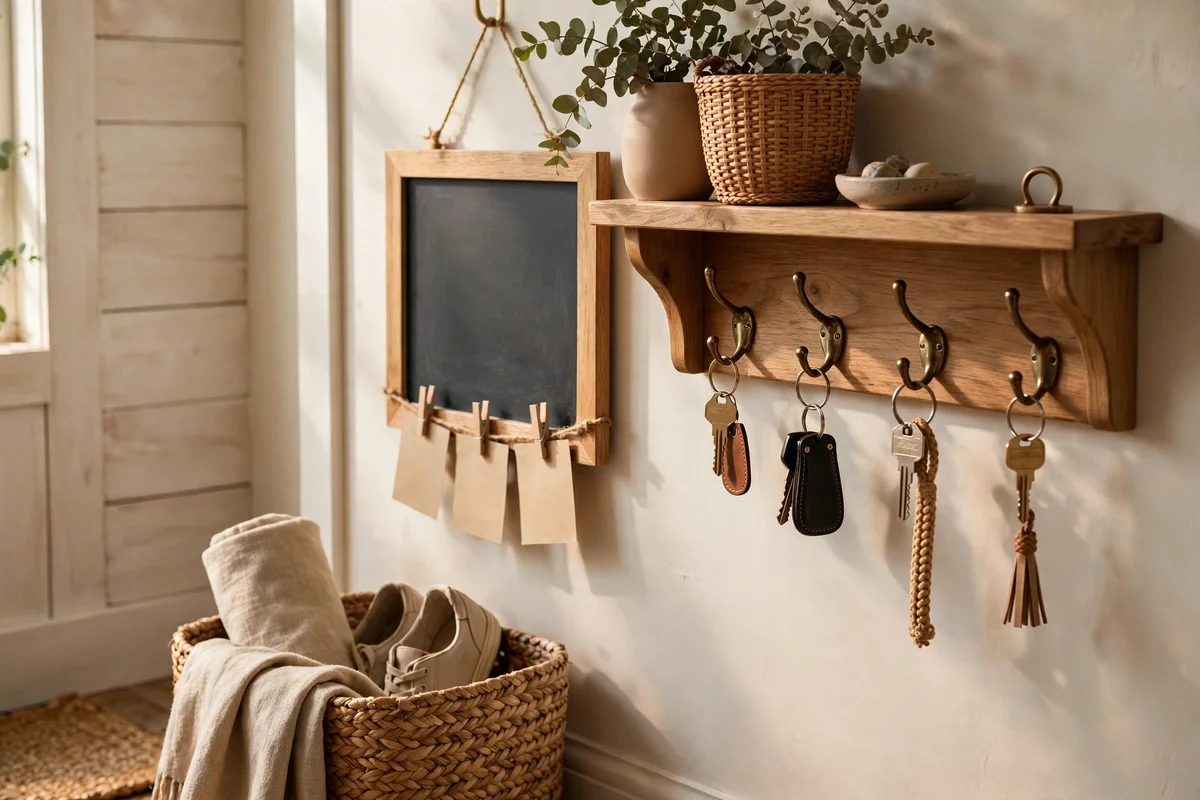
A small chalkboard by the door catches the reminders that notes on phones never deliver in time. Choose a board of 40 by 30 cm hung at eye level beside the key shelf, with a tray for two chalk sticks or a marker. Each evening, write the next day’s essentials: packed lunches, library books, permission slips. The whole family reads it while reaching for coats.
Wipe the board clean each Sunday and start the week fresh, or old notes blur into ignored background. The mistake to avoid is letting the board become decoration with a fixed quote, which teaches everyone to stop reading it. Framed chalkboards cost 12 to 25 pounds, while changeable letter boards run 20 to 40. Keep a duster in the key tray.
21. Place a Heavy Doormat Outside and a Softer One Inside
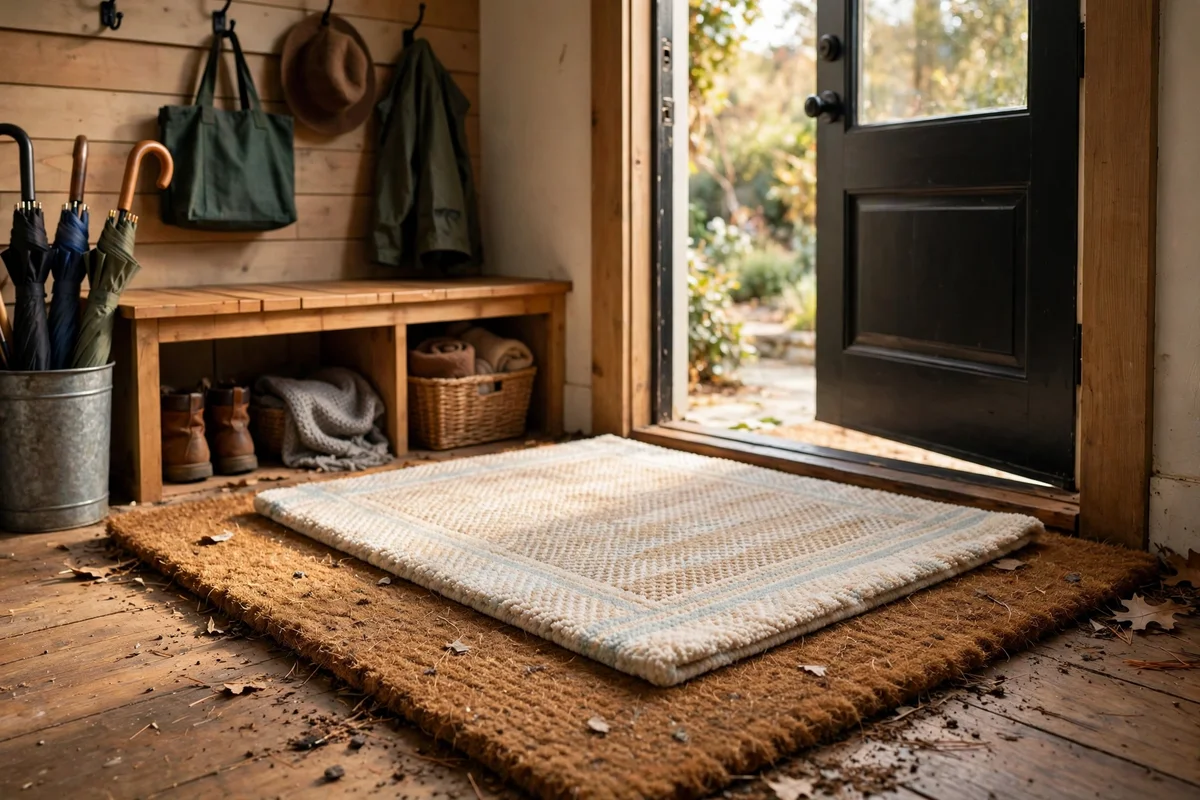
Two doormats work as a team: a coarse scraper mat outside and a softer absorbent mat inside. Choose an outdoor coir mat of 75 by 45 cm with a deep pile that strips grit from soles, and an indoor cotton or microfibre mat of similar size that soaks up remaining damp. Together they trap up to 80 percent of dirt before it reaches the floor. Shake the outdoor mat weekly and wash the indoor one fortnightly.
The mistake to avoid is a single thin mat that saturates by mid-morning and then spreads mud further. Replace the outdoor mat when its fibres flatten, usually every one to two years. Coir mats cost 12 to 25 pounds, while washable indoor mats run 15 to 35. A boot scraper fixed beside the step handles the worst days.
22. Hang a Canvas Tote on Each Hook for Library Books and Returns
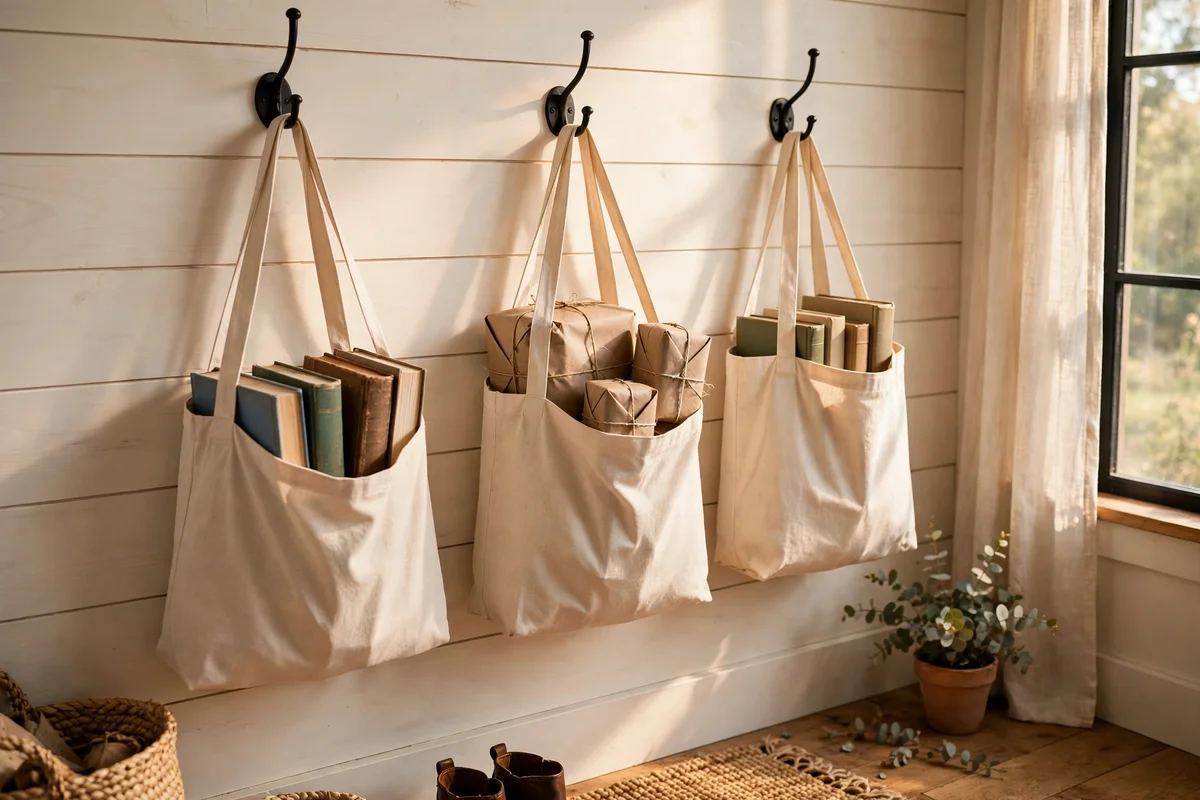
A plain canvas tote hung on each family hook corrals the small items that must leave the house: library books, parcels to post, forms to return. Choose sturdy totes of 35 by 40 cm with a 25 cm handle drop that slips over the hook easily. Keep the tote half empty so there is always room for tomorrow’s addition. On the way out, the whole bag goes, which beats hunting for loose items.
Empty returning totes the same evening so they stay ready for the next round. The mistake to avoid is using the tote as extra storage, which turns it into a second clutter basket. Plain canvas totes cost 4 to 8 pounds each in multi-packs. A quick machine wash every month keeps them looking smart.
23. Refresh the Space Each Season With a Quick Swap Box System
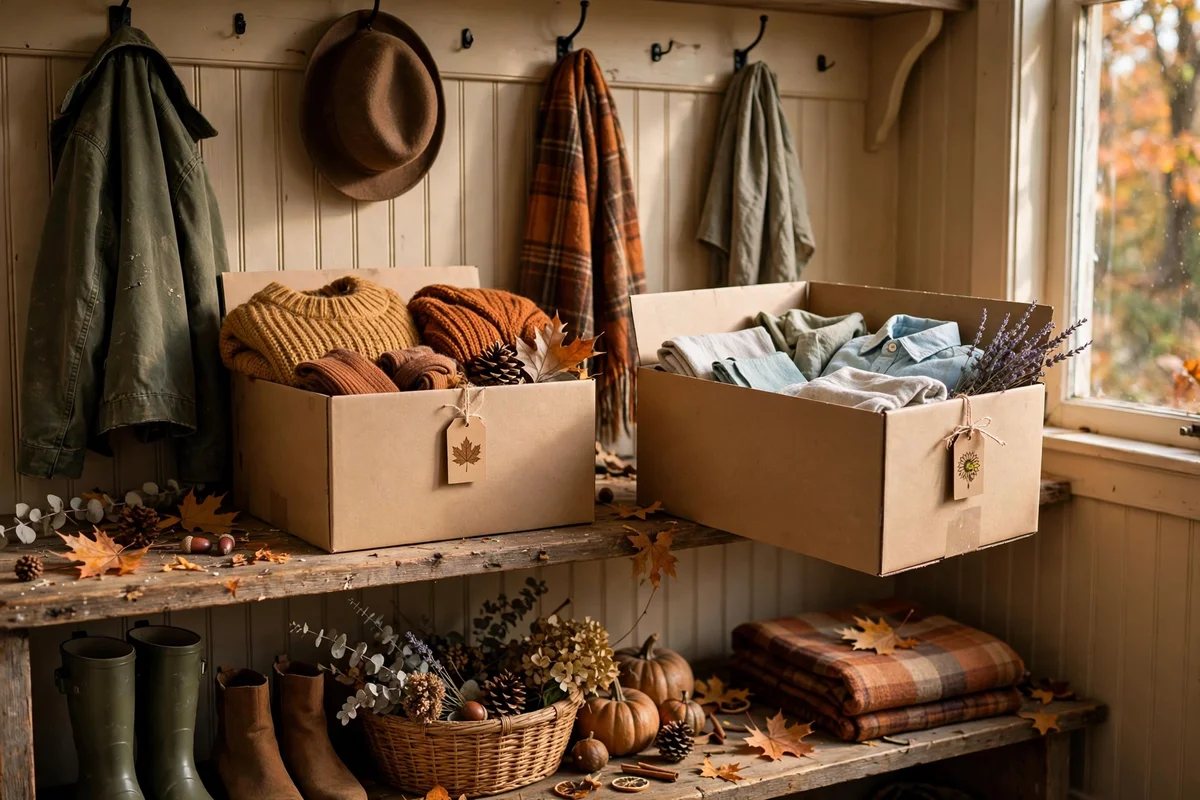
A single swap box per person makes seasonal changeovers a one-hour job instead of a weekend project. Use lidded boxes of 50 by 35 cm, one per family member, holding the next season’s hats, gloves, scarves and light layers. When the weather turns, swap the box contents with the daily baskets in one sitting. Store the boxes on the top shelf between changeovers, clearly labelled.
Schedule the swap for the first weekend of October and April, and wash everything before it goes into storage. The mistake to avoid is keeping three seasons of kit in circulation, which crowds the hooks and slows every departure. Lidded storage boxes cost 8 to 15 pounds each. Donate outgrown items during each swap to keep volumes steady.
The thread running through all 23 ideas is simple: give everything a home within two steps of the door, and the chaos has nowhere to gather. Hooks and baskets keep belongings personal, trays and mats contain the weather, and seasonal rotation stops last winter’s kit crowding this autumn’s mornings. A mudroom that works is rarely beautiful by accident; it is beautiful because every object earns its place.
This week, start with the easiest win of all: set a boot tray inside the door and assign one hook and one basket to each person. Those two moves take under an hour and change the feel of the doorway immediately. Once the system is running, add the bench, the runner and the key shelf one weekend at a time, and enjoy the quiet that follows.
Frequently Asked Questions
How much does a basic mudroom setup cost for a family of four?
Between 150 and 400 pounds covers the essentials: two boot trays, a row of hooks, four baskets, a washable runner and a key shelf. Add 80 to 150 for a storage bench if budget allows. Buy the trays and hooks first, since they deliver the biggest daily difference, then add comfort pieces over the following months.
What flooring survives muddy boots best in a mudroom?
Sealed porcelain tiles and rigid vinyl plank handle mud, water and grit far better than wood or carpet. Choose a textured slip-resistant finish and water-resistant grout or tight seams. Dark grout hides footprints between cleans. Expect 15 to 30 pounds per square metre for vinyl plank and 40 to 80 for porcelain, fitted.
How do I keep a small mudroom from feeling cramped?
Use the walls, not the floor: hooks, a fold-down seat and a slim key shelf keep the walkway clear. Choose a bench no deeper than 35 cm and a runner no wider than 90 cm. A mirror and warm under-shelf lighting make narrow spaces feel larger. Keep every item to one per person so nothing overflows.
How often should I clean and rotate mudroom storage?
Sweep or shake mats weekly, rinse boot trays every two to three days in winter, and wash runners monthly. Rotate seasonal crates twice a year, in early October and early April, washing contents before storage. A ten-minute weekly reset, emptying totes and sorting post, keeps the whole system running smoothly.
Can I create a mudroom without a dedicated room?
Yes. A 120 cm stretch of hallway wall beside the door works well: a boot tray below, hooks and a slim shelf above, and a narrow bench if space allows. Define the zone with a washable runner so the system reads as one area. Even a corner of a utility room or garage entry can follow the same one-hook-one-basket rules.