Home Improvement
24 Fall Porch Decor Ideas That Make Coming Home the Best Part of the Day
By Anna Wells · · 21 min read
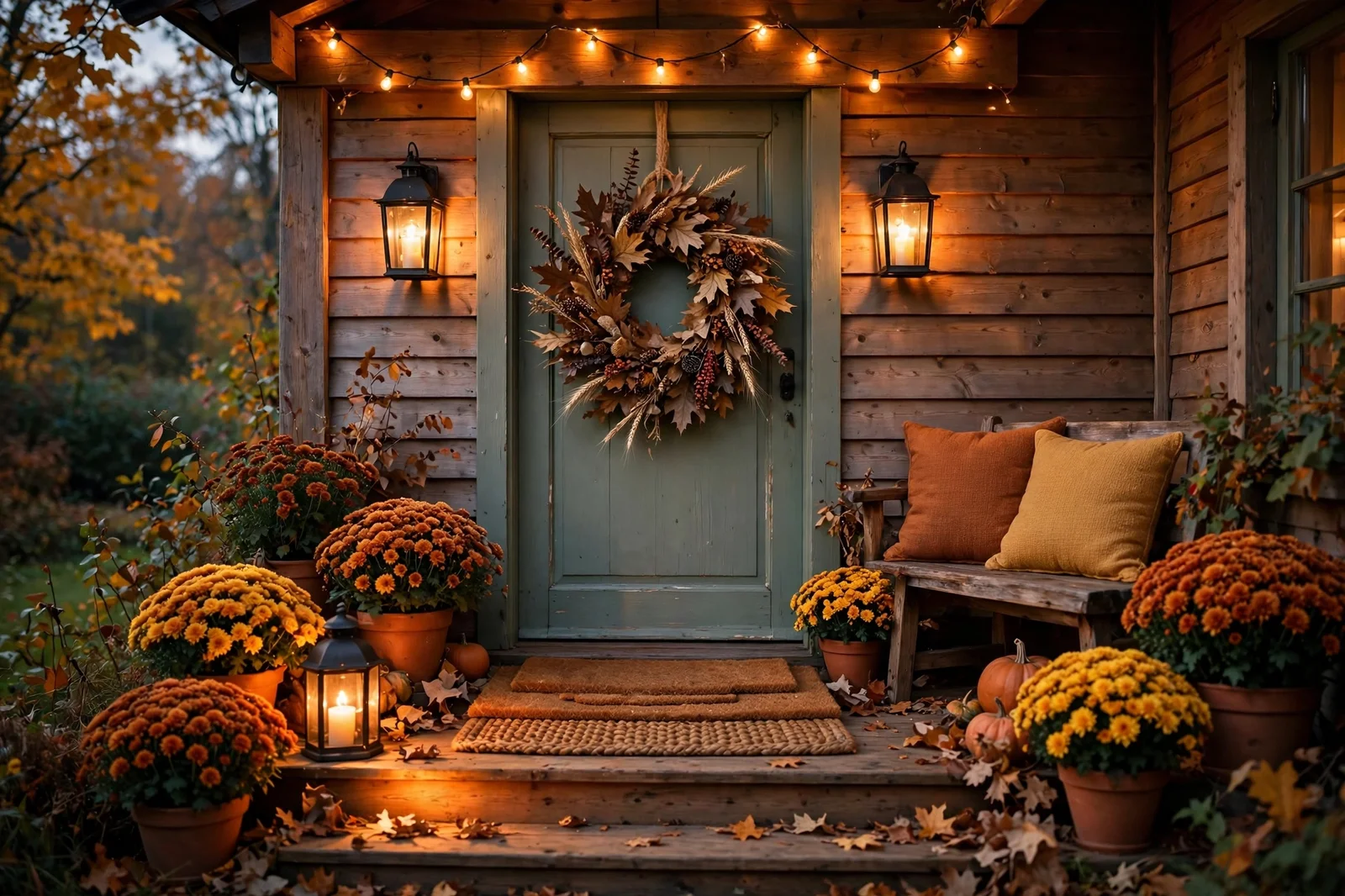
Turn the walk up your front steps into the warmest moment of the day with 24 concrete fall porch decor ideas, from layered mats and dried wreaths to dusk lighting that welcomes you home.
The streetlamps come on a little earlier now, and the light across your steps turns the colour of honey. Keys jingle, the door creaks, and for one long minute the porch feels like the calmest room of the house. That is the autumn porch at its best: a small stage between the rush of the day and the quiet of the evening, dressed in leaves, wool and warm glass.
This guide gives you 24 fall porch decor ideas that treat the whole porch as one scene, not just a pair of planters. You will find a dried-leaf and wheat wreath for the door, layered mats that survive wet shoes, benches and rockers dressed in autumn cushions, lanterns and dusk lighting, a drink tray for slow evenings, weatherproof storage, and wind-proofing tricks that keep everything in place. Every idea names sizes, materials and budget tiers, so you can start this weekend with whatever porch size you have.
Porches range from a single concrete stoop barely wider than the door to a deep veranda that holds a full seating set, so the ideas below scale in both directions. Each section notes the space it suits and what to skip when room is tight. Nothing here needs power tools or a big budget: a wreath, two mats and one good lantern will already change how the walk home feels.
Work through the list in order if you are starting from bare concrete, or dip into the sections that match the gaps in your current setup. Begin with the door and the floor, since those two zones greet you first, then build outward to seating, light and storage. By the final idea, coming home at dusk will genuinely feel like the best part of the day.
1. Hang a Dried-Leaf and Wheat Wreath on the Front Door

A wreath 55 to 65 cm across suits a standard front door without hiding the panels. Build it on a 35 cm grapevine ring, wiring in dried maple and oak leaves with short lengths of florist wire, then add wheat stems at a ratio of roughly one wheat bunch for every two leaf clusters. Hang it centred at eye level from an over-door hook rated for at least 3 kg. Budget wreaths cost 15 to 30 dollars; handmade dried versions run 40 to 60.
Keep the wreath on a sheltered door, because even dried leaves shed quickly under direct rain. Once a week, press loose leaves back into the ring and stand the wheat heads upright with your fingers. At season’s end, store it in a shallow box lined with tissue so brittle stems survive until next autumn. If the door faces full afternoon sun, choose wheat-heavy designs, since dried leaves bleach to pale grey within weeks under strong light.
2. Layer Two Doormats for a Textured Welcome
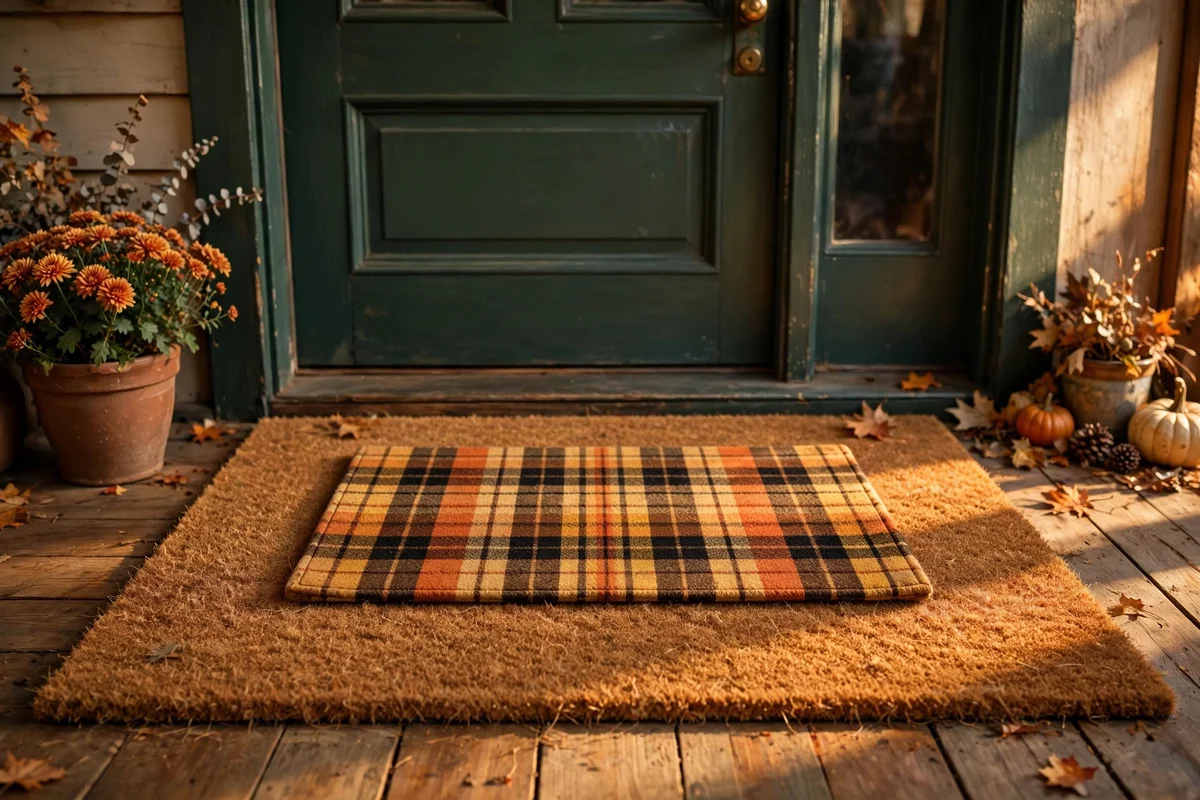
Layering starts with a large coir rectangle, 75 by 120 cm, placed flat on the porch floor, then a smaller patterned mat, around 45 by 75 cm, centred on top. The bottom mat scrapes shoes; the top one carries the autumn pattern, like plaid, herringbone or a pumpkin motif. Keep both mats within the same warm colour family, such as chestnut, rust and cream, so the layers read as one deliberate piece rather than clutter.
Shake both mats out weekly and hose the coir layer down once a month, letting it dry fully before restacking. The mistake to avoid is stacking two thick mats, which lifts the pile above the door sweep and makes the door stick. Choose one thick base and one thin topper, each under 1.5 cm thick. A good coir base costs 12 to 20 dollars, and patterned toppers start around 10.
3. Set a Bench With Autumn-Tone Outdoor Cushions

A bench 110 to 130 cm long gives two seats without crowding a standard porch, and a 45 cm seat depth leaves room for cushions plus a throw. Choose cushions in rust, mustard and warm brown, all in solution-dyed acrylic so rain beads off instead of soaking in. Place the bench facing the street or angled slightly toward the door; an angled bench feels inviting rather than staged. Two cushions of 45 cm square plus one lumbar cushion is plenty.
Fluff cushions daily by giving each corner a sharp tug, which keeps the fill even through a wet season. Bring foam-core cushions under cover during heavy storms, even if the fabric is weatherproof, because soaked cores take days to dry. The common mistake is matching every cushion exactly; pick three tones in one family and alternate them. Bench plus cushions usually totals 80 to 150 dollars at mid-tier shops.
4. Add a Rocker With a Folded Plaid Throw
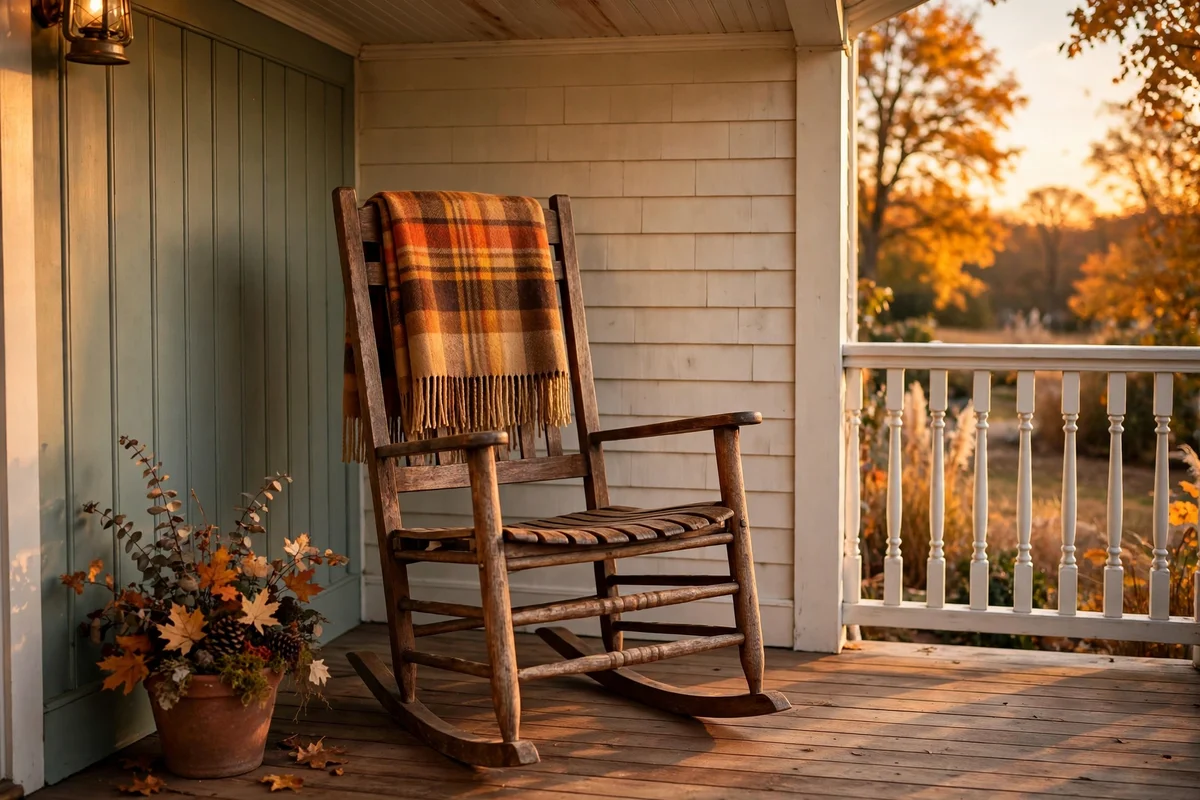
A wooden rocker with a seat 55 to 60 cm wide fits porches as narrow as 90 cm deep, leaving a safe walkway past it. Fold a plaid throw in thirds lengthwise and drape it over the chair back so the fringe hangs evenly on both sides. Choose throws in autumn checks of rust, forest green and cream; wool blends look best but acrylic throws survive porch damp far better. One rocker angled toward the door reads as an invitation to sit.
Keep the throw off the wet floor by draping it high and bringing it indoors on rainy nights. Wash throws every two weeks during the season, since porch dust settles fast. The mistake to avoid is placing the rocker dead centre on a small porch, where it blocks the path; tuck it into a corner instead. Second-hand rockers cost 25 to 60 dollars, and a decent plaid throw runs 15 to 30.
5. Flank the Door With Flickering Lanterns
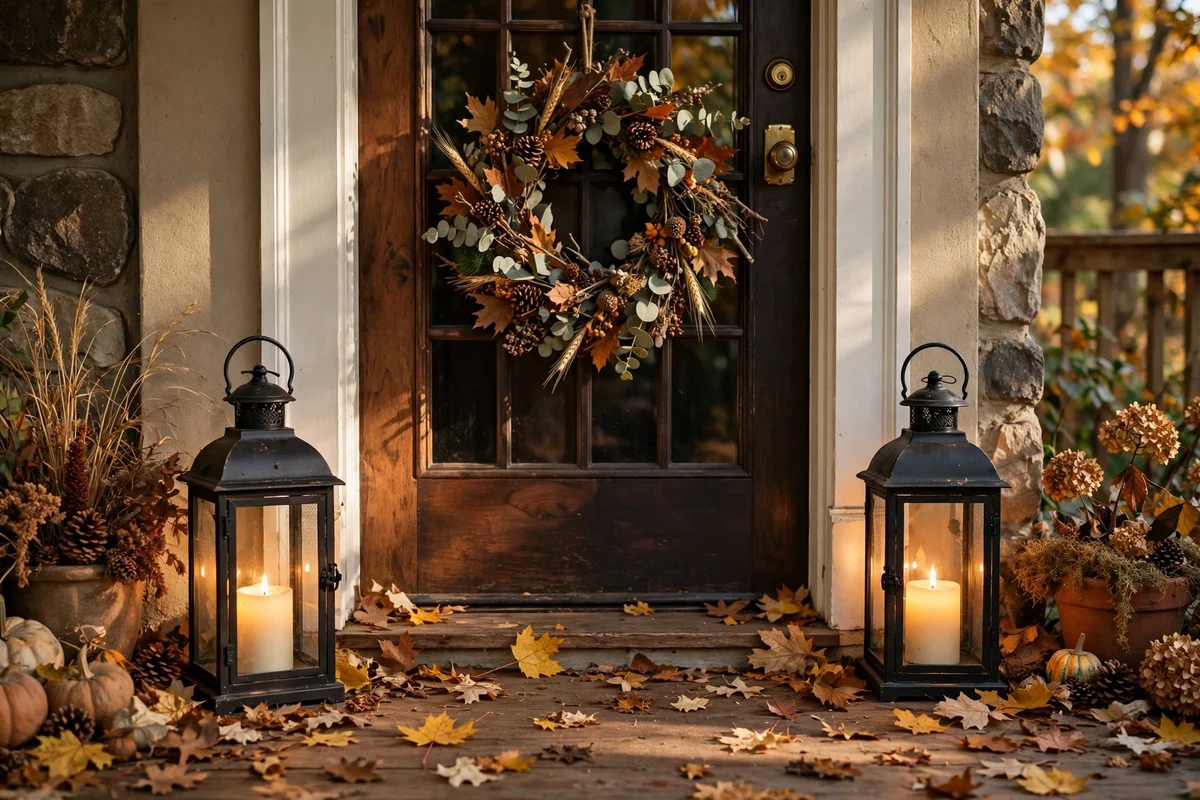
Two lanterns, one on each side of the door, frame the entrance with warm light at dusk. Choose metal lanterns 30 to 40 cm tall so they read clearly from the street, and fit each with an LED pillar candle of 10 to 15 cm with a built-in timer. Black or bronze lanterns suit most door colours; warm wood lanterns soften modern doors. Keep the lanterns 30 to 40 cm from the door frame so the handles stay clear.
Set the timer to switch on at 6 pm so the porch is lit before you arrive home. Wipe glass panels monthly with a damp cloth, because porch grime dims the glow surprisingly fast. The mistake to avoid is real flame candles in a windy spot; one gust can blow soot across the glass or worse. A pair of lanterns with LED candles usually costs 25 to 50 dollars.
6. Plant Chrysanthemums in Weathered Terracotta Pots

Chrysanthemums are the workhorse of autumn planters, blooming for six to eight weeks in rust, gold and deep red. Use terracotta pots 25 to 35 cm wide with drainage holes, filling the bottom third with coarse gravel so autumn rain never waterlogs the roots. Tuck three mums into each pot at 15 cm spacing, and fill gaps with trailing ivy for softness. Group the pots in odd numbers, three or five, for a natural look.
Water when the top 3 cm of soil feels dry, which in autumn is usually twice a week. Deadhead spent blooms weekly to push new buds open through November. The mistake to avoid is leaving pots in their nursery plastic sleeves, which trap water and rot the crowns. Each potted mum costs 5 to 10 dollars, so a full trio stays under 30.
7. Hang a Basket of Trailing Autumn Greens
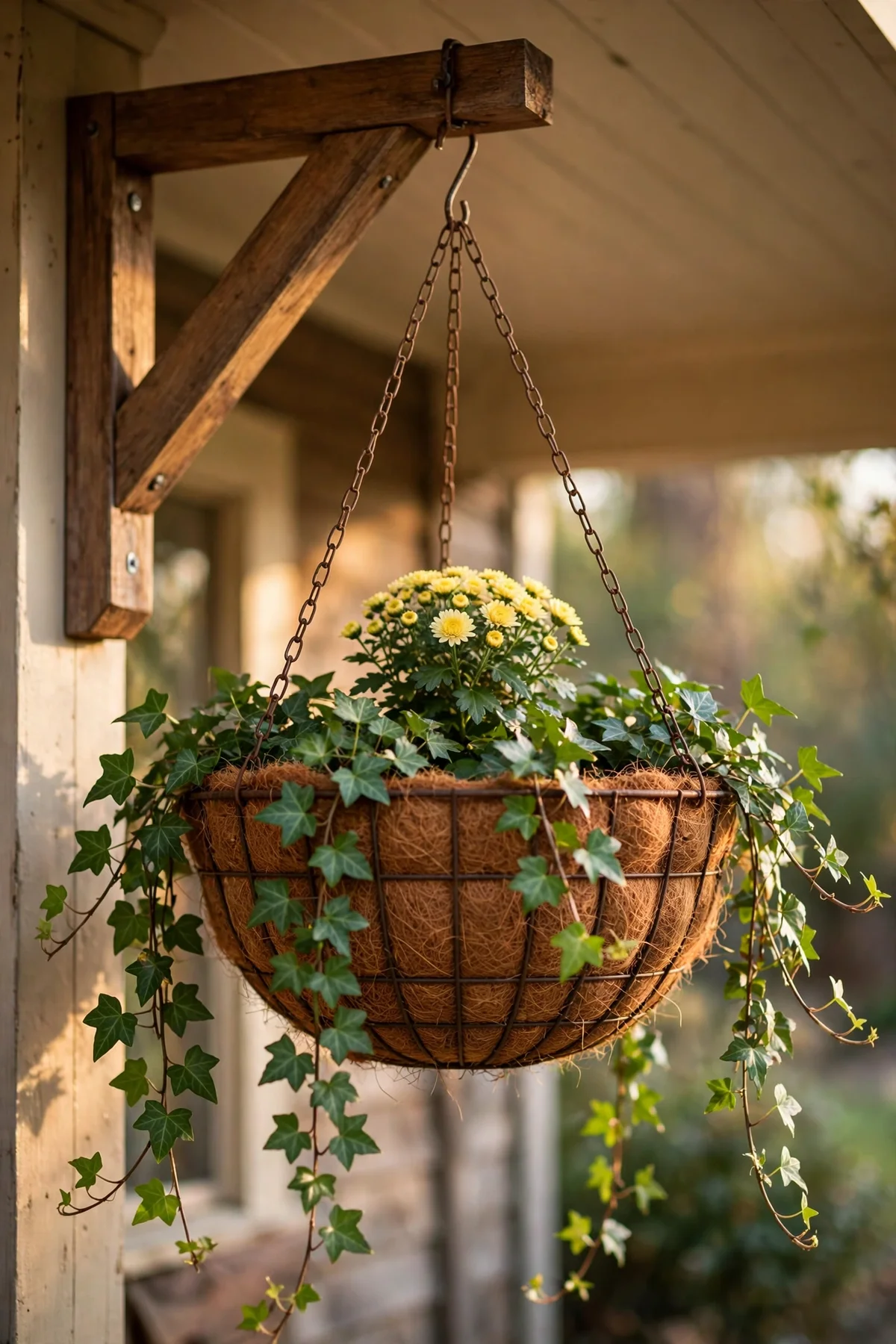
A hanging basket 35 to 40 cm across fills vertical space that floor planters cannot reach. Line a wire basket with coir, then plant the rim with trailing ivy and place a small mum or ornamental grass in the centre. Hang it from a sturdy bracket screwed into a stud or joist, rated for at least 7 kg once watered, with the basket rim about 200 cm off the floor so tall visitors clear it.
Water hanging baskets every other day, since wind dries them faster than ground pots. Turn the basket a quarter rotation weekly for even growth. The mistake to avoid is hanging from a gutter or a thin trim board; a full basket can weigh over 8 kg and will tear trim loose. Basket, liner and plants together usually cost 20 to 35 dollars.
8. Style a Side Table With a Warm Drink Tray

A side table 40 to 50 cm wide beside the bench or rocker turns the porch into a sitting spot, not just a pass-through. Top it with a wooden or metal tray 30 to 35 cm across holding a teapot or thermos, two sturdy mugs, and a small bowl of dates or nuts. Keep the tray arrangement to three zones: drink, cups, snack. A tray with raised edges stops mugs sliding in wind.
Bring the tray indoors each night so drinks and snacks stay fresh and the teapot avoids overnight damp. Wipe the table top weekly with a damp cloth, since sugary spills attract insects fast. The mistake to avoid is a glass tray, which chips and cracks with autumn temperature swings; choose wood or enamelled metal. A simple side table and tray pair costs 30 to 55 dollars.
9. String Warm Festoon Lights Along the Porch Beam
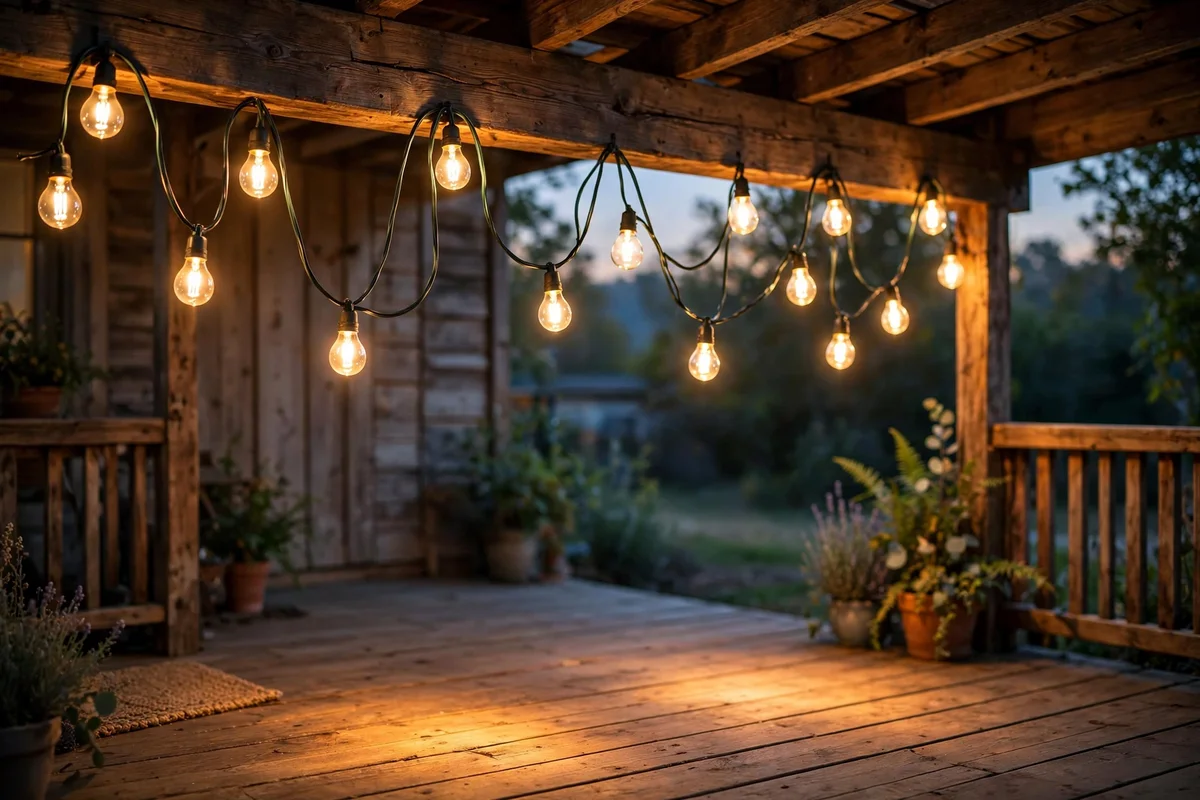
Festoon lights with 2700K bulbs give the porch a honeyed glow that cool white strings never match. Run one strand along the main beam, letting it sag 10 to 15 cm between hooks for a relaxed drape, and keep bulbs 20 to 25 cm apart. Use outdoor-rated strings only, and plug them into a timer or dusk sensor so they greet you automatically. One 10 metre strand covers most standard porches.
Hook the strand into the beam with small cup hooks every 60 cm so wind cannot whip it loose. Check the string monthly for bulbs that have dimmed, and replace them before the whole strand looks tired. The mistake to avoid is leaving lights on all night, which wears bulbs out in one season; six hours on a timer doubles their life. A 10 metre outdoor strand costs 20 to 40 dollars.
10. Fit a Dusk-to-Dawn Bulb in the Porch Fixture
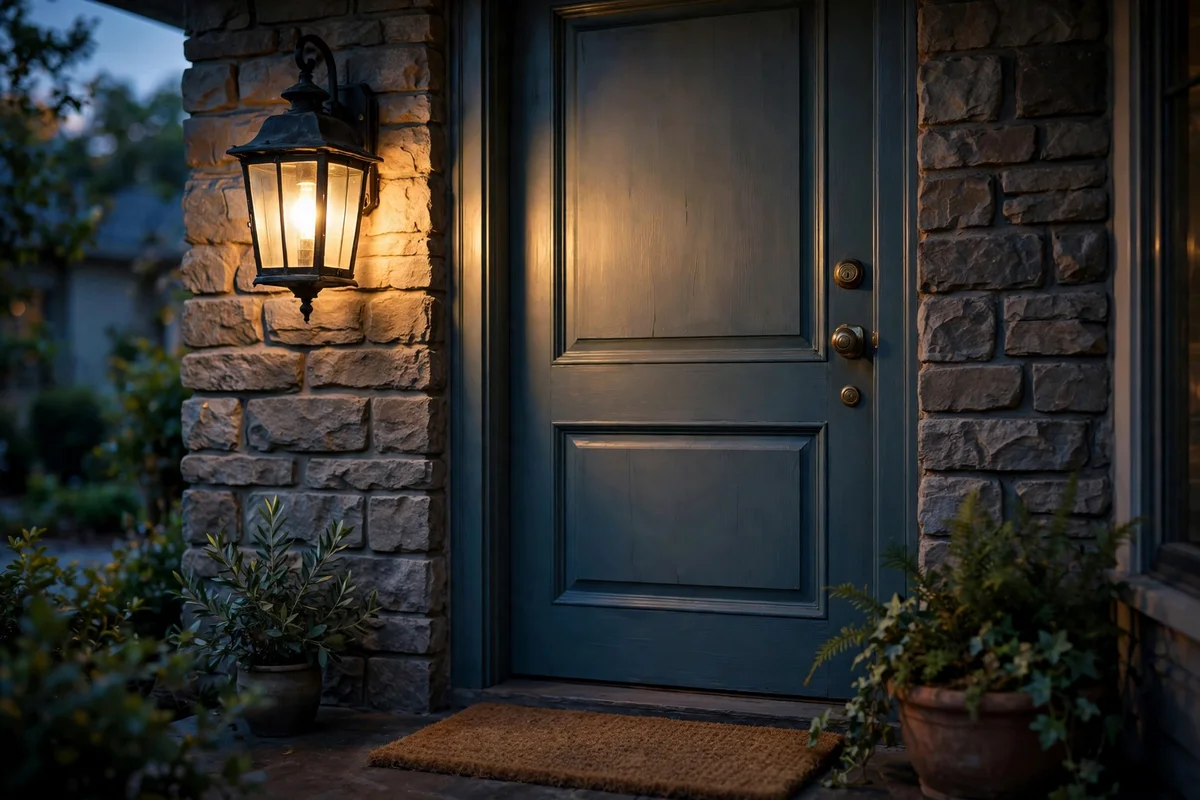
A dusk-to-dawn LED bulb screws into any standard porch fixture and switches itself on at twilight, so the porch is never dark when you arrive. Choose 2700K and 600 to 800 lumens: warm enough to feel cosy, bright enough to find the keyhole. It draws about 9 watts, costing pennies a month to run. Make sure the fixture lens is clean first, because a dusty lens can halve the effective light.
The built-in sensor needs a clear view of the sky, so do not pair the bulb with a motion-sensor fixture that fights it. Test the bulb by cupping your hand over the sensor; it should light within a minute. The mistake to avoid is placing it in a shaded fixture behind a pillar, where it may stay on all day. These bulbs cost 8 to 15 dollars and last three to five seasons.
11. Store Cushions in a Cedar Deck Box
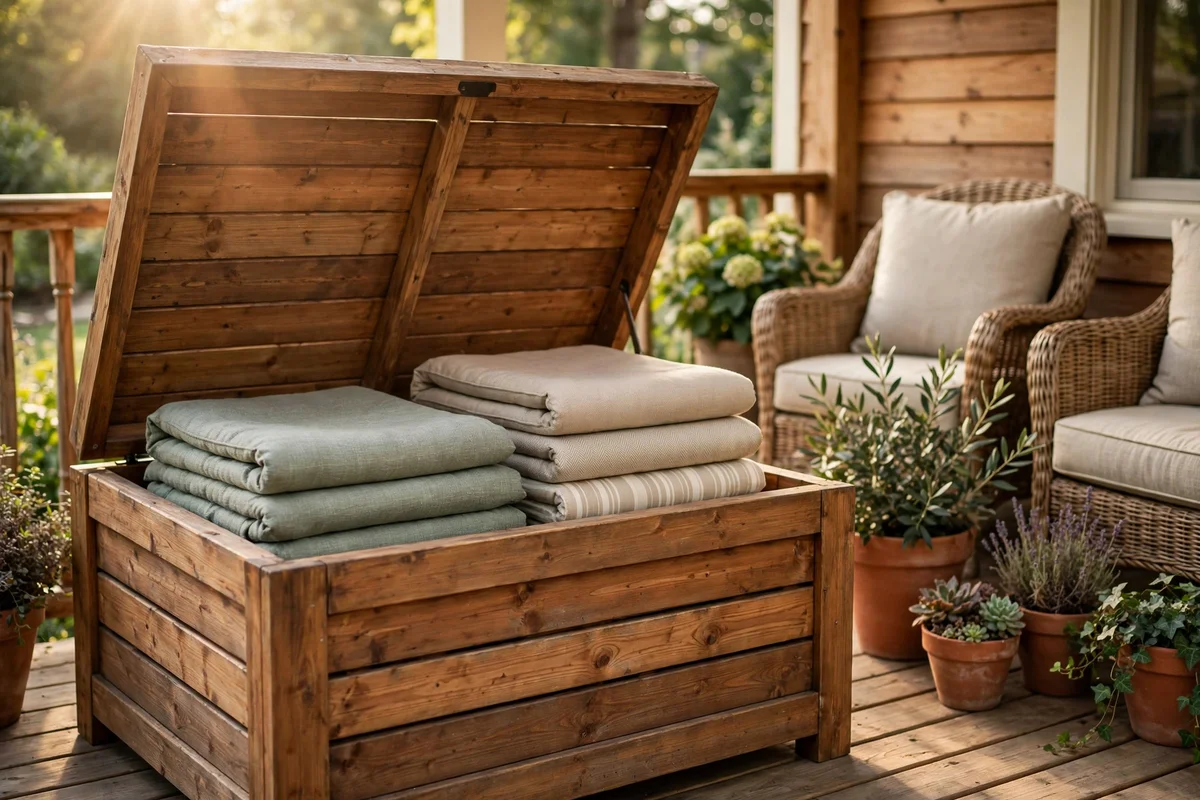
A cedar deck box 120 cm long holds four to six seat cushions and doubles as extra seating with a firm lid. Cedar naturally resists moisture and insects, which is why it outlasts plastic boxes in damp autumns. Place the box within two steps of the seating so stowing cushions becomes a habit, not a chore. Drill two small drainage holes in the base if the box did not come with them.
Shake cushions off before storing, and never pack damp cushions away, since trapped moisture breeds mildew within days. Leave the lid ajar for an hour after rain so residual damp escapes. The mistake to avoid is a box without a lid overhang, which lets rain track straight inside; check that the lid lips over the base. Cedar boxes cost 90 to 160 dollars; resin alternatives run 50 to 90.
12. Lean a Blank Wooden Sign by the Porch Rail
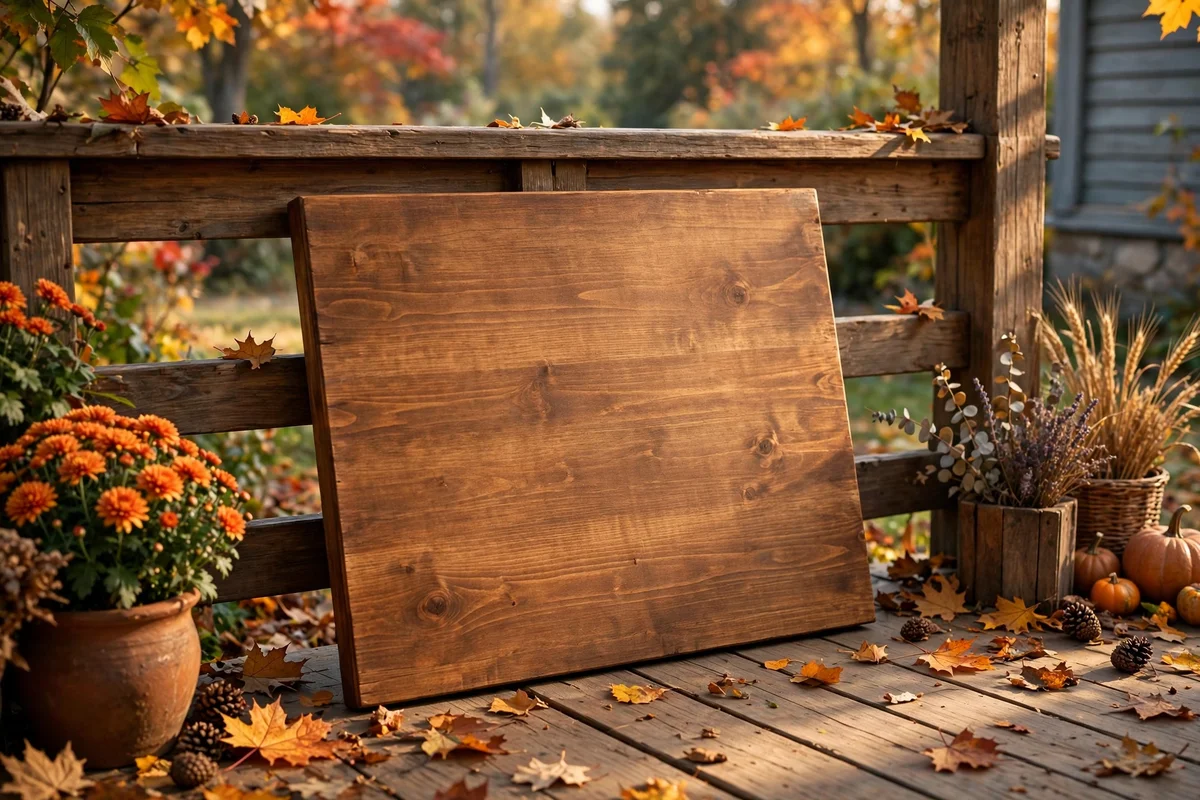
A simple wooden sign 60 to 90 cm tall leans against the porch rail or wall for a handcrafted focal point. Choose reclaimed-look pine or cedar in a warm stain, and keep the board blank, so the wood grain itself is the decoration. Prop it at a slight angle with the base 10 to 15 cm from the wall, and rest it on a non-slip pad so it cannot creep in wind.
Seal the board with a clear exterior varnish once a year to stop autumn rain greying the wood. If you later add a painted word or family name, keep lettering simple and weatherproof with exterior acrylic paint. The mistake to avoid is hanging a heavy sign from a rail with thin wire; leaning is safer and easier to move. Blank wooden signs cost 20 to 45 dollars at craft shops.
13. Dress a Tiny Stoop With One Tall Planter
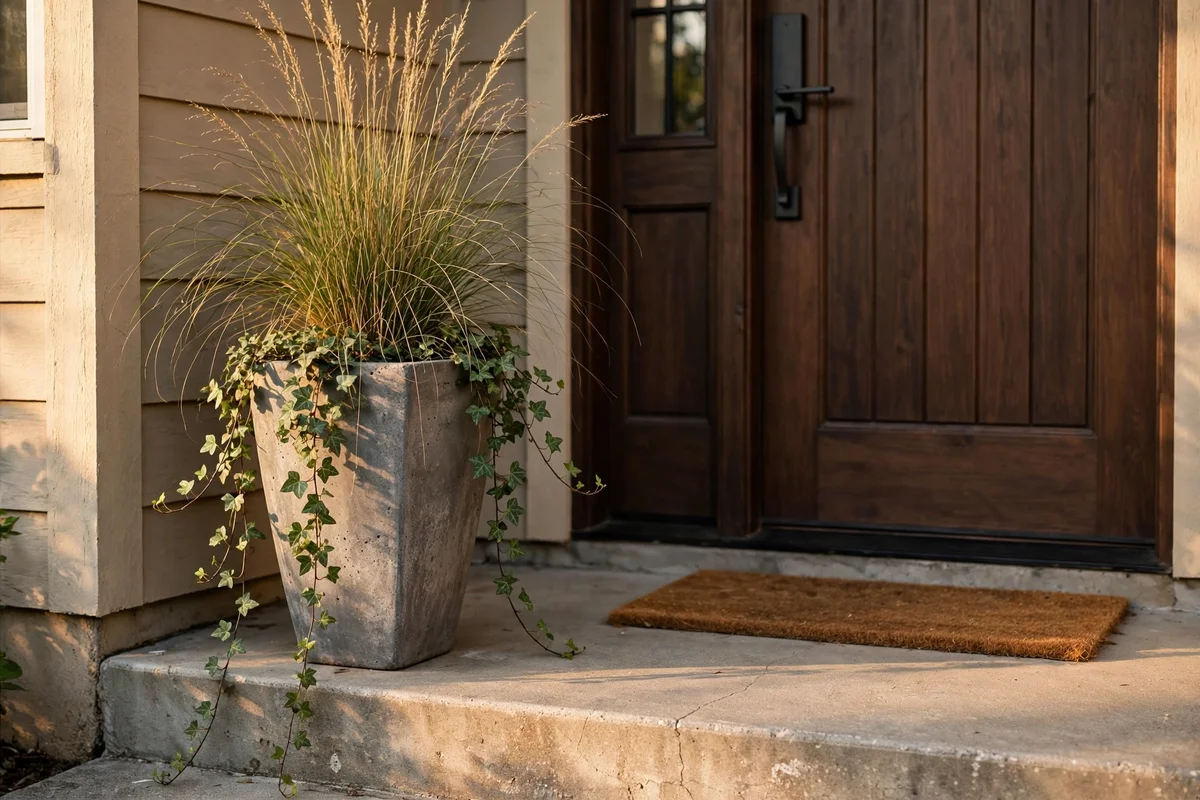
A stoop barely 90 cm wide cannot hold a seating set, but one tall planter 50 to 60 cm high beside the door gives the whole entrance autumn presence. Choose a narrow urn or tapered pot under 30 cm wide so the walkway stays clear, and plant it with a single ornamental grass plus a trailing edge of ivy. Keep everything on the hinge side of the door, leaving the swing path fully open.
On a stoop, every item must earn its footprint, so skip stacked mats and use one slim coir mat only. Water the tall planter twice a week, since narrow pots dry fast. The mistake to avoid is a heavy stone urn with no anchor; a 15 kg pot can still tip in a gust, so wedge it against the wall. One good tall planter costs 25 to 50 dollars.
14. Anchor a Wide Veranda With Odd-Numbered Planter Groups
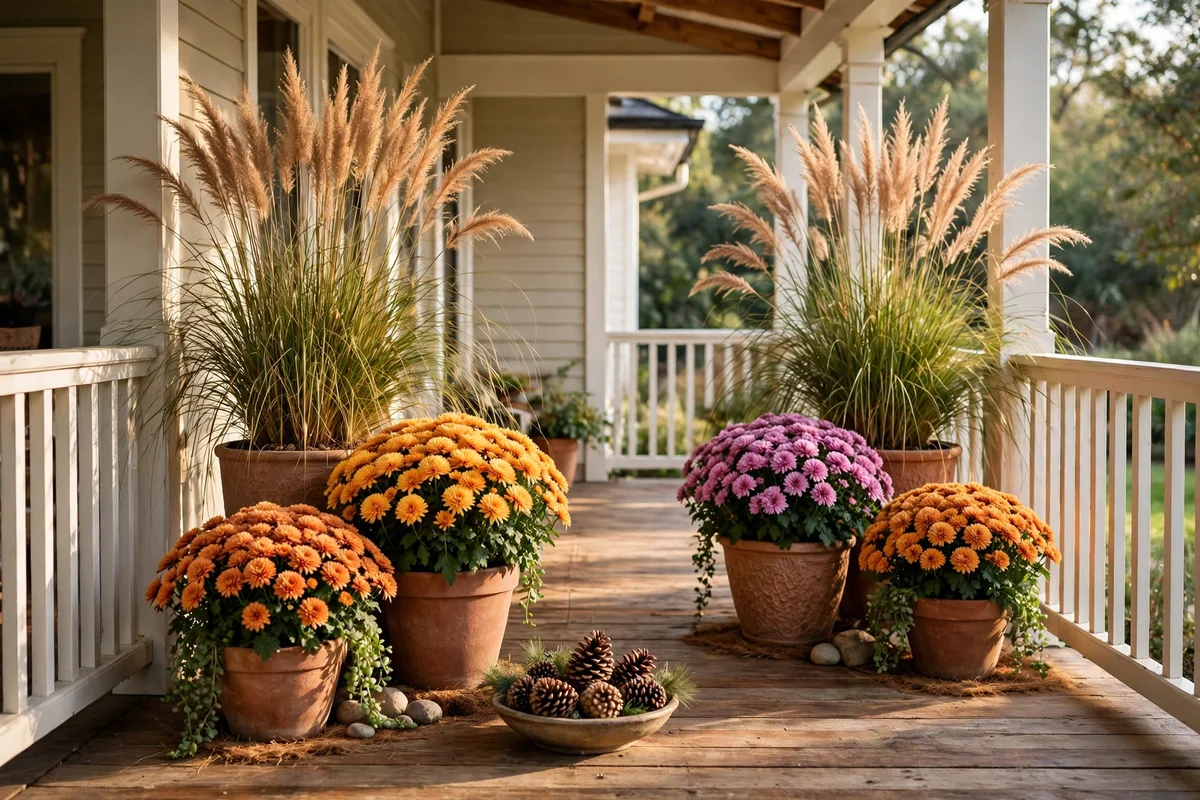
A wide veranda swallows pairs of pots, so group planters in threes and fives at staggered heights. Place the tallest pot, 60 to 70 cm, at the back near the wall, a mid pot of 40 cm in front, and a low bowl of 25 cm at the front edge. Repeat the grouping at the other end of the veranda for balance. Odd numbers read as natural; even numbers read as showroom rows.
Use the same pot material across the group, such as all terracotta or all weathered zinc, so the eye rests. Fill the tallest pot with ornamental grass for movement, the mid pot with mums, and the low bowl with pinecones and dried seed heads. The mistake to avoid is spreading ten small pots along the rail; three bold groups beat a scattered line. A group of three costs 40 to 70 dollars.
15. Choose Solution-Dyed Acrylic for Rainproof Softness

Solution-dyed acrylic is the fabric to look for on any cushion, throw or seat pad that lives outdoors. The colour is baked through each fibre rather than printed on top, so it survives rain and sun without fading for three to five seasons. Check the label for a water-repellent finish and a rub rating above 20,000 cycles for daily seating. It dries in under an hour after a shower, unlike cotton canvas.
Even weatherproof fabric needs airflow, so never leave cushions flat on a wet seat; stand them on edge or store them. Brush off leaves and pollen weekly with a soft brush, and spot-clean spills the same day. The mistake to avoid is machine-washing acrylic covers hot; lukewarm water and air drying keeps the water-repellent finish intact. Acrylic cushion covers cost 20 to 40 dollars each.
16. Secure Loose Decor With Hidden Anti-Wind Tricks
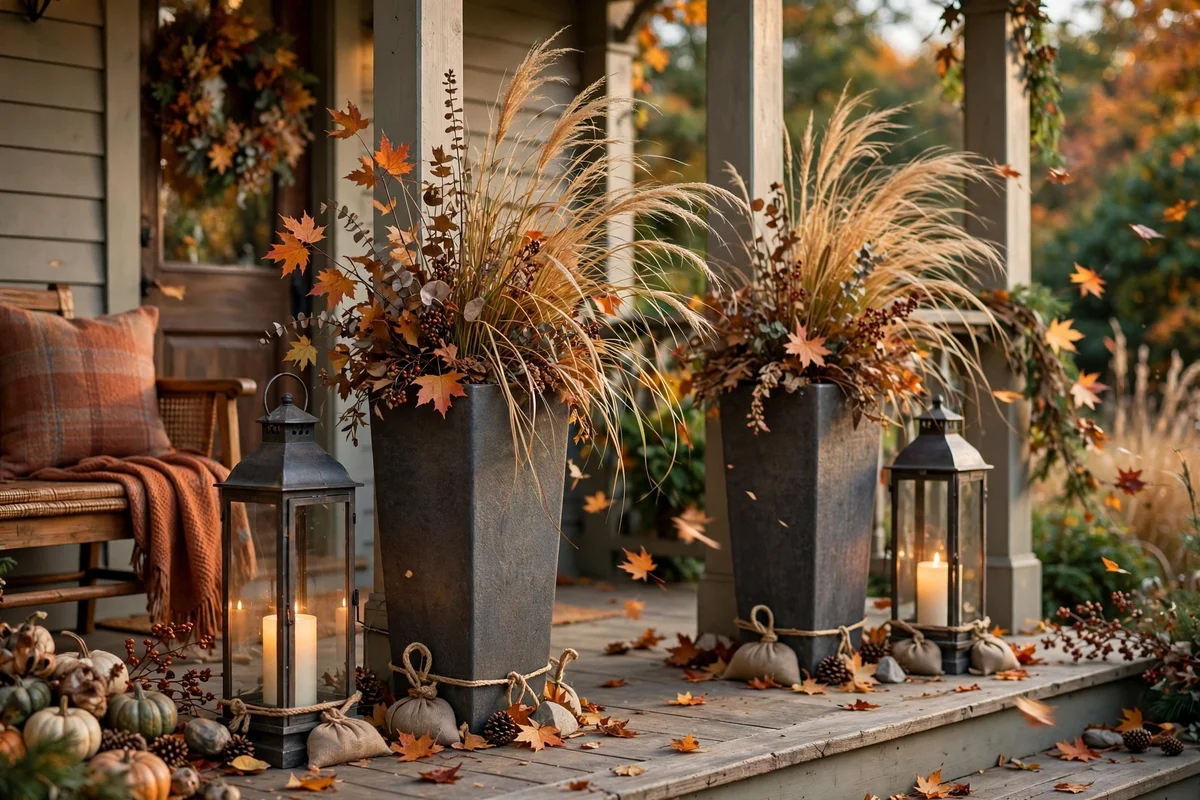
Autumn gusts undo porch styling overnight, so anchor everything invisibly. Place a 2 kg bag of sand or gravel inside tall planters before planting, thread fishing line through lantern handles and tie it to the rail, and press museum gel under lightweight trays and frames. Choose a heavy coir mat over a featherweight printed one, and stop mat corners creeping with two discreet pebbles tucked beneath them.
Test each anchor by giving the item a firm shake; if it shifts more than a few centimetres, add weight. Bring throws and the drink tray indoors during storm warnings, since no anchor saves flying fabric. The mistake to avoid is glueing anything to the porch floor, which damages surfaces and fails anyway; weight and ties work better. A full windproofing kit of sand, line and gel costs under 15 dollars.
17. Fill a Galvanized Bucket With Dried Wheat Stems

A galvanized bucket 25 to 30 cm tall filled with dried wheat stems adds height and harvest texture beside the door or bench. Bundle 30 to 40 stems with twine, trim them to 70 to 80 cm, and fan them out so the heads catch the light. The zinc finish of the bucket suits both rustic and modern porches. Place the bucket on the wall side of the walkway so brushing past does not scatter stems.
Keep the bucket under the porch roof, since soaked wheat droops and moulds. Shake the bundle outdoors monthly to release dust, and replace the stems each autumn; a year-old bundle looks tired. The mistake to avoid is standing the bucket where the door swings; one thump sends forty stems across the porch. A bucket and fresh stems together cost 12 to 25 dollars.
18. Keep a Wicker Basket of Spare Blankets by the Bench
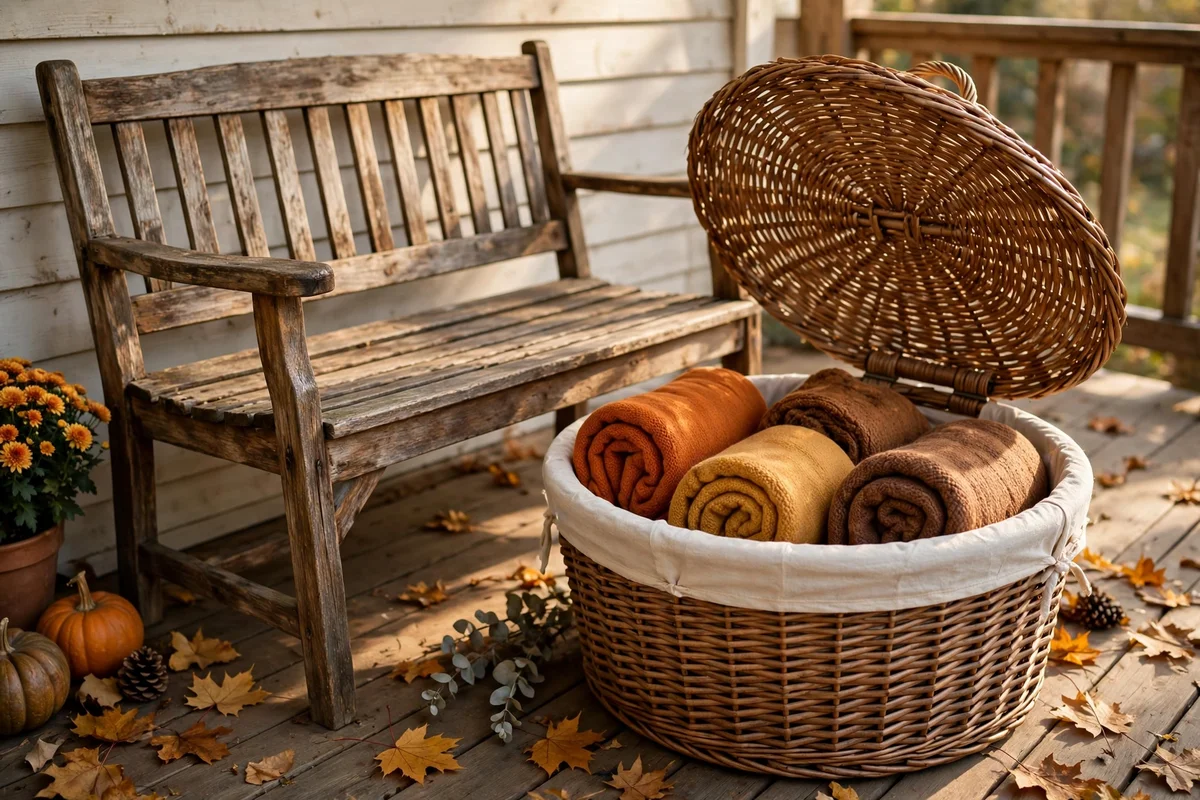
A lidded wicker basket 50 to 60 cm wide beside the bench holds two or three rolled blankets for chilly evenings. Choose a basket with a snug lid so damp cannot settle on the folded fabric, and line the inside with a cotton sack for extra protection. Roll rather than fold the blankets; rolled blankets fit better and unroll without creases. Keep the basket off the floor on small risers to dodge splashing rain.
Air the blankets in morning sun once a week to stop mustiness. Wash them monthly during the season, since porch dust and damp settle deep into folds. The mistake to avoid is an open basket, which collects rain and leaves in a week; the lid is the whole point. A good lidded wicker basket costs 25 to 45 dollars, and it earns the money every cold evening.
19. Stack Pumpkins in Three Graduated Sizes

Three pumpkins in graduated sizes, roughly 30 cm, 22 cm and 15 cm across, stack into a tidy tower beside the steps. Choose a flat-bottomed large pumpkin as the base, and keep the tower to three so it stays stable in wind. Mix one classic orange with two in cream or deep green for a grown-up palette. Real pumpkins last four to six weeks in cool autumn air; faux ones last for years.
Set the stack on a bed of straw or a coir mat so the base pumpkin never sits in standing water. Check the bottom pumpkin weekly for soft spots, and compost any that turn. The mistake to avoid is carving display pumpkins early, since carved pumpkins collapse within days; keep this stack whole. Three real pumpkins cost 12 to 20 dollars; quality faux ones run 25 to 45.
20. Wind Battery Fairy Lights Around the Porch Columns
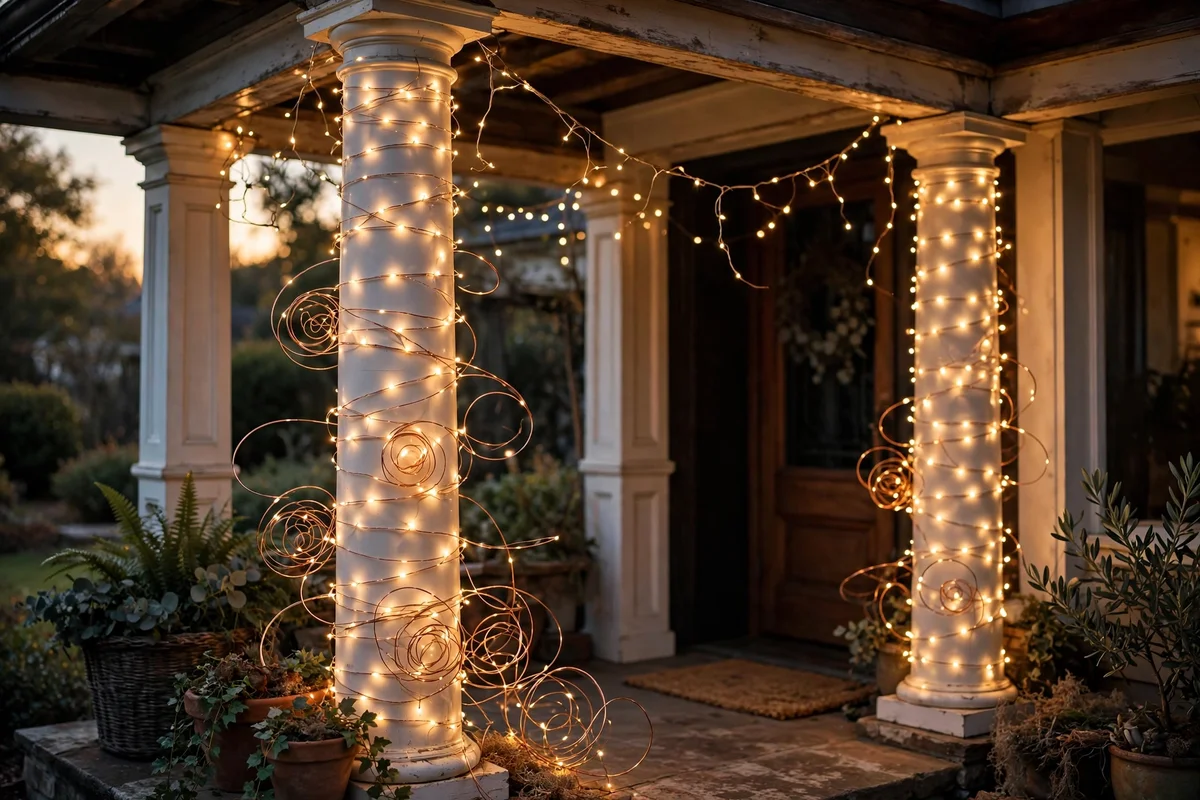
Battery fairy lights on a thin copper wire disappear by day and turn columns into glowing pillars at dusk. Wind one 5 metre strand per column, spacing the wraps 8 to 10 cm apart from base to top, and tuck the battery pack behind the column base where rain cannot reach. Choose warm white 2700K; multicolour strands break the calm mood. Two columns take about ten minutes to dress.
Use lights with a built-in six-hour timer so they switch off around midnight automatically. Keep a spare set of rechargeable batteries charged, since cold autumn nights drain batteries faster. The mistake to avoid is wrapping the wire tightly enough to dent the column finish; keep the wraps loose. A 5 metre strand costs 6 to 12 dollars, so even four columns stay cheap.
21. Run a Runner Mat Along a Long Porch Floor
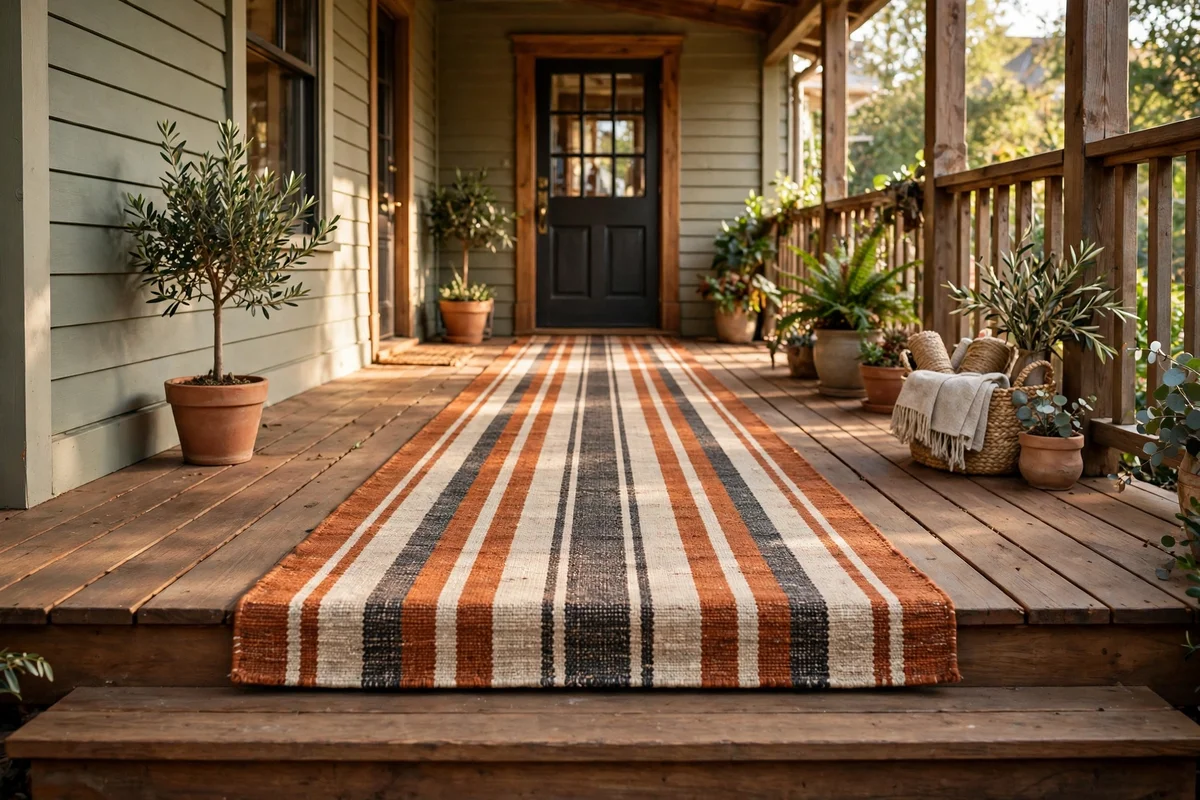
A runner 60 to 70 cm wide and 180 to 240 cm long guides the eye down a long porch and warms bare concrete underfoot. Choose a flatweave in a simple stripe or border pattern, in rust, cream and charcoal, so it reads from the street. Centre it on the walking line from steps to door, leaving at least 15 cm of bare floor each side. A low pile under 1 cm keeps the door sweep clear.
Shake the runner out weekly and hose it down monthly, drying it fully before relaying. In heavy rain weeks, roll it up and store it upright; a soaked runner left flat breeds mildew. The mistake to avoid is a runner without a non-slip underlay, which creeps across smooth concrete within days. A good outdoor runner costs 25 to 50 dollars.
22. Set a Coir Basket of Pinecones by the Door
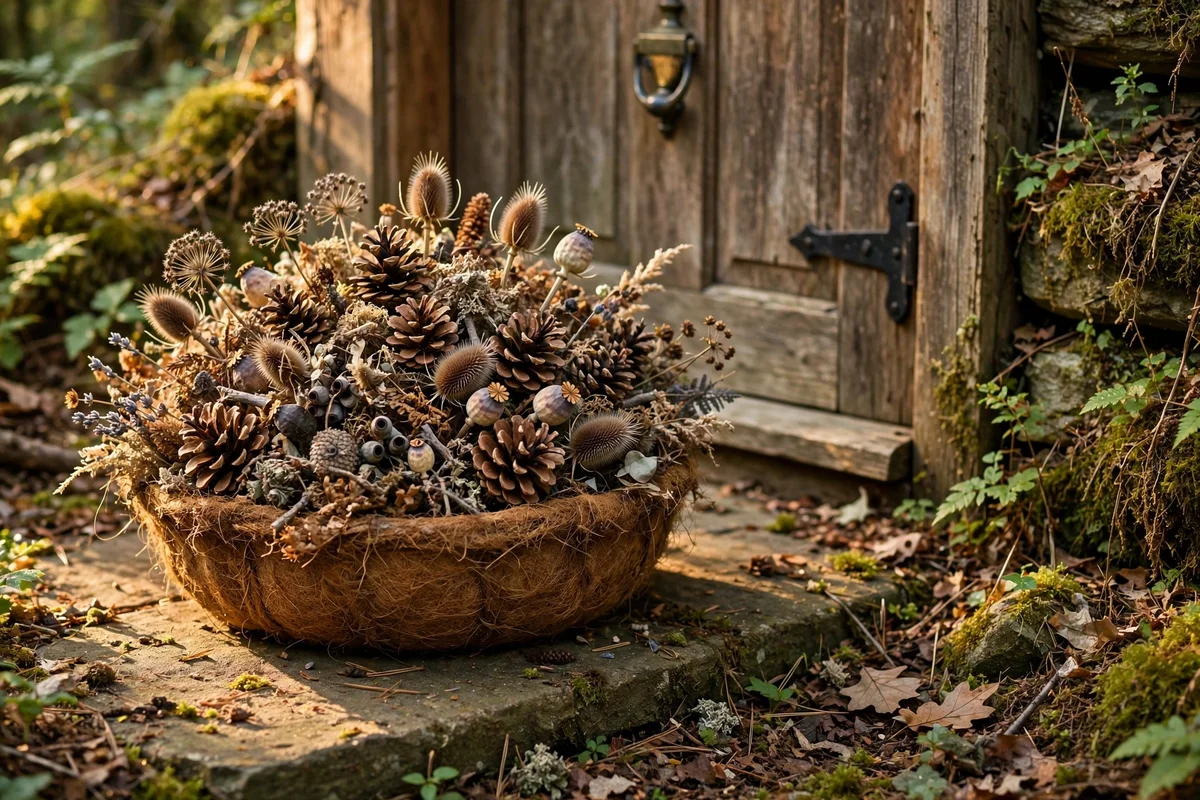
A shallow coir or seagrass basket 30 to 40 cm across filled with pinecones brings woodland texture to the doorstep for almost nothing. Gather cones in two sizes, large open ones and small tight ones, and mound them loosely so they spill naturally over the rim. Mix in a few dried seed heads or small gourds for variety. The basket sits best on the hinge side of the door, clear of the swing.
Bake gathered pinecones at 100 C for 45 minutes before display; the heat kills insects and opens the scales beautifully. Refresh the display by shaking out dust monthly. The mistake to avoid is placing the basket where the roof drips, since soaked cones close up and go grey. A basket and foraged cones cost 8 to 18 dollars, making this the cheapest idea in the set.
23. Line the Steps With Solar Stake Lanterns
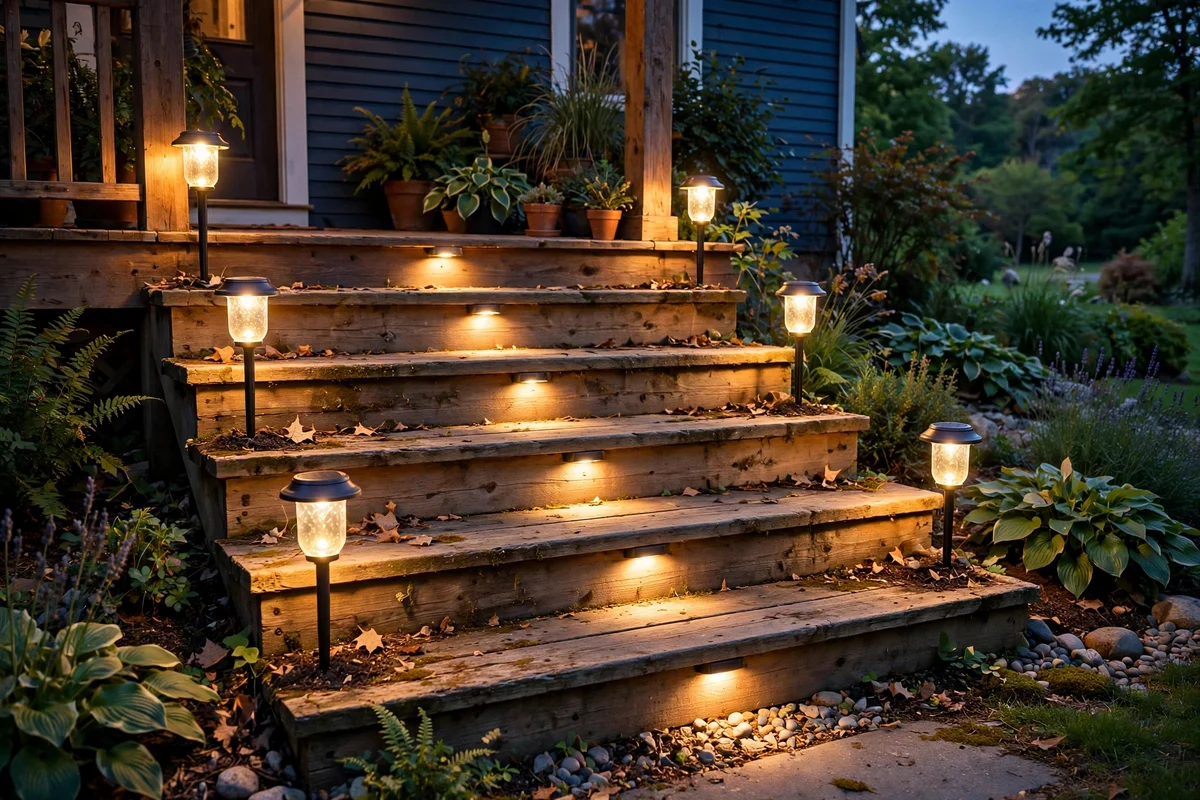
Solar stake lanterns turn the steps into a lit path without any wiring. Push one stake into the soil or a weighted pot base at each step, alternating sides for a zigzag rhythm, and choose lanterns 25 to 30 cm tall so they glow above the tread. Pick models with a warm 2700K LED and a real dusk sensor, not a fixed timer, so they adapt as evenings shorten. Three to five lanterns suit most step runs.
Wipe the solar panel monthly with a damp cloth; a dusty panel halves the charge and the lanterns die by 9 pm. In deep shade, move stakes to the sunniest nearby spot each morning. The mistake to avoid is cheap lanterns without replaceable batteries; when the cell dies in one season, the whole lantern becomes waste. Good solar lanterns cost 8 to 15 dollars each.
24. Build a Dusk Ritual Around Your New Porch Scene
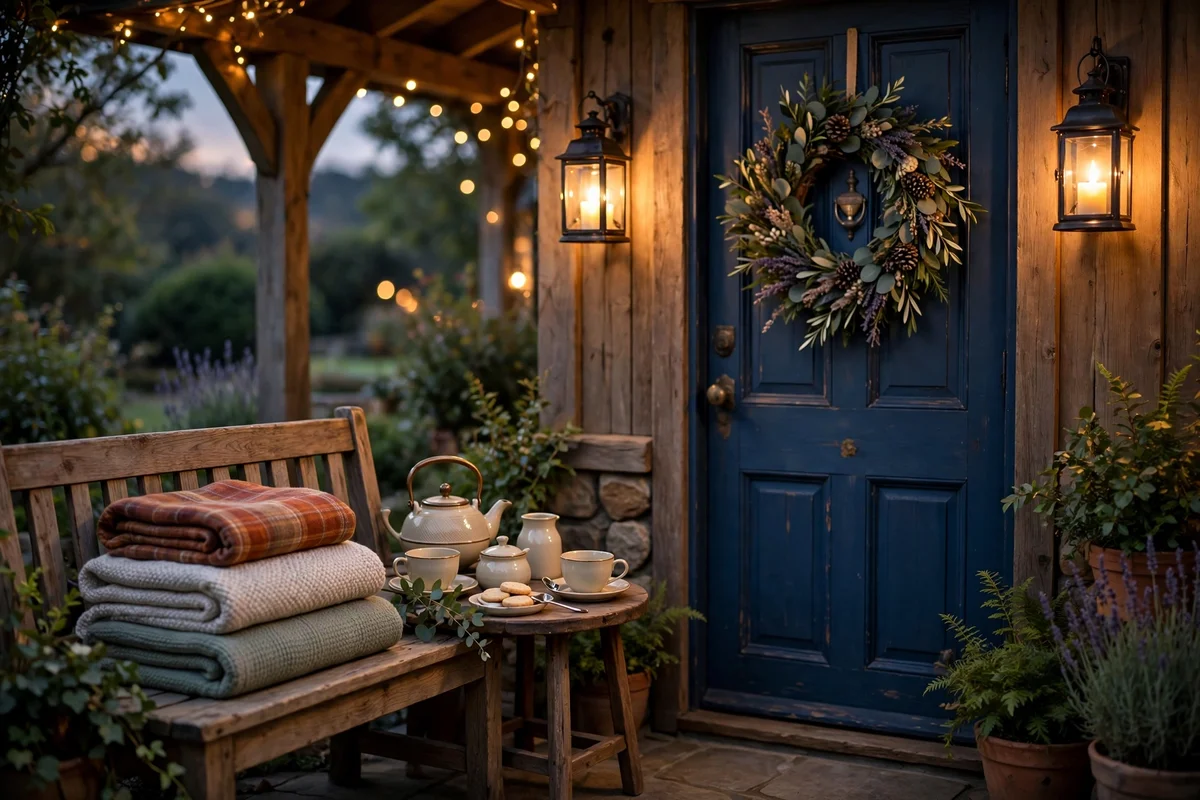
The styling works hardest when it becomes a habit. Set the lantern timers and festoon lights to switch on at 6 pm, lay the drink tray with the teapot before sunset, and fold the throws over the bench arms so the porch looks ready, not stored. Keep the side table stocked with mugs and a tin of tea bags through the season. Ten minutes of evening setup turns the porch into the room you actually use.
Invite the household onto the porch for the first ten minutes after arriving home, before the television or the chores begin. Watch how the dusk light moves across the wreath and the columns while the tea cools to drinking temperature. The mistake to avoid is treating the porch as decoration only; an unused porch slowly becomes storage. Use it nightly for a week and the habit will hold through winter.
A fall porch does not need every idea at once. The layered mats, the wreath and one warm light already carry most of the effect, and the rest can arrive week by week as the season deepens. Keep the palette tight, the fabrics weatherproof and the anchors hidden, and the whole scene will look after itself through wind and rain. What matters is that the porch greets you, not just your guests.
This week, start with the easiest win: hang the wreath, lay the two mats, and fit a dusk-to-dawn bulb in the porch fixture. That trio takes under an hour and costs less than dinner out, yet it changes the walk home immediately. Then add one idea each weekend, a lantern here, a pumpkin stack there, until the porch feels finished. By the first frost, coming home at dusk will honestly be the best part of your day.
Frequently Asked Questions
How much does a full fall porch refresh cost?
Between 150 and 400 dollars if you buy everything new, but you can start for under 60 with a wreath, two layered mats and a dusk bulb. Spend the biggest share on weatherproof cushions and a cedar storage box, since those last for years. Buy the seasonal plants last; mums and pumpkins are cheap and replaceable.
What if my porch is only a tiny stoop?
Choose three items maximum: a wreath on the door, one tall planter on the hinge side, and a single slim coir mat. Hang a lantern from a wall hook instead of using floor space, and skip seating entirely. Every piece should be under 30 cm wide so the walkway stays clear.
How do I keep porch decor from blowing away?
Weight tall planters with 2 kg of sand before planting, tie lantern handles to the rail with fishing line, and set museum gel under light trays. Bring throws and the drink tray indoors in storms. Test each piece with a firm shake; if it moves more than a few centimetres, add weight.
Which fabrics survive autumn rain on a porch?
Solution-dyed acrylic is the best choice; the colour runs through the fibre so it resists fading, rain and mildew for three to five seasons. Look for a water-repellent finish and quick drying. Avoid cotton canvas, which soaks through and grows mildew. Always bring cushions under cover in heavy storms.
When should I set up fall porch decor?
Start in mid-September so mums and grasses establish before the first frost, and keep the display through Thanksgiving. Swap the wreath and pumpkins first, since they set the tone fastest. Take down real pumpkins before hard frosts, and store cushions indoors once nightly temperatures drop near freezing.