Living Room
20 Cosy Fall Corner Decor Ideas That Turn Neglected Corners Into Favourite Spots
By Anna Wells · · 22 min read
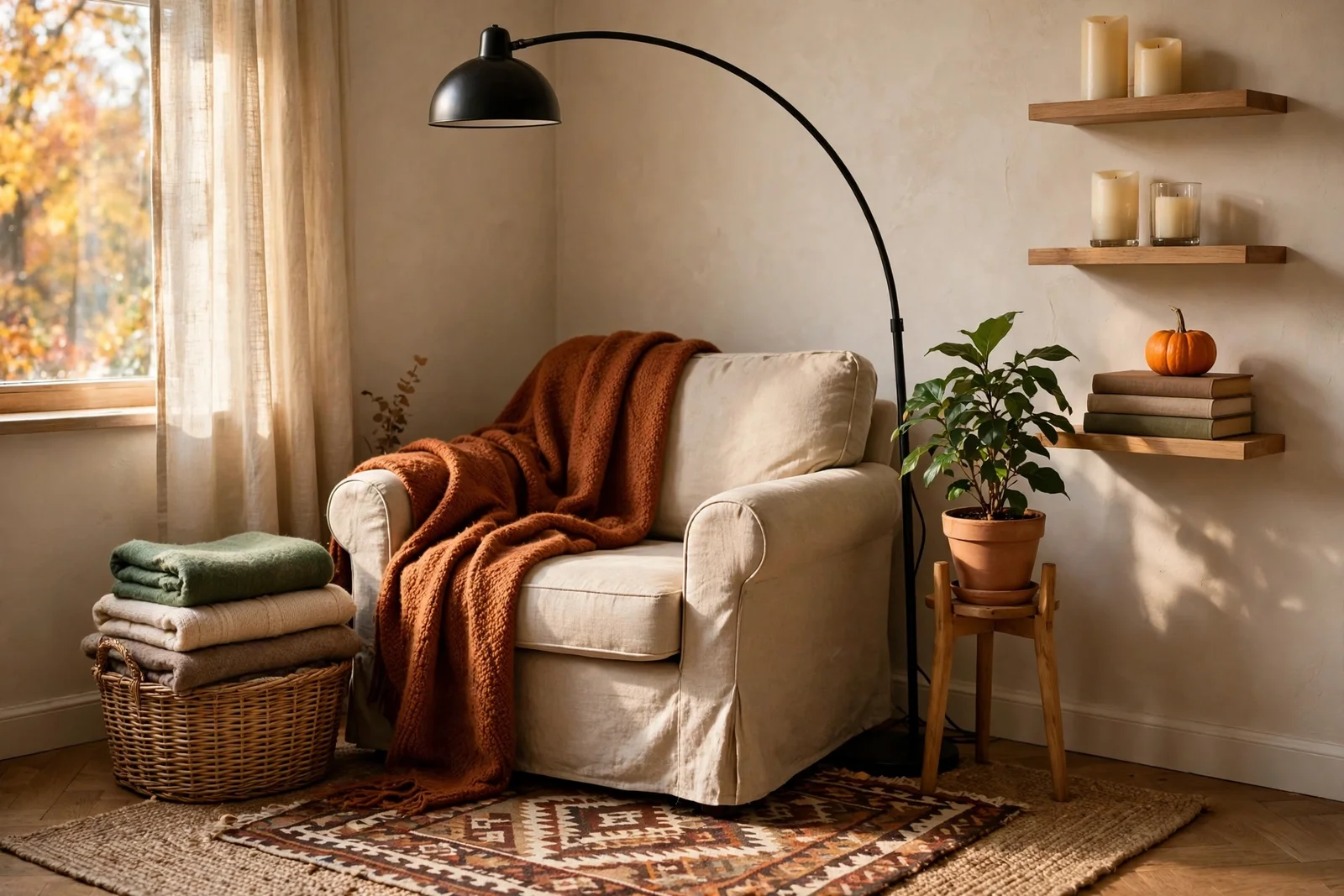
Twenty practical ways to turn forgotten room corners into warm autumn retreats, from angled armchairs to basketfuls of blankets.
There is a corner in almost every home that collects dust instead of memories: the awkward angle beside the sofa, the empty stretch by the bedroom window, the dining room corner that only ever holds a chair nobody uses. When autumn arrives, those corners feel even colder, because the season asks for warmth and they have none to give.
The good news is that a corner needs very little to become the favourite spot in the room. An armchair angled into the angle, a basket of throws within reach, a pool of lamplight at ankle height: small, honest pieces arranged with care do the whole job. Nothing here needs building skills or a big budget.
This collection brings 20 concrete ideas for fall corners in living rooms, bedrooms, dining rooms and halls. Every idea names the pieces, the sizes and the placement, plus one mistake to avoid, so you can copy a corner exactly or mix pieces across the set.
Start with the idea that fits the corner you already own, then add one piece at a time. By the end of the list you will have a warm, working plan for every neglected corner in the house.
1. Angle a Small Armchair Into the Corner and Drape a Wool Throw Over One Arm
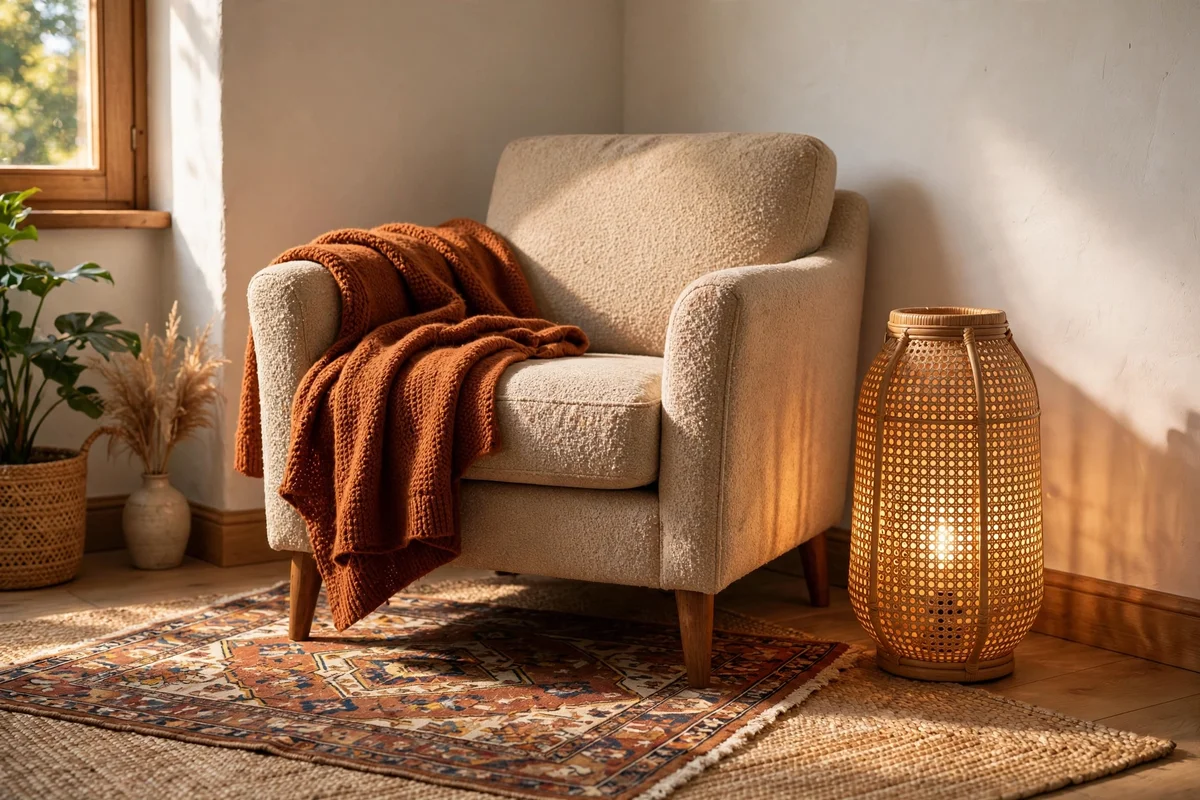
An armchair between 60 and 75 cm wide fits most living room corners without dominating the room. Pull it 10 to 15 cm out from each wall and angle it near 45 degrees so the seat faces the room, not the walls. This opens a small triangle of space behind the chair, ideal for a floor lamp cord or a slim plant stand. Choose a seat height around 45 cm, which pairs well with a low footstool later. Solid oak legs suit autumn and survive daily use.
Fold a wool or wool-blend throw to about 40 cm wide and drape it over one arm, letting 30 to 50 cm hang down the side. A throw in rust, ochre or deep green ties the corner to the season without a full redecorate. Keep the rest of the chair clear so sitting down is one motion, not a reshuffle. The mistake to avoid is pushing the chair flat against both walls, which traps the sitter and blocks the plug sockets behind. Budget option: a sturdy second-hand armchair plus one new throw costs under 90 pounds or dollars.
2. Stack Three Floor Cushions in Harvest Tones for a Quick Perch
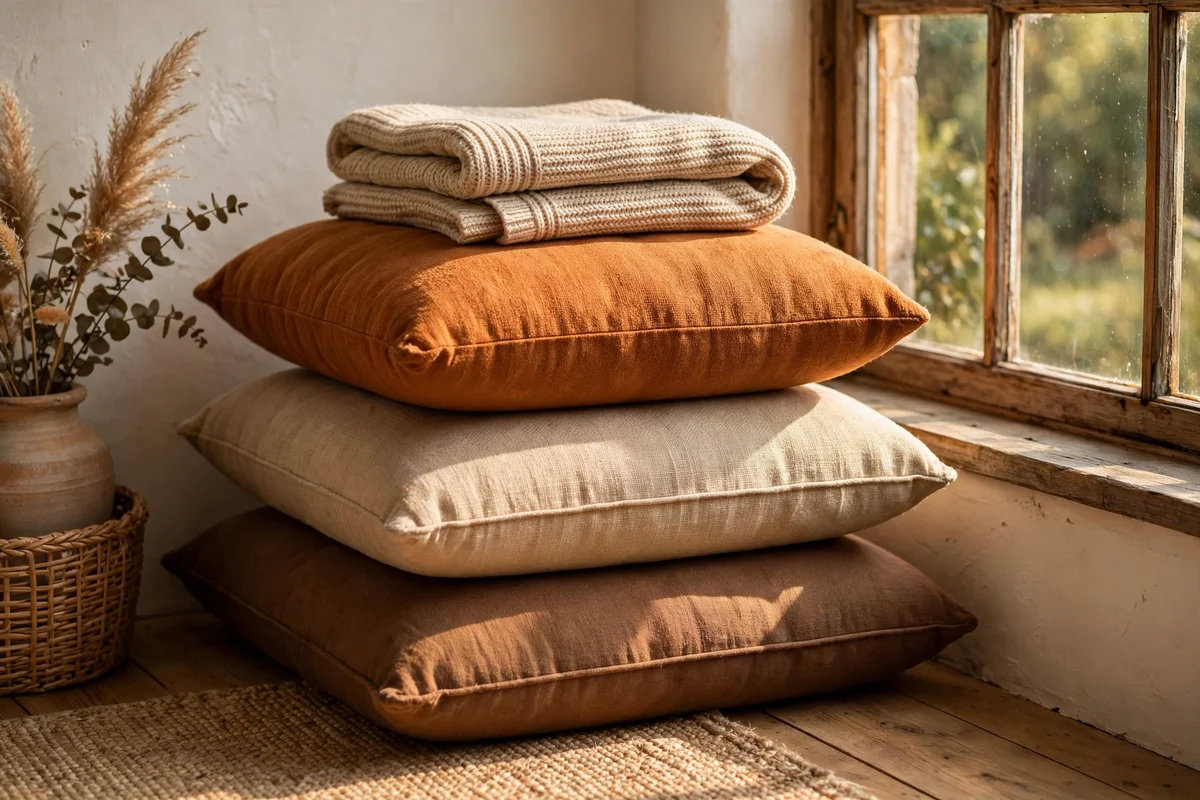
Three floor cushions, each 50 to 60 cm square and 15 to 20 cm thick, stack into a neat perch beside a low window or in a hall corner. Pile them largest at the bottom and rotate the top one 45 degrees so the stack looks casual, not sloppy. Harvest tones like pumpkin, wheat and warm brown link the corner to autumn without a single new furniture piece. When guests arrive, the stack splits into extra seating in seconds. Choose washable cotton or canvas covers since floor cushions collect dust faster than chair seats.
Keep the stack against the wall on a small washable rug so the bottom cushion stays clean and the whole perch reads as a deliberate spot. Fluff the filling weekly by shaking each cushion and leaving it in fresh air for an hour, which keeps the loft even. The mistake to avoid is using slippery satin or velvet covers, which slide off the stack the moment someone leans in. Budget route: three plain inserts plus separate autumn covers usually total 35 to 55 pounds or dollars, cheaper than one new chair.
3. Fill a Woven Basket With Two Folded Blankets for Grab-and-Go Warmth
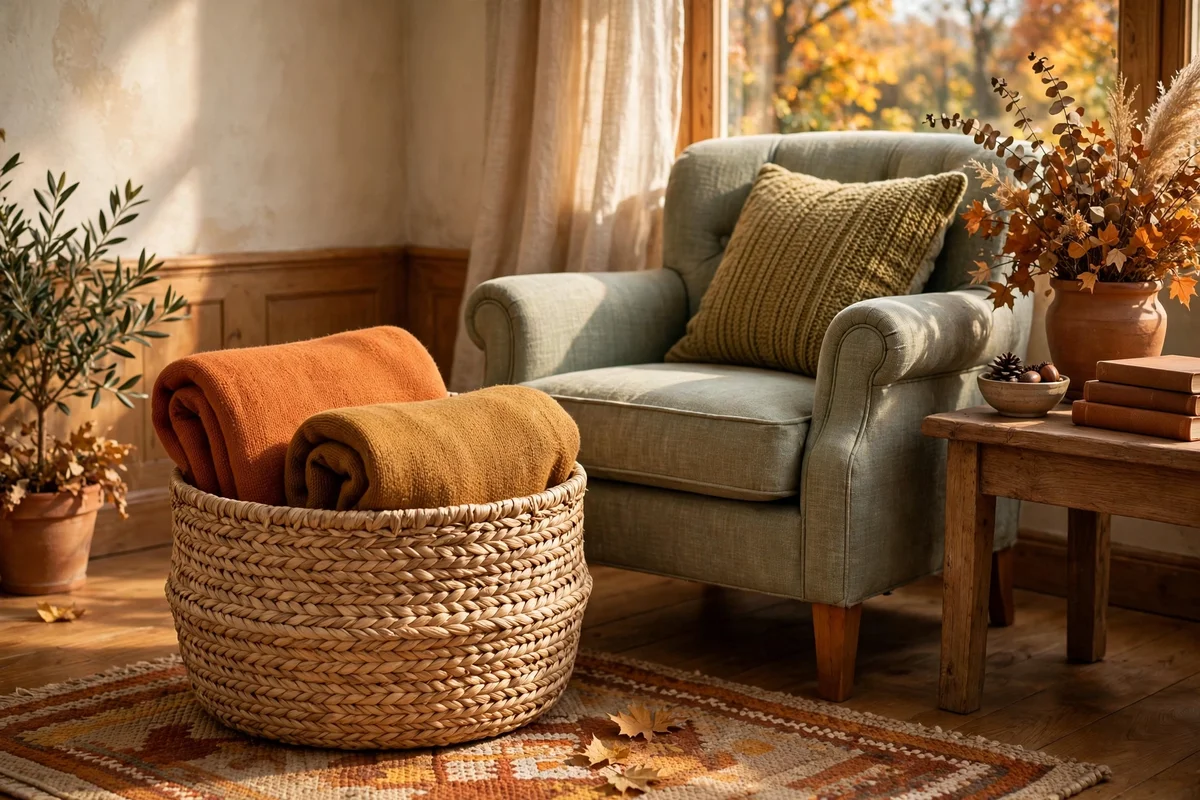
A round woven basket 40 to 50 cm wide and 35 to 45 cm tall holds two folded throws well, with the tops fanned for a soft look. Set it beside the armchair or at the foot of the bed so a warm layer is within arm’s reach. Seagrass or willow baskets suit autumn because their tan colour echoes the season, and the weave lets blankets breathe instead of trapping damp. Fold each throw into thirds lengthwise, then roll or fold into a 30 cm bundle that stacks neatly. Two blankets are enough for a couple sharing the corner.
Keep the basket on a cork or felt pad if the floor is polished wood, because damp basket bases can mark the finish over time. Shake the throws out once a week to stop the fibres flattening where they are folded. The mistake to avoid is stuffing the basket so full the blankets crease and lose their softness; two is the right number, with a third draped over the chair instead. Mid budget: a large handwoven basket plus two wool-blend throws usually costs 45 to 70 pounds or dollars.
4. Mount Two Floating Corner Shelves for Books and Small Autumn Pieces
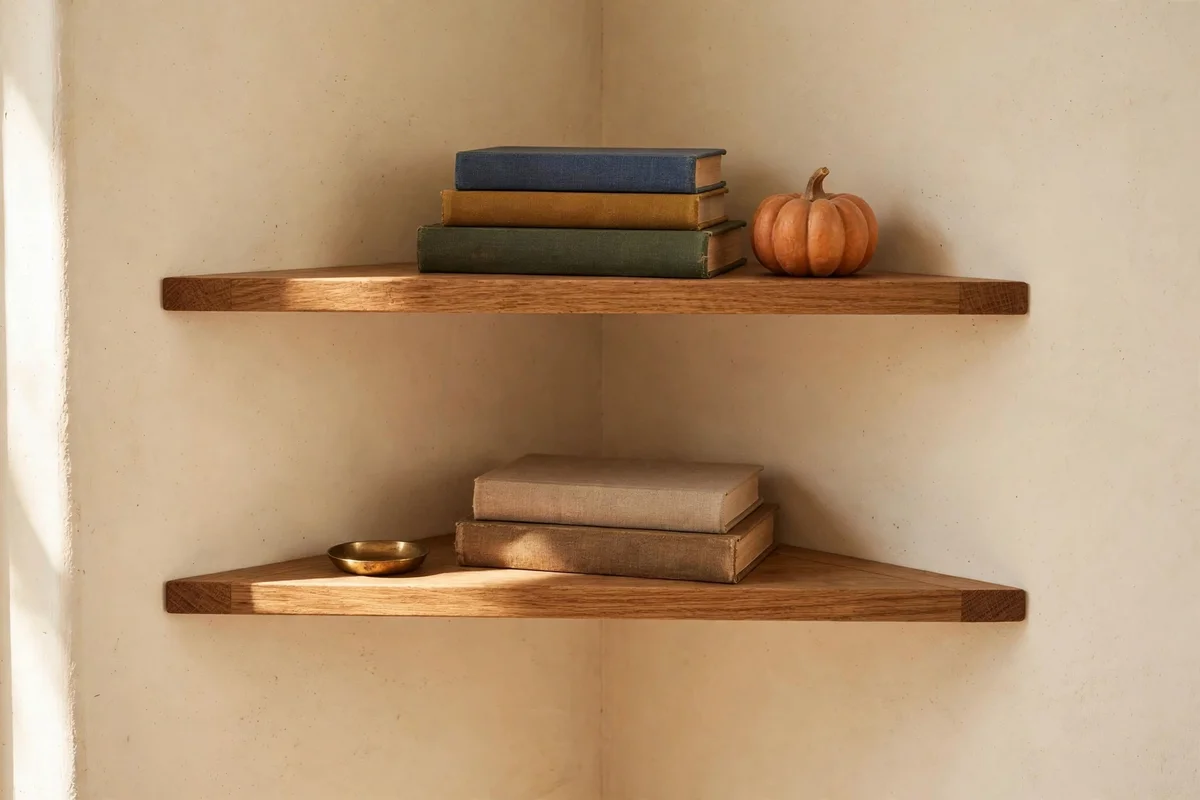
Two floating shelves, each 30 to 45 cm long, mounted one above the other with 25 to 30 cm between them, turn a bare corner into display space. Position the lower shelf about 120 cm from the floor so books and small pieces sit at easy eye level from a chair. Fix both into studs or use heavy-duty plaster anchors rated for at least 10 kg, since shelves loaded with books get heavy fast. Solid pine or oak boards 2.5 cm thick look warm against cream or sage walls. Keep brackets hidden for a clean floating line.
Style the lower shelf with four to six books stacked flat or upright, then add one small pumpkin and a tiny brass dish on the upper shelf. Leave at least one third of each shelf empty so the display breathes instead of crowding. Wipe shelves with a dry microfibre cloth monthly, as dust shows fast on dark wood in autumn light. The mistake to avoid is mounting shelves above a door swing or a walkway, where books get knocked off by passing shoulders. Budget build: two pine boards plus concealed brackets usually costs 20 to 35 pounds or dollars.
5. Arc a Floor Lamp Over the Corner for Soft Overhead Light
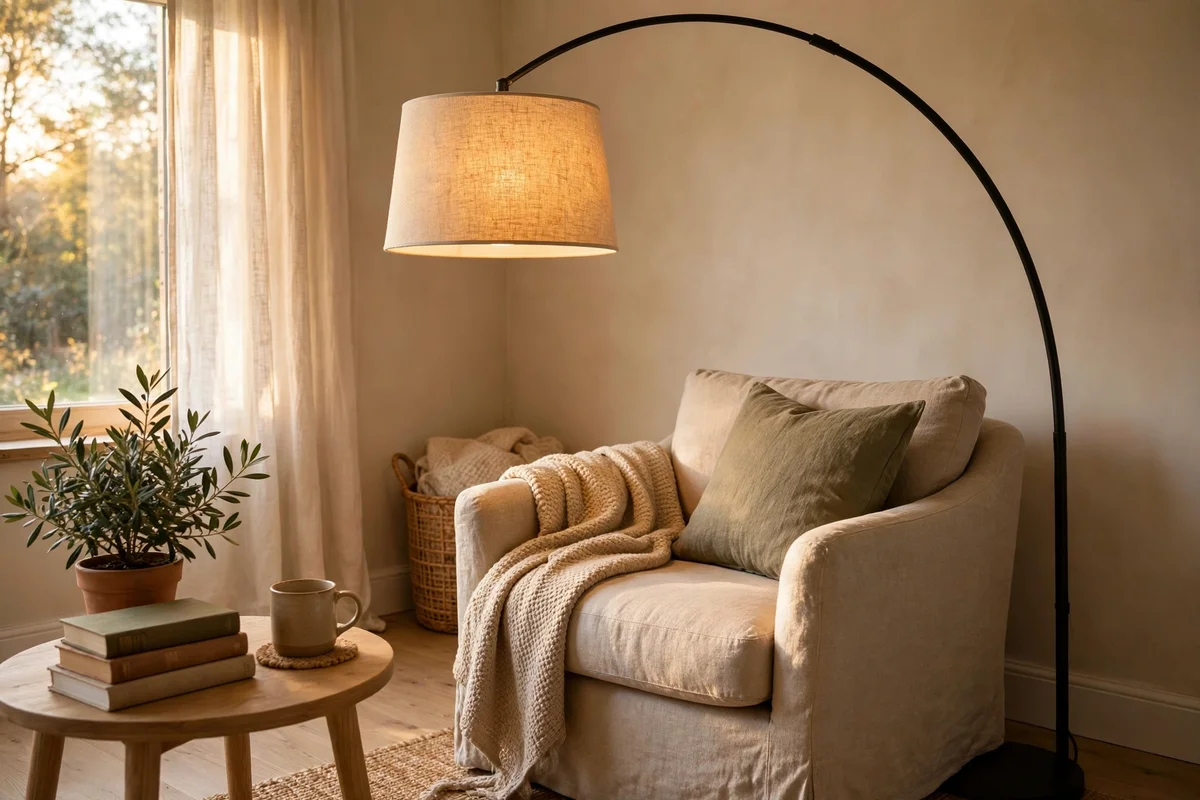
An arc floor lamp with a 150 to 180 cm reach throws warm light over a corner chair, which ceiling lights never manage. Place the base 40 to 50 cm behind or beside the chair so it never blocks the walking path into the corner. Aim the shade to sit about 140 cm above the seat, high enough to clear the reader’s head but low enough for task light. A linen or paper shade in cream spreads the glow softly; avoid bare bulbs that glare from the side. Use a warm 2700K bulb near 800 lumens for reading comfort.
Run the cord along the wall edge and secure it with adhesive clips every 40 cm so nobody trips on the way to the chair. A lamp with an inline foot switch or a remote dimmer saves the reader from getting up to adjust the light. Dust the shade monthly with a brush, since dust dulls light output over autumn and winter. The mistake to avoid is a lamp whose arc is too short, which parks the shade behind the reader’s head and casts shadows on the page. Mid budget arc lamps cost 60 to 120 pounds or dollars.
6. Raise a Leafy Plant on a Wooden Stand to Fill the Vertical Space
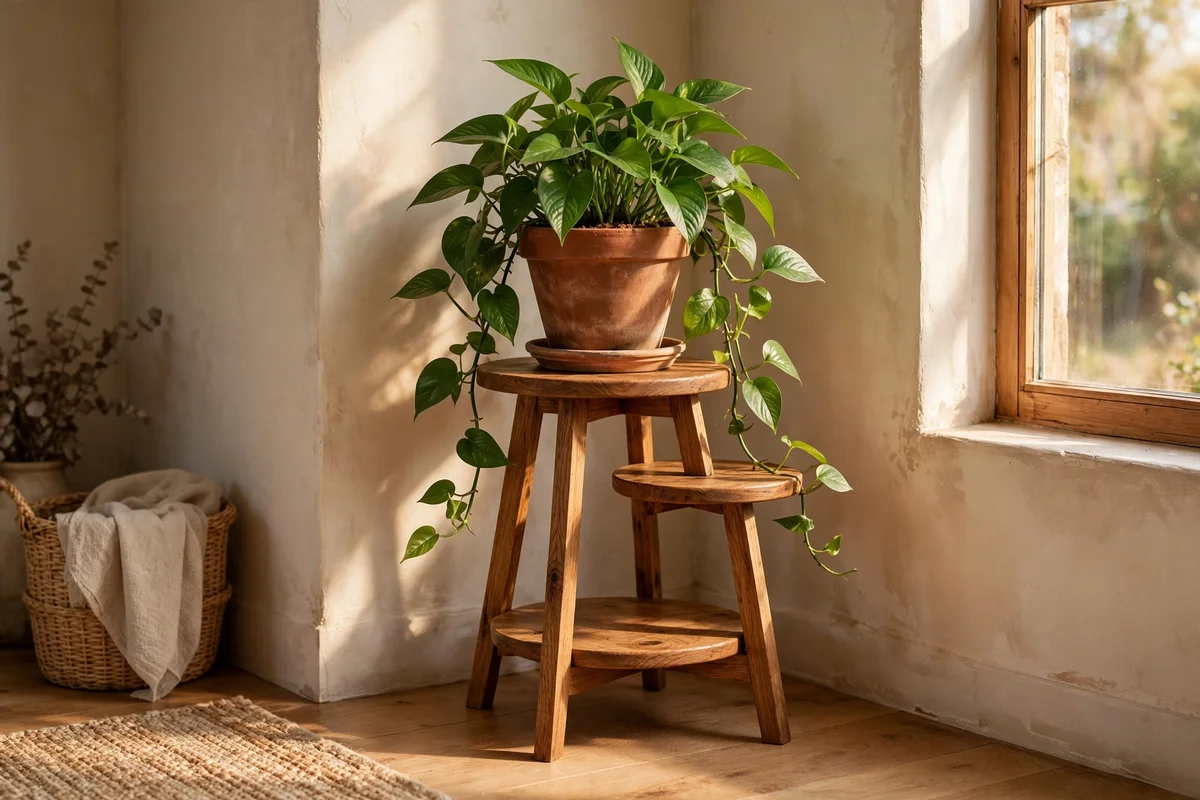
Corners often waste the vertical metre above a chair, and a plant on a 40 to 60 cm wooden stand fills it. Choose an easy-care plant like a ZZ plant, peace lily or snake plant in a 15 to 20 cm pot, all of which tolerate the lower light of a corner. The stand lifts the foliage into the light path and keeps leaves clear of the chair back. Terracotta pots or a woven seagrass cover suit autumn tones. Place the stand 20 to 30 cm from the wall so air moves behind the leaves and watering is easy.
Water only when the top 3 cm of soil feels dry, which usually means every 7 to 10 days in autumn, and empty the saucer after watering. Turn the pot a quarter turn every two weeks so growth stays even and the plant does not lean toward the window. The mistake to avoid is a thirsty fern or a plant with dropping berries in reach of small children; choose sturdy, safe foliage instead. Budget setup: a wooden stand plus a nursery plant in a terracotta pot usually totals 25 to 45 pounds or dollars.
7. Top a Stack of Three Books With a Small Faux Pumpkin

Three hardback books, each roughly 23 cm tall, stacked flat make a neat little pedestal about 10 cm high on a corner side table. Lay them largest at the bottom with spines facing out for a tidy look, then set one small faux pumpkin of 8 to 12 cm on top. Faux pumpkins hold their colour all season and survive bumps from elbows and toddlers, which real ones do not. Pick books with cloth covers in rust, cream or forest green so the stack reads autumnal from across the room.
Keep the stack clear of the table edge by at least 15 cm so the pumpkin cannot be knocked to the floor. Dust the pumpkin with a dry cloth when you dust the table, since orange surfaces show grey dust quickly. The mistake to avoid is piling seven or eight books into a wobbly tower; three sturdy volumes stay put and the proportions look intentional. Budget route: charity-shop hardbacks plus one faux pumpkin from a craft store usually costs under 15 pounds or dollars.
8. Layer a Jute Rug Under a Smaller Wool Rug at a 45-Degree Angle
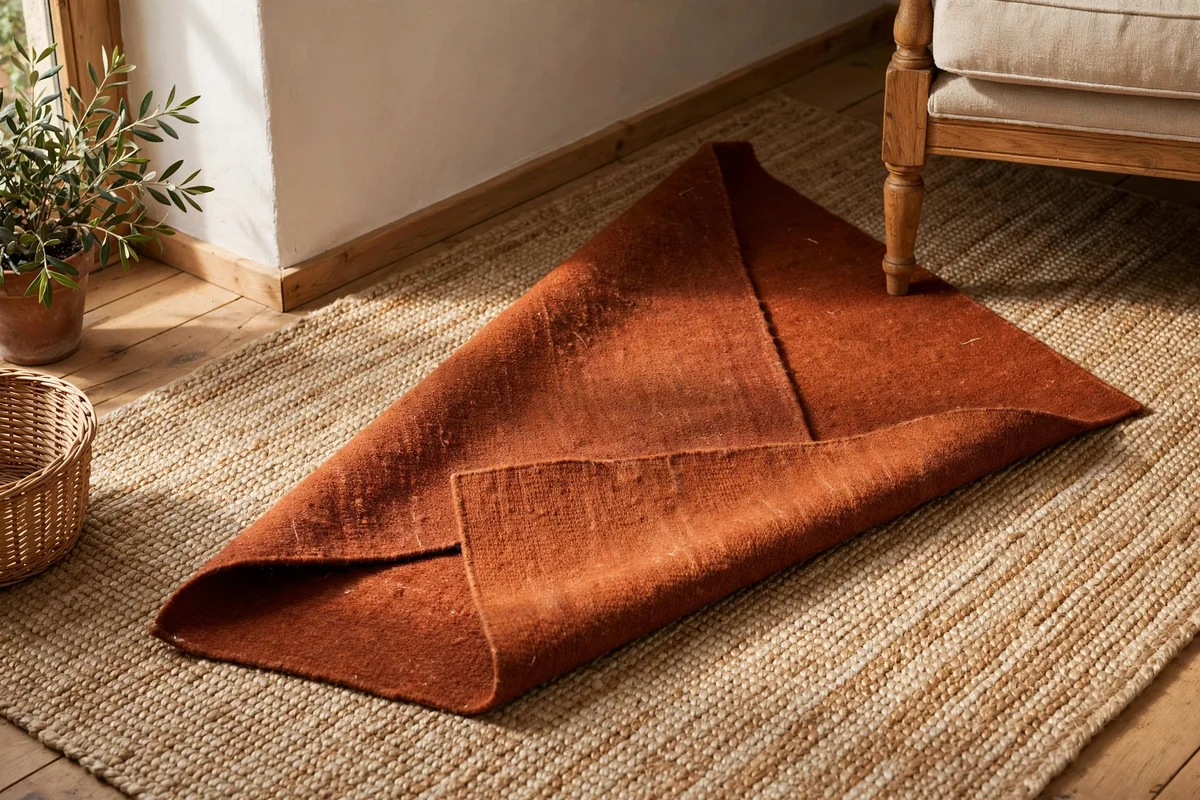
Layering rugs defines a corner instantly without moving a single wall. Lay a flat jute rug about 150 by 230 cm first, then turn a smaller wool rug of 120 by 170 cm at 45 degrees over it so the corners peek out. The natural jute adds texture while the wool layer brings warmth and autumn colour like rust or oatmeal. This double layer also softens hard floors under a chair and footstool. Keep both rugs flat with a low-profile rug pad underneath to stop slipping and curling.
Vacuum the top rug weekly and shake out the jute layer monthly, since grit settles between layers and wears the fibres. If a corner lifts, press it with double-sided rug tape rather than tucking it under furniture, which creates a trip ridge. The mistake to avoid is layering two thick pile rugs, which wobbles under chair legs; one flat base plus one medium pile is the stable mix. Budget layering: a jute base plus a patterned wool-look rug usually totals 70 to 110 pounds or dollars.
9. Line a Shelf With Three Flameless Candles in Amber Glass Holders
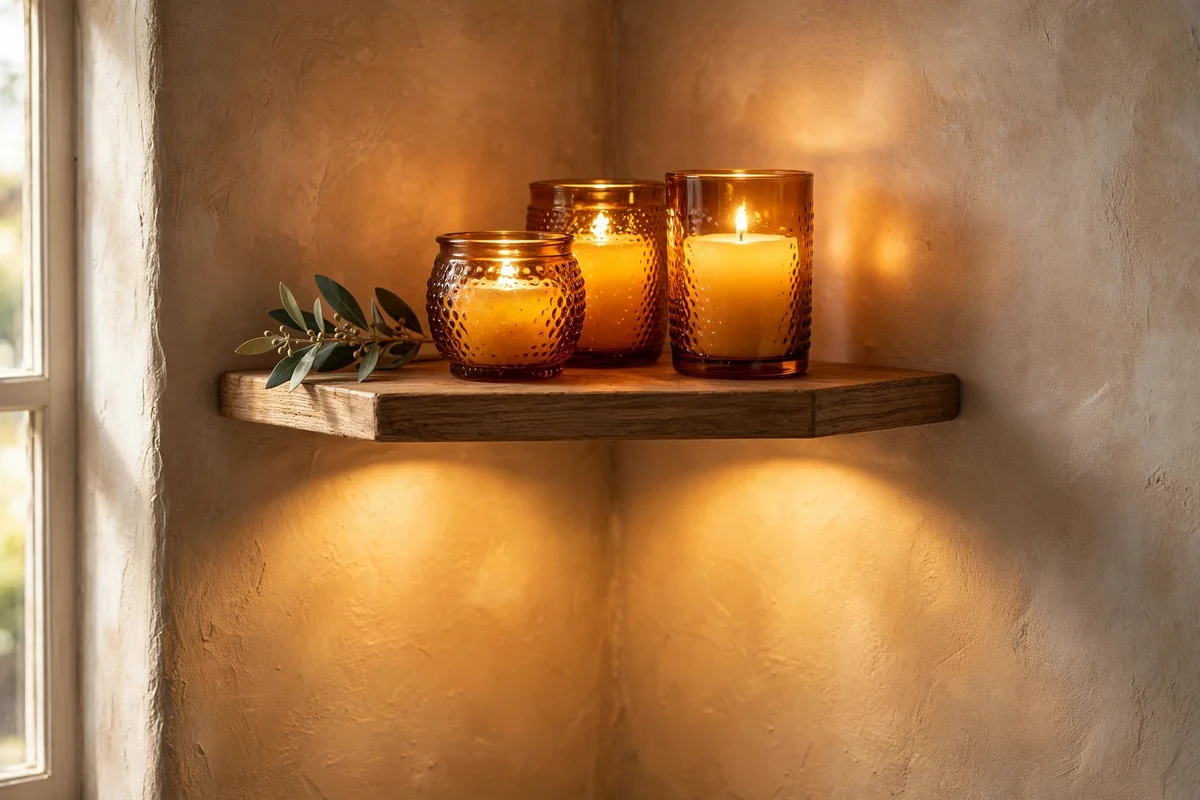
Three flameless candles in amber glass holders, each 8 to 12 cm tall, bring candlelight to a corner shelf with no flame and no worry. Set the trio 10 to 15 cm apart on a floating shelf or mantel corner so the glow pools across the wall behind. Amber glass warms the white LED light into a convincing honey tone that suits autumn evenings. Choose candles with a built-in timer so they switch on at dusk and off six hours later without a thought. Keep them clear of books and fabric by at least 10 cm for a tidy look.
Replace the batteries once a season, usually two AA cells per candle, and wipe the glass with a damp cloth to keep the glow bright. Because there is no flame, these candles suit shelves in bedrooms and halls where real candles would be unsafe. The mistake to avoid is mixing warm-white and cool-white candles in one corner, which makes the light look uneven and artificial. Budget set: three amber glass flameless candles with timers usually costs 18 to 30 pounds or dollars.
10. Hang a Small Round Mirror Above the Corner to Bounce Afternoon Light
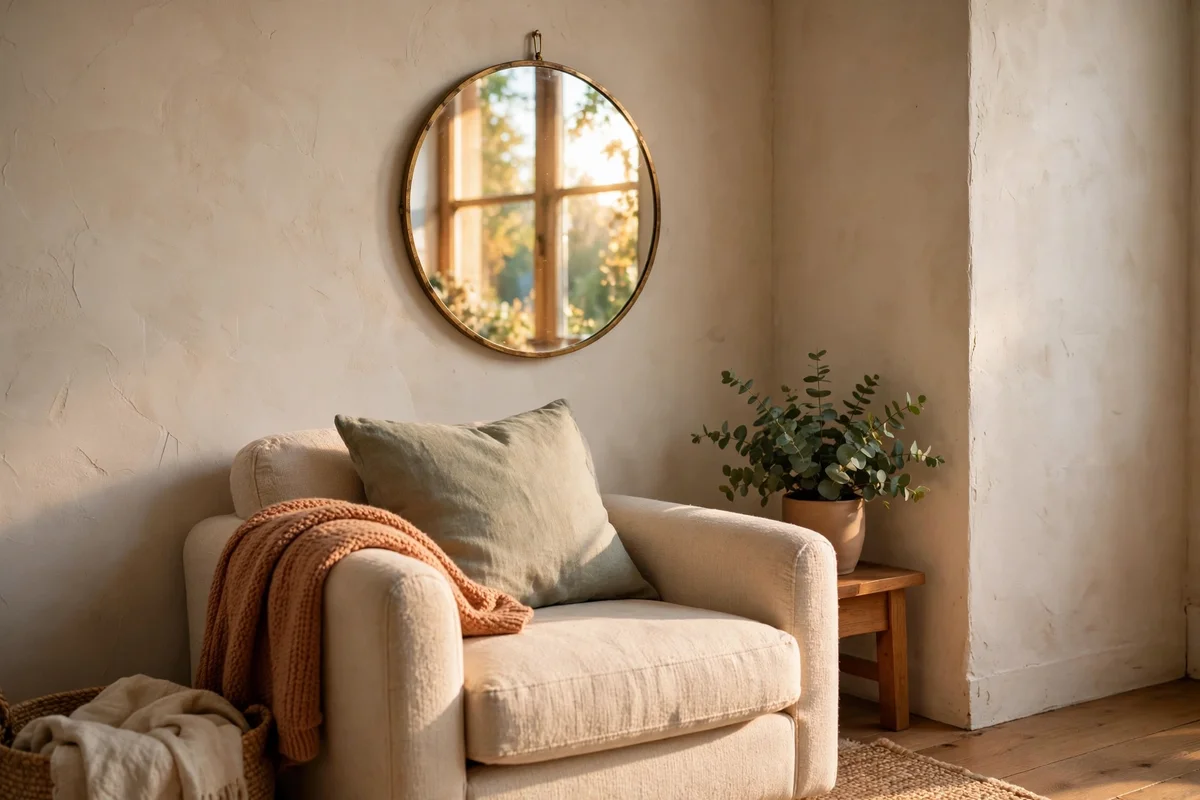
A round mirror 40 to 60 cm across, hung 150 to 160 cm from the floor at the corner angle, doubles the afternoon light that reaches the chair. Hang it where it reflects a window or a lamp, never a blank wall, so it earns its place. A thin brass or oak frame keeps the mirror warm and seasonal rather than stark. Fix it on a proper wall hook rated for the weight, since even a small mirror can weigh 3 kg. In a dining room corner it also makes the space feel wider at evening meals.
Clean the glass monthly with a microfibre cloth and a little white vinegar in water, which cuts the haze without streaks. Check the hook every season by giving the mirror a gentle tug, as temperature changes loosen fixings over time. The mistake to avoid is hanging the mirror so high it only reflects the ceiling; light bouncing off the ceiling does nothing for a reading corner. Budget option: a round rattan or thin-framed mirror usually costs 25 to 45 pounds or dollars.
11. Set a Low Stool Beside the Armchair as a Tea and Book Table
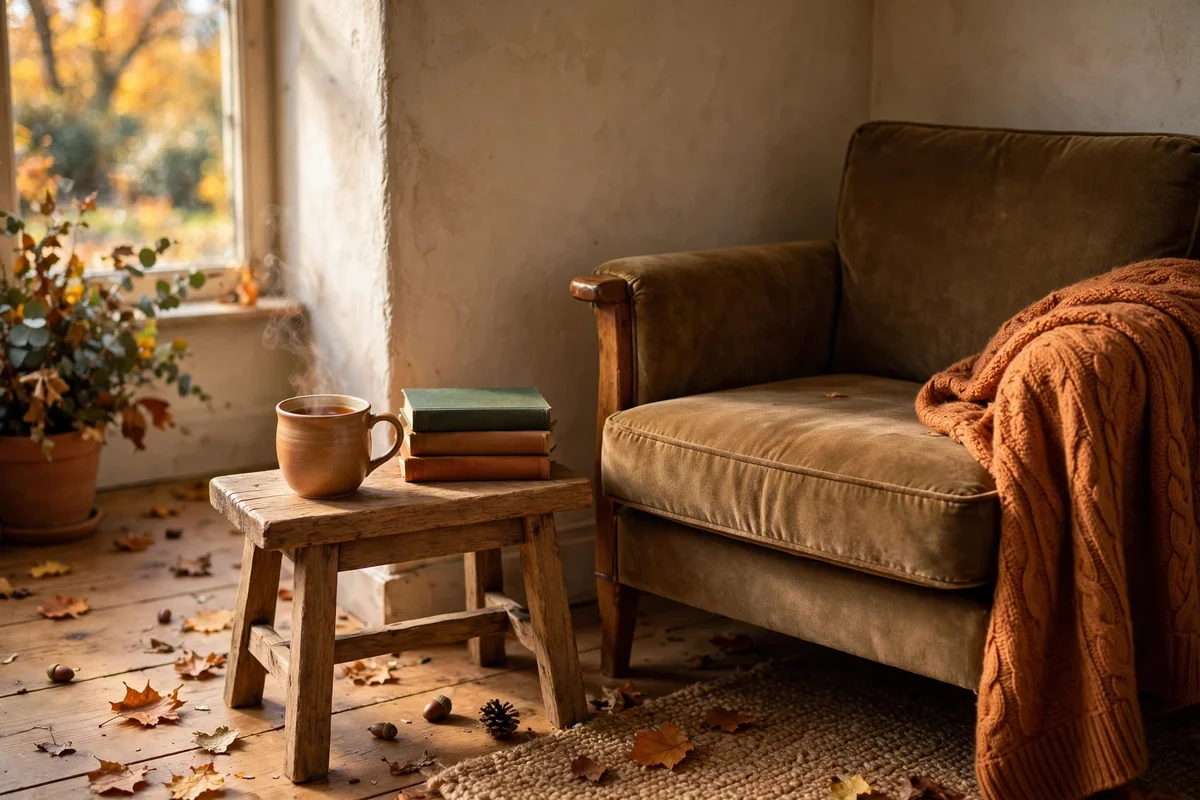
A low wooden stool 40 to 45 cm tall beside the corner armchair works as a side table for tea and the current book. Choose a stool top at least 30 cm across so a mug and a small stack of books share it without crowding. Solid beech or pine suits autumn and takes a coaster without marking, unlike veneer. Push the stool 10 cm from the chair arm so reaching for tea is one easy stretch. In a bedroom corner the same stool doubles as a nightstand, which keeps the furniture count low.
Keep a ceramic mug and a small lidded jar of dates or nuts on the stool for quiet autumn afternoons, with the book stack beside them. Wipe the top weekly, since tea rings show fast on bare wood; a thin cork mat under the mug solves it. The mistake to avoid is a stool taller than the chair arm, which forces an awkward lift for every sip and topples easily. Budget pick: a plain solid-wood stool usually costs 20 to 35 pounds or dollars, far less than a matching side table.
12. Add a Plaid Cushion and a Bolster to Deepen the Chair Seat
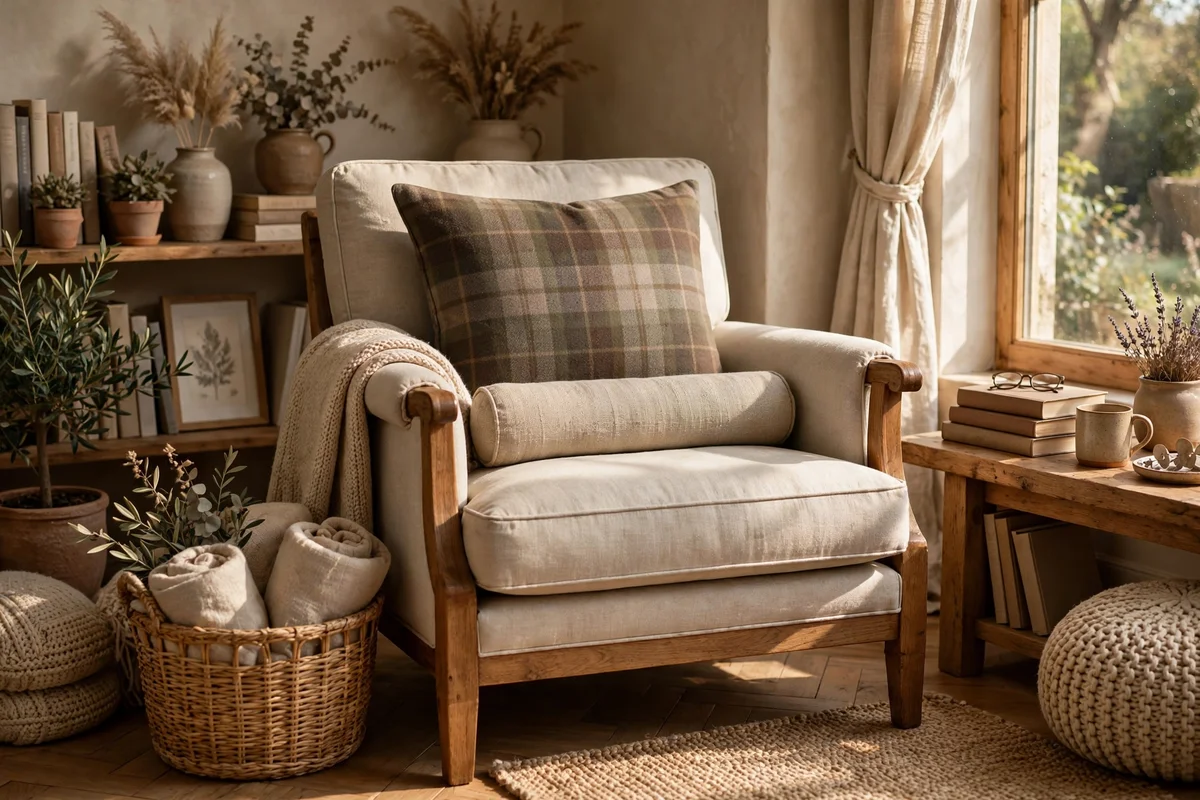
A plaid cushion 45 to 50 cm square against the chair back and a bolster 15 cm across and 45 cm long along the seat turn a plain armchair into a reading seat. The cushion supports the lower back while the bolster fills the front edge, so legs rest higher and the seat feels deeper. Wool or wool-blend covers in muted tartan, rust check or forest plaid bring autumn pattern without a single wall change. Keep the patterns small-scale, since large checks overwhelm a corner chair. Wash covers at the start of the season for a fresh reset.
Plump the cushion daily with two firm chops to the top corners, which keeps the filling even and the plaid pattern crisp. Store the bolster on the chair seat when the corner is not in use so it never migrates to the sofa. The mistake to avoid is mixing four or five competing patterns in one corner; one plaid plus one solid bolster is plenty. Budget route: a cushion cover plus a bolster insert usually totals 25 to 40 pounds or dollars if you reuse existing inserts.
13. Drape a Sheepskin Over the Floor Cushion Stack for Extra Softness
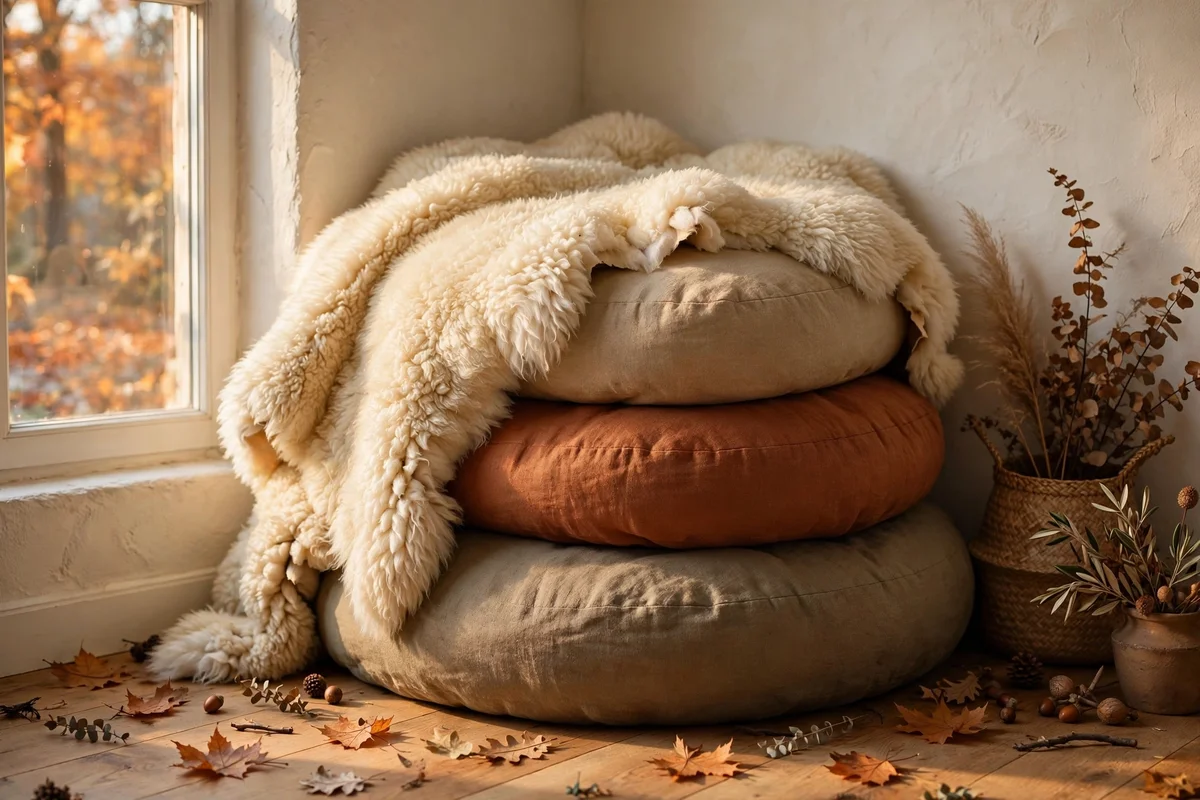
A single sheepskin about 60 by 90 cm draped over the top of a floor cushion stack adds warmth the moment the temperature drops. Let it hang 20 to 30 cm down one side so it stays put without pins or ties. Natural ivory or warm grey sheepskins suit autumn palettes and soften hard cushion edges for bare feet. Real sheepskin insulates well, while good faux versions wash easily in the machine. Shake it outdoors weekly to keep the fibres loose and free of dust.
Keep the sheepskin out of direct afternoon sun, which dries the leather backing and yellows ivory wool over one season. Brush it monthly with a wide-tooth comb or a pet brush to stop the pile matting where people sit. The mistake to avoid is washing real sheepskin in hot water, which shrinks it badly; use cool water and air dry flat. Budget option: a quality faux sheepskin usually costs 15 to 30 pounds or dollars, half the price of the real thing.
14. Place a Narrow Console Behind a Bedroom Corner Chair With a Carafe and Cup
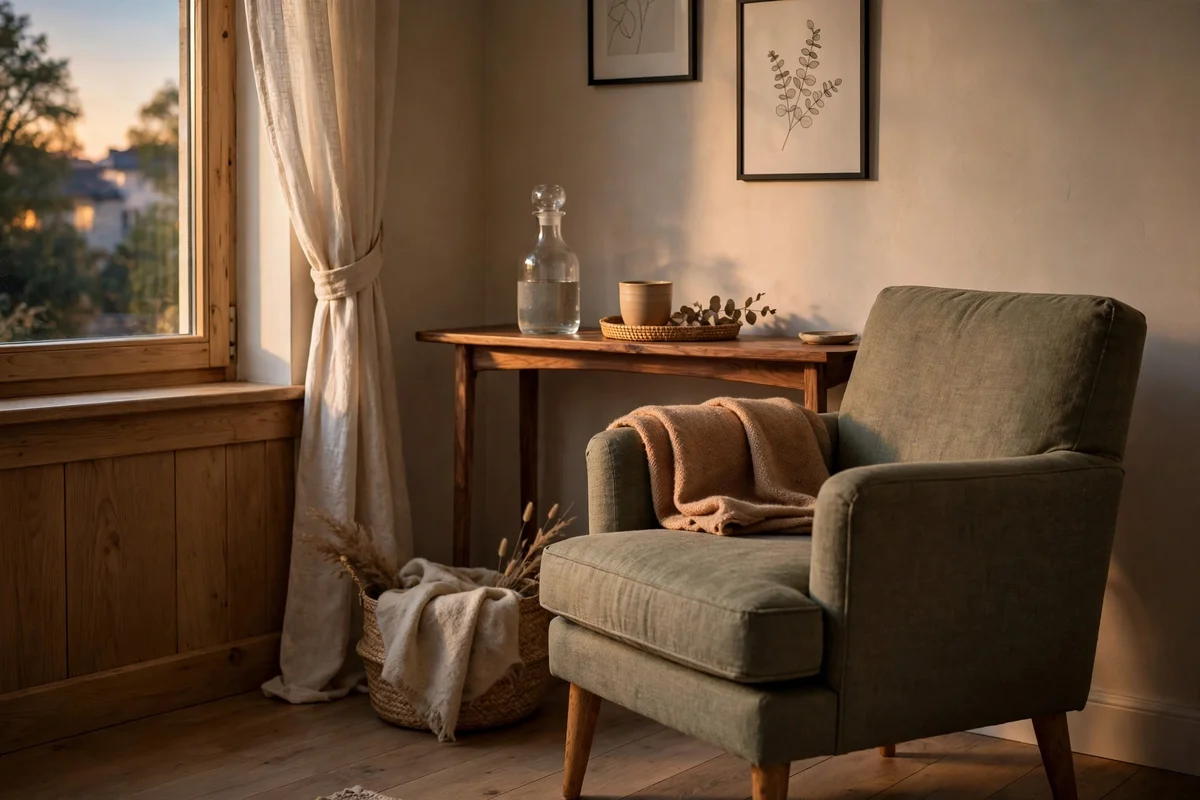
A narrow console 80 to 100 cm wide and 25 to 30 cm deep fits behind a bedroom corner chair where a full table cannot. Set a glass carafe and one ceramic cup on a small tray at one end, with a folded hand towel beside them for a calm bedtime setup. Keep the console 10 cm clear of the wall so curtains or bedding never snag. Solid mango or acacia wood suits warm bedrooms and resists water rings from the carafe. This one piece turns a spare chair into a proper evening retreat.
Refill the carafe each evening with fresh water and wash the cup daily, since still water tastes flat after two days. Keep a small flameless candle on the tray for a soft bedtime glow that is safe near bedding. The mistake to avoid is loading the narrow console with books and clutter until the carafe has no safe spot; three items per surface keeps it calm. Budget setup: a slim console plus a glass carafe set usually costs 55 to 95 pounds or dollars.
15. Tuck a Crate of Pinecones and Acorns Under a Hall Corner Bench
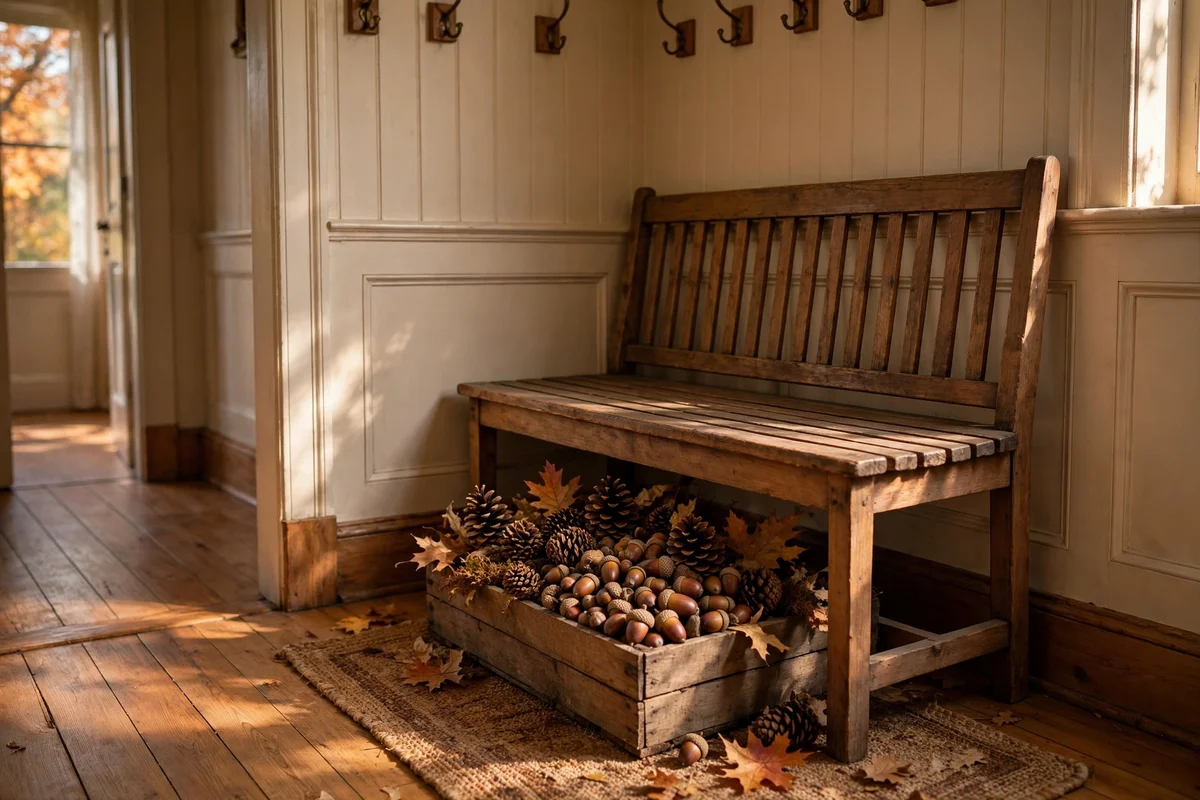
A low wooden crate 35 to 45 cm wide tucked under a hall bench turns a dead corner into a seasonal display. Fill it two thirds full with pinecones, acorns and a few dried seed heads gathered on autumn walks, keeping the top layer loose for texture. Bake gathered cones at 100 degrees Celsius for 45 minutes to kill any insects before bringing them indoors. A crate with slatted sides suits farmhouse and heritage halls. Set it 5 cm back from the bench front so it reads as intentional, not stored clutter.
Top up the crate with fresh finds through the season and compost anything that crumbles or loses its shape. Keep the crate off damp floors with two small felt pads underneath, since wet wood stains stone and tile. The mistake to avoid is piling cones above the crate rim, where they spill across the hall every time the bench is bumped. Budget route: a second-hand crate plus gathered cones costs almost nothing, while a bag of dried cones from a craft shop is 8 to 12 pounds or dollars.
16. Hang a Small Wreath of Dried Wheat on the Corner Wall at Eye Level
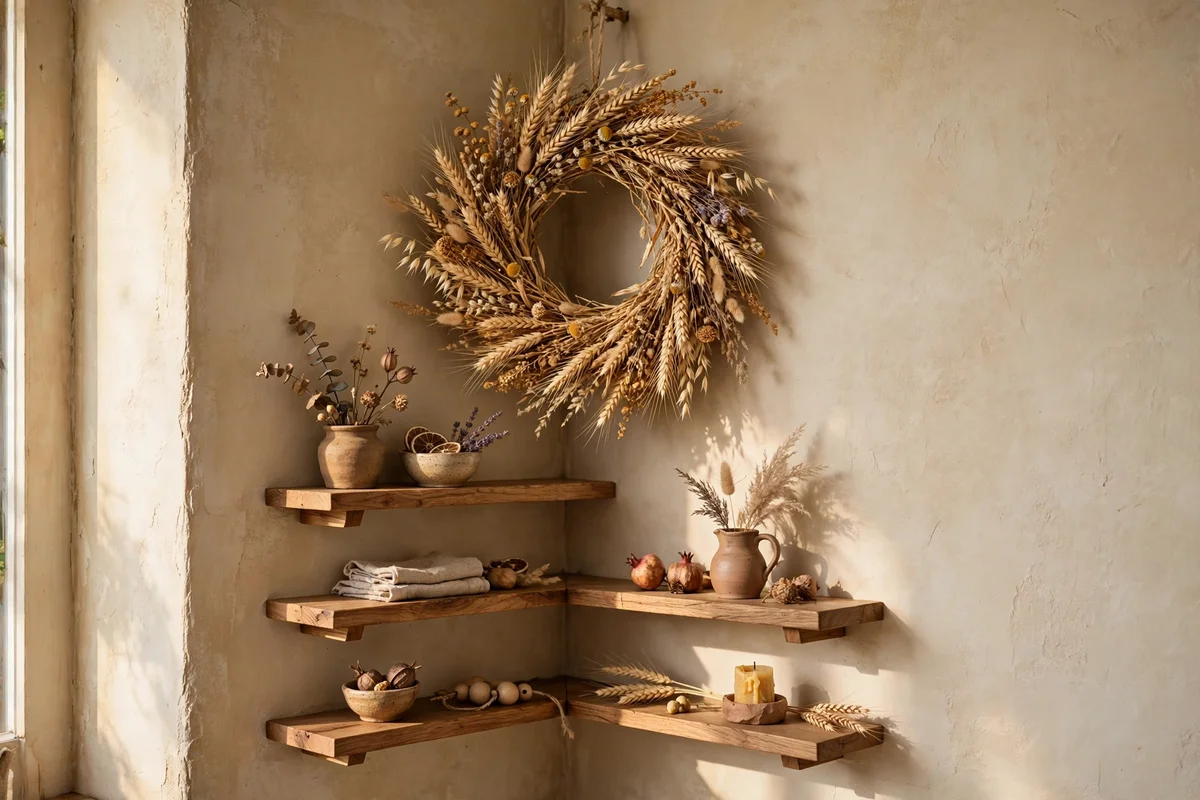
A dried wheat wreath 30 to 40 cm across hung at 150 to 160 cm on a corner wall brings harvest texture to an empty vertical space. Hang it where the two walls meet at a slight angle, using one small nail or adhesive hook rated for 1 kg. Dried wheat keeps its golden colour for two to three seasons if it stays dry, unlike fresh flowers that fade in a week. Pair it with the corner shelves or the mirror so the wall reads as one composed group. Keep it away from radiators, which make the stalks brittle.
Dust the wreath gently with a cool hairdryer on low once a month, since wheat heads trap dust that dulls the gold. If a stalk snaps, tuck a spare wheat stem into the back with florist wire rather than replacing the whole wreath. The mistake to avoid is hanging dried wheat above a real candle or a hot lamp, which is a fire risk; use flameless light nearby instead. Budget buy: a dried wheat wreath usually costs 12 to 22 pounds or dollars from a florist or craft market.
17. Set a Lantern With a Flameless Candle on the Floor Beside the Chair Leg
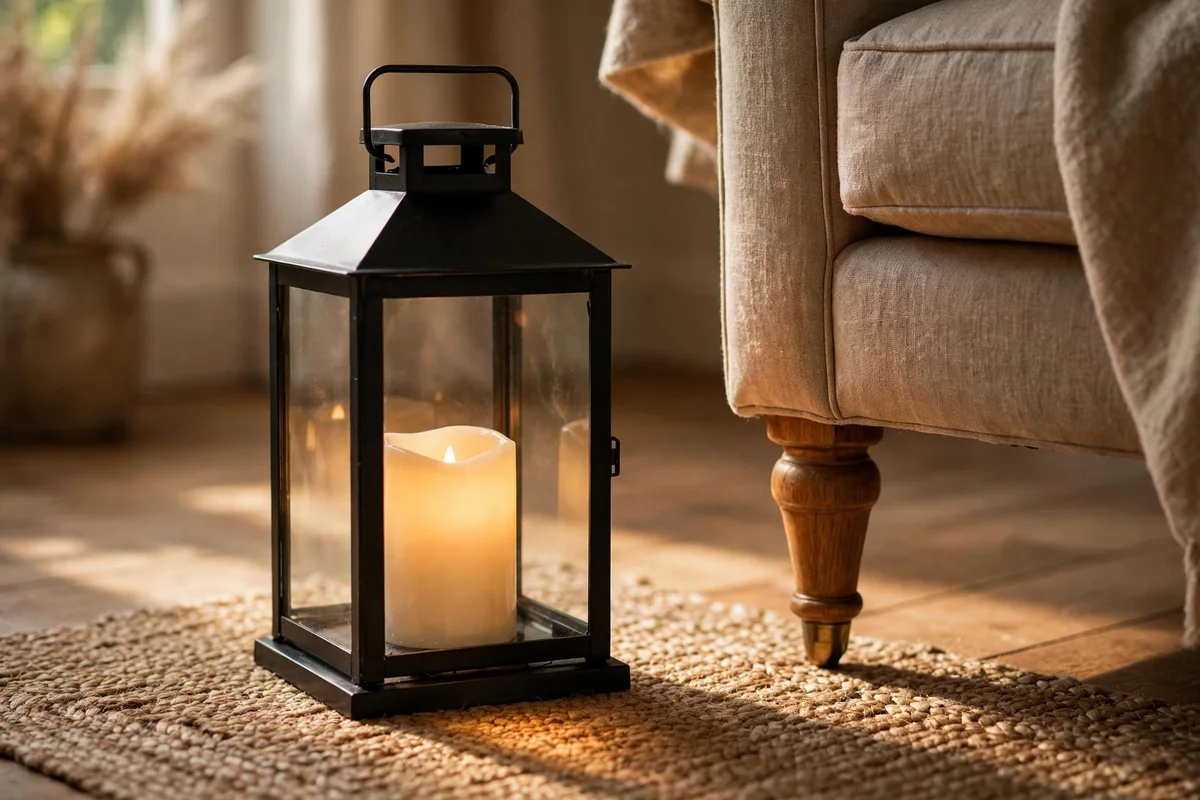
A glass and metal lantern 25 to 35 cm tall on the floor beside the chair leg casts a warm pool of light at ankle height. Place it 15 to 20 cm from the chair leg and the same distance from the wall so it never blocks the walking path. Drop one flameless pillar candle 10 to 15 cm tall inside, on a timer that starts at dusk. Brushed black metal or aged brass frames suit autumn; clear glass shows the full glow. This low light makes the whole corner feel anchored after dark.
Keep the lantern glass clean with a damp cloth monthly, since smudges halve the light that escapes. Change the candle batteries each season and keep one spare set in the basket with the blankets. The mistake to avoid is a lantern with a real flame at floor level near throws and cushions, which is unsafe; flameless is the only sensible choice here. Budget pick: a metal and glass lantern plus a timer candle usually costs 22 to 40 pounds or dollars.
18. Drape Fairy Lights Along a Floating Shelf for a Warm Evening Glow
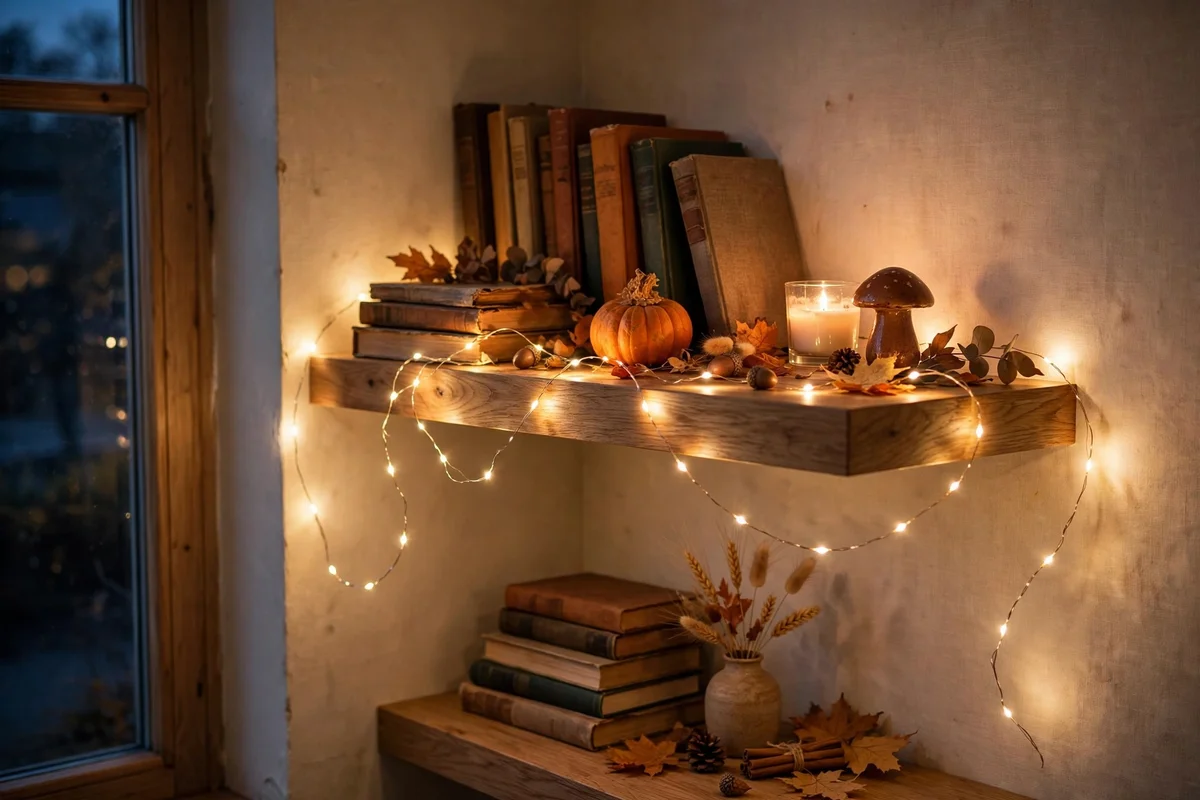
A 3 to 5 metre string of warm-white fairy lights draped along the front edge of a floating shelf turns the corner magical after dark. Weave the wire in loose S curves, letting 5 to 8 cm loops hang between small hooks or clear clips. Battery fairy lights with a timer keep the shelf cord-free; one set of three AA batteries usually lasts the season on a six-hour timer. Keep the lights 10 cm clear of books and dried wheat so nothing touches the warm bulbs. Warm white near 2700K suits autumn far better than cool blue tones.
Check the battery box monthly and swap batteries when the glow dims, since fading lights look tired rather than cosy. Coil the spare length behind a book on the shelf instead of cutting it, which keeps the string reusable next year. The mistake to avoid is wrapping fairy lights tightly around dried stems, which both hides the light and risks heat damage; let the lights rest lightly along the shelf front. Budget set: a 5 metre timer string usually costs 8 to 15 pounds or dollars.
19. Place a Woven Hamper of Apples on a Dining Room Corner Stool

A low woven hamper 30 to 40 cm across filled with apples on a dining room corner stool brings the harvest table feeling to an unused corner. Set the stool 20 cm out from the corner so the hamper clears the wall and guests can reach the fruit. Line the hamper with a clean cotton cloth, then pile the apples two layers deep so none bruise under the weight. Red and green eating apples mixed together look abundant and last two weeks in a cool corner. This display doubles as a healthy snack station through autumn.
Check the apples twice a week and remove any that soften, since one spoiling apple turns the rest fast. Wash the cotton liner monthly and let it dry fully before relaying the fruit. The mistake to avoid is filling the hamper above the rim, where apples roll onto the floor whenever the stool is nudged. Budget setup: a woven hamper plus a bag of seasonal apples usually costs 15 to 25 pounds or dollars, and the fruit gets eaten, not wasted.
20. Hang a Curtain Panel From a Corner Bracket to Soften a Bare Wall
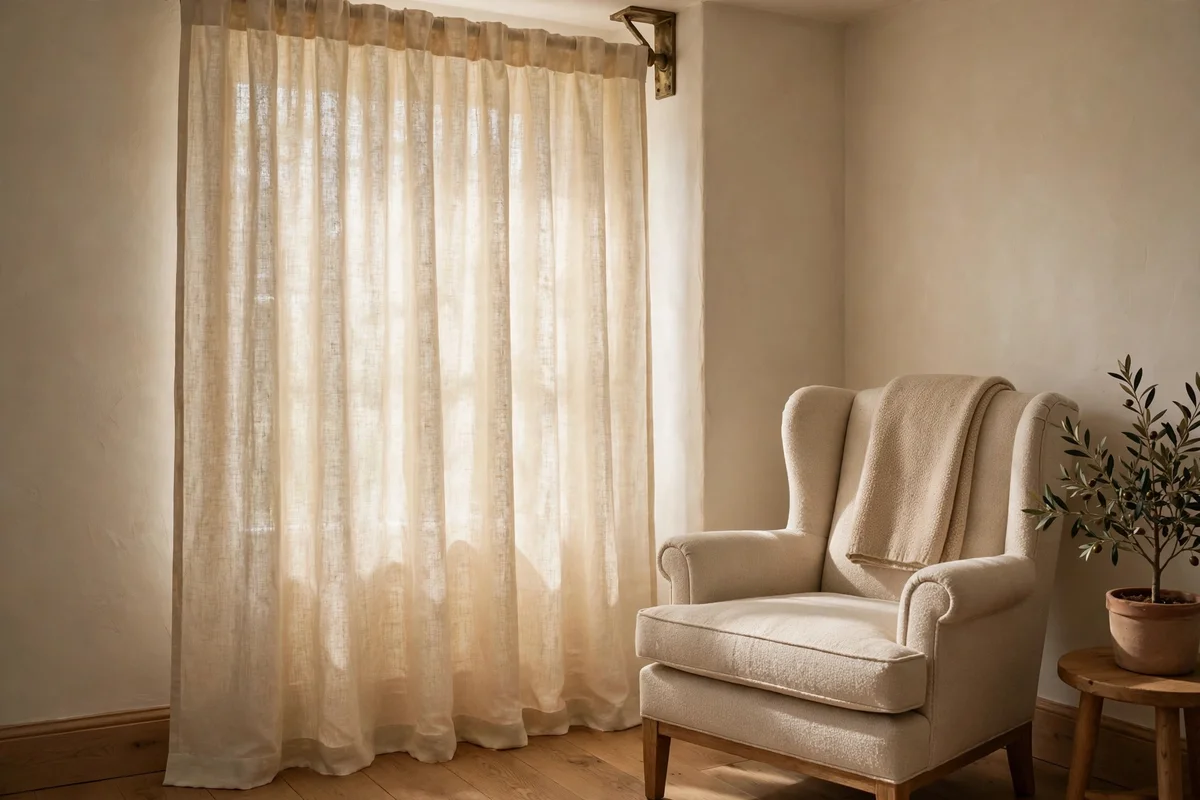
A curtain panel 140 cm wide hung from a corner bracket softens a bare wall behind a reading chair. Mount the bracket 20 cm above the window or picture frame, or 210 cm high on a bare wall, and let the panel fall to 5 cm above the floor. Linen or cotton in warm cream, oat or soft rust filters daylight gently and hides the corner in one move. Hang the panel 10 cm out from the wall on the bracket so it never snags the chair. One panel is enough; a pair overwhelms a corner.
Steam or iron the panel before hanging so it falls in clean folds from day one. Vacuum the lower hem monthly with a brush attachment, since floor-level fabric collects dust fast. The mistake to avoid is a heavy blackout lining that drags the panel stiff and straight; an unlined or lightly lined panel moves softly and suits the cosy mood. Budget pick: one ready-made linen-look panel plus a short bracket usually costs 30 to 55 pounds or dollars.
Every idea in this set follows the same simple recipe: one comfortable seat, one warm layer, one pool of light, and one or two autumn details. That is all a neglected corner needs to become a favourite spot for the season. You do not need a full redecorate, a big budget, or any building work. Most corners come together in a single weekend with pieces you already own plus two or three small buys.
Start this week with the easiest win: angle your chair into the corner and drape a throw over one arm. That single change takes ten minutes and transforms how the corner feels immediately. Then, when you are ready, add the basket of blankets and one flameless candle. Small corners reward small steps, and each piece you add makes the next one more inviting.
Frequently Asked Questions
How much does a cosy fall corner cost to put together?
Between 30 and 150 pounds or dollars for most corners. A basket with two throws and a flameless candle covers the basics for around 40. A corner with an armchair, rug layering and a lamp runs higher, near 120 to 200. Start with what you own, then add one piece at a time. Living with the corner for a week usually prevents one or two wrong buys.
What size armchair fits a small room corner?
Choose a chair 60 to 75 cm wide with a seat height near 45 cm. Angle it 45 degrees and leave 10 to 15 cm behind it for cords and air flow. Measure your corner before buying: the chair should leave at least 60 cm of walking space in front. In very tight corners, a slipper chair without arms or a deep floor cushion stack works better.
Are flameless candles safe around children and pets?
Yes, flameless candles are the safe choice for family corners. They use cool LED lights with no flame, no heat and no wax, so small hands and curious pets cannot get burned. Choose battery candles with timers so they switch off on their own. Keep the battery compartment screwed shut and change batteries yourself, since button cells must stay out of reach of toddlers.
How do I keep a corner rug from slipping on hard floors?
Use a low-profile rug pad cut 2 cm smaller than the rug on every side. For layered rugs, pad both layers so the stack stays stable under chair legs. Vacuum weekly and check corners monthly for curling, pressing lifts flat with double-sided rug tape. On polished wood, a felt pad protects the finish from scratches as well as stopping slips.
Can I create a fall corner in a rented home?
Absolutely. Every idea here works without drilling: angle a chair, stack floor cushions, fill a basket with blankets, drape a sheepskin, and set flameless candles on existing surfaces. For shelves and wreaths, use strong adhesive hooks rated for the weight instead of nails. Keep original fittings in a bag for move-out day, and take your pieces with you when you leave.