Living Room
21 Built In Bookshelf Styling Ideas That Give Shelves a Library Calm
By Anna Wells · · 21 min read
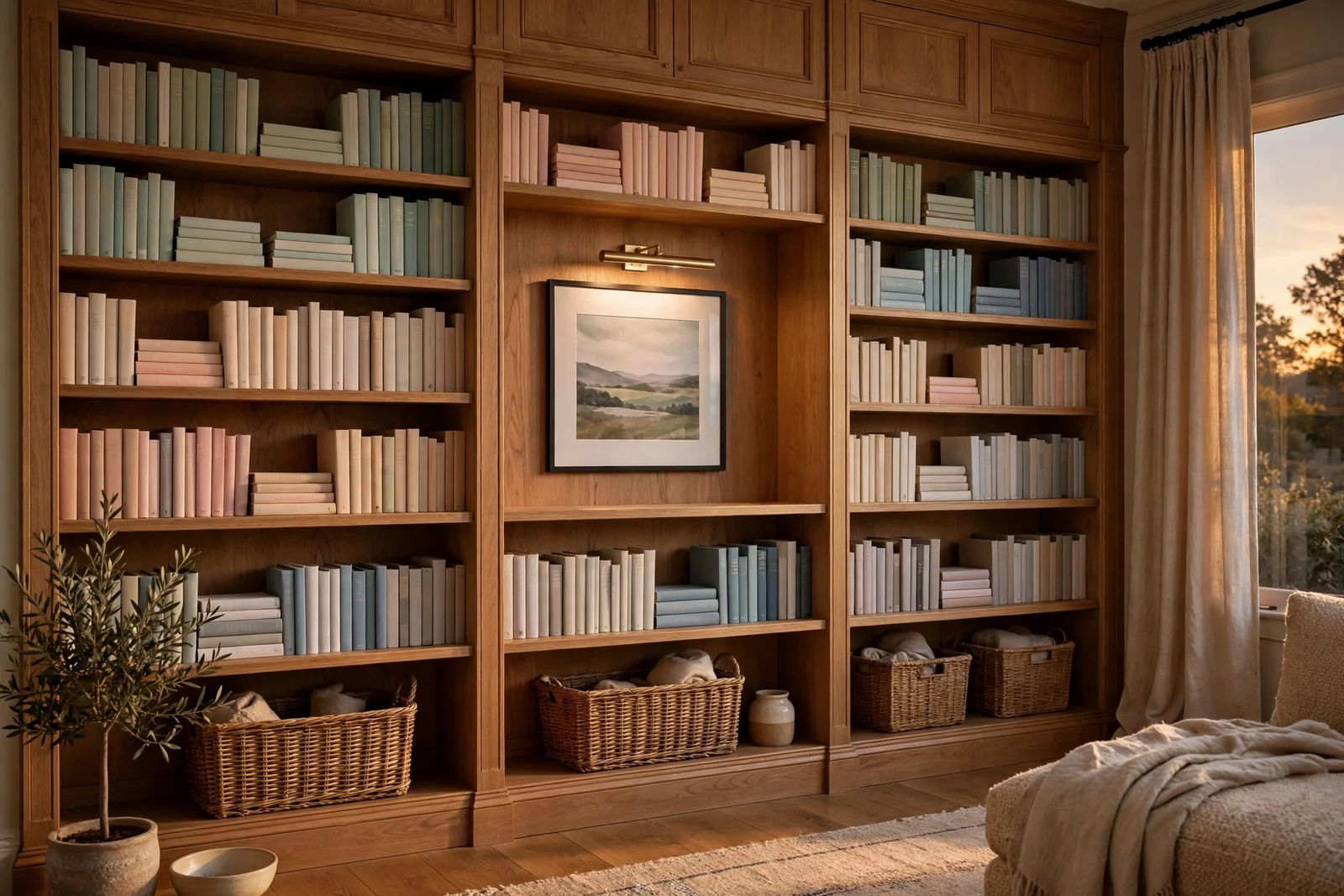
Twenty-one practical ways to arrange books, objects, light and storage so built-in shelves feel calm, orderly and welcoming.
There is a particular quiet that falls over a room when its shelves are in order. Morning light moves across straight rows of spines, the low hum of the house softens, and the bookcase stops being furniture and becomes a kind of companion. Most of us have lived with the opposite: leaning towers of paperbacks, gaps where books fell, a shelf of forgotten objects.
Built-in bookcases carry a promise that freestanding ones cannot quite match. They belong to the architecture, which means they can carry a library calm from floor to ceiling when they are styled with a designer’s quiet logic. The trick is not buying more decor. It is deciding what stays, how books stand, and where the light falls.
These twenty-one ideas work shelf by shelf, from sorting books by height to hiding clutter in baskets and washing shelves with warm light. Every one is practical, most cost little, and each can be done in an afternoon. Together they give your bookcases the steady, collected feeling of a room that has been loved for years.
Start with the shelf that bothers you most and work outward from there.
1. Sort Books Tallest to Shortest for a Calm Ascending Rhythm
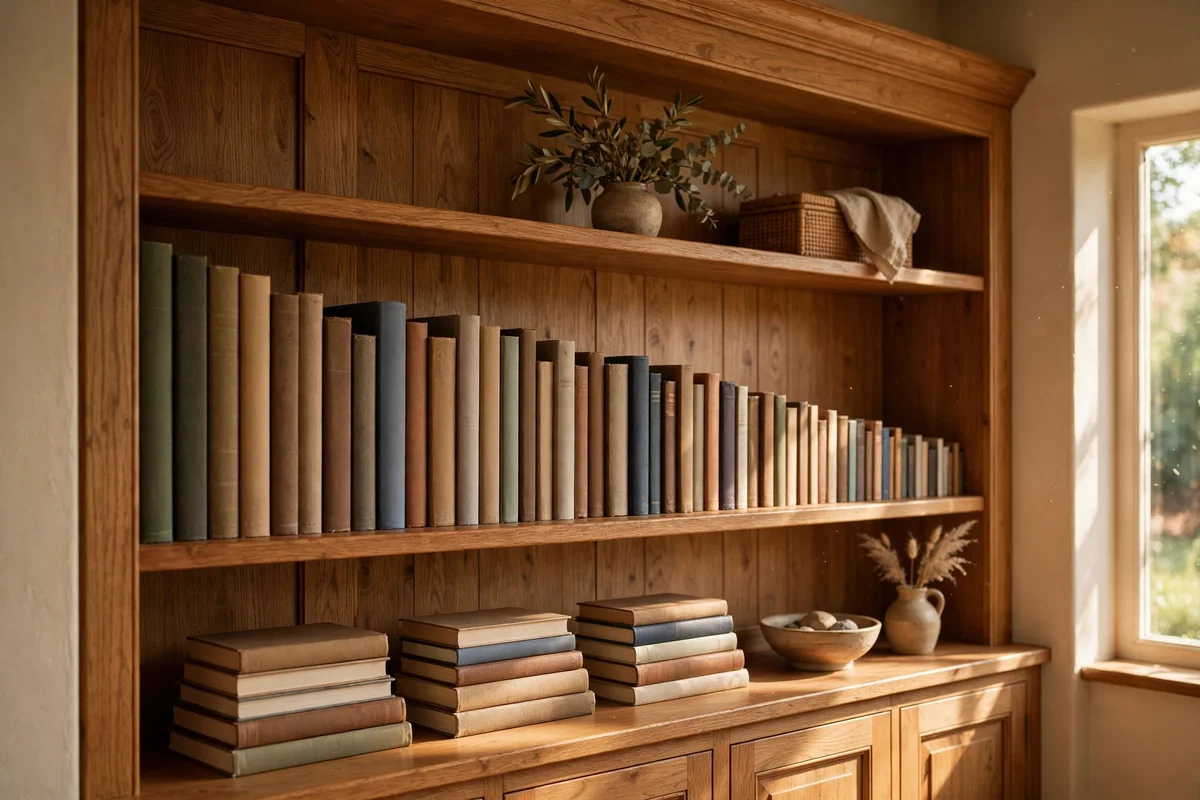
Pull every book off one shelf and sort the pile by height before anything goes back on. Stand the tallest spines at the left end and step down toward the right, or mirror the pattern with the tallest at both ends falling toward the centre, so the row forms a gentle wave the eye follows without effort. Keep the height difference between neighbouring books small, no more than 2 or 3 cm, and the line stays gradual rather than jagged. This one habit can calm an ordinary shelf in under twenty minutes.
Tallest at the ends also closes the awkward short gaps that make shelves look unfinished. Rest oversized art books upright on the lowest shelf where their weight is safest, let medium paperbacks fill the middle rows, and place the smallest volumes near the top where they are easy to reach down. The mistake to avoid is forcing every row to exactly the same height, which looks rigid and shows dust on every exposed top edge. Let the rhythm change from shelf to shelf.
2. Group Books in Soft Colour Blocks Rather Than Strict Rainbow Bands
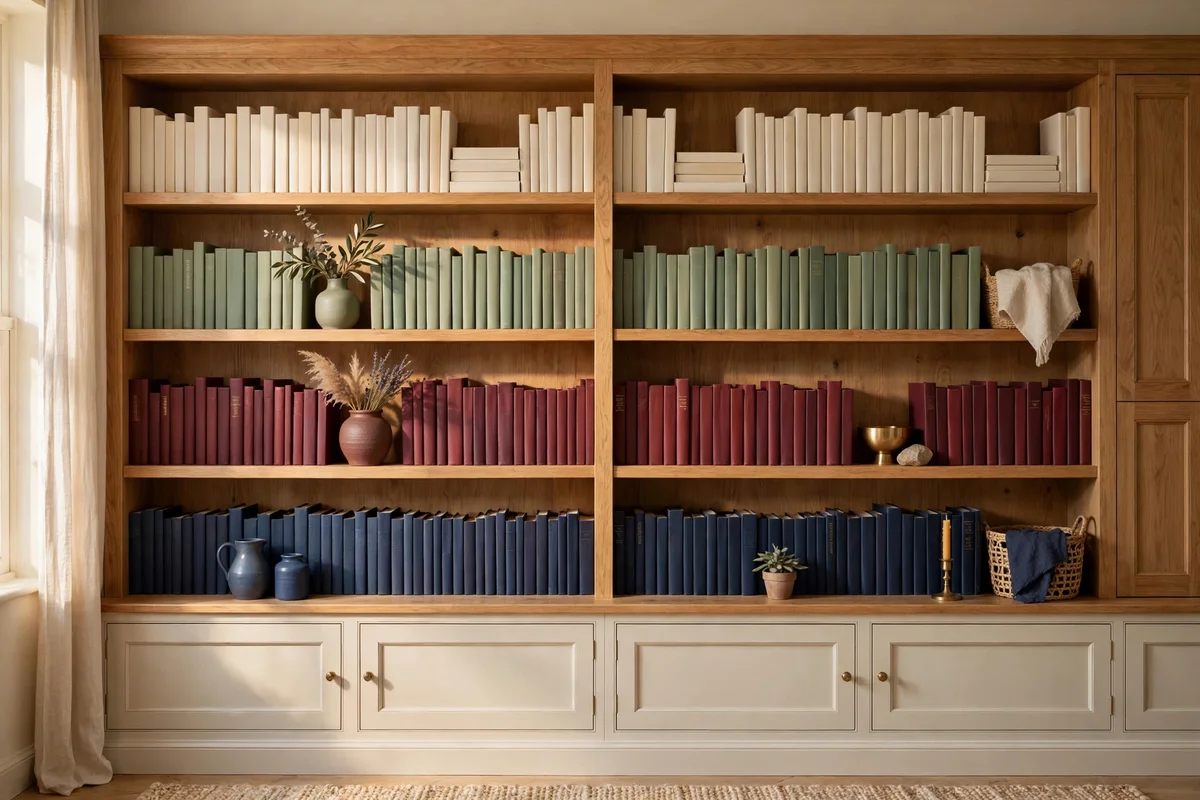
Instead of a full rainbow, which can look busy, gather spines into loose colour families: creams with soft whites, forest greens with deep teals, burgundies with warm browns, navies with charcoals. Slide each family together in its own cluster of fifteen to thirty books, letting two families share a long shelf with a small object between them. The result reads as calm colour movement rather than a stripey display, and it is far easier to keep tidy than a strict colour order.
Start with the neutrals, since most home libraries are dominated by cream, beige and brown spines. Pull the brightest jackets forward as accents inside their colour family rather than spreading them across the whole case. A paper book jacket can be turned inside out for a plain cream cover if one loud spine breaks the mood, a thrifty trick that costs nothing. Avoid removing dust jackets permanently, since they protect the binding and hold resale value.
3. Keep Two Thirds Books and One Third Objects on Every Shelf
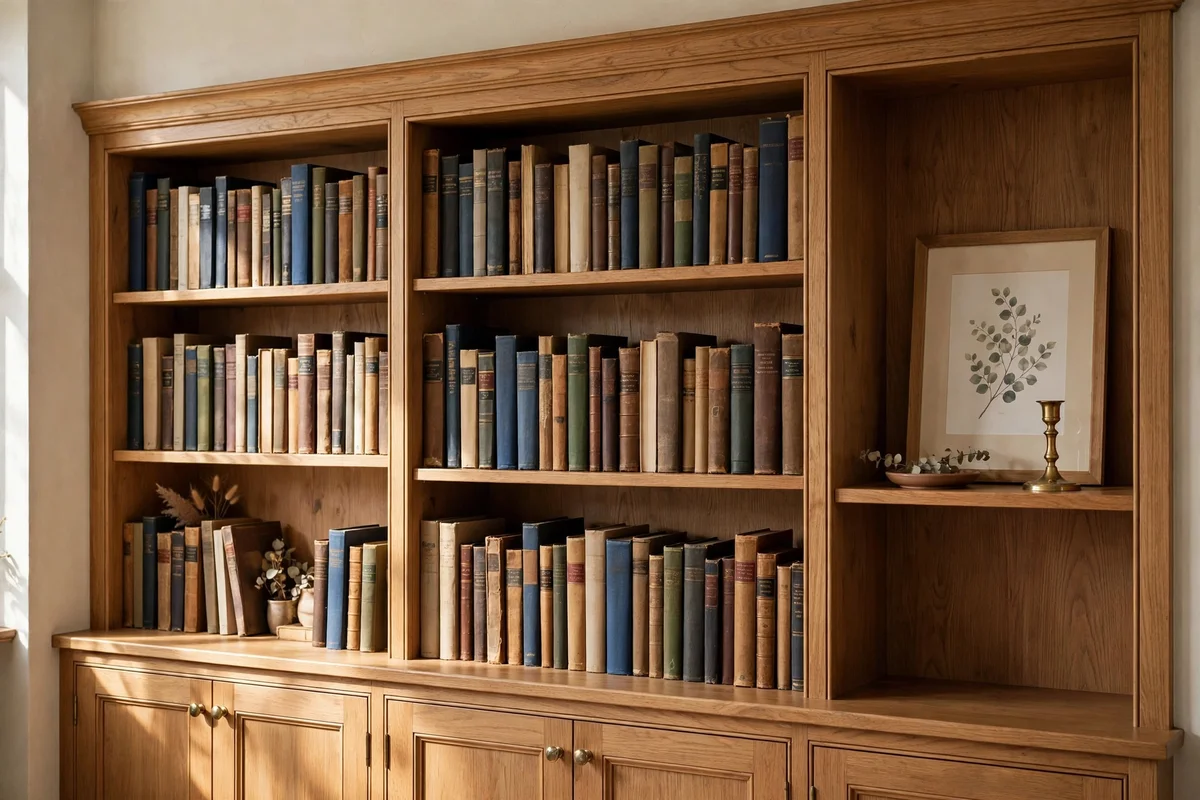
The simplest styling rule for built-ins is proportion: let books fill roughly two thirds of each shelf and give objects the remaining third. On a 90 cm shelf that means about 60 cm of standing books and 30 cm of breathing room for a small framed print, a brass candlestick or a lidded box. The eye reads the books as the main story and the objects as punctuation, which is why shelves styled this way photograph well and stay restful in person.
Apply the ratio shelf by shelf rather than across the whole bookcase, since one crowded shelf ruins the effect of five calm ones. If a shelf holds only paperbacks, add a small horizontal stack beside them to claim the object third without buying anything new. The common mistake is creeping clutter: a souvenir here and a candle there until books shrink to half the shelf. Once a month, walk the case and return any shelf to its two thirds.
4. Build Horizontal Stacks of Three to Five Books as Plinths
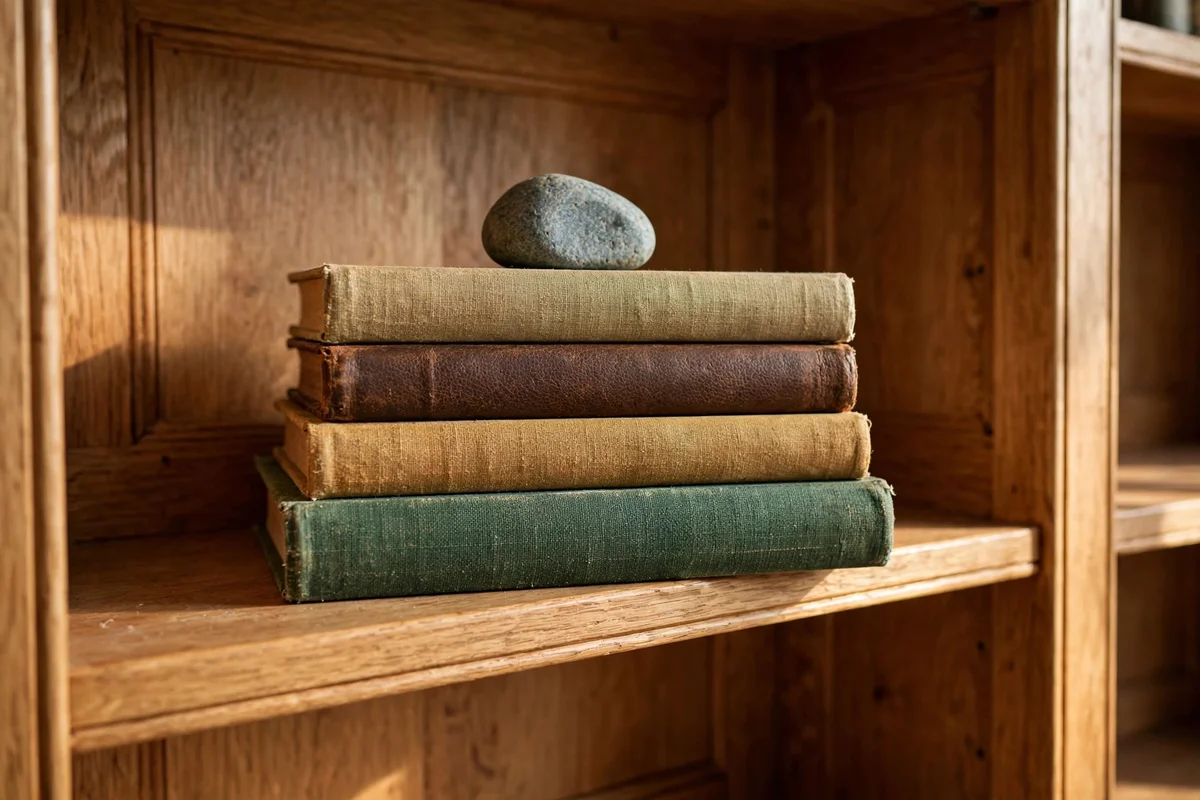
Lay books flat in stacks of three to five to break up long rows of vertical spines and create plinths for small objects. Choose the largest book for the base, usually 25 to 30 cm long, and shrink each layer slightly so the stack tapers like a small ziggurat. Set one stack per shelf at most, positioned off centre, and top it with a single object: a small plant, a stone paperweight or a folded cloth. The stack gives the shelf weight at its base.
Keep stacks low enough to stay under the shelf above, leaving at least 5 cm of clearance so removing a book never scrapes the wood. Alternate the direction of spines in the stack, facing out on one layer and sideways on the next, so the pile looks intentional from every angle. The mistake to avoid is stacking more than five books high, which topples easily and blocks the view of the shelf behind. Three is often the calmest number.
5. Slide Woven Baskets Along the Lowest Shelves for Hidden Storage
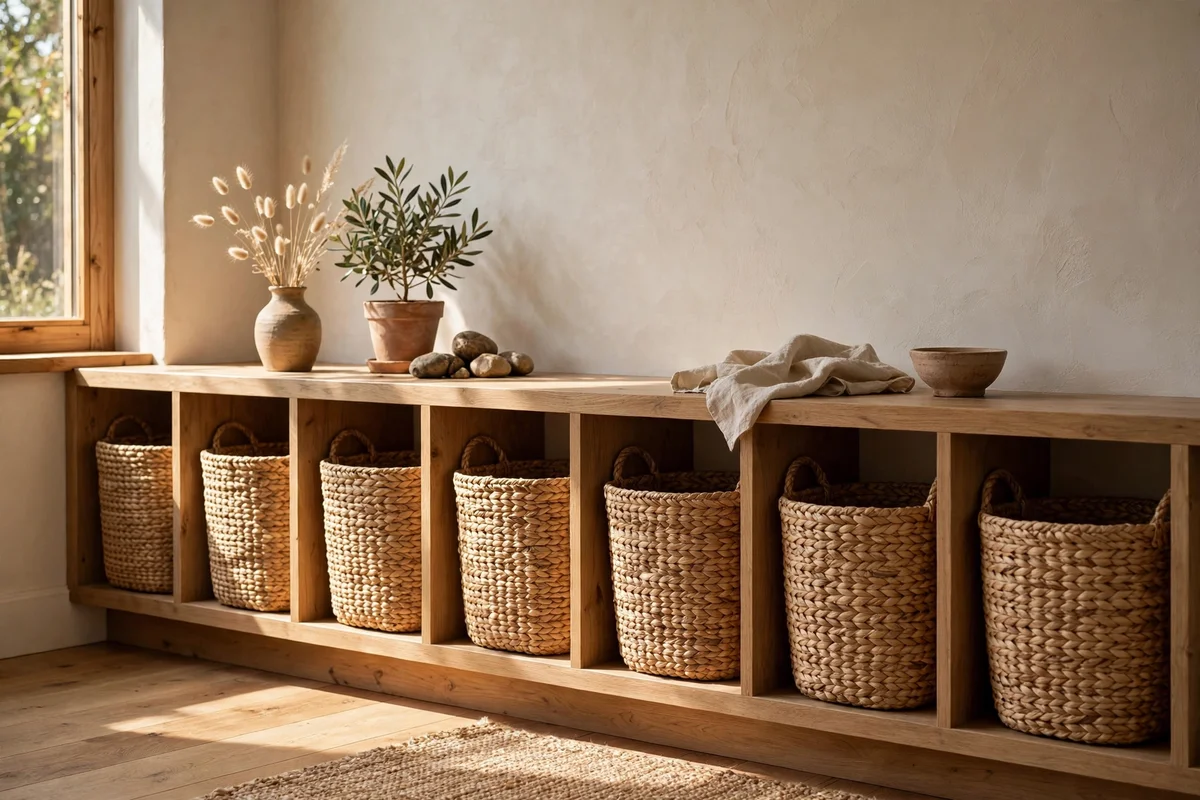
The lowest shelves, from floor level up to about 60 cm, are perfect for woven baskets that swallow clutter whole. Measure the opening first, then buy baskets 2 cm narrower than the shelf width and 5 cm shorter than the shelf height so they slide in and out without scraping the wood. Natural seagrass, water hyacinth or rattan suit most living rooms and cost 12 to 25 pounds or dollars each in standard 30 cm cubes. Two or three baskets in a row read as one calm band of texture.
Give each basket a job so the storage actually works: one for charging cables and small electronics, one for children’s picture books, one for the throws that migrate around the room. Add a small handwritten label on a kraft tag tied with twine if several people use the shelves. The mistake to avoid is buying baskets before measuring, since a basket that wedges in place will scuff the shelf finish every time it is forced. Measure twice, buy once.
6. Hide Clutter in Matching Lidded Boxes on Knee-Level Shelves
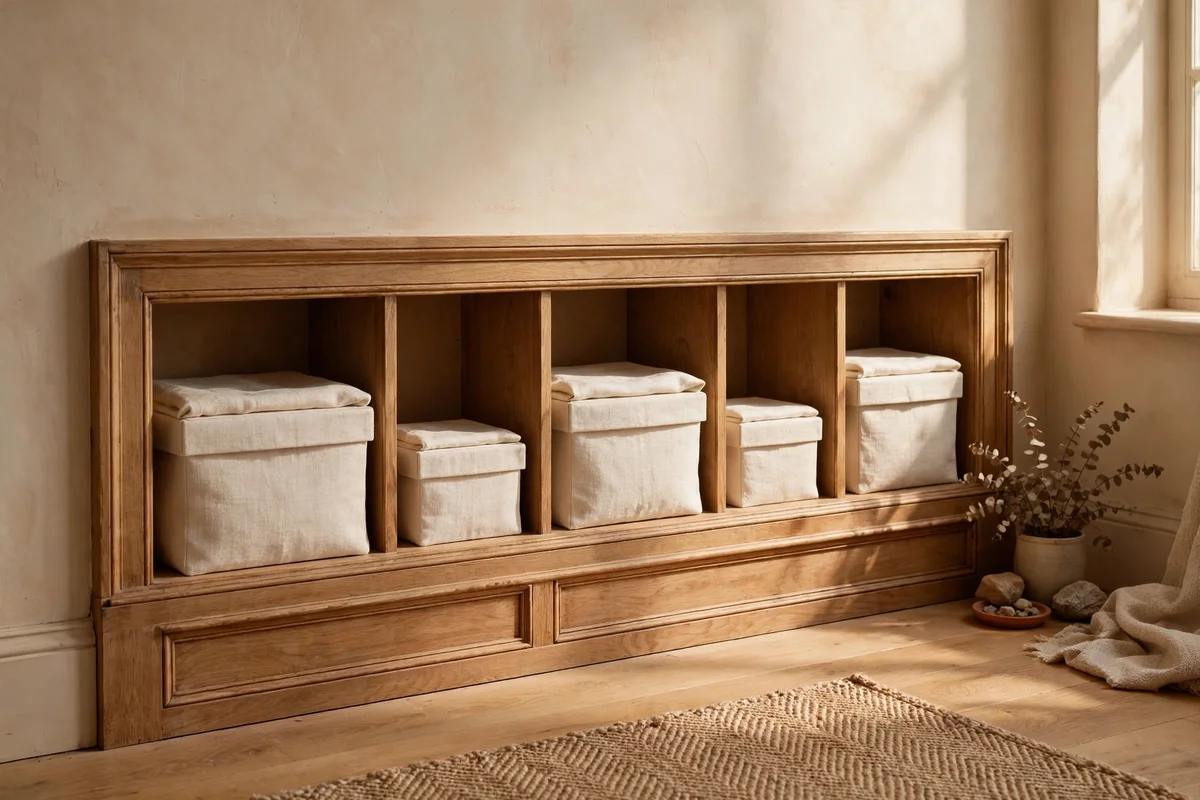
Where baskets feel rustic, lidded boxes feel tailored, which suits a more formal built-in. Choose boxes in one material, such as cream linen, walnut veneer or pale oak, in two sizes only: a 35 cm box for board games and magazines, and a 25 cm box for remote controls, reading glasses and spare batteries. Stack no more than two high on shelves between 40 and 70 cm from the floor, where knees and hands reach naturally. The matching lids keep the shelf line clean even when the contents are chaos.
Line the inside of each box with a piece of felt to stop small items rattling when the box is pulled out. If the boxes sit in a sunny spot, choose fabric over cardboard, which fades and warps in direct light within a year. The mistake to avoid is buying one box at a time in different colours, which turns the shelf into a patchwork. Wait until you can afford a set of four to six in the same finish, and buy them all together.
7. Fit Slim Picture Lights Over Framed Prints and Favourite Shelves
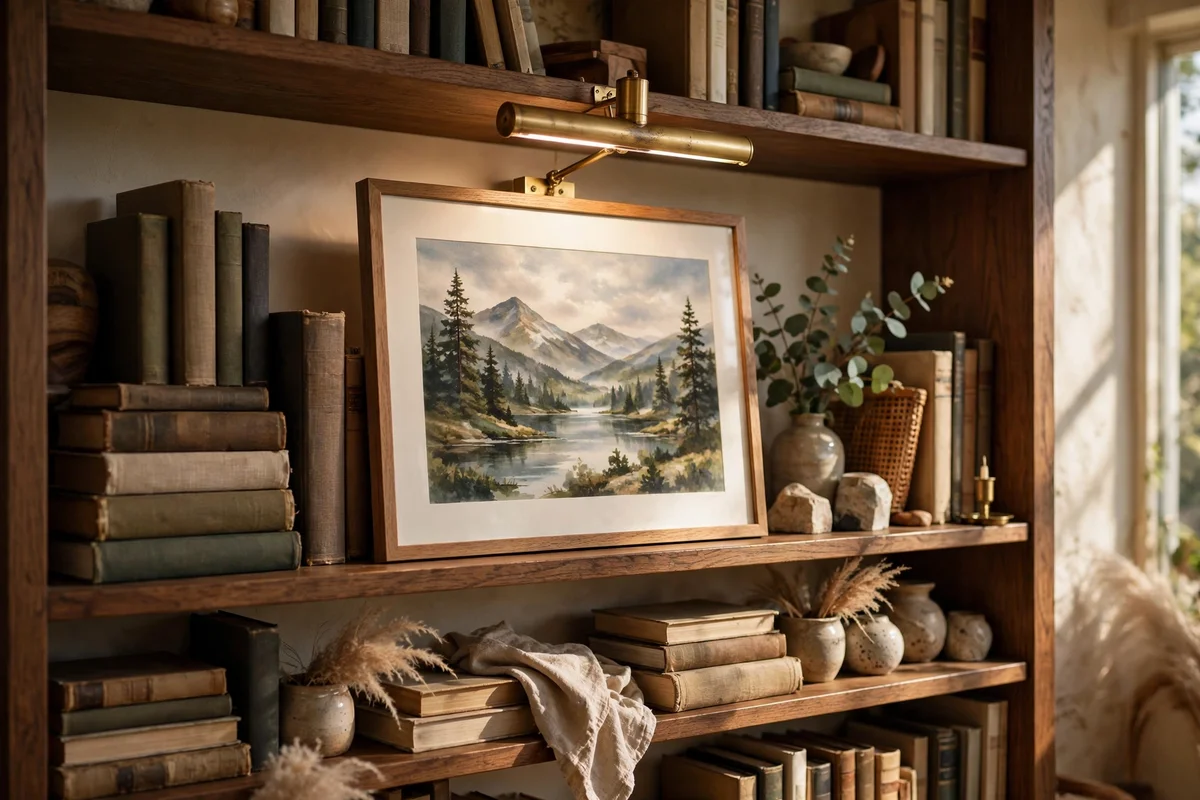
A slim brass or black picture light, 30 to 45 cm wide, mounted 10 to 15 cm above a framed print or a special shelf, turns that one spot into the room’s quiet focal point. Choose a warm 2700K bulb and a shade that throws light down and slightly forward so it grazes the spines without glaring into eyes. Battery powered picture lights now last three to six months on a charge and cost 20 to 40 pounds or dollars, which makes them ideal for bookcases with no nearby socket.
Fit only one or two picture lights in a whole bookcase wall, over the prints or objects you love most. Too many lit spots turns a calm library into a gallery corridor. Hide the slim cable behind the shelf upright or choose a rechargeable model to avoid visible wires entirely. The mistake to avoid is cool white 4000K light, which makes wood look grey and paper look clinical. Warm light is what makes a bookcase glow at dusk.
8. Run Low LED Strip Lighting Under Each Shelf for Evening Warmth
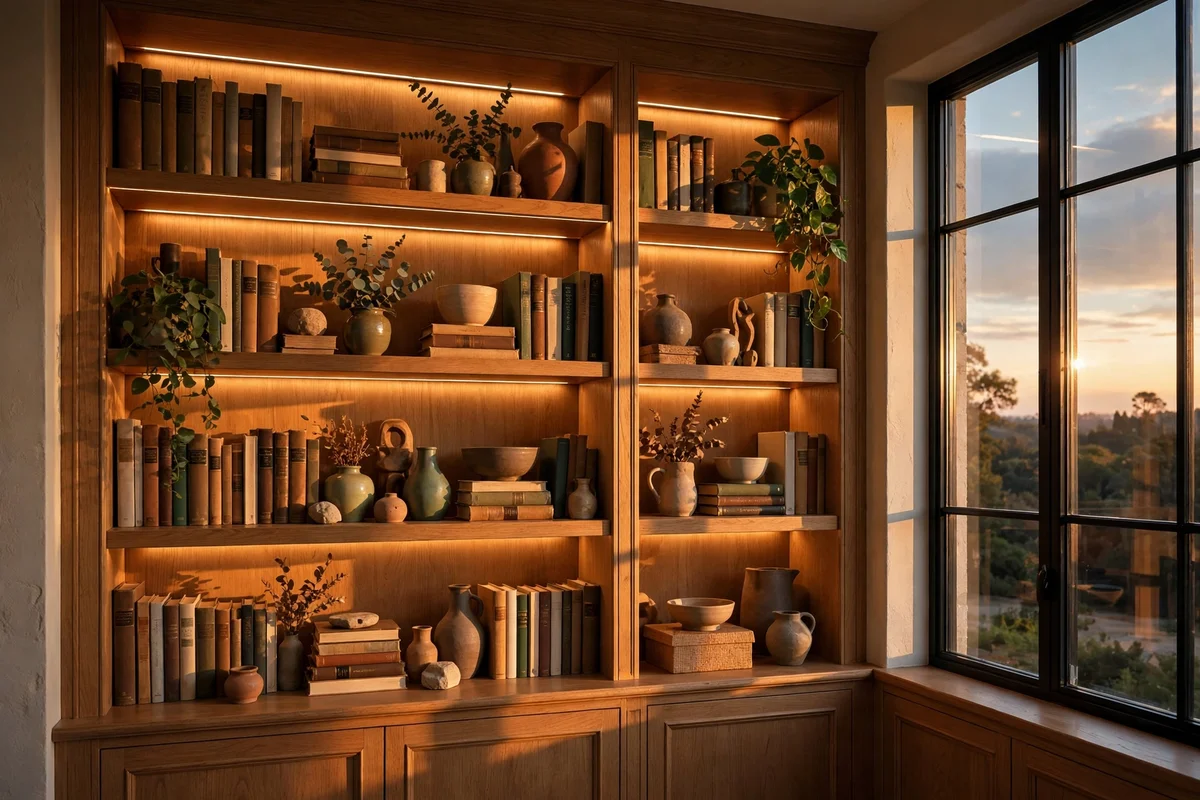
Adhesive LED strips fixed to the underside of each shelf, set 3 to 5 cm back from the front edge, wash the books below in a soft pool of light. Pick a warm white 2700K strip with a dimmer, and keep the brightness low, around 30 percent, so the shelves glow rather than glare. A 5 metre reel with a plug-in transformer costs 15 to 30 pounds or dollars and usually covers three to four shelves, making this the cheapest lighting upgrade with the biggest evening impact.
Run the strip in one continuous line where shelves connect, tucking the cable down the back corner of the bookcase where it disappears. Add a simple timer plug so the lights switch on at dusk and off at bedtime without anyone touching them. The mistake to avoid is mounting the strip flush with the shelf front, where the bare diodes become visible dots of harsh light. Set back and dimmed, the source vanishes and only the warmth remains.
9. Mirror Bookcase Towers on Both Sides of a Fireplace
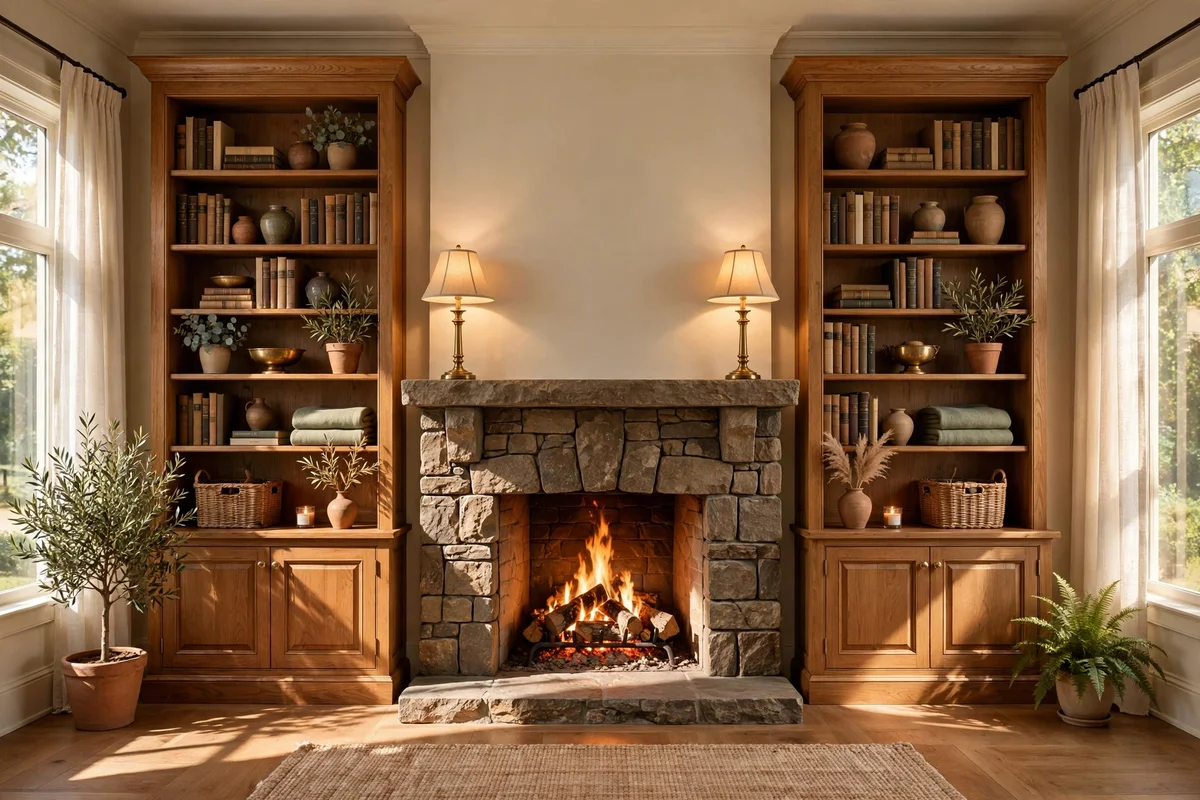
A pair of built-in towers flanking a fireplace looks settled only when the two sides talk to each other. Keep the same shelf heights on both towers, fill the bottom two shelves with the heaviest books on each side, and echo one strong object across the pair: a matching pair of lamps, two similar baskets, or the same framed print in different sizes. The symmetry frames the fireplace like a hearth in an old library, and the room immediately feels more anchored.
Mirror the structure, not every object, or the display turns stiff. Let the books themselves differ between sides, since identical shelves look staged, but repeat one colour in objects on both towers to tie them together. Keep the mantel shelf itself simple, three objects at most, so the towers do the decorative work. The mistake to avoid is filling the fireplace shelves with small fiddly items that read as clutter from the sofa; larger shapes carry across the room better.
10. Style Shelves Around a Television Without the Screen Taking Over
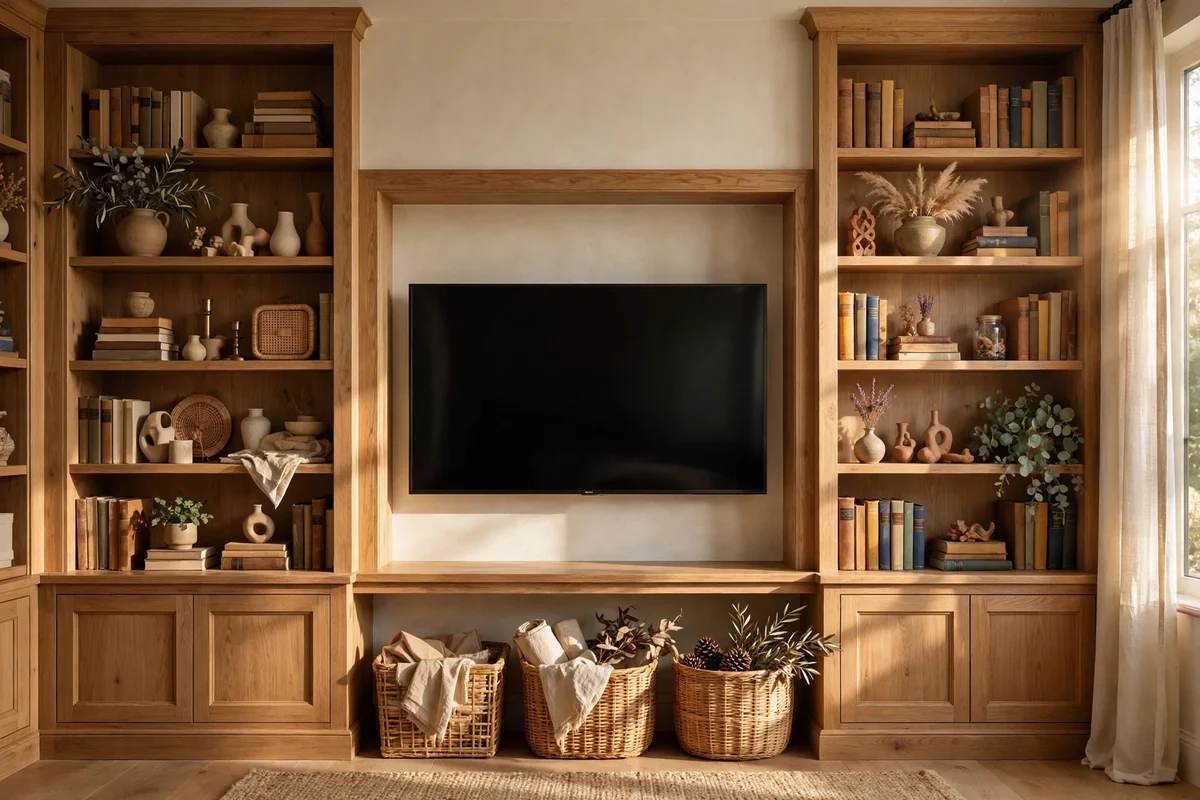
When a television sits between built-in shelves, give the screen a calm frame by keeping the surrounding shelves slightly fuller than usual, since visual weight around the black rectangle stops it dominating the wall. Place books on the shelves closest to the screen and move delicate objects one shelf further out, where the eye rests when the television is off. A row of closed baskets on the shelf below the screen hides the boxes, consoles and cables that usually spoil the look.
Leave at least 15 cm of clear air between the top of the television and the shelf above so heat escapes and the screen can be tilted. Run all cables through a channel or behind the bookcase back panel before styling a single book, since loose wires undo every other effort. The mistake to avoid is placing glossy framed prints opposite a window near the television wall, where reflections fight the screen. Matte frames keep the whole wall restful.
11. Lean Framed Prints Two Deep Against the Back of Shelves
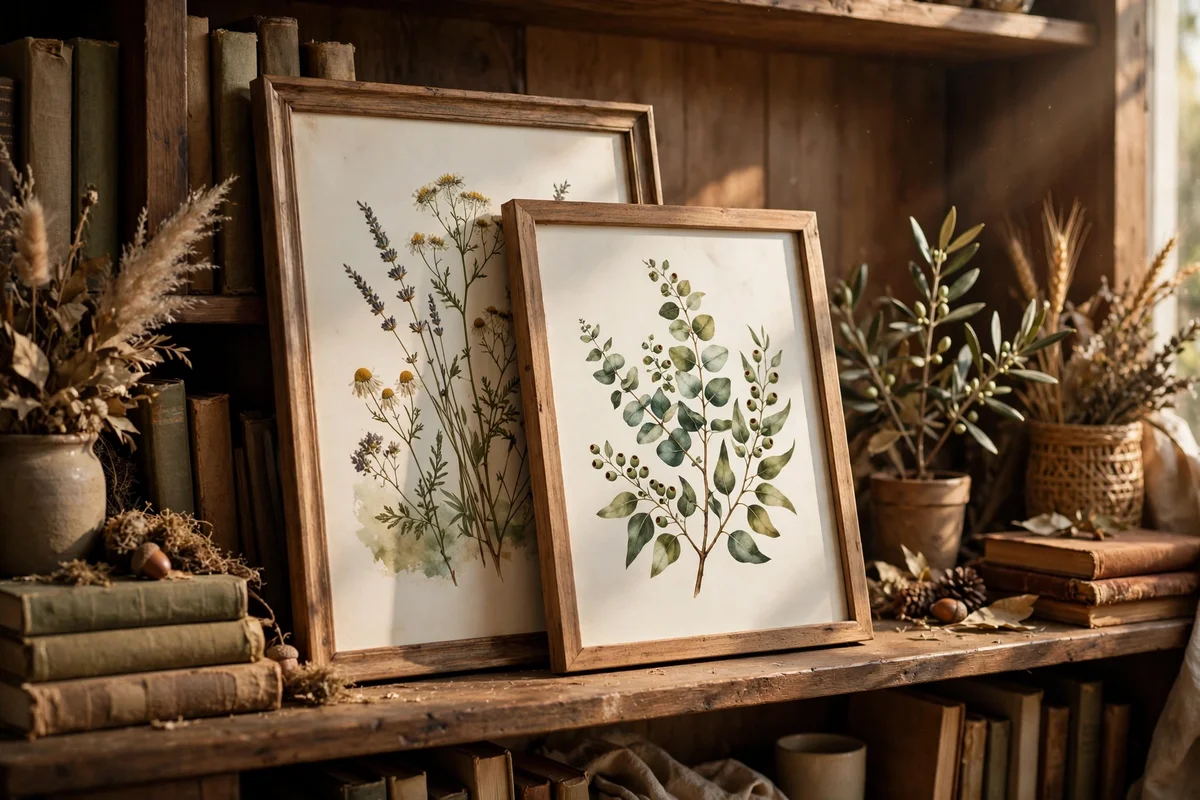
Leaning framed prints against the back panel of a shelf adds art without a single nail hole. Place a larger print, 25 to 35 cm tall, at the back and a smaller one, 15 to 20 cm tall, in front of it, slightly overlapping, so the pair reads as one layered composition. Use slim oak, walnut or black frames that echo the room’s other woodwork, and keep the artwork calm: landscapes, botanical studies or simple abstract washes in muted tones suit a library mood best.
Anchor the leaning prints with books or a small object at each side so they cannot slide, and check the lean angle, about 10 degrees, so the top rests safely against the back without straining the frame. Change the prints twice a year to keep the shelf feeling fresh, storing the spares flat between sheets of tissue paper. The mistake to avoid is leaning a heavy glazed frame on a high shelf, where a knock could send glass down the whole bookcase. Keep glass low.
12. Swap Small Objects With the Seasons Instead of Restyling Everything
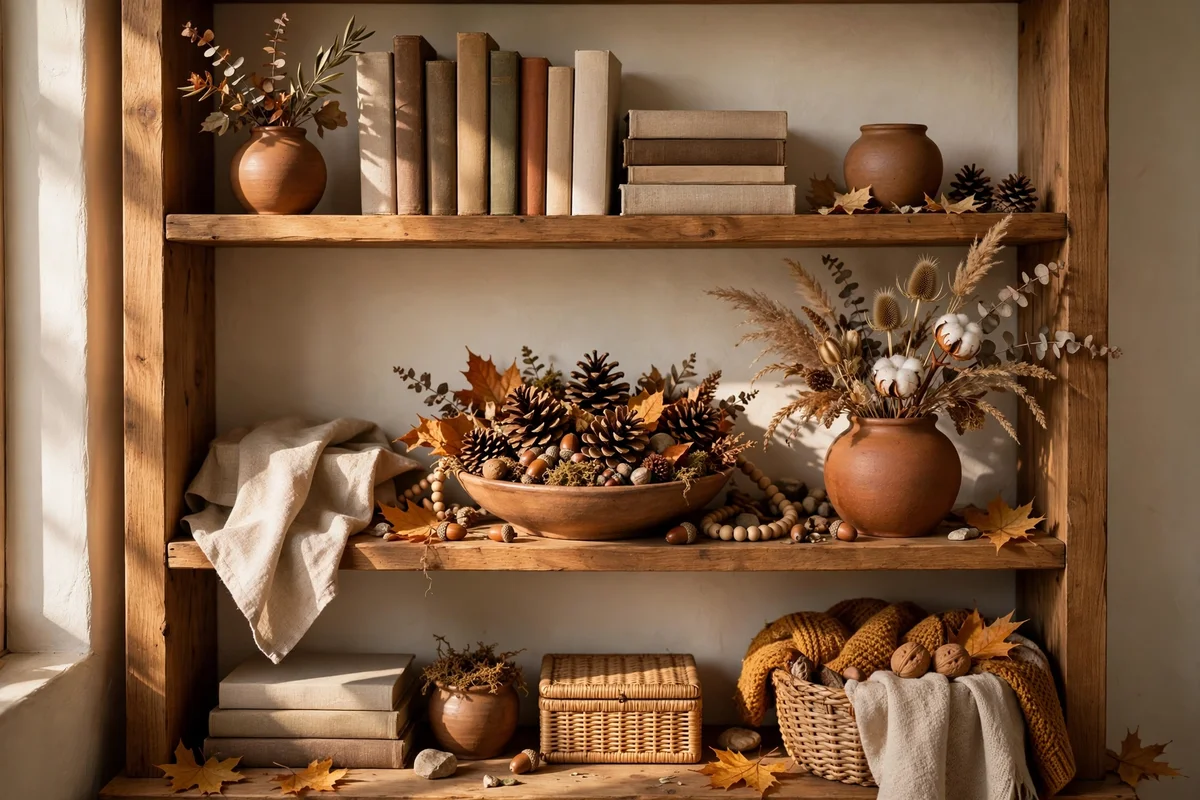
A full restyle twice a year is exhausting, so keep the books exactly where they are and swap only the objects. In autumn, trade a ceramic vase for one in a warmer glaze and add a bowl of pinecones or dried seed heads; in spring, bring in a pale green bowl and a small jug of budding branches. Three to five swapped objects across a whole bookcase is enough to make the room feel new, and each swap takes under half an hour.
Store the off-season objects together in one labelled box on a high shelf or in a cupboard, so the next swap means lifting one box down rather than hunting through the house. Keep the baskets, boxes and lighting untouched through every season, since changing the structure as well as the decor doubles the work. The mistake to avoid is seasonal clutter, where autumn brings six new items and spring removes none. One in, one out keeps the calm intact.
13. Choose a Shelf Depth of 25 to 30 cm for Books and 35 cm for Baskets
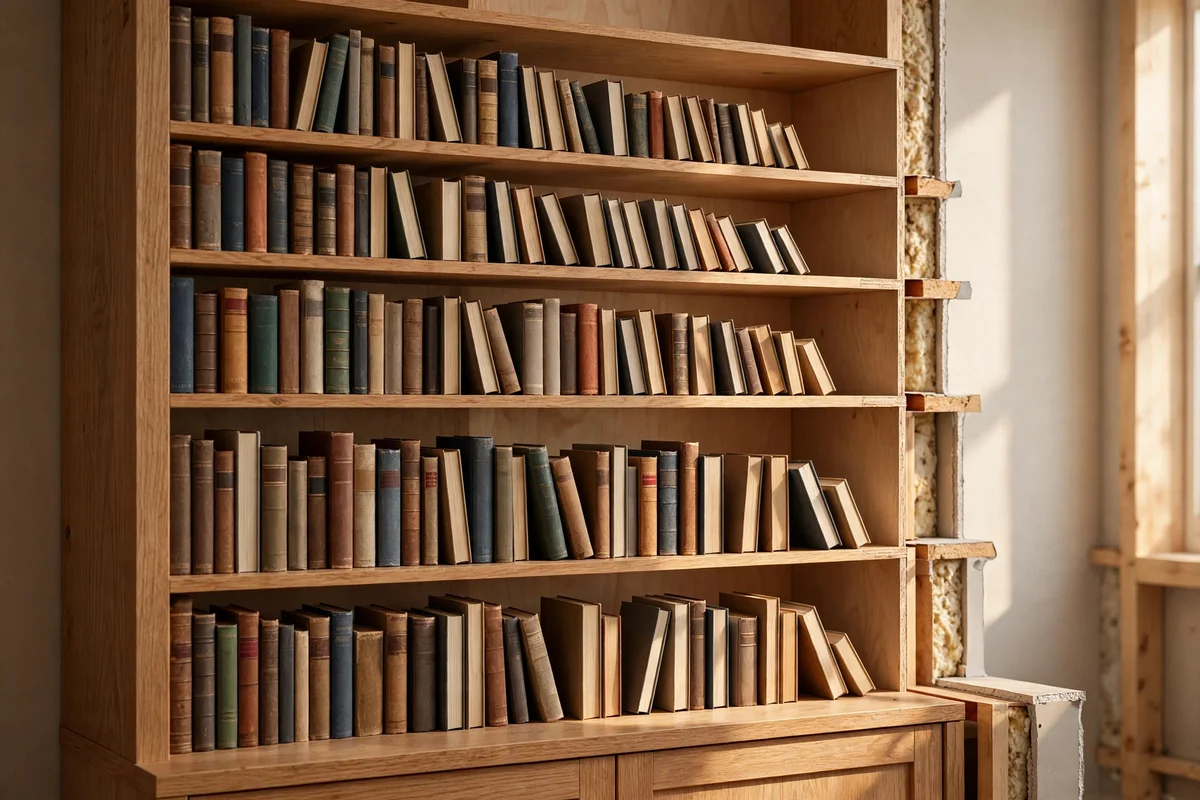
Standard books need surprisingly little depth: most hardbacks sit happily on a 25 cm shelf with 2 to 3 cm to spare at the front, while oversized art books want 30 cm. Deeper shelves look generous but waste the front 10 cm, where dust gathers and small objects get lost. If you are having built-ins made, ask for 28 cm shelves through the book sections and 35 cm on the lowest shelf only, where baskets and boxes need the extra room.
For existing shelves that are too deep, pull books forward so their spines sit 2 cm behind the shelf edge, which makes the shelf look purposefully full. Use the hidden space behind the front row for slim storage: spare book jackets, flat wrapping paper or a thin document box. The mistake to avoid is lining small objects along the very front edge of a deep shelf, where they look stranded in a field of empty wood. Bring everything forward instead.
14. Leave 30 to 40 cm Between Shelves and Vary Heights for Large Books
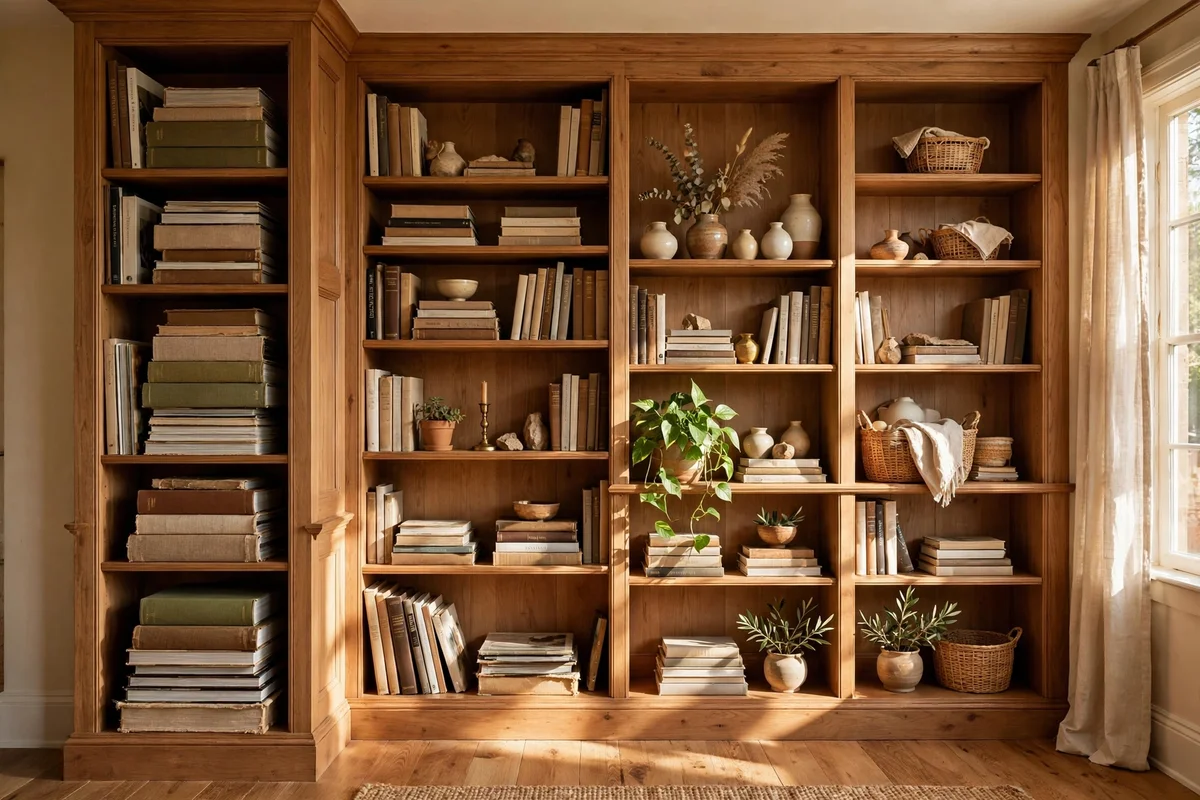
Most novels are 20 to 23 cm tall, so a 30 cm gap between shelves gives comfortable clearance plus room for a hand to reach in. Dedicate one taller bay of 38 to 40 cm for art books, atlases and tall reference volumes, which usually measure 28 to 35 cm. Adjustable shelf pins are worth their weight here: moving one shelf up by 5 cm can rescue a whole row of books that currently lean because they are 1 cm too tall for their slot.
Plan the tall bay before filling anything, ideally near the bottom where heavy books belong anyway. Keep the remaining shelves at even 30 cm intervals so the bookcase reads as orderly even with one deeper section. If your shelves are fixed, stand the tallest books in the middle bay and let shorter paperbacks fill the tighter shelves at the top. The mistake to avoid is leaving a 45 cm gap above paperbacks, which wastes a shelf that could hold a whole extra row of books.
15. Leave One Breathing Shelf in Every Column of Five
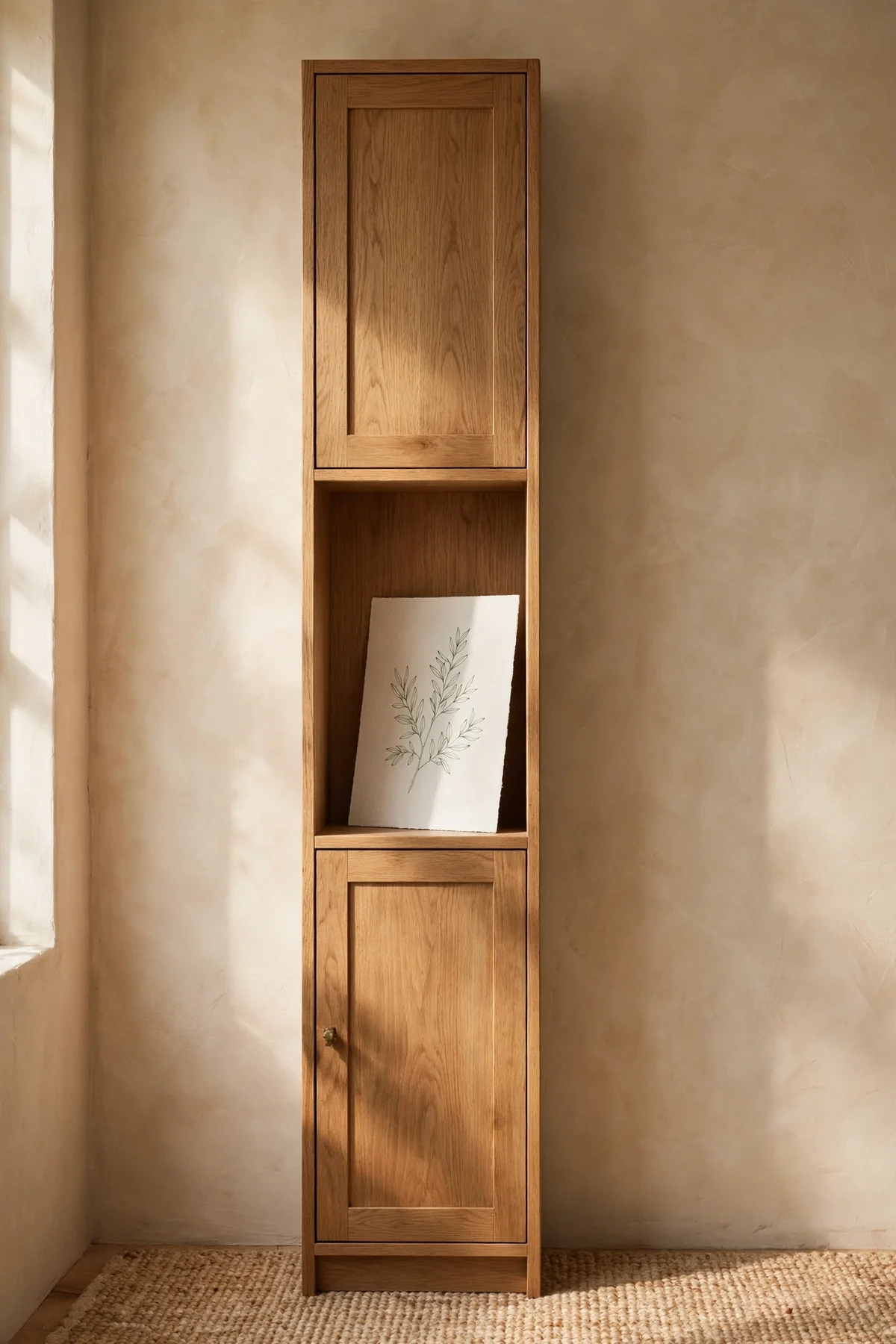
A bookcase filled edge to edge on every shelf feels like storage, not a library. In each vertical column of five shelves, leave one shelf deliberately quiet: a single leaning print, a low stack of two books and one small object, or simply books with generous air between groups. The empty space lets the eye rest and makes the full shelves beside it look curated rather than crammed, the same way a pause makes music clearer.
Rotate which shelf breathes when you do your seasonal swap, so no single shelf becomes the permanent dumping ground for unsorted items. The breathing shelf is also the natural home for the season’s featured object, a spring vase or an autumn bowl, which gives the whole bookcase a focal point that changes through the year. The mistake to avoid is filling the breathing shelf temporarily with books that have nowhere else to go. Guard it like a reading chair.
16. Place Heavy Art Books and Encyclopaedias on the Lowest Sturdy Shelf

A single large art book can weigh 3 to 4 kg, and a row of them easily passes 20 kg, which is more than most middle shelves are rated to hold without sagging. Keep these heavyweights on the lowest fixed shelf, ideally one that is screwed directly into the bookcase sides rather than resting on pins. Standing them upright with a sturdy bookend, or stacking them flat in piles of three, spreads the load and keeps the shelf board perfectly straight for decades.
Low placement has a second benefit: the biggest, most colourful spines anchor the base of the bookcase visually, the way a strong foundation steadies a building. Put the heaviest shelf at the bottom of the column nearest the room’s corner, where the structure is strongest. The mistake to avoid is storing heavy books up high to admire the covers, which strains both the shelf and anyone lifting a 4 kg book down from above shoulder height. Admire them at the bottom.
17. Use One Pair of Bookends Per Bookcase to Keep Rows Standing Straight
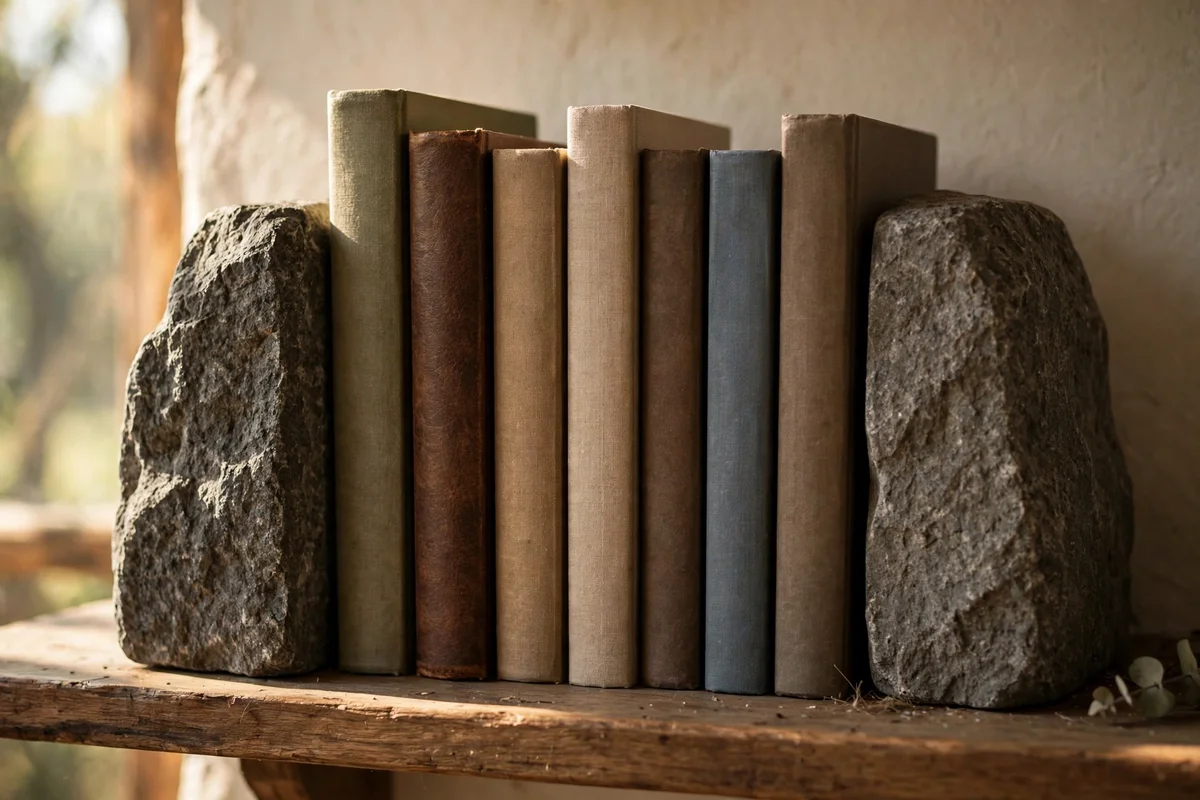
Leaning books at the end of a row drag the whole shelf down visually, so one good pair of bookends per bookcase is a small investment with an outsized effect. Choose heavy ends in stone, cast metal or solid wood, at least 1 kg each, since light decorative ends slide under a row of real books. Place them to squeeze each row gently upright, leaving no more than 1 cm of slack, and the rows hold their posture for months without attention.
Match the bookend material to something else in the room: stone ends beside a stone fireplace, walnut ends with walnut furniture, brass ends echoing brass lighting. One pair per bookcase is enough; more pairs chop the shelves into fussy segments. If a row is too short for the ends to grip, fill the gap with a horizontal stack of two or three books instead. The mistake to avoid is novelty bookends too light for the job, which topple and can knock objects off the shelf.
18. Run a Thread of One Wood Tone Through All Baskets and Frames
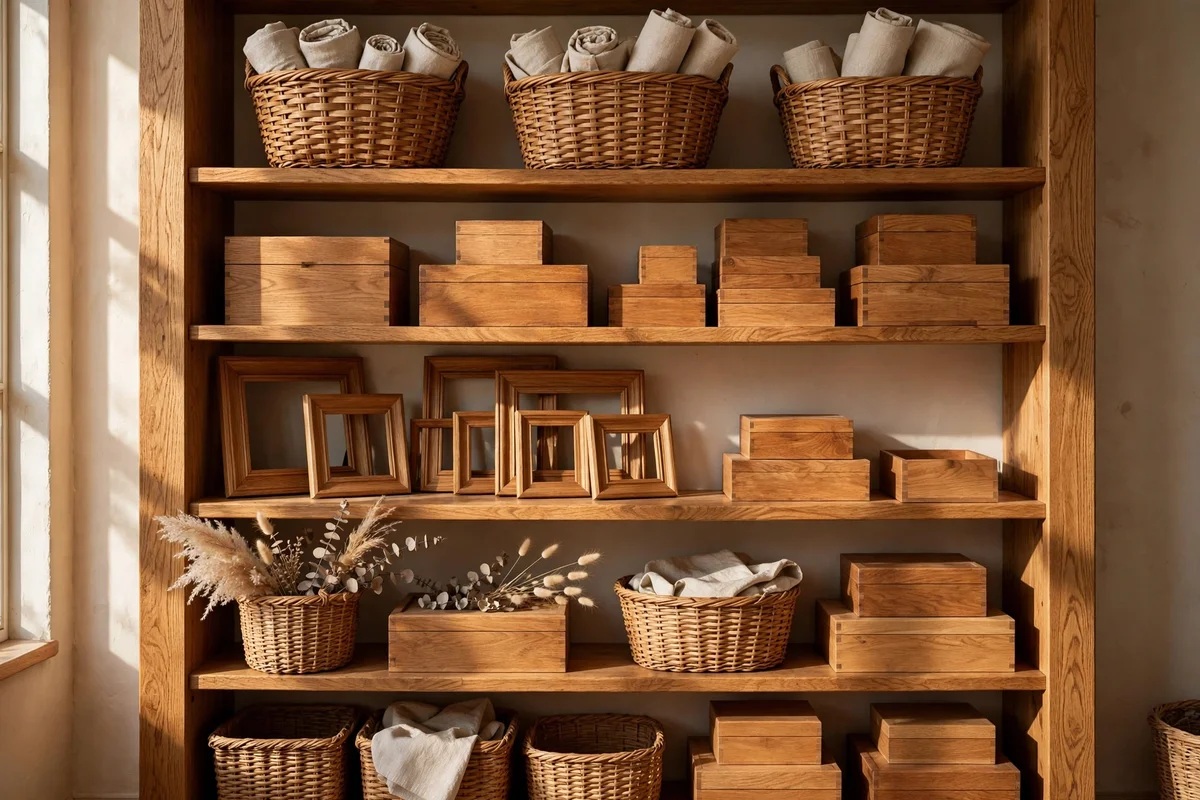
The quietest way to unify a bookcase is repetition of material: pick one wood tone, such as warm oak, deep walnut or pale ash, and echo it in the baskets, the picture frames, the lidded boxes and the bookends. When every container and frame shares the same undertone, shelves full of different coloured books still read as one family. Two or three materials across a whole bookcase is the limit; a fourth starts to look like a collection of unrelated purchases.
If your existing baskets are mixed, unify them cheaply with matching kraft labels or by lining them with the same natural fabric, which reads as one material from across the room. When buying new, take a photo of your shelf wood on your phone so the shop tone matches at home, since showroom lighting lies. The mistake to avoid is mixing warm oak baskets with cool grey boxes on the same shelf, which splits the shelf into two visual halves that never settle.
19. Tuck a Small Potted Plant at One End of the Middle Shelf
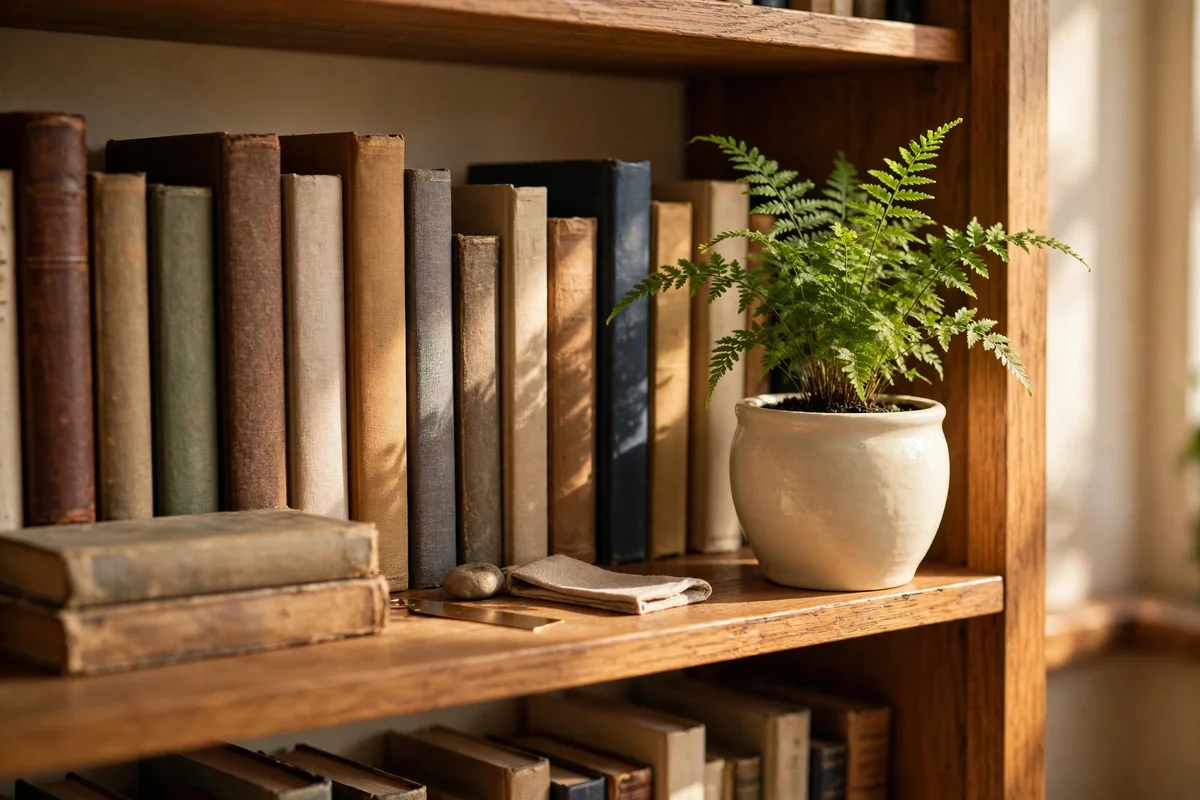
One living plant on a bookshelf softens all the straight lines of books and wood. Choose a compact, low-maintenance plant in a 10 to 12 cm pot, such as a small fern, a trailing pothos or a pilea, and place it at the end of the middle shelf where it catches ambient light. A simple ceramic pot in cream or sage keeps the focus on the leaves. One plant per bookcase is plenty; a shelf of plants becomes a greenhouse and steals the library mood.
Water the plant over the sink rather than on the shelf, since even careful watering leaves rings on wood over time. Check the light: if the middle shelf is dark, swap the plant to the top shelf or choose a variety that tolerates shade. Dust the leaves monthly with a damp cloth so they stay glossy. The mistake to avoid is a plant that outgrows its spot within months, sending tendrils across the books. Prune trailing stems back to 30 cm twice a year.
20. Line Up Shelf Tops With the Fireplace Mantel for One Clean Horizon
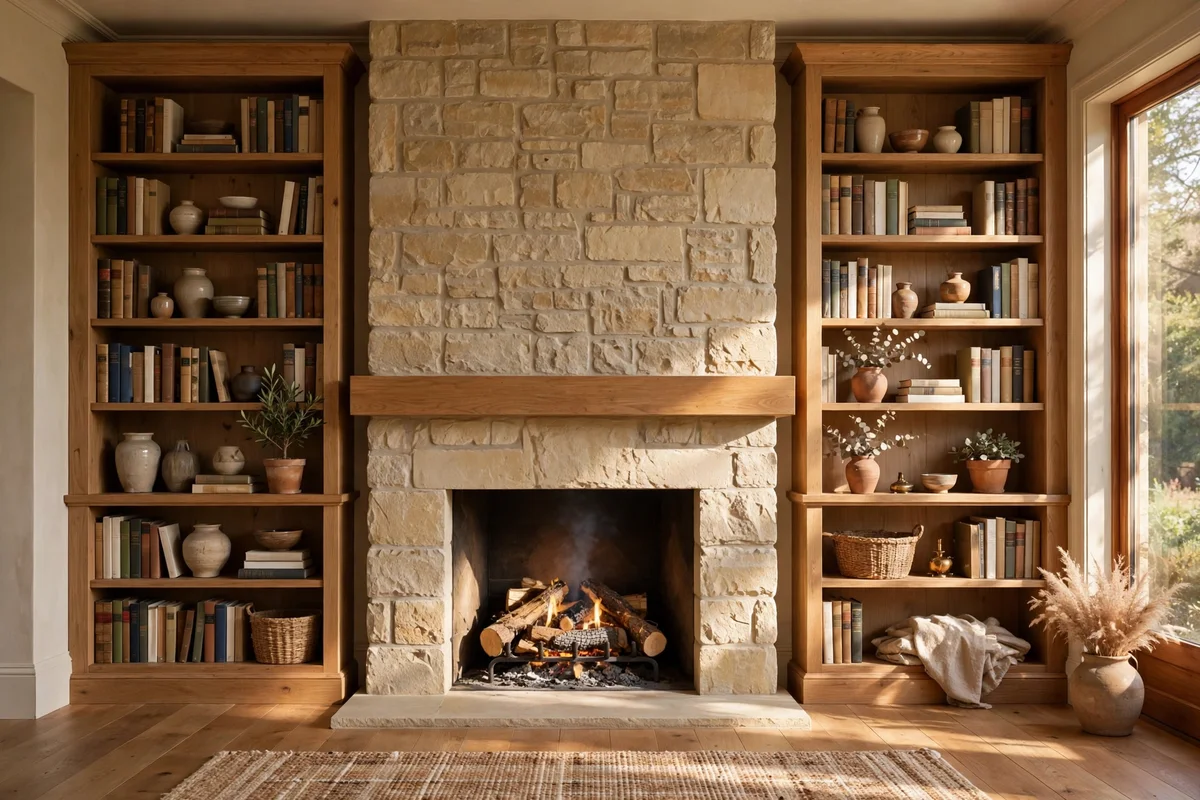
When bookcases flank a fireplace, aligning the top of the mantel with a shelf line on each tower creates one continuous horizon across the whole wall. Measure the mantel height, usually 110 to 130 cm from the floor, and set the nearest adjustable shelf within 2 cm of that line on both sides. The room reads as a single designed composition instead of three separate pieces of furniture, which is the difference between fitted and merely adjacent.
If the mantel cannot move and the shelves are fixed, use styling to fake the alignment: run a long low object, such as a row of horizontal books or a slim box, along each shelf at mantel height. Keep everything above that line symmetrical and everything below it practical, since the eye registers the horizon first. The mistake to avoid is a tall object on the mantel that breaks the line, like a 50 cm vase between two low shelves. Keep the mantel profile low and calm.
21. Measure the Television Gap First and Build Shelves 15 cm Clear of It
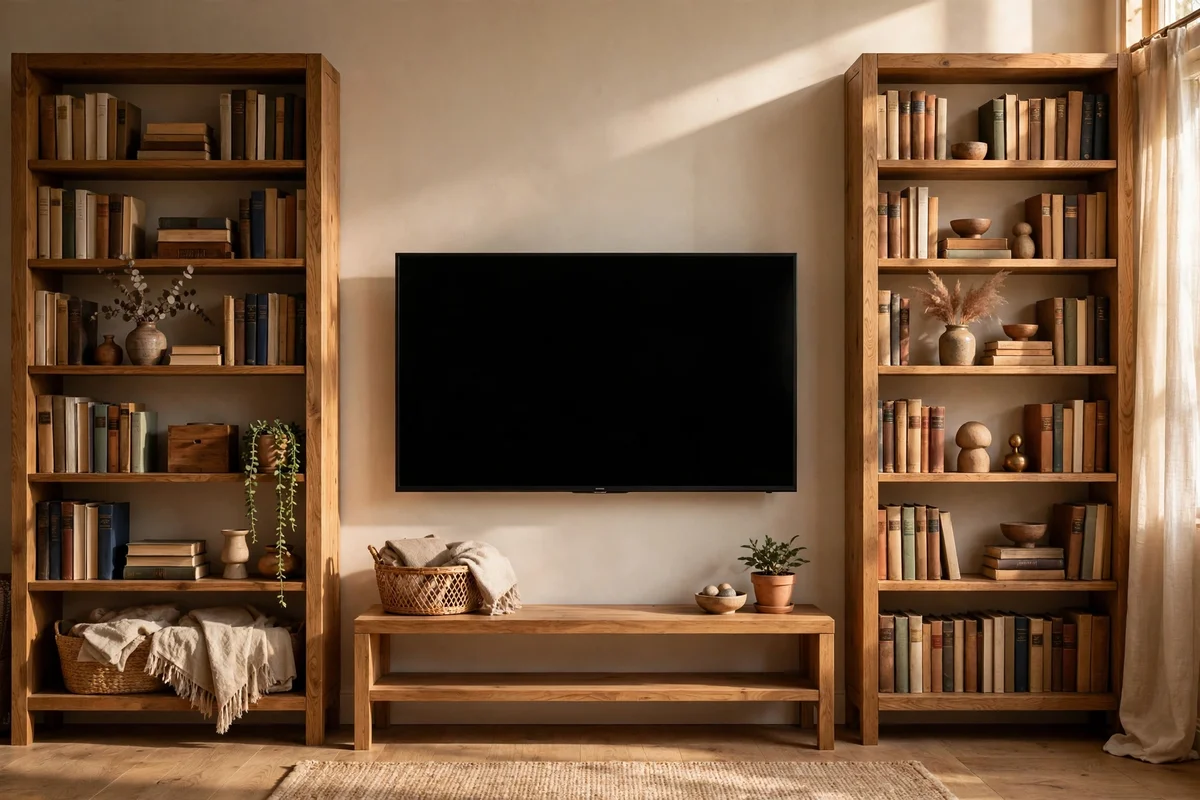
Before styling a single book around a television, measure the screen’s width and height and mark a clear zone 15 cm wider on each side and 15 cm above the top. Everything inside that zone stays empty: no leaning frames, no trailing plants, no stacked books creeping toward the bezel. The breathing room stops the wall looking cramped, gives heat space to rise, and leaves room to tilt or upgrade the screen later without restyling the shelves.
Style outward from the clear zone, placing the tallest book rows nearest the gap so the shelves step down toward the room’s edges. Keep remote controls in a lidded box on the shelf directly below the screen, within arm’s reach of the sofa. The mistake to avoid is filling the gap with just one small thing, since one small thing becomes three within a month and the television starts to look wedged in. Protect the gap as fiercely as the breathing shelf.
A calm bookcase is not built in a weekend; it is edited over time. Each of these ideas asks for one small decision, sorting by height, leaving one shelf breathing, warming the light, and the decisions add up into the library feeling that makes a room worth lingering in. The shelves do not need to be perfect, only intentional and truly lived with.
This week, start with the easiest win: pull the books off your most cluttered shelf, sort them by height, and put back only what belongs. Twenty minutes, no spending, and the shelf will already feel different. Once that calm is visible, the next idea follows naturally, perhaps a basket for the low shelf or a picture light over a favourite print.
Frequently Asked Questions
How much does it cost to restyle built-in bookshelves?
Most of these ideas cost nothing, since sorting, spacing and the two thirds rule only take time. A realistic budget for the extras is 60 to 150 pounds or dollars: baskets at 12 to 25 each, a battery picture light at 20 to 40, and an LED strip reel at 15 to 30. Buy the storage first, since hidden clutter makes every other change look better.
How do I style bookshelves around a television without it looking messy?
Keep a clear zone 15 cm wider than the screen on each side and above it, and style outward from there. Place books on the shelves nearest the screen and move delicate objects further out. Hide consoles and cables in a closed basket below the screen, and run wires behind the back panel. Matte frames near the television avoid reflections that fight the picture.
What is the best shelf depth for a home bookcase?
For books alone, 25 to 30 cm is ideal: most hardbacks sit comfortably with a little air at the front. Go to 35 cm only on the lowest shelf, where baskets and lidded boxes need the depth. Deeper shelves waste the front space, so pull books forward until spines sit 2 cm behind the edge and use the hidden rear for slim storage.
How do I keep styled shelves tidy with children in the house?
Give the lowest shelves to the children: baskets for their books and toys, nothing fragile below 70 cm. Keep your styled objects on the middle and upper shelves, out of small hands’ reach. Accept that the bottom row will be rearranged daily and tidy it in two minutes each evening. Lidded boxes are your friend, since a quick lid hides any chaos.
Should books be arranged by colour or by subject?
For a calm look, arrange by colour in soft family blocks; for a working library, keep subjects together. A good compromise is colour blocks within each subject area, so the cookery books stay together but read as one warm band. Whichever you choose, apply it consistently across the whole bookcase, since mixing systems shelf by shelf is what makes bookcases look restless.