Living Room
21 Rustic Console Table Decor Ideas That Layer Wood, Linen and Stone
By Anna Wells · · 23 min read
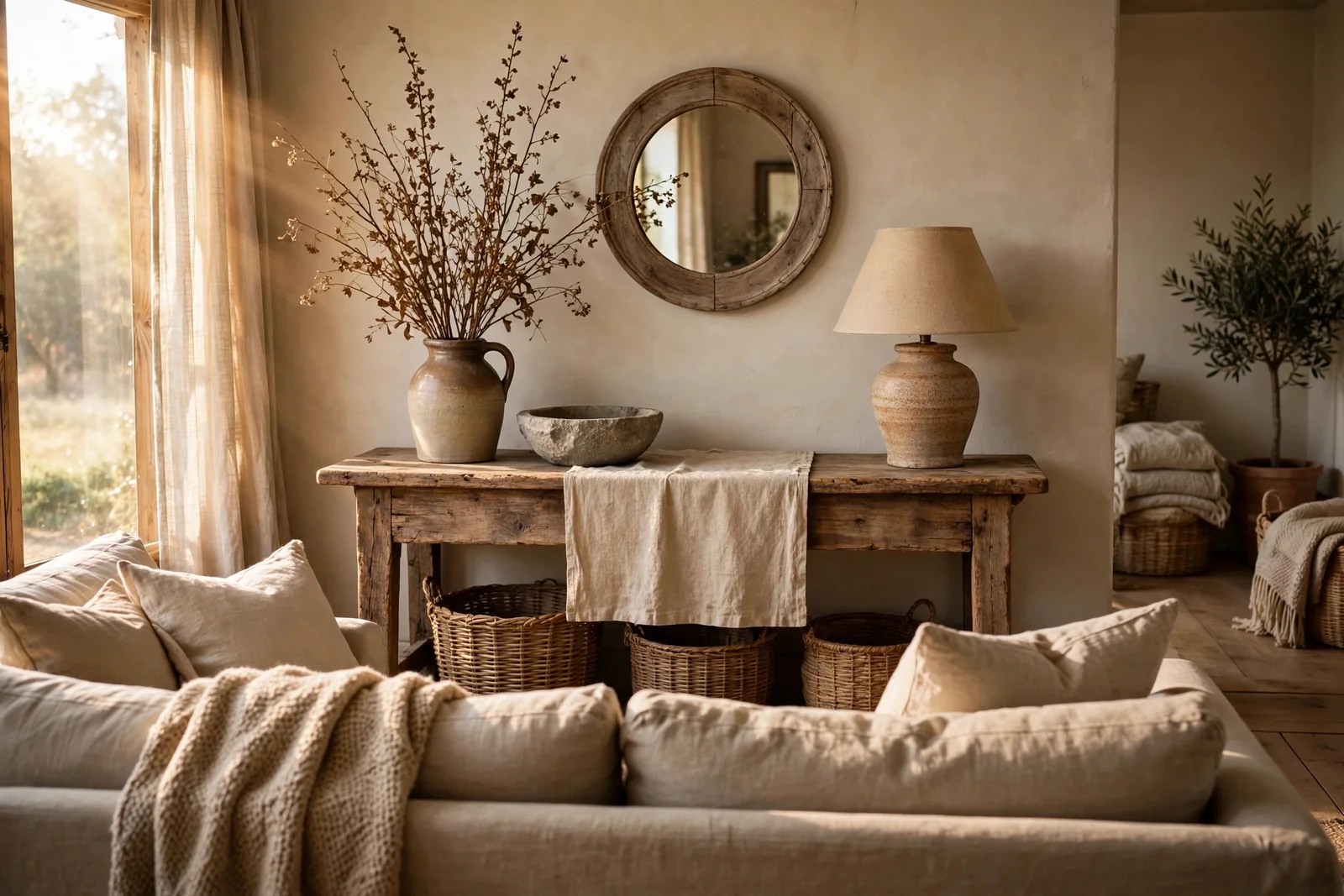
Layer wood, linen and stone into a console table that glows in any room, with anchors, height tricks and seasonal swaps.
Morning light moves slowly across the living room and catches the rough edge of a wooden console table set behind the sofa. The linen runner lies soft and unpressed, a stone bowl holds its quiet weight, and tall branches lift the whole arrangement toward the ceiling. Nothing here asks for attention, yet the corner feels settled, as if the room has exhaled. This is the pull of rustic styling: honest materials, calm layers, and pieces that look better the longer they are kept.
A console table earns its keep in almost any room. It can anchor a blank wall in the living room, fill the narrow run of a hallway, or sit low behind the sofa where it turns dead space into a display. The same three materials work everywhere: wood brings warmth, linen brings softness, and stone brings grounding weight. Learn to layer the three and one table can carry a whole season of moods.
Below are 21 ideas that build a console you will love living with. Each one is concrete, with sizes, placements and budget notes, and the arrangement rules stay the same whether the table stands in a hallway, behind a sofa or against a living room wall. Start with the anchor, add height in layers, then let baskets, light and seasonal swaps do the quiet work.
You need no new furniture to begin. Most of these ideas start with pieces you already own, rearranged with a steadier eye and a little patience. Read through, choose your anchor first, and let everything else fall into place around it.
1. Hang a Round Weathered Wood Mirror as the Console Anchor
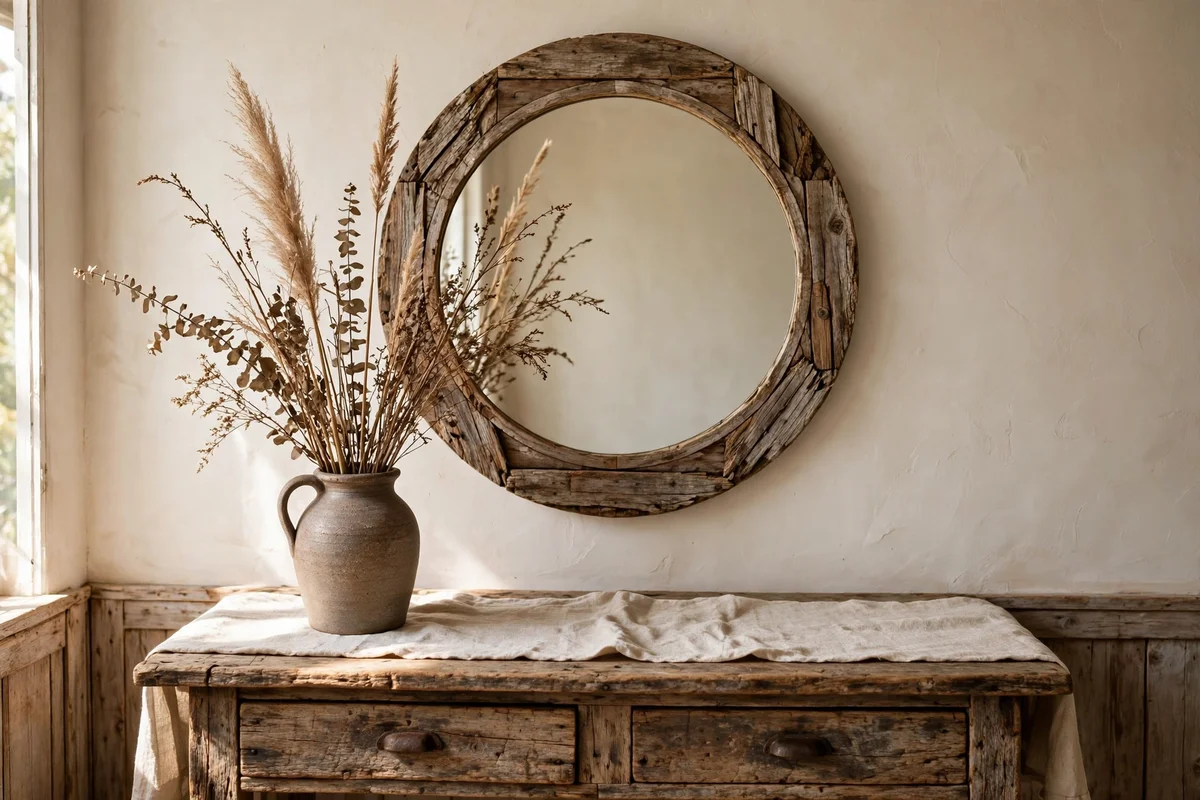
A round mirror 70 to 90 cm across makes a confident anchor above a console table, and a weathered wood frame keeps it firmly in rustic territory. Hang it so the bottom edge sits 15 to 20 cm above the tabletop, close enough to feel connected and high enough to leave styling room. Centre it over the table or nudge it slightly left so a tall branch can rise on the right. Check the reflection first: a mirror facing a window doubles daylight beautifully, while one facing a blank wall just doubles blankness.
Fix the mirror into a wall stud or use anchors rated for at least double its weight, since a timber-framed mirror can weigh 6 to 10 kg. Budget tip: second-hand round mirrors in wooden frames appear often at charity shops for 15 to 30 pounds or dollars; a light sanding and clear wax refresh the frame in an afternoon. The mistake to avoid is hanging the mirror too high, which breaks the link with the table and leaves a floating gap. Keep the whole anchor zone within the table’s width so the arrangement reads as one calm composition.
2. Lean a Large Landscape Print in an Oak Frame Above the Table
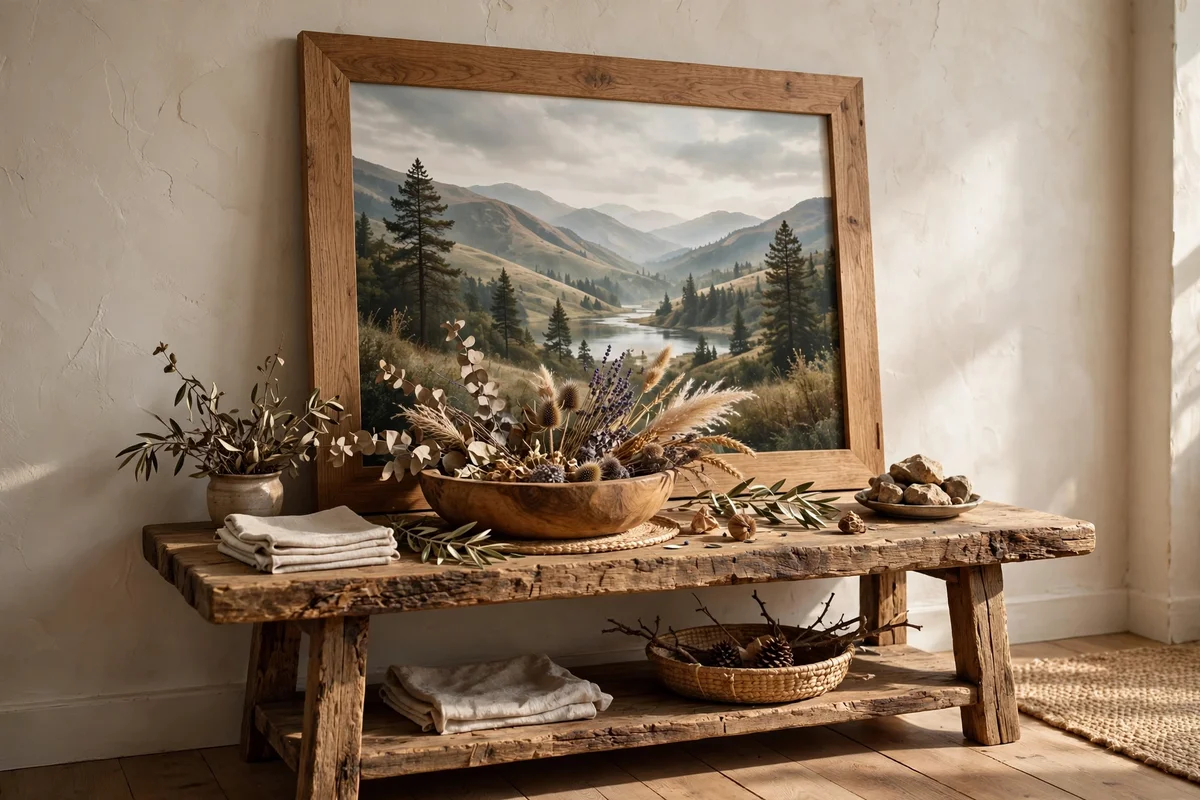
If a mirror feels too reflective, lean a large landscape print in an oak frame against the wall instead. Aim for a frame 60 to 80 cm wide and 80 to 100 cm tall on a standard 120 to 150 cm console; the art should span roughly two thirds of the table width. Lean it at a slight angle with the bottom edge resting 5 cm in front of the wall, and secure the top with a discreet hook or museum putty so it cannot slide. Choose calm scenes: misty fields, coastlines or orchards suit the rustic mood best.
A print costs far less than an original painting and looks just as settled in a simple oak frame. Budget route: order a 50 by 70 cm archival print online for 10 to 20 pounds or dollars and frame it in a ready-made oak frame for another 20 to 35. The common mistake is choosing a frame wider than the table, which makes the console look lost underneath. Keep 10 to 15 cm of bare wall visible on each side of the frame so the art crowns the table rather than swallowing it.
3. Lay a Natural Linen Runner Along the Table Centre
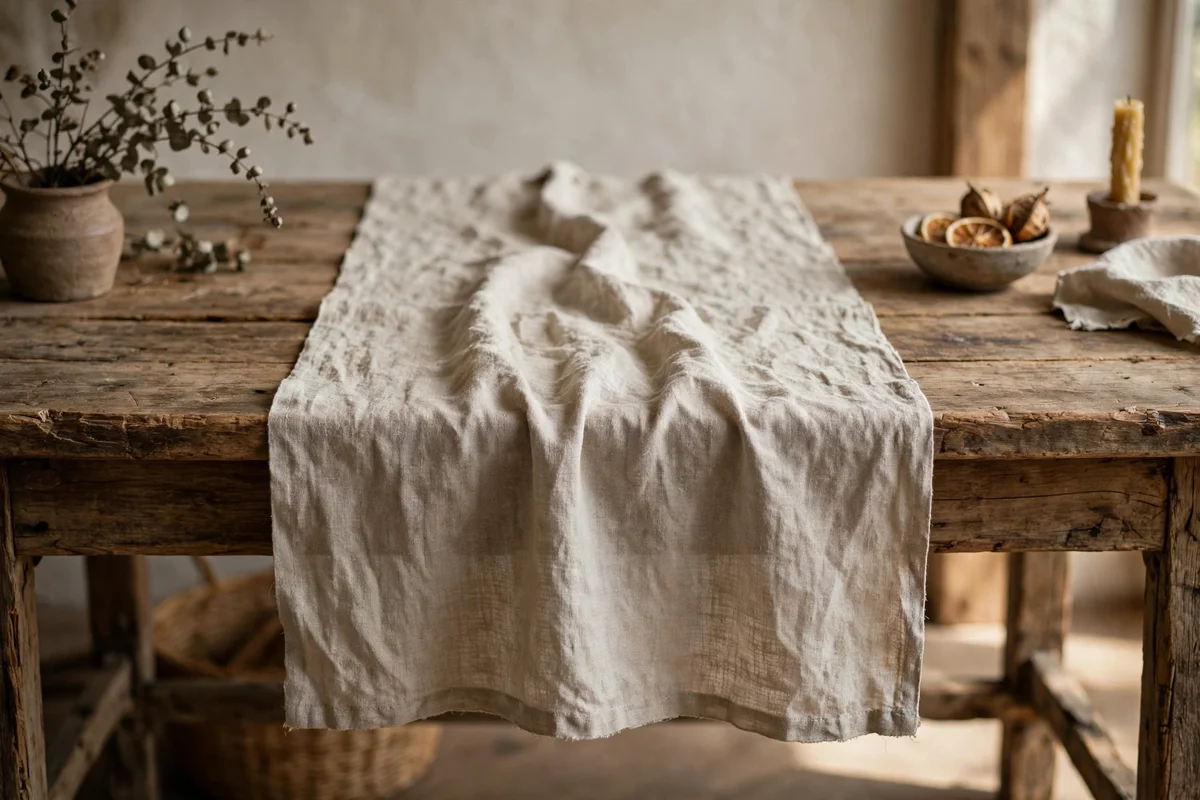
A natural linen runner is the quiet foundation of the whole arrangement. Choose one 30 to 40 cm wide and 20 to 30 cm longer than the tabletop so 10 to 15 cm drape over each end; on a 140 cm console that means a runner around 165 cm long. Lay it dead centre and let it wrinkle naturally, since pressed linen fights the relaxed rustic mood. Undyed flax or oatmeal tones work with every wood finish, from pale pine to dark walnut, and the weave adds texture before a single object is placed.
Runners protect the tabletop from scratches and ring marks while softening hard edges, so they earn their place twice over. Budget tip: a metre of medium-weight linen from a fabric shop costs 8 to 15 pounds or dollars; hem two raw edges and you have a custom runner. The mistake to avoid is a runner so wide it hangs over the table sides, which looks sloppy and catches on passing hips in a hallway. Wash linen cool and skip the iron; a little creasing is exactly the point.
4. Stack Three Clothbound Books to Lift a Small Object
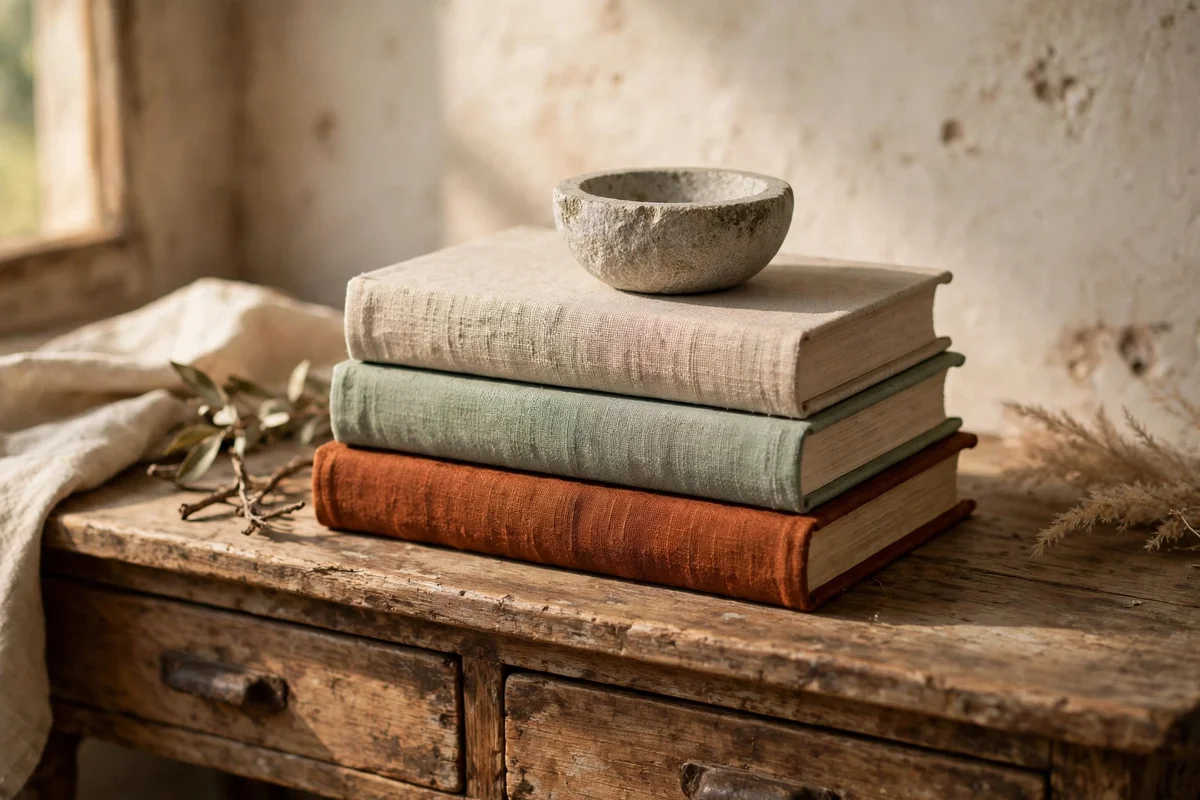
A stack of three clothbound books is the classic way to add height to a low object. Choose books 20 to 28 cm long with muted covers in sage, rust or oatmeal, and stack them largest at the bottom, smallest on top, rotating each slightly for a relaxed feel. The stack should reach 8 to 12 cm tall; place a small stone bowl, a candle or a sprig-filled bud vase on top so the eye travels upward. Keep the stack within the back third of the table so the front edge stays clear and usable.
Charity shops sell handsome clothbound books for 1 to 3 pounds or dollars each, making this the cheapest height trick in the book. Cover bright modern jackets with kraft paper if the colours clash, secured with a strip of double-sided tape. The mistake to avoid is stacking more than four books, which turns a plinth into a wobbly tower that dominates the table. Dust the stack monthly with a soft cloth, and never place lit candles directly on book covers; use a stone coaster or saucer beneath.
5. Set Tall Dried Branches in a Stoneware Jug at One End
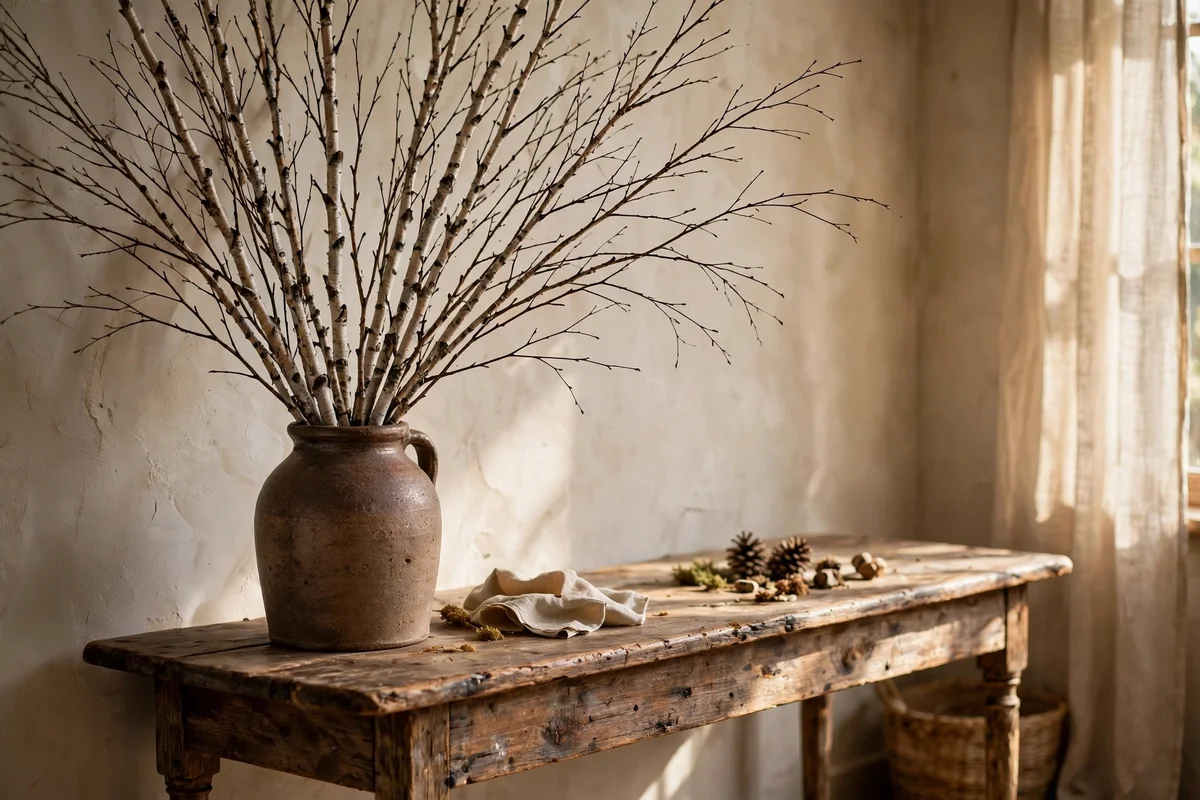
Tall branches bring the vertical lift every console needs. Choose stems 70 to 100 cm long, birch, willow or contorted hazel, and stand five to seven in a heavy stoneware jug so they fan naturally. Place the jug at one end of the table, roughly in the outer third, where its height balances a lower lamp or bowl at the other end. The branches should rise 40 to 60 cm above the tabletop; anything taller starts to fight the mirror or art hanging above. Dried stems last for years and need no water.
Forage branches on walks or buy bundles of dried stems for 8 to 18 pounds or dollars; pussy willow and birch stems are widely available in autumn. Weigh the jug down with clean pebbles if the stems make it top-heavy, especially on a narrow 30 cm deep console. The mistake to avoid is cramming in too many stems, which reads as a thicket rather than a graceful spray; five to seven is plenty. Shake dust off outdoors every few months and replace any stem that starts shedding.
6. Balance the Far End With a Low Stone Bowl of Pine Cones
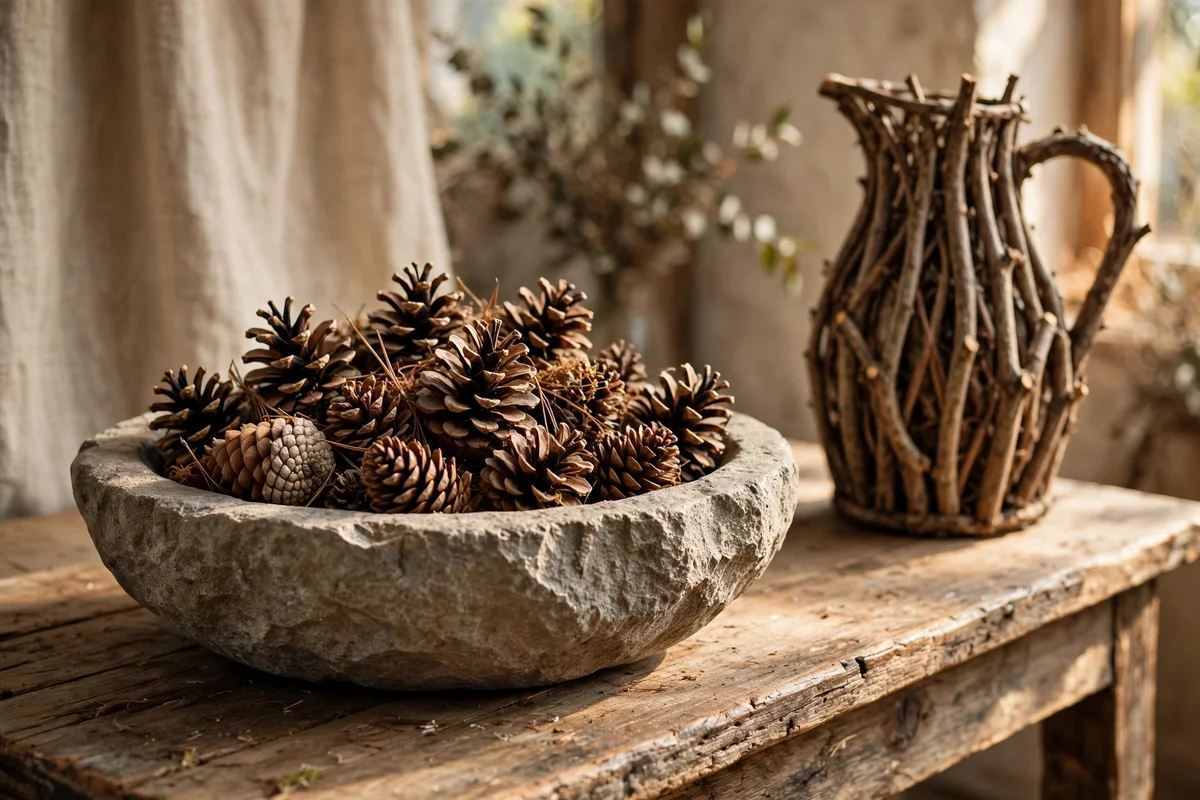
Every tall element needs a low, weighty partner, and a stone bowl of pine cones does the job beautifully. Choose a bowl 25 to 35 cm across with a rough, honed finish, and fill it two thirds full with eight to twelve pine cones of mixed sizes. Set it at the opposite end of the table from the branches, pulled slightly forward so it sits in the front third while the jug holds the back. The low, dark mass grounds the arrangement and stops the eye from sliding off the table edge.
Stone bowls cost 15 to 40 pounds or dollars new, but concrete or reconstituted stone versions give the same look for less. Collect pine cones on autumn walks for free and bake them at 100 degrees Celsius for an hour to kill any insects before bringing them inside. The mistake to avoid is overfilling the bowl into a mound, which looks fussy; keep the cones level with the rim. Wipe the bowl with a damp cloth monthly, since stone shows dust quickly in bright rooms.
7. Slide Two Woven Baskets Under the Table for Hidden Storage
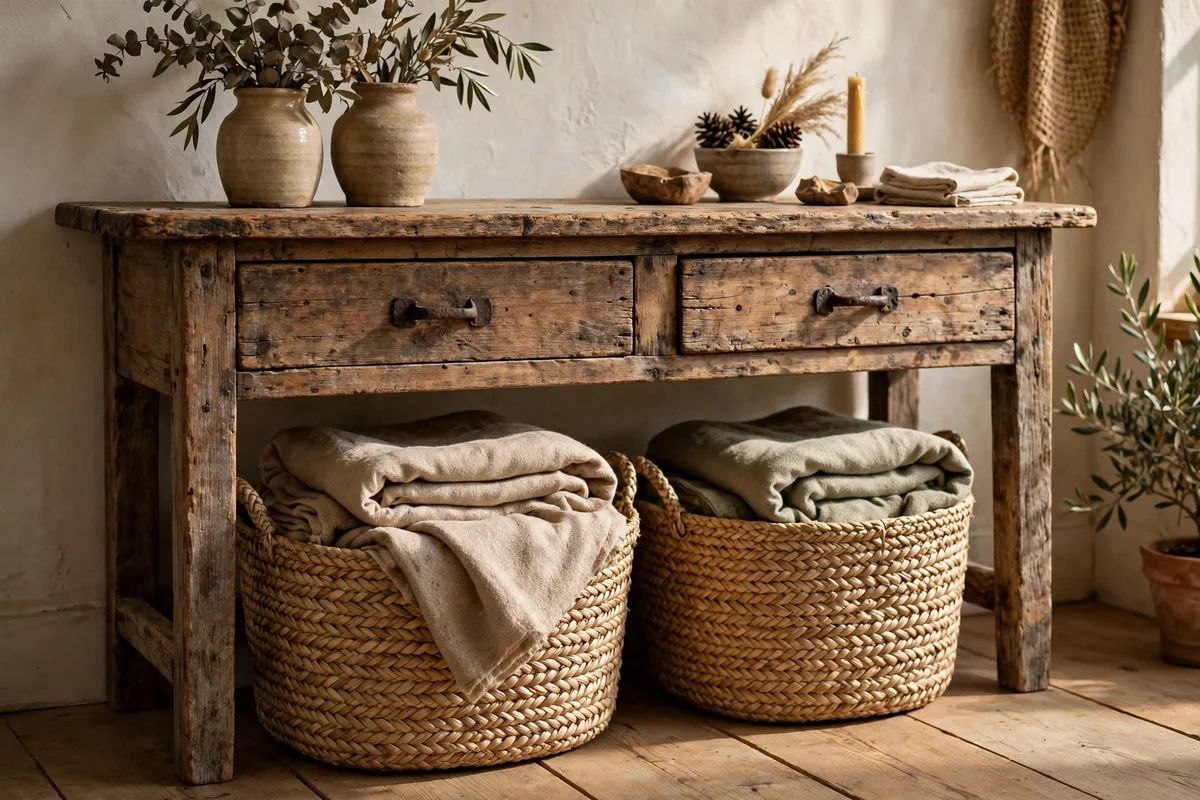
The space beneath a console table is storage waiting to happen. Slide two woven seagrass or water-hyacinth baskets underneath, each 35 to 45 cm wide and 25 to 30 cm tall, leaving a 5 cm gap between them for breathing room. Use them for the things that clutter a hallway or living room: spare throws, board games, shoe polish kits or children’s colouring supplies. Keep the basket fronts flush with the table legs so the line stays tidy from across the room.
A pair of baskets costs 20 to 45 pounds or dollars at home stores, less at markets. Choose baskets with a tight weave and no fraying handles so they slide in and out without snagging the floor. The mistake to avoid is buying baskets taller than the clearance under the table; measure the gap first, aiming for at least 3 cm of air above each basket. Vacuum the weave with a brush attachment twice a year, since dust settles deep into natural fibres.
8. Add a Ceramic Lamp With a Flax Shade for Evening Warmth
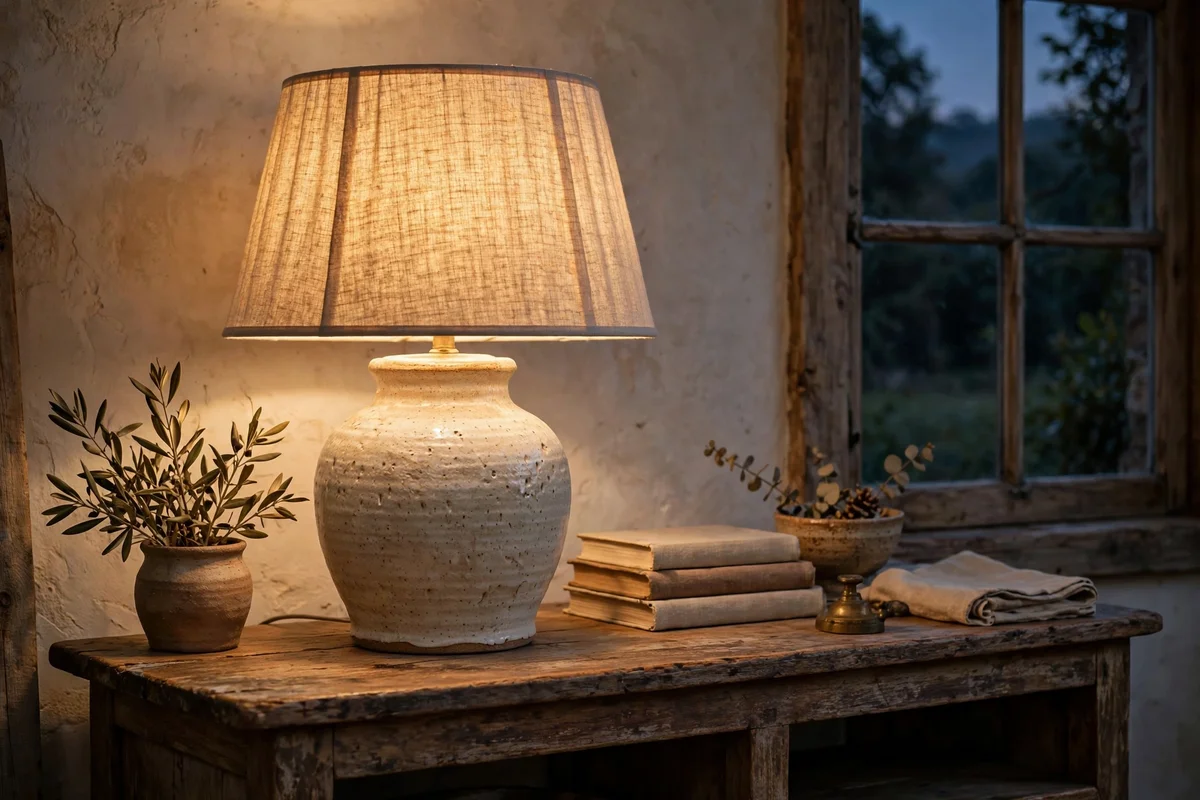
A lamp turns a daytime display into an evening glow. Choose a ceramic table lamp 40 to 50 cm tall with a flax or oatmeal linen shade 25 to 30 cm across, and fit a warm 2700K LED bulb of 6 to 8 watts. Place the lamp at the end opposite the tall branches so light and height balance each other across the table. In a hallway, the lamp becomes a gentle night light for the whole corridor; behind a sofa, it pools soft light exactly where evening tea is poured.
Ceramic lamps with linen shades start around 35 pounds or dollars at high-street stores; thrifted bases with new shades cut that in half. Keep the shade’s bottom edge at least 10 cm above any nearby branches so heat never touches dried stems. The mistake to avoid is a cool white bulb, which turns linen grey and wood flat; warm light is non-negotiable here. Wipe the shade with a dry microfibre cloth monthly, since linen shades show dust in raking light.
9. Drape a Chunky Knit Throw Over One Corner of the Table
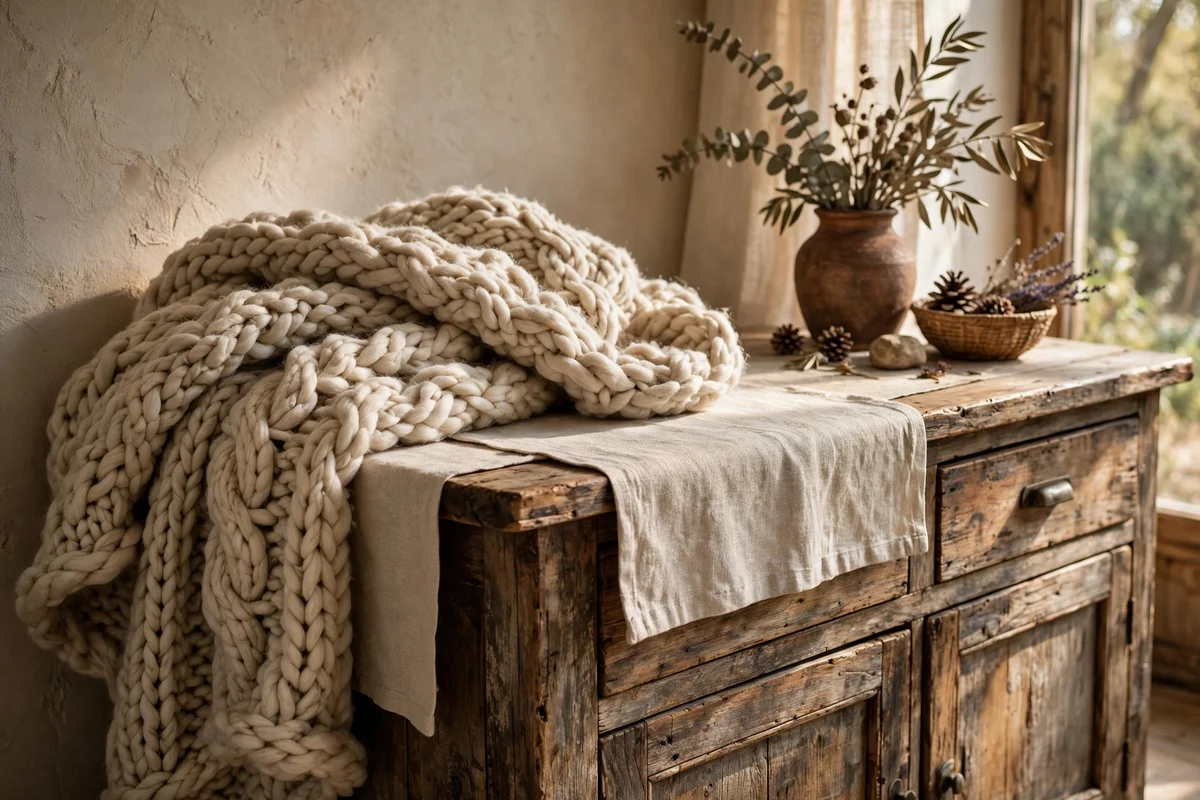
A chunky knit throw softens the table’s hard corner and adds the cosy layer linen alone cannot give. Fold a throw 130 by 170 cm into thirds lengthwise and drape it over one front corner so 40 to 50 cm hangs down the side and the rest pools softly on the tabletop. Choose undyed wool, cream cotton or a warm oatmeal knit; the chunky texture should contrast with the smooth linen runner underneath. In autumn and winter this one addition makes the whole console feel warmer without moving a single object.
Chunky throws cost 25 to 60 pounds or dollars; cotton knits at the lower end wash easily and suit homes with children. Tuck the tabletop end of the throw under the nearest heavy object so it stays put when someone brushes past. The mistake to avoid is letting the throw cover more than a quarter of the table, which hides the styling instead of softening it. Air the throw outside monthly and wash per its label, since wool holds cooking smells from open-plan kitchens.
10. Group Three Pillar Candles in Descending Stone Holders
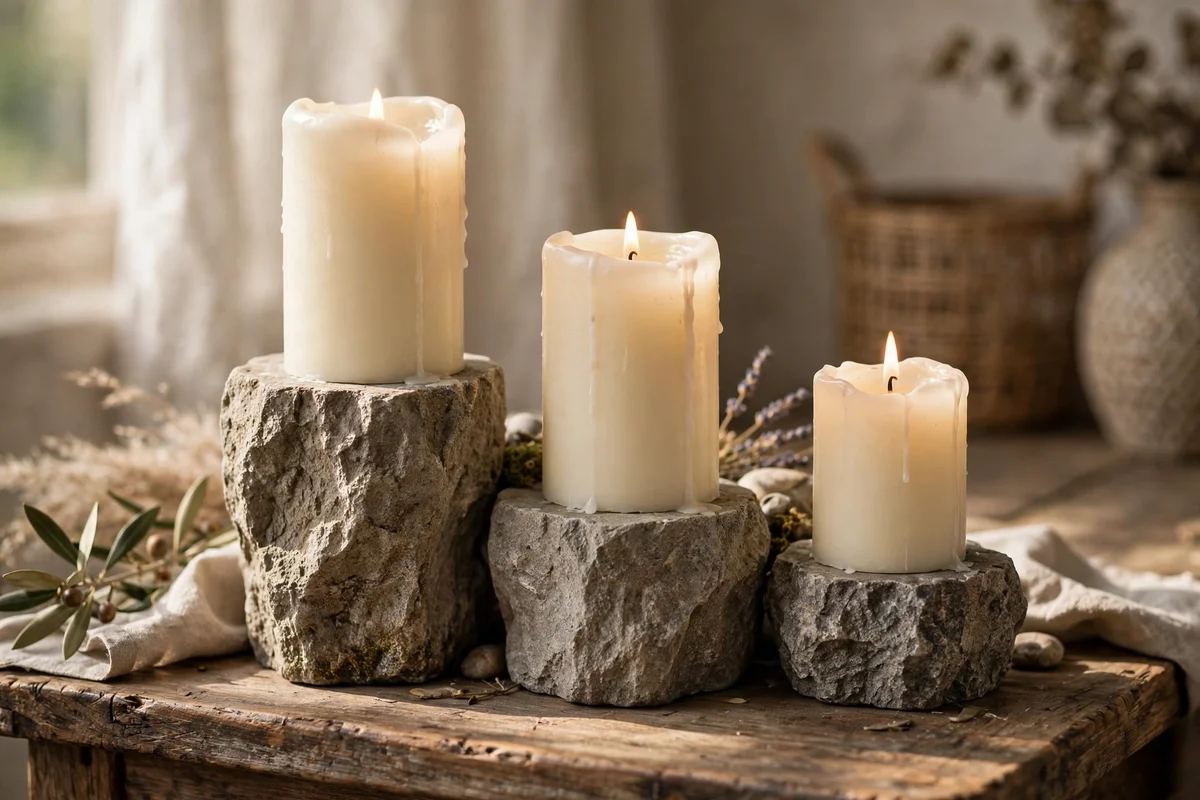
A trio of pillar candles in descending heights creates a gentle staircase of light. Choose unscented ivory or beeswax pillars 15, 20 and 25 cm tall, each in a rough stone or concrete holder 8 to 10 cm across, and group them tight with 2 to 3 cm between holders. Place the cluster in the middle third of the table, slightly back from the front edge, where it bridges the tall branches and the low bowl. Light them only when someone is in the room, and trim wicks to 5 mm for a clean, smoke-free flame.
Three stone holders cost 12 to 30 pounds or dollars as a set; beeswax pillars burn longer and drip less than paraffin. Keep candles at least 15 cm from the linen runner and 30 cm from dried branches, since both are flammable. The mistake to avoid is mixing scented candles with the natural materials here; fragrance fights the honest wood and linen character. Let pillars cool fully before moving them, and wipe holders with a damp cloth to remove wax dust between burns.
11. Fill a Carved Wooden Dough Bowl With Dried Botanicals
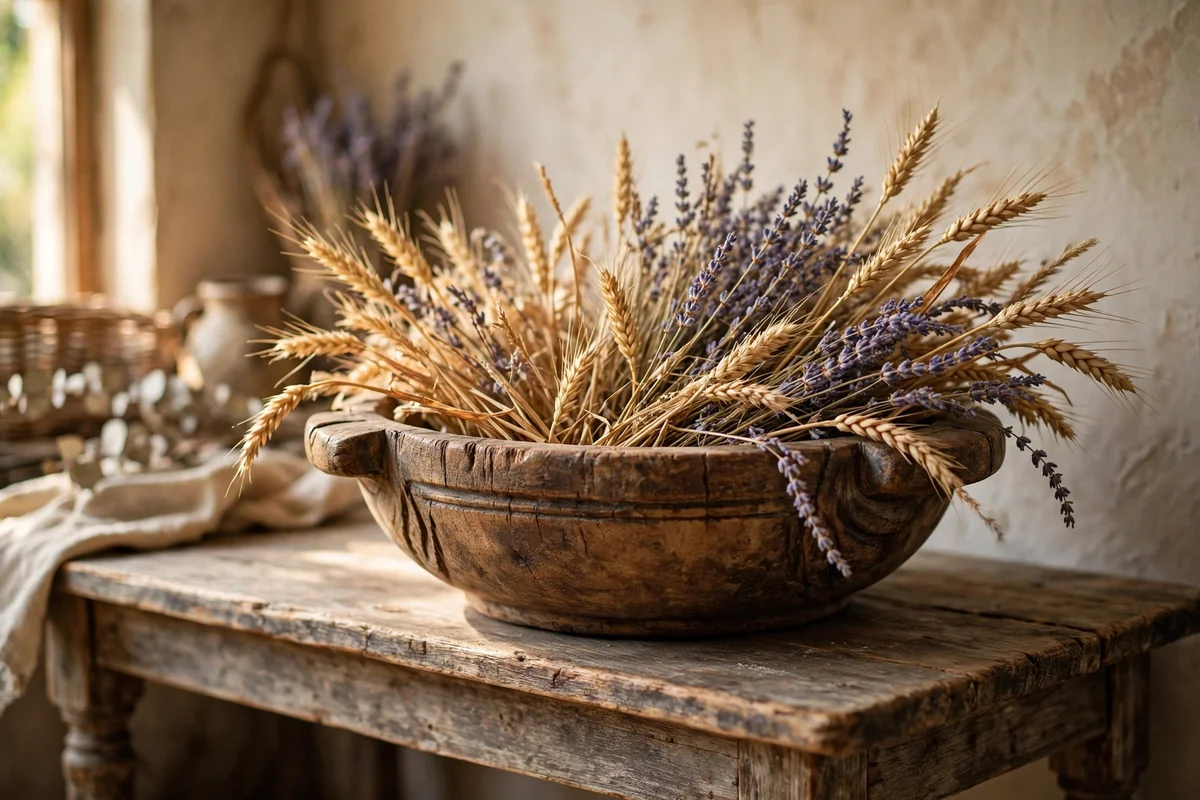
A carved wooden dough bowl is a rustic classic that earns its place as a low, textural centrepiece. Choose a bowl 40 to 55 cm long with visible tool marks and a warm walnut or pine tone, and fill it loosely with dried botanicals: wheat stems, lavender bundles, dried eucalyptus or bleached ruscus. Mound the botanicals 10 to 15 cm above the rim so the bowl reads full but never stuffed. Centre it on the linen runner in the middle third of the table, where its length echoes the table’s own horizontal line.
Vintage dough bowls cost 20 to 50 pounds or dollars at antique fairs; new carved reproductions run 25 to 40. Line the bowl with a linen offcut before adding botanicals to protect the wood from stem scratches. The mistake to avoid is using fresh flowers or damp moss, which stain the wood and rot the stems; dried only. Refresh the botanicals once a year in late summer when dried flower stalls are fullest and cheapest.
12. Arrange a Woven Tray With a Glass Carafe and Linen Napkins
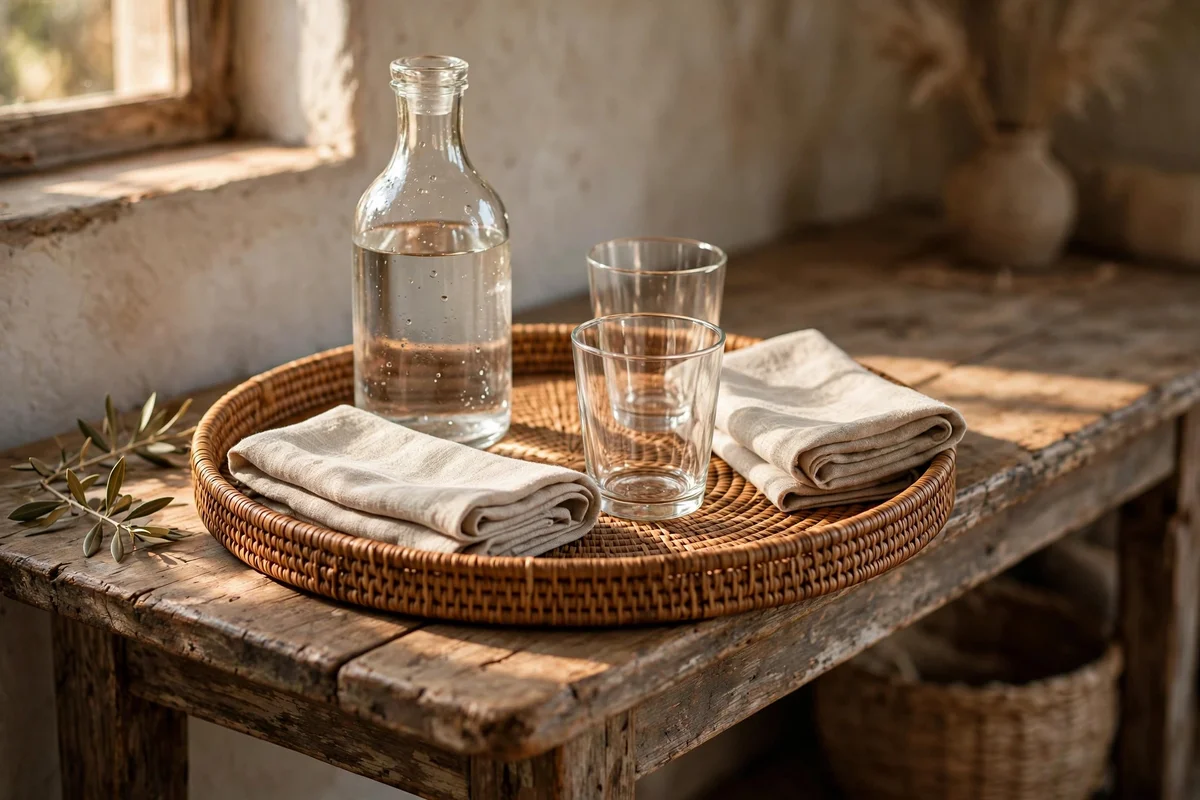
A console behind the sofa sits within arm’s reach, so make it useful with a small refreshment tray. Set a round woven tray 35 to 40 cm across on the runner and place a glass carafe of water, two small glasses and a stack of four folded linen napkins inside. The tray keeps everything corralled and protects the wood from condensation rings. This setup suits family evenings perfectly: guests help themselves without anyone crossing the room, and the glass and linen echo the table’s natural materials.
A woven tray costs 10 to 25 pounds or dollars; glass carafes start at 8. Refill the carafe each morning and wash it every two days so water stays fresh and the glass stays clear. The mistake to avoid is using the tray as a permanent drinks station with sticky juice bottles, which defeats the calm styling; water and napkins only. In a hallway console, swap the carafe for a small dish of wrapped sweets for visitors, keeping the same tidy tray logic.
13. Divide the Tabletop Into Thirds Before Placing Anything
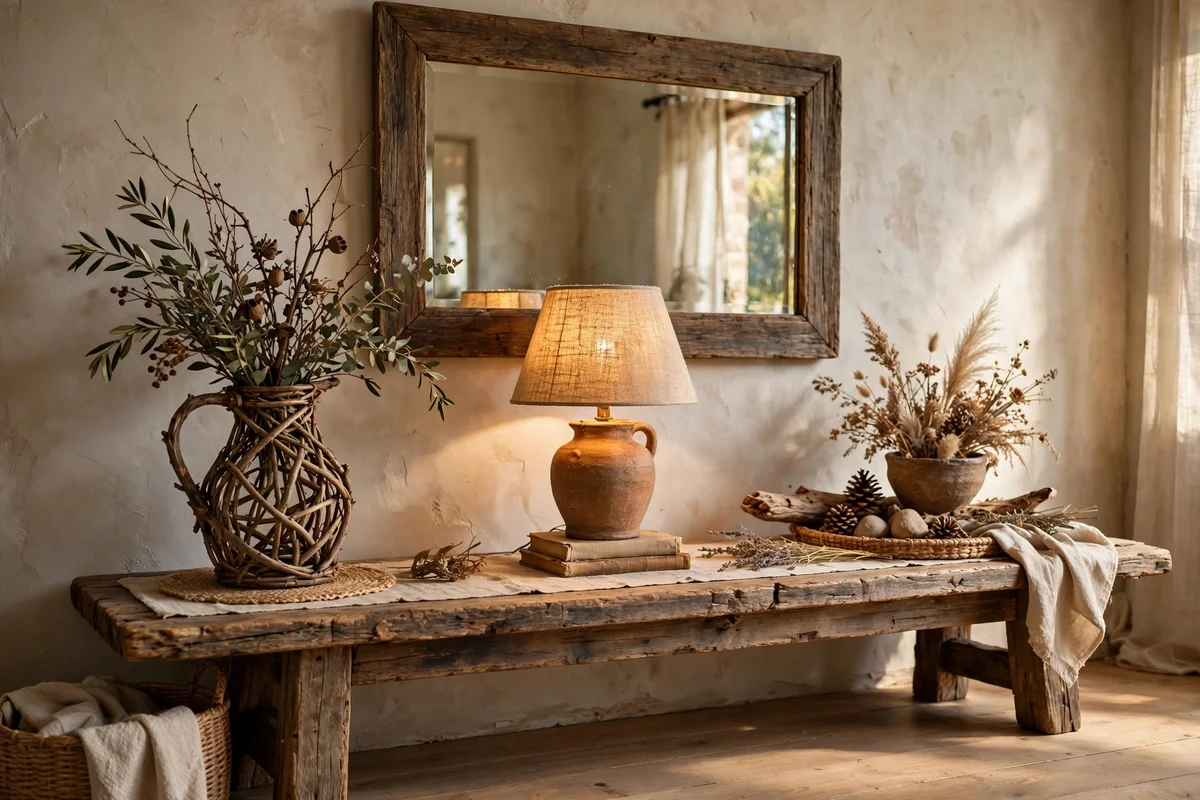
The rule of thirds is the simplest styling tool there is. Mentally divide the console into three equal zones along its length: left, middle and right. Give each zone one job: the left holds height, the middle holds the low anchor, and the right holds light, or any order that suits your room. On a 150 cm console each zone is 50 cm wide, room enough for one hero piece plus one small companion. This invisible grid stops the common drift toward pushing everything to the centre.
Stand back three metres after placing each zone and check the silhouette; the eye should travel left to right without snagging. Leave at least one zone with visible breathing room around its pieces, since negative space is what makes styled tables look calm. The mistake to avoid is treating the thirds as rigid boxes; let a branch lean across a boundary or a runner flow through all three. Photograph the table on your phone to spot crowding your eyes have learned to ignore.
14. Stack Two Aged Timber Boxes for Storage and Height
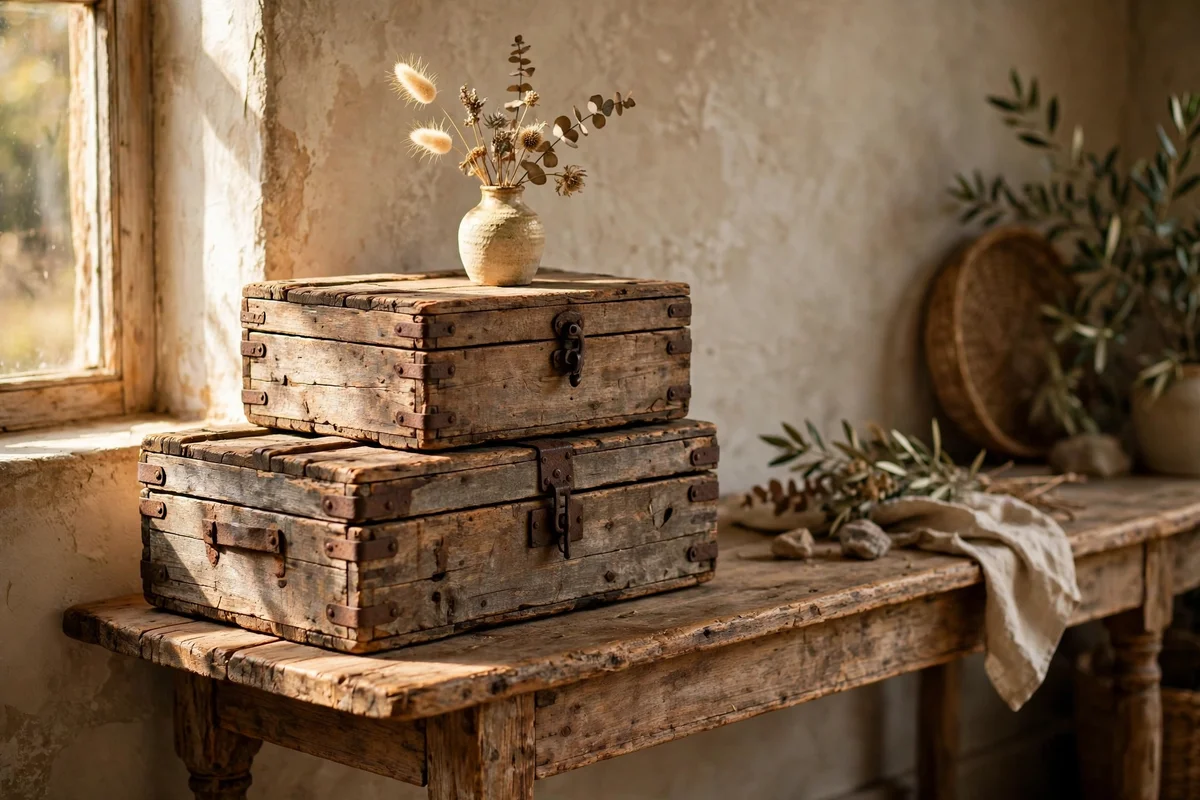
Two aged timber boxes stacked at one end give height and hide clutter in one move. Choose boxes 30 to 40 cm wide with 15 to 20 cm of height each, in reclaimed pine or weathered oak, and stack them slightly offset so 3 to 4 cm of the lower lid shows. Use the top box as a plinth for a small vase or candle, and the bottom one for the remote controls, reading glasses and chargers that always migrate to the living room. Place the stack in the back third so the front of the table stays open.
Old wooden boxes cost 10 to 30 pounds or dollars each at flea markets; new storage boxes in a rustic finish run 15 to 25. Check that lids close flat and hinges hold before buying, since warped lids ruin the stacked look. The mistake to avoid is filling the boxes so full the lids bulge; leave a finger’s width of space at the top. Wipe boxes with a dry cloth and rub a little beeswax into dry patches twice a year to keep the timber fed.
15. Hang Two Small Botanical Prints Off Centre Above the Table
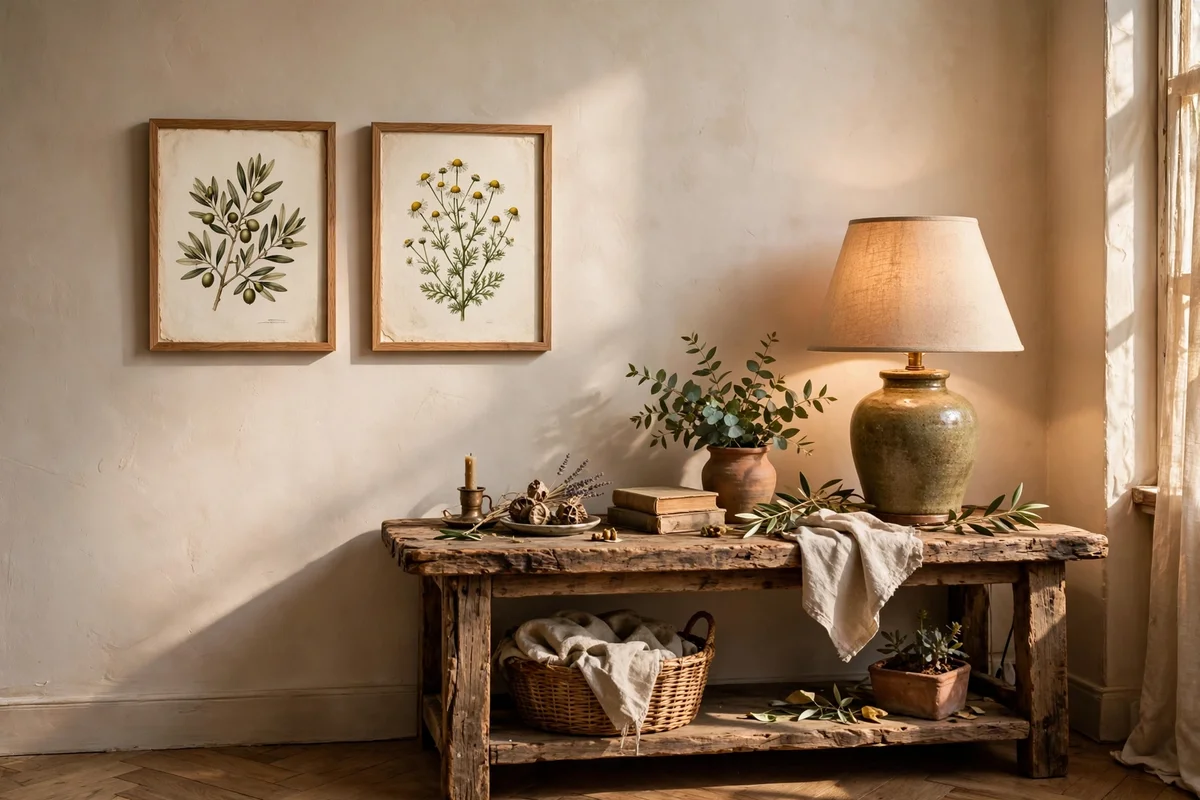
Two small botanical prints hung off centre add charm without competing with the main anchor. Choose prints 20 by 25 cm in matching thin oak frames, and hang them stacked vertically or side by side with 5 to 8 cm between frames. Place the pair above the quieter end of the table, for example over the lamp, so the tall branches at the other end keep their dominance. Keep the art line level: the centre of the grouping should sit about 145 to 155 cm from the floor, comfortable viewing height.
Botanical print pairs cost 8 to 20 pounds or dollars unframed; thin oak frames add 6 to 10 each. Use proper picture hooks rather than adhesive strips for anything over half a kilo, since prints above a console get bumped. The mistake to avoid is hanging the pair dead centre, which fights the main mirror or print for attention; off centre is the whole point. Dust frames with a soft brush monthly, and keep them out of direct sun so the inks do not fade within a few years.
16. Rest a Smooth River Stone Sculpture on Folded Linen
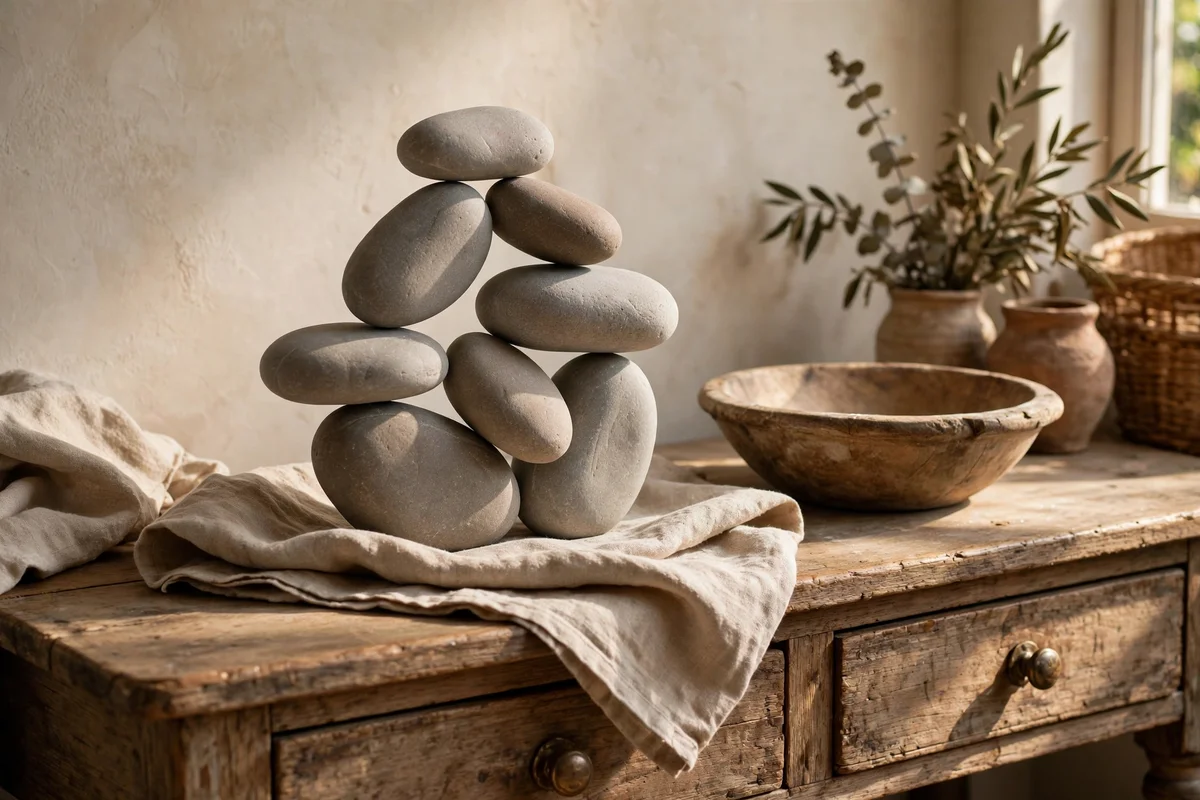
A single smooth stone sculpture brings the grounding weight that wood and linen cannot give alone. Choose a hand-carved or naturally smooth river stone 12 to 18 cm tall, and rest it on a twice-folded linen napkin or offcut so the fabric cushions the tabletop. Place it in the middle third near the dough bowl or candle cluster, where its quiet mass steadies the lighter objects around it. One stone is enough; two starts a collection and three turns the console into a rock display.
Smooth stone sculptures cost 10 to 35 pounds or dollars; a beautiful found stone from a riverbank costs nothing and carries its own story. Wash found stones in warm soapy water and dry them fully before placing them on linen. The mistake to avoid is choosing a stone with sharp edges or a wobbly base, which scratches wood and risks toppling. Felt pads under the linen add extra protection on soft pine tabletops, and a yearly wash keeps the stone’s colour true.
17. Swap Summer Grasses for Autumn Seed Heads Each Season
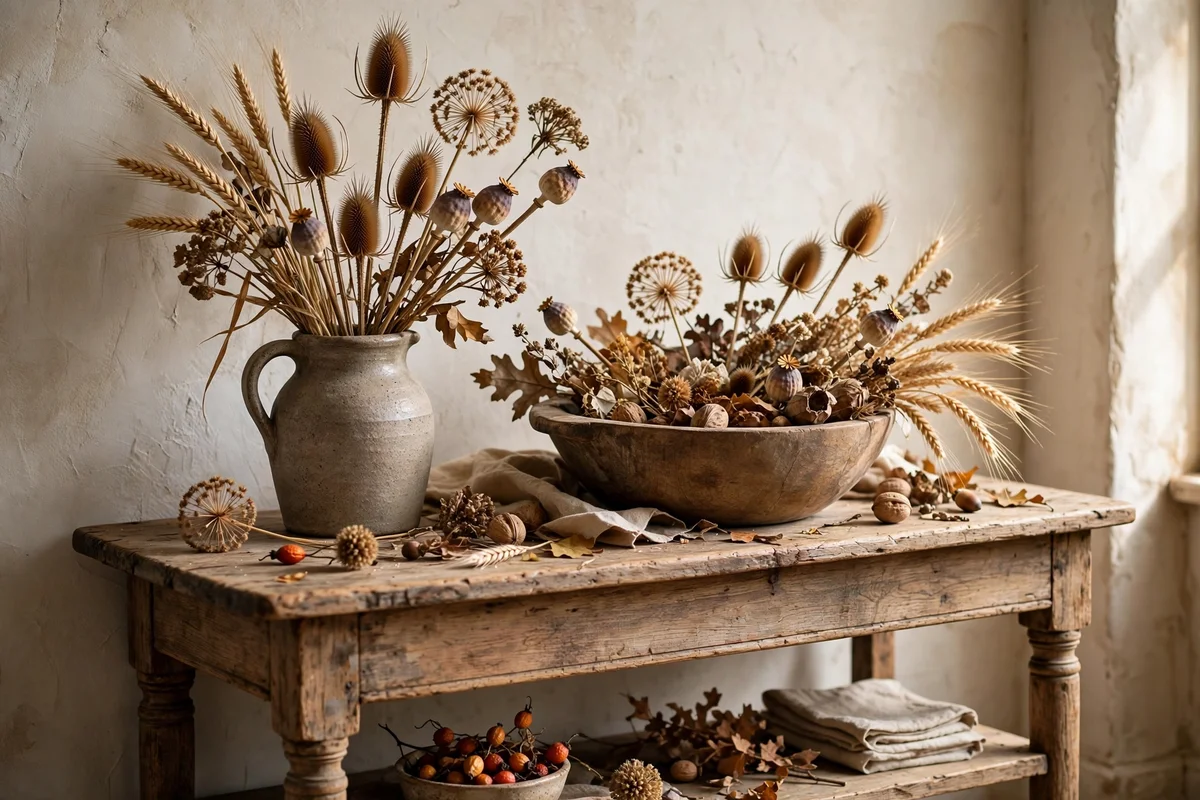
Seasonal swaps keep the console feeling alive while the wood, linen and stone bones stay put all year. In late September, lift the summer grasses from the jug and the dough bowl and replace them with dried seed heads: honesty, teasel, wheat and poppy pods. The swap takes twenty minutes and changes the whole mood from light to harvest-rich. Keep the same vessels, the same linen runner and the same mirror; only the botanicals change, which is exactly why the system works.
A bundle of dried seed heads costs 5 to 12 pounds or dollars at autumn markets; foraged teasel and honesty are free on country walks. Store the out-of-season botanicals upright in a tall paper bag in a dry cupboard so they keep their shape for next year. The mistake to avoid is swapping everything at once including vessels and textiles, which erases the calm continuity you built. Change the botanicals only, and let the table’s bones carry the familiarity through every season.
18. Tuck a Grain Sack Cushion Against a Hallway Console
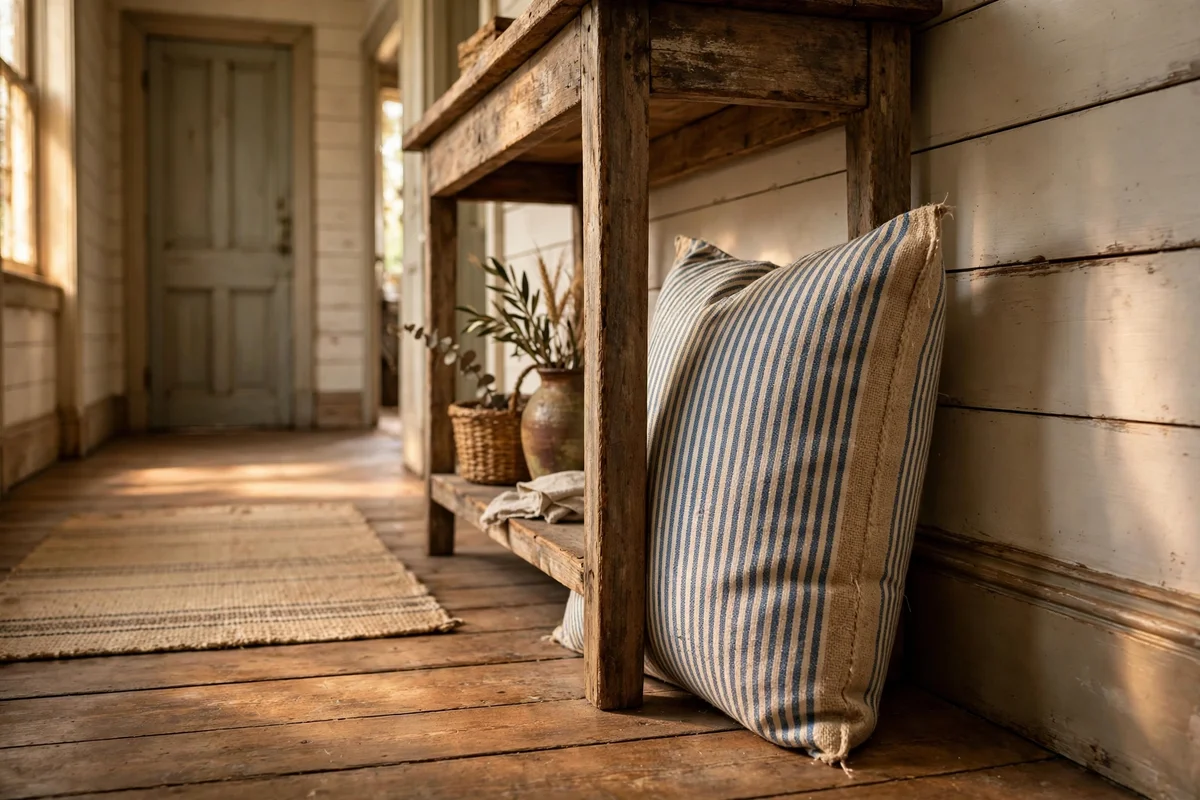
In a hallway the console often stands alone, so a cushion on the floor beside it softens the whole scene. Tuck a 45 by 45 cm grain sack cushion against the table leg or lean it on the lower shelf, in natural ticking stripe or faded red stripe. The cushion fills the awkward gap between table and floor and gives the hallway a lived-in feel. It also doubles as a kneeling pad when you tie shoes on the bench or sort the post over the baskets below.
Grain sack cushions cost 15 to 35 pounds or dollars; genuine vintage sacks sewn into covers sit at the higher end. Shake the cushion outside weekly, since hallway floors collect the most dust in the house. The mistake to avoid is choosing a cushion wider than the space between the table legs, which looks wedged rather than tucked; measure the gap first. Keep one spare cover so you can wash the working one without leaving the corner bare.
19. Place a Wrought Iron Lantern With a Pillar Candle Nearby
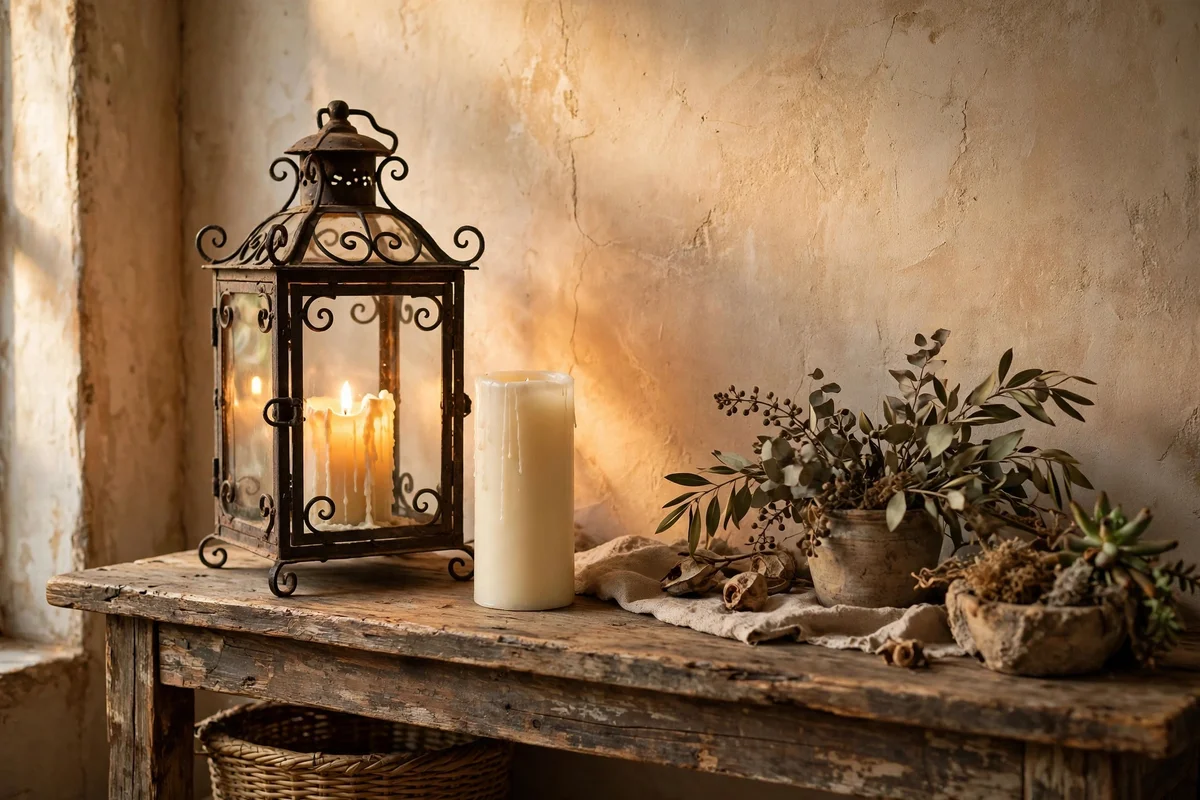
A wrought iron lantern adds old-world character and a second source of evening light. Choose a lantern 25 to 35 cm tall with clear glass panels, and set a 10 cm ivory pillar candle inside on a metal drip plate. Place it on the tabletop at the quieter end or on the floor beside the console leg, where its glow washes up the wall behind. The dark iron frame echoes the rustic mood and contrasts beautifully with pale linen and pale wood, especially after sunset.
Iron lanterns cost 18 to 45 pounds or dollars; look for solid welds and a door that closes properly. Never leave a lit candle unattended, and keep the lantern 30 cm from linen throws and dried branches. The mistake to avoid is using a coloured or flickering LED candle that cheapens the look; a plain warm-white LED pillar works if real flame is not practical. Wipe the glass panels with vinegar water monthly so soot never builds into a film.
20. Pot a Small Olive Tree in a Terracotta Pot at One End
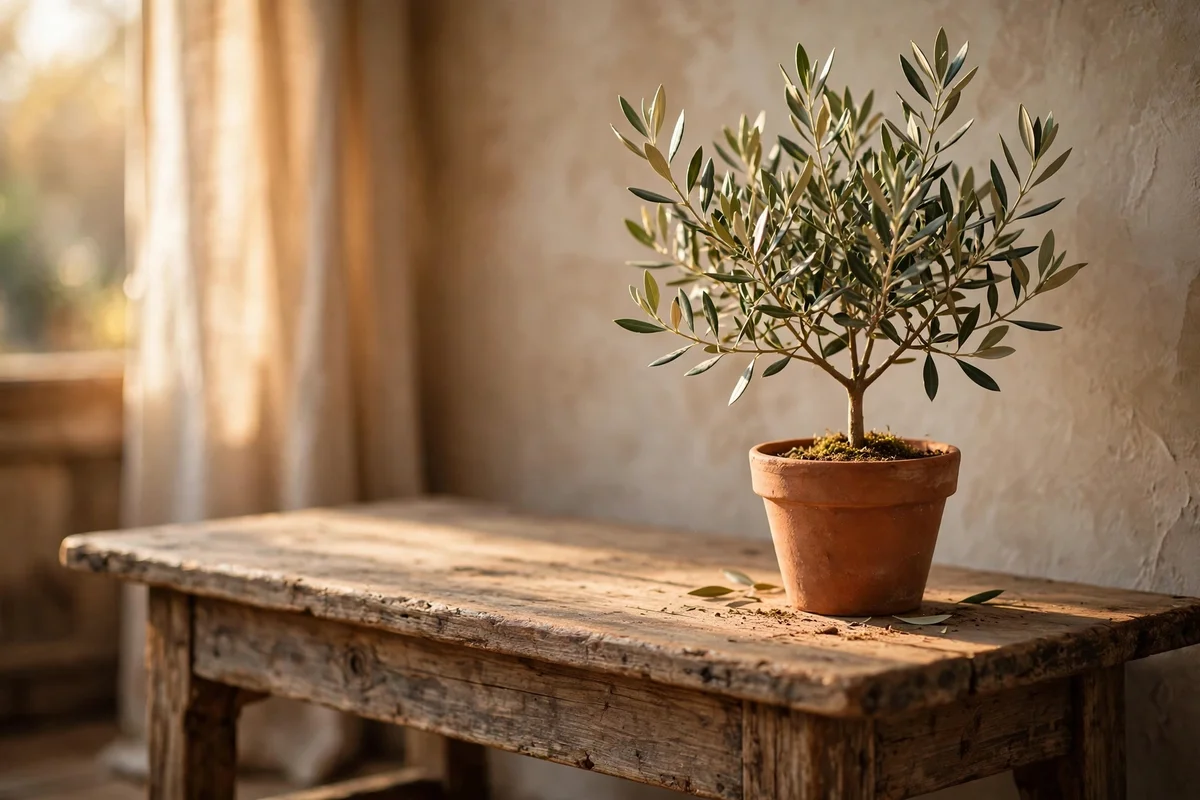
A small olive tree brings living green to the console without demanding daily attention. Choose a tree 40 to 60 cm tall in a 15 to 18 cm terracotta pot, and set it at the end opposite the lamp so foliage and light balance across the table. The silvery leaves suit the rustic palette perfectly, and terracotta’s warm orange clay echoes the wood tones. Water when the top 3 cm of soil feel dry, usually every seven to ten days, and turn the pot a quarter turn monthly for even growth.
Small olive trees cost 15 to 30 pounds or dollars at garden centres; terracotta pots add 5 to 10. Set the pot on a cork mat or stone coaster so watering never marks the wood. The mistake to avoid is placing the tree where the lamp shade blocks its light; olives need the brightest spot you can give them, ideally within two metres of a window. Prune lightly in spring, removing no more than a third of the growth, to keep the shape compact on the table.
21. Finish the Look With a Small Stone Vessel of Dried Lavender
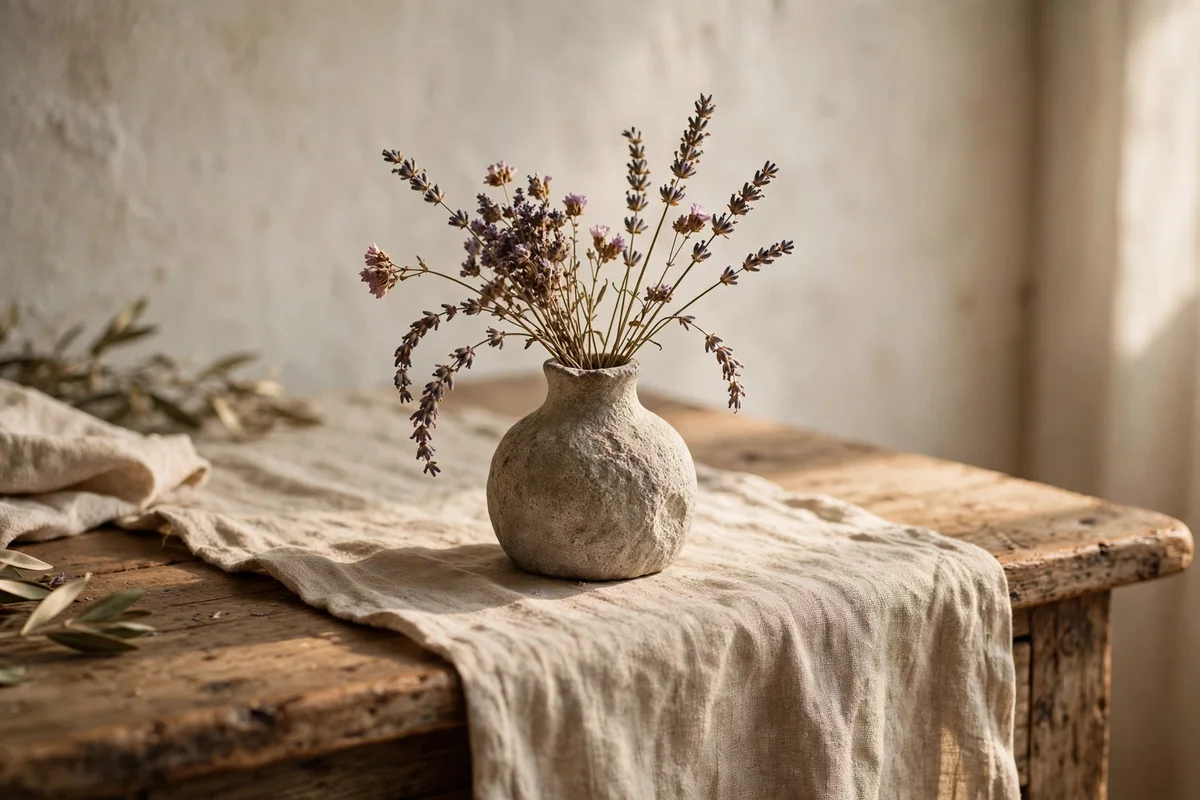
The finishing touch should be small, fragrant and simple. Tuck a stone or concrete bud vessel 8 to 12 cm tall into the quietest gap on the table and fill it with three to five stems of dried lavender. The purple-grey buds add the only cool colour note in the arrangement, and their scent drifts gently without any spray or plug-in. Place it near the front edge where hands pass, so the fragrance releases when someone brushes the stems walking by.
Dried lavender bundles cost 4 to 10 pounds or dollars at markets and last a full year indoors. Keep the vessel away from direct sun, which bleaches the buds to grey within months. The mistake to avoid is adding a second fragrant element, such as scented candles or potpourri, which muddles into a confusing mix; let the lavender carry the scent alone. Refresh the stems each summer when new harvest bundles arrive, and compost the old ones.
A well-styled console is never finished in a single afternoon; it settles over weeks as you notice what the light does and which corner feels empty. The ideas above share one spirit: honest materials, calm repetition and room to breathe. Wood warms, linen softens and stone grounds, and together they make a table that suits family life rather than fighting it. Keep that trio in mind and the styling almost arranges itself.
This week, start with the simplest change of all: clear the table completely, lay a linen runner down the centre, and divide the top into thirds. Place one anchor, one tall piece and one low piece, then live with it for three days before adding anything else. That single unhurried hour teaches more about your room than any shopping trip, and it costs nothing at all.
Frequently Asked Questions
What size console table works best in a living room?
A console 120 to 150 cm wide and 30 to 40 cm deep suits most living room walls and fits neatly behind a standard sofa. Leave at least 75 cm of walkway in front if it stands in a hallway. Measure your wall first and choose a table that spans roughly two thirds of it; anything wider crowds the room, anything narrower looks lost.
How much does it cost to style a console table from scratch?
Between 60 and 200 pounds or dollars if you buy everything new: a runner, a mirror or print, a lamp, baskets and a few vessels. Thrifted finds cut that to 30 to 80. Start with the anchor and the runner, which carry most of the look, and add one piece a month. Spreading purchases also stops the styling from looking like a shop display.
How do I stop a console table behind the sofa from looking cluttered?
Use the rule of thirds: three zones, one hero piece per zone, and visible breathing room around each. Keep the front edge clear and push taller items toward the back. Limit yourself to five to seven objects total. If the table still feels busy, remove one thing and live with it for two days; subtraction fixes more clutter than rearrangement.
Can I hang a mirror above a console in a rented home?
Yes, with care. Choose a mirror under 5 kg and hang it from two removable adhesive hooks rated for the combined weight, or lean a large framed print against the wall instead, which needs no fixings at all. Keep the original wall untouched and photograph it on move-in day. Heavy timber-framed mirrors belong on proper wall anchors, so save those for a home you own.
How do I update console styling for each season without buying new decor?
Keep the bones fixed: the same runner, mirror, lamp and baskets all year. Swap only the botanicals, in September for seed heads, in December for pine and dried orange slices, in spring for pussy willow. Store off-season stems upright in paper bags in a dry cupboard. One twenty-minute swap changes the mood completely and costs little or nothing.