Living Room
22 Corner Fireplace Ideas That Completely Change the Room
By Anna Wells · · 21 min read
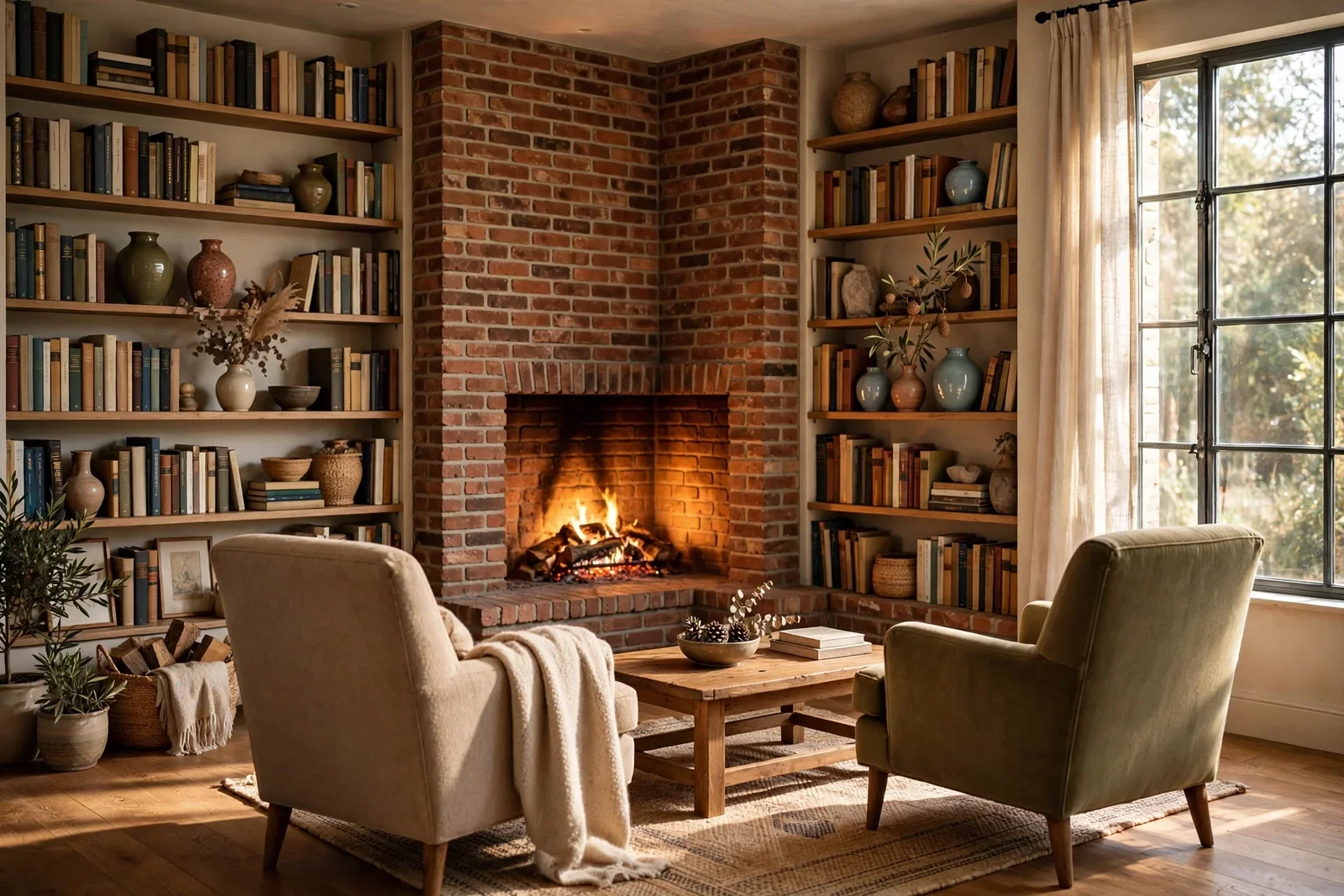
Turn an awkward corner hearth into the warmest seat in the house with 22 practical ideas for seating, shelves, surrounds and safe clearances.
On a cold evening, the corner fireplace should be the warmest seat in the house, yet in so many living rooms it sits ignored while everyone faces the television. The angled hearth looks awkward, the walls on either side stand bare, and furniture drifts to the flat walls as if the corner were a problem to route around. It does not have to be that way.
A fireplace in the corner is really a gift: two walls to decorate instead of one, a hearth visible from two directions, and a natural wedge of space that invites angled, sociable seating. Worked with rather than against, the corner becomes the room’s anchor, the place where the eye lands and the family gathers.
These 22 ideas show exactly how to do it. You will find seating layouts angled toward both fire and conversation, built-in shelves that fill the awkward flanks, tile and stone surrounds made for an angled hearth, mantel styling for a corner shelf, and clear guidance on televisions, electric and bioethanol inserts, rugs cut to the angle, and the safety clearances that keep everyone comfortable.
Every idea is practical, with sizes, materials and budgets included, so you can start this weekend with whatever corner you have. Let us begin with the single change that transforms everything: aiming the furniture at the fire.
1. Angle Two Armchairs and a Loveseat Toward the Corner Fire
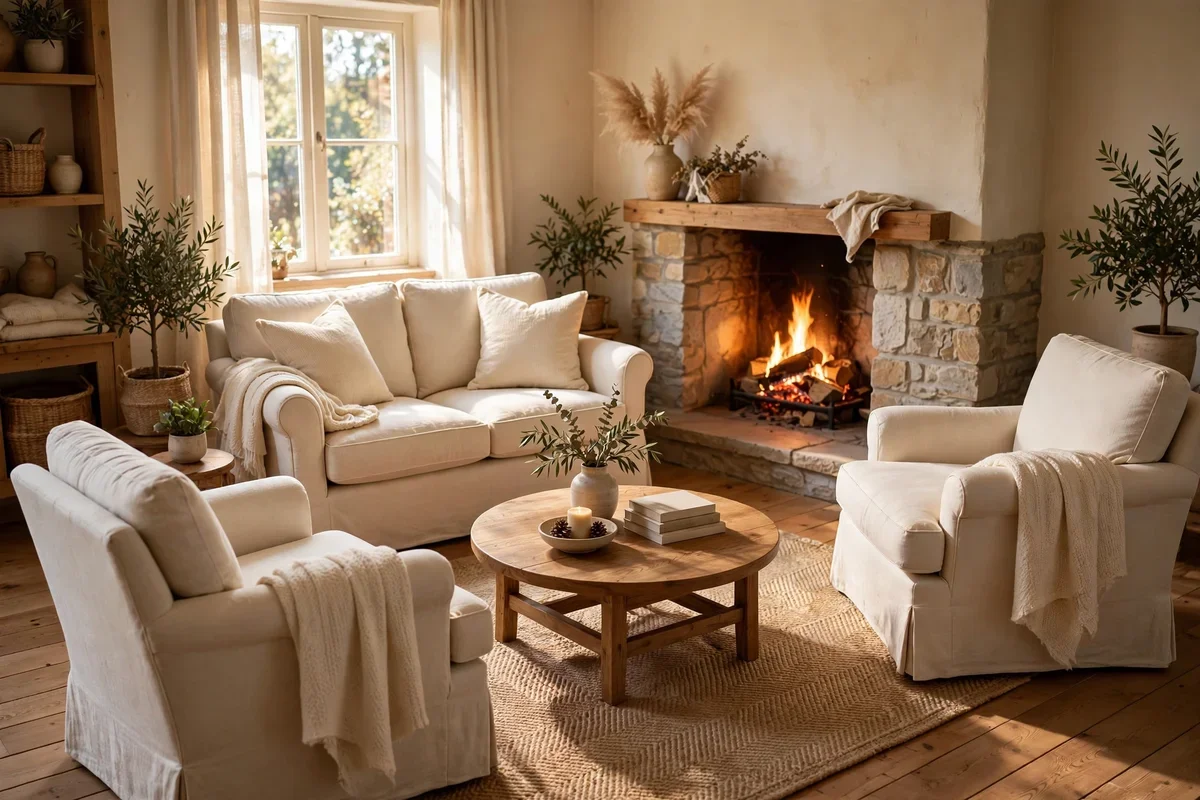
Positioning the main seating in a loose V that faces the corner hearth turns an awkward angle into the room’s anchor. Place a loveseat about 240 cm from the fire, then set an armchair on each side, each angled 30 to 45 degrees toward the flame. Keep the front legs of every chair 90 to 120 cm from the hearth edge for comfort and safety. The result feels like a natural gathering circle rather than furniture pushed flat against walls.
Choose chairs with low arms and visible legs so sightlines stay open and the room does not feel crowded. A round or oval coffee table between the chairs suits the wedge of space better than a rectangle, and 60 to 80 cm diameter is usually right. The mistake to avoid is aiming every seat straight at the television instead; when the fire leads, conversation comes back. Budget tip: two matching second-hand armchairs plus a simple loveseat can total under 500 dollars.
2. Build Floor-to-Ceiling Shelves on Both Flanking Walls
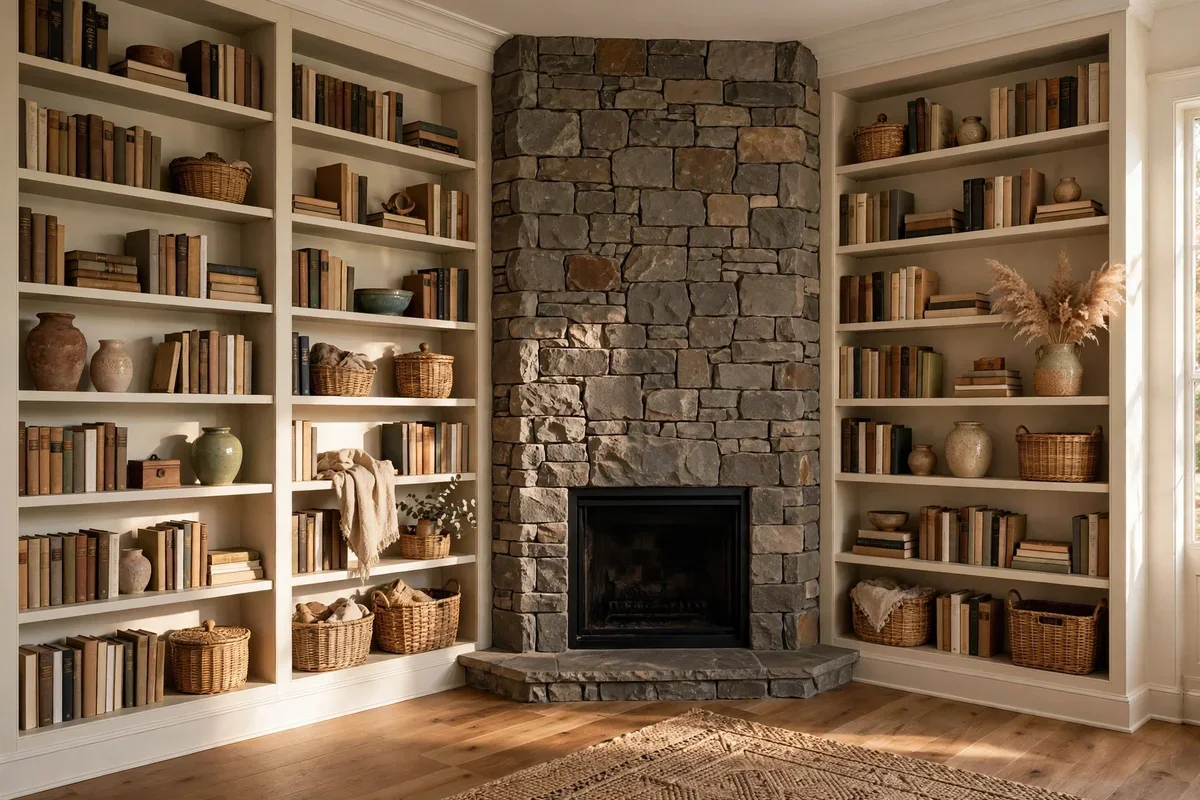
The walls on either side of a corner fireplace often sit empty and make the fire look stranded. Built-in shelving from floor to ceiling on both flanks frames the angled hearth like a stage and adds serious storage. Plan each run 60 to 90 cm wide with shelves 25 to 30 cm deep, spaced 30 to 35 cm apart for books and decor. Painted the same colour as the wall, the shelves read as architecture rather than furniture, and they balance the composition on both sides of the fire.
Leave one shelf per run mostly empty so the display breathes; crowded shelves read as clutter, not charm. Mix vertical books, stacked books, a ceramic vase and one woven basket per unit, repeating the rhythm on both sides. The common mistake is making the two sides fight for attention, so keep heights and colours loosely mirrored. Budget tier: stock bookcases fitted with a simple face frame cost far less than full carpentry, often 200 to 400 dollars per side.
3. Wrap the Angled Hearth in Herringbone Brick Tile
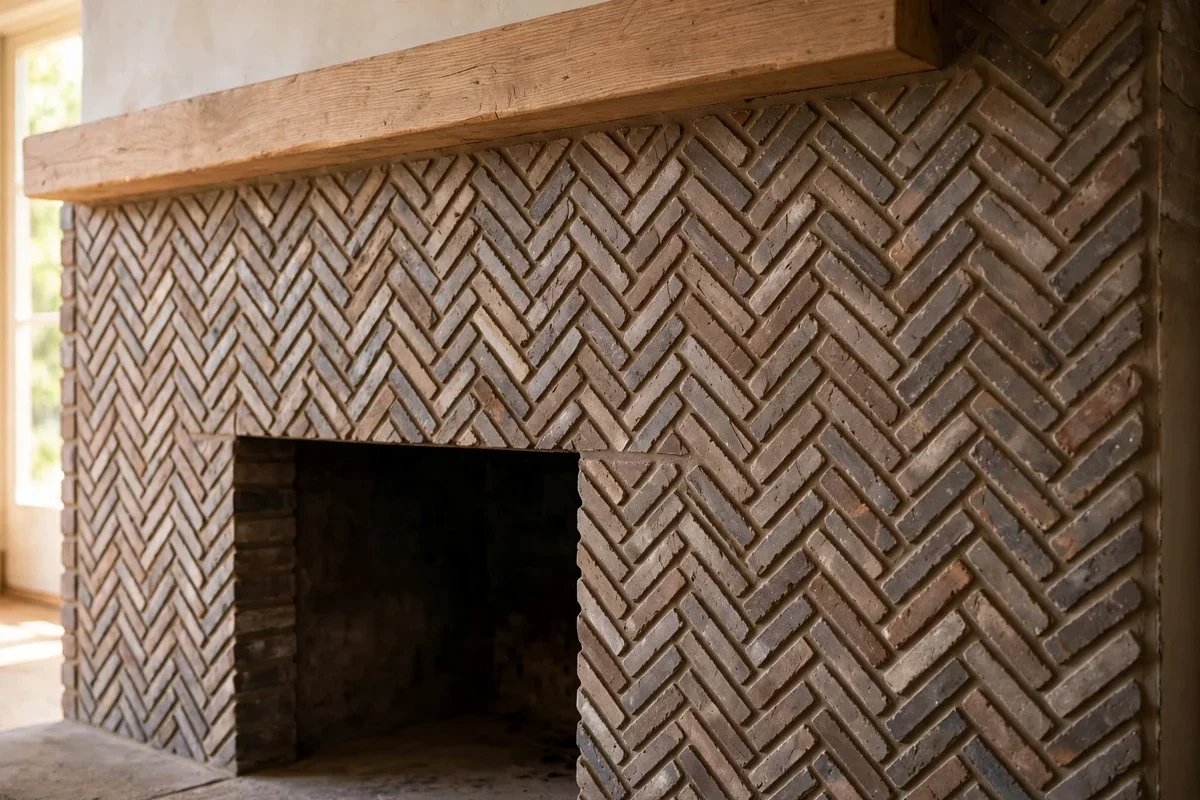
Herringbone brick tile suits a corner fireplace because the pattern naturally leads the eye around the angle instead of stopping dead at it. Use thin brick slips about 5 by 20 cm laid at 90 degrees, with grout lines of 6 to 8 mm in a warm grey or putty tone. Cover both faces of the corner up to mantel height, or about 120 to 140 cm, so the hearth reads as one continuous folded surface. Brick brings old-world texture without heavy masonry costs.
Seal the tile with a matte heat-rated sealer so soot and dust wipe off easily. Thin brick is lightweight, which matters on corner framing that may not carry full stone weight, and it cuts with a simple wet saw for clean mitred corners. The mistake to avoid is running the pattern around the outside corner without planning the fold; dry-lay one course first to keep the herringbone symmetrical. Expect 8 to 14 dollars per square foot installed, mid-range overall.
4. Lay Large-Format Stone Slabs on the Corner Hearth
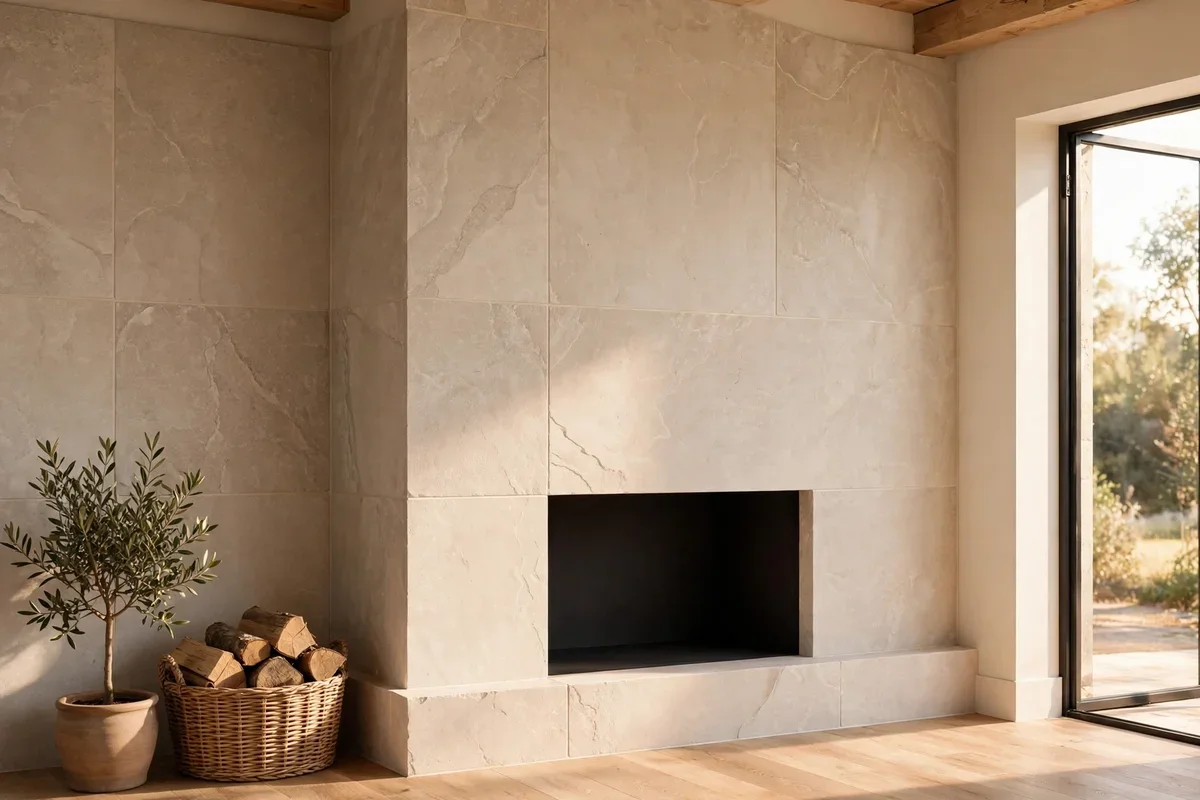
Large-format stone slabs give a corner fireplace a calm, sculptural face with almost no grout lines to interrupt the angle. Choose slabs 60 by 120 cm or larger in limestone, slate or honed basalt, cut so the corner joint falls on a single crisp line. Keep the stone 10 to 20 mm thick for the firebox surround and full depth for the hearth floor, where it should extend at least 40 cm in front of the opening on both angled faces. The monolithic look feels timeless and quiet.
Honed and matte finishes hide dust and fingerprints far better than polished stone near a working fire. Budget tier: porcelain slabs that mimic limestone cost a fraction of real stone and handle heat well, making them a smart mid-range choice. The mistake to avoid is butting two polished edges at the corner without a proper arris; a tiny bevel catches light beautifully and hides small chips. Real stone slab work is investment level, often 40 to 70 dollars per square foot fitted.
5. Style a Narrow Corner Mantel Shelf With Layered Decor
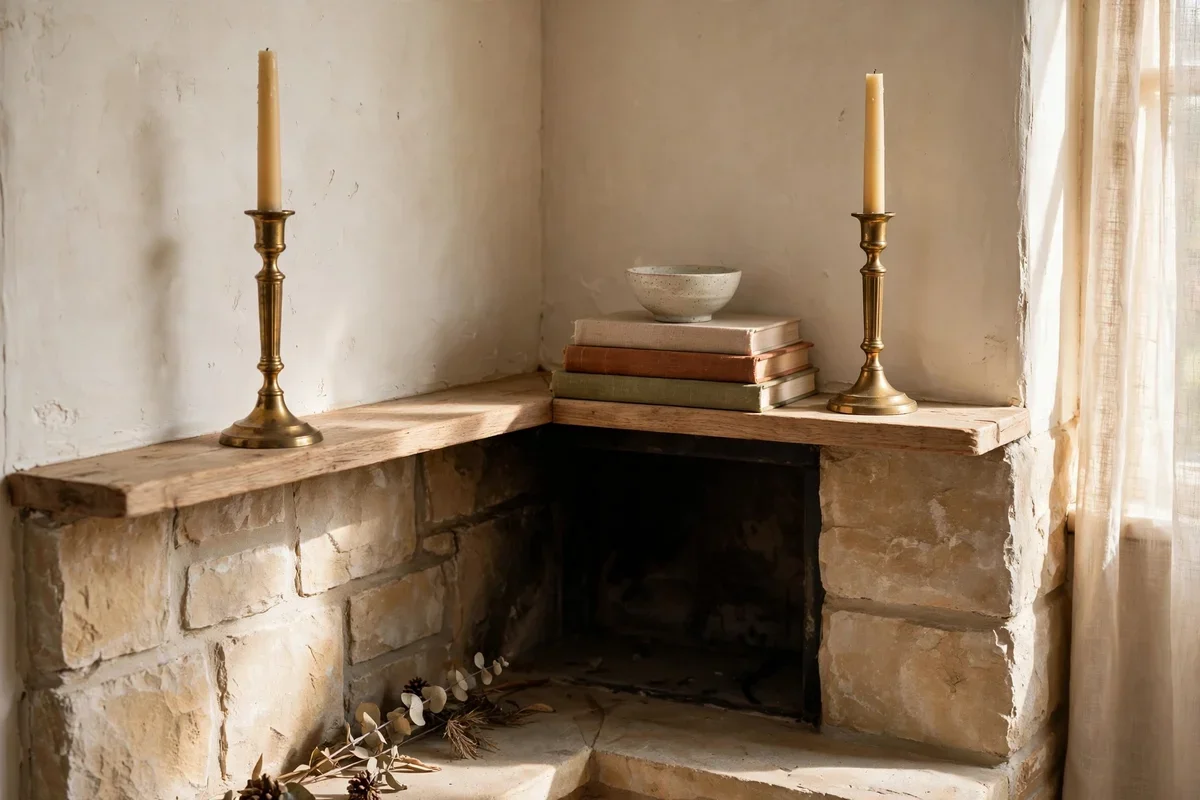
A corner mantel is usually a short shelf spanning the angle, so styling must be edited tightly. Build height with one tall object on each end, such as a pair of 30 to 40 cm candlesticks or vases, then fill the middle with a low stack of two or three books and a small bowl. Keep everything 15 cm back from the shelf front edge so pieces cannot fall into the hearth. The layered rhythm of tall, low, tall suits the wedge shape.
Above the shelf, a round mirror or a single framed print anchors the composition without competing with the angle. Use odd numbers and repeat one material, such as brass or oak, across the objects for calm. The mistake to avoid is crowding the short shelf with many small trinkets, which looks busy on a small span; five to seven objects total is plenty. Budget tip: thrifted brass candlesticks plus a charity-shop frame usually costs under 40 dollars.
6. Hang the Television on the Adjacent Wall, Not Above the Fire
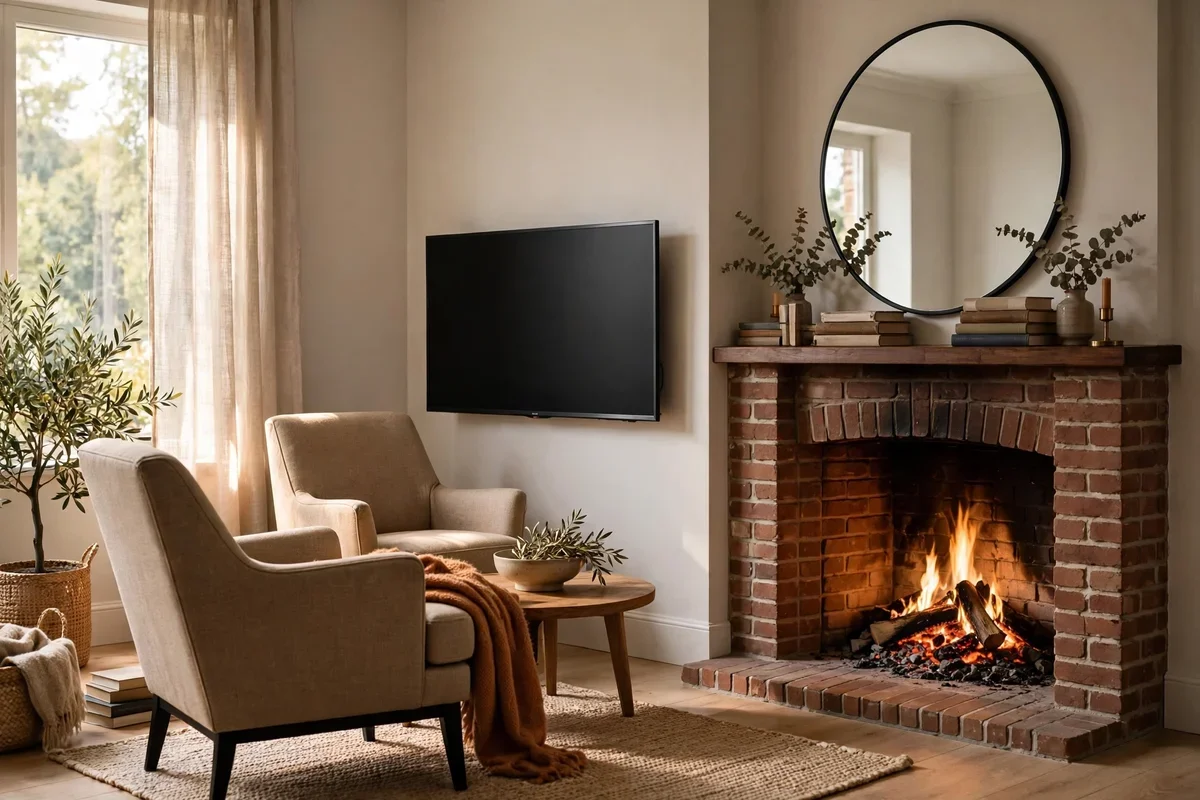
Mounting the television on the wall beside the fireplace, instead of over the mantel, solves the classic corner-fire dilemma in one move. Aim for the wall that sits 90 to 120 cm from the fireplace centre, and hang the screen so its centre lands 105 to 120 cm from the floor for a sofa seat height of about 45 cm. This keeps necks comfortable and lets the mantel stay a styling surface rather than a screen shelf. The fire and the television can now share the room without one dominating the other.
Run cables inside a slim surface-mounted channel painted to match the wall so nothing dangles. Tilt the mount 5 to 10 degrees toward the main seating if the wall meets the sofa at a sharp angle. The mistake to avoid is hanging the screen directly above the hearth, where rising heat shortens the television’s life and the high viewing angle strains necks. A pivoting mount of 40 to 80 dollars usually costs far less than a mantel-mount bracket anyway.
7. Rest the TV on a Low Media Stand Across the Room
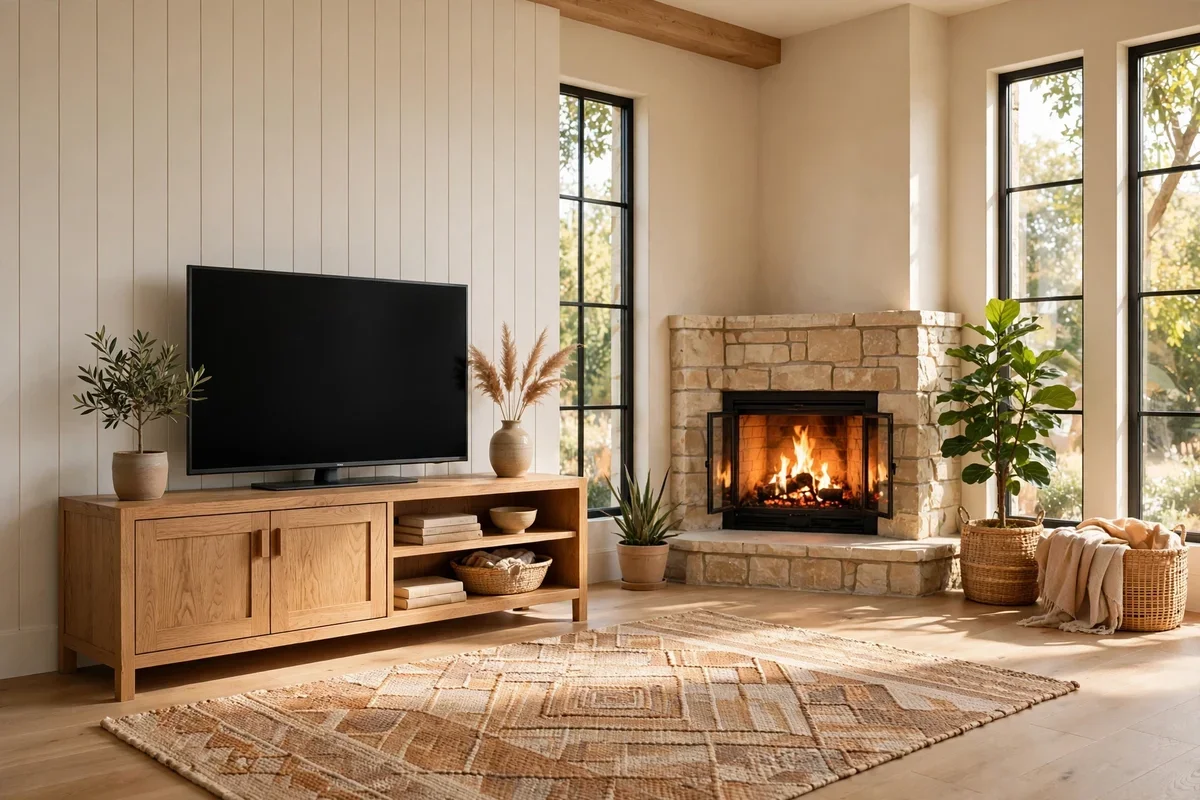
When no adjacent wall suits a mount, a low media stand on the opposite side of the room gives the television a proper home away from the fire. Choose a stand 120 to 150 cm wide and no more than 50 cm tall so the screen centre stays at that comfortable 105 to 120 cm line. A closed cabinet in oak or walnut hides remotes, game consoles and chargers behind doors, which keeps the corner fireplace the visual hero of the room instead of a tangle of wires.
Anchor the stand with a flatweave rug that extends at least 20 cm past each end so it reads as one deliberate zone. Ventilation matters: leave 10 cm behind the cabinet and keep consoles on open shelves so heat escapes. The mistake to avoid is buying an oversized entertainment unit that rivals the fireplace for attention; smaller stands cost 150 to 350 dollars and let the room breathe. Match the wood tone loosely to the mantel for harmony.
8. Fit an Electric Fireplace Insert Into the Corner
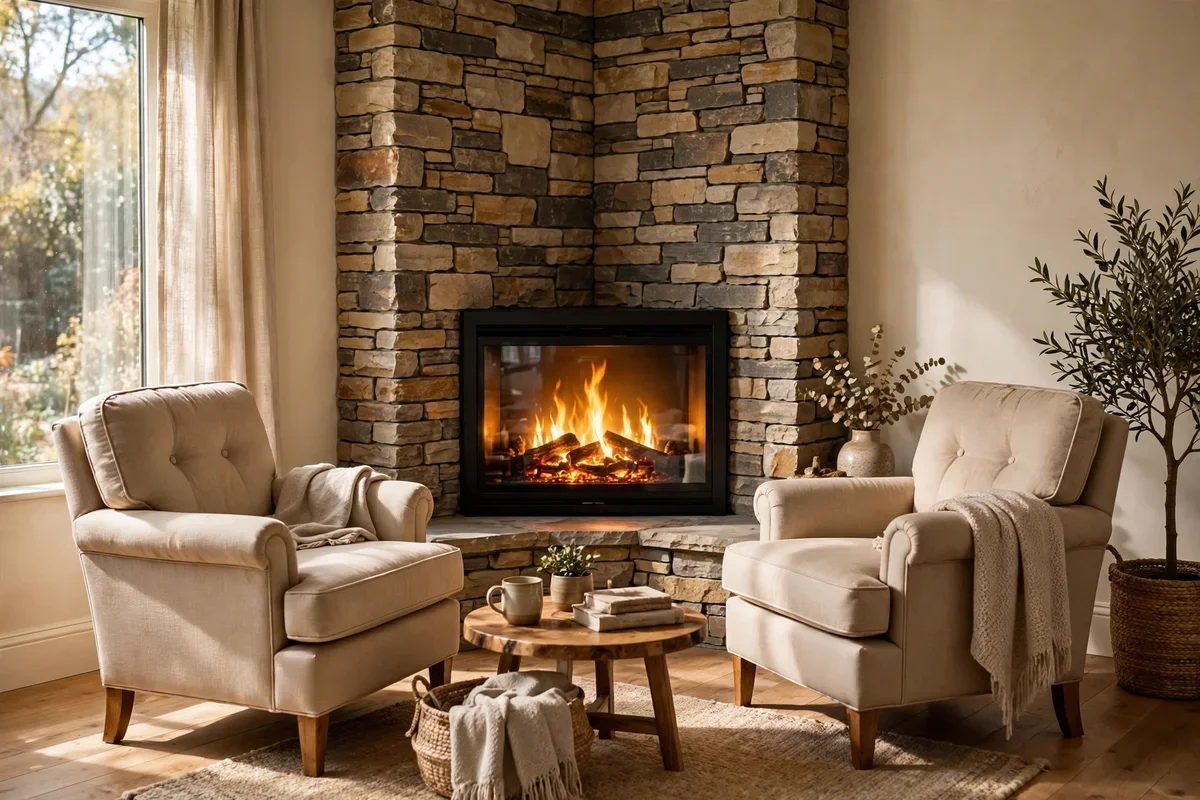
An electric insert turns an awkward or unusable corner flue into a reliable, instant fire with none of the smoke or ash. Measure the existing opening carefully, then choose an insert 5 to 10 cm smaller on each side so it slides in cleanly. Most inserts run 1 to 2 kilowatts on a standard plug and include adjustable flame effects with a thermostat. The corner position means the glow is visible from two seating directions at once, which multiplies the cosiness.
These inserts stay cool to the touch on the outer case, making them family safe around children and pets, though you should still keep soft furnishings 60 cm from the front. No flue, chimney or gas line is needed, just one accessible outlet, and there is no ventilation requirement beyond normal room air. The mistake to avoid is skipping the measuring step and discovering the insert rocks in an oversized opening. Quality corner inserts cost 250 to 600 dollars.
9. Try a Bioethanol Free-Standing Fire for Awkward Corner Flues
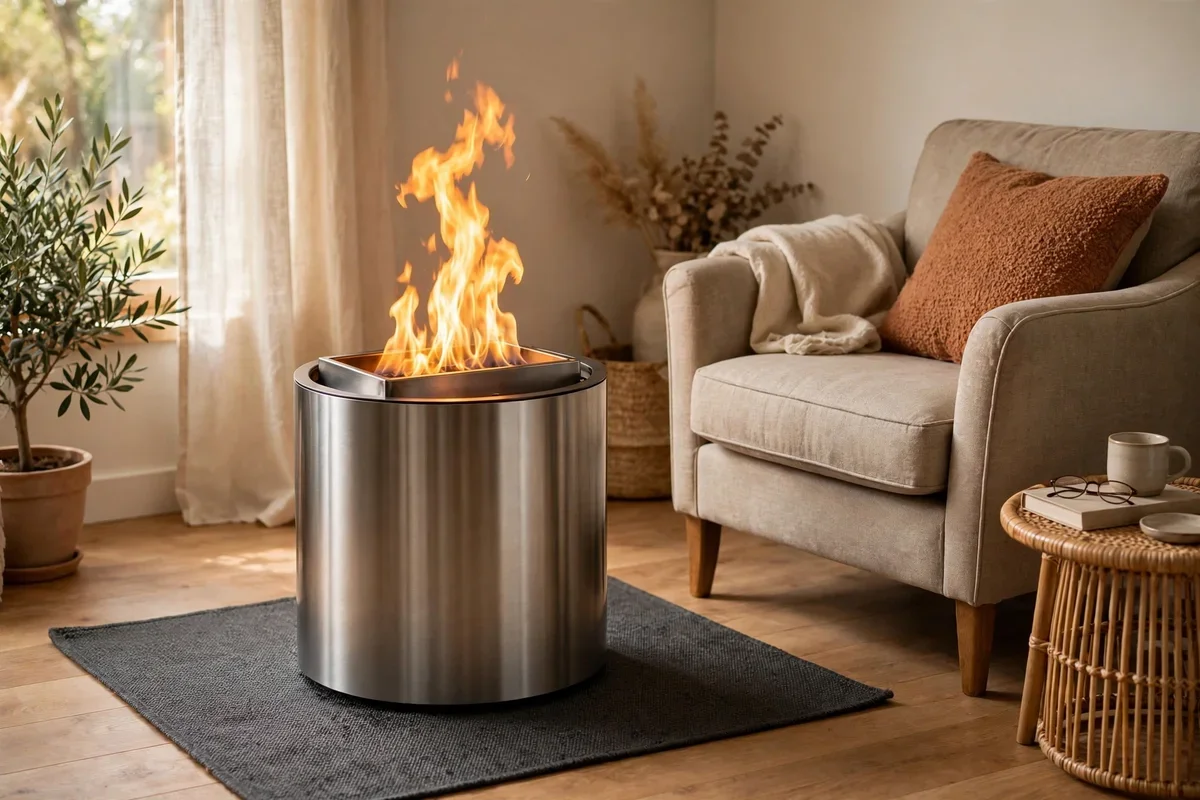
Where a corner has no workable flue at all, a free-standing bioethanol fire gives real flame without a chimney. These units burn liquid bioethanol in a small steel reservoir, producing a clean flame with no smoke or soot, and most corner models are 40 to 60 cm wide and simply sit on the floor. One litre of fuel typically burns two to three hours, which suits an evening gathering. Place it 60 to 90 cm out from the corner walls on a heatproof mat.
Family safe use means refuelling only when the unit is completely cold, never topping up a lit or warm burner, and keeping fuel bottles sealed and stored away from the fire. Ventilation is simple but real: open a window or door slightly during use since burning consumes room oxygen, and never sleep with it lit. The mistake to avoid is treating it like a decorative candle; it is a real flame that needs the same respect as any open fire. Units cost 150 to 400 dollars.
10. Cut a Rug Into a Wedge That Mirrors the Hearth Angle
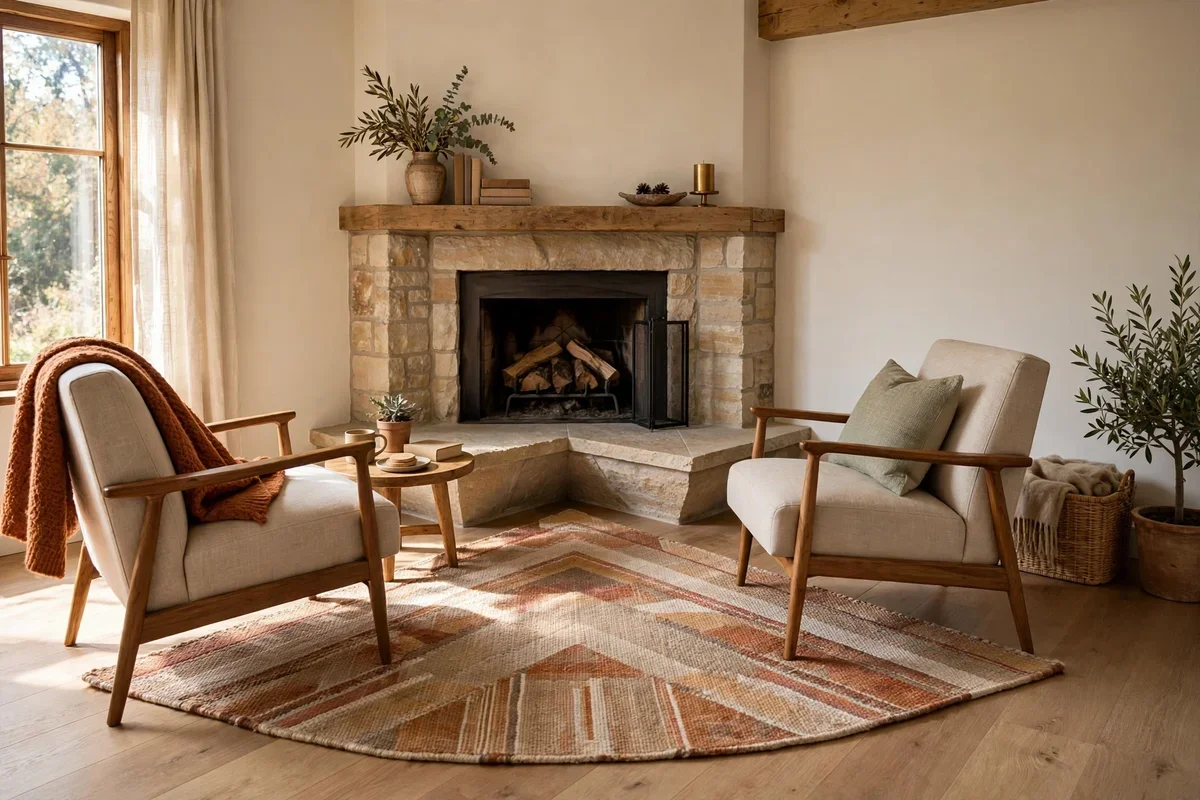
A rectangular rug under a corner fireplace always looks like it does not belong, so a wedge-cut rug that follows the hearth angle feels tailor-made. Mark the 45-degree line where the hearth turns and cut a flatweave rug to sit parallel, about 60 cm out from the hearth edge on both faces. Many flatweave or jute rugs cut cleanly and can be bound at a carpet shop for 20 to 40 dollars, turning an affordable rug into a custom piece.
If cutting feels too bold, place a round rug, 180 to 210 cm across, so its edge sits equidistant from both faces of the corner; the curve softens the angle naturally. Either way, keep rug fibres 40 cm from the firebox opening as a hearth clearance rule. The mistake to avoid is tucking rug corners under the hearth legs or surround, which looks sloppy and can trap heat. Wedge rugs work beautifully under angled seating too.
11. Layer a Round Jute Rug Under an Angled Coffee Table
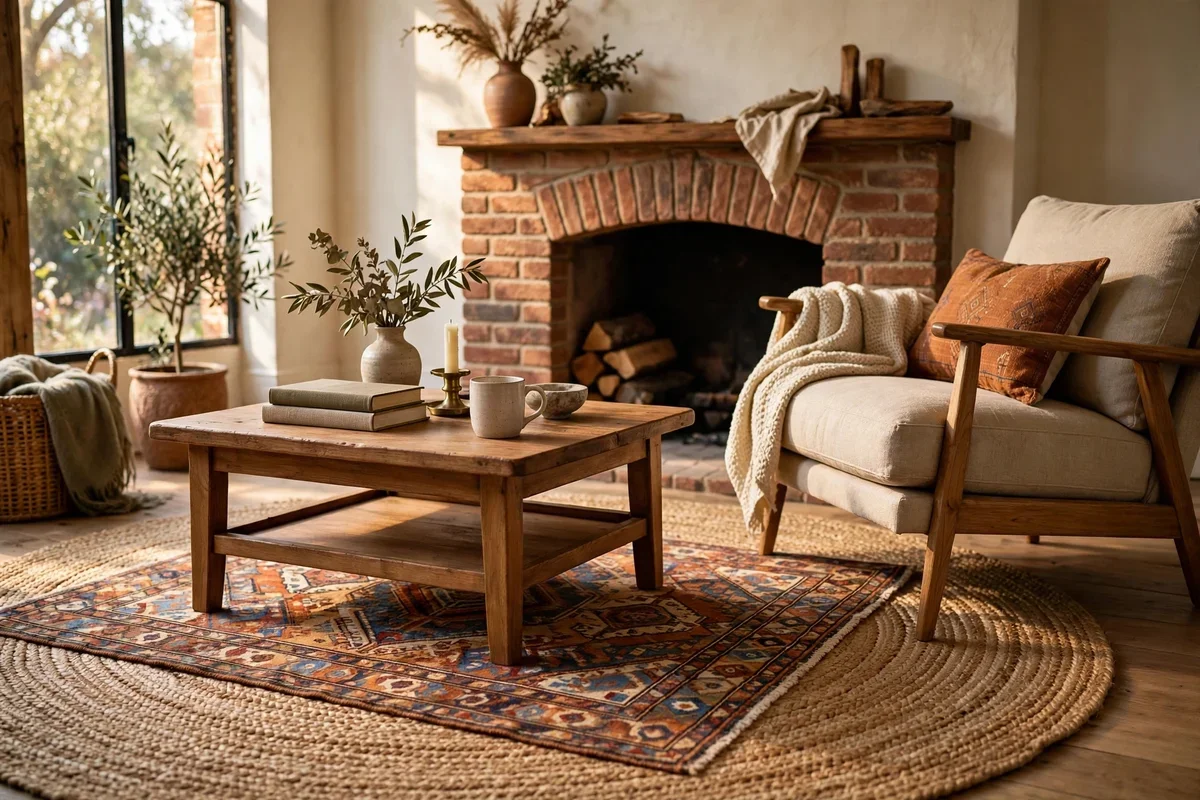
Jute’s sandy texture is a calm counterpoint to brick or stone, and a round rug suits the wedge of floor space a corner fire creates. Choose a 150 to 180 cm round jute rug and centre it on the coffee table, letting the table sit fully on the rug with 20 to 30 cm of jute showing on every side. The circle echoes the curved arrangement of angled armchairs and stops the room’s geometry from feeling all sharp corners and diagonals.
Layer a smaller patterned rug, about 120 cm across, on top for softness underfoot and a touch of colour. Use a thick felt pad underneath to stop the jute sliding on hard floors and to protect the floor from the rough weave. The mistake to avoid is placing bare jute directly on timber; the fibres scratch over time. Jute rugs cost 60 to 150 dollars at this size, and the layered topper can be a budget find from a home store.
12. Leave Proper Hearth Clearance on Both Faces of the Fire
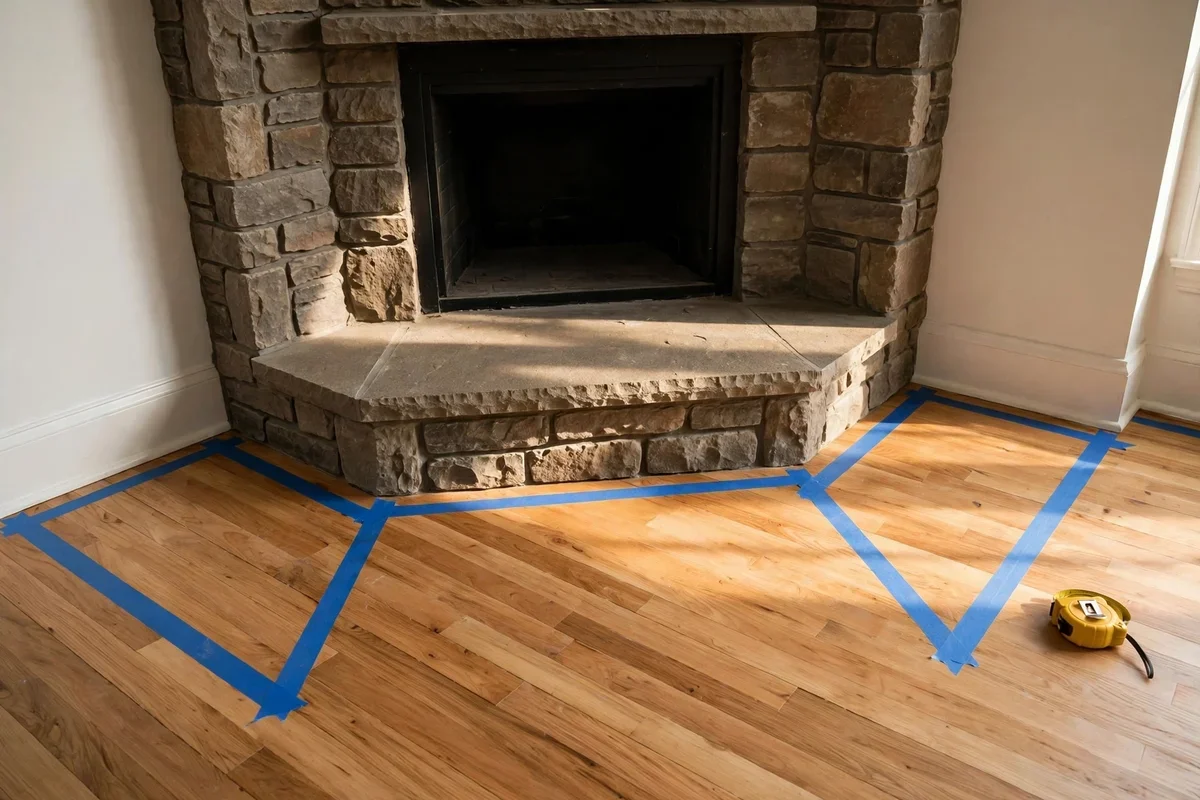
A corner fireplace has two faces meeting at an angle, and clearances apply to both. Keep the hearth extension at least 40 cm deep in front of every part of the firebox opening, measuring straight out from each angled face. Combustible furniture, curtains and timber shelving need 90 cm of clear space from the firebox on each side, so mark the line with tape on the floor before placing anything. These distances protect walls and floors from radiant heat.
Local codes may ask for more than these minimums, so check your area’s rules before finalising furniture placement. This is especially important where furniture sits close on both flanks of the corner, since heat radiates in two directions. The mistake to avoid is measuring clearance from the mantel edge instead of the firebox opening, which underestimates the real heat zone. A few minutes with a tape measure now prevents scorched furniture and a costly refinish later.
13. Mount Heat Shields Where Furniture Sits Close to the Fire
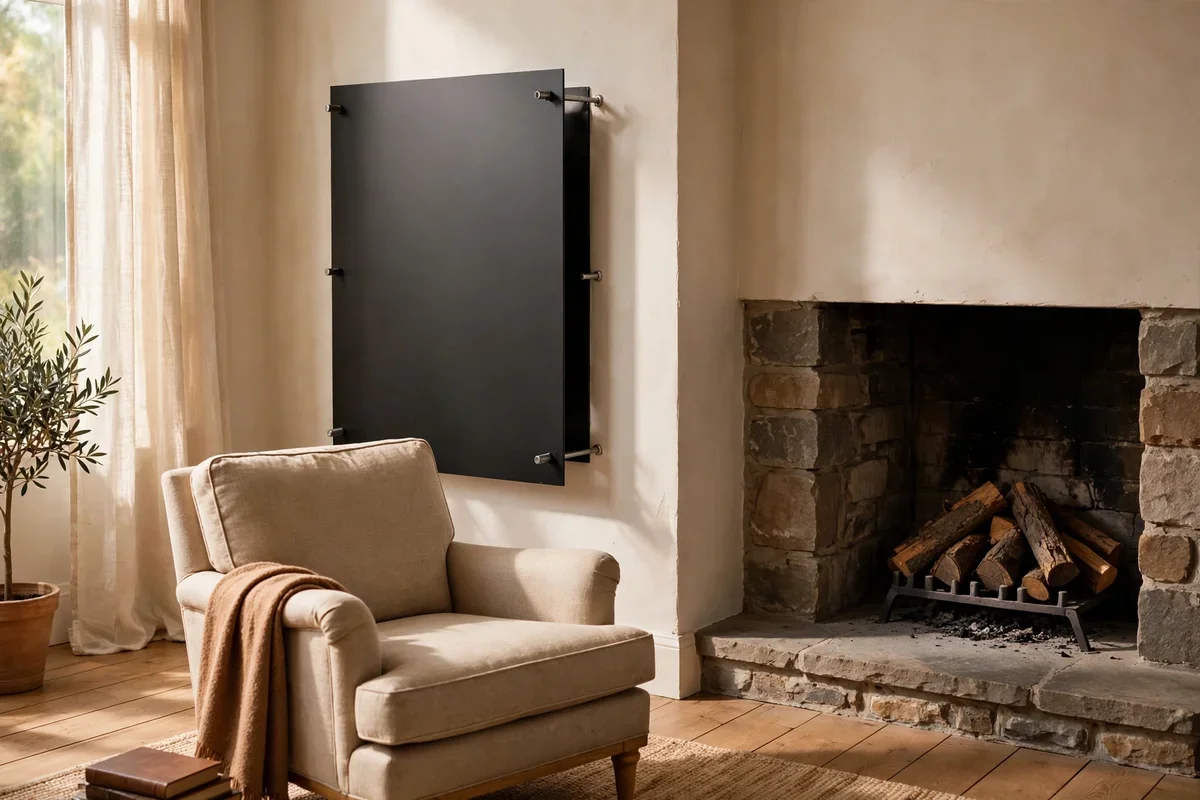
When a favourite armchair must sit nearer the fire than ideal, a heat shield protects the upholstery without moving the layout. Mount a sheet of 24-gauge steel or a purpose-made fireplace heat shield on 2.5 cm spacers behind the furniture, or on the wall section nearest the heat, so air flows behind the panel. This simple gap drops the surface temperature dramatically, often by half. Keep the shield 5 to 8 cm larger than the area it protects on every side.
Heat shields can be painted matte black or covered with decorative tile so they read as intentional design. They matter most on the flank walls of a corner fire, where heat strikes surfaces at an angle. The mistake to avoid is screwing the shield flat against the wall with no air gap; without the 2.5 cm ventilated space it barely helps. A fabricated steel shield costs 40 to 90 dollars, far less than replacing a heat-damaged chair.
14. Frame the Fire With a Pair of Matching Bookcases
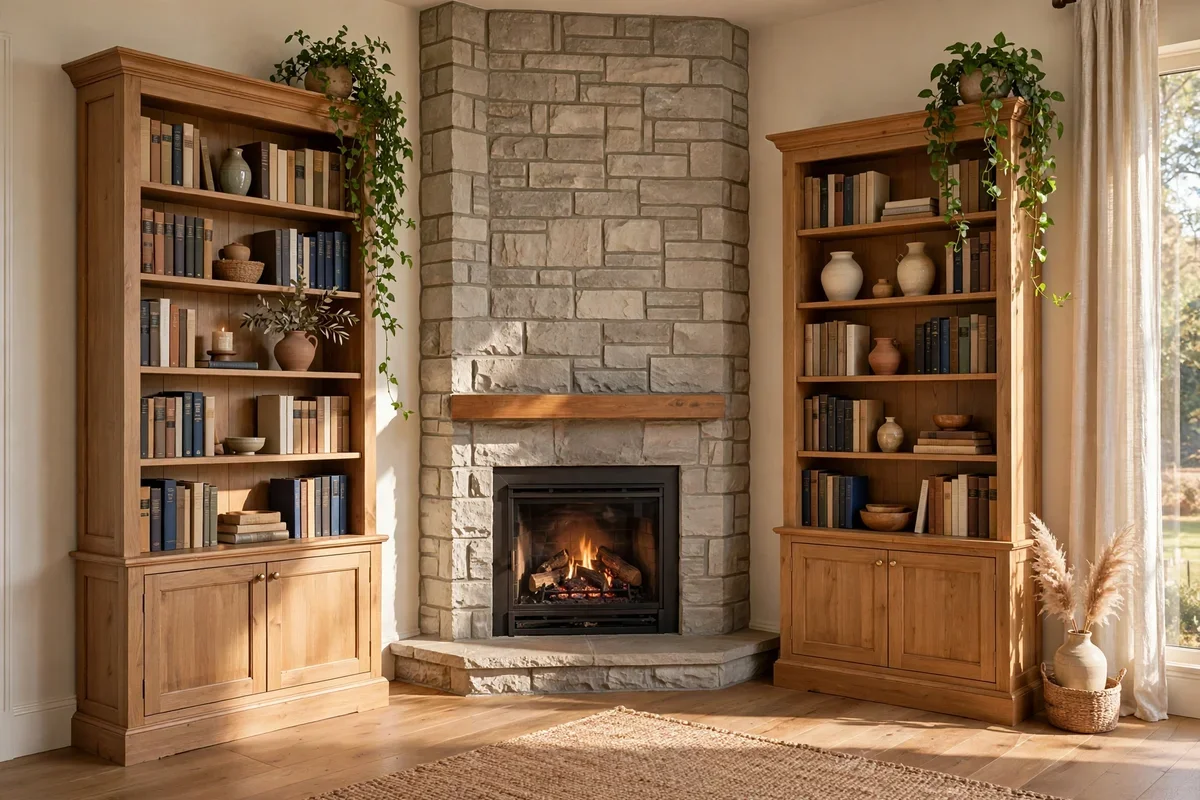
If full built-ins feel like too much, a pair of matching tall bookcases on the flanking walls gives the same framing effect at a fraction of the cost. Choose bookcases 60 to 80 cm wide and 180 to 210 cm tall, and stand them 30 to 45 cm from the fireplace surround on each side so the fire keeps its own breathing room. Identical units on both sides create the symmetry an angled hearth needs to feel anchored rather than adrift.
Top each bookcase with the same object, a trailing plant or a pair of matching lamps, to strengthen the mirrored look. Secure every bookcase to the wall with anti-tip hardware, especially in homes with children who climb. The mistake to avoid is choosing open-back bookcases against a dark wall, which shows dust and wall marks; a finished back panel looks far tidier. Two quality bookcases plus hardware usually cost 200 to 450 dollars total.
15. Run Wainscoting Around the Corner to Unify Both Walls
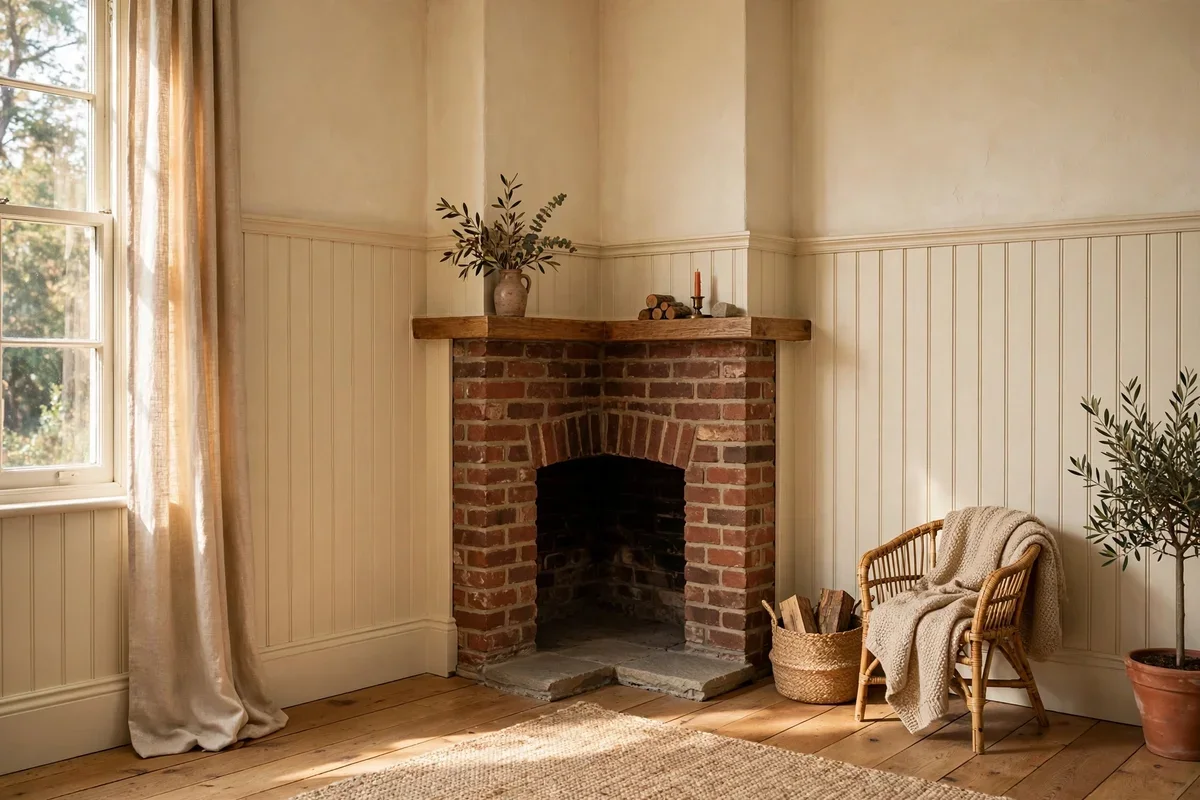
Wainscoting carried continuously around the corner where the fireplace sits makes the two walls read as one thoughtful plane instead of two separate strips. Install beadboard or shaker-style panels 90 to 110 cm high on both flanks, letting the trim mitre cleanly through the angle. Painted in a soft white or warm cream, the panelling adds old-world craft to rooms that otherwise feel plain, and it gives the fireplace a finished backdrop.
Keep combustible panelling at least 30 cm from the firebox opening and never run wood trim across the firebox face itself; use stone or tile there. The lower half of the wall takes the detail while the upper half can hold art or a mirror. The mistake to avoid is stopping the wainscoting dead at the fireplace surround on each side, which chops the wall awkwardly; carry it behind any flanking bookcases for a continuous line. Materials run 5 to 10 dollars per linear foot.
16. Paint the Corner Walls a Deeper Shade Than the Rest
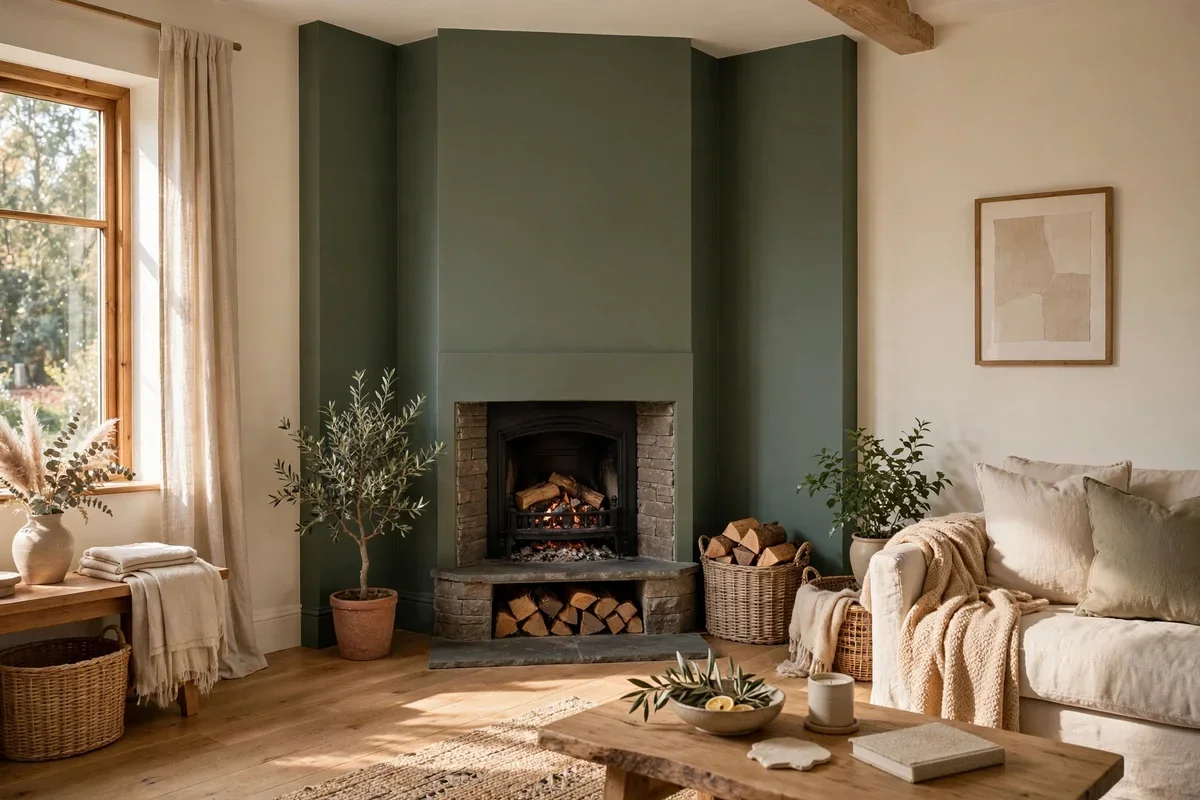
Painting the two walls that meet at the fireplace one or two shades deeper than the room creates a natural alcove that draws people toward the fire. A warm putty, sage or terracotta tone concentrates the eye on the hearth while the lighter walls keep the room bright. Carry the deeper colour only across the fireplace walls, stopping at the inside corner where each wall meets its neighbour, so the effect reads as a deliberate colour block.
Sample the colour at the corner itself, since angled light behaves differently there than on flat walls; paint a 60 cm square test patch and view it morning and evening. Eggshell finish wipes clean near a working fire. The mistake to avoid is going too dark in a small room, which can make the corner feel like a cave; test in a north-facing room before committing. One or two litres of quality paint usually covers both walls for 40 to 80 dollars.
17. Light the Flanking Walls With Wall Sconces Angled Toward the Fire
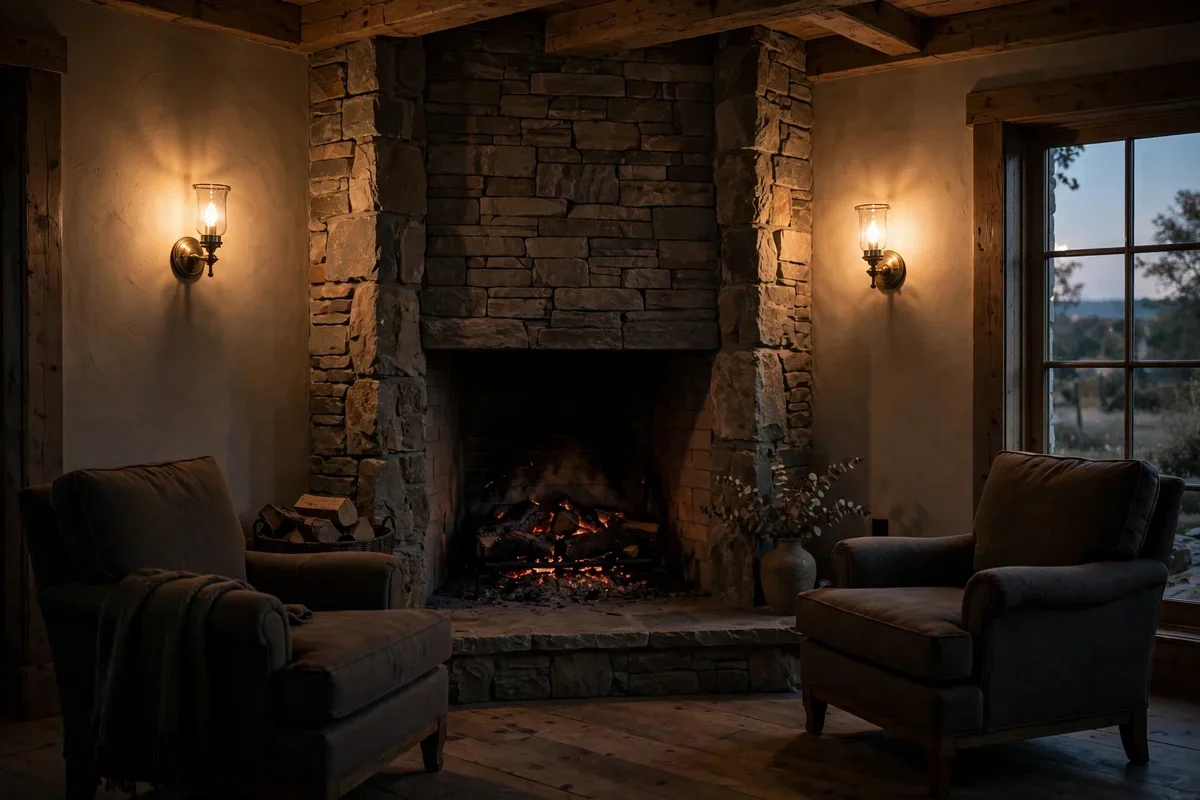
Wall sconces on both flanking walls wash the fireplace surround in warm light and make the hearth the evening focal point. Mount them 150 to 170 cm from the floor and 60 to 90 cm out from the surround edge on each side, aiming the shades slightly toward the fire so the glow frames it. Choose 2700K warm bulbs of 4 to 6 watts each, dimmable if possible, so the light can drop to ember levels after the main lamps go off.
Hardwired sconces look cleanest, but plug-in swing-arm sconces with a cord cover suit renters and cost far less. Keep fabric shades at least 30 cm from the firebox opening as a heat precaution. The mistake to avoid is using cool 4000K bulbs, which fight the fire’s warm glow and make stone look grey. A pair of plug-in sconces plus warm LED bulbs typically costs 80 to 160 dollars.
18. Dress the Hearth With a Basket of Logs and a Fireside Tool Set
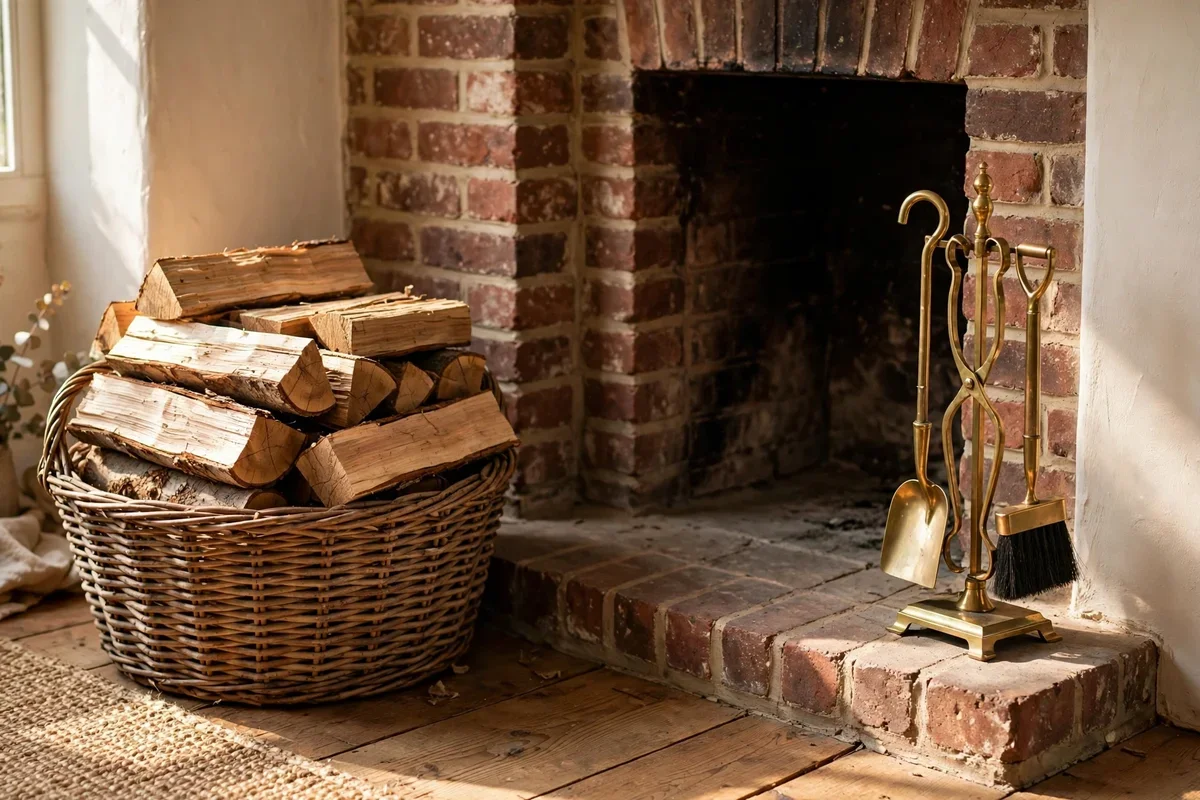
Even when the fire is unlit, a woven log basket beside the hearth tells the story of the fireplace. Choose a basket 40 to 50 cm tall in willow or seagrass and fill it two-thirds full with kiln-dried logs, split 25 to 30 cm long so they fit the firebox. Place it on one face of the corner, at least 40 cm from the opening, and keep a compact four-piece tool set, poker, tongs, brush and shovel, standing at the other face for balance.
Kiln-dried logs with under 20 percent moisture burn cleaner and leave less soot on the surround. A small lidded bucket for ash keeps the hearth tidy between cleanings. The mistake to avoid is stacking logs against the surround where bark rubs soot and moisture into the finish; the basket exists to prevent exactly that. Basket plus tools is a budget project, often 50 to 100 dollars, and it instantly makes the fire feel loved.
19. Stack Firewood in a Corner Log Store
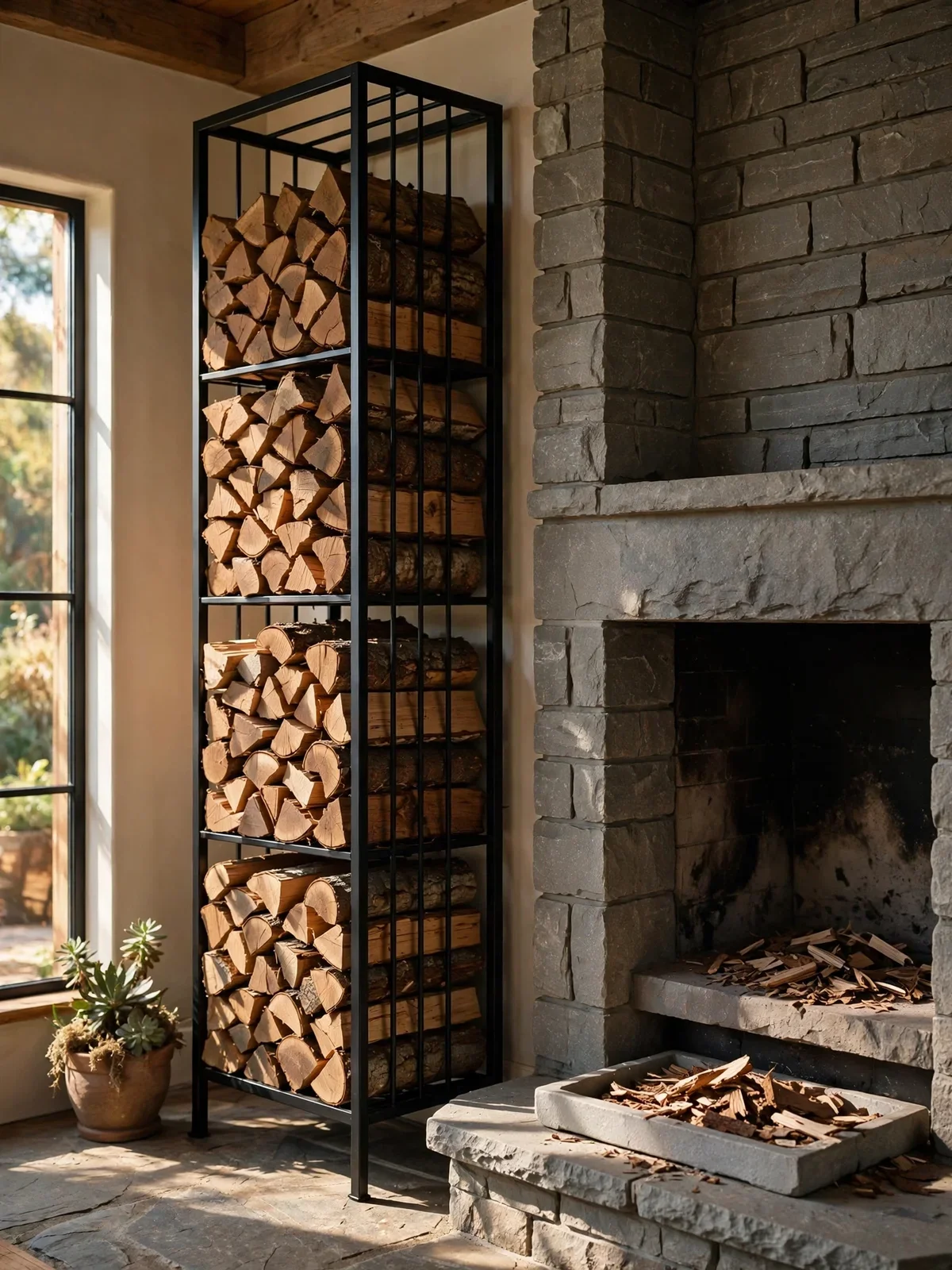
A tall, narrow log store tucked against one flank wall keeps fuel within arm’s reach and turns storage into decor. Look for a metal or timber store 50 to 60 cm wide and 90 to 120 cm tall with an open front so air circulates around the logs. Position it at least 90 cm from the firebox opening to respect clearance rules, and place a stone or metal tray underneath to catch bark and dust. Neatly stacked rows of cut ends look handsome and rustic.
Store only what you will burn in a week or two indoors; bulk wood belongs in a dry outdoor rack to keep insects and damp out of the house. Rotate the stock so the oldest logs burn first. The mistake to avoid is overfilling the store so logs press against the wall, which traps moisture and stains paint; leave a hand’s width of air behind the unit. A well-made log store costs 70 to 140 dollars.
20. Hang a Round Mirror on the Wall Beside the Fireplace
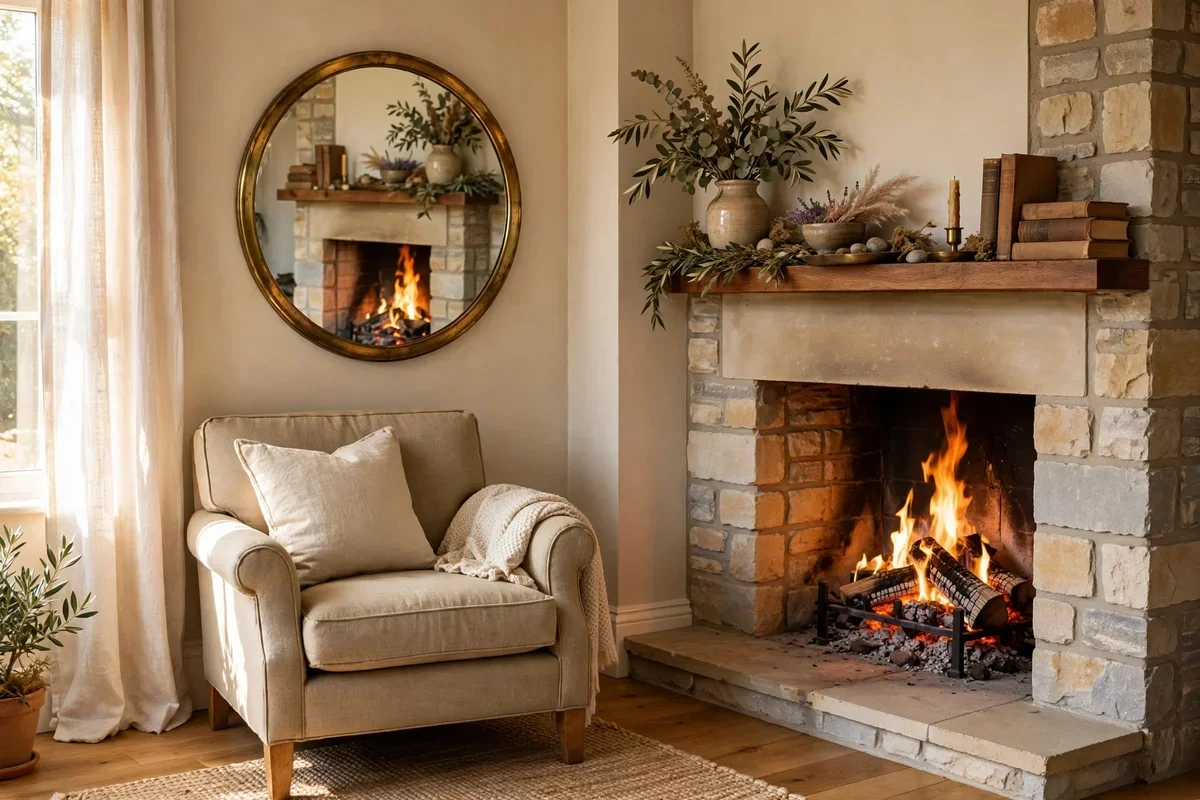
A round mirror on one flank wall does double duty: it bounces firelight around the room and softens the corner’s hard geometry. Hang a 70 to 90 cm diameter mirror so its centre sits about 150 cm from the floor, roughly 60 cm from the fireplace surround. The circle contrasts beautifully with the angular hearth, and it reflects the flickering flames so the fire feels larger from across the room. Choose a simple wood or brass frame.
Check the reflection before fixing the hanging point; you want flames and the mantel styling in the glass, not the television or a blank ceiling. Use proper wall anchors rated for the mirror’s weight, since a 90 cm mirror can weigh 8 to 12 kg. The mistake to avoid is hanging the mirror too high, which wastes its firelight-bouncing power; centre it at seated eye level for the biggest effect. Good round mirrors cost 60 to 130 dollars.
21. Create a Reading Nook in the Opposite Corner
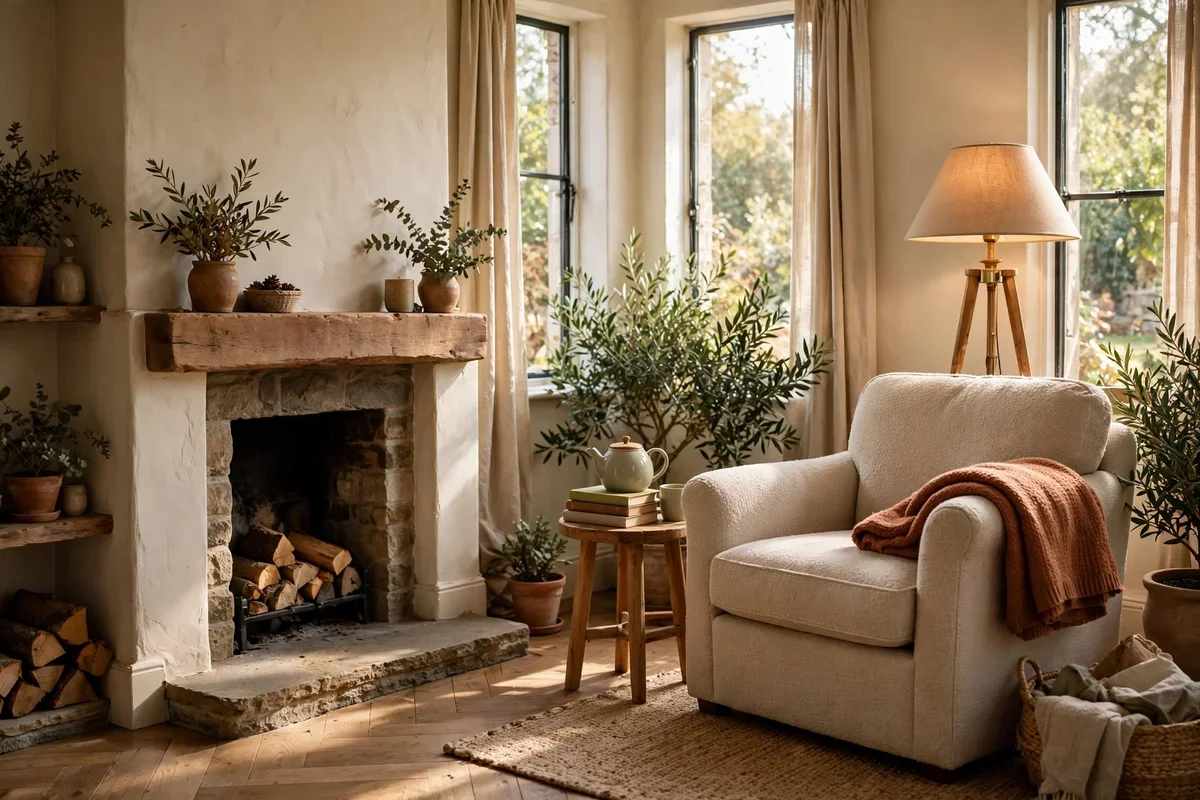
A corner fireplace leaves the far corner of the room free, and that is the perfect spot for a reading nook. Place a comfortable armchair angled toward the window or the room’s centre, add a floor lamp with a warm 2700K bulb on the chair’s left side if the reader is right-handed, and set a small side table 25 cm across within arm’s reach for tea. The nook balances the fireplace corner so the whole room feels furnished, not half-empty.
A folded throw and one lumbar cushion make the chair inviting, while a small basket beside it holds books or magazines. Keep the lamp shade bottom about 110 to 120 cm from the floor so light falls over a reader’s shoulder. The mistake to avoid is pushing the nook so far into the corner that the chair cannot pull out; leave 60 cm behind it. A second-hand chair plus a new lamp and table often totals under 250 dollars.
22. Keep a Child and Pet Safe Zone Around the Hearth
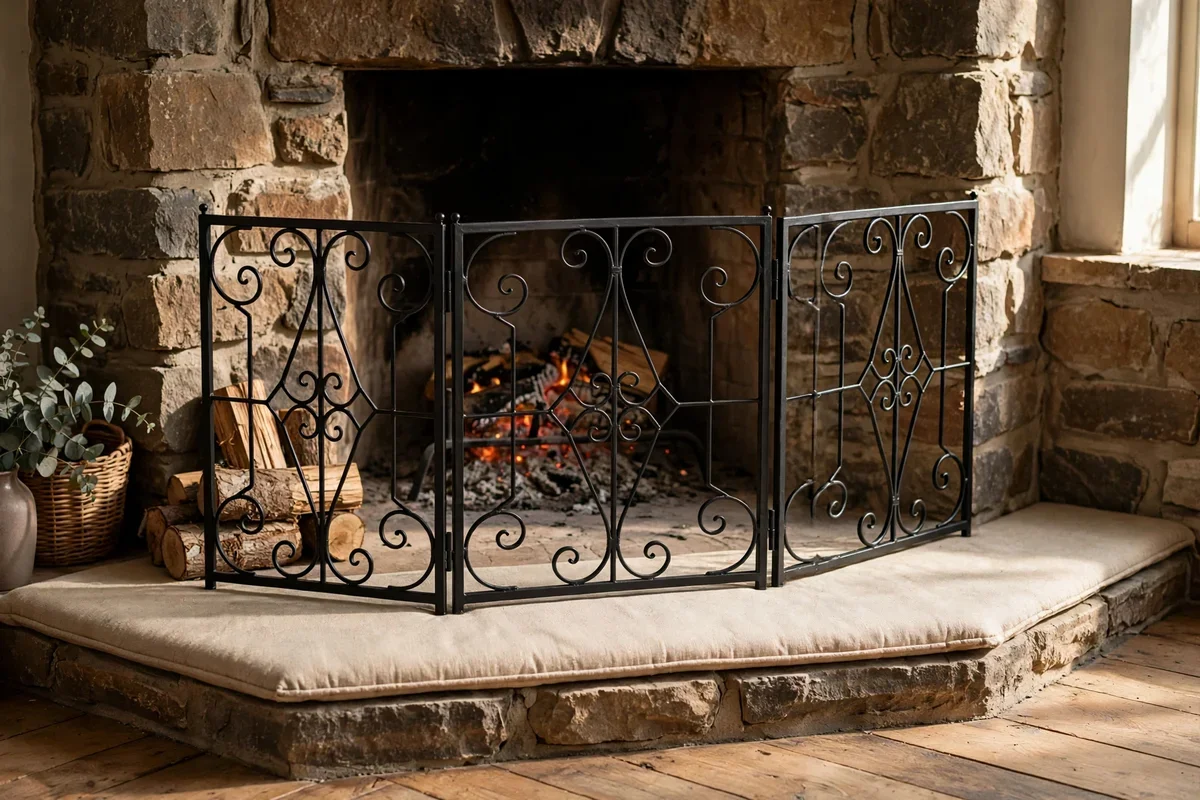
Corner fireplaces tempt little hands and paws from two directions, so a hearth gate matters more here than with a flat-wall fire. Choose a three-panel metal fireplace screen or gate that spans both angled faces, standing at least 60 cm from the firebox opening and secured so it cannot tip. A hinged design lets adults reach the fire for tending while keeping toddlers and pets a safe distance during and after use, since the surround stays hot long after the flames die.
Add a soft hearth pad or bumper over sharp stone edges at crawling height, and store firelighters, matches and tools in a locked cupboard rather than on the mantel. Teach older children the one-metre rule: no touching anything within a metre of the fire. The mistake to avoid is removing the gate on mild evenings; the hearth stays a hazard even when unlit because of hard edges. A quality three-panel gate costs 80 to 150 dollars.
A corner fireplace stops being a problem the moment you let the angle lead. Angled seating, flanking shelves, a surround that folds with the corner, and honest safety clearances all say the same thing: this hearth belongs exactly where it is. Pick the ideas that suit your room and your budget, and apply them one at a time rather than all at once.
The easiest first step costs nothing. This week, pull your main chair 60 cm toward the corner and angle it 30 degrees to face the fire, then sit down with your evening tea and notice the difference. Small moves like this build the room’s warmth in a steady, gentle way, and the bigger projects will feel natural once the seating leads the way.
Frequently Asked Questions
What is the best seating layout for a corner fireplace living room?
Place a loveseat 240 cm from the fire with an armchair on each side, each angled 30 to 45 degrees toward the flame. Keep chair fronts 90 to 120 cm from the hearth edge. A round coffee table of 60 to 80 cm suits the wedge of space and keeps conversation and the fire equally in view.
How much clearance do I need around a corner fireplace?
Keep the hearth at least 40 cm deep in front of every part of the firebox opening, measured from each angled face. Furniture, curtains and timber shelving need 90 cm of clear space from the firebox. Local codes may ask for more, so check your area rules before finalising placement.
Can I put a TV near a corner fireplace?
Yes, but mount it on the wall beside the fireplace rather than above the mantel. Hang the screen centre 105 to 120 cm from the floor and use a slim cable channel painted to match the wall. Rising heat above the hearth shortens a television’s life and strains necks, so the adjacent wall is the kinder spot.
What tile or stone suits an angled corner hearth?
Herringbone brick slips suit the fold of a corner, while large-format limestone or slate slabs give a calm sculptural face with few grout lines. Use heat-rated sealer on tile and honed finishes on stone. Budget pick: porcelain slabs that mimic limestone handle heat well at a fraction of real stone cost.
Are electric fireplace inserts a good choice for a corner fireplace?
Yes. Most inserts run 1 to 2 kilowatts on a standard plug, need no flue or chimney, and include adjustable flame effects with a thermostat. Choose one 5 to 10 cm smaller than the opening on each side, keep soft furnishings 60 cm away, and enjoy a glow visible from two seating directions at once.