Living Room
22 Olive Green Living Room Ideas That Feel Calm, Grounded and Elegant
By Anna Wells · · 19 min read
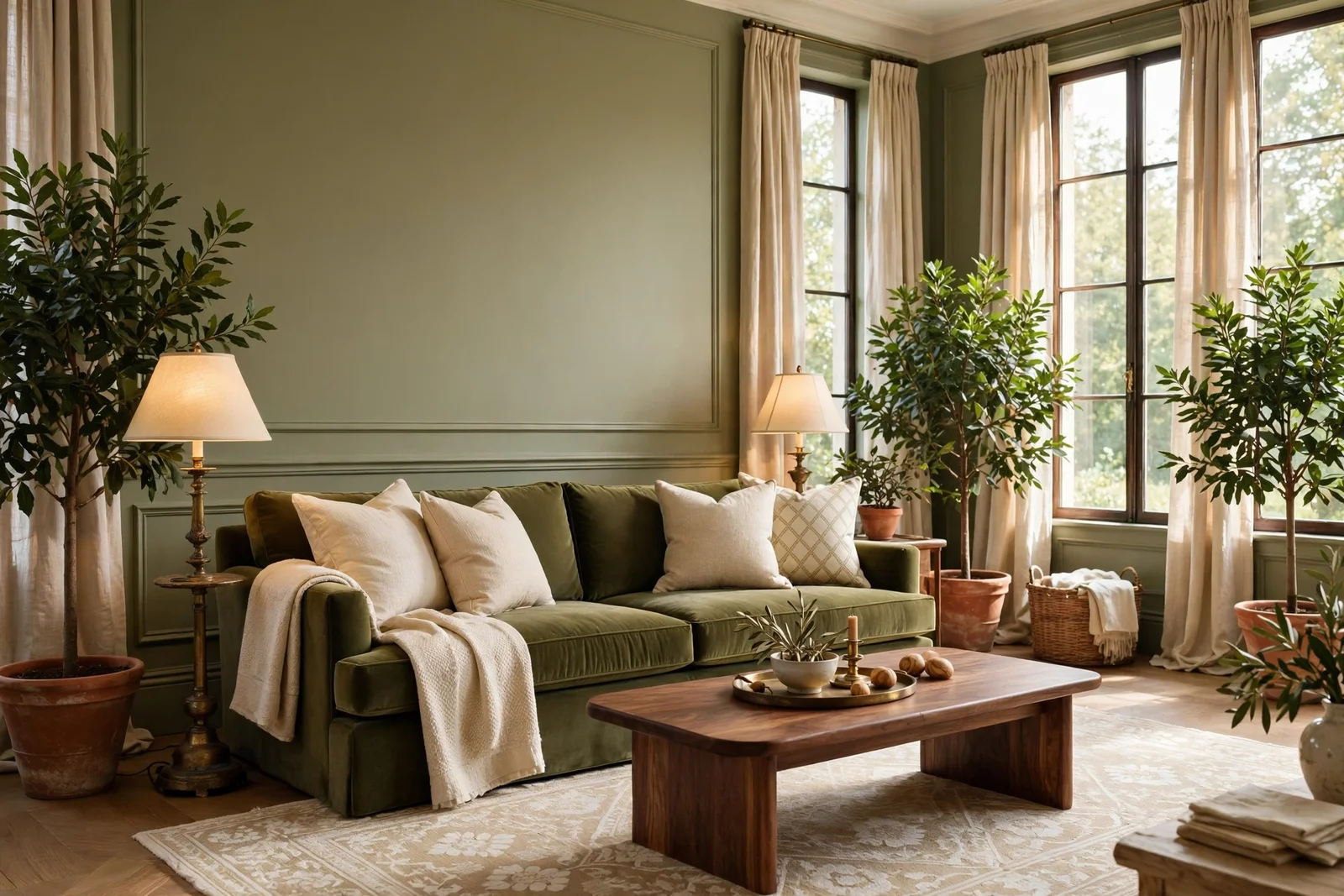
Olive green behaves like a neutral with a heartbeat: calm, grounding and endlessly elegant. Here are 22 concrete ways to bring it into your living room, from wall colours for every light to sofas, textiles and the pairings that flatter it.
Morning light moves slowly across a sitting room, catching the edge of an olive velvet cushion and the leaves of a bay tree by the window. The room feels settled before the day has properly begun, every colour sitting comfortably beside its neighbour. That is the quiet gift of olive green: it calms a space the way a garden calms a mind.
Olive is a heritage green that behaves like a neutral. It sits happily with cream walls, warm white woodwork, walnut and pale oak, aged brass, terracotta and soft blush, which means it rarely asks you to redecorate everything else. Used boldly on walls or quietly in cushions and curtains, it brings depth without drama.
This collection gathers 22 practical ideas for olive green living rooms, each one concrete enough to shop for or start this weekend. You will find wall colours for north and south facing rooms, an olive sofa used as the anchor, cautious ways to try the colour in accents, and the textiles, plants, floors and rugs that ground it.
Work through them in order or dip into the pairings that suit the room you already have. Every idea names materials, sizes and a mistake to avoid, so you can commit to olive with confidence.
1. Paint North-Facing Walls in a Soft Mid-Tone Olive for Steady Calm
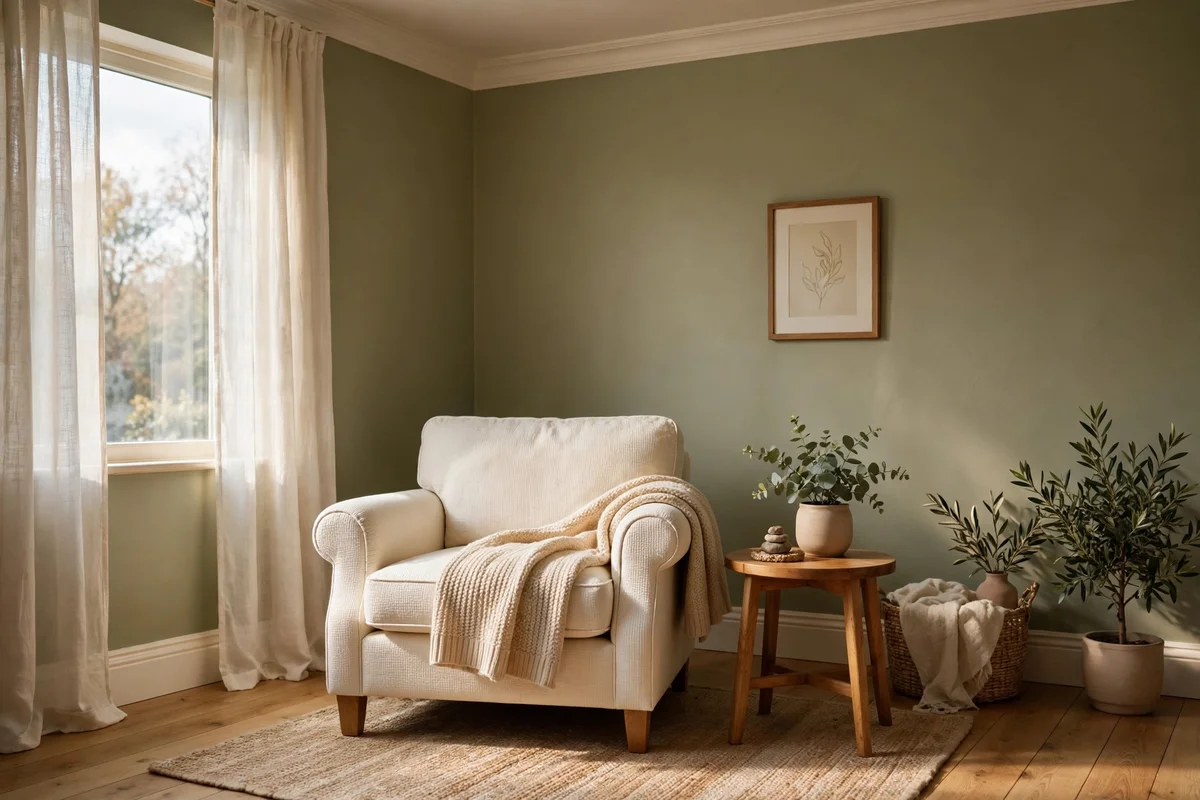
North-facing rooms receive cool, indirect light for most of the day, so choose an olive with warm yellow undertones rather than a grey-leaning sage. A soft mid-tone, about the depth of dried herbs, keeps the walls from looking flat or chilly. Paint the ceiling in warm white and keep the woodwork the same shade so the green flows uninterrupted from wall to wall.
Test with a large A2 painted board moved between walls at different hours before you commit, because northern light shifts subtly through the day. Budget around 45 to 70 pounds or dollars per 2.5 litre tin of good emulsion, and most living rooms need two tins for two coats. The mistake to avoid is choosing a deep olive here; in cool light it can read almost brown and shrink the room.
2. Choose a Deeper Olive for South-Facing Walls to Soften Bright Light
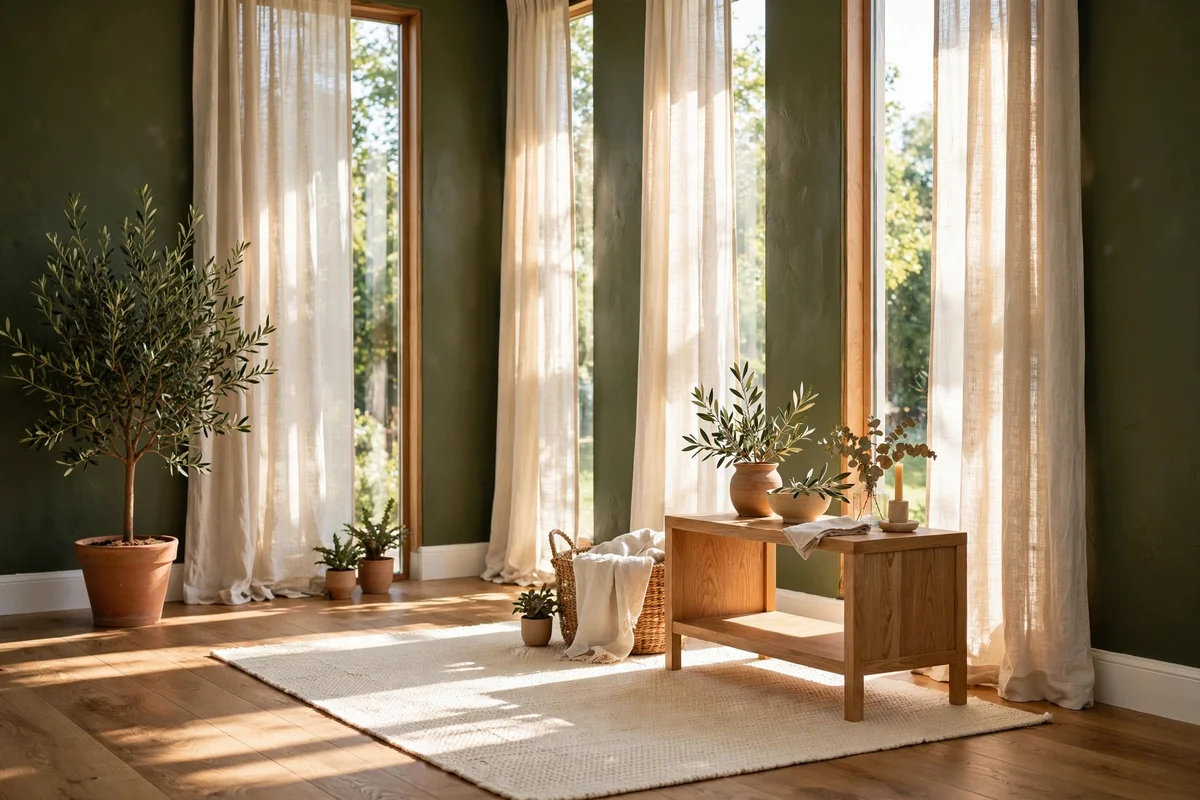
South-facing rooms take strong, warm sun for much of the day, which means they can carry a deeper, richer olive without feeling dark. Look for shades with a hint of bronze or umber in the undertone, sitting two or three steps darker than a mid-tone on the paint card. The extra depth tames glare on bright afternoons and gives the room a settled, library-like calm by evening.
Because strong sun fades pigments, choose a quality emulsion with good lightfastness and keep a small pot for touch-ups. Hang pale linen curtains that filter rather than block the light, and let a cream rug bounce brightness back up. The mistake to avoid is a yellow-heavy olive in this aspect; under direct sun it can turn almost chartreuse, so check your sample in full afternoon glare.
3. Anchor the Room With a Classic Olive Sofa and Cream Cushions
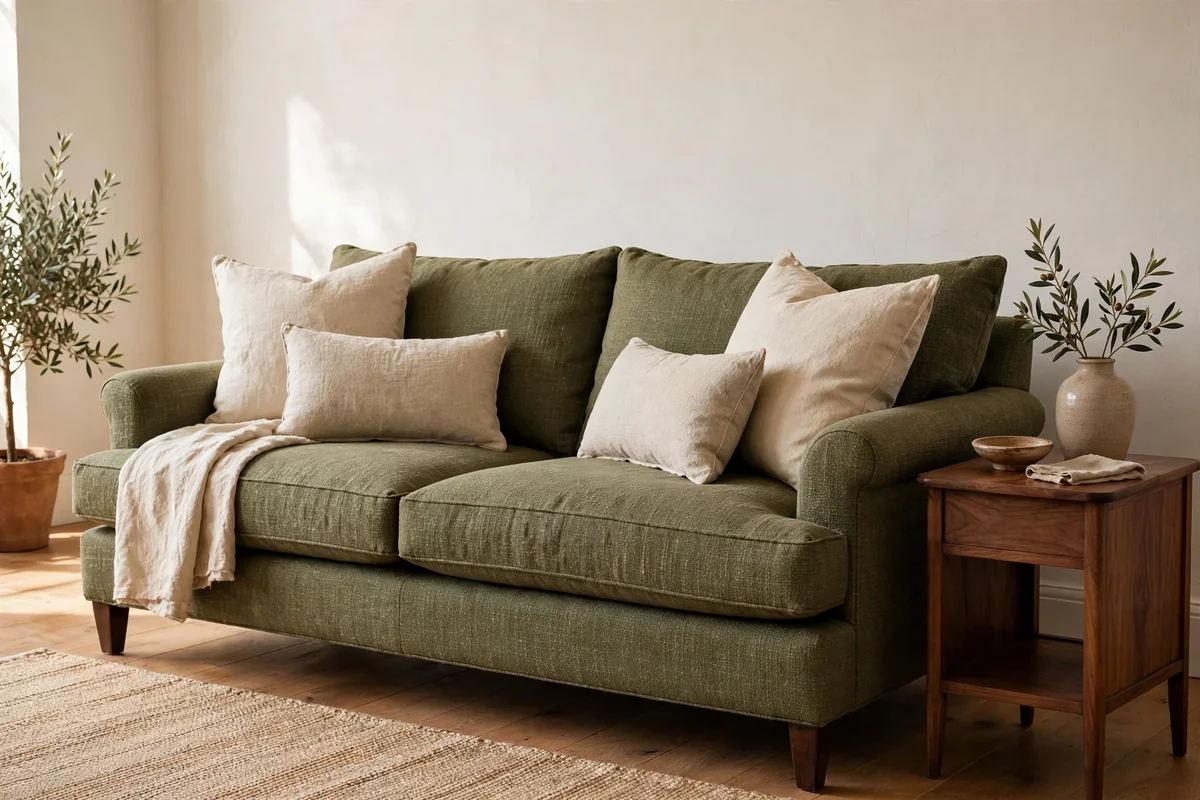
An olive sofa is the simplest way to make the colour the heart of the room without painting a single wall. Choose a classic three-seater between 200 and 230 cm wide in a tightly woven cotton or linen-blend fabric that will wear well. Dress it with cream and natural linen cushions in two sizes, 45 cm squares at the back and 40 cm in front, so the green reads as calm rather than heavy.
A mid-range olive sofa typically costs 700 to 1,200 pounds or dollars; budget options in the same fabric family start near 400. Vacuum the upholstery monthly with a soft brush head and rotate loose cushions weekly to even out wear. The mistake to avoid is pairing the sofa with matching olive armchairs, which overdoses the colour; one olive anchor plus neutral seating keeps the balance.
4. Layer Olive Velvet Cushions in Odd Numbers on Neutral Seating
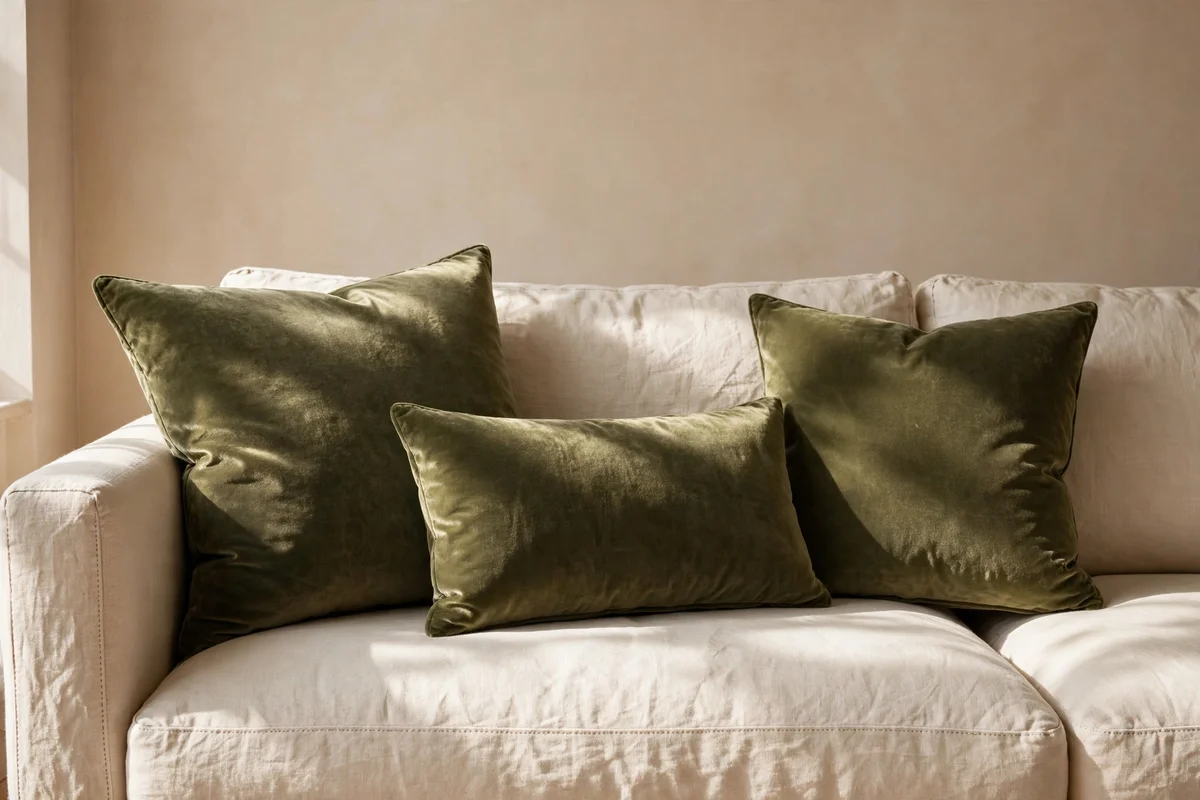
Velvet cushions are the cautious decorator’s best friend: all the richness of olive with none of the commitment. On a cream, oatmeal or warm white sofa, arrange three or five cushions in olive velvet, mixing 45 cm squares with one 30 by 50 cm lumbar. The sheen of velvet catches the light and makes even a plain sofa look considered, and the colour can be swapped seasonally.
Buy cushion covers rather than filled cushions if you already own good feather or recycled inserts; covers cost 12 to 30 pounds or dollars each in cotton velvet. Choose a plain weave for two cushions and a subtle texture, like a pinstripe or small quilting, for the third to add interest. The mistake to avoid is an even number of identical cushions, which looks staged; odd numbers feel natural and relaxed.
5. Hang Floor-Length Olive Linen Curtains From a Brass Rod
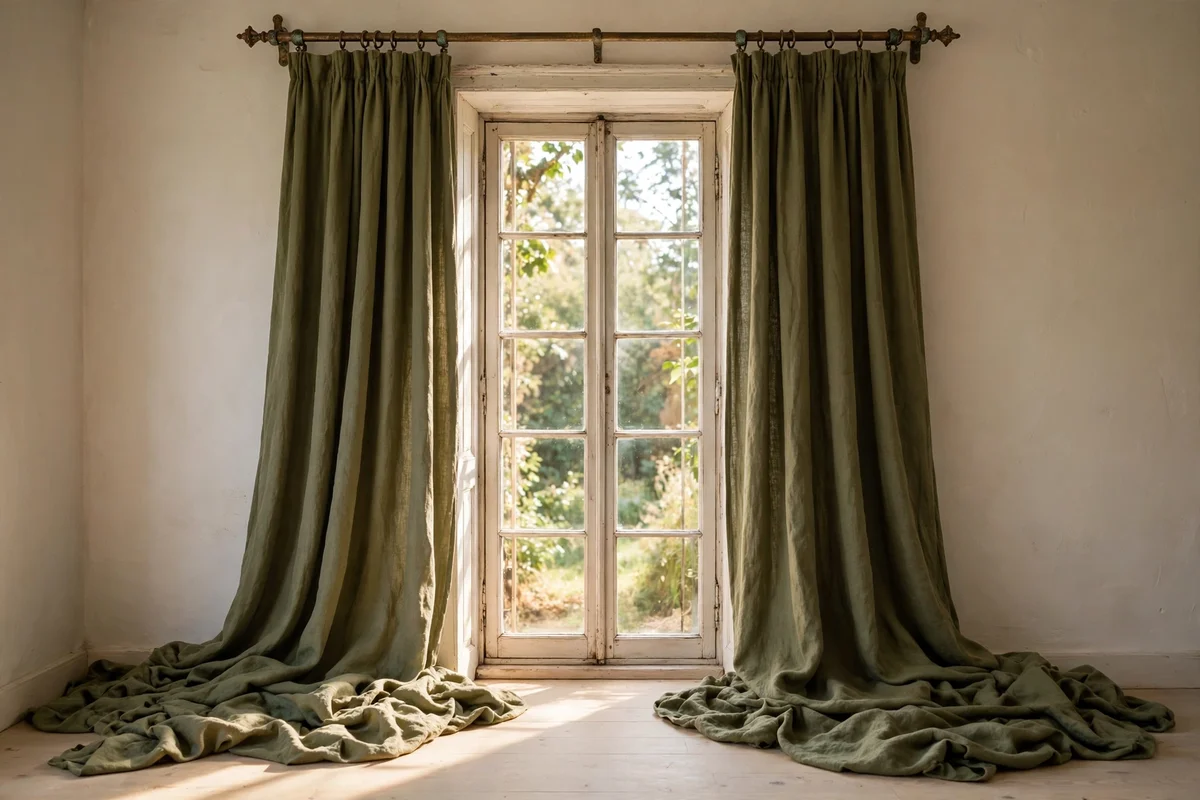
Olive curtains frame the window like foliage and soften daylight into a green-tinted glow. Choose a washed linen or linen-blend in a muted olive, hung from an aged brass rod mounted 10 to 15 cm above the frame and 10 cm wider each side. Curtains should just kiss the floor or puddle by 2 to 3 cm; anything shorter breaks the line and makes the window look unfinished.
Allow one and a half to two times the window width in fabric so the curtains gather in generous folds. Ready-made pairs in this style cost 60 to 140 pounds or dollars depending on drop; made-to-measure starts near 250. Wash linen curtains on a cool cycle and hang them slightly damp to smooth creases naturally. The mistake to avoid is a shiny polyester in olive, which cheapens the colour; matte linen keeps it earthy.
6. Paint a Bookcase in Muted Olive and Style With Cream Ceramics
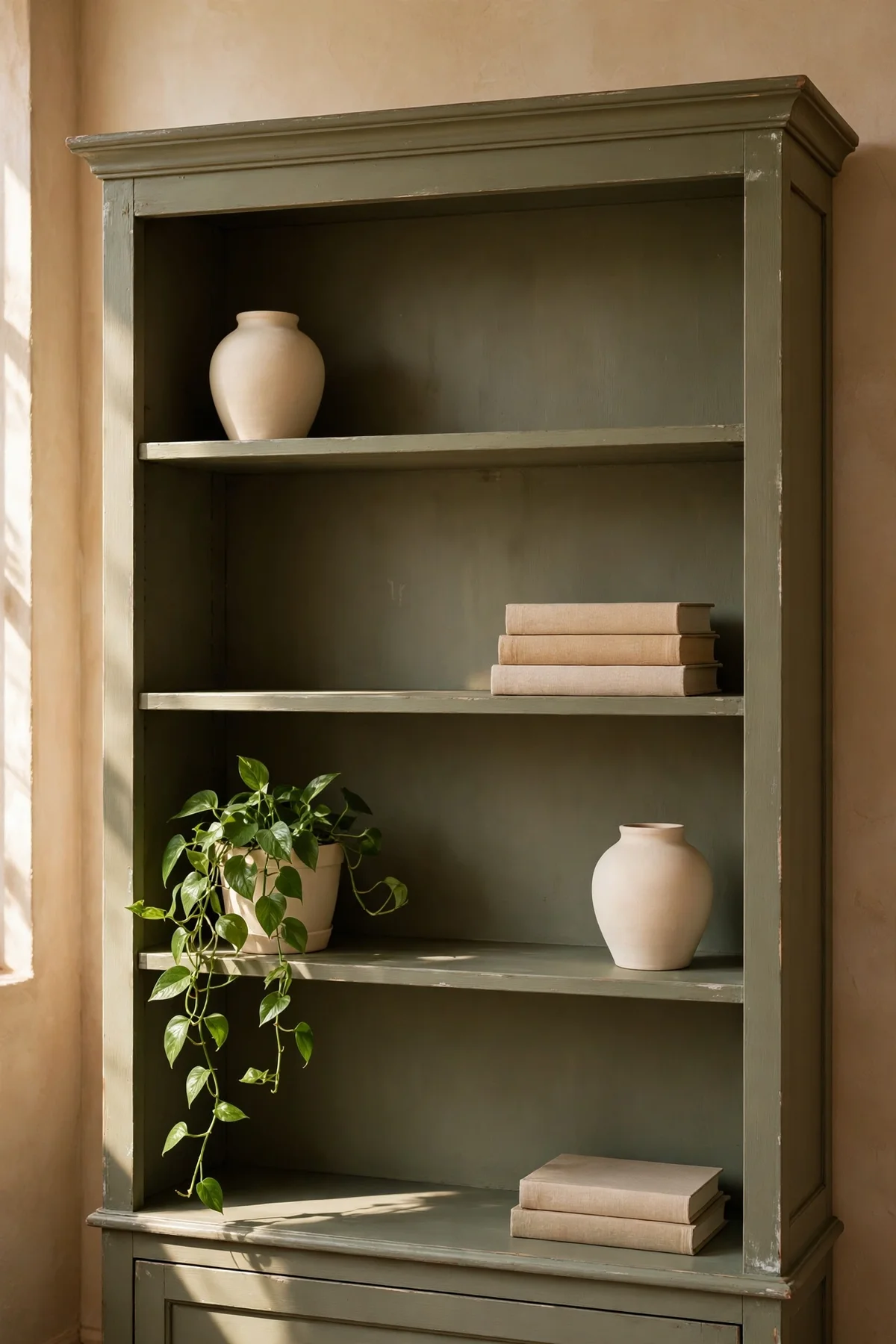
A painted bookcase is the perfect middle ground between cushions and full walls. Choose a simple pine or second-hand wooden bookcase about 90 cm wide and paint it in a muted, chalky olive with two coats of furniture paint, sanding lightly between coats. Style the shelves with cream ceramics, stacked books with their spines turned inward, and one trailing plant to soften the lines.
Leave roughly one third of each shelf empty so the olive paint shows and the display breathes. A tin of furniture paint costs 20 to 35 pounds or dollars and covers a standard bookcase with paint to spare. The mistake to avoid is filling every shelf edge to edge; crowded shelves hide the colour you painted for, so edit ruthlessly and let the green do the talking.
7. Pair Olive Walls With Warm White Woodwork and a Cream Rug
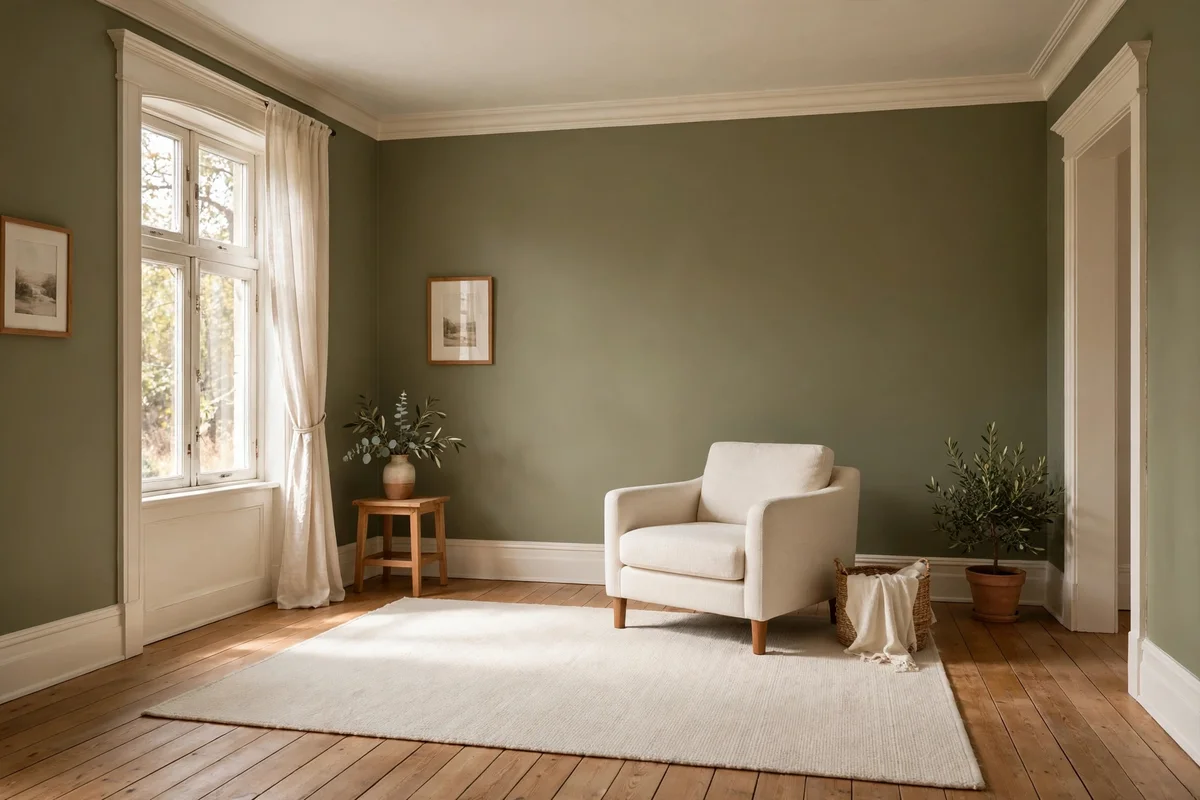
Warm white woodwork is what stops olive walls from feeling heavy. Paint skirting boards, architraves and the ceiling in a soft warm white with the faintest cream undertone, using eggshell on wood and matt emulsion on the ceiling. The pale trim outlines the green like a picture frame, and a large cream rug, at least 160 by 230 cm, lifts the floor so the room breathes.
Keep the ratio roughly 70 percent olive walls to 30 percent warm white trim and ceiling, which reads as balanced rather than boxy. If your existing woodwork is brilliant white, it can make olive look muddy, so a warm white repaint is worth the effort. The mistake to avoid is adding a dark rug here; deep colours on the floor close the room in, while cream opens it back up.
8. Ground Olive Upholstery With a Walnut Coffee Table and Brass Lamp
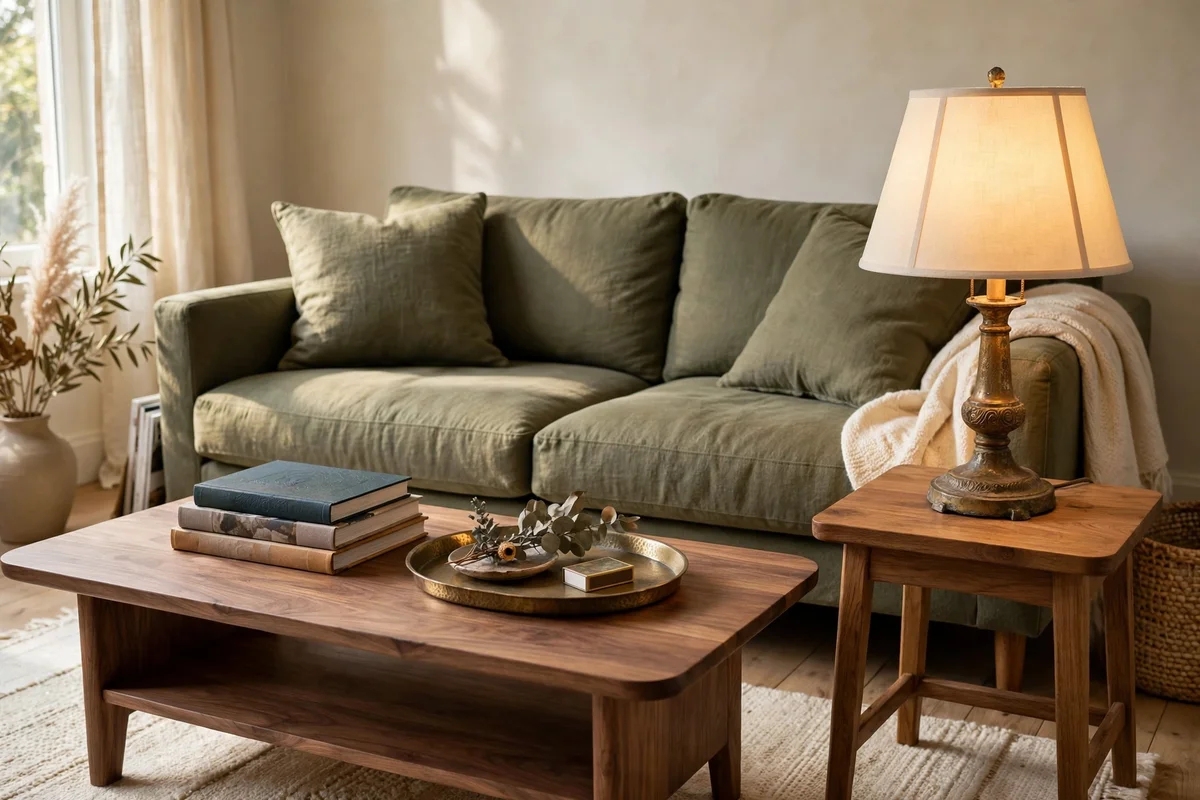
Walnut is olive’s most natural wooden partner: the deep brown grain steadies the green and adds a heritage weight that pale woods cannot. Choose a walnut coffee table about 110 to 130 cm long and 45 cm high, set 40 to 45 cm from the sofa edge so there is room to walk around it. A low stack of art books and a small brass tray on top keeps the surface styled but useful.
Add one aged brass table lamp, 40 to 50 cm tall, on a side table so warm light pools across the olive fabric in the evening. Second-hand walnut tables often cost 80 to 200 pounds or dollars, a fraction of new. The mistake to avoid is matching walnut with more dark wood everywhere; balance one dark piece with cream textiles and pale walls so the room stays calm, not sombre.
9. Keep Olive Fresh Against Pale Oak Floors and a Jute Rug
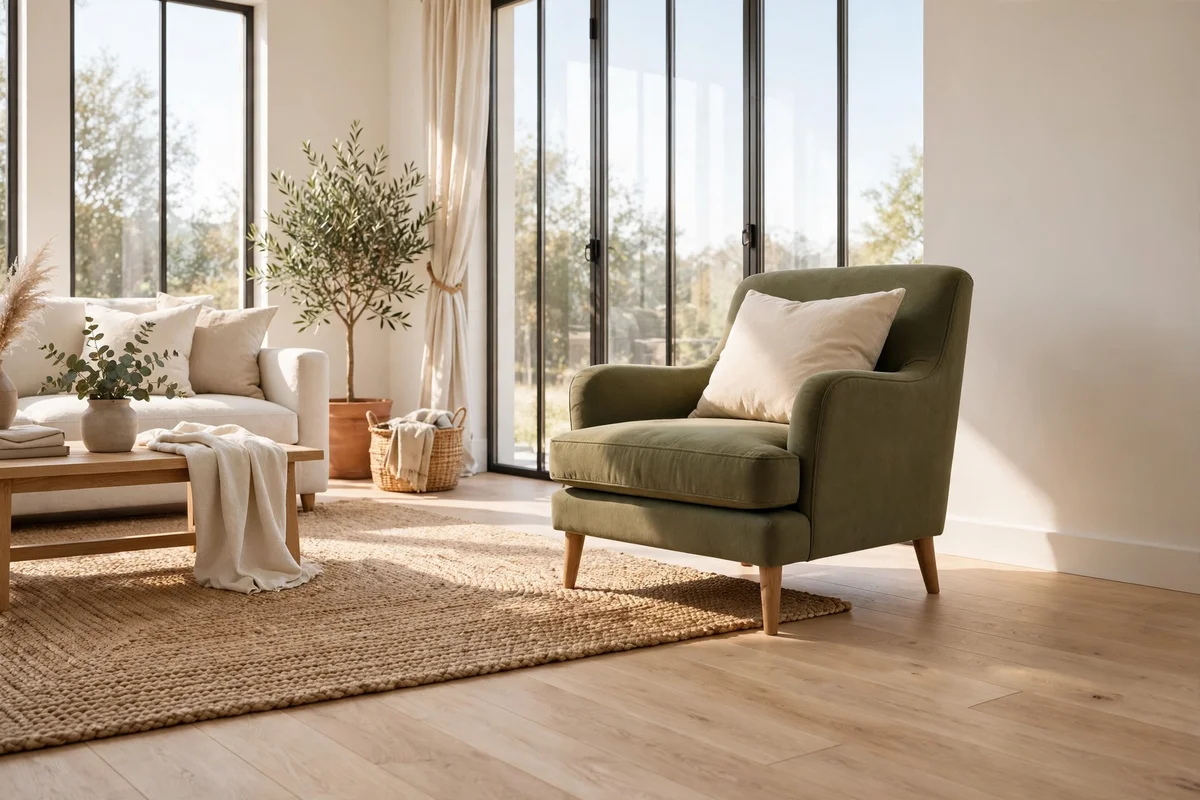
Pale oak floors stop olive from ever feeling heavy, because the light wood reflects daylight up into the green. If you are refinishing floors, choose a natural matte lacquer rather than an orange-toned varnish, which clashes with olive’s cool depth. Lay a natural jute rug, roughly 200 by 290 cm, under the seating group so the texture contrast between smooth wood and woven fibre does the decorating.
Jute rugs cost 80 to 180 pounds or dollars for a large size and wear well in living rooms, though they shed a little at first. Vacuum without a beater bar and rotate the rug twice a year for even wear. The mistake to avoid is layering a patterned rug over the jute against olive walls; three strong elements fight, so keep the rug plain and let cushions carry any pattern.
10. Add Aged Brass Table Lamps and Picture Lights to Olive Walls
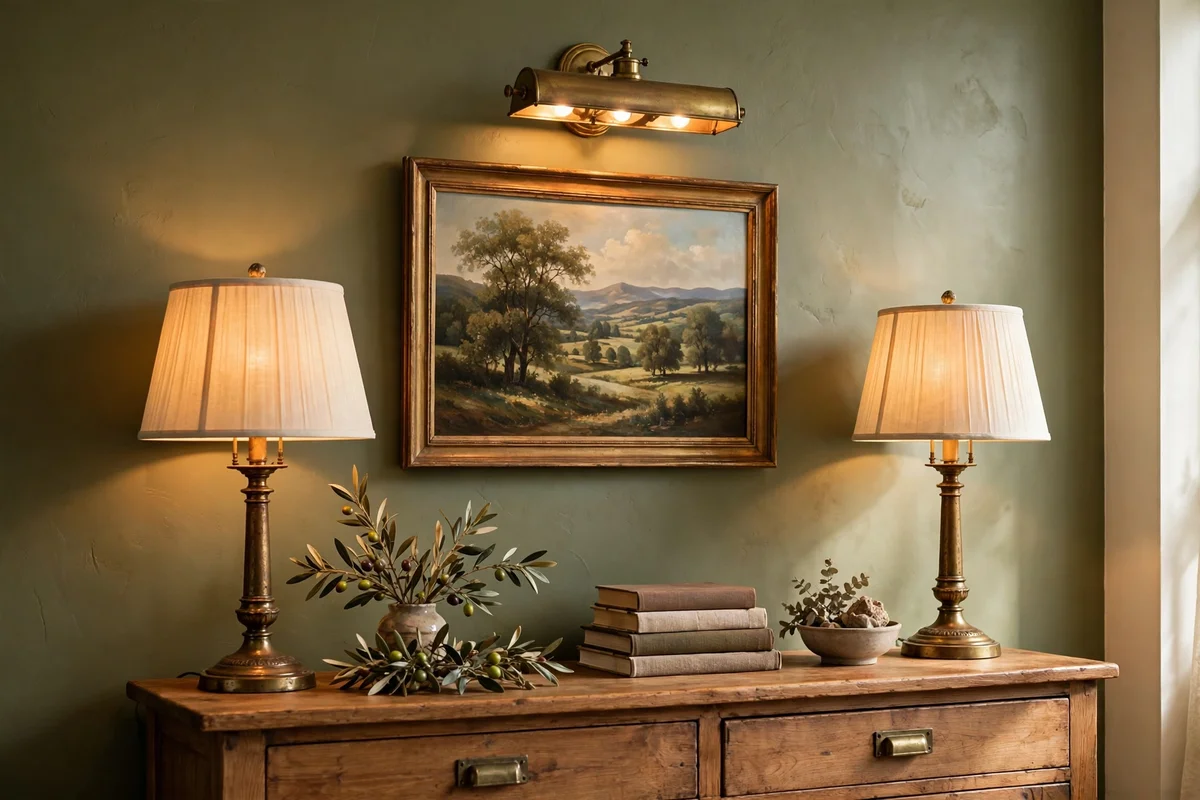
Aged brass is the metal olive was waiting for: warm, mellow and quietly traditional. Place a pair of brass table lamps, 45 to 55 cm tall with cream drum shades, on the console or side tables flanking the sofa, keeping both lamps identical for symmetry. Add a brass picture light above the mantel or artwork, mounted 15 to 20 cm above the frame, to wash the wall in a soft evening glow.
Use warm 2700K bulbs everywhere so the brass glows amber rather than glaring yellow. Budget 40 to 90 pounds or dollars per lamp for good high-street designs; picture lights start near 50. The mistake to avoid is mixing brass with chrome or nickel in the same sightline, which makes the metalwork look accidental; commit to one warm metal and repeat it at least three times around the room.
11. Warm Olive With Terracotta Plant Pots and a Fired-Clay Throw
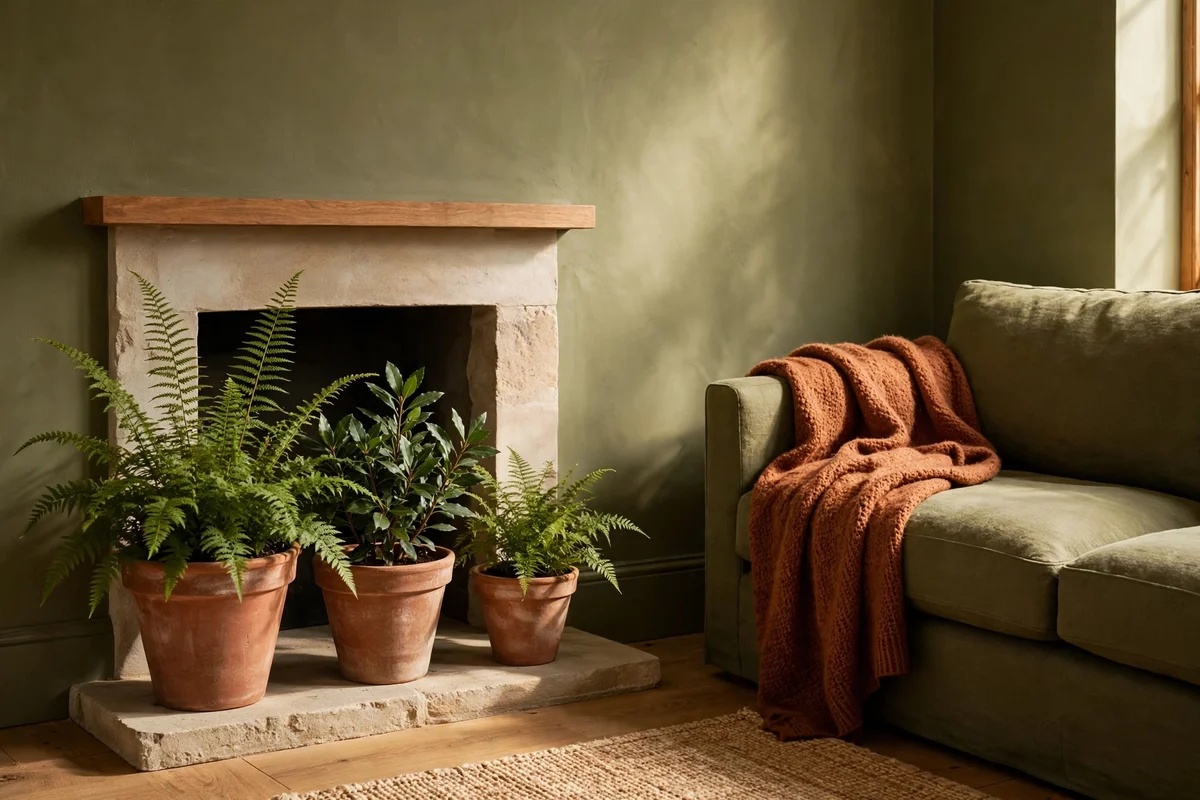
Terracotta and olive are garden companions, so the pairing feels instantly natural indoors. Group three terracotta pots in graduated sizes, roughly 15, 20 and 28 cm tall, beside the fireplace or in a bright corner, planted with bay, rosemary or ferns. Drape a fired-clay or rust-toned throw across one sofa arm; the warm orange-red lifts the green the way autumn leaves lift a hedgerow.
Terracotta pots cost 8 to 25 pounds or dollars each, and a good wool throw in rust tones runs 50 to 90. Water plants with a long-spout can to avoid splashing the pots, and rotate them monthly for even growth. The mistake to avoid is scattering single small pots around the room; one generous group of three reads as a deliberate arrangement, while singles look like afterthoughts.
12. Soften Deep Olive With Blush Pink Cushions and a Wool Throw
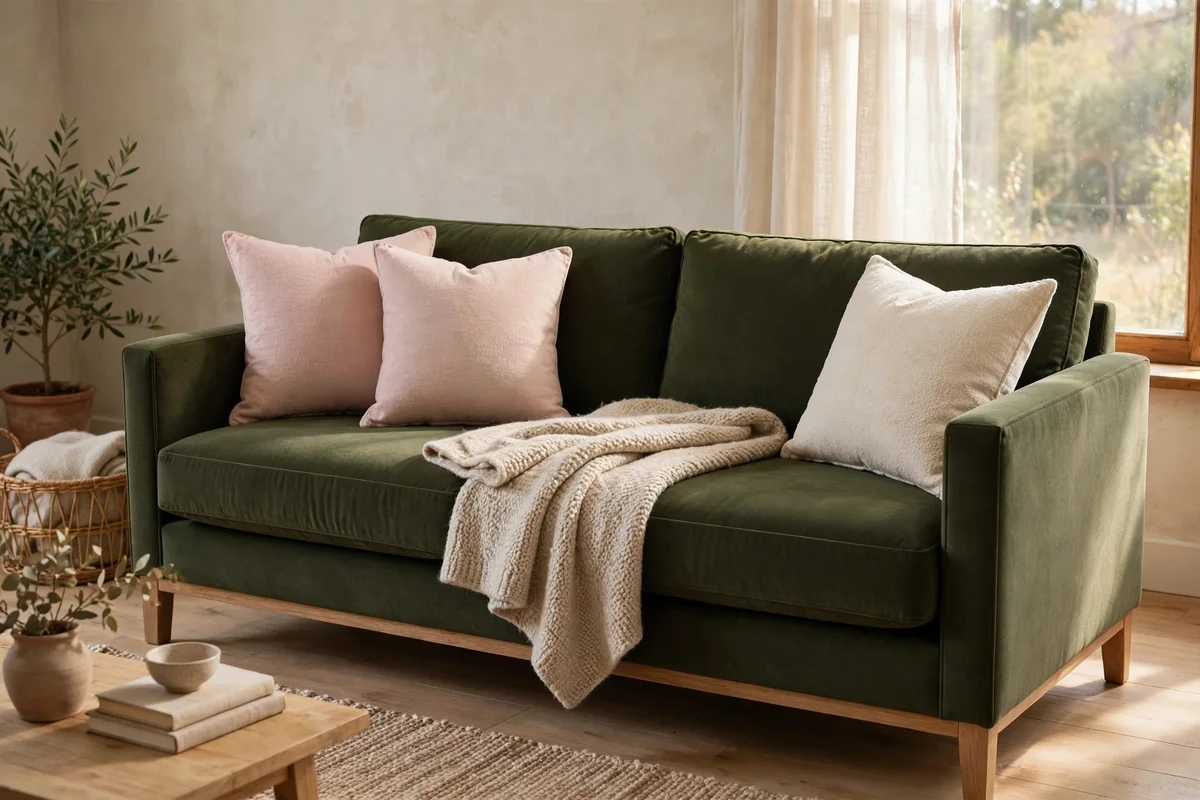
Blush pink takes the seriousness out of deep olive without weakening it. On a dark olive sofa or against olive walls, add two blush cushions in a matte cotton or washed linen, 45 cm square, plus one smaller 40 cm cushion in cream to bridge the tones. Fold a soft wool throw in oatmeal or pale blush across the seat; the pale colours float above the dark green and keep the seating inviting.
Keep blush to about one fifth of the room’s palette so it stays an accent, not a theme. Blush cushion covers cost 15 to 35 pounds or dollars each, and a pure wool throw starts near 60. The mistake to avoid is a glossy satin blush against matte olive; the shine clash cheapens both, so match matte to matte and let texture, not sparkle, create the contrast.
13. Dress Windows in Natural Linen to Let Olive Walls Breathe
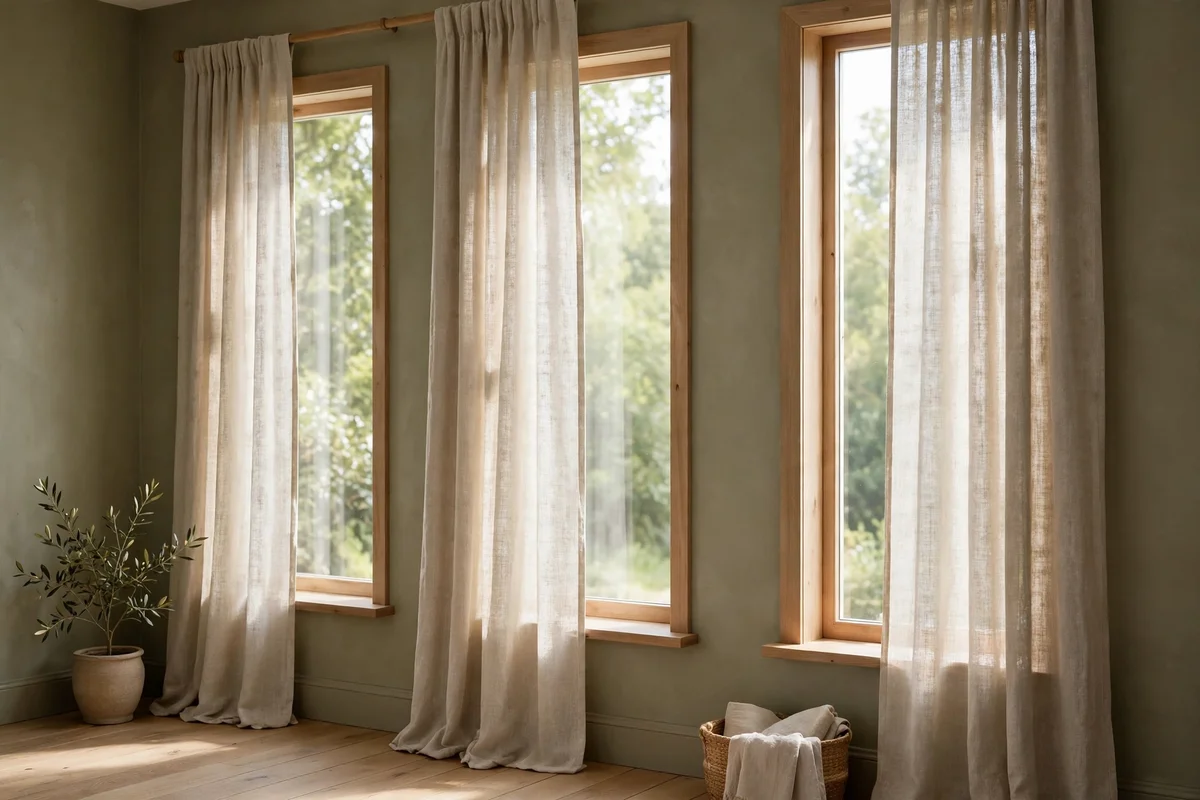
When the walls carry the colour, the windows should carry the light. Natural undyed linen curtains in oatmeal or flax soften bright windows without competing with olive paint, and their nubby texture adds the interest that a plain wall needs. Hang them high and wide as before, 10 to 15 cm above the frame, and let them fall to just kiss the floor.
Linen softens with every wash, so choose a medium weight that drapes rather than a stiff canvas weave. Expect 70 to 160 pounds or dollars for a ready-made pair in a standard drop. The mistake to avoid is pairing olive walls with heavy interlined curtains in a dark colour; the room ends up with two strong boundaries and feels smaller, while pale linen keeps the edges open.
14. Drape an Olive Velvet Throw Over the Arm of a Cream Chair
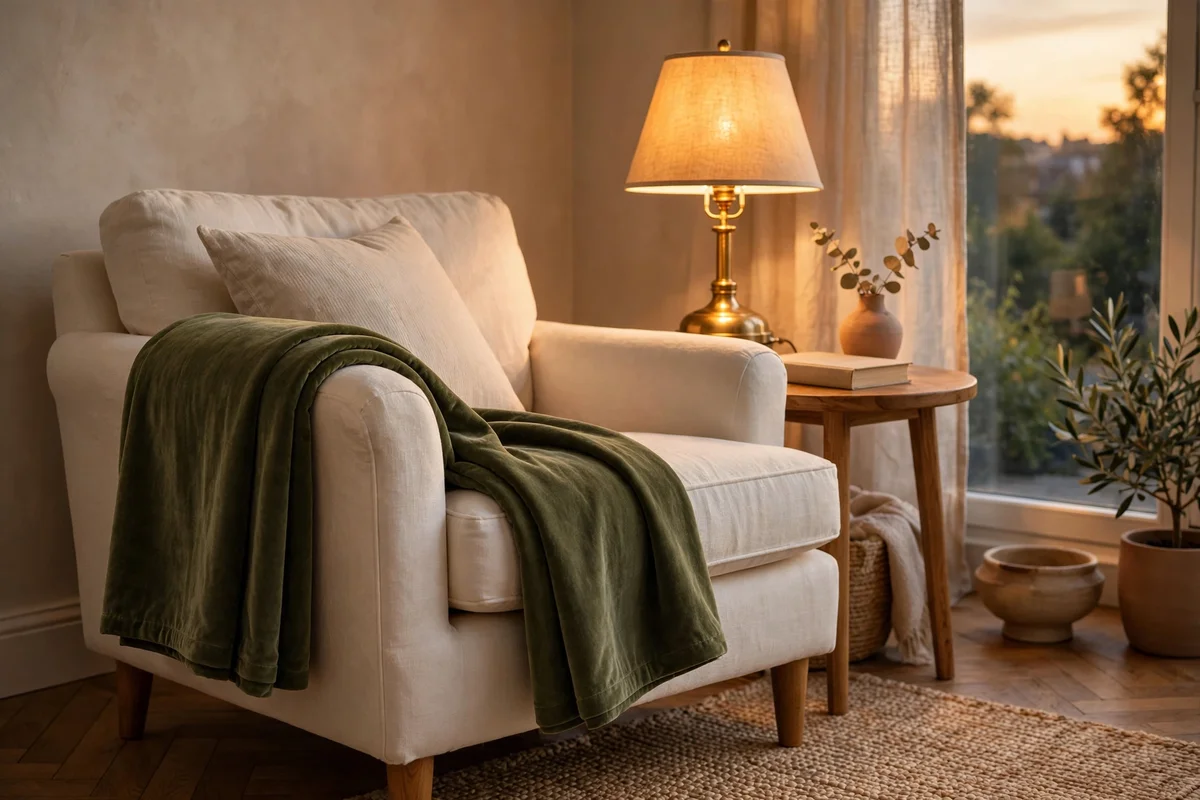
A single olive velvet throw is the five-minute version of this whole look. Choose a throw about 130 by 180 cm in cotton velvet, folded in thirds lengthways and laid over the arm of a cream or oatmeal armchair so the folded edge faces the room. The deep pile catches lamplight beautifully in the evening, turning an ordinary reading chair into the calmest seat in the house.
Cotton velvet throws cost 40 to 80 pounds or dollars; brush the pile weekly with a soft clothes brush to keep it looking rich. If the throw slides, a few discreet stitches of curtain tape on the underside add grip without damage. The mistake to avoid is leaving the throw unfolded and bunched; a neat lengthways fold shows the colour properly, while a crumpled throw just looks untidy.
15. Slipcover a Reading Chair in Olive Linen With Piping Trim
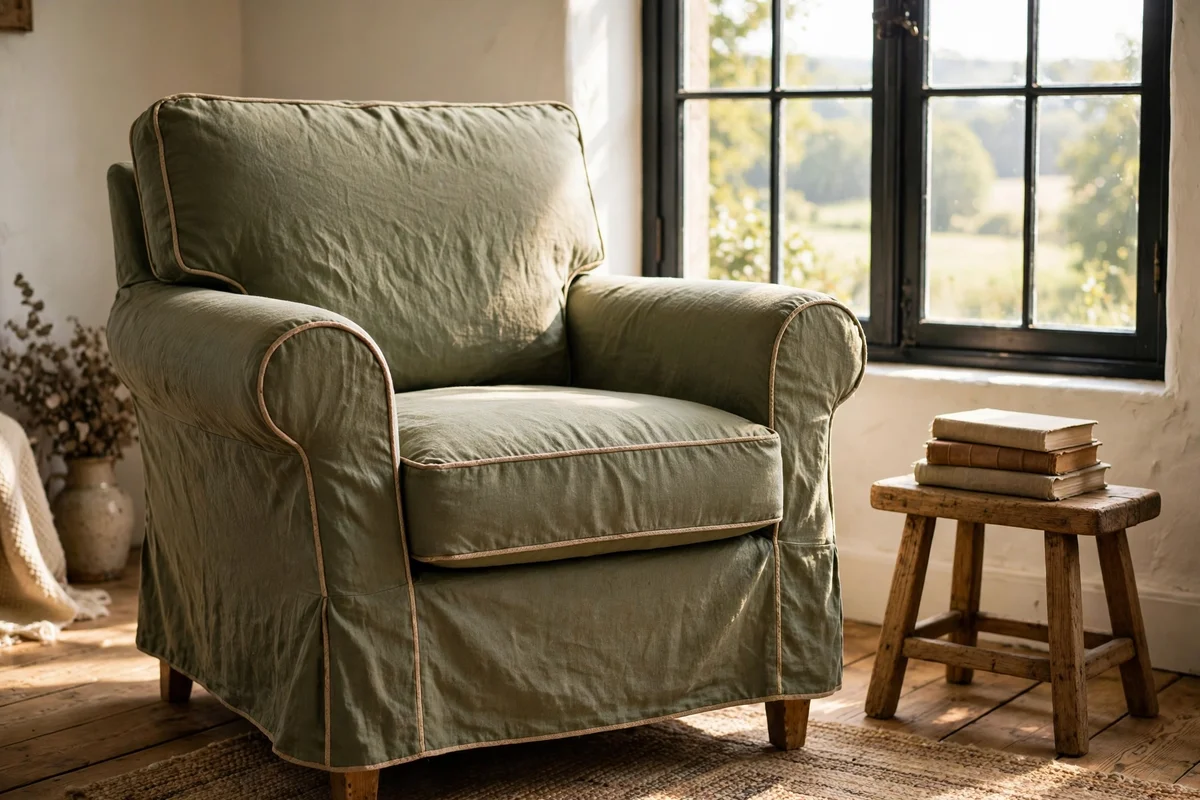
A slipcovered armchair in olive linen brings a relaxed, country-house ease that tailored upholstery cannot. Choose a simple armchair with clean lines and have a slipcover made in a medium-weight washed olive linen, finished with contrast piping in natural flax along the seams. The piping defines the shape and stops the loose cover from looking shapeless, while the linen wrinkles gracefully with use.
Made-to-measure slipcovers cost 150 to 350 pounds or dollars depending on the chair; the huge advantage is washability, since the cover comes off for a cool machine wash. Tuck the skirt neatly each week to keep the lines crisp. The mistake to avoid is a dark olive linen on a chair that sits in strong sun; linen fades faster than velvet, so keep this chair a metre or two from the brightest window.
16. Echo Olive Walls With Bay Trees and Trailing Ferns in Clay Pots
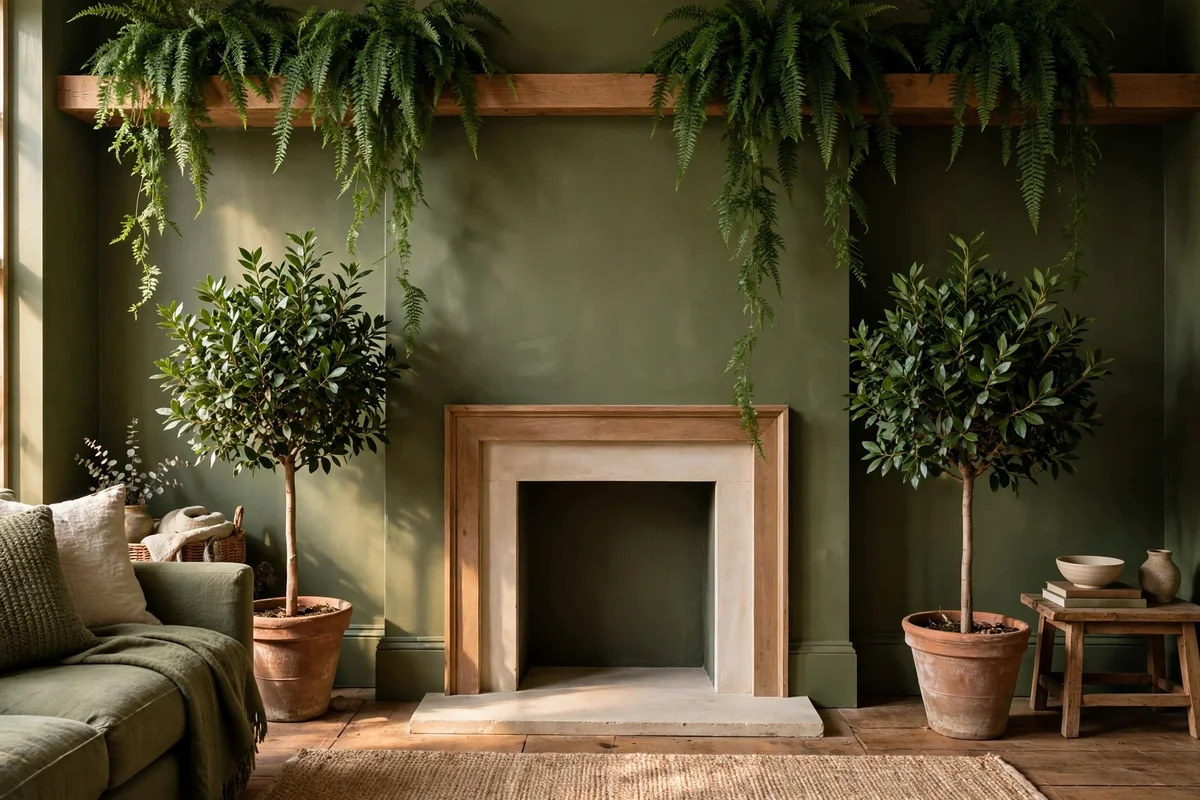
Living plants are the finishing touch that makes olive walls feel intentional rather than painted on. A pair of standard bay trees in terracotta pots, 60 to 90 cm tall, flanks a fireplace or window beautifully, while trailing ferns on high shelves soften the top of the room. The real greens of the leaves sit in perfect harmony with the painted olive, because one echoes the other.
Bay trees cost 25 to 60 pounds or dollars each depending on height; water when the top 3 cm of compost feels dry and feed monthly in spring and summer. Ferns like humidity, so mist them twice a week. The mistake to avoid is plastic plants; their flat, unvarying green sits dead against real olive paint, while living leaves bring the movement and subtle colour shifts the room needs.
17. Choose Mid-Tone Oak Floorboards That Flatter Olive Green
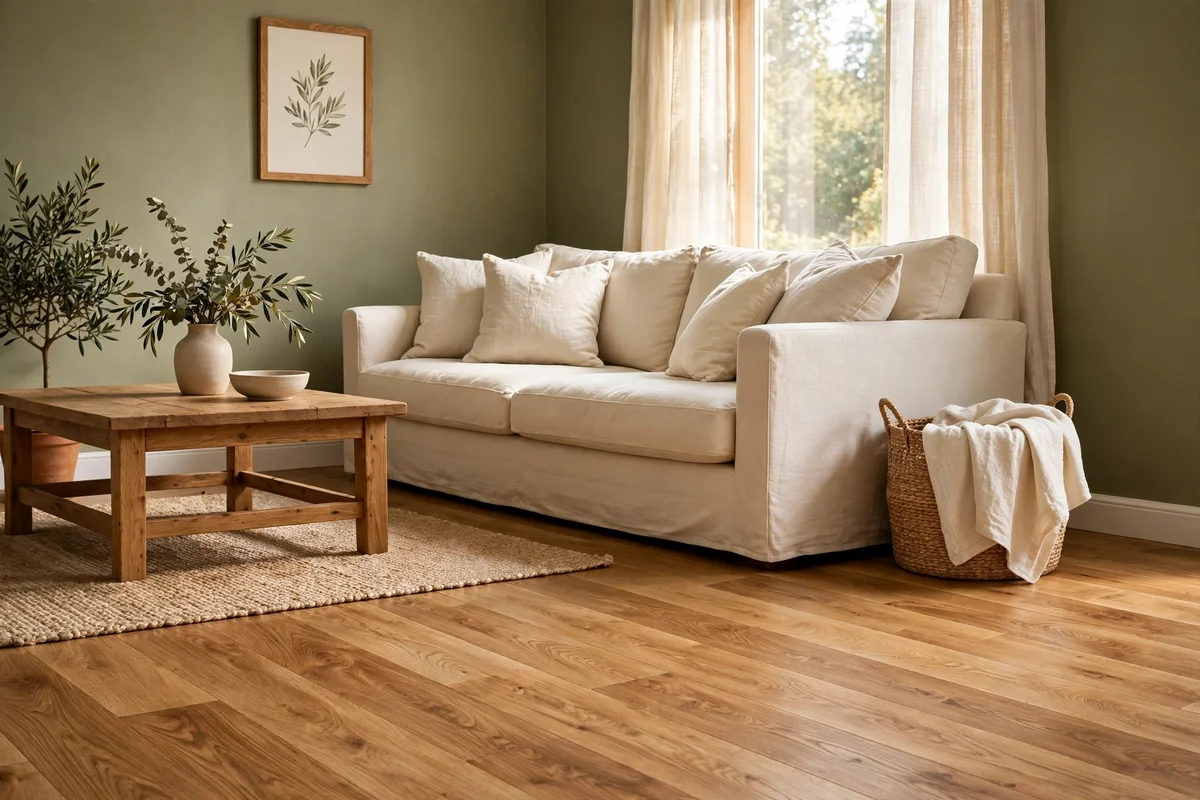
Floorboards set the undertone of the whole room, so choose a mid-tone oak with a natural, neither orange nor grey, finish. The honeyed wood sits between olive walls and cream textiles like a bridge, warming the green without competing with it. If you are laying engineered oak, a brushed and matte-lacquered board hides dust and shows the grain honestly.
Engineered oak costs 40 to 80 pounds or dollars per square metre fitted; a typical living room needs 20 to 25 square metres. Sweep weekly with a soft brush and mop monthly with a barely damp mop and wood-safe cleaner. The mistake to avoid is a grey-washed oak with olive; the cool grey fights the warm green and the floor looks perpetually dusty instead of calm.
18. Lay a Cream and Olive Patterned Rug to Zone the Seating Area
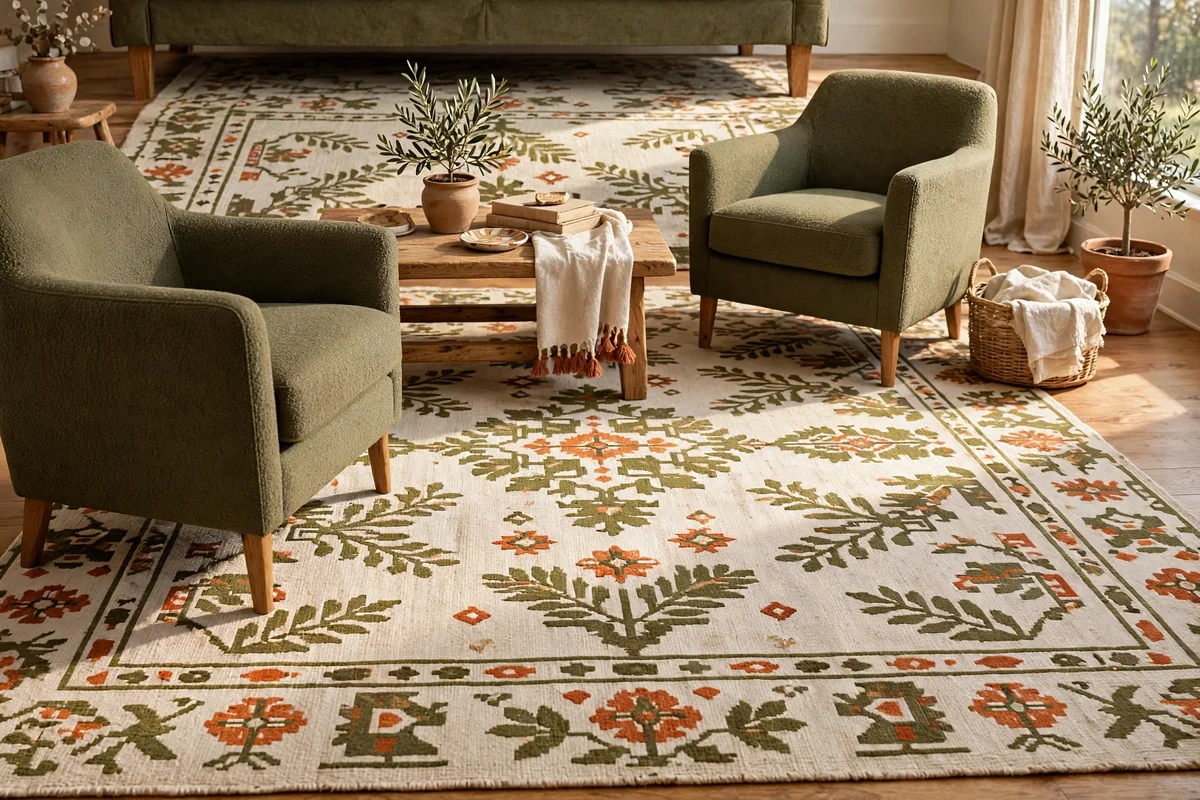
A patterned rug in cream and olive does two jobs: it zones the seating area and it ties the wall colour to the floor. Look for a flatweave or low-pile design with a cream ground and olive motifs, perhaps with touches of terracotta or faded rust. Size it generously at 200 by 290 cm so the front legs of the sofa and both armchairs rest on the rug.
Flatweave rugs in this palette cost 120 to 300 pounds or dollars for the large size. Vacuum weekly on both sides twice a year to stop grit wearing the backing. The mistake to avoid is a rug that stops short of the chairs; a too-small rug chops the seating group into islands, while one big enough to hold every front leg makes the arrangement feel settled and generous.
19. Paint an Interior Door in Olive to Link Hallway and Sitting Room
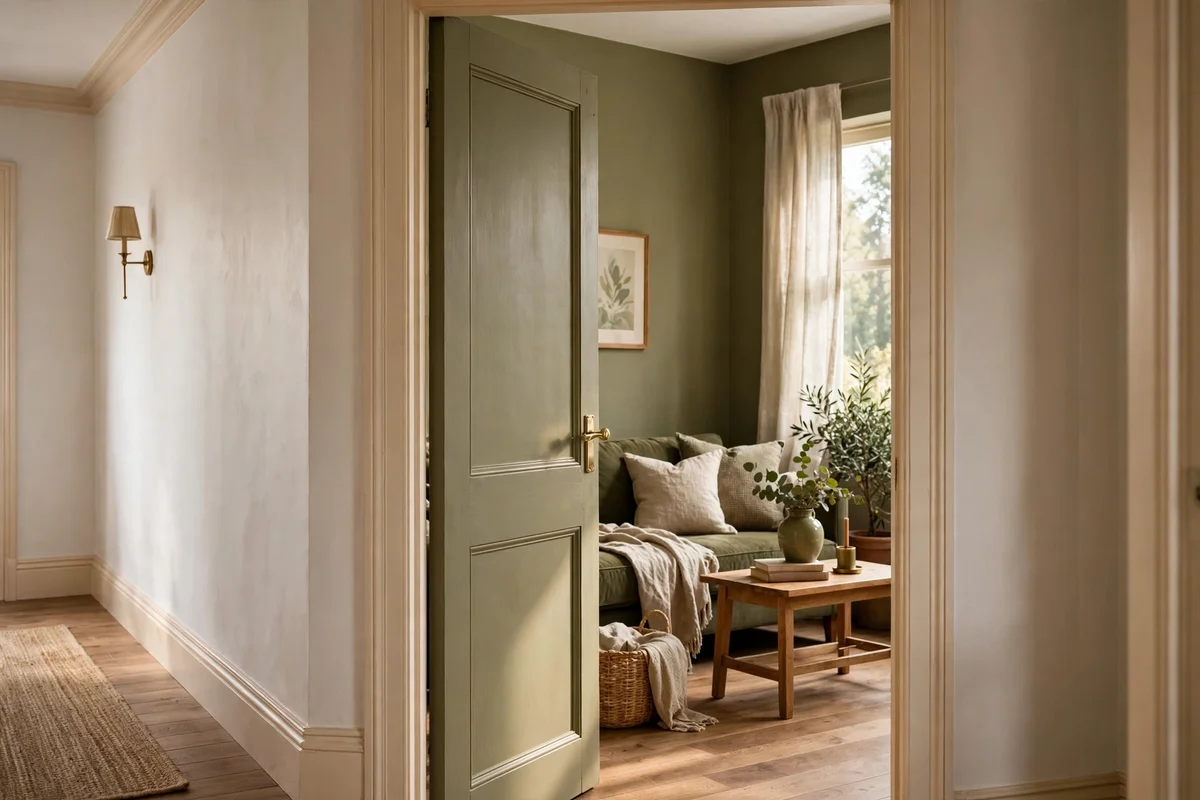
An olive interior door is a small commitment with an outsized effect: it carries the colour from the sitting room into the hallway and makes the two spaces feel like one considered home. Paint both faces in the same muted olive as the room, using eggshell for a wipeable finish, and keep the frame in warm white so the green panel stands proud.
One litre of eggshell covers a standard door with two coats and costs 15 to 30 pounds or dollars. Remove the handle and number plate before painting, and paint early in the day so the door can dry with the room ventilated. The mistake to avoid is painting only one face; a half-painted door looks unfinished from the hallway and breaks the flow you painted it to create.
20. Style an Olive Ottoman as a Footrest and Extra Seat by the Fire
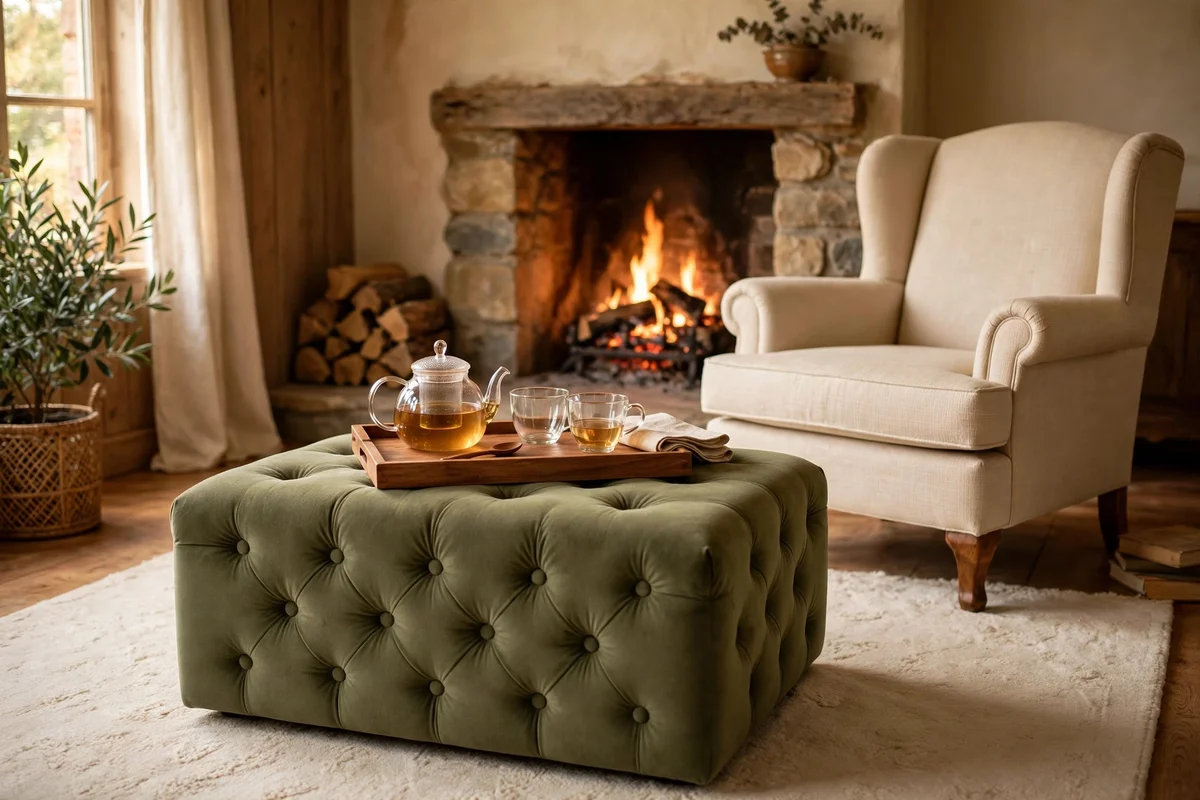
A buttoned olive ottoman, roughly 90 by 60 cm and 40 cm high, works as a footrest, an extra seat and a surface for a tray of tea things. Place it 30 to 40 cm from the main chair so feet reach it comfortably, and choose a wipeable cotton velvet or a sturdy linen that forgives spills. A hinged lid adds hidden storage for throws and magazines, which keeps the room tidy.
Storage ottomans in olive fabrics cost 120 to 280 pounds or dollars. Check the lid mechanism closes softly and the base sits level before you buy. The mistake to avoid is an ottoman that is too tall; anything above 45 cm forces knees up and turns a footrest into an obstacle, so measure your chair’s seat height and match it within 5 cm.
21. Hang Framed Botanical Prints With Olive Mats Above the Sofa
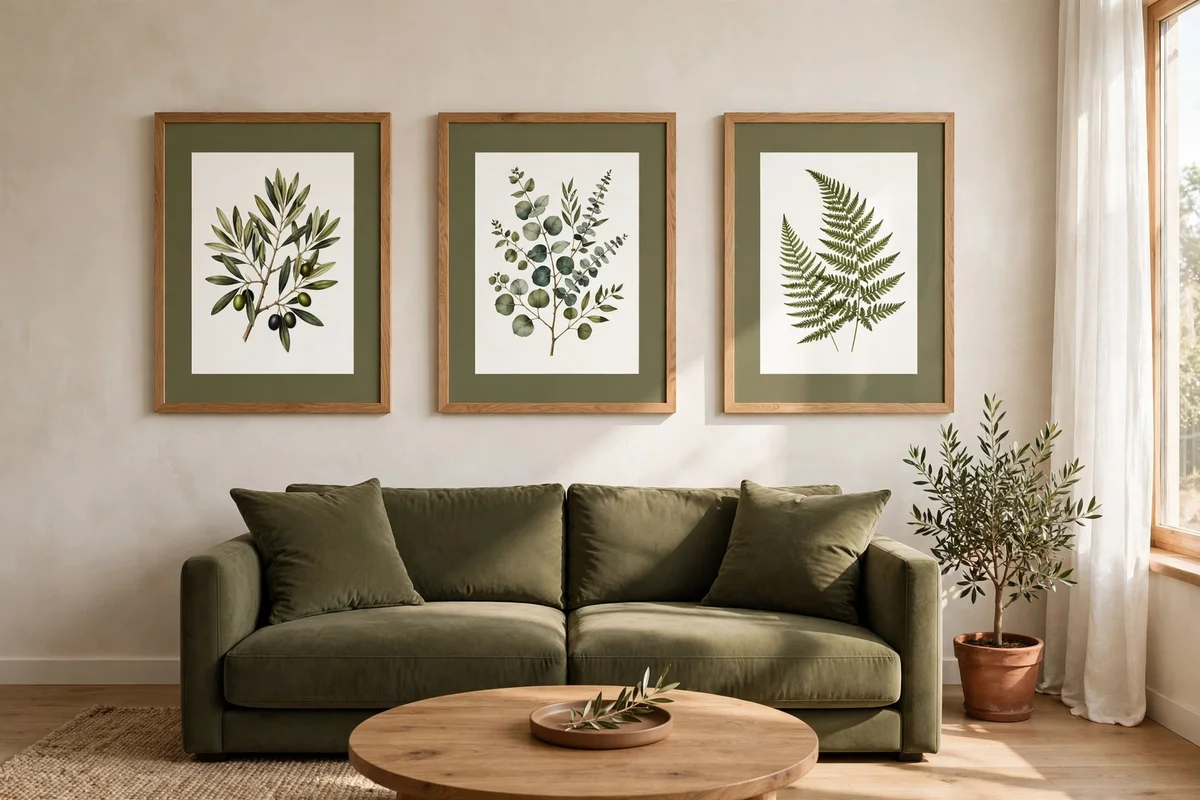
Botanical prints with olive mounts turn a plain wall into a quiet gallery and repeat the room’s green at eye level. Choose three prints in simple oak or black frames, each about 30 by 40 cm, and hang them in a row with 8 to 10 cm between frames, centred 145 to 155 cm from the floor. The olive mats bridge the artwork and the walls so the whole arrangement feels designed, not random.
Unframed botanical prints cost 10 to 25 pounds or dollars each; simple frames add 15 to 30. Use two picture hooks per frame for anything over 40 cm wide so it hangs level. The mistake to avoid is hanging the row too high; art that floats near the ceiling disconnects from the sofa, so keep the bottom of the frames 20 to 25 cm above the sofa back.
22. Fit Olive Lampshades on Brass Bases for Evening Glow
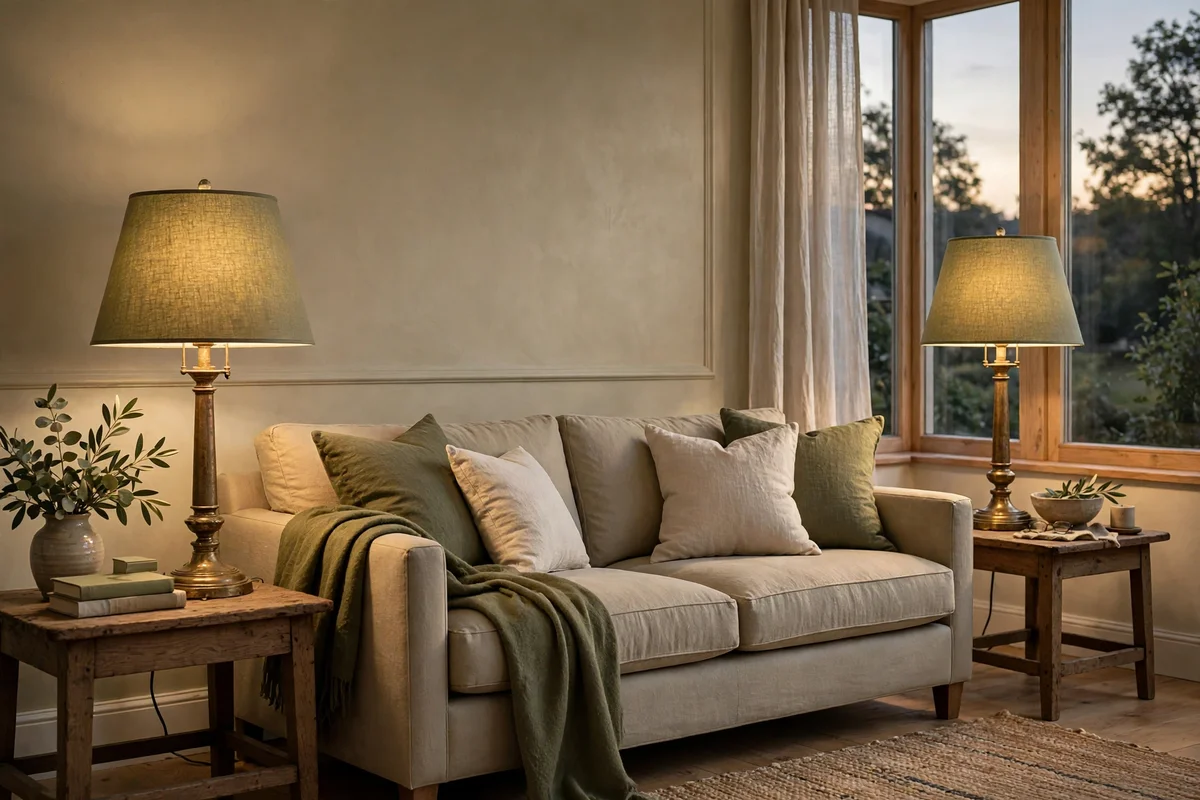
Olive lampshades on aged brass bases bring the colour to lamplight height, where it glows rather than shouts. Choose tapered drum shades in olive linen or cotton, 30 to 35 cm across the bottom, fitted to brass table lamps on either side of the sofa. The green shade warms the light pooling beneath it, tinting the nearby wall in the gentlest olive haze.
Olive shades cost 25 to 50 pounds or dollars each; check the fitting, ES or BC, matches your lamp holder before ordering. Use warm 2700K bulbs of 6 to 9 watts so the shade glows without overheating. The mistake to avoid is an opaque dark shade on a dim lamp; the combination gives almost no light, so keep the fabric light enough to pass a soft glow.
Olive green earns its place the way all true neutrals do: by making everything around it look better. Whether you paint four walls in a soft mid-tone, choose one olive sofa as the anchor, or simply add a pair of velvet cushions and a linen throw, the colour rewards restraint. Start with the version that matches your courage, live with it for a fortnight, and let the room tell you what comes next.
If you try one thing this week, drape an olive throw or set two olive cushions on the seating you already own. It costs little, takes five minutes, and shows you immediately how the green behaves in your light from morning to evening. From that small honest test, every bigger decision about walls, sofas and rugs becomes much easier to make.
Frequently Asked Questions
Does olive green work in a north-facing living room?
Yes, and it is one of the most forgiving colours for cooler northern light. Choose a soft mid-tone olive with warm undertones rather than a grey or sage-leaning shade, and pair it with warm white woodwork and cream textiles to keep the room from feeling flat. Test a large painted sample board on each wall and look at it in morning and evening light before committing.
What colours go best with an olive green sofa?
Cream, warm white and natural linen keep it calm; walnut and pale oak add heritage warmth; aged brass brings a quiet glow. For contrast, terracotta cushions or a fired-clay throw add earthy energy, while blush pink softens the green beautifully. Avoid pairing olive with cold greys or stark white, which can make it look muddy instead of rich.
Is olive green a good wall colour for a small living room?
It can be, provided you choose wisely. A soft, warm mid-tone olive wraps a small room in calm without shrinking it, especially with warm white ceilings and a large cream rug to lift the floor. Keep curtains light, mirror one wall if you can, and avoid very deep olive on all four walls, which suits larger rooms better.
How can I try olive green without repainting?
Start with textiles: two olive velvet or linen cushions, a folded throw and floor-length curtains change a room dramatically and all come with you when you move. An olive painted bookcase or a large framed botanical print with olive mats adds the colour at furniture level. Plants with deep green leaves, like bay or ferns in terracotta pots, echo the tone for almost no cost.
What rug colours work with olive green walls?
Cream and warm white rugs lift olive walls and keep the floor feeling light; a natural jute or sisal rug adds texture and suits the earthy mood. For pattern, choose a rug with cream grounds and olive, terracotta or faded rust motifs, which ties walls to floor. Size generously: the front legs of the sofa and chairs should all sit on the rug, ideally a 200 by 290 cm piece.