Living Room
22 Rustic Modern Living Room Ideas That Blend Old Timber With Clean Lines
By Anna Wells · · 22 min read
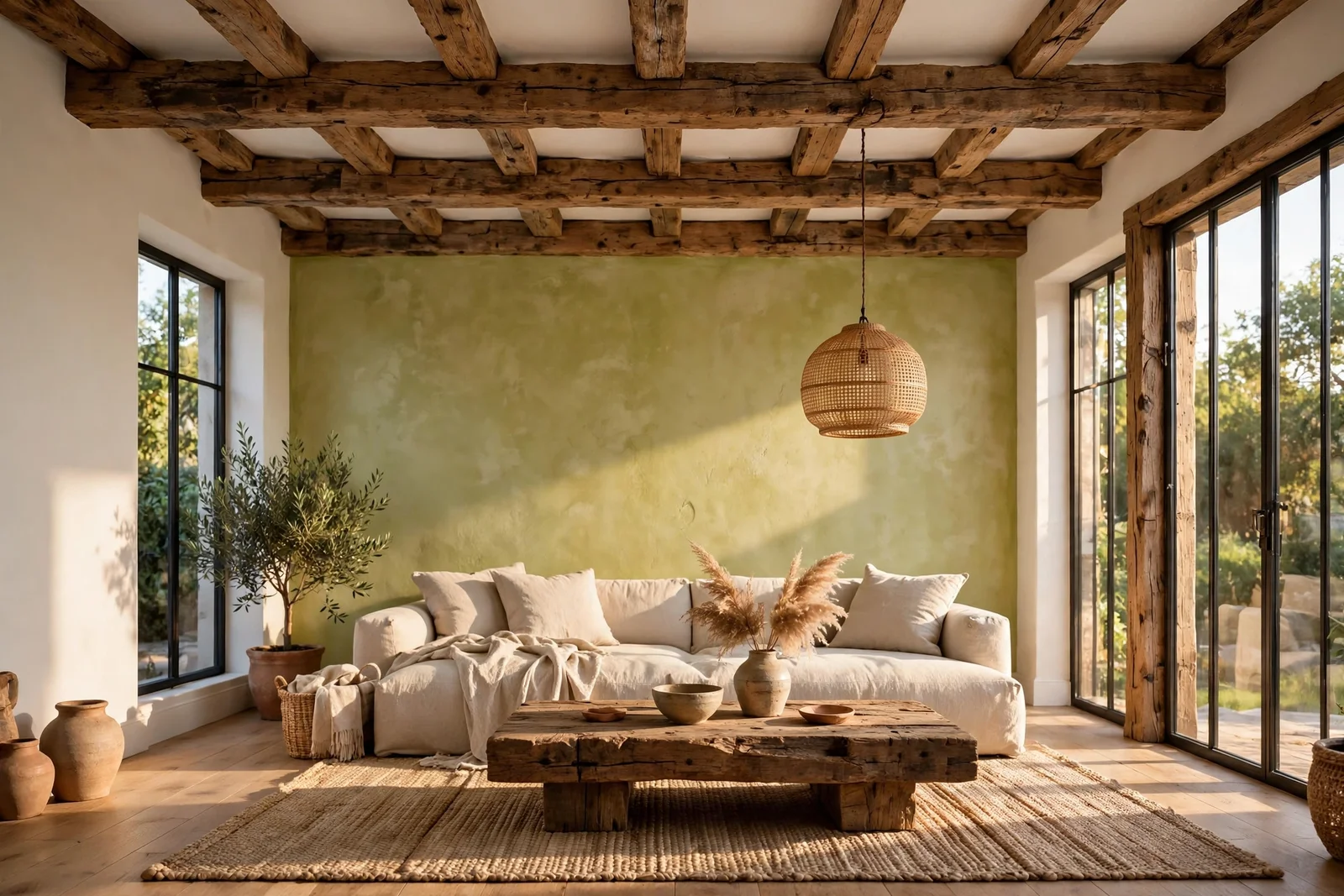
Reclaimed timber and clean modern lines can share one room beautifully. These 22 ideas show the balance, the simple 70/30 ratio rule, and a fully costed example room.
Late afternoon light falls across a rough-sawn oak beam, and below it a plain linen sofa sits low and quiet against a limewashed wall. That contrast is the whole promise of rustic modern style: old timber bringing history and warmth, clean lines keeping the room calm and easy to live in. Nothing competes. The beam tells a story, and the sofa lets the eye rest.
This look suits family rooms because it forgives daily life. Timber hides scuffs, woven wool softens noise, and a neutral palette of warm white, clay and soft charcoal never shouts. The danger is tipping too far, into a themed cabin or a cold showroom. These 22 ideas hold the middle ground, with exact placements, sizes and budgets, plus the simple 70/30 ratio rule that keeps everything in balance.
You will find reclaimed beam ideas, limewash and stone walls, modern lighting in honest materials, woven textiles, and black metal used with restraint. Every suggestion is original, practical and family friendly, built for real rooms where people gather, read and rest. Work through the list, then finish with a fully costed example room that shows the whole style for one honest price.
Start with the ceiling and work down. The first ideas set the structure, the middle ones fix the balance, and the later ones add the softness.
1. Float Reclaimed Timber Beams Across a Plain White Ceiling
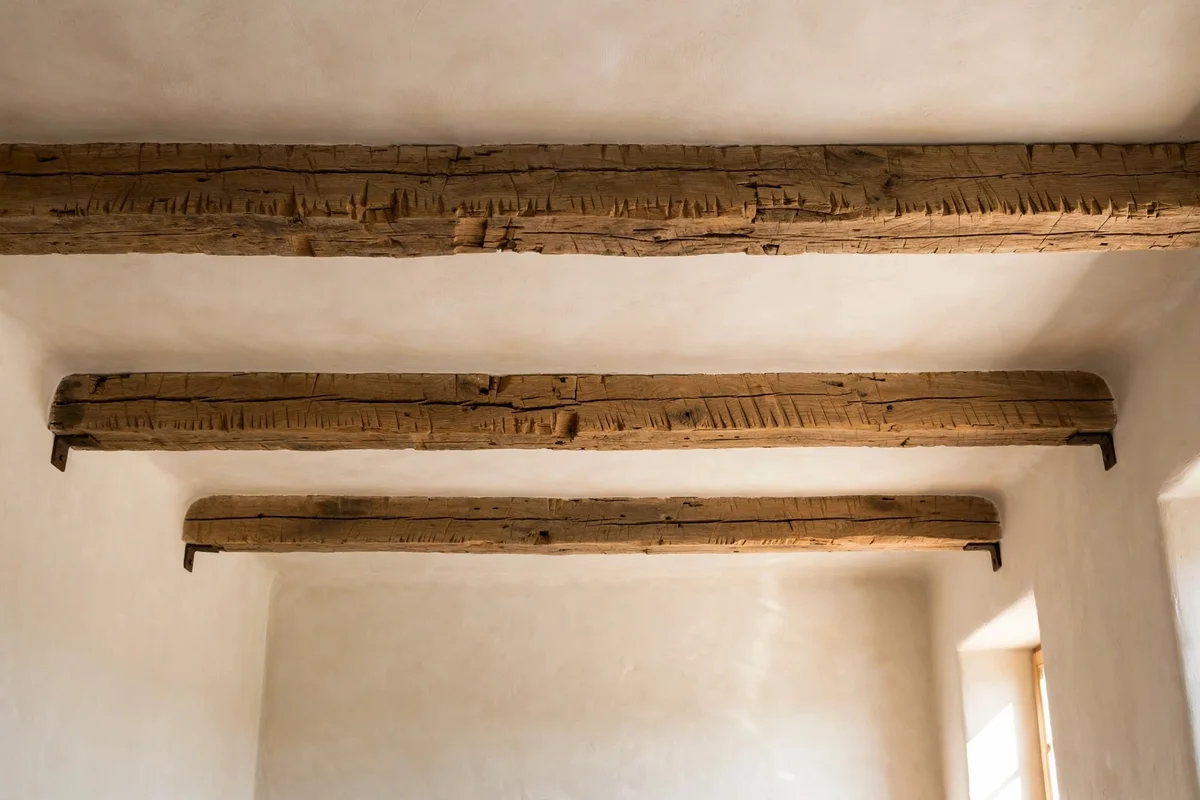
Start with three to five reclaimed beams, each 15 to 20 cm square, spanning the ceiling at 60 to 90 cm intervals. Reclaimed oak or pine carries saw marks and small cracks that new timber cannot fake, and 3 to 5 metre lengths suit most living rooms without a joint. Fix them with concealed steel brackets rated for at least 30 kg per beam, set into joists. Keep the ceiling itself warm white, so the beams read as sculpture against a calm field, not as a dark lid.
Budget one weekend for a confident DIY fit, or hire a carpenter for half a day; beams cost 40 to 120 per length depending on age and region, with brackets adding about 15 each. The mistake to avoid is boxing the beams in with heavy timber cornicing or a second wood wall, which tips the room into theme territory. Leave at least 2.4 metres of clear head height below the lowest beam, and pair beams with one modern pendant rather than rustic lanterns.
2. Anchor the Room With a Thick Reclaimed Wood Coffee Table
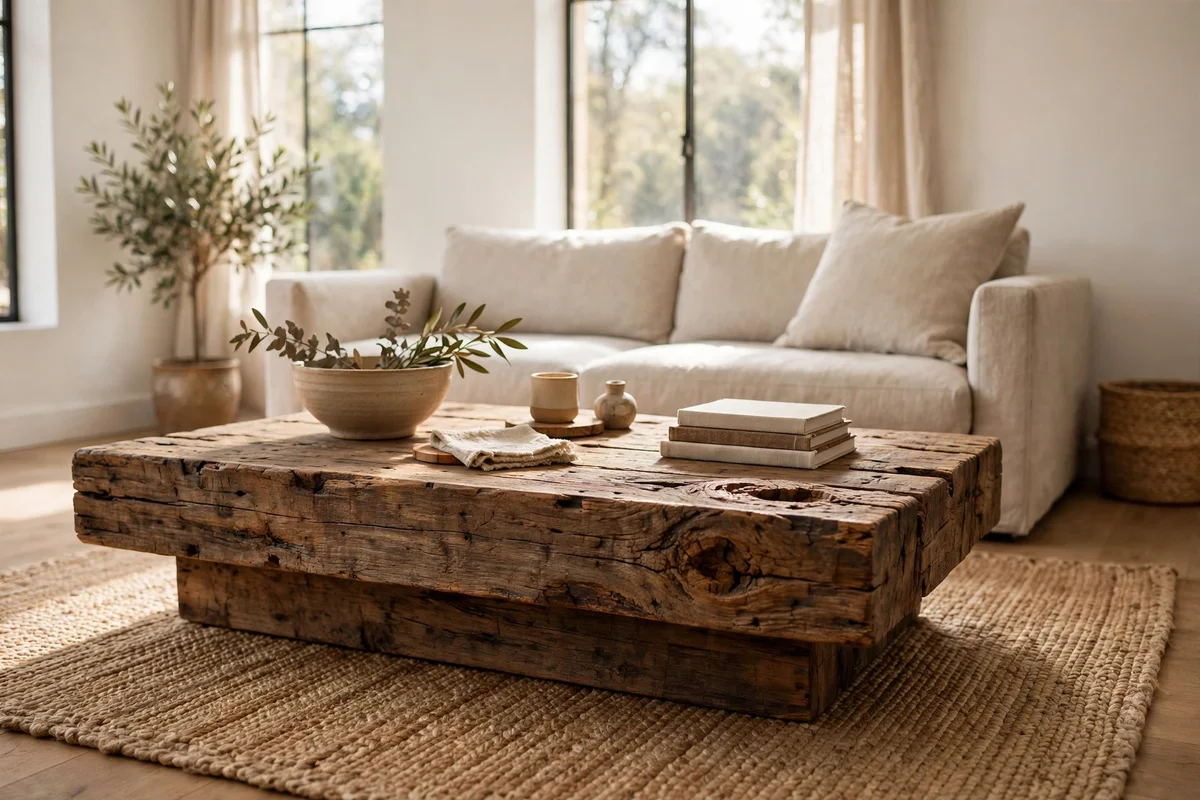
A coffee table 110 to 130 cm long, 55 to 65 cm deep and at least 5 cm thick gives the room its timber anchor without swallowing floor space. Reclaimed oak, elm or old floorboards finished with clear matte oil keep the surface honest and show grain, knots and nail shadows. Position it 40 to 45 cm from the sofa edge, the distance knees clear comfortably. Straight modern legs in black metal or a simple slab base keep the look current rather than farmhouse.
Expect 150 to 400 for a good reclaimed top on a simple base, or half that if you sand and oil a salvaged tabletop yourself. The mistake to avoid is matching the table to beams in the same wood tone; two slightly different aged timbers look collected, while an exact match looks like a set. Style the top with one stack of books, one ceramic bowl and clear space for cups. Keep coasters close, since oiled wood still marks under hot mugs.
3. Place a Simple Linen Sofa Against a Limewashed Wall
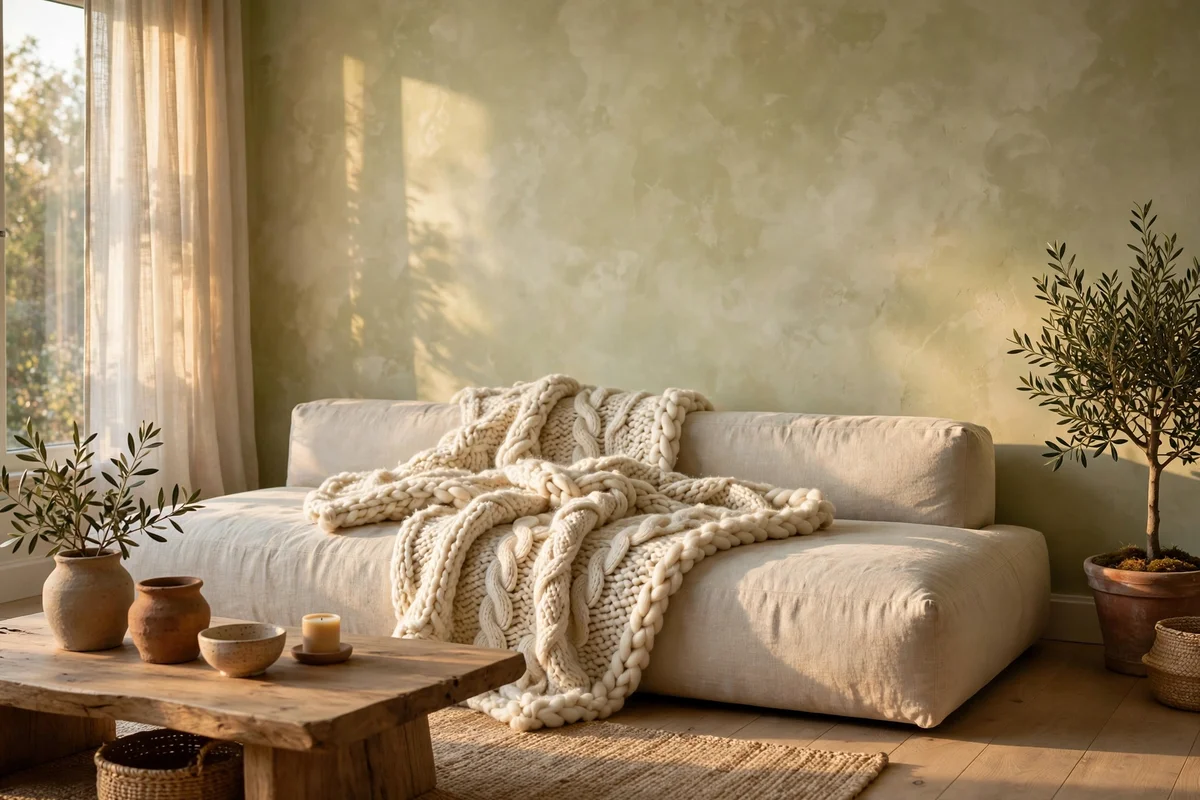
A low, straight-lined sofa in stonewashed linen, 200 to 230 cm for a three-seater, gives the room its modern half. Linen in warm white, oatmeal or soft clay shrugs off daily use and washes well, which suits family rooms better than pale velvet. Set it 10 to 15 cm from a limewashed wall so air moves behind the cushions and the texture stays visible. Choose blocky track arms or a clean bench seat rather than rolled arms, which pull the room toward traditional.
Limewash paint costs little more than standard emulsion, about 60 to 90 for a feature wall including the specialist brush, and one coat usually covers in the clouded, soft way that defines the finish. The mistake to avoid is sealing the wall with glossy varnish, which kills the chalky depth limewash is chosen for. Style the sofa with two plain cushions and one woven throw only; a limewashed wall needs breathing room, not a gallery of frames.
4. Let One Charcoal Wall Anchor the Room’s Dark Side
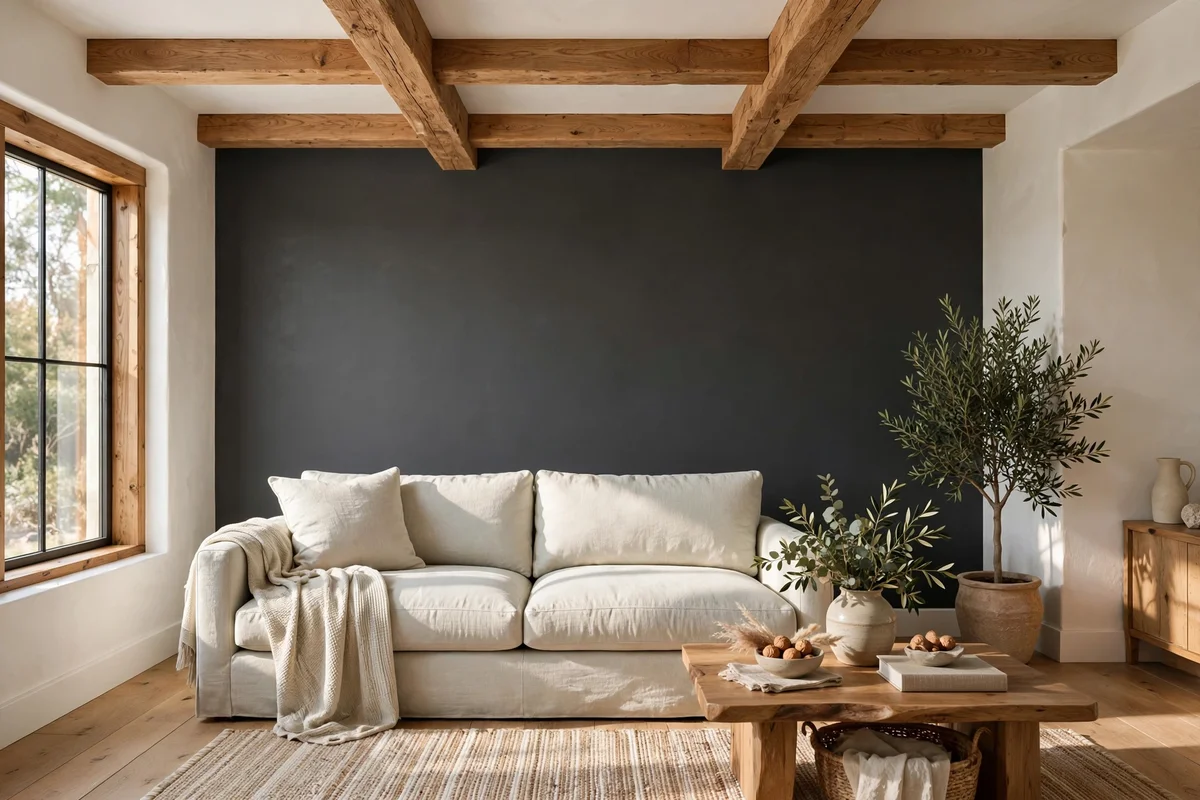
One wall in soft charcoal, ideally the wall behind the television or the longest seating wall, stops the neutral palette drifting into blandness. Charcoal with a warm undertone, not blue-black, sits happily beside oak beams and clay textiles. Paint it in matte finish so the colour absorbs light like fabric rather than reflecting it. Keep skirting boards and the ceiling warm white; the dark wall should be a single framed gesture, with clean edges masked with tape for a sharp line.
A single wall takes about 5 litres of paint and one afternoon, roughly 40 to 70 for quality matte paint. The mistake to avoid is repeating charcoal on a second wall or in heavy furniture; one dark gesture is sophistication, two is a cave. Let the charcoal wall carry the black metal elements, a slim shelf or a picture light, so the room’s small dark accents gather there instead of scattering.
5. Rest a Live-Edge Timber Bench Beside a Modern Sofa
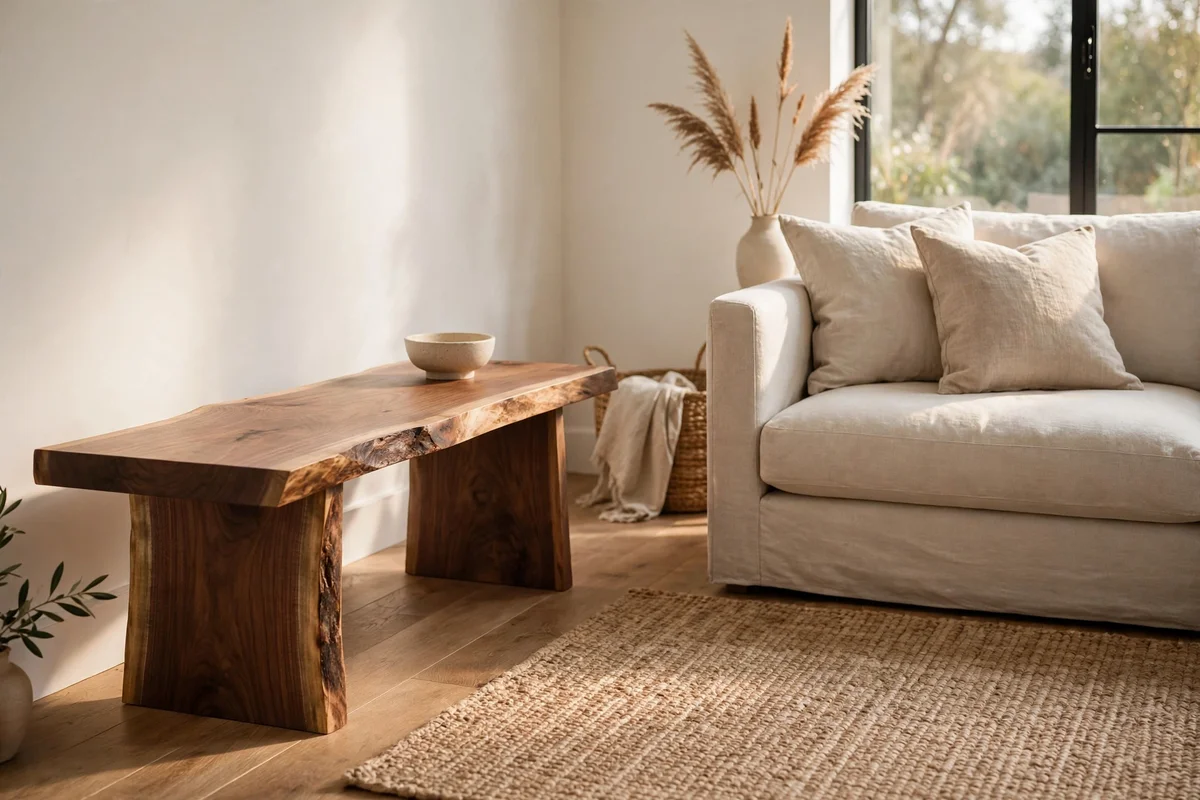
A live-edge bench, 120 to 150 cm long and about 40 cm deep, set perpendicular to the sofa or along a bare wall, adds rustic timber at sitting height. The natural edge keeps the wood’s story visible while the straight modern sofa nearby keeps it intentional. Choose a slab 4 to 6 cm thick in walnut, oak or acacia, sanded smooth on top and sealed with matte hardwax oil so cups and books slide safely. One bench replaces two side tables and offers extra seats when family visits.
Prices run 120 to 350 for the slab plus simple black metal legs, or under 80 if you find a local sawmill offcut. The mistake to avoid is pairing the bench with a second live-edge piece nearby; one natural edge is a statement, two compete. Dress it with a single folded wool runner or leave it bare, and keep the floor beneath clear so its silhouette stays visible from the doorway.
6. Wash Walls Warm White and Save Clay for Textiles
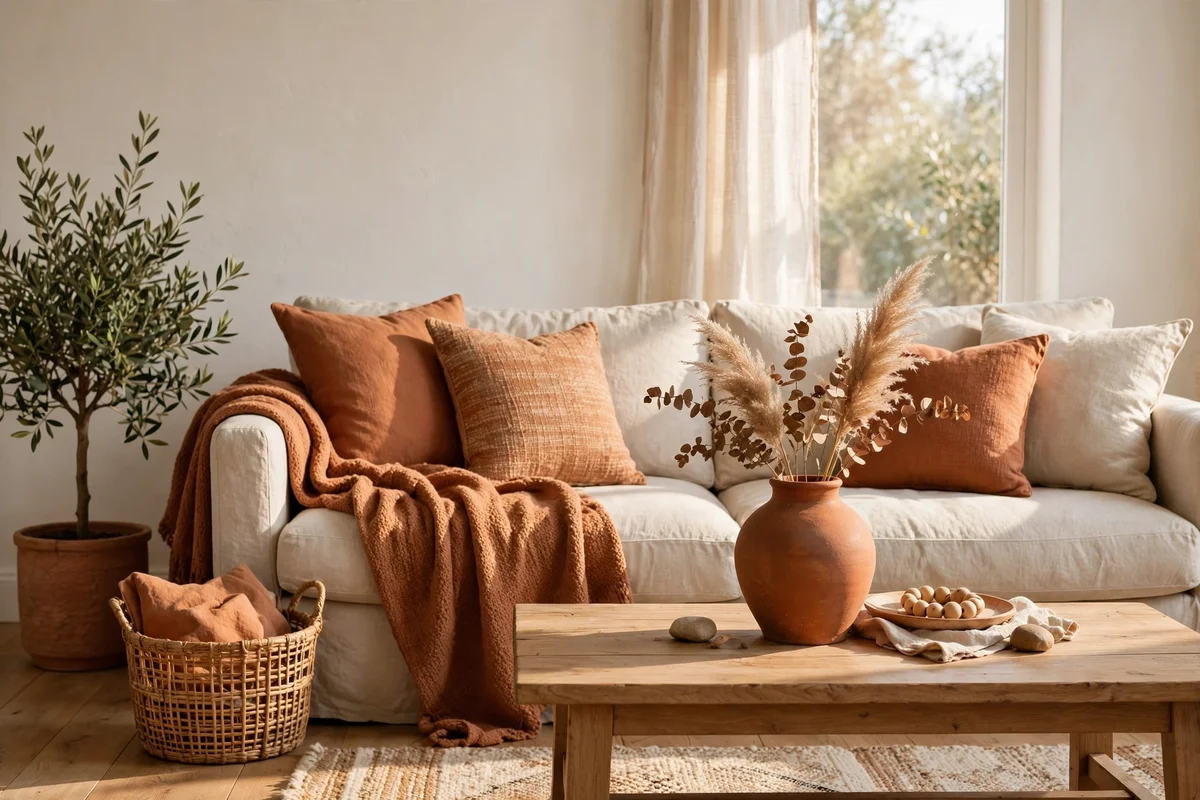
Warm white walls, think shades like soft chalk, warm bone or pale plaster, bounce light around the room without the cold edge of brilliant white. They let reclaimed timber look golden rather than grey, which is the whole point of the pairing. Reserve clay tones, terracotta, burnt sienna, muted rust, for textiles and ceramics: two cushions, one throw, one vase. That keeps the colour movable, so a seasonal refresh costs the price of a cushion cover rather than a paint job.
Painting a living room warm white takes 10 to 15 litres and a weekend, about 60 to 120 for good paint. The mistake to avoid is choosing a cool grey-white under warm oak beams; the clash makes timber look dirty instead of rich. Test three swatches on the wall beside your largest timber piece and check them at midday and lamplight before committing. Clay cushions in washable cotton cost 15 to 30 each and carry the whole colour story.
7. Mount Slim Black Metal Shelves on One Wall Only
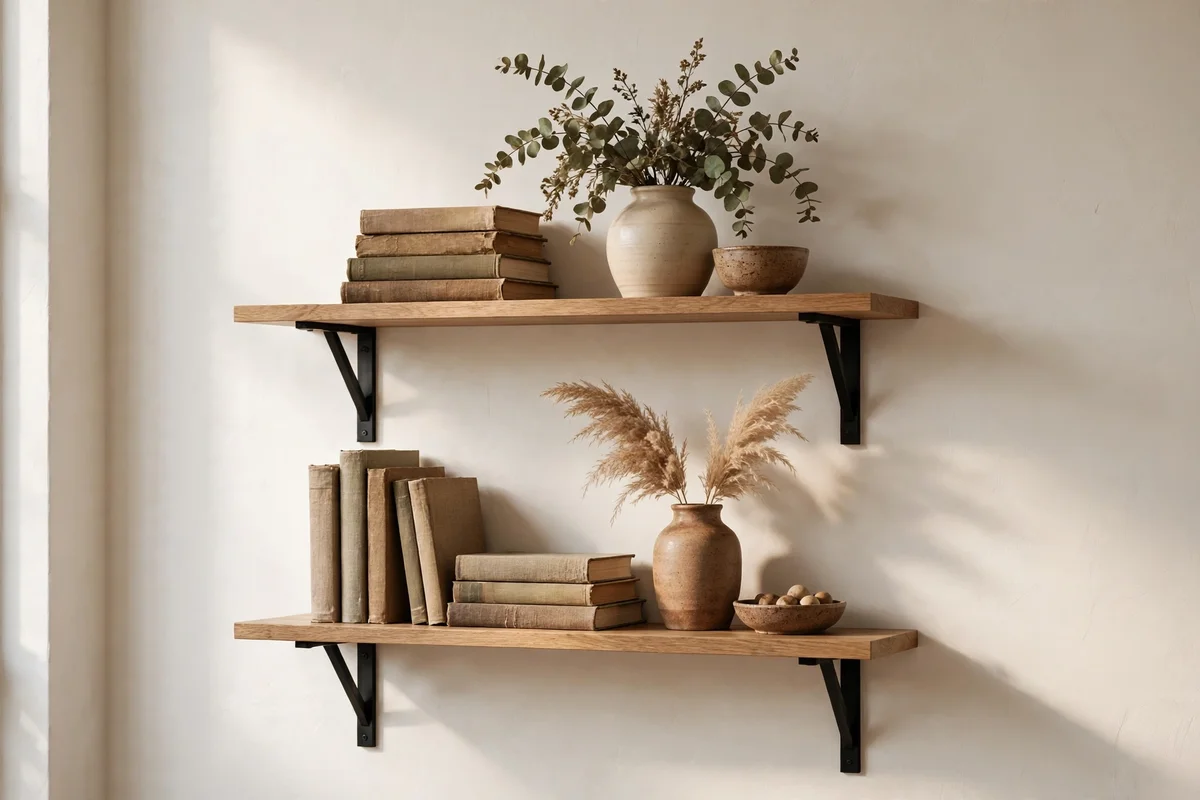
Two or three slim shelves with black metal brackets, each 60 to 90 cm long and 20 cm deep, give the room its industrial note without stealing the show. Mount them on one wall only, ideally beside a window or over a console, spaced 35 to 40 cm apart so books and vases sit comfortably. Black metal should account for a small fraction of the room’s surfaces; brackets, a lamp stem and a frame or two are enough. Powder-coated steel suits the palette better than chrome.
Three brackets and two oak boards cost 50 to 110, or under 30 if you cut the boards from a salvaged plank. The mistake to avoid is running black metal shelving across two walls or pairing it with a black metal coffee table, media unit and lamp; the room turns industrial rather than rustic modern. Style each shelf with books grouped upright, one ceramic vase and breathing space. Dust brackets monthly, since dark metal shows dust fast.
8. Soften Hard Edges With Woven Jute and Chunky Wool
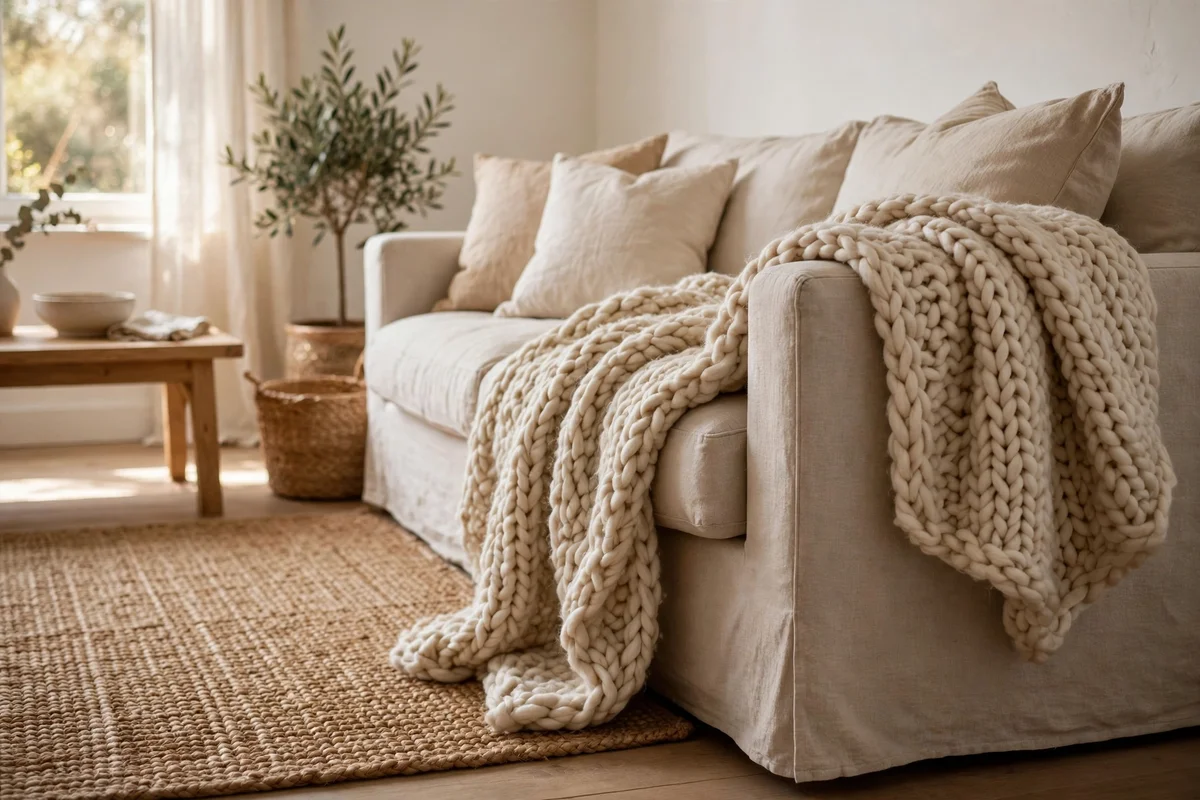
Woven textiles are the softness layer that keeps timber and stone from feeling hard. Lay a jute rug 160 by 230 cm under the seating group, its weave adding texture underfoot at a budget price. Drape a chunky wool throw, at least 130 by 180 cm, over one sofa arm, and add two cushions in woven cotton or linen with visible texture. Jute and wool both age gracefully, and their natural variation hides the small marks family life leaves behind.
A 160 by 230 cm jute rug costs 80 to 180, a chunky wool throw 40 to 90, and woven cushions 20 to 35 each. The mistake to avoid is mixing too many weaves; jute, wool and one cotton texture are plenty, and adding seagrass, sisal and macrame turns texture into clutter. Vacuum jute weekly without the beater bar, and air wool throws outside twice a year to keep them fresh without washing.
9. Hang a Sculptural Pendant in Oak, Paper or Woven Cane
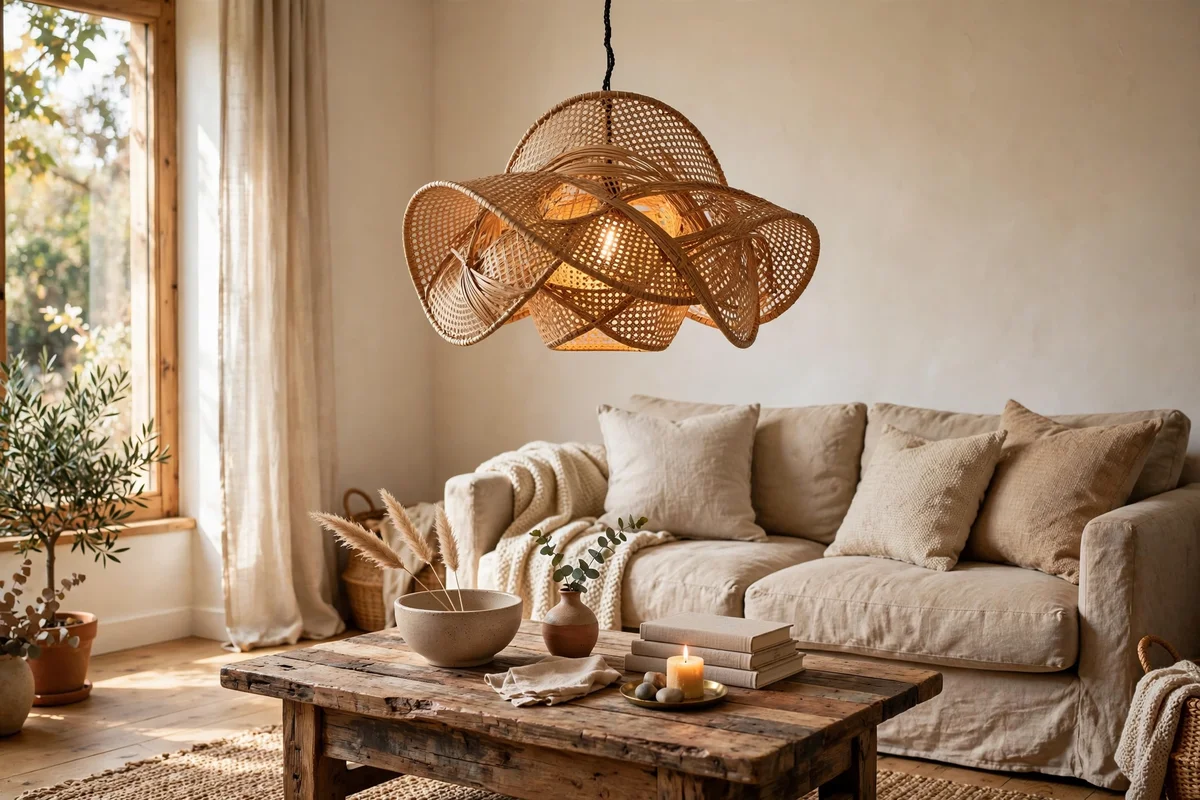
Lighting in honest materials, bent oak, rice paper, woven cane, bridges the rustic and modern halves of the room. Hang one pendant 75 to 90 cm above the coffee table, or 35 to 40 cm above a side table if it lights a reading spot. Choose a shape with clean geometry, a dome, a cone or a drum, in a material with visible craft. Fit a warm 2700K dimmable bulb; cool daylight bulbs flatten timber grain and make linen look grey.
Paper and cane pendants run 30 to 90, oak and turned-wood designs 80 to 200. The mistake to avoid is hanging three small pendants where one confident piece belongs; rustic modern favours one strong shape over a scattered cluster. If the ceiling has beams, centre the pendant between two beams rather than piercing one, and use a fabric-wrapped cord in black or natural linen.
10. Work the Seventy Thirty Rule: Clean Lines First, Timber Second
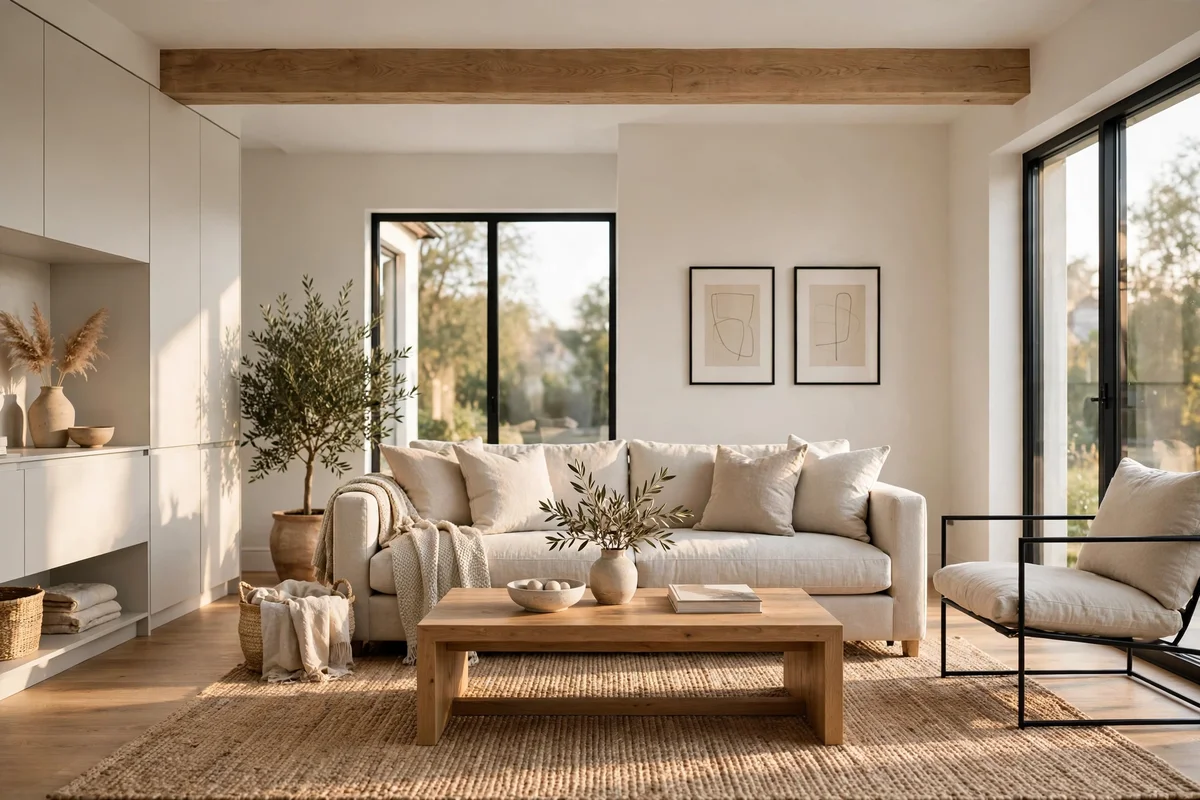
The ratio that keeps the room modern is roughly seventy percent clean and thirty percent rustic. Count it simply: sofa, walls, rug, lighting and most storage stay plain and modern, while beams, one timber table, a bench and woven textiles supply the rustic share. When you add a new piece, ask which side of the balance it joins. If the rustic side is already full, choose the modern version. This audit takes ten minutes and prevents the slow drift toward theme.
Photograph the room and count the rustic pieces in the image; cameras are more honest than memory. The mistake to avoid is letting the rustic side creep past half through small additions, a timber clock here, a crate there, until the modern base disappears. If you inherit or love many rustic pieces, raise the modern share with plain slipcovers, minimal frames and clear surfaces to restore the balance.
11. Cost One Complete Example Room From Floor to Ceiling
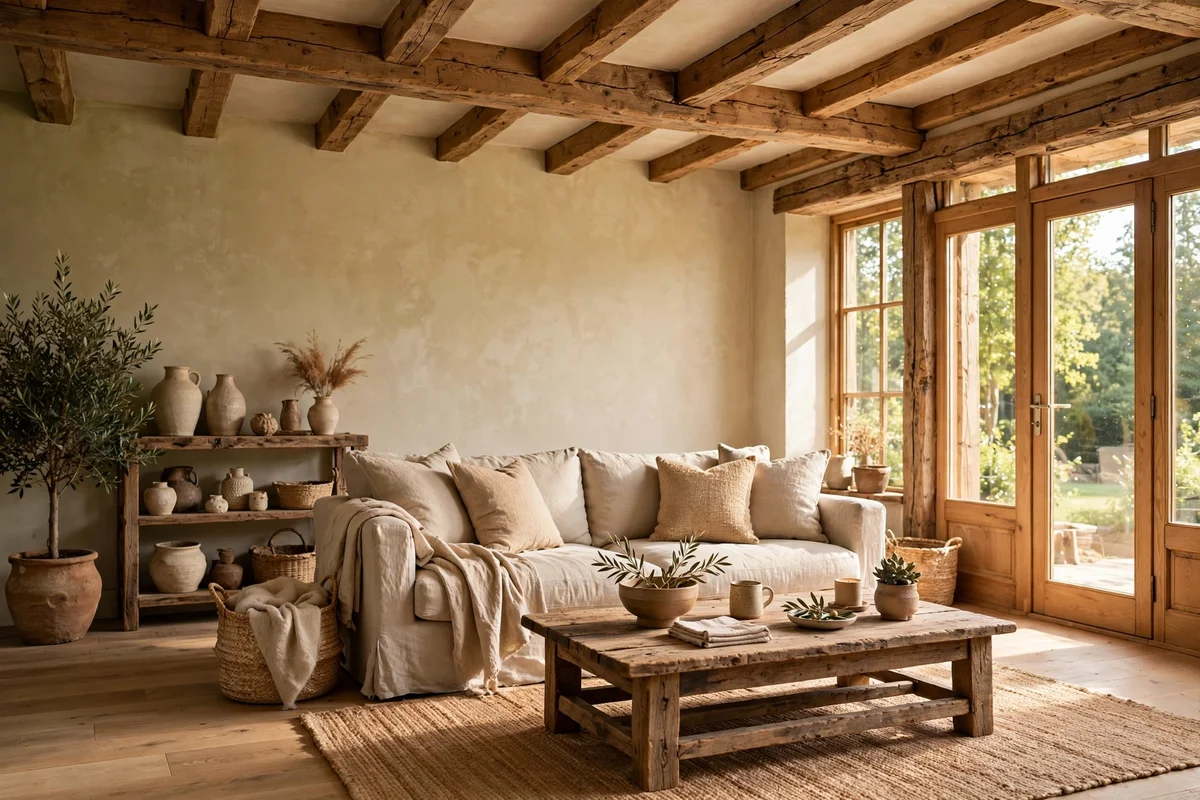
Here is a 4 by 5 metre living room costed in full. Four reclaimed oak beams at 80 each plus brackets totals 380. A three-seater linen sofa in warm white costs 700. A reclaimed coffee table 240, a live-edge bench 180, and a 160 by 230 cm jute rug 120. Limewash for the feature wall 75, warm white paint for the rest 90, one charcoal accent wall 55. That is the structure and the seating for 1,840.
Finishing layers add about 620 more: a cane pendant 70, a wool throw 60, four woven cushions at 25 each, three black metal shelf brackets with an oak board 85, a linen curtain pair 90, two woven baskets 45, and one large ceramic vase 70. The full room lands near 2,460, honest money for a room that looks settled from day one. The mistake to avoid is trimming the rug or the lighting first; cheap versions of those two pieces undo the whole room faster than any saving justifies.
12. Frame the Sofa With Two Low Timber Side Tables
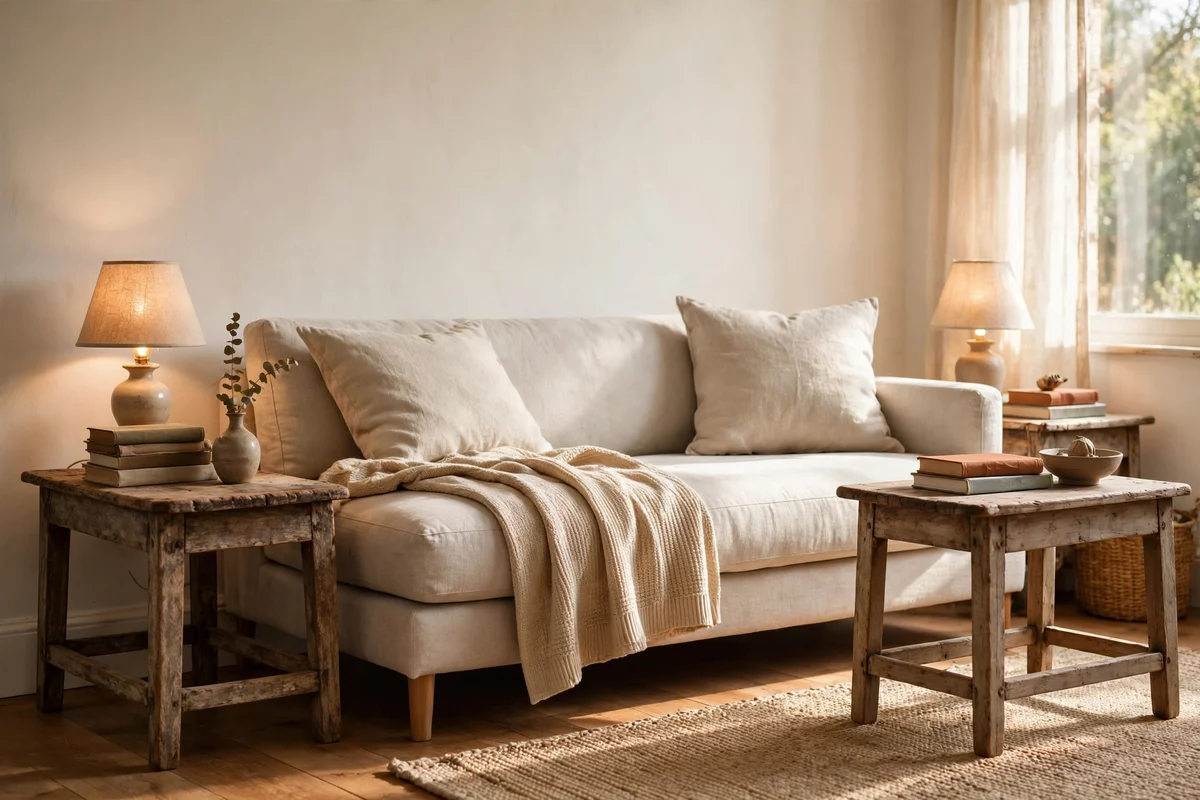
Two low side tables in aged timber, 40 to 50 cm square and 45 to 55 cm high, flank the sofa and repeat its timber story at a smaller scale. Keep tops clear enough for a lamp on one side and a small stack of books on the other; a table buried under objects reads as clutter, not craft. Choose a simple plank top on straight legs rather than turned or carved designs, so the tables echo the room’s clean lines. Match their tone loosely to the coffee table, not exactly.
Aged timber side tables cost 60 to 140 each, or under 40 as unfinished pine cubes you stain and oil yourself. The mistake to avoid is buying tables taller than the sofa arms; side tables should sit 2 to 5 cm below arm height so lamps and cups stay easy to reach. If floor space is tight, choose one table and a slim black metal floor lamp on the other side, which keeps the symmetry without the bulk.
13. Crown a Simple Shelf With One Aged Timber Slab
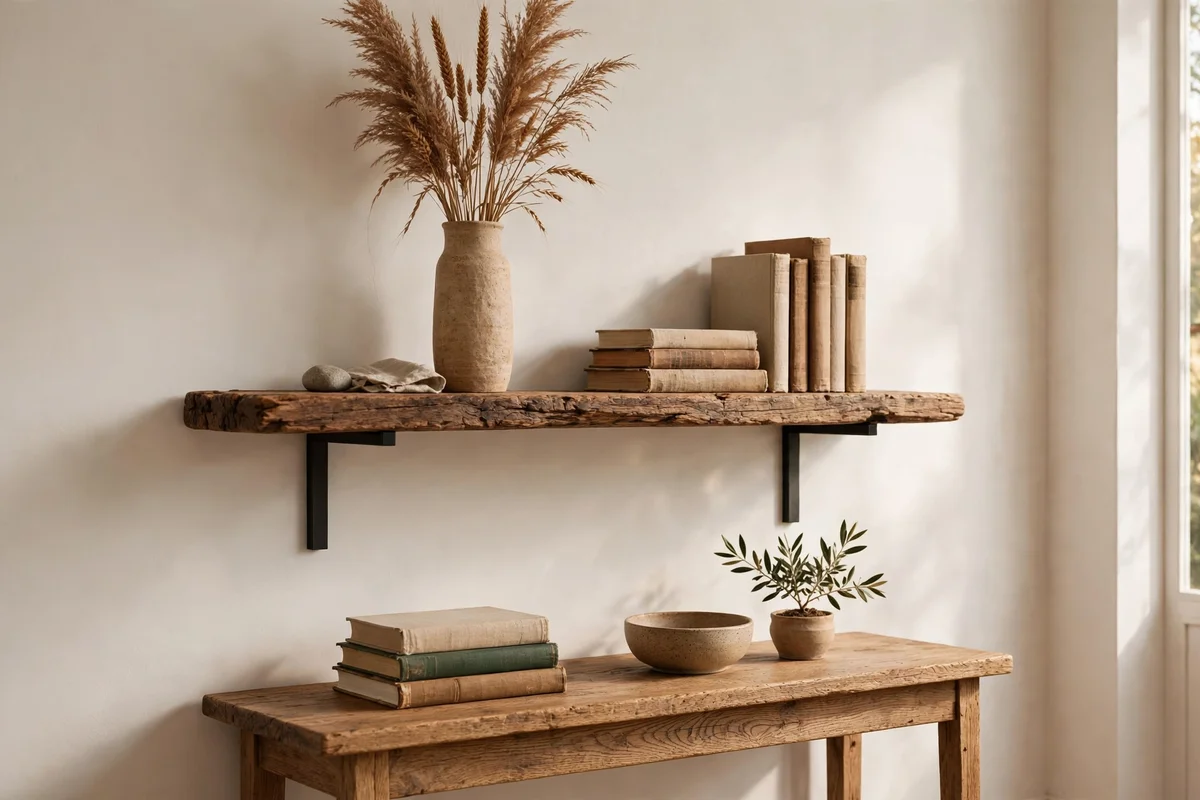
A single aged timber slab, 90 to 120 cm long and 20 to 25 cm deep, laid across two plain brackets, makes a shelf with presence. Mount it 140 to 150 cm from the floor over a console or a reading chair, high enough to see and low enough to reach. The slab should be the only rustic element on that wall; keep brackets simple black metal or plain white, and the wall behind it clean. One slab per room is the rule, since a second one starts a theme.
A 100 cm oak slab costs 50 to 120, brackets 10 to 25 each. The mistake to avoid is loading the slab with a row of small ornaments; style it with three items at most, one tall vase, one short stack of books and one small plant pot. Sand the front edge smooth even if the top stays rough, since forearms and sleeves catch on splinters. Oil once a year to keep the colour rich.
14. Give a Modern Console Black Metal Legs and Stop There
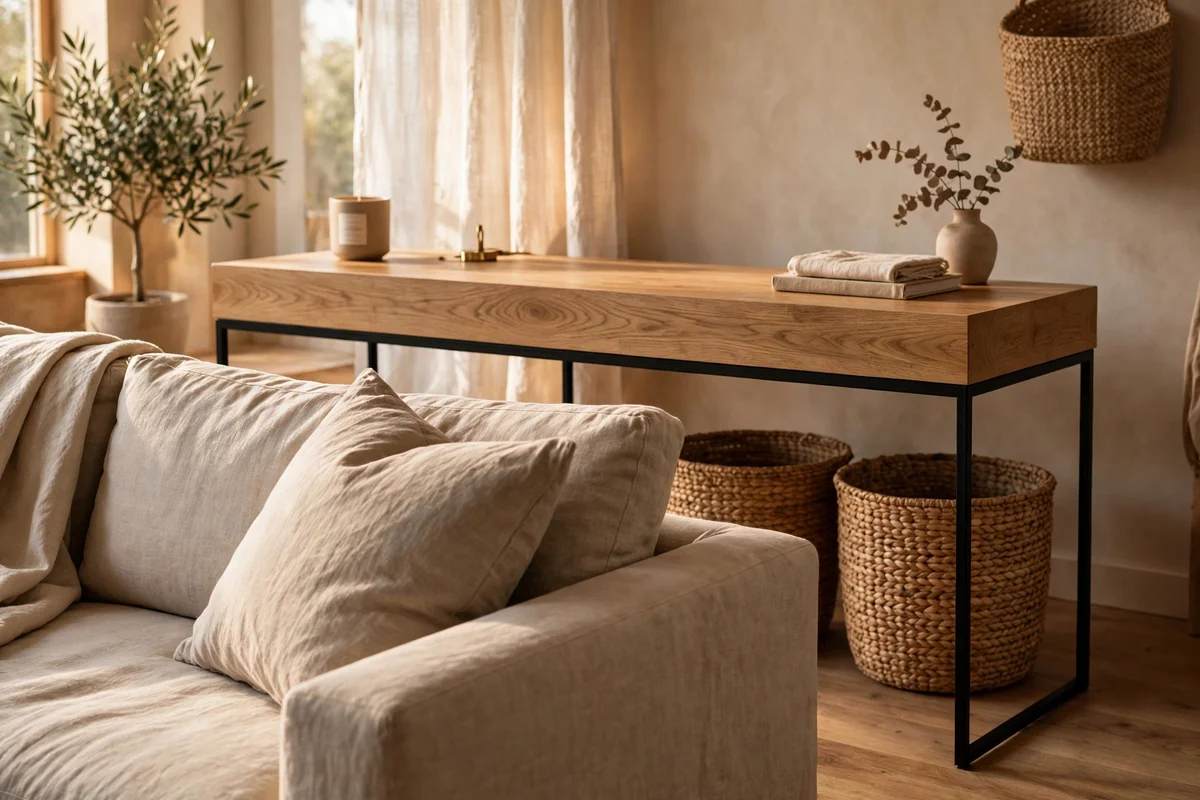
A console table with a plain timber or painted top on slim black metal legs brings the industrial note in one piece. Choose a top 100 to 130 cm long and 30 to 35 cm deep, with legs 75 to 80 cm high for hallway height or 45 cm for a sofa-back console. The top stays simple, one material, no carving, so the black legs are the detail. Place it behind the sofa or against an entry wall with two baskets underneath for throws and magazines.
Consoles in this style cost 120 to 280, or under 70 if you fit black metal hairpin legs to a salvaged top. The mistake to avoid is adding more black metal nearby; with legs this visible, skip the black shelf brackets on the same wall and let one dark element do the work. Wipe the legs with a damp cloth twice a year, since dust settles visibly on matte black, and check the leg fixings annually.
15. Fold a Chunky Wool Throw Over Crisp Linen Cushions

Layering is where the room’s softness comes from, and it costs the least. Fold a chunky knit wool throw into thirds and lay it across one sofa corner, letting one end drop to the seat. In front of it, place two cushions in crisp linen or woven cotton, 45 to 50 cm square, in clay or warm white. The wool brings rustic texture while the linen keeps the modern crispness; the contrast between the two weaves is the whole trick.
A good wool throw costs 40 to 90, linen cushion covers 15 to 30 each. The mistake to avoid is draping throws on every seat until the sofa looks like a bedding display; one throw and two to four cushions are enough, and the rest of the upholstery should stay bare and clean. Shake throws outside monthly and wash cushion covers each season to keep the layers looking intentional rather than tired.
16. Light Dark Corners With Honest Floor Lamps in Timber and Steel
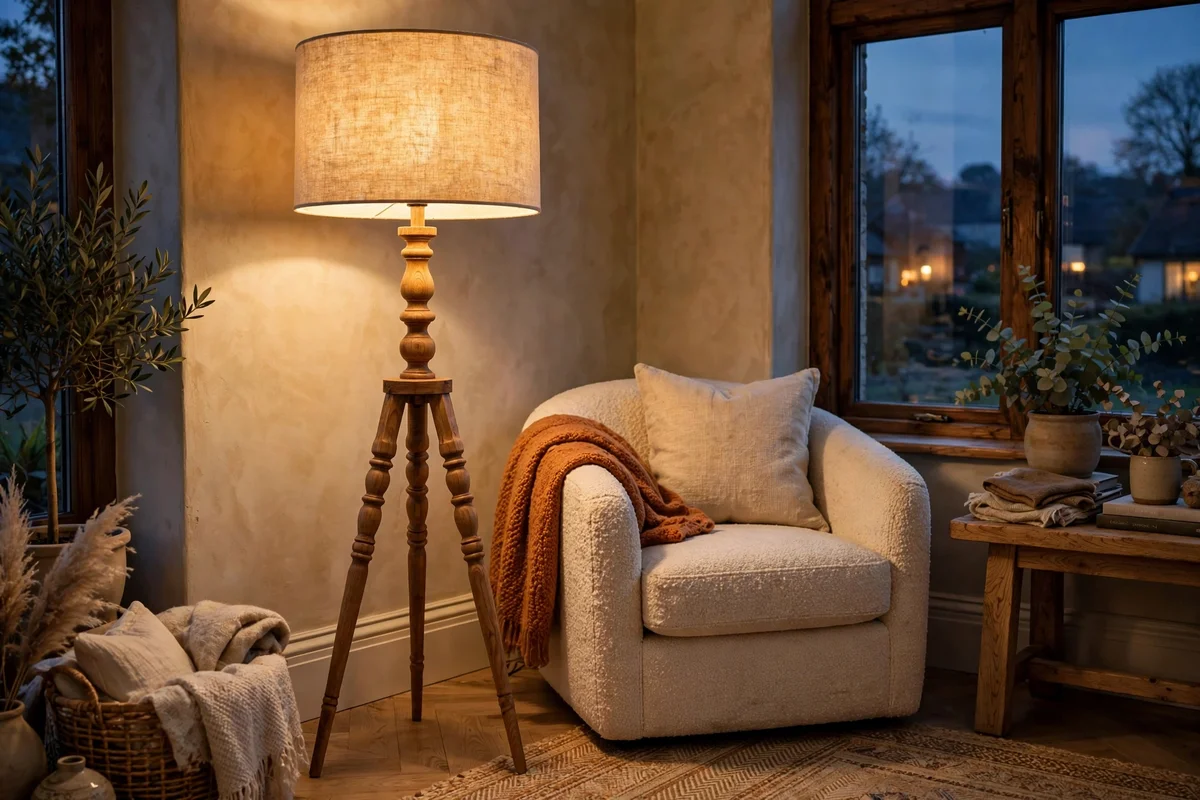
Corners away from windows need light with character, and a floor lamp in turned timber or blackened steel answers without a rustic cliche. Choose a lamp 150 to 170 cm tall with a simple drum or cone shade in linen, positioned 30 to 40 cm behind an armchair so reading light falls over the shoulder. A timber tripod base or a slim steel arc both suit the style; what matters is one honest material and a clean silhouette. Use a 2700K bulb for evening warmth.
Floor lamps in this style cost 70 to 200. The mistake to avoid is placing the lamp where its shade blocks the room’s sightline from the doorway; light the corner, do not wall it off. Keep the cord tight against the wall with small clips, and add a dimmer plug so the corner glows softly in the evening instead of blazing. One lit corner changes the whole room after dark.
17. Build the Palette on Warm White, Clay and Soft Charcoal
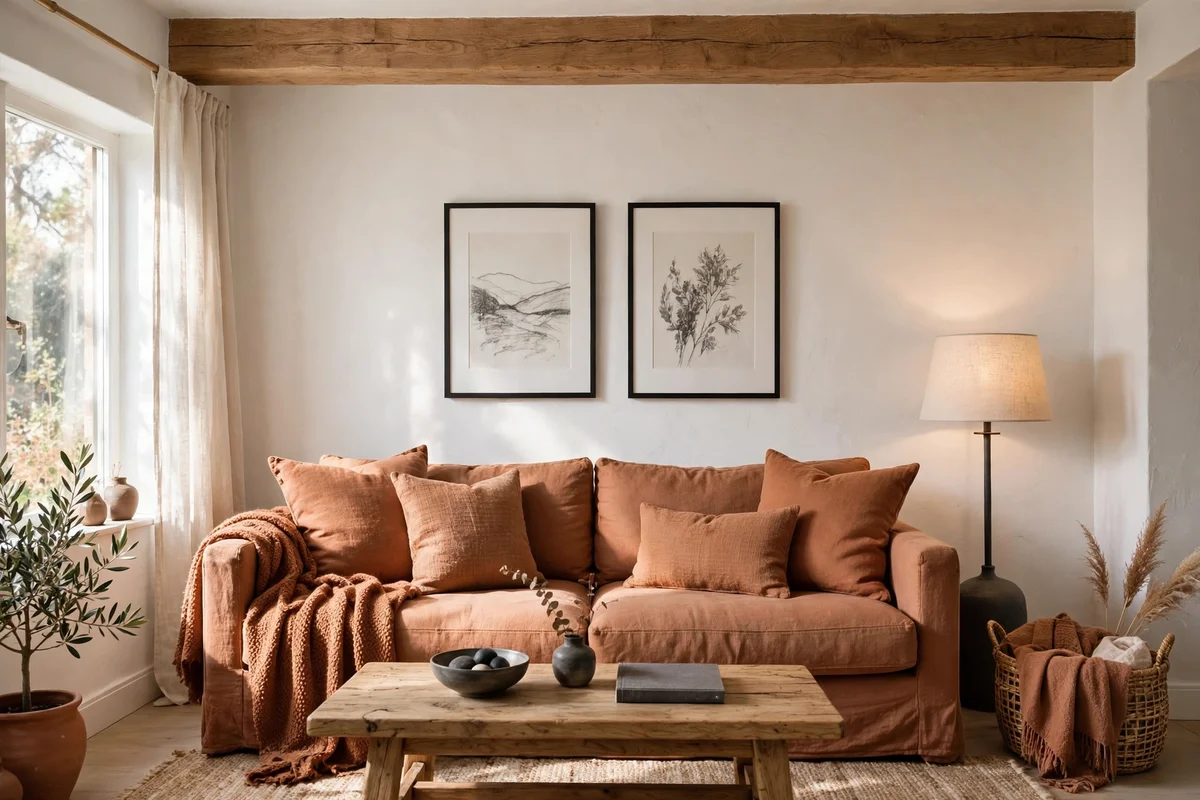
A three-colour palette keeps every buying decision easy. Warm white covers walls, ceiling and large upholstery, about sixty percent of what the eye sees. Clay tones, terracotta, ochre, muted rust, take roughly thirty percent through cushions, throws, ceramics and one rug. Soft charcoal takes the final ten percent: a lamp stem, picture frames, shelf brackets, one cushion. Write these three colours on a card and carry it when you shop, so impulse buys in the wrong shade never come home.
This palette costs nothing extra, since it is a decision, not a purchase. The mistake to avoid is adding a fourth strong colour, sage, navy or forest green, which pulls the room toward a different style entirely. If you crave green, bring it as a living plant, which reads as life rather than colour. Test any new cushion against your card in daylight before the tags come off.
18. Set a Stone Fireplace Wall Behind a Minimal Low Sofa
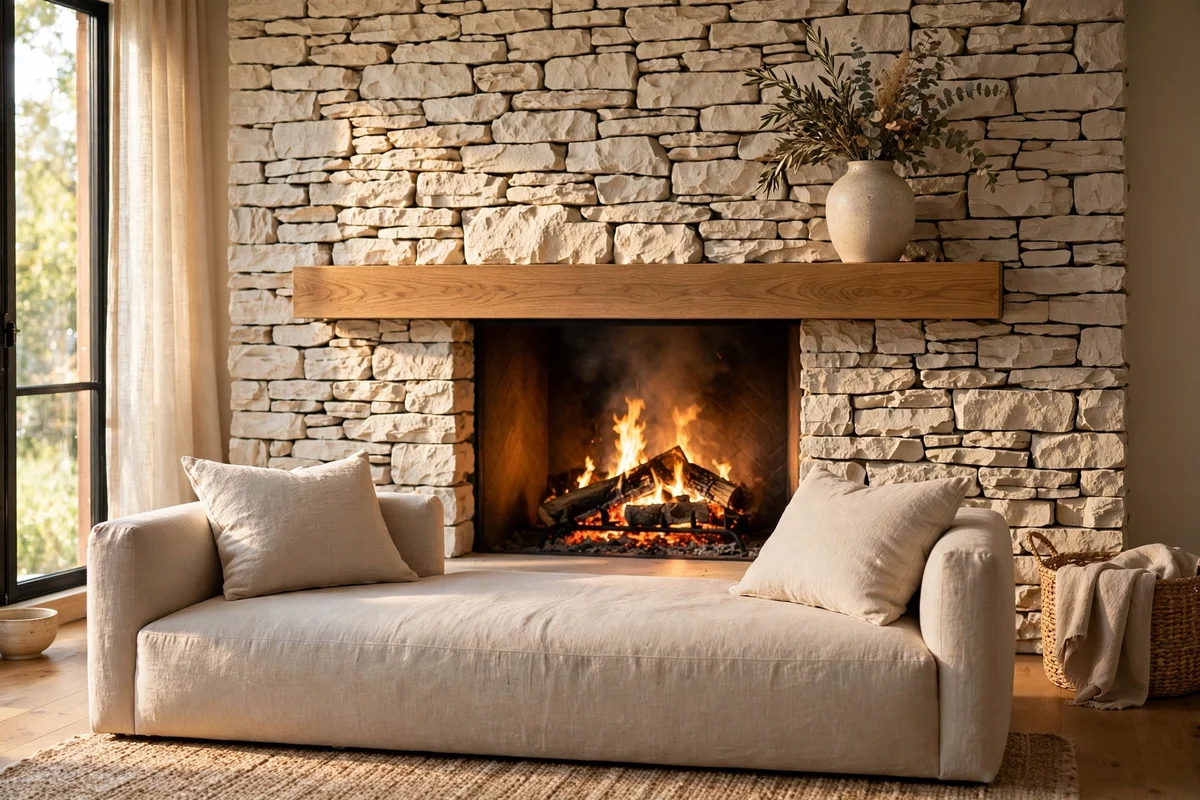
A stone clad chimney breast or fireplace wall gives the room its oldest surface, and a low modern sofa in front of it completes the contrast. Keep the stone in a light, dry-stacked limestone or sandstone rather than dark slate, so it glows instead of looming. Set the sofa 60 to 80 cm from the hearth, leaving room to tend the fire or style the mantel. The sofa itself stays minimal: low back, straight arms, plain linen, so the stone does the talking.
Real stone cladding costs 60 to 120 per square metre installed, or 25 to 45 per square metre for lightweight stone-look panels fitted in a weekend. The mistake to avoid is extending the stone onto a second wall or the ceiling; one stone surface is heritage, more is a grotto. Style the mantel with one timber slab shelf, one ceramic vase and a small stack of books, then leave the rest bare.
19. Ground the Seating Zone With a Flatweave Natural Rug
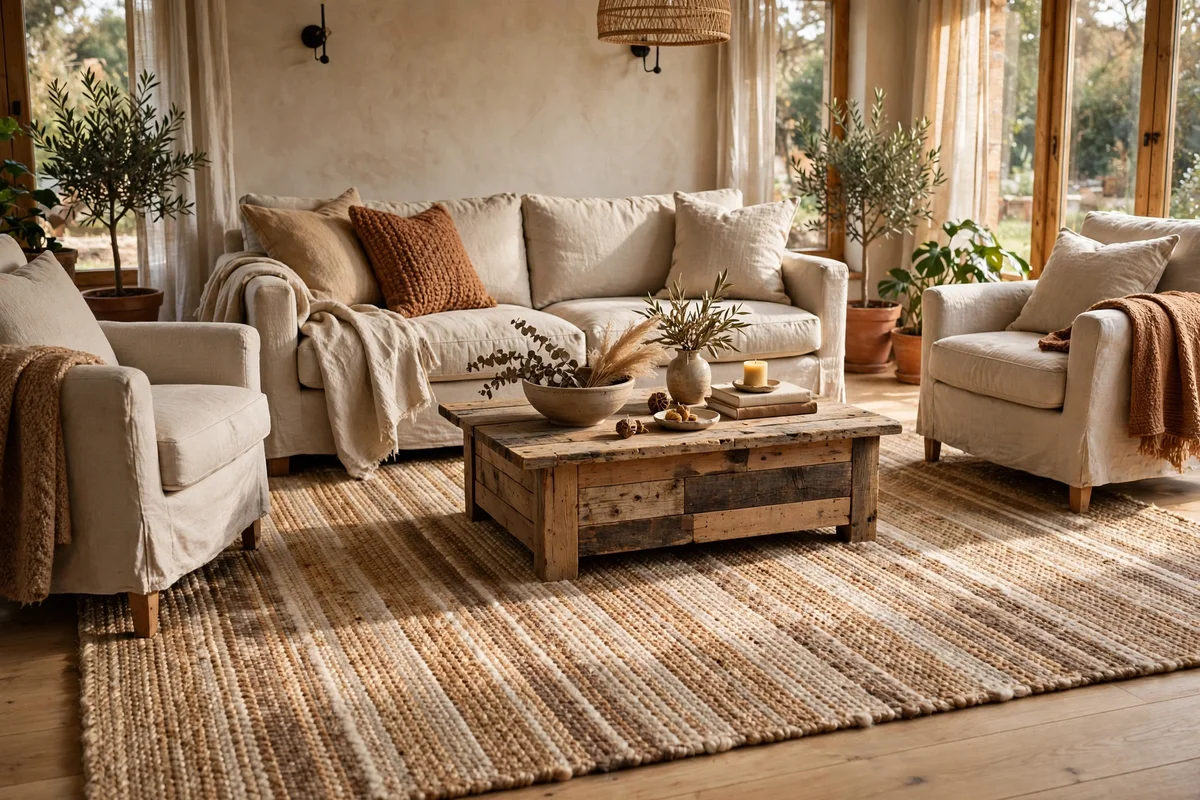
A flatweave rug in jute, wool or cotton, 200 by 300 cm for a standard seating group, defines the modern zone of the room. All front legs of the sofa and armchairs should sit on the rug, with at least 20 cm of rug showing beyond the furniture on each side. Choose a weave with a subtle stripe or border in clay and warm white rather than a busy pattern, so it calms the timber above it. Flatweave piles do not trap crumbs the way deep pile does, which matters in family rooms.
A 200 by 300 cm flatweave costs 150 to 350 in wool, 80 to 200 in jute or cotton. The mistake to avoid is buying a rug that only fits under the coffee table; a too-small rug chops the room into islands and makes the seating group look lost. Measure the full seating footprint, add 40 cm each side, and buy that size. Rotate the rug twice a year so sunlight and foot traffic wear it evenly.
20. Style Open Timber Shelves With Books and One Vase Each
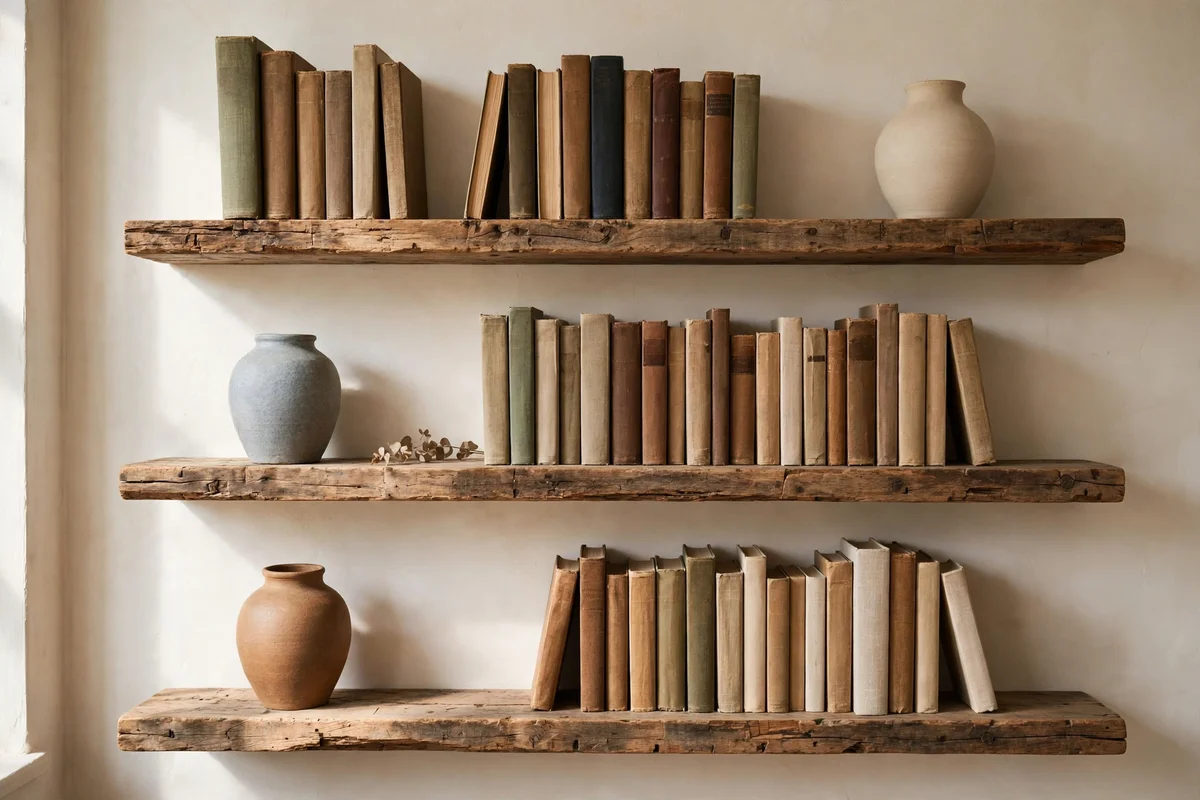
Open shelves earn their place when they hold real things simply. Group books upright in blocks of five to eight, spines aligned, with one small gap per shelf for the eye to rest. Add one ceramic vase or stoneware jug per shelf, nothing taller than 30 cm, in clay, cream or soft grey. Leave a third of each shelf empty; the empty space is what keeps open storage modern rather than cluttered. Timber shelves suit warm white walls, where their grain stands out.
Styling shelves costs almost nothing if you shop your own home first; one new vase costs 20 to 45. The mistake to avoid is filling every shelf edge to edge, which turns display into storage and hides the timber itself. Step back to the doorway after styling; if any shelf looks busy, remove one item rather than adding. Dust shelves fortnightly, since open timber shows a film of dust within days.
21. Hang Natural Linen Curtains High Over Timber Window Trim
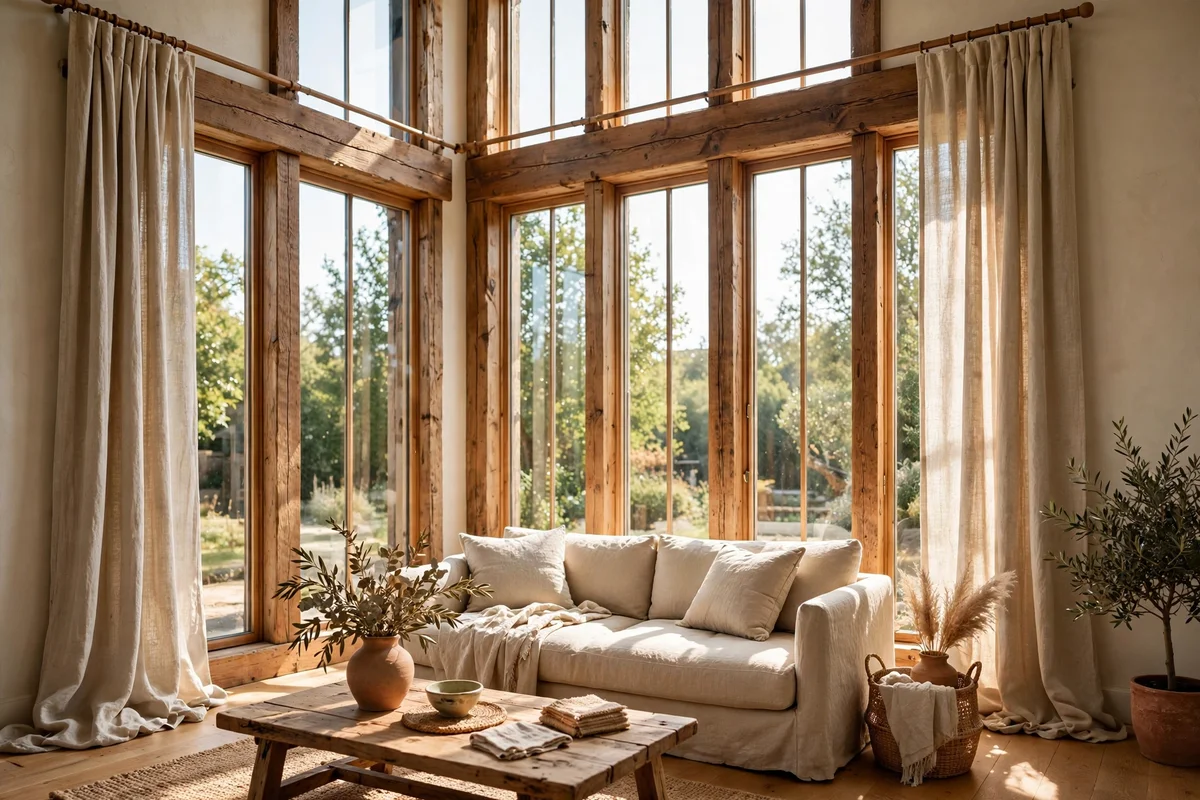
Natural linen curtains soften tall windows and repeat the room’s woven layer at height. Mount the rod 10 to 15 cm above the window frame and 15 to 20 cm wider on each side, so the open curtains clear the glass and the window looks larger. Choose unlined or lightly lined linen in warm white or oatmeal, panels 1.5 to 2 times the window width for a gentle gather. Let them fall to 1 to 2 cm above the floor, which reads tailored rather than fussy.
Linen curtain pairs cost 70 to 160 depending on width, rods 20 to 50. The mistake to avoid is hanging curtains that stop at the sill; short curtains chop the window and fight the room’s calm verticals. If the window trim is timber, keep it visible by choosing a slim dark or brass rod mounted on the wall above, not on the trim itself. Steam curtains after hanging so the linen falls straight.
22. Finish With Woven Baskets and Iron Hooks, Used With Restraint
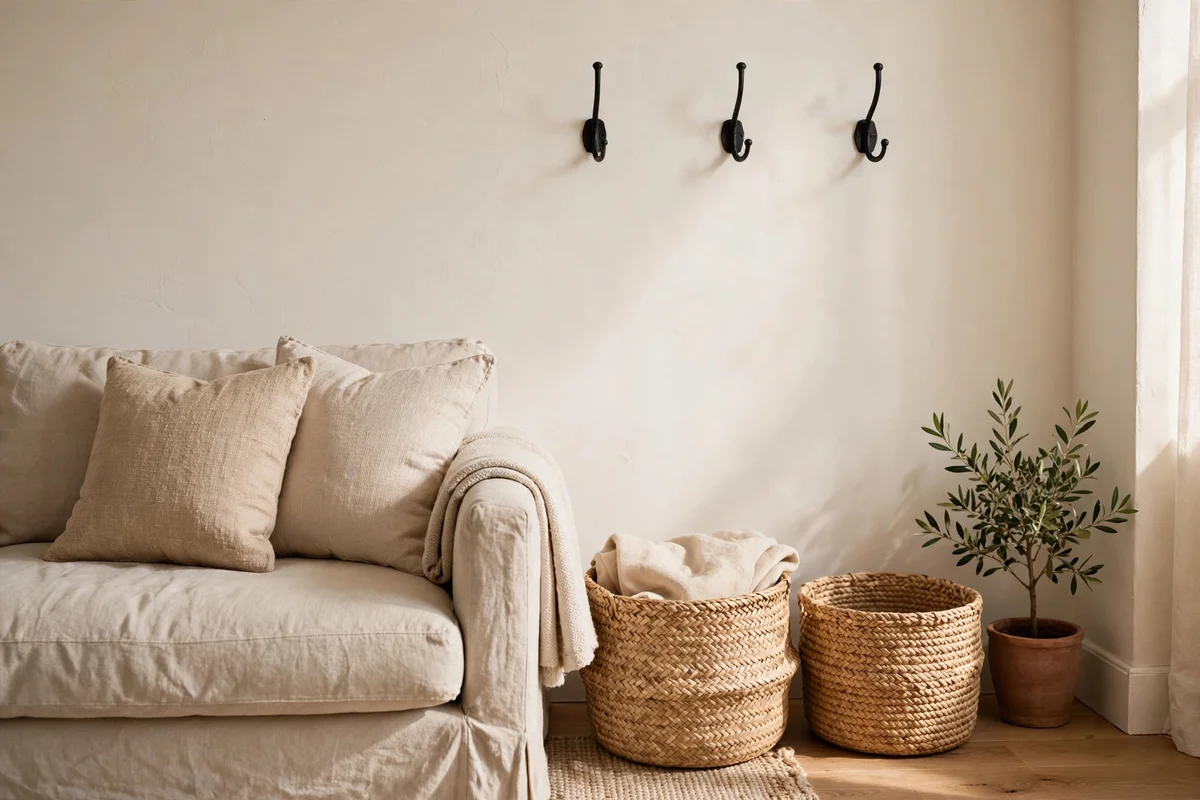
The final rustic notes should be small and useful. Place two woven baskets, 35 to 45 cm wide, beside the sofa for throws and beside the fireplace for kindling or magazines. Fix three to five black iron hooks on one short stretch of wall, 140 to 150 cm high, for a coat, a tote bag and one woven hat. These pieces add craft without demanding attention, and every one of them works hard. Baskets in seagrass or rattan suit the palette better than dark wicker.
Two baskets cost 30 to 70, a set of five iron hooks 15 to 30. The mistake to avoid is scattering baskets and hooks through every corner; confine them to two spots so they read as a decision, not leftovers. Line basket bases with a cloth bag to protect floors from scratching, and tighten hook screws once a year since loaded hooks loosen over time.
Rustic modern style is really a discipline of restraint: let old timber carry the history, let clean lines carry the calm, and keep the two in their seventy thirty balance. Every idea here works alone, so there is no need to redo the room at once. The beams and stone give the room its soul, the linen and flatweave keep it livable, and the single charcoal wall makes sure the calm never turns bland.
This week, try the easiest win first: fold one chunky wool throw over your sofa and swap two cushions for clay linen, then stand in the doorway and notice how the balance shifts. That ten-minute change teaches the ratio better than any mood board. Keep your three-colour card in your pocket, add timber one honest piece at a time, and let the room grow into the calm, crafted space it wants to be.
Frequently Asked Questions
How much does a rustic modern living room refresh cost?
Between 400 and 1,200 for a meaningful refresh using paint, textiles, lighting and one timber piece. A full room with beams, a new sofa and stone cladding lands near 2,400, as the example room shows. Start with the rug, throw and cushions for under 300, then add timber pieces one at a time as budget allows. Avoid financing the whole room at once; living with each layer prevents costly mistakes.
Can I get the rustic modern look in a small living room?
Yes, by keeping the timber pieces compact and the modern base dominant. Choose one live-edge bench instead of beams, a slim coffee table under 110 cm, and a flatweave rug that fits the seating group exactly. Paint walls warm white and keep the charcoal accent to one short wall or an alcove. In rooms under 15 square metres, skip ceiling beams entirely; low timber side tables give the same warmth without pressing down on the space.
Is a limewash wall practical with children and pets?
Limewash is a mineral finish that touches up easily, which suits busy family rooms. Keep a small jar of the mixed paint for quick dab repairs on scuffs, and choose the wall behind the sofa rather than a hallway where shoulders brush past. Avoid sealing it with wipeable varnish, since that kills the chalky look. For the hardest-wearing option, use a matte mineral paint in a limewash effect, which tolerates gentle wiping.
How do I mix different wood tones without it looking messy?
Stay within one temperature family, all warm or all cool, and let the tones vary in depth. Pair honey oak beams with a darker walnut bench and a mid-tone elm table; the shared warmth ties them together. Keep the ratio in check by limiting the room to three wood finishes at most. If a piece clashes, a coat of matte oil in a matching stain usually pulls it into line for under 20.
Are reclaimed beams safe to install on a normal ceiling?
Yes, when they are fixed into joists with proper brackets rated for the load. Most decorative beams weigh 10 to 25 kg each, well within what standard joists carry. Have a carpenter check joist direction and spacing before you buy, and never fix heavy beams to plasterboard alone. Seal reclaimed timber and check for old nails before lifting it overhead. If your ceiling is under 2.4 metres, choose shallow 10 cm beams or skip them.