Living Room
22 TV Wall Decor Ideas That Make the Screen Part of the Room
By Anna Wells · · 19 min read
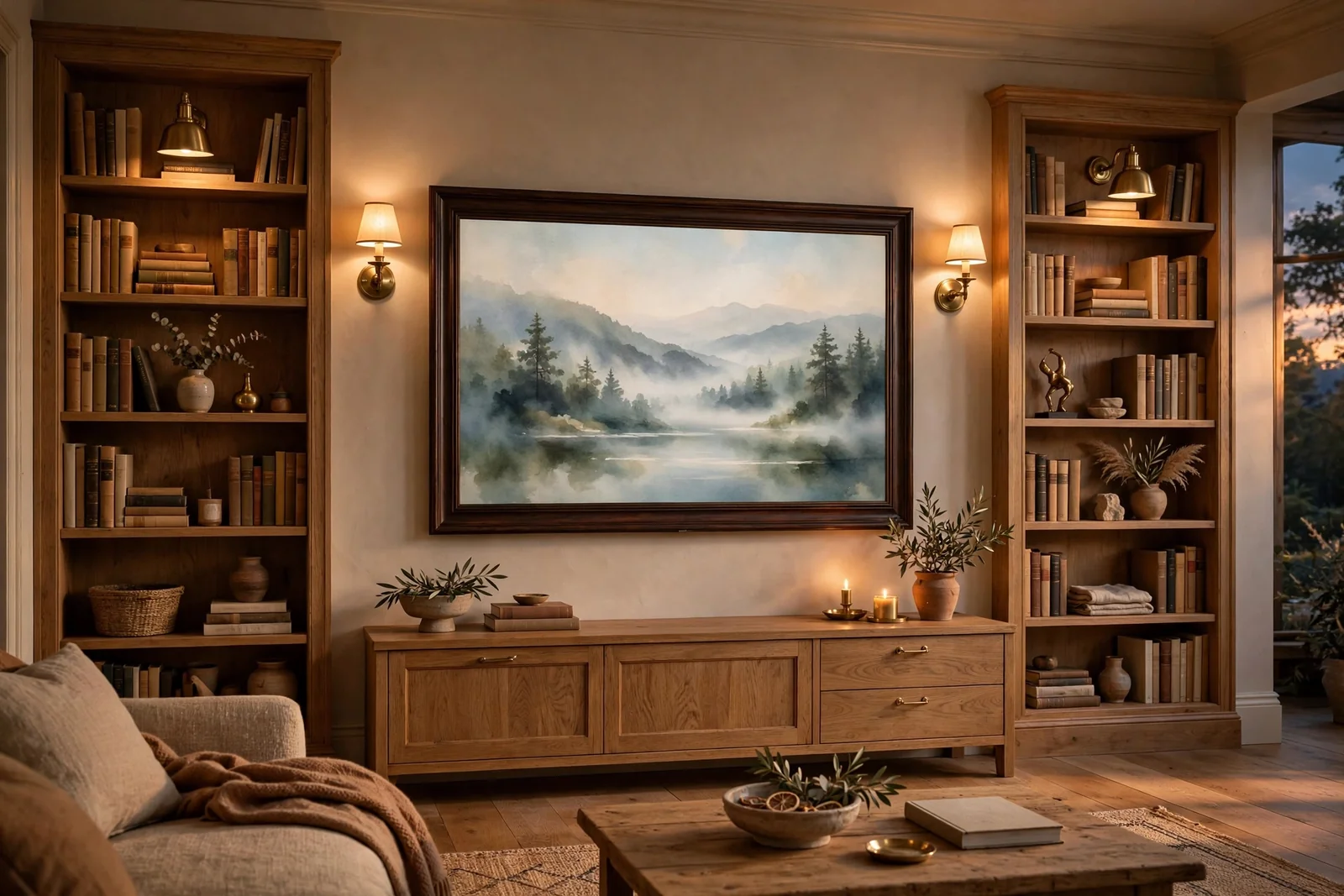
A television does not have to look like a black hole in a decorated room. These 22 practical, family friendly ideas use framing, colour, shelving and lighting to make the screen a calm part of the wall.
On a quiet evening, the television wall is where the whole household gathers: cushions dented, a tray of tea on the side table, the last of the daylight slipping past the curtains. It deserves the same care as the mantel or the dining table, because it is the room’s most looked-at surface.
A television does not have to look like a black hole in a decorated room. With framing, colour, shelving and a little lighting, the screen becomes one considered part of the wall, as calm when it is off as it is useful when it is on.
These 22 ideas cover the full picture: built-in shelves and panelling, gallery walls, paint tricks, cable hiding, console styling and the evening lighting that makes film night feel gentle. Every idea is practical, budget-conscious and family friendly.
Start with the one that bugs you most, then add the next. A decorated television wall is built in small, satisfying steps.
1. Frame the Screen With Twin Built-In Bookshelves
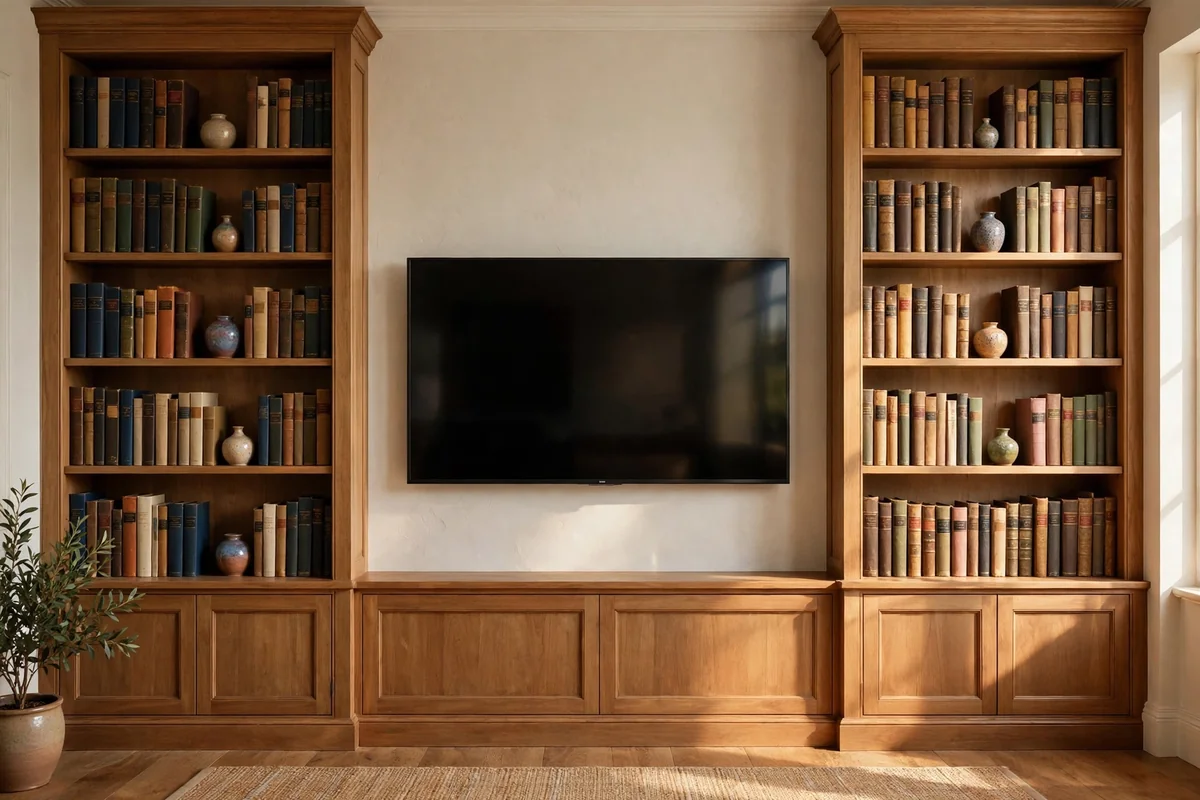
A pair of built in bookshelves flanking the television turns the screen into one panel of a library wall. Keep each shelf unit between 40 and 60 cm wide and set the screen dead centre, so the composition reads as one calm piece of joinery. Paint the shelves the same colour as the skirting boards, which stops the screen jumping out as a black rectangle. Leave one shelf per unit partly empty; overcrowding makes the whole wall feel busy.
The common mistake is making shelves too shallow for real books, so allow 25 to 30 cm of depth for paperbacks and small vases. If custom joinery is out of budget, use two tall flat-pack bookcases fixed to the wall with brackets and add a top pelmet board so they read as one unit. This sits at a mid budget tier, roughly 300 to 600 pounds or dollars for a convincing pair. Fix every unit into studs so nothing wobbles when doors close.
2. Add a Picture-Frame Surround That Sits Flush to the Wall

A chunky frame surround built from oak or painted timber makes the television read as framed art rather than a gadget. Cut four frame rails so the outer edge extends 8 to 10 cm beyond the screen on every side, and keep the depth under 6 cm so the profile sits close to the wall. Mitre the corners neatly and paint the frame in the wall colour for a quiet look, or choose warm oak for a heritage gallery feel.
Mount the television first, then hang the frame around it on hidden cleats so the screen can slide out for servicing. The mistake to avoid is a frame so deep it casts a shadow across the picture when a picture light is on; a shallow profile solves this. A joiner charges roughly 150 to 300 for this, while a self-made version from prepared timber costs under 60. Set the screen to show a soft landscape painting when guests visit.
3. Paint the Wall Behind the Screen a Deep Calming Colour
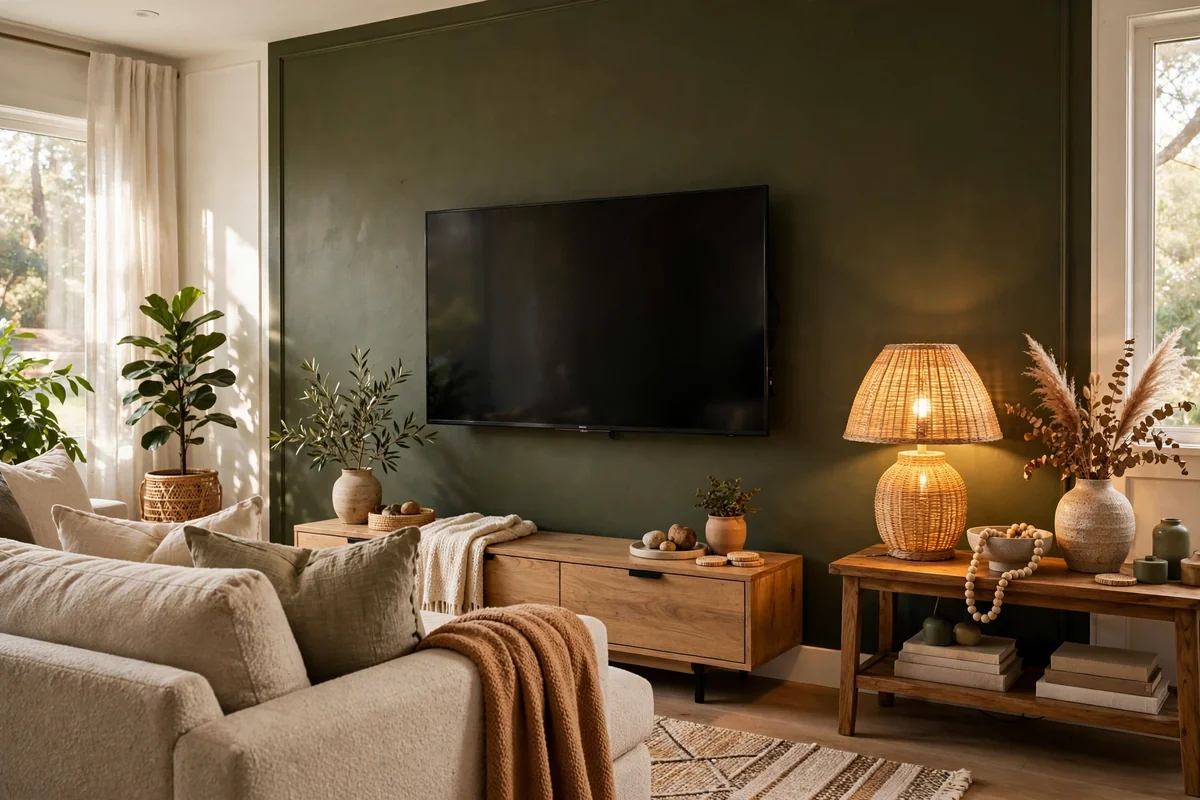
One deep painted wall lets a switched-off screen dissolve into the background instead of shouting across the room. Choose colours like deep olive, ink navy or a rich warm brown, and paint just the television wall, not the whole room, so the effect stays calm. Use a matt or eggshell finish because gloss bounces light and doubles screen glare. Two coats over a tinted primer give the depth that makes this trick work.
Test the colour on a large board first and view it beside the screen both on and off, since some greens throw a cast onto the room during films. Keep the remaining walls two or three shades lighter in the same family so the space feels connected rather than patched. The budget is the friendliest in the whole list: one tin of quality paint usually costs 30 to 50 and covers a single feature wall easily. Avoid pairing a very dark wall with a tiny dim lamp.
4. Panel the TV Wall With Vertical Wood Battens
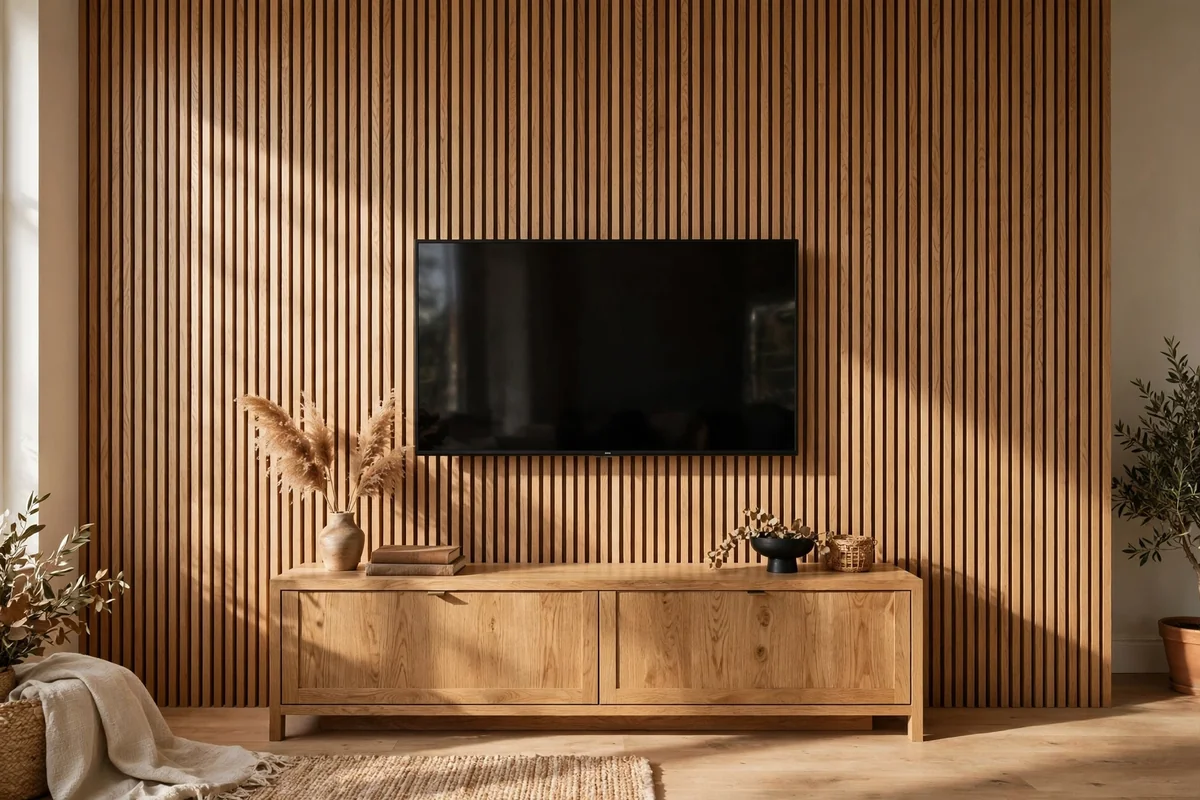
Vertical battens add texture that makes the television feel anchored rather than floating on a bare wall. Fix battens 5 to 8 cm wide with 2 to 3 cm gaps between them, running floor to ceiling across the wall behind the screen. Oak, ash or painted pine all work; treat oak with a warm neutral oil to keep the grain gentle. Fix battens with adhesive and panel pins, then fill and paint, or leave the timber natural.
Run the television cables in the gap behind the middle batten before fixing it, so wiring disappears completely. The mistake to avoid is stopping the battens at picture height, which makes the television look perched; full height gives the finished built-in feel. A single wall usually needs 20 to 30 battens and costs 80 to 180 in materials. Paint the wall behind the battens dark first so the gaps read as shadow lines.
5. Hang a Gallery Wall Around the Screen in Matching Frames
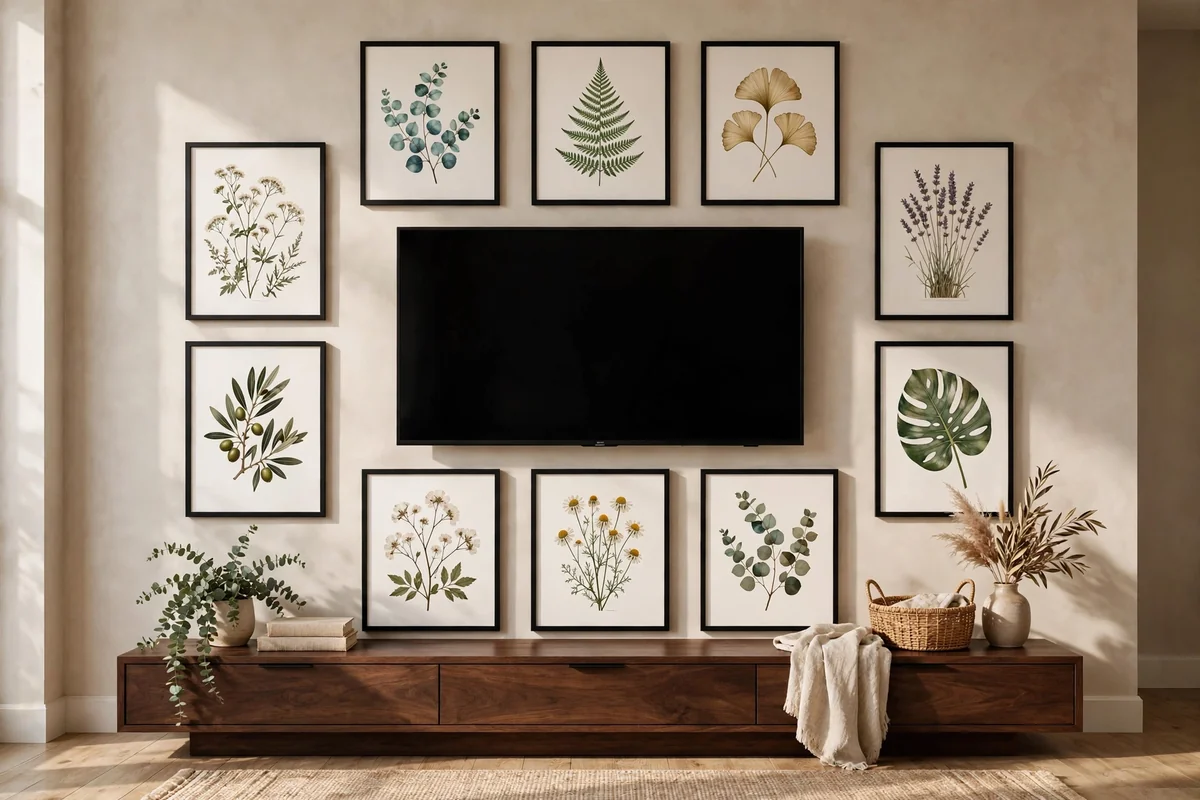
A gallery wall that includes the television among the frames stops it being the only black rectangle in the room. Choose frames in one finish, such as thin black or warm oak, and mix botanical prints, small landscapes and quiet sketches in a loose rectangle around the screen. Keep 8 to 12 cm between frames and let the composition sit 10 to 15 cm wider than the television on each side.
Plan the layout on the floor first and mark positions with painter’s tape before a single nail goes in. Leave the space directly below the screen clear for the console, since art hung too low crowds the remote control zone. Use picture-hanging strips for renter-friendly mounting. The mistake to avoid is mixing five different frame styles, which reads as clutter; one or two finishes keeps it gallery calm. Second-hand frames make this a 50 to 120 project.
6. Run Every Cable Through a Painted Wall Raceway
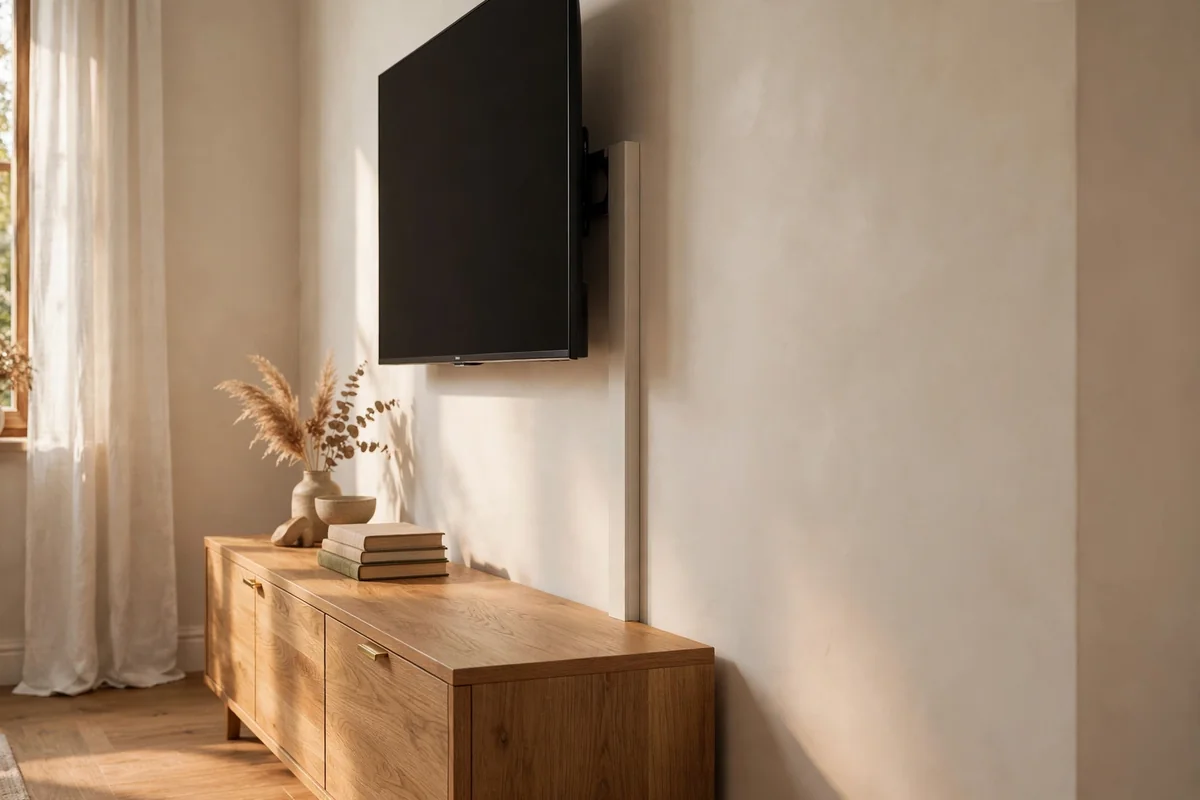
Visible cables undo even the most careful styling, so a paintable raceway is the single highest-impact fix. Measure from the back of the television to the console or socket, then cut the channel to length and paint it in the wall colour before sticking it up. Most kits are 1 to 2 metres and come in adhesive backed lengths; keep runs straight down rather than diagonal, since diagonal runs always catch the eye.
Leave the power lead a little slack inside the channel so the television can be tilted or serviced without ripping the cover off. The mistake to avoid is bundling HDMI and power cables tight against each other in a cheap channel with no heat rating; keep power separate where you can. One or two kits cost 15 to 30 and take about 40 minutes to fit. Once painted, the channel disappears into the wall entirely.
7. Tuck Boxes and Streaming Sticks Inside a Ventilated Console
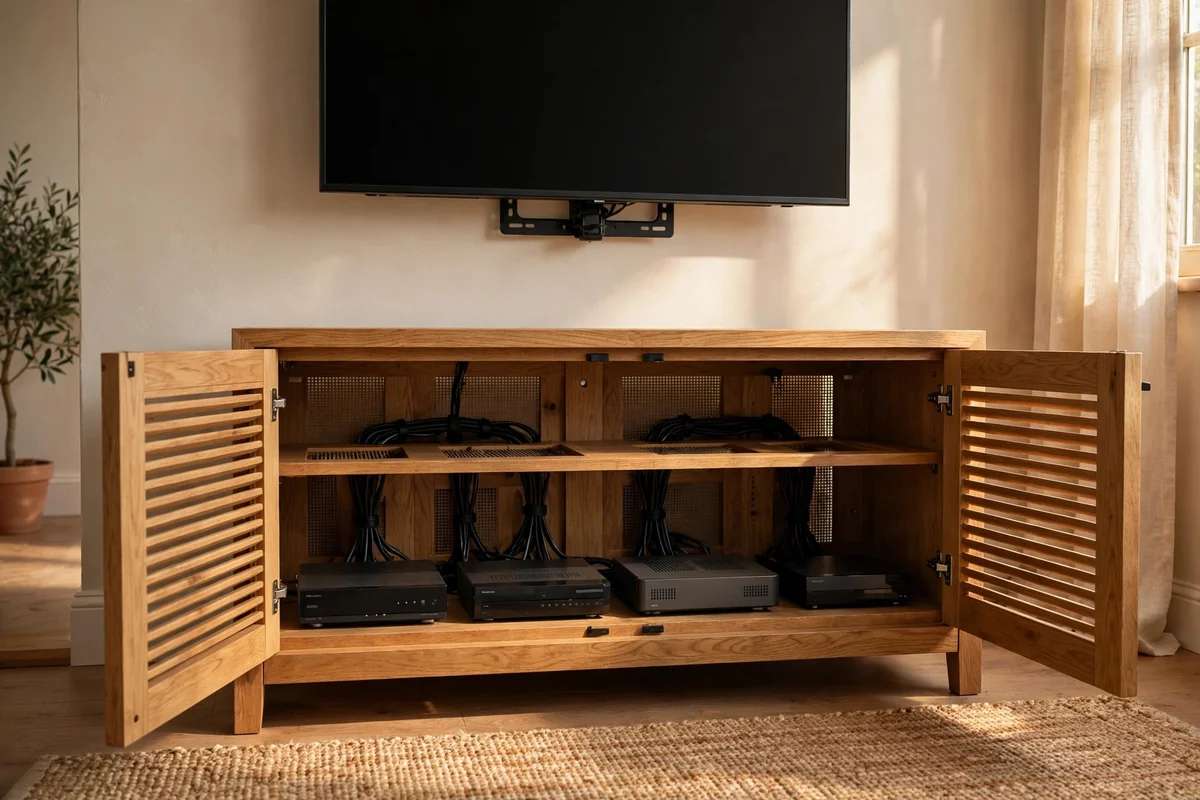
Set-top boxes, consoles and routers belong behind closed doors, but they need air. Choose a console with louvred fronts, a slatted back or an open rear panel so heat escapes, and keep at least 5 cm of clear space around each device. Stick the remote receivers just inside the front edge so signals still reach them through the gap. Cable-tie leads inside the cabinet to stop tangles when you swap a device.
The mistake to avoid is stacking a games console directly on a router; both run hot and together they shorten each other’s life. Place a small adhesive temperature strip inside if you are unsure about airflow. This fix costs nothing beyond a 10 pack of cable ties and a ventilated console you probably already own. Check once a month that vents are not blocked by stacked magazines or blankets.
8. Keep Console Books Below the Bottom Edge of the Picture
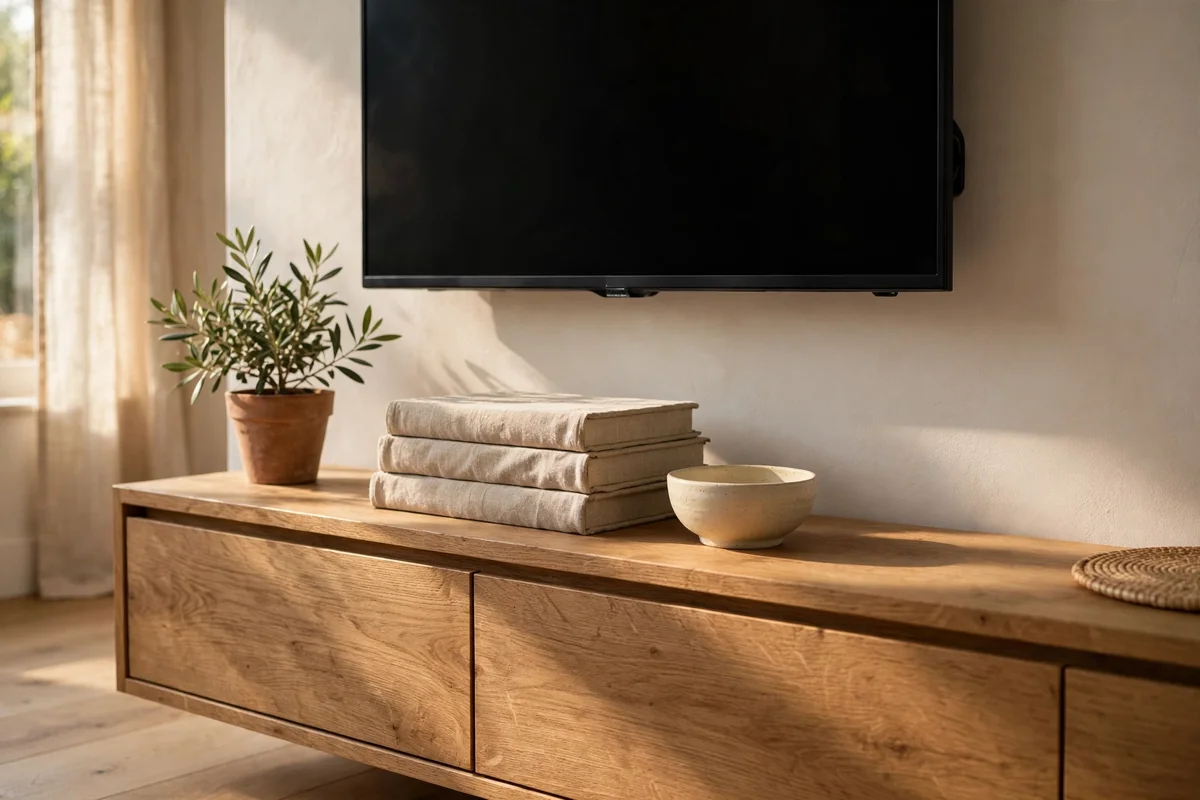
Books on the console add warmth, but anything that breaks the bottom line of the screen competes with the picture. Stack two or three books horizontally so the tallest stack stays 10 to 15 cm below the screen’s lower bezel. Choose covers in muted linen, sage or terracotta tones that echo the room, and turn spines inward for a calmer look if the lettering is loud. Weigh heavier art books at the bottom for stability.
The mistake to avoid is building a tower of six or more books that wobbles whenever a drawer closes; three is the calm maximum. This styling costs nothing if you shop your own shelves, and charity shops sell handsome clothbound volumes for a few pounds each. Reposition books seasonally so the console feels alive rather than fixed. Keep liquids away from this zone; coasters belong on the side table instead.
9. Style the Console in Three Quiet Zones
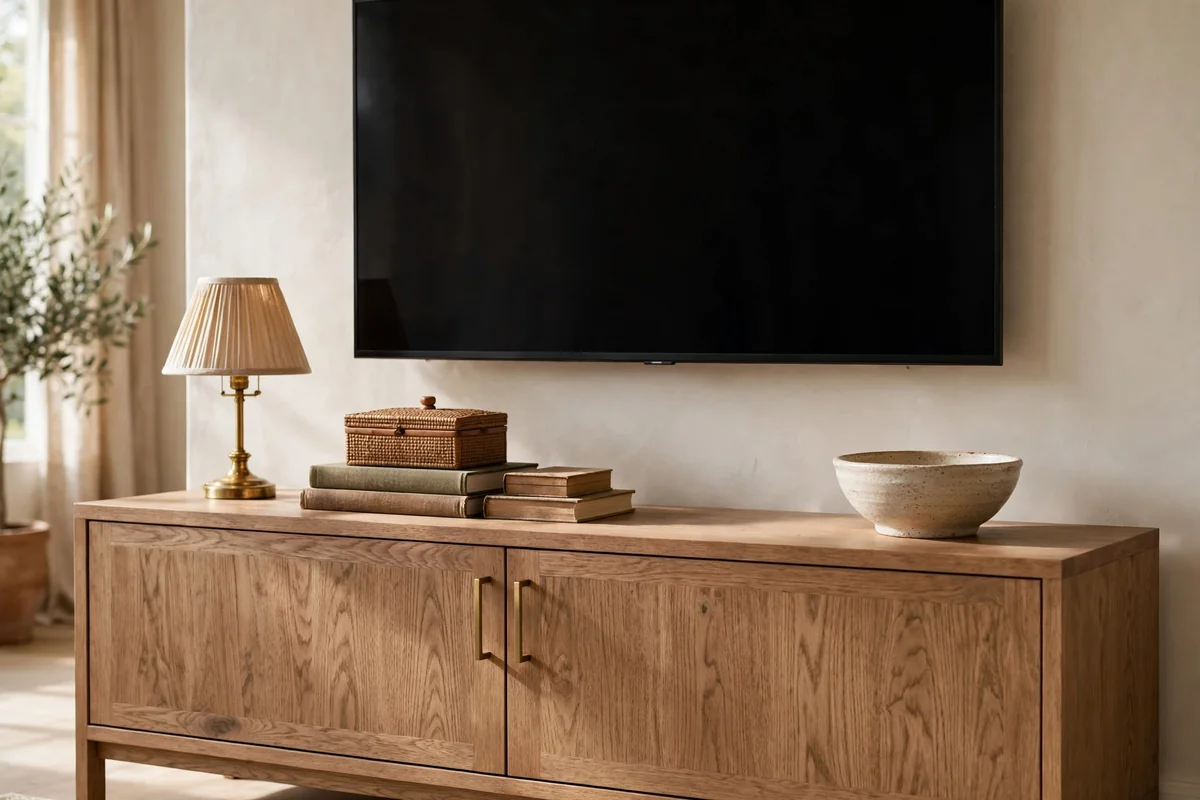
A simple left, centre and right formula keeps a wide console from drifting into clutter. Put a small lamp or a tall branch arrangement at one end, a low stack of books or a lidded box in the centre, and a single ceramic bowl or folded throw at the other end. Each zone should be no wider than a third of the console, with 20 to 30 cm of breathing room between groups.
Keep every object under the height rule: nothing rises above the screen’s bottom edge. The mistake to avoid is using only tiny objects on a long console; one medium piece, like a 30 cm vase, anchors each zone. This is a styling exercise, not a shopping one, so the budget is zero to small. Photograph the console from the sofa and edit whatever pulls the eye first.
10. Hang a Slim Picture Light Above the Frame
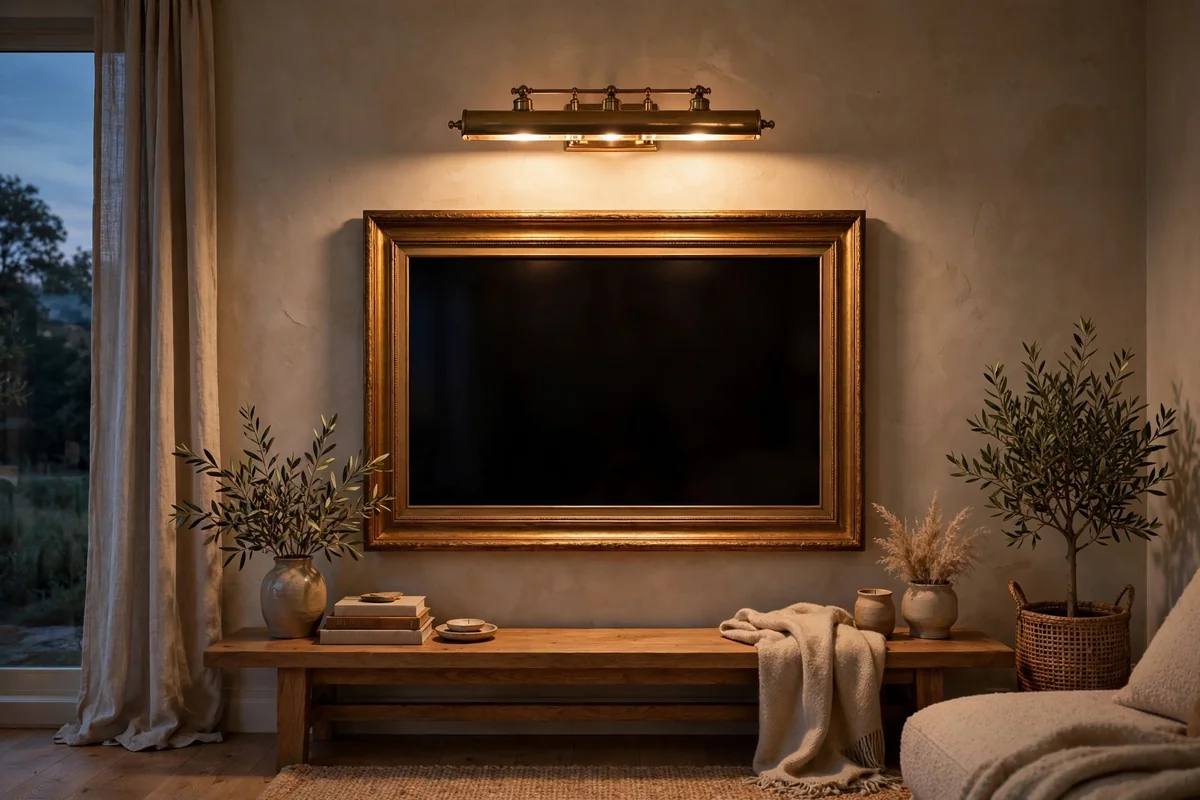
A slim picture light mounted 15 to 20 cm above the screen throws a soft wash over the frame surround or the art above, and it gives the wall presence when the television is off. Choose a 30 to 40 cm brass or matte black fixture with a warm 2700K LED source and a shade that directs light downward, never into viewers’ eyes. Plug-in models with a cable cover suit renters perfectly.
The mistake to avoid is a cool white bulb, which makes the whole wall feel like an office; warm light keeps evening rooms restful. Many picture lights now dim from the cord or a small remote, which is ideal for switching between gallery glow and film night. Budget options start around 25, with solid brass versions at 80 to 120. Angle the shade slightly outward so light lands on the frame, not the screen.
11. Fit Warm Bias Lighting Behind the Television
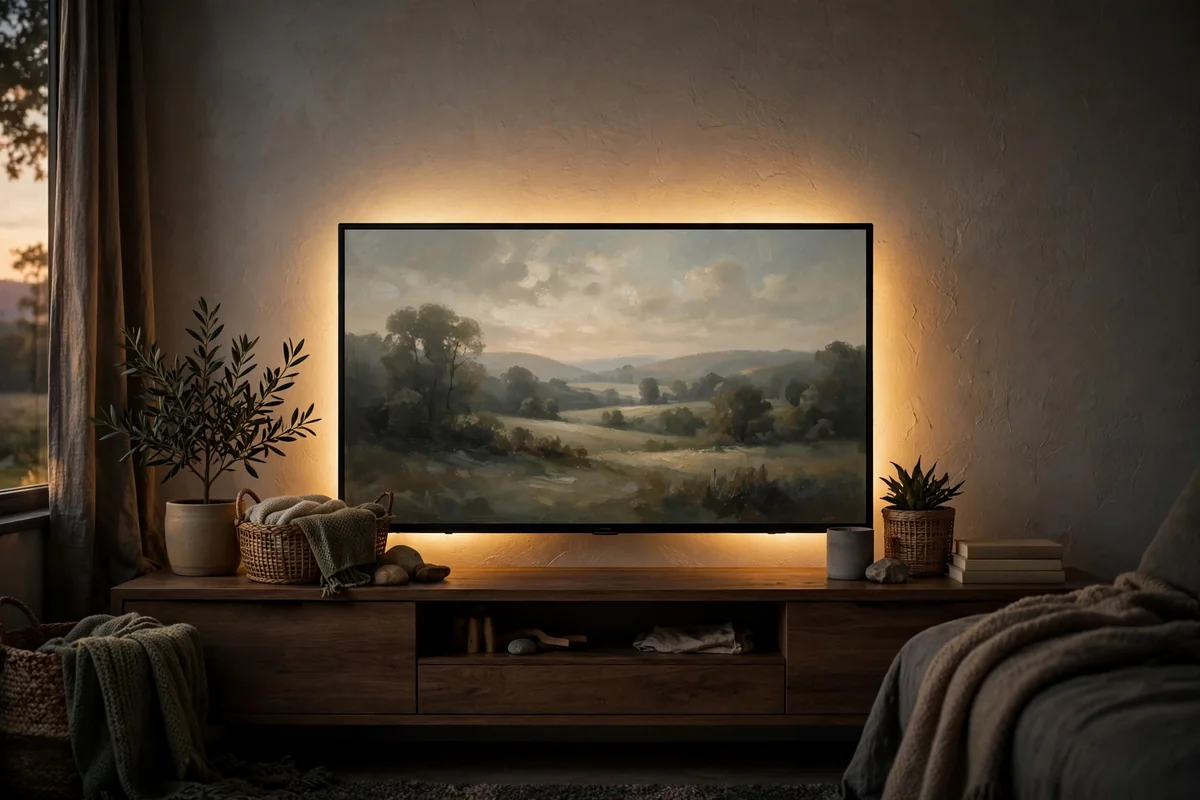
A strip of warm LED behind the television softens the contrast between the bright screen and a dark room, which makes evening viewing noticeably easier on the eyes. Fix the strip to the back of the set, 5 to 10 cm in from the edge, so the glow spills evenly onto the wall behind. Choose 2700K rather than colour-changing strips; warm white flatters the room, while coloured light fights with the film’s colours.
Power the strip from the television’s USB port so it switches on and off with the screen automatically. The mistake to avoid is a strip that is too bright; keep it at 30 to 50 percent brightness so it reads as a halo, not a spotlight. A quality warm-white kit costs 15 to 25 and fits in under an hour. This is the cheapest comfort upgrade in the whole list.
12. Mount a Pair of Sconces Beside the Screen at Eye Level
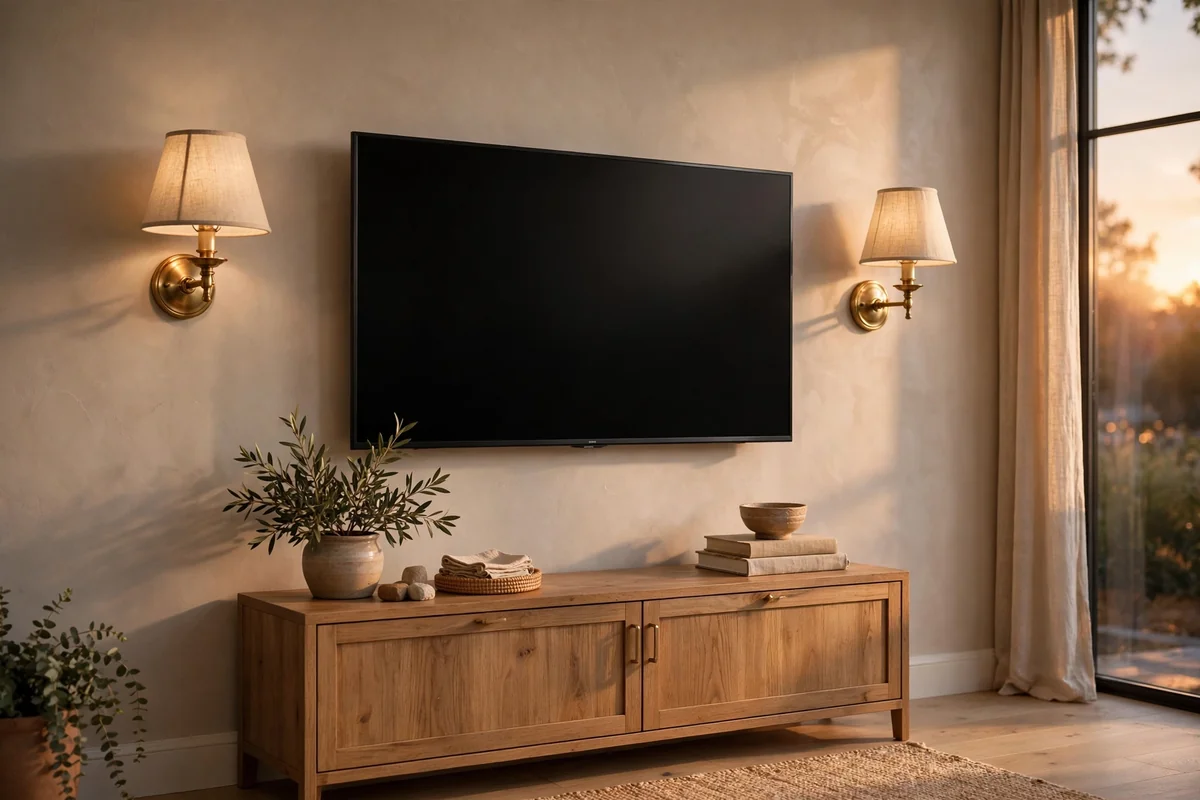
Two wall sconces placed 1.4 to 1.6 metres from the floor and 60 to 80 cm from the screen edge give the television wall a furniture feel. Pick shades that point light upward and downward rather than straight out, so nothing glares into seated eyes. Warm brass arms with linen or opal glass shades suit heritage rooms, while simple black arms suit quieter modern spaces.
Wire sconces into the same dimmer circuit as the main lights if you can, so the wall transitions smoothly from bright tidying to film night. The mistake to avoid is mounting sconces too close to the screen, where bright shades reflect in the glass during dark scenes. Plug-in swing-arm versions work for renters at 40 to 70 each. This symmetry makes even a plain wall-mounted screen feel dressed.
13. Float a Low Oak Console Beneath a Wall-Mounted Screen
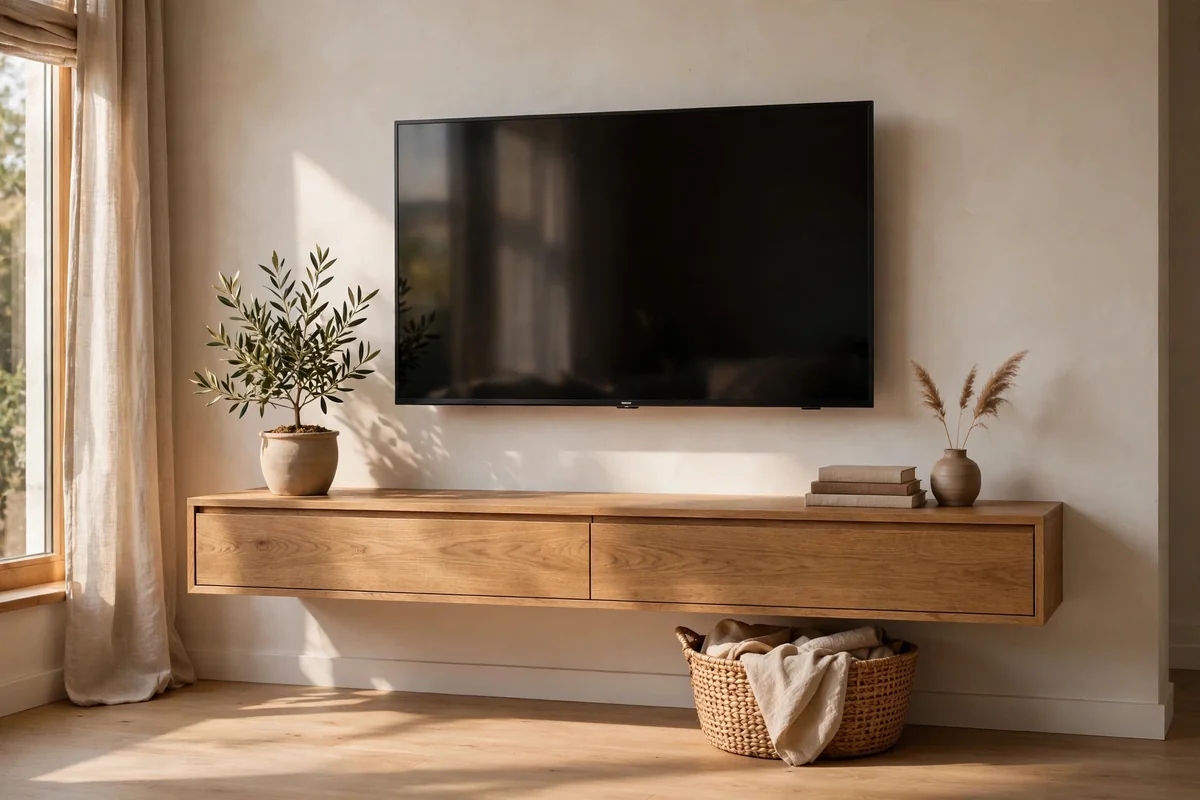
A wall-mounted console floating 25 to 30 cm above the floor keeps cables off the carpet and makes the room feel lighter. Choose a unit at least 20 cm wider than the television on each side, in oak or warm walnut, and fix it into wall studs with the manufacturer’s brackets. The gap beneath is perfect for a low basket or a folded throw, which keeps the floor line clean.
The mistake to avoid is mounting the console so high that the gap to the screen exceeds 30 cm; the two pieces should read as one vertical composition. Run cables inside the wall or through a raceway between the two units before final fixing. A solid floating console costs 200 to 500 at mid tier, with flat-pack versions from 80. Oil the oak once a year to keep it rich.
14. Hang One Large Round Mirror Above the Console
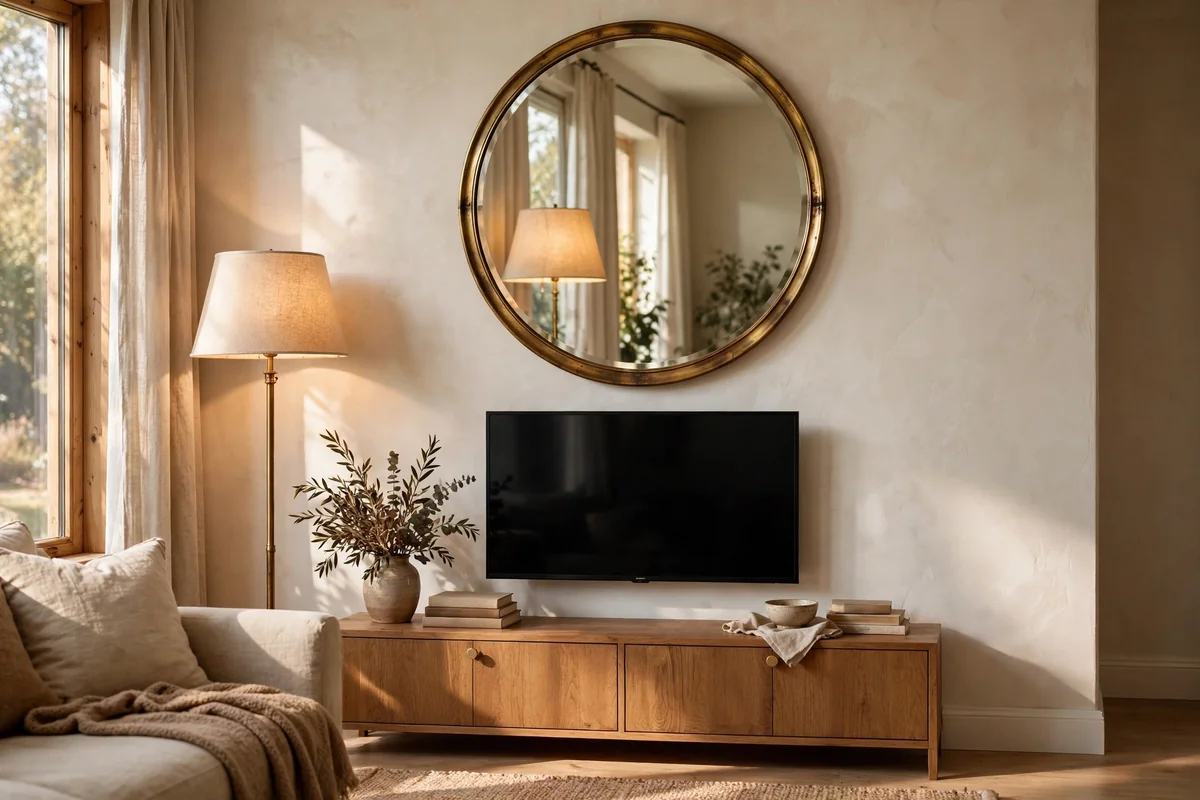
One generous round mirror, 70 to 90 cm across, centred above the screen gives the wall a focal point that balances the television below. Hang it so its centre sits at about 150 to 160 cm from the floor, which suits both standing glances and seated views. A slim brass or oak frame echoes warm rooms, while a thin black frame suits cooler palettes.
The mistake to avoid is a mirror that directly reflects the screen, which doubles the visual noise; position it above and slightly forward of the viewing angle, and angle it a degree or two downward if needed. A mirror this size in a thin frame costs 80 to 180. It also bounces evening lamplight around the room, which is welcome when the television stays off.
15. Let Open Shelving Overlap the Screen for a Library Feel
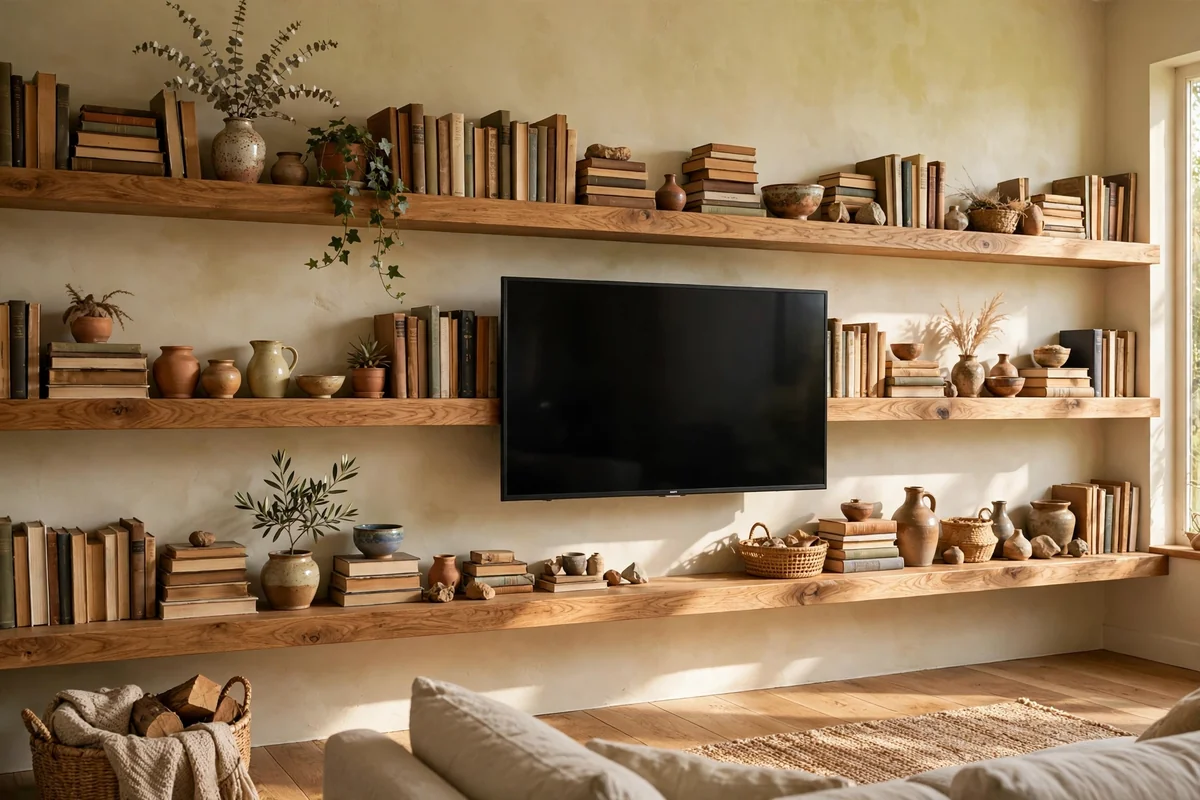
Shelves that run across the wall and pass behind the television create a continuous library ribbon that absorbs the screen into the collection. Use floating shelves 20 to 25 cm deep, spaced 30 to 40 cm apart, and let the television overlap the middle shelf line. Leave the shelf sections immediately beside the screen for books and quiet objects so the screen sits in a frame of spines.
Fix each shelf into studs or use heavy-duty plaster anchors, since a shelf of hardback books can weigh 15 kg or more. The mistake to avoid is placing small breakable objects on the shelf directly above the screen, where a falling item could damage it; keep that stretch for light books only. Three quality oak shelves cost 90 to 200. This arrangement makes the television feel like one volume among many.
16. Soften the Corners With Tall Floor Vases of Dried Branches
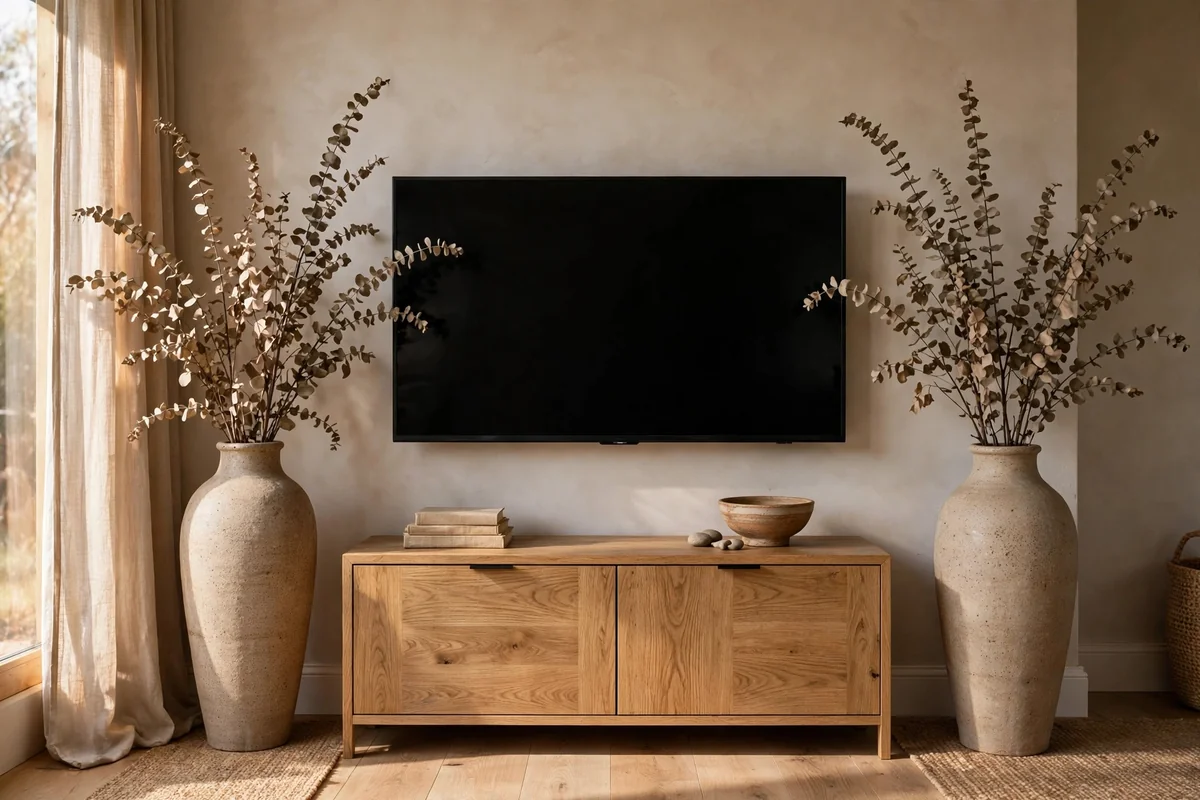
Two tall floor vases placed at the outer corners of the television wall soften the hard rectangle of the screen. Choose vessels 50 to 70 cm tall in stoneware or aged ceramic and fill them with dried branches, pussy willow or eucalyptus stems cut to about one and a half times the vase height. Dried stems suit a low-maintenance home: no watering, no shedding, and they last for years.
Keep the vases at least 40 cm from the screen edge so nothing brushes the picture when someone reaches behind. The mistake to avoid is overfilling: seven to nine stems per vase reads elegant, while twenty reads like a hedge. Vases cost 20 to 50 each and stems another 15. Shake stems outside twice a year to keep them dust-free.
17. Anchor the Seating With a Large Flatweave Rug
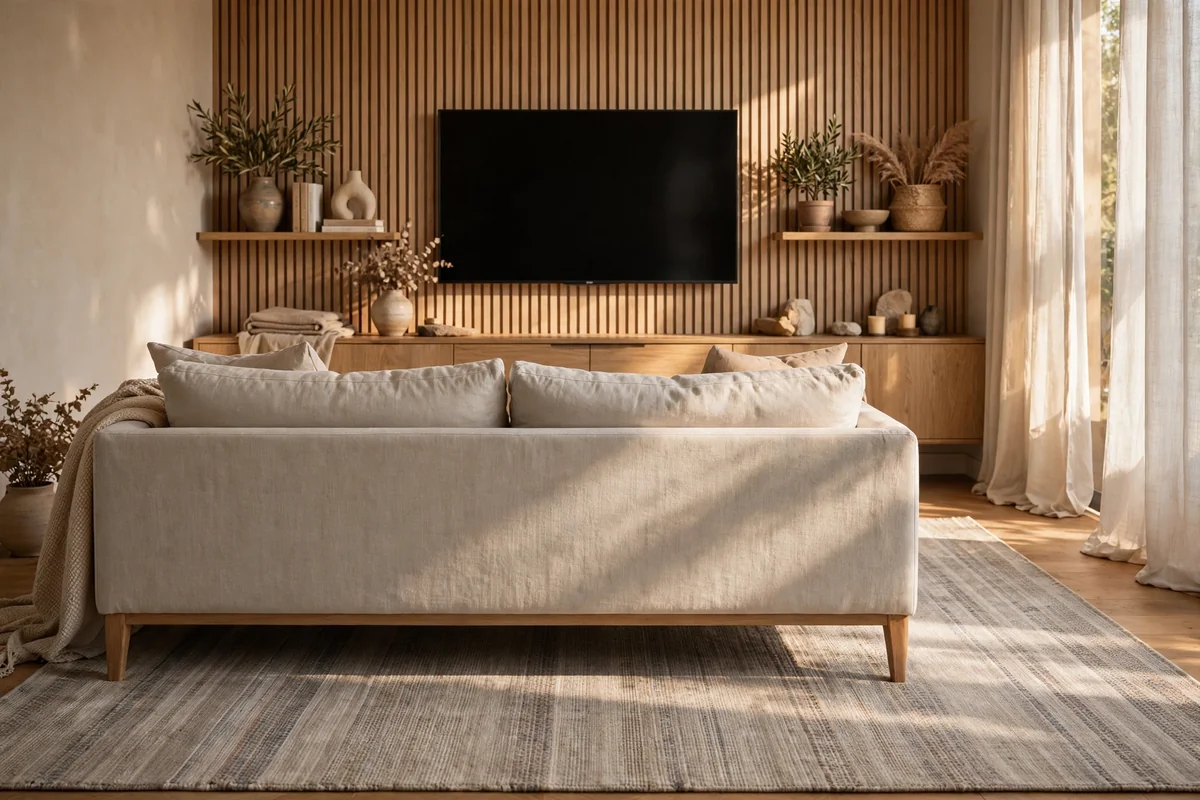
A flatweave rug in front of the viewing sofa pulls the television wall into the same conversation as the seats. Size it so the front legs of the sofa and any armchairs rest on the rug, which usually means at least 160 by 230 cm in a medium living room. Wool or cotton flatweaves in muted stripes, subtle checks or a quiet Persian pattern add warmth without pattern wars.
Keep the rug low pile so chair legs slide and remote controls do not vanish into the fibres. The mistake to avoid is a rug that stops short of the seating, which strands the sofa as an island; the rug should bridge the gap between screen and seats. Expect 120 to 300 for wool at this size, with cotton from 60. Vacuum weekly and rotate twice a year for even wear.
18. Close Shutter Doors Over the Screen When It Is Off
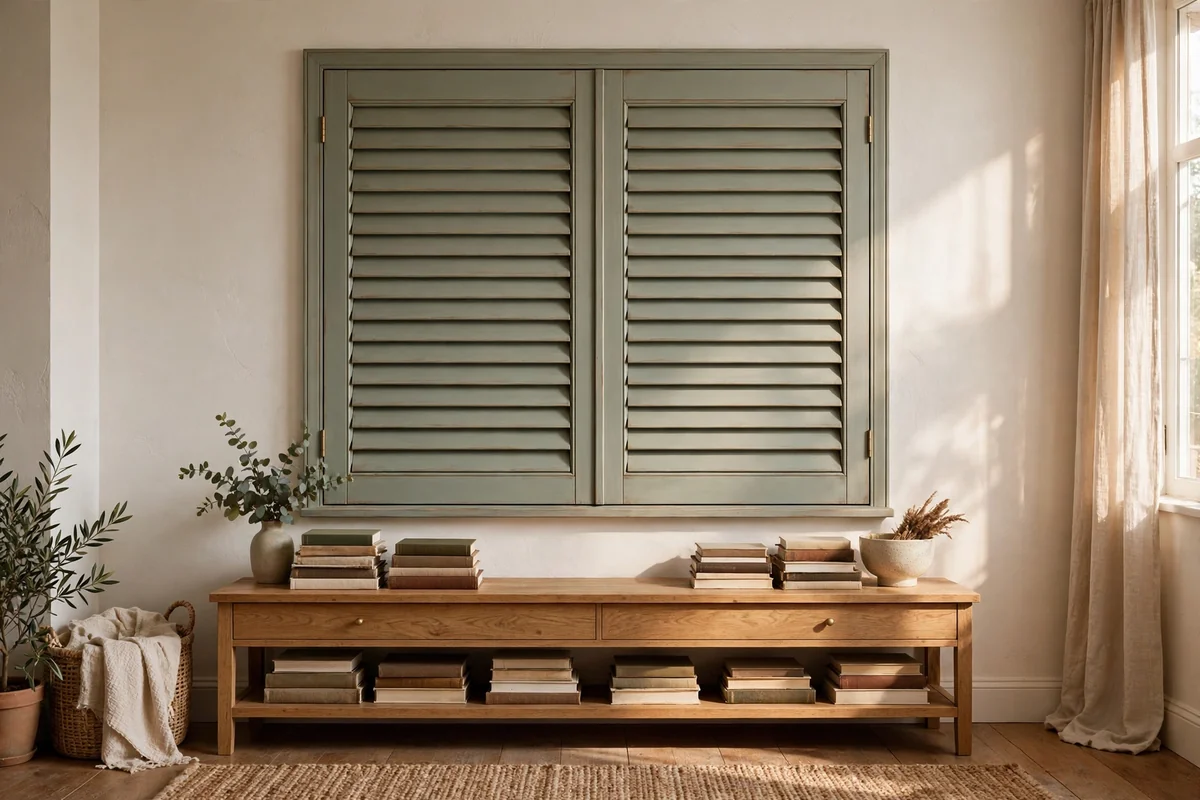
A pair of shutter or cabinet doors mounted on the television wall lets the screen vanish completely during the day. Fix sliding barn-style doors or hinged louvred doors on a track above and below the screen, sized to cover the full width plus 10 cm on each side. Choose painted timber or cane-fronted panels to suit the room; louvres allow remote signals to pass through when closed.
The mistake to avoid is doors that rattle when the volume rises; felt pads and a magnetic catch keep everything silent. Sliding doors need a sturdy wall or a mounted header board to carry the weight. A pair of ready-made louvred doors costs 100 to 200, with track hardware around 40. Closing the doors each morning turns the television wall into a quiet furniture piece.
19. Size the Console Wider Than the Screen for Calm Proportions
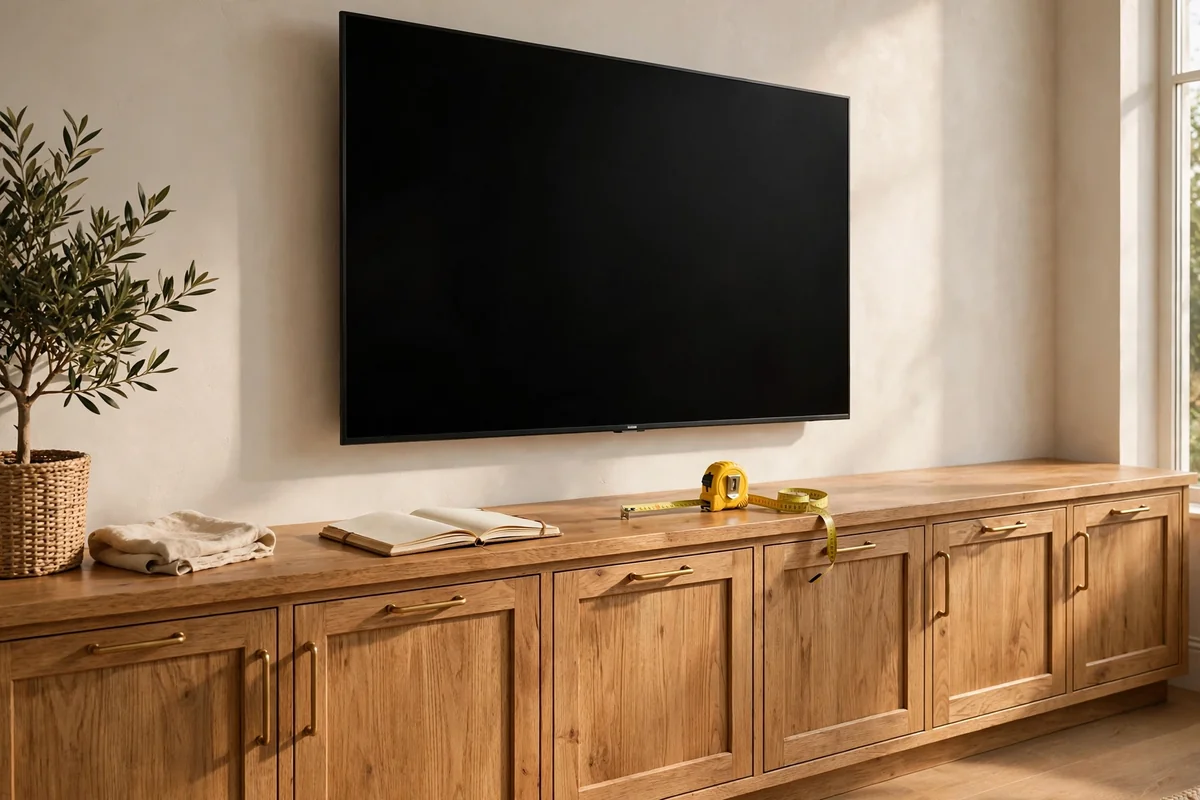
A console that extends 20 to 30 cm beyond the screen on each side creates a stable base that makes the television feel deliberately placed. Measure your screen’s full width including the bezel before buying, since a 55-inch screen spans about 124 cm. The console should also be deep enough, 35 to 45 cm, to hold the television stand safely with room to spare at the back for ventilation.
The mistake to avoid is a console narrower than the screen, which makes the television look top-heavy and risks a toppling knock from the side. If your current unit is too short, flanking it with two matching side cabinets achieves the same wide line. This is a measuring rule rather than a purchase, so it costs nothing. Apply it before any other styling, since proportions carry the whole wall.
20. Tuck the Soundbar Flush Under the Screen Edge
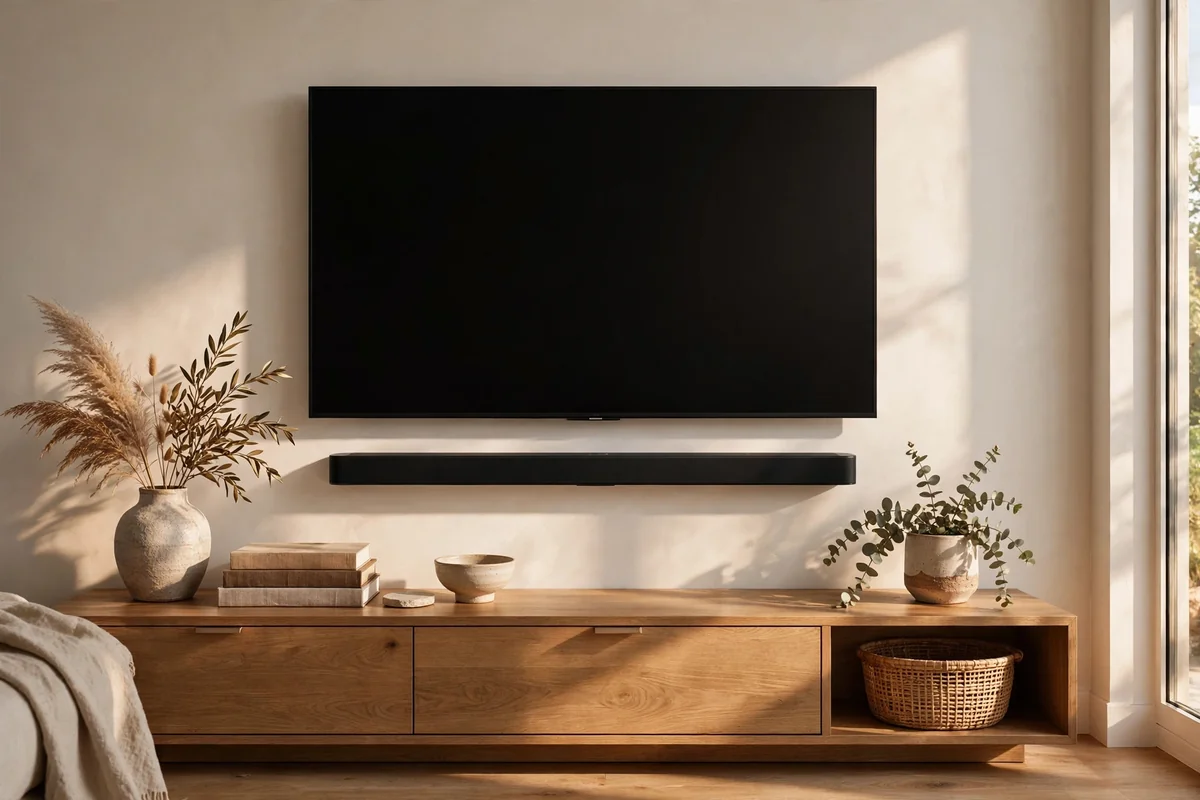
A soundbar mounted directly beneath the television, 2 to 5 cm below the bottom bezel, reads as one clean band instead of two competing objects. Use the manufacturer’s mounting brackets or a slim universal mount fixed into the same studs as the television. Centre it exactly and keep its front face flush with or slightly behind the screen’s face so it never blocks the remote sensor.
The mistake to avoid is resting the soundbar on the console a metre below the screen, which disconnects the sound from the picture visually and acoustically. Run its cable through the same raceway as the television leads before final fixing. Soundbars cost 80 to 300 at mid tier, with mounts under 25. If you skip a soundbar entirely, a slim pair of bookshelf speakers at the console ends does the same visual job.
21. Keep Remotes and Small Clutter in One Lidded Basket
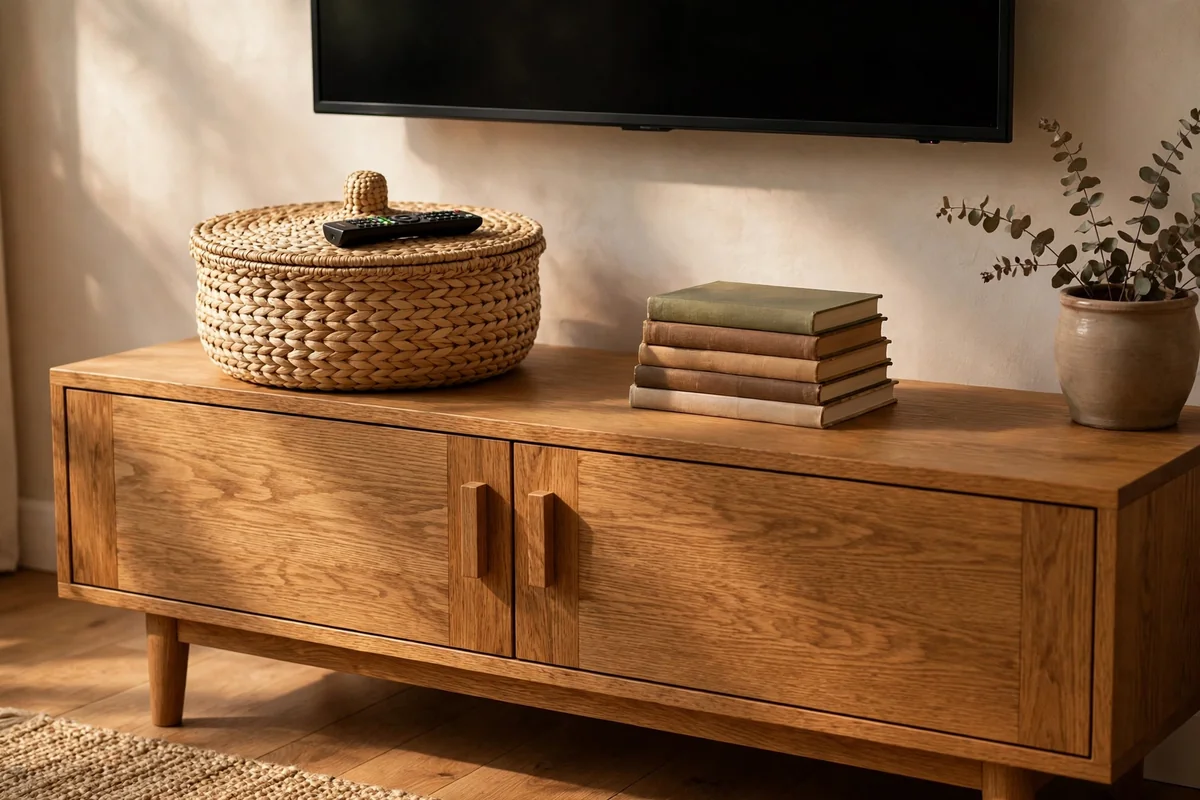
A single lidded basket on the console or beside the sofa swallows remotes, batteries, charging cables and the small clutter that collects around any television. Choose a woven seagrass or lidded wood basket about 25 to 35 cm across so it holds everything without becoming a junk drawer. A lid keeps the contents invisible, which is the whole point; open trays invite overflow.
Sort the basket once a month and remove anything that has not been used in the last fortnight. The mistake to avoid is buying a basket so large it becomes a dumping ground; if it takes two hands to lift, it is too big. Baskets cost 15 to 40 and suit every room style. Place it at the console end nearest the usual seat so tidying takes one step.
22. Put Evening Lighting on a Timer Plug for Effortless Glow
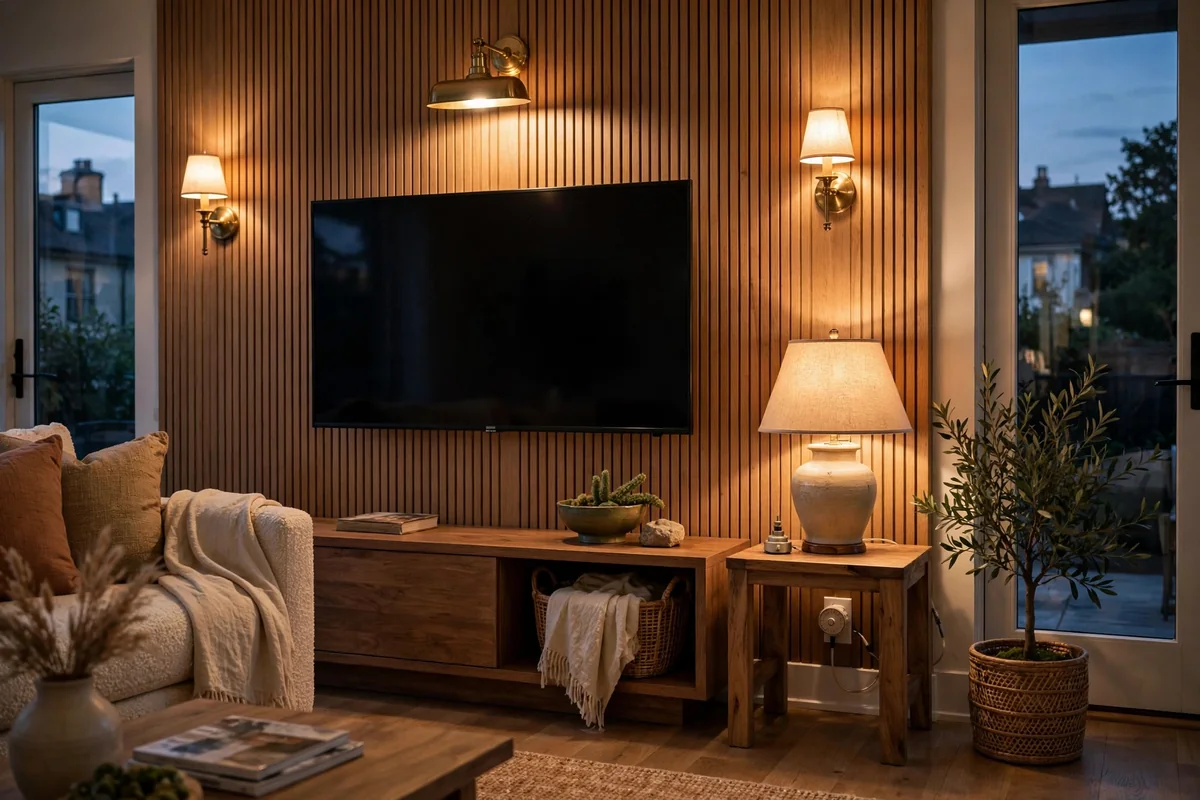
A simple timer plug on the picture light, sconces or a table lamp means the television wall glows every evening without anyone remembering a switch. Set it to come on at dusk and off at bedtime, adjusting by about 15 minutes a month as daylight shifts. Mechanical timers cost under 10, while smart plugs with app scheduling run 15 to 25 and handle the seasonal drift automatically.
The mistake to avoid is plugging the television itself into the timer, which cuts power abruptly and can interrupt software updates; timer only the decorative lighting. Group two or three lamps on one plug with a short extension lead to create a whole evening scene in one action. This is the smallest effort idea in the set and the one most likely to make the wall feel finished every single day.
Across these 22 ideas, one thread runs through: the television stops being an intruder when the wall treats it like furniture. Framing, shelving, colour and lighting each give the screen a job to do, so it rests quietly in the room instead of dominating it. None of these ideas needs a renovation budget or specialist skills, just measuring, patience and a warm bulb or two.
If you try only one thing this week, paint the cable raceway and hide the wires. It takes under an hour, costs very little, and every other idea on this list looks twice as good once the cables are gone. Then choose your next step from the wall itself and enjoy a living room that feels finished from sofa to screen.
Frequently Asked Questions
How far should the sofa sit from the TV?
As a rule, sit 1.5 to 2.5 times the screen’s diagonal away. A 55-inch screen suits a viewing distance of roughly 2.1 to 3.5 metres. In a small room, mount the TV on the wall and use a slim console to free up floor space, which often gains you the extra half metre you need for comfortable viewing.
What colour should I paint the wall behind the TV?
Choose a deep, muted tone like olive, ink navy or warm brown in a matt finish. Dark matt paint reduces glare and lets a switched-off screen blend away. Keep the other walls two or three shades lighter in the same colour family. Always test a large swatch beside the screen, on and off, before committing to a full tin.
Can I decorate around the TV in a rented flat?
Yes. Use paintable adhesive cable raceways, plug-in picture lights and sconces, picture-hanging strips for gallery walls, and a lidded basket for clutter. A freestanding bookshelf pair flanking the TV needs only wall brackets. Every idea above except drilling battens into the wall has a removable version that landlords accept.
How much does a TV feature wall cost?
A painted feature wall with hidden cables can cost under 80. Adding battens or a gallery wall brings most projects to 150 to 300. Built-in style shelving with a wide console lands between 400 and 800. Start with the cable raceway and lighting, which are the cheapest changes and make every other upgrade look better.
How do I hide TV cables without drilling?
Stick a paintable adhesive raceway down the wall in the wall colour, route HDMI leads through it and leave power separate. Run slack leads behind a freestanding console instead of across the floor. A smart plug on the TV’s USB port can power bias lighting without extra adapters. The whole job takes about an hour.