Living Room
23 Rug Size Rules for Every Room in the House
By Anna Wells · · 22 min read
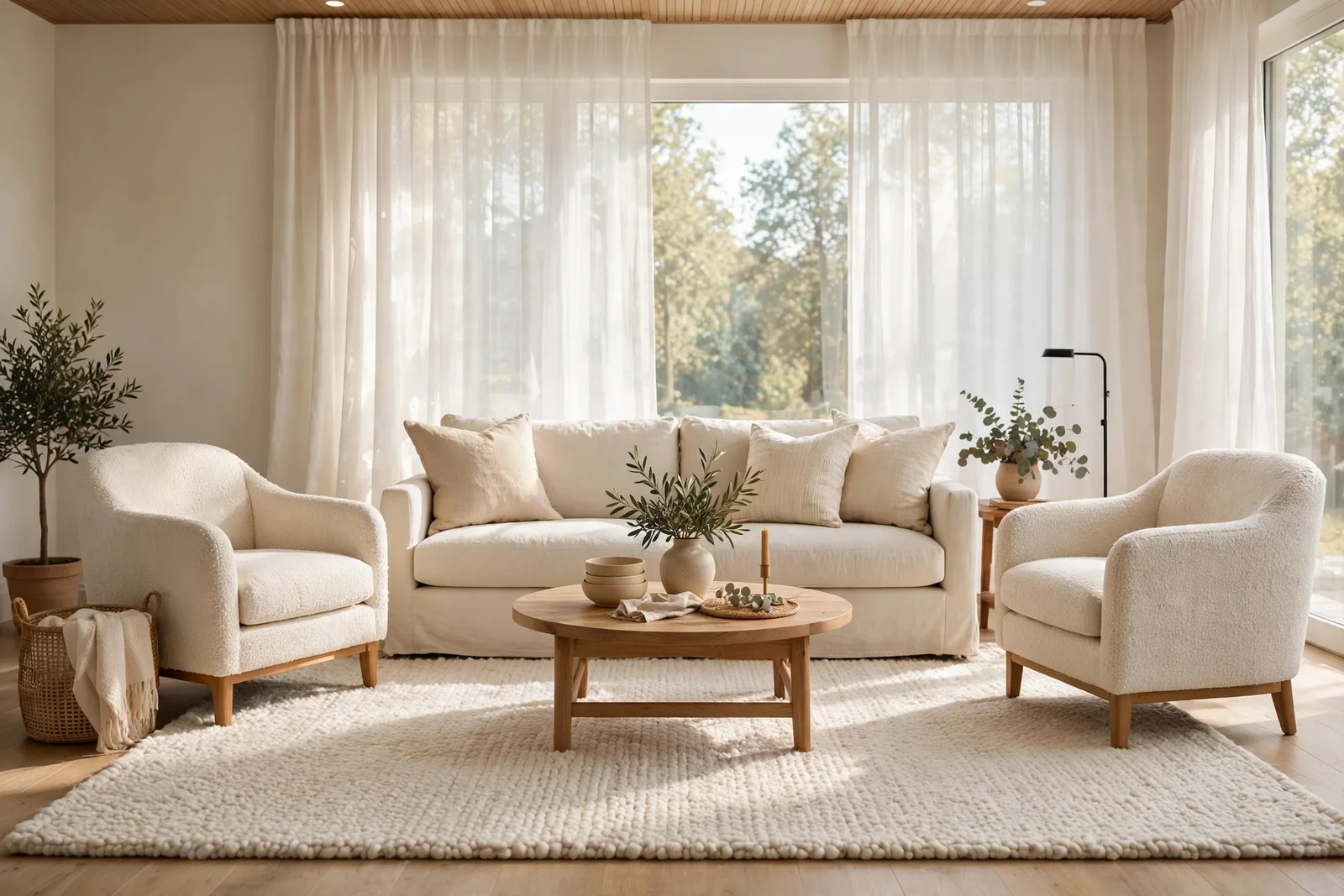
A room-by-room guide to choosing the right rug size, with exact centimetre and feet measurements for living rooms, dining tables, bedrooms, runners, layering and the simple tape-on-the-floor test.
The rug arrives, you unroll it with real excitement, and something feels quietly off. The sofa legs dangle past its edge, the dining chairs catch on the border, and the bedroom floor still greets your bare feet with a chill each morning. Nearly every rug disappointment comes down to size rather than style, and size is the one thing you can settle before spending a penny.
This guide walks you room by room through 23 practical sizing rules, each with exact centimetre and feet measurements you can transfer to your own floor. You will learn the three living room layouts, the chair pull-out allowance for dining tables, how far a bedroom rug should reach on the sides and the foot, runner widths for hallways and kitchens, layering tricks, rug pads, door clearance, and the golden rule for choosing between two sizes.
Every rule carries the numbers that matter, one mistake to avoid, and a budget tip suited to family homes. All you need is a tape measure and a roll of painter’s tape. By the end, you will know precisely which rug size each room in your house is asking for.
Let us start in the living room, where most sizing confusion begins.
1. Float All Furniture Legs on the Rug in Big Living Rooms
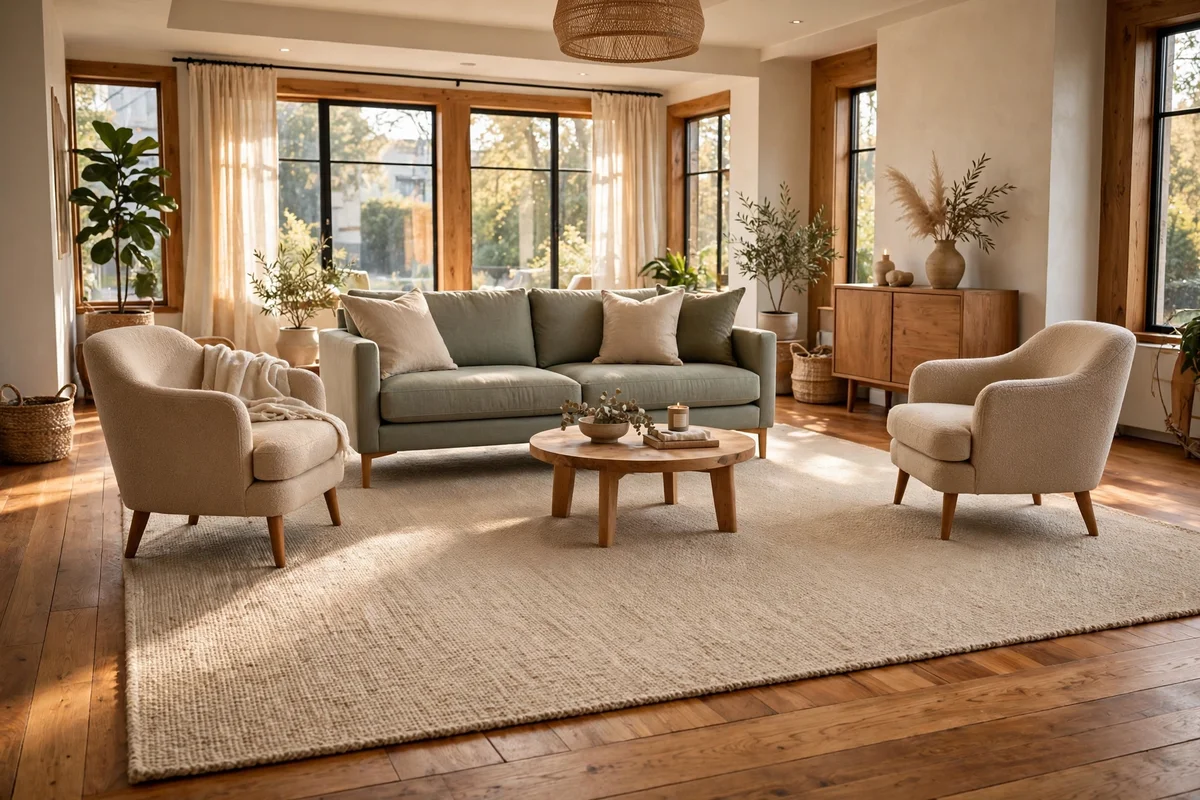
In a generous living room, the most grounded look comes from placing every furniture leg on the rug. A three-seat sofa of about 210 centimetres (7 feet) plus two armchairs needs a rug of at least 240 by 340 centimetres (about 8 by 11 feet). The rug should extend 20 to 30 centimetres beyond the outermost chair legs so the seating reads as one island. This layout suits rooms wider than 4 metres and feels calm and complete.
Start by measuring your seating footprint from the back of the sofa to the front of the chairs, then add 50 centimetres all round. A flatweave or low-pile rug works best here because doors and chair legs move easily over it. The mistake to avoid is stopping the rug halfway under the sofa, which makes furniture look adrift. Budget tip: a 240 by 340 centimetre cotton flatweave often costs far less than a hand-knotted piece and suits busy family rooms.
2. Rest Just the Front Legs of Sofas on the Rug
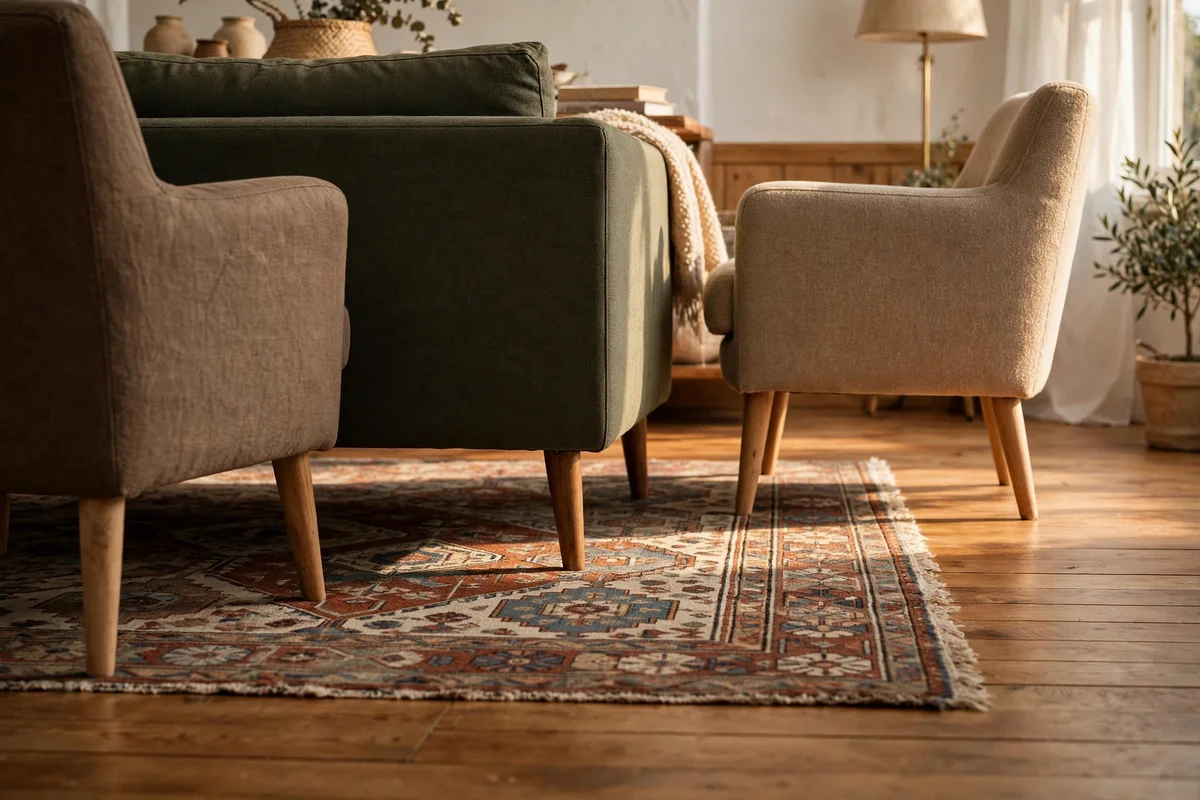
For medium living rooms this is the most forgiving layout. Place the rug so the front legs of the sofa and armchairs rest on it while the back legs stay on the bare floor. A rug of 200 by 290 centimetres (about 6.5 by 9.5 feet) suits a three-seat sofa up to 230 centimetres (7.5 feet) wide. Pull the sofa forward until its front feet sit 15 to 20 centimetres onto the rug, then angle armchairs in so their front legs join the same line.
This layout visually connects the seating without demanding a huge rug, and it works in rooms as narrow as 3.5 metres. Keep at least 25 centimetres of rug in front of the sofa so feet land softly when you stand up. The common mistake is pushing the rug too far under the sofa, which swallows the pattern and wastes half the fabric. A mid-range 200 by 290 centimetre wool blend is the sweet spot for price and durability in family homes.
3. Let a Small Rug Float Free Between the Seating
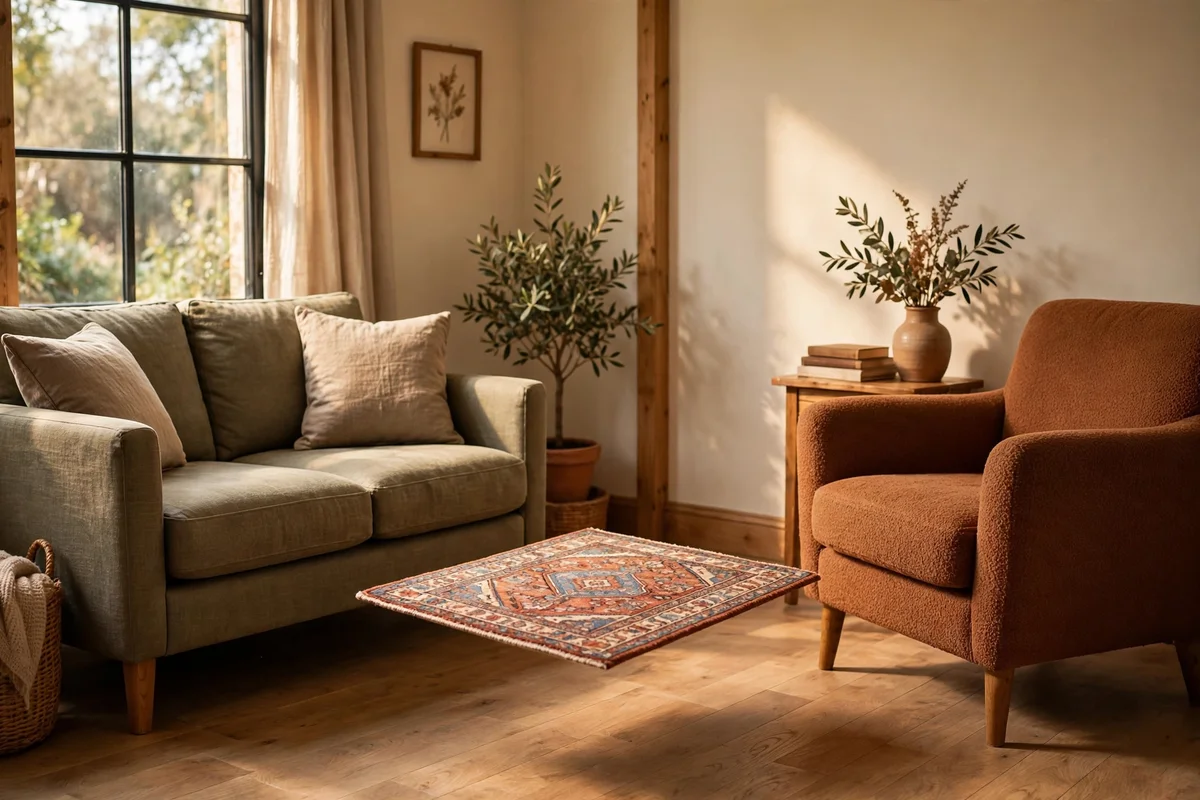
In tight sitting rooms the rug can simply float, touching no furniture at all. A rug of 120 by 170 centimetres (4 by 5.6 feet) centred between a two-seat sofa and a single armchair adds colour and softness without crowding. Leave at least 30 centimetres of clear floor between the rug edge and each furniture leg so the gap looks deliberate rather than accidental. This trick suits rented flats and box rooms where every centimetre counts.
Choose a flatweave or thin cotton rug so the door sweeps over it cleanly and chairs glide without snagging. Anchor the look with a small round coffee table in the centre, keeping 20 centimetres of rug visible around its base. The mistake to avoid is buying a floating rug that is so small it reads as a doormat; 120 by 170 centimetres is the honest minimum. Budget tip: washable cotton rugs in this size are plentiful and easy to refresh each season.
4. Fit Two-Seat Sofas on a 160 by 230 cm Rug
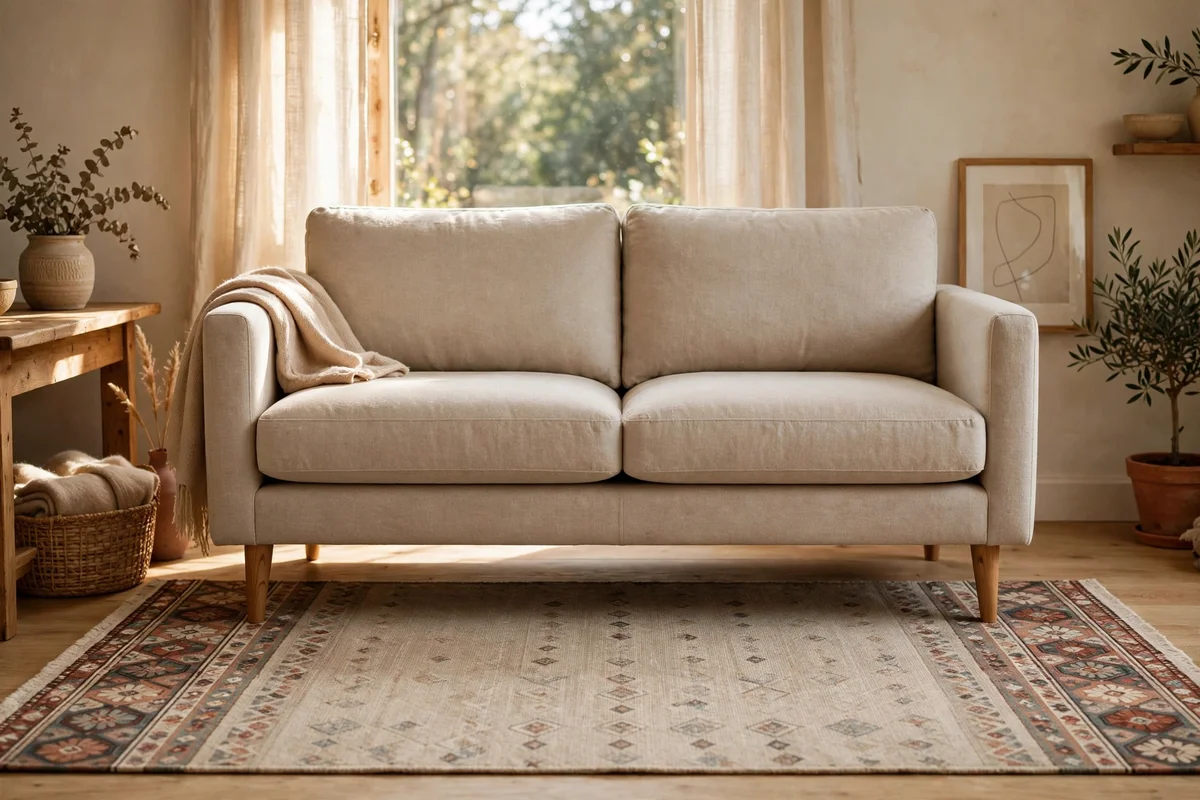
A two-seat sofa usually measures 140 to 160 centimetres (4.6 to 5.2 feet) wide, so a rug of 160 by 230 centimetres (about 5.2 by 7.5 feet) gives it a comfortable frame. Place the rug lengthways with the sofa, letting the front legs sit 15 centimetres onto the rug. This leaves a generous 35 to 45 centimetres of pattern visible on each side of the sofa, which balances the composition and gives the room a finished border.
If the room stretches beyond 4 metres, step up to 200 by 290 centimetres (6.6 by 9.5 feet) so the rug still fills the floor honestly. Add one armchair angled at the rug corner with its front legs on, and keep the coffee table centred. The mistake to avoid is centring the rug on the wall instead of the seating; always align it to the furniture. A washable 160 by 230 centimetre rug is a budget-friendly choice for households with small children.
5. Anchor Three-Seat Sofas With a 200 by 290 cm Rug
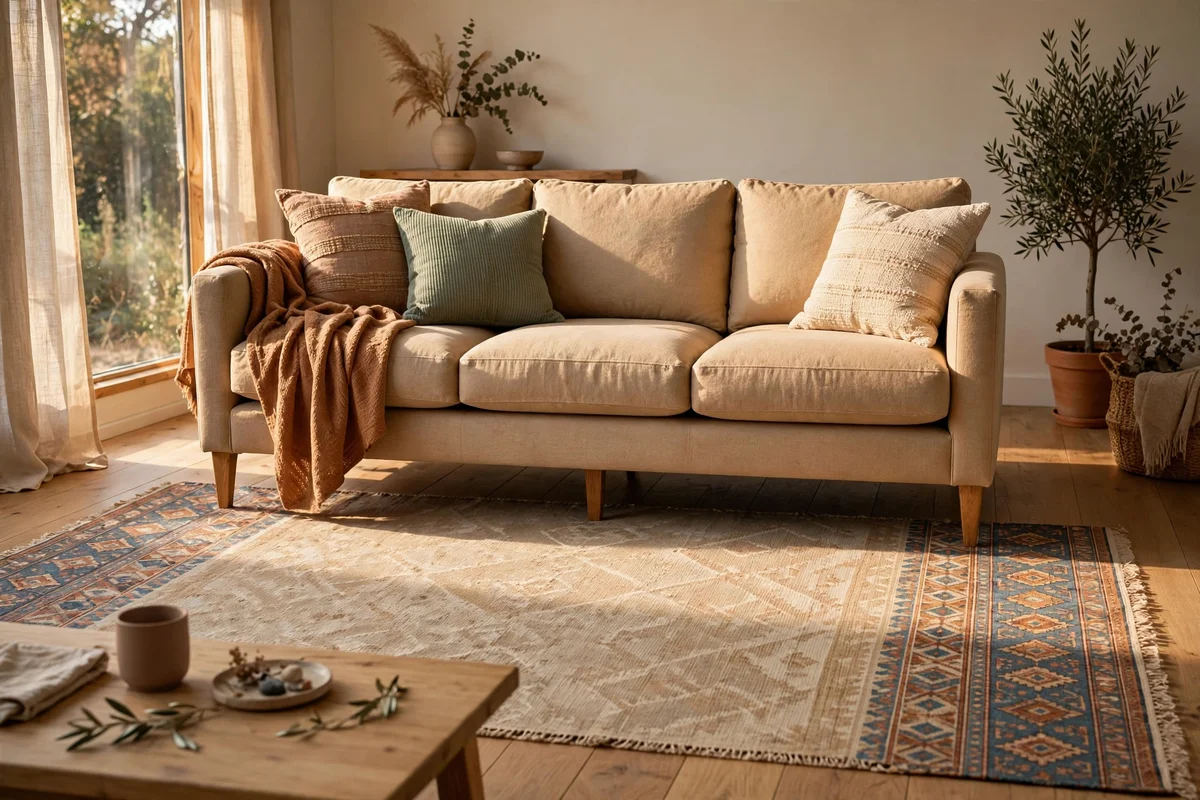
Three-seat sofas run 200 to 230 centimetres (6.6 to 7.5 feet) wide and need a rug with presence. A 200 by 290 centimetre rug (about 6.6 by 9.5 feet) placed lengthways lets the sofa front legs rest on it with 30 to 45 centimetres of rug showing on each side. Position the rug so 25 centimetres of it slides under the sofa; any less and the sofa looks perched, any more and you hide the pattern you paid for.
In rooms wider than 4.5 metres, the next size up, 240 by 340 centimetres (about 8 by 11 feet), keeps the rug from looking like a postage stamp. Pair the sofa with two armchairs facing in, front legs on the rug, and leave 20 centimetres between chair backs and the rug edge. The mistake to avoid is matching the rug width exactly to the sofa width; equal edges make both look smaller. Wool-blend rugs in this size sit in the mid price tier and last for years.
6. Measure Dining Rugs With the Chair Pull-Out Allowance
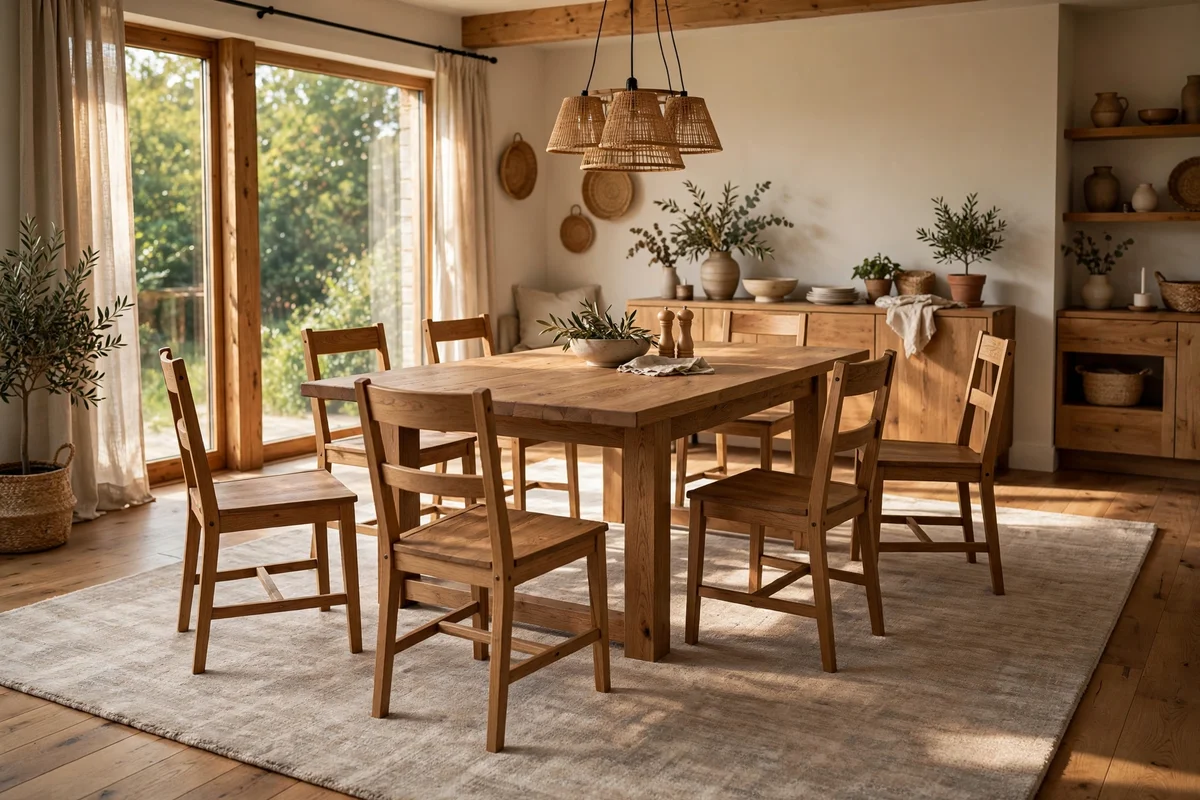
Dining chairs slide back 60 to 75 centimetres (2 to 2.5 feet) when people sit down, and the rug must hold the back legs even then. Add 60 centimetres beyond the table edge on all four sides: a 180 by 90 centimetre table (6 by 3 feet) needs a rug of at least 300 by 210 centimetres (about 10 by 7 feet). Mark the allowance with tape, pull out every chair, and check the back legs stay on fabric before you buy.
Round tables follow the same rule with diameter: a 120 centimetre (4 foot) round table needs a rug at least 240 centimetres (8 feet) across so chairs rest fully on it. Choose low-pile, easy-clean weaves for dining rooms because crumbs and spills are certain. The mistake to avoid is sizing the rug to the table alone; chairs teetering half on and half off the edge will drive you mad within a week. Washable flatweaves keep this high-traffic zone simple to maintain.
7. Extend Bedroom Rugs 60 cm Beyond Each Side of the Bed
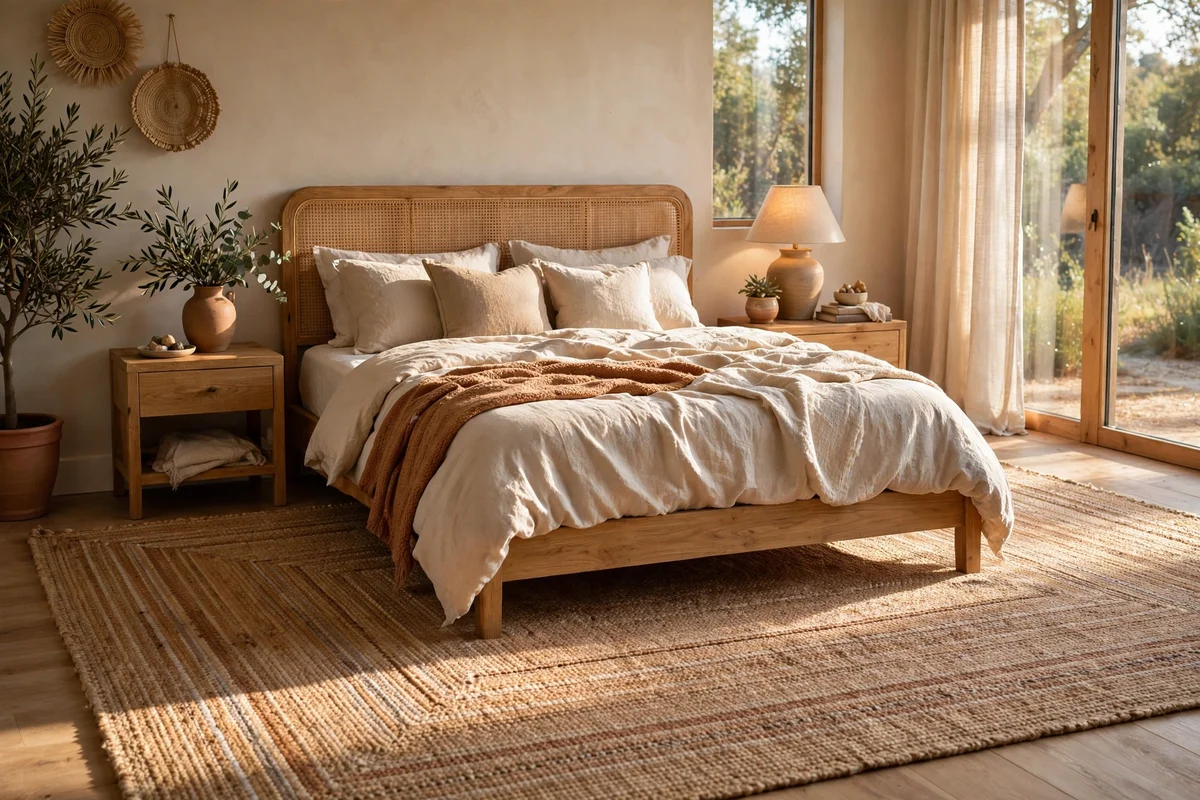
Your feet should land on softness, not cold floor, when you get out of bed. A queen bed of 160 centimetres (5.2 feet) wide needs a rug that stretches 60 to 75 centimetres (2 to 2.5 feet) beyond each side. For a 200 centimetre (6.6 foot) long bed, a rug of 230 by 300 centimetres (7.5 by 10 feet) placed two-thirds under the bed gives that landing zone. Measure from the mattress edge, not the bed frame, for the true stepping point.
Slide the rug under the bed so it starts just in front of the nightstands, keeping their legs on the floor for stability. A medium-pile wool or cotton rug feels warm underfoot and deadens morning noise. The mistake to avoid is a rug that ends flush with the mattress edge, forcing bare feet onto cold boards every morning. Budget tip: a simple cotton dhurrie layered at the bedside costs little and washes easily when seasons change.
8. Run the Bedroom Rug 45 cm Past the Foot of the Bed
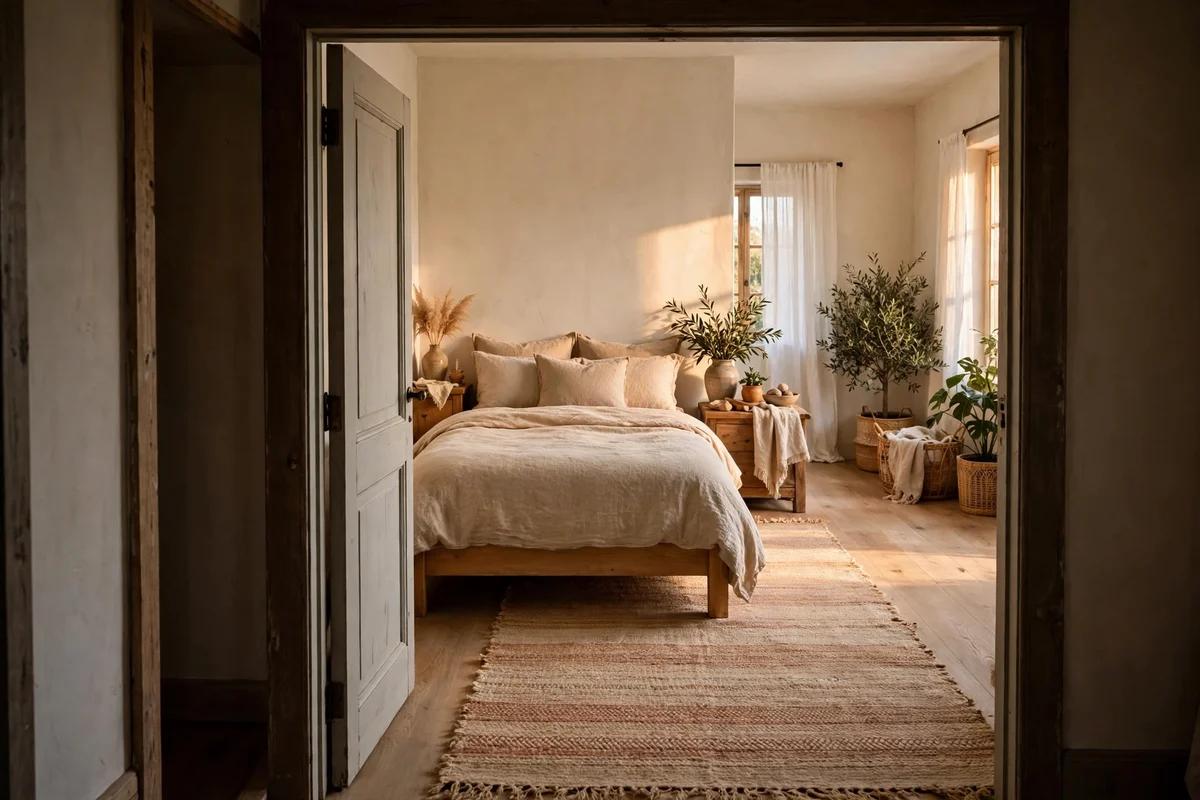
The foot of the bed is the second barefoot zone most people forget. Extend the rug 45 to 60 centimetres (1.5 to 2 feet) beyond the foot so stepping around the bed stays soft. With a 200 centimetre (6.6 foot) bed and a rug beginning two-thirds of the way under it, a 300 centimetre (10 foot) long rug lands the far edge exactly right. This also frames the bed beautifully from the doorway, giving the whole room a tailored finish.
If the rug will not reach the foot, add a matching runner or a folded throw rug at the bed end instead of buying oversized. Keep the rug at least 10 centimetres clear of wardrobe and dresser doors so they swing freely. The mistake to avoid is letting the rug bunch against the bed base; smooth it flat and tuck the edge under the frame. A low-profile rug pad beneath stops the whole arrangement creeping toward the foot overnight.
9. Match Hallway Runner Width to the Corridor, Not Habit
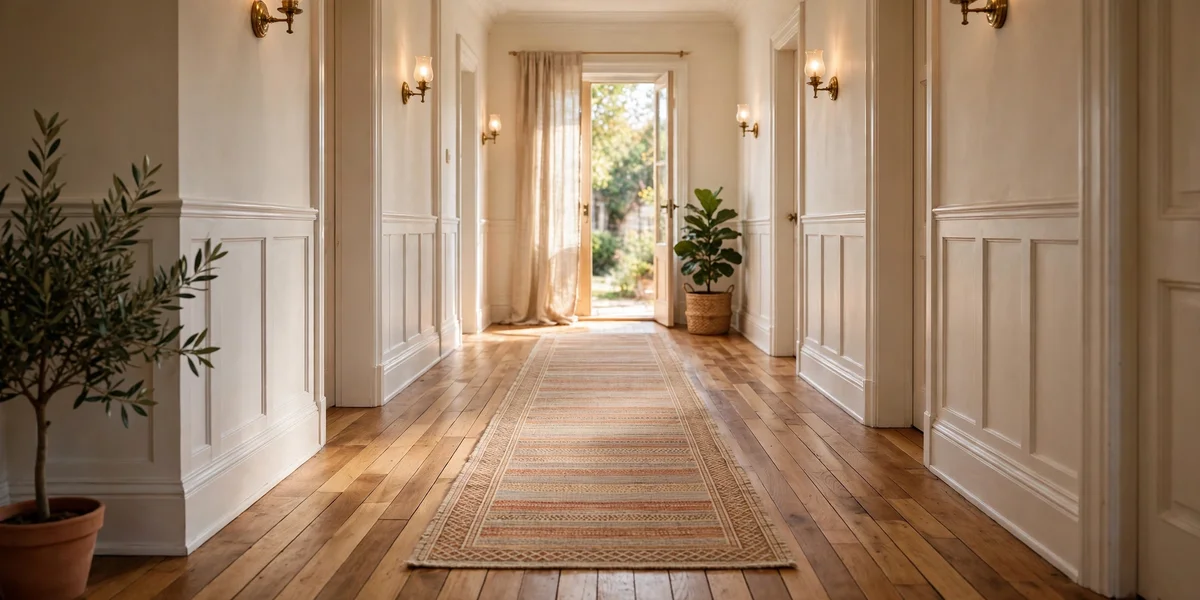
Runner width should follow the hallway, leaving 10 to 15 centimetres (4 to 6 inches) of bare floor on each side. In a narrow 90 centimetre (3 foot) corridor, a 60 to 70 centimetre (2 to 2.3 foot) runner keeps the walk clear. In a generous 120 to 140 centimetre (4 to 4.6 foot) hallway, an 80 to 90 centimetre (2.6 to 3 foot) runner fills the space without touching the skirting. Measure the corridor at both ends because older houses taper.
Length matters too: leave 15 to 20 centimetres of floor at each doorway threshold so the runner does not butt against the frame. For long corridors, join two runners end to end with a 5 centimetre overlap rather than one giant piece, which is easier to clean. The mistake to avoid is a runner so wide it curls against the skirting and trips everyone. Budget tip: cotton runners in standard 70 by 230 centimetre (2.3 by 7.5 foot) sizes are inexpensive and machine washable.
10. Lay Kitchen Runners With Clearance for Doors and Steps
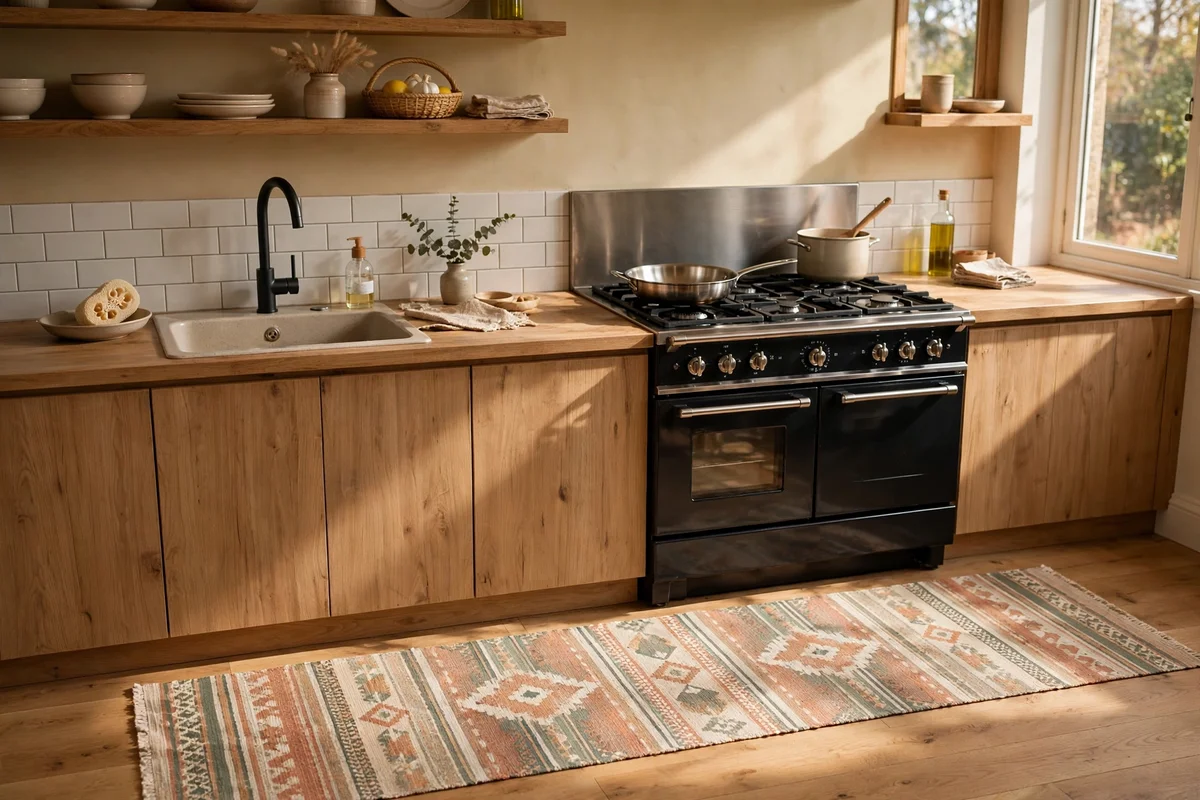
A kitchen runner belongs where you stand: in front of the sink, the cooker and the main prep counter. Choose 70 to 90 centimetres (2.3 to 3 feet) wide and 120 to 200 centimetres (4 to 6.6 feet) long, keeping 10 centimetres clear of cupboard and dishwasher doors so they open without catching. In galley kitchens, one long runner down the centre softens the whole walkway and catches spills where they happen.
Pick flatweave cotton or washable low-pile synthetics because kitchen rugs face grease, water and dropped food daily. A rubber-backed pad stops sliding on tiles, which matters on wet floors. The mistake to avoid is a thick shaggy rug by the cooker; it traps crumbs and sits too close to heat. Budget tip: indoor-outdoor runners in warm patterns cost little, hose down easily, and survive the busiest family kitchens for years.
11. Layer a Small Precious Rug Over a Large Plain Base
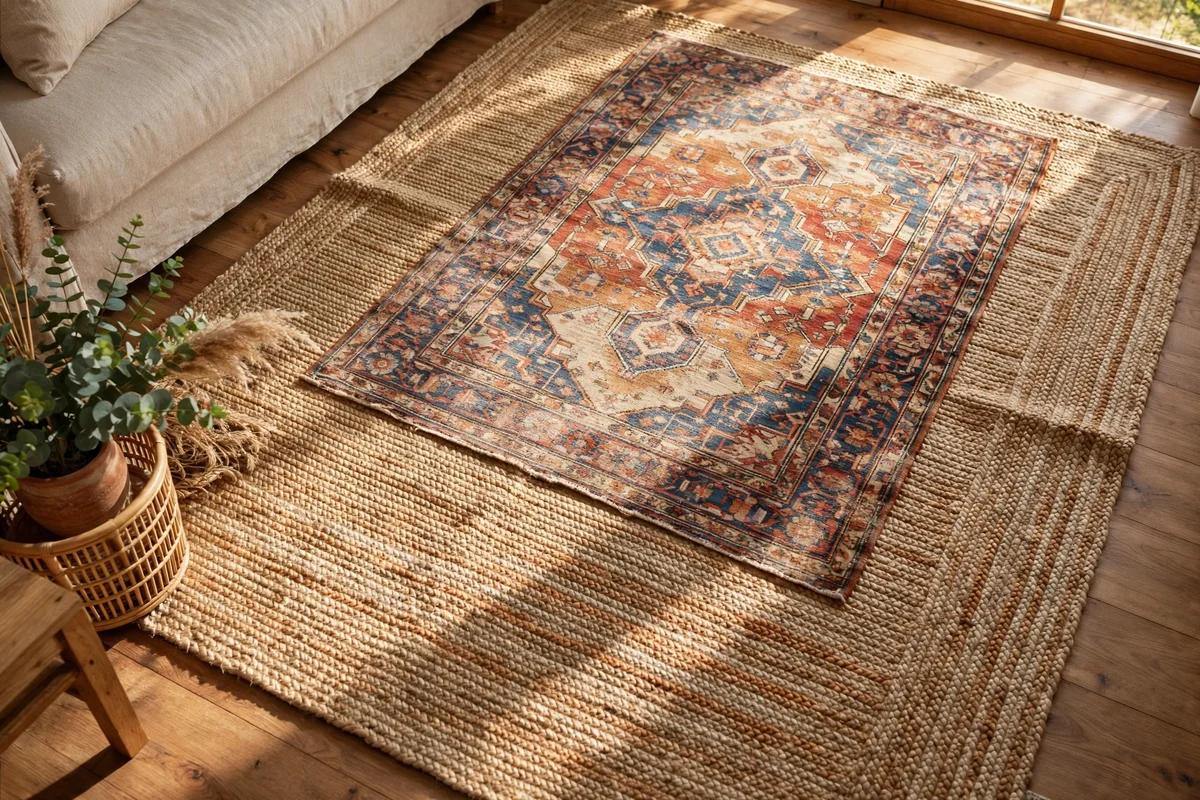
When a treasured vintage or hand-knotted rug is too small for the room, layer it over a larger plain rug instead of hiding it away. Set a 200 by 290 centimetre (6.6 by 9.5 foot) jute or sisal base first, then centre or offset a 120 by 170 centimetre (4 by 5.6 foot) patterned rug on top. The plain base supplies the correct footprint while the small rug becomes the artwork of the floor.
Keep the top rug 20 to 30 centimetres inside the base on all sides so the border reads clearly. Use double-sided rug tape or a thin pad between the layers to stop slipping. The mistake to avoid is layering two busy patterns together, which fights for attention; one quiet base and one star always wins. Budget tip: a natural jute base plus one smaller patterned rug costs less than one huge hand-knotted piece.
12. Cut the Rug Pad Two Centimetres Smaller Than the Rug
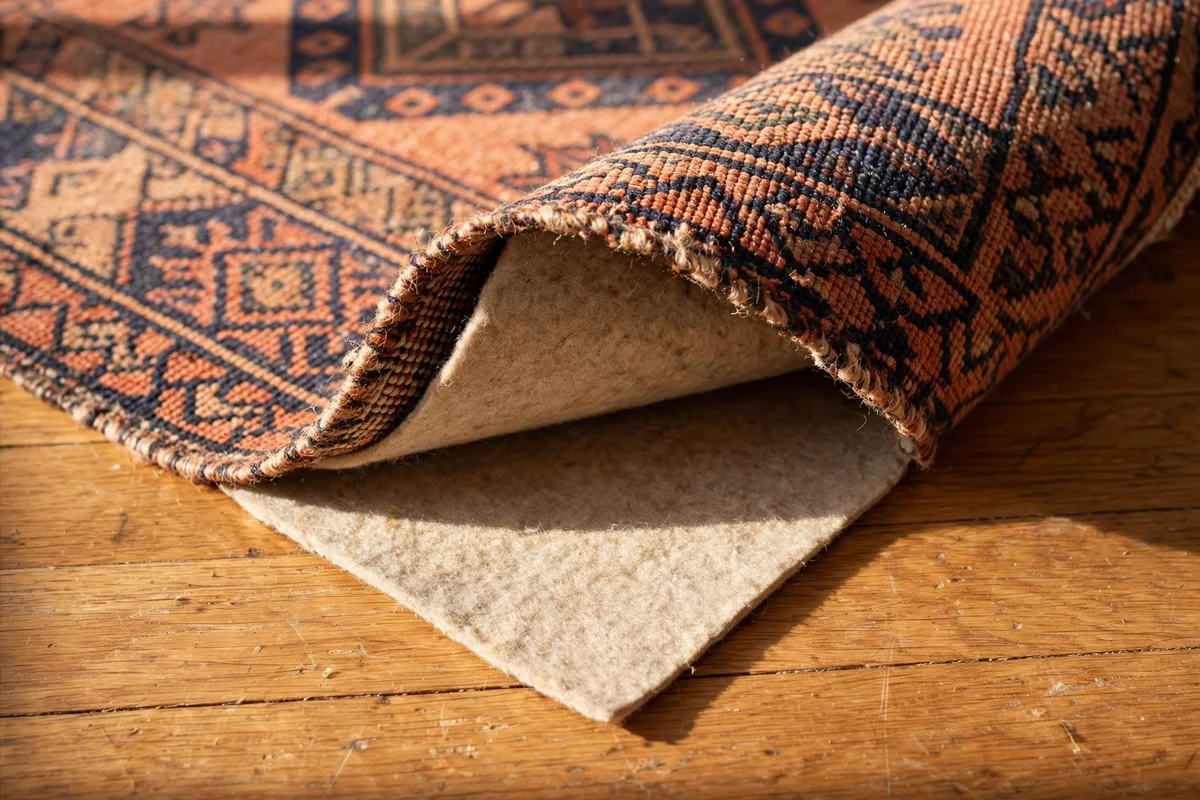
A rug pad should sit 2 to 3 centimetres (about 1 inch) inside the rug edge on every side so it never peeks out. Buy a standard pad close to your rug size, then trim it with sharp scissors along the rug outline. Felt and rubber combination pads grip hard floors best, while pure felt pads add the most cushioning underfoot. The pad stops the rug creeping, adds 6 to 10 millimetres of softness, and protects wooden floors from scratches.
Replace pads every five to seven years because compressed felt stops cushioning and rubber can yellow pale floors. For washable rugs, choose a pad that survives the machine too, or skip the pad and use rug tape instead. The mistake to avoid is a pad larger than the rug; the visible grey edge ruins the look and collects dust. Budget tip: standard felt-rubber pads cost a fraction of the rug and double its comfortable life.
13. Test Every Door Swing Against Rug and Pad Thickness
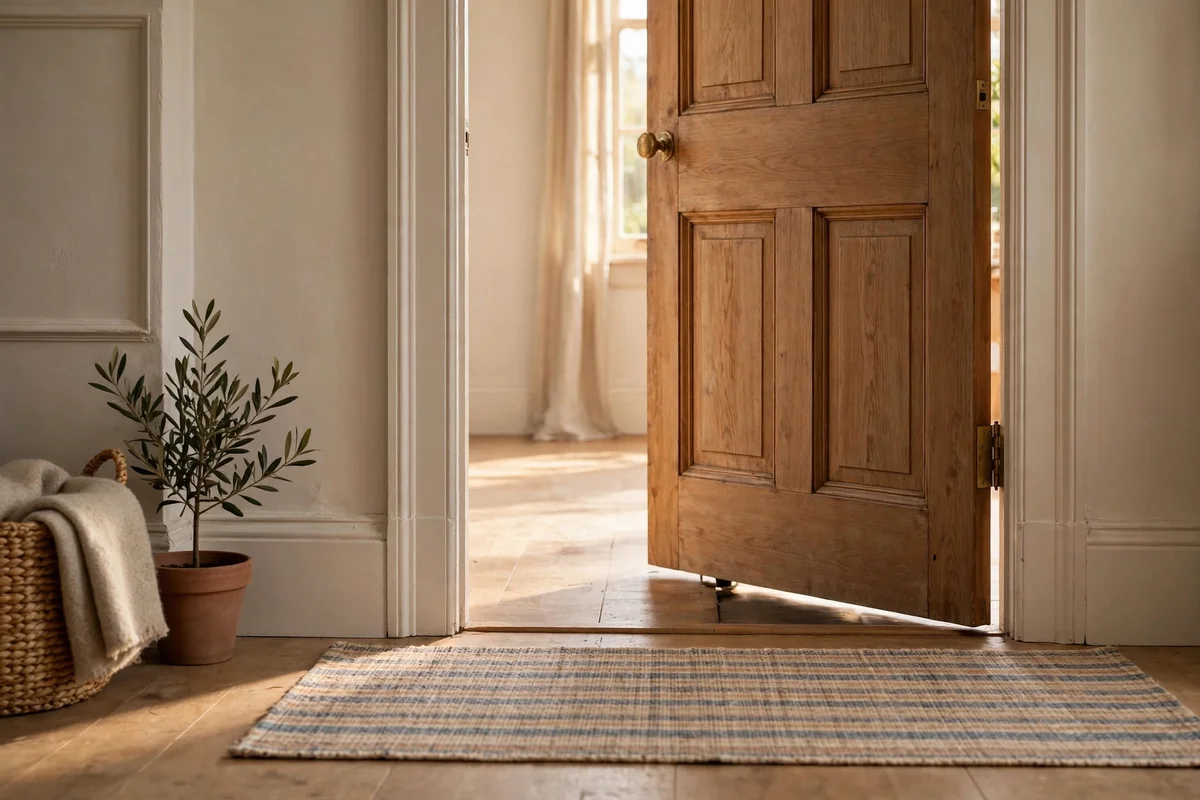
Interior doors usually clear the floor by 15 to 20 millimetres, and a thick rug plus pad can jam them. Measure the gap under each door with a ruler, then compare it to your planned rug pile plus pad, which together often reach 20 to 25 millimetres. If the gap is tight, choose a flatweave under 6 millimetres thick for that doorway zone. This simple check takes two minutes and saves the cost of planing a door.
For doors that must swing over a rug, trim the pad back 10 centimetres from the door arc or leave the rug 30 centimetres short of the swing. Sliding and pocket doors avoid the problem entirely and suit thick bedroom rugs. The mistake to avoid is forcing a swollen door shut; the rubbing damages both the rug edge and the door paint. Budget tip: adhesive felt strips under the door bottom are a cheap fix only for gaps under 5 millimetres.
14. Leave 20 to 30 cm of Bare Floor Around the Rug
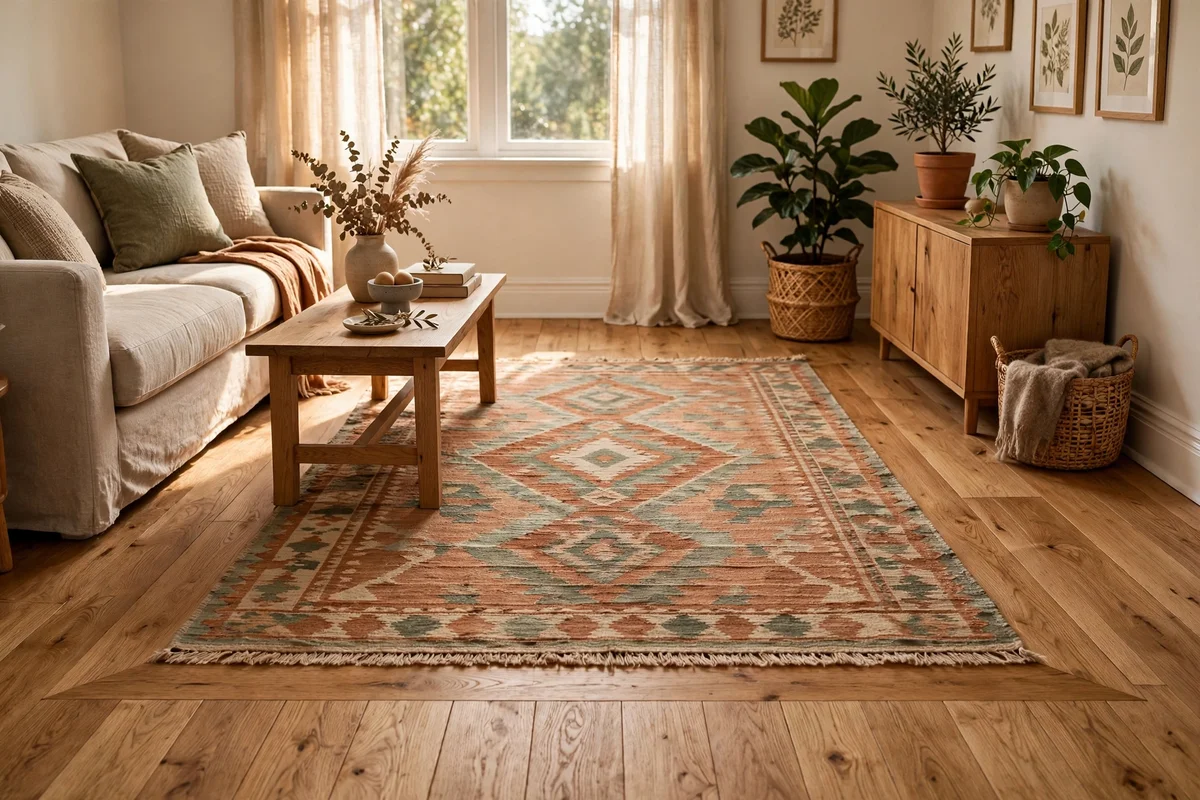
A frame of bare floor between the rug and the wall makes both look better. Aim for 20 to 30 centimetres (8 to 12 inches) of visible floor on the long sides, and at least 15 centimetres at the short ends in small rooms. This border shows off wooden or tiled floors and stops the rug looking like fitted carpet. Measure from the skirting board, not the wall plaster, since skirting can add 2 centimetres.
In open doorways the border can narrow to 10 centimetres without harm, but never let the rug touch two opposite walls at once. If your chosen size leaves less than 15 centimetres on the sides, drop down one rug size rather than squeezing. The mistake to avoid is a wall-to-wall fit that traps dust along the skirting and looks like a carpet mistake. A correctly framed rug also makes vacuuming and mopping the edges far easier.
15. Give the Coffee Table a 20 cm Rug Margin All Round
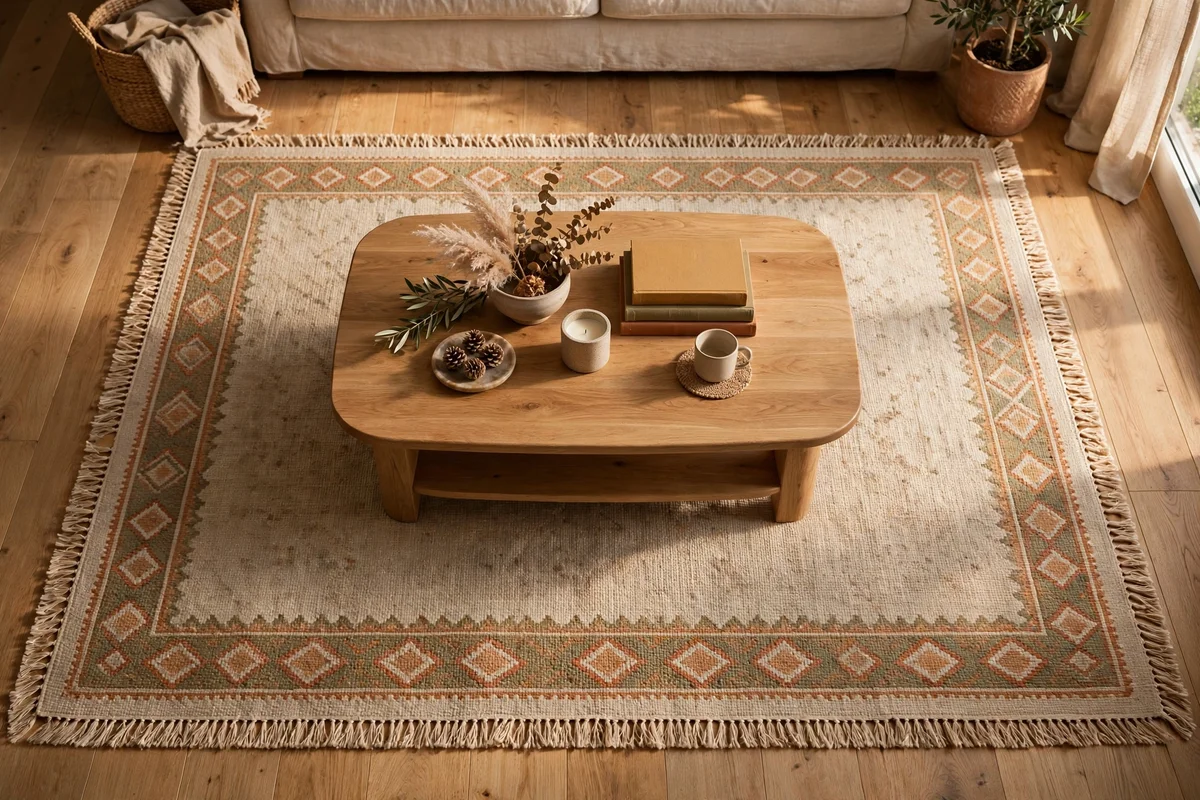
The rug under a coffee table should extend 20 to 30 centimetres (8 to 12 inches) beyond the table on every side. A table of 120 by 60 centimetres (4 by 2 feet) therefore needs a rug at least 160 by 100 centimetres, and in practice a 160 by 230 centimetre (5.2 by 7.5 foot) rug serves the whole seating group. This margin catches feet, steadies the table legs, and gives the arrangement a calm, finished outline.
Centre the table on the rug, not the rug on the table: shift the rug until its edges run parallel to the sofa. For round coffee tables of 90 centimetres (3 feet), a round rug of 150 to 180 centimetres (5 to 6 feet) keeps the margin even all round. The mistake to avoid is a rug that ends exactly at the table legs; from above it looks like the table is wearing the rug. Low-pile weaves here survive feet, trays and the occasional spilt tea.
16. When Caught Between Sizes, Always Size Up
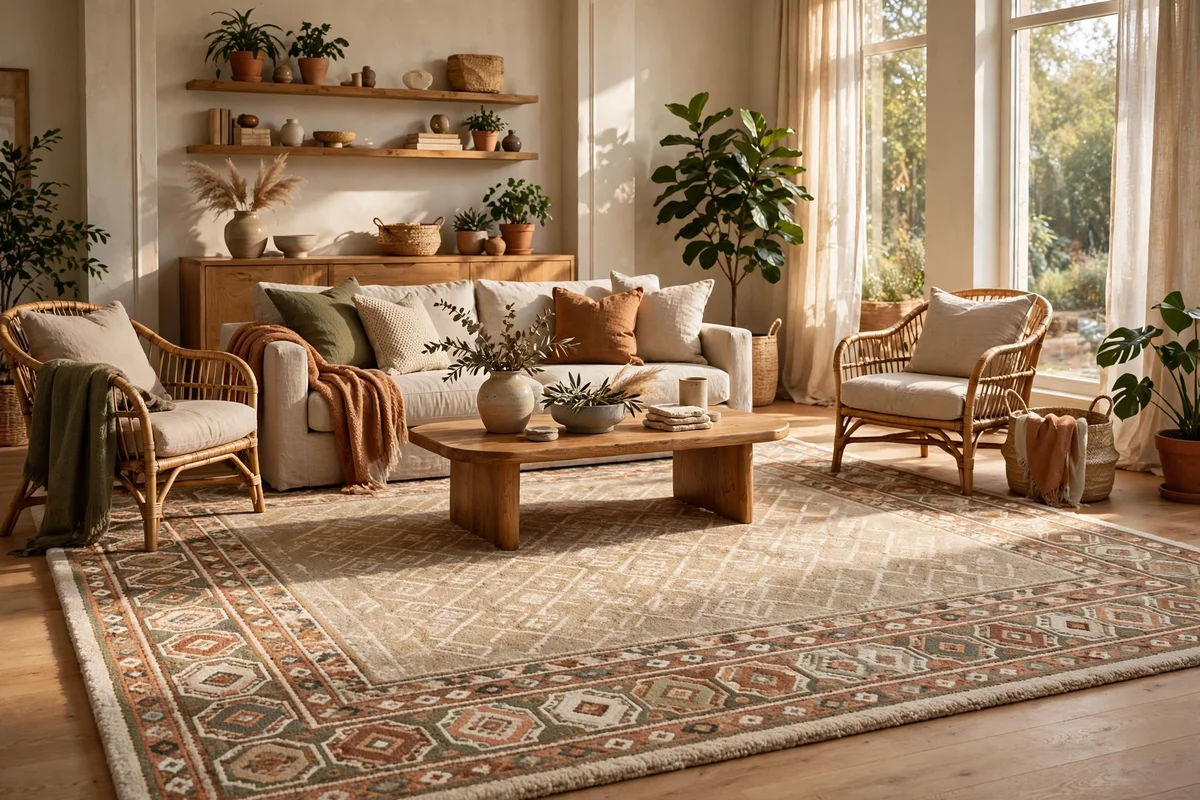
A rug that is slightly too small chops the room into awkward fragments, while one slightly too large simply feels generous. If your tape outline shows 190 by 280 centimetres but the shop sells 160 by 230 (5.2 by 7.5 feet) and 200 by 290 (6.6 by 9.5 feet), choose the larger. The extra 10 centimetres on each side costs a little more but saves the cramped look that makes visitors sense something is off.
This rule holds for every room: dining rugs that clear the chairs, bedroom rugs that reach the sides, and living rugs that hold the furniture. The only exception is a hallway, where width is fixed by the walls. If budget is tight, choose the larger size in a simpler weave rather than the smaller size in luxury pile; scale changes the room, but fibre only changes the texture. A bigger flatweave beats a smaller hand-knotted rug for impact.
17. Mark the Rug Outline With Painter’s Tape Before Buying
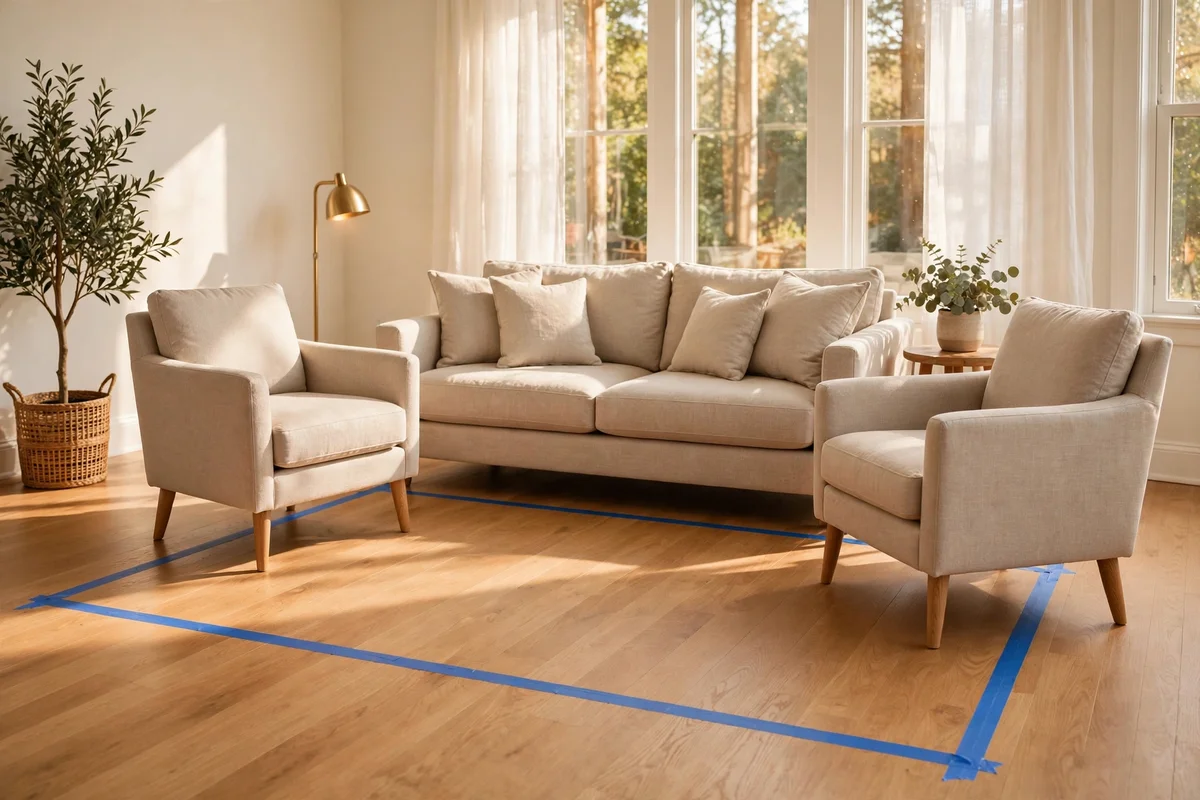
Painter’s tape turns guessing into knowing. Tape the full rectangle of your planned rug size onto the floor, using the centimetre measurements from this guide, then live with it for 48 hours. Walk around it, open every door, pull out the dining chairs, and watch how the outline sits against the furniture. This test costs almost nothing and has saved countless buyers from a rug that looked right online but wrong in the room.
Use low-tack tape on wooden floors so it lifts without marking the finish, and press the corners down firmly so the outline stays true. Photograph the taped outline from the doorway; the camera reveals balance problems your eyes miss. The mistake to avoid is taping only the length and guessing the width; tape all four sides. If the outline feels tight after two days, size up before you order, not after the rug arrives.
18. Translate Standard Rug Sizes Into Your Room Plan
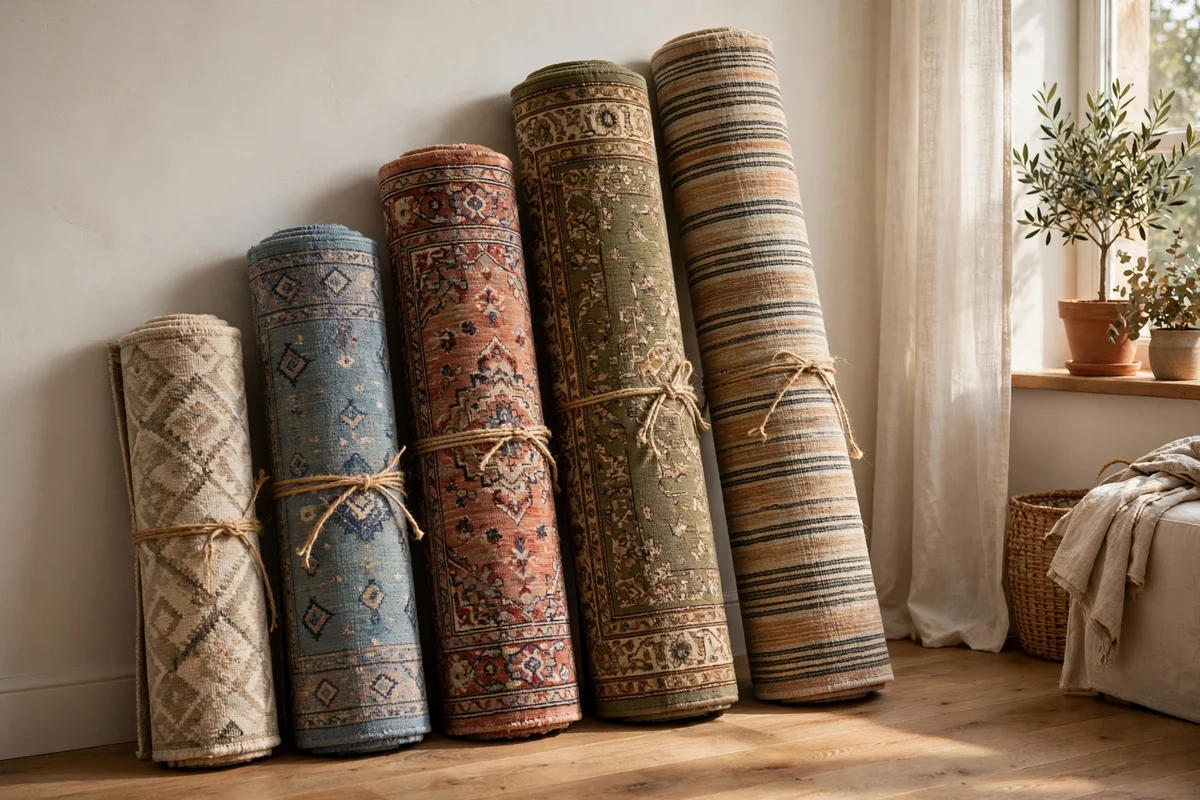
Shops sell the same sizes worldwide, so learn the five you will meet most. A 120 by 170 centimetre rug (4 by 5.6 feet) suits bedside strips and small sitting corners. A 160 by 230 centimetre rug (5.2 by 7.5 feet) fits two-seat sofas and single beds. A 200 by 290 centimetre rug (6.6 by 9.5 feet) anchors three-seat sofas and queen beds. Knowing these by heart makes browsing faster and sizing mistakes rarer.
The two largest standards are 240 by 340 centimetres (about 8 by 11 feet) for big living rooms and king beds, and 270 by 360 centimetres (9 by 12 feet) for open-plan spaces. Runners commonly come 70 by 230 centimetres (2.3 by 7.5 feet) or 80 by 300 centimetres (2.6 by 10 feet). The mistake to avoid is assuming a named size like eight by ten is exact; always read the centimetre label. Keep a note of these five on your phone when you shop.
19. Choose Low Pile Where Doors Swing, Plush Beside Beds
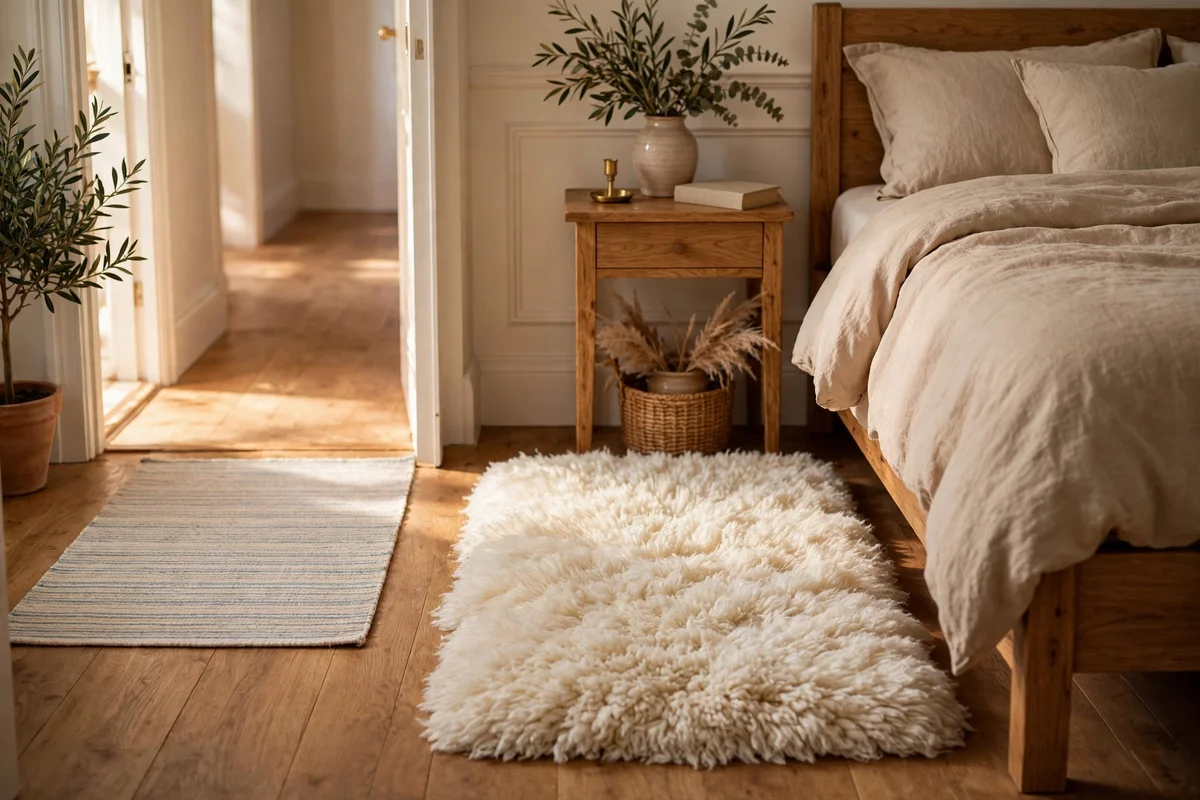
Pile height should follow the room’s job. Hallways, entries and kitchens need flatweave or low pile under 10 millimetres so doors swing and feet move freely. Living rooms suit medium pile of 10 to 15 millimetres, which feels soft without swallowing chair legs. Bedrooms can take plush pile of 20 millimetres or more, where bare feet enjoy it most and no doors drag across it.
Thick rugs also muffle sound, so a deep pile in the bedroom or study genuinely quiets the house. Remember that stated pile height ignores the pad, so add 6 millimetres when checking door clearance. The mistake to avoid is deep shag in the dining room, where chair legs sink and crumbs vanish forever. Budget tip: medium pile wool blends give the softest feel per pound in living rooms and wear far better than cheap shag.
20. Centre Round Rugs Under Round Tables With Even Overhang
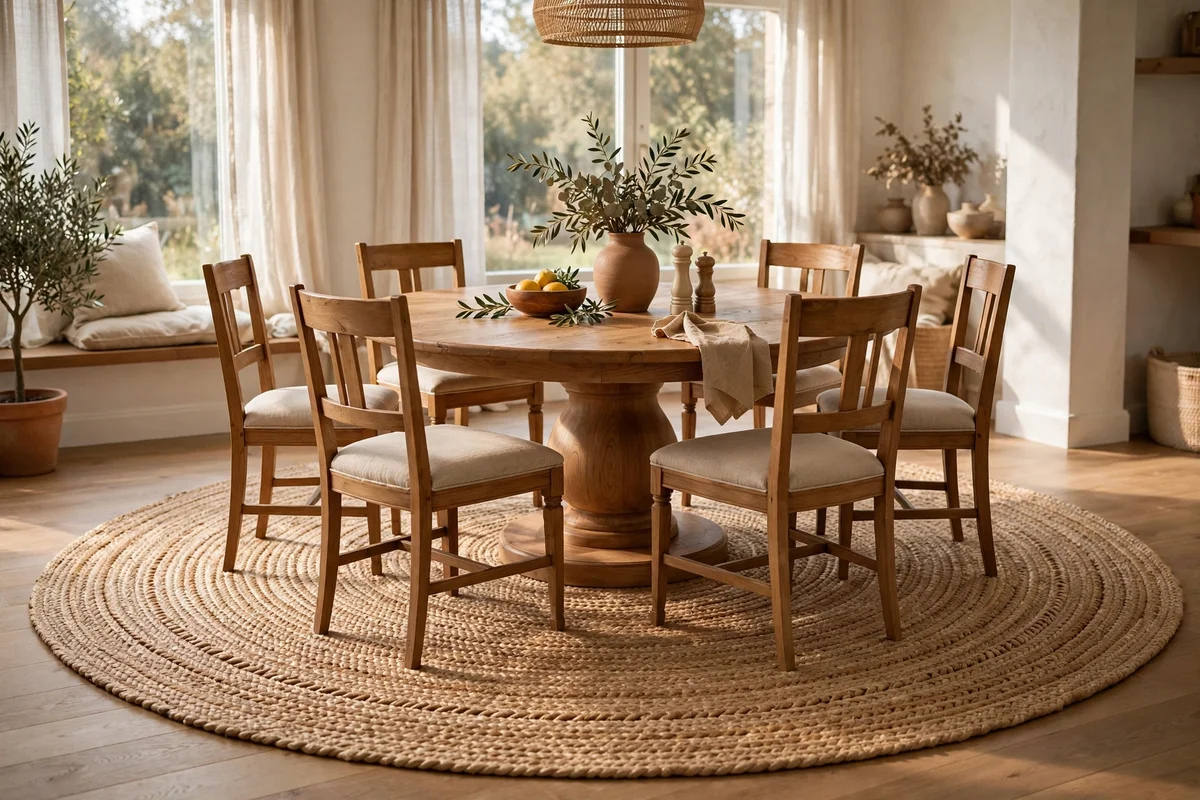
Round tables ask for round rugs, and the chair rule still applies in every direction. A 120 centimetre (4 foot) round dining table needs a rug of 240 to 270 centimetres (8 to 9 feet) across, giving chairs 60 to 75 centimetres of pull-out room all round. Centre the rug exactly under the table pedestal so the overhang stays even; an off-centre rug makes one side feel cramped and the other wasteful.
For round coffee tables of 90 to 100 centimetres (3 to 3.3 feet), a rug of 180 to 210 centimetres (6 to 7 feet) keeps 45 centimetres of soft floor around the base. In a square seating corner, a round rug softens hard angles beautifully. The mistake to avoid is a rug only slightly larger than the table, which looks like a giant coaster. Washable round rugs are widely available and suit family dining rooms well.
21. Define Zones in Open-Plan Rooms With Separate Rugs
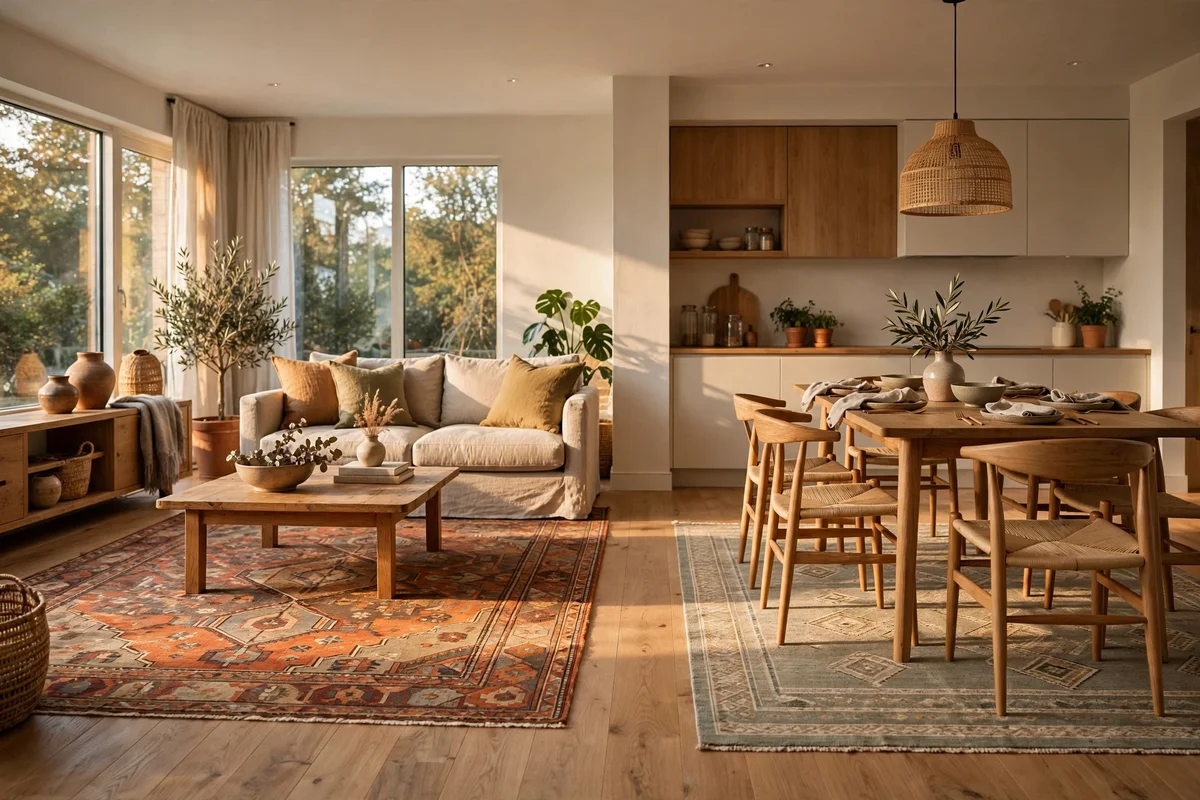
Open-plan spaces need visual boundaries, and rugs draw them best. Give the living zone its own rug, sized for the sofa as this guide describes, and the dining zone its own rug with full chair clearance. Leave 30 to 45 centimetres (1 to 1.5 feet) of bare floor between the two rugs so each zone reads separately. Keep the palettes related, perhaps the same cream base with different accents, so the room still feels unified.
Align the rug edges with the furniture rather than the walls, since open plans have few walls to guide you. A runner can link the zones along the walkway if the gap feels too stark. The mistake to avoid is one giant rug spanning both zones; it flattens the plan and wastes fabric under walkways. Budget tip: two medium standard-size rugs cost less than one custom giant and are far easier to clean.
22. Rest the Front Feet of Armchairs on the Living Rug
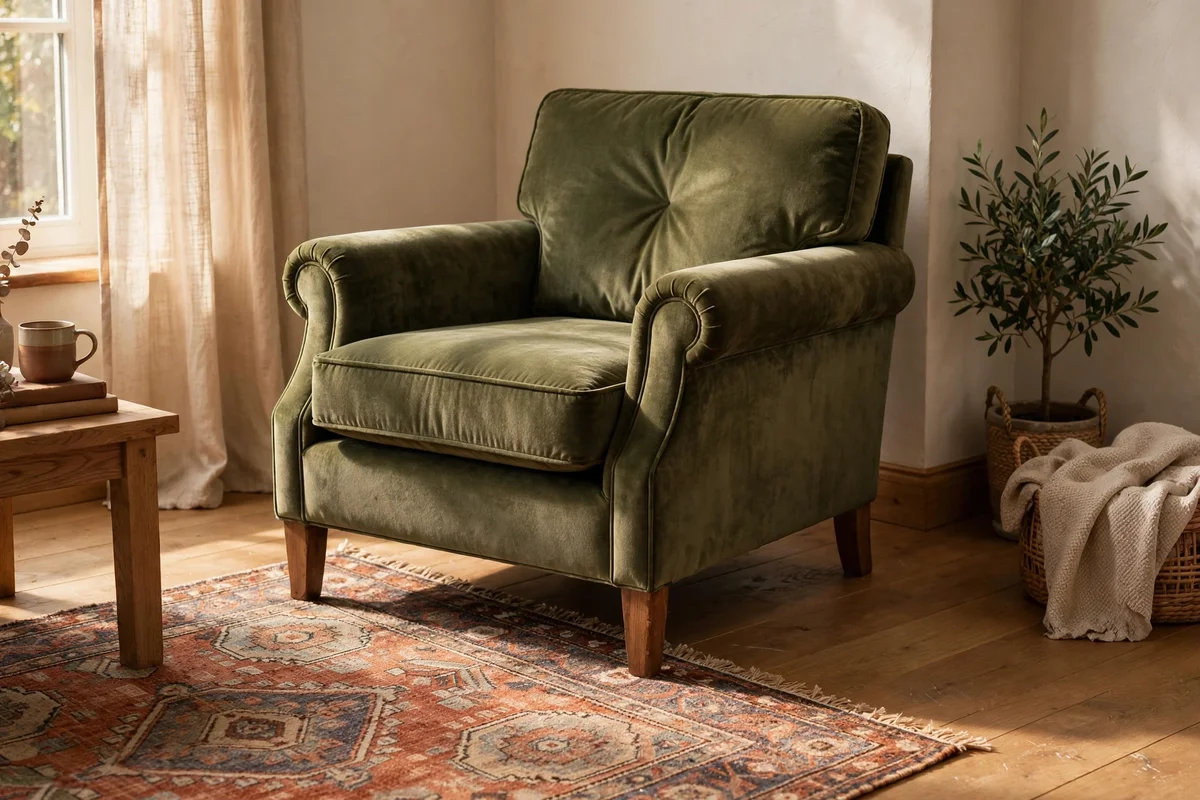
An armchair with all four legs off the rug looks stranded, floating apart from the conversation. Pull each armchair forward until its front feet sit 10 to 15 centimetres onto the rug, which visually joins it to the sofa group. In a front-legs-on layout with a 200 by 290 centimetre (6.6 by 9.5 foot) rug, angled chairs at the two front corners complete the classic arrangement. This small shift changes the whole feeling of the seating.
If the rug is too small for the chairs to reach, either size up or bring the chairs closer to the sofa and accept a cosier grouping. Swivel chairs need an extra 10 centimetres of rug in front because they travel as they turn. The mistake to avoid is one chair on and one chair off the rug, which unbalances the pair instantly. A quick tape outline, as described earlier, settles the question before you spend anything.
23. Recheck the Fit Once the Rug Arrives and Settles
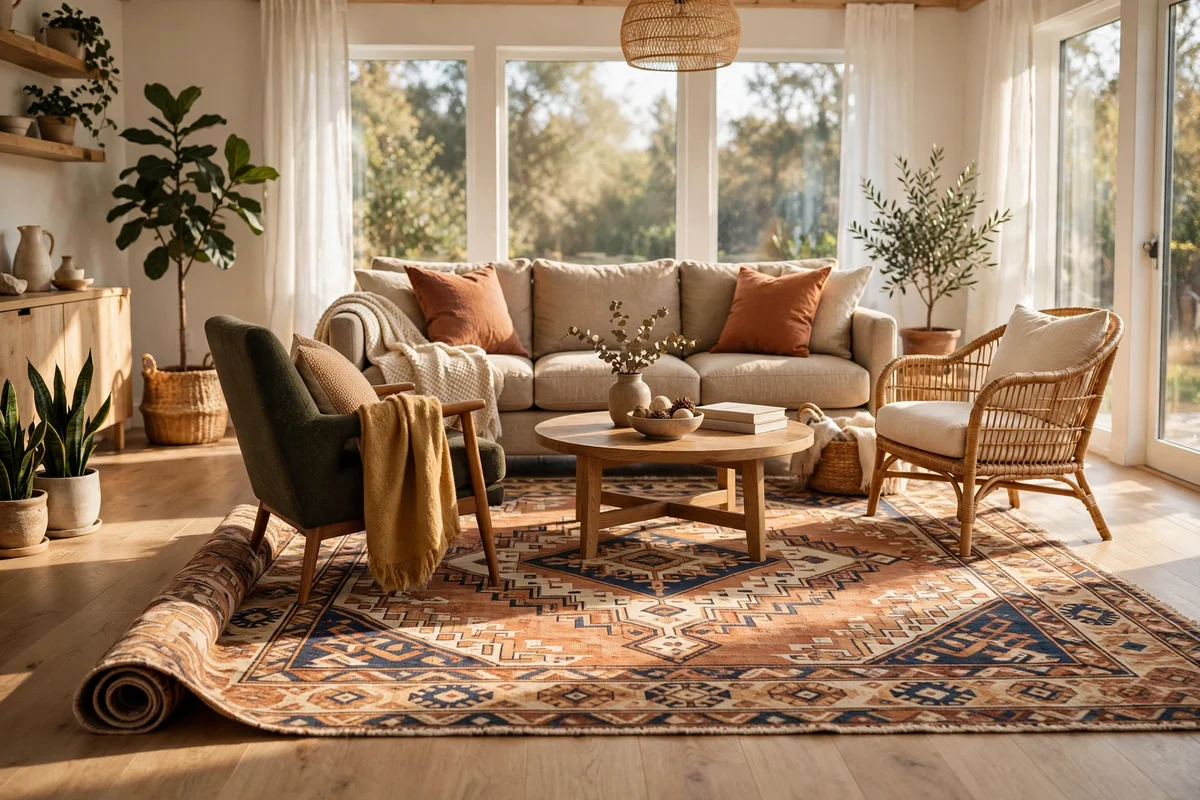
A new rug rarely lies flat on day one. Unroll it pile-side down for 24 to 48 hours, or reverse-roll stubborn curls for a few hours, before judging the fit. Remeasure the taped outline against the real rug, checking the 20 centimetre wall border, the chair pull-out allowance and every door swing. Keep the tags and receipt until this check is done, since most shops accept returns only in unused condition.
Walk the room at different times of day; morning light reveals lumps and evening lamps show true colour. If the rug creeps, trim the pad back 2 centimetres and add rug tape at the corners. The mistake to avoid is cutting the pad or the rug to force a fit in the first week; fibres relax and the rug may grow slightly. Once the layout holds for a week, the size is right and the room can settle around it.
Rug sizing is really a short list of habits: give furniture room to sit on the rug, leave chairs their pull-out space, land bare feet on softness beside the bed, keep a border of bare floor at the walls, and always size up when you hesitate. These 23 rules share one spirit, which is to measure twice and buy once, so the rug feels like it was made for the room. A well-sized rug quietly pulls every piece of furniture into one calm composition.
This week, try just one thing: the painter’s tape test from rule seventeen. Tape your planned rug size onto the living room floor, live with the outline for two days, and watch how it changes your sense of the space. That single rectangle of tape will tell you more than a hundred product photos, and it costs almost nothing. Once you see the outline working, ordering the right size becomes the easy part.
Frequently Asked Questions
What size rug should I buy for a living room with a three-seat sofa?
Choose 200 by 290 centimetres (about 6.6 by 9.5 feet) for the classic front-legs-on layout, with the sofa front feet resting 15 to 20 centimetres onto the rug. In rooms wider than 4.5 metres, step up to 240 by 340 centimetres (about 8 by 11 feet) so every leg sits on the rug. Always tape the outline on the floor first to confirm the fit.
Should a rug go under the dining table or just around it?
It must go fully under the table and the chairs, even when chairs are pulled out. Add 60 to 75 centimetres beyond the table edge on all sides, so a 180 by 90 centimetre table needs at least a 300 by 210 centimetre rug. Chairs with back legs off the rug rock and catch, so the pull-out allowance is the measurement that matters most.
How far should a bedroom rug extend past the sides of the bed?
Aim for 60 to 75 centimetres (2 to 2.5 feet) beyond each side of the mattress so your feet land on softness when you rise. A queen bed of 160 centimetres wide pairs well with a 230 by 300 centimetre rug placed two-thirds under the bed. Extend 45 to 60 centimetres past the foot of the bed as well for the full soft zone.
Do I really need a rug pad under every rug?
On hard floors, yes: a pad stops creeping, adds cushioning and protects the floor from scratches. Trim it 2 to 3 centimetres smaller than the rug on every side so it never shows. On carpet, a thin pad still helps, but rug tape can work instead. Replace pads every five to seven years, as compressed felt stops doing its job.
My rug is slightly too small. Should I replace it or work around it?
If it misses by one size, replace it, because a small rug fragments the room. If replacement is not possible, layer it over a larger plain rug such as jute, keeping 20 to 30 centimetres of the base visible all round. This rescue works for treasured or expensive rugs, but for a new purchase, the size-up rule is always the better answer.