Living Room
25 Earth Tone Living Room Ideas That Feel Grounded, Warm and Quietly Rich
By Anna Wells · · 23 min read
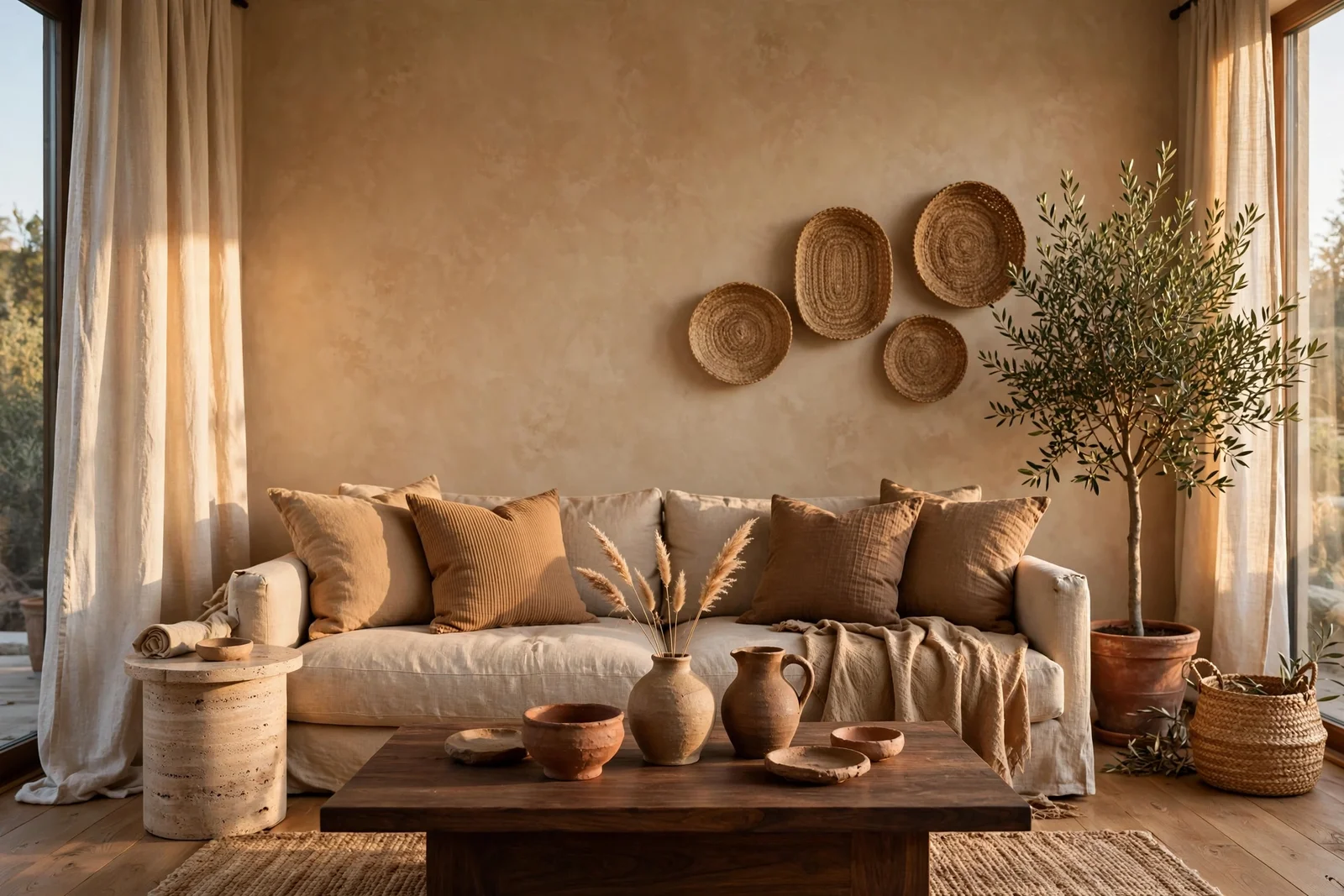
Earth tones bring a living room back to nature: clay, sand, camel, olive and warm cream layered with linen, wool, rattan and honest wood. These 25 ideas show exactly how to layer them so the room stays warm and rich, never flat or muddy.
Morning light lands on a clay-coloured wall and turns it the colour of warm bread crust. A sand sofa holds its shape against that glow, and a wool throw in camel spills over one arm. Nothing in the room shouts. Everything feels settled, as if the materials have been there for decades rather than delivered last week. This is what an earth tone living room does best: it calms a space the way a walk through dry hills calms the mind.
Earth tones are the colours of soil, stone, straw and bark: clay, sand, camel, olive, umber and warm cream. They suit family life because they hide the small marks of everyday use and they never date. Below are 25 concrete ideas for layering them wall to sofa to cushion, mixing wood tones safely, and using plants, ceramics and warm lighting so the room stays quietly rich instead of flat.
Each idea includes sizes, materials and budget guidance, plus the common mistake that flattens earth tone rooms and how to avoid it. Start anywhere that speaks to you; the first idea costs nothing more than a fresh look at your walls.
1. Paint Walls in Warm Clay Limewash for Depth Without Darkness
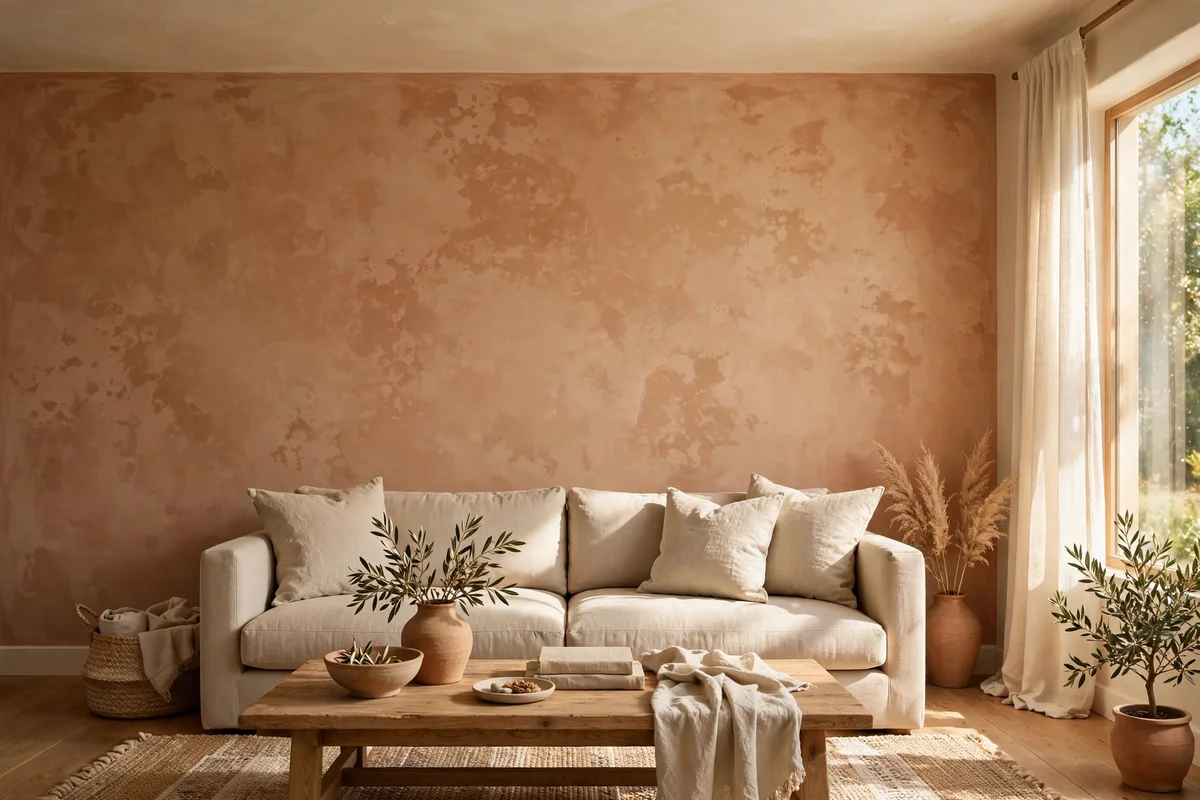
A clay wall in a mid tone, roughly the colour of terracotta flowerpots, gives the whole room a sunlit base that flat paint rarely achieves. Limewash is the ideal finish because its mineral texture breaks up large wall areas with soft mottling, so the colour never reads as one flat block. For a 4 by 5 metre living room, buy 7 to 8 litres for two coats, and allow a full 24 hours of drying between coats. Roll or brush in loose, random strokes and do not overwork each patch, since variation is the point.
Choose your shade one step lighter than the colour card suggests, because clay deepens noticeably once it dries on a full wall. Paint a 1 metre square test patch and live with it for two days of different light before committing. The common mistake is pairing clay walls with equally mid-tone everything, which drains the contrast; keep the sofa and rug at least two shades lighter or darker. A mid clay reads beautifully beside warm cream ceilings and sand-coloured upholstery.
2. Layer a Sand Sofa With Camel and Umber Cushions
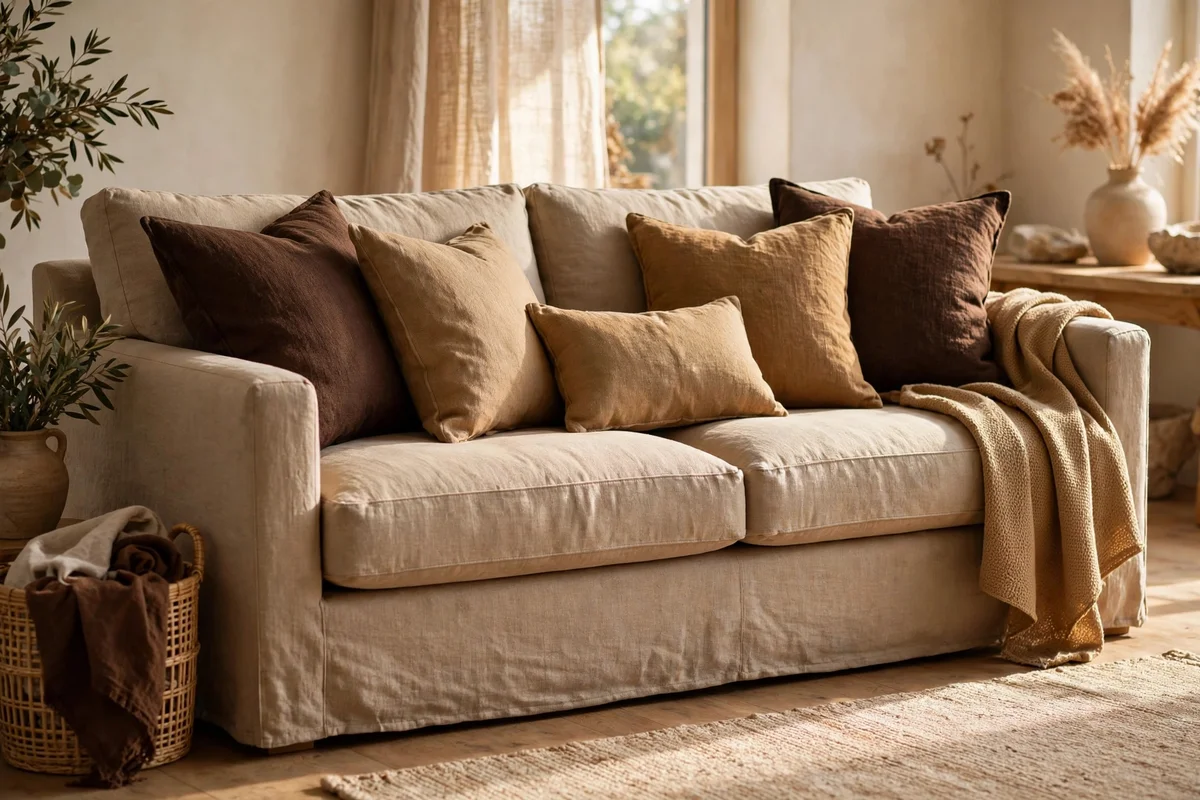
A sofa in sand, somewhere between oatmeal and light camel, acts as the calm middle of the palette and lets darker cushions do the talking. For a standard 200 cm three-seater, five cushions give fullness without crowding: two 50 cm squares in plain camel at the corners, two 45 cm squares in a warm stripe or subtle pattern, and one 30 by 50 cm lumbar in deep umber at the centre. Keep cushion covers in linen or cotton with visible weave so light plays across the surface.
Feather and recycled-fibre fills hold their plumpness better than cheap foam, so buy inserts one size larger than the cover, for example a 55 cm insert inside a 50 cm cover, for that tailored overstuffed look. The mistake to avoid is scattering six different cushion colours across the sofa; earth tones need discipline, so restrict the whole arrangement to three colours maximum from the clay, camel, umber and olive family. Rotate covers seasonally instead of buying new cushions each year.
3. Anchor the Seating Zone With One Dark Walnut Coffee Table
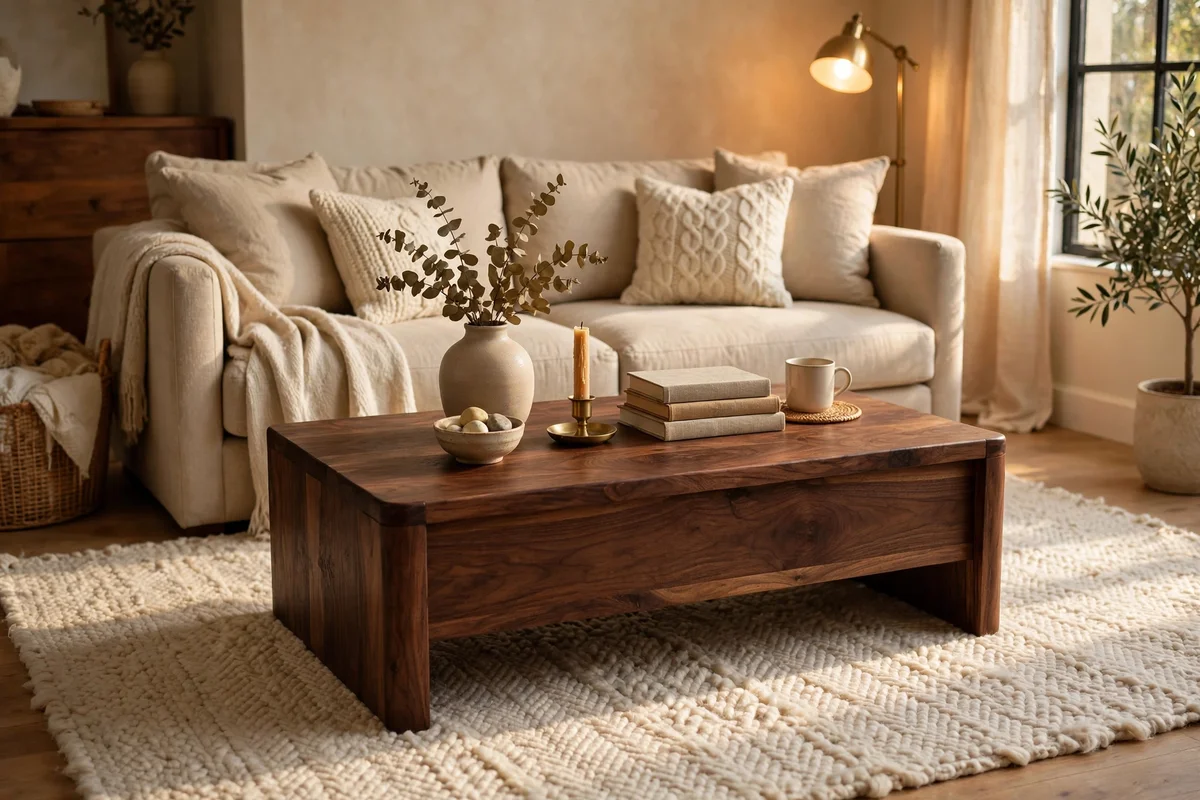
Every earth tone room needs one dark anchor, and a walnut coffee table is the classic choice because dark wood grounds the airy middle tones above it. Choose a table between 110 and 130 cm long and 50 to 60 cm wide for a standard three-seater, keeping 40 to 45 cm of legroom between table edge and sofa front. A simple rectangular or soft oval shape works best; fussy carving fights the calm mood. The table should sit at roughly the same height as the seat cushions, around 40 to 45 cm.
Walnut reads richer than black-painted wood and pairs naturally with clay, camel and olive. If a solid walnut table stretches the budget, look for walnut veneer over engineered wood, which looks identical at seating distance and costs half as much. The mistake is placing a light oak table in a room full of light tones; with no dark anchor, everything floats and the room feels unfinished. One dark piece per seating zone is the rule: table here, darker bookcase or chair elsewhere.
4. Mix Mid-Tone Oak and Dark Walnut at a 70-30 Ratio
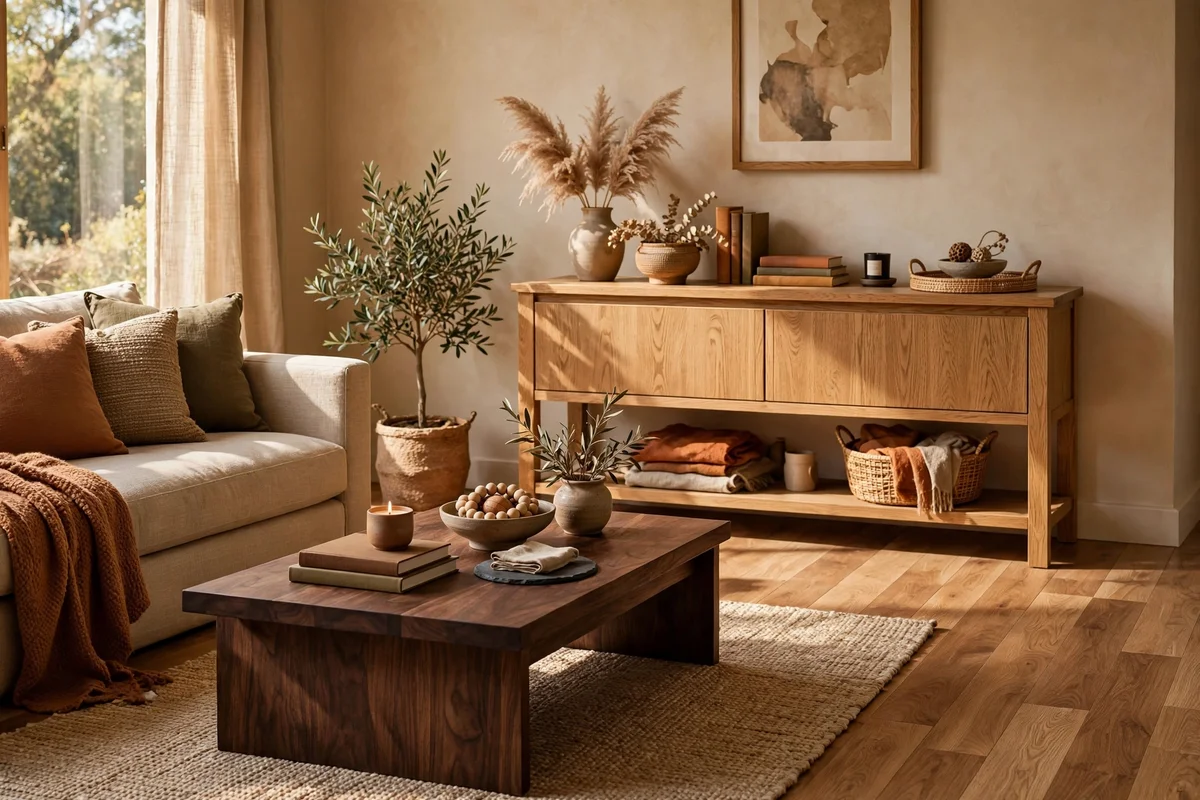
Mixing wood tones is safe when you keep a clear ratio: roughly 70 percent mid-tone oak to 30 percent dark walnut across the room’s visible wood. In practice that means oak floors, an oak TV console and oak shelf brackets carry the room, while a walnut coffee table and one dark frame provide the contrast. When both woods share warm undertones, the eye reads them as family rather than clash. Count pieces before buying; two dark pieces among six light ones keeps the balance.
Tie the two woods together with a bridge element, such as a woven tray or ceramic bowl that contains both tones, so the transition looks deliberate. If your floors are cool grey oak, warm them visually with a large camel rug rather than fighting them with furniture swaps. The mistake to avoid is a 50-50 split of light and dark wood, which reads as indecision. Let the mid oak dominate, let the walnut punctuate, and the room stays calm and collected.
5. Lay a Flatweave Wool Rug in Warm Cream Under the Sofa
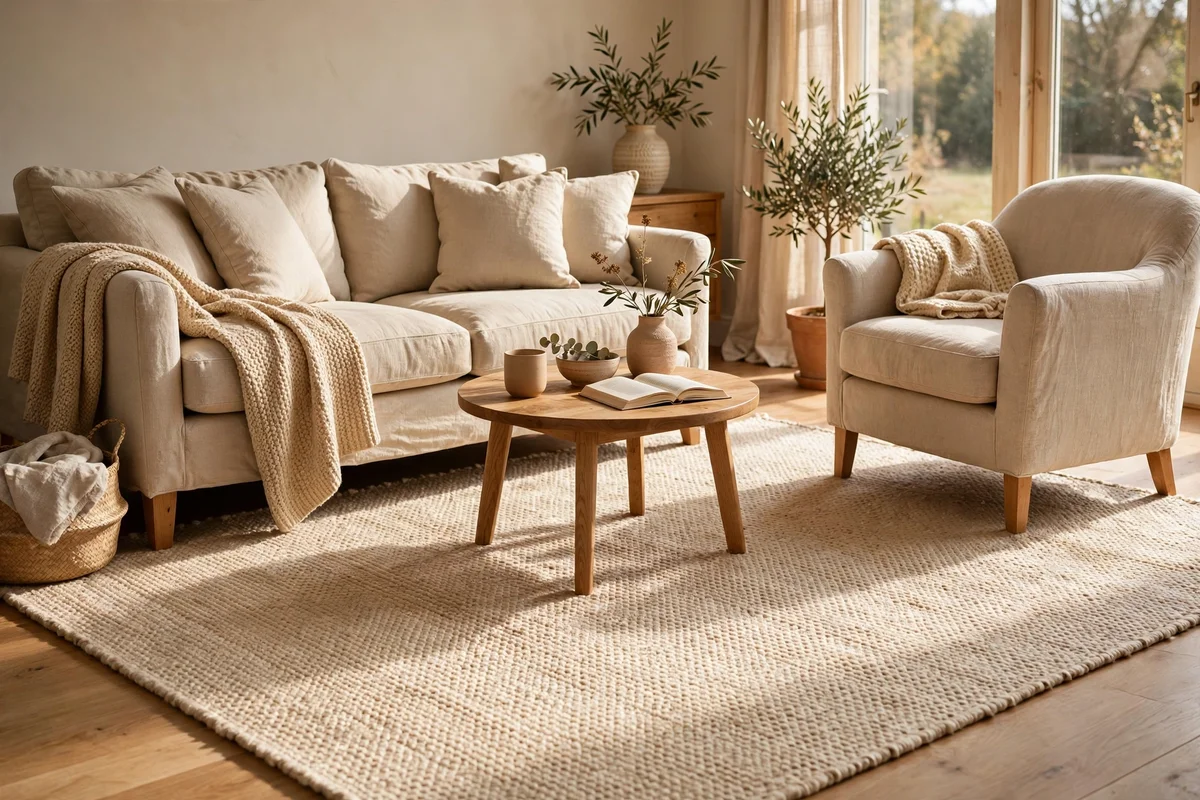
A warm cream wool rug, roughly 200 by 300 cm for a standard seating group, lifts the whole palette and stops umber and walnut from sinking into a dark hole at floor level. Flatweave suits family rooms because crumbs shake out easily and chair legs glide across it, though a low pile of 8 to 12 mm adds comfort under bare feet. Place the front legs of the sofa and armchairs on the rug so the furniture reads as one connected island.
Choose cream with a warm undertone, never bright optic white, which turns stark against clay walls. Natural undyed wool in shades of sheep white and oatmeal hides dust far better than pale grey. The mistake is buying a rug that only sits under the coffee table; a floating rug that touches no furniture makes the seating area feel scattered. Budget tip: a good wool flatweave in this size runs 150 to 300 pounds or dollars, and second-hand rugs often wear in beautifully.
6. Drape Raw Linen Over the Sofa Arm for Honest Texture
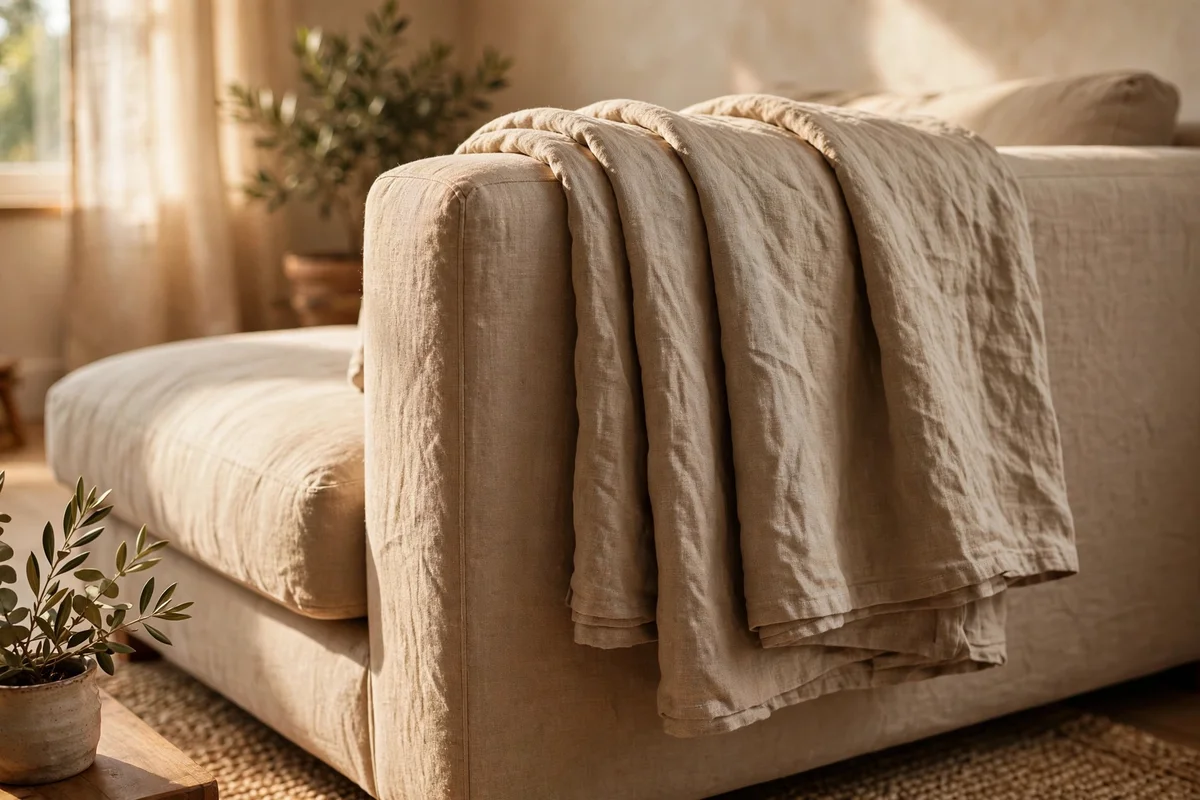
One raw linen throw, about 130 by 180 cm, folded in thirds and laid over a single sofa arm, adds the creased, lived-in texture that keeps earth tones from looking staged. Linen wrinkles are part of its character, so skip the iron and let the fabric fall naturally. Choose flax, oatmeal or a soft clay stripe; avoid anything dyed a sharp colour that fights the palette. The throw should hang unevenly, longer on the outside of the arm, for a relaxed line.
Linen softens with every wash and lasts for years, making it one of the best value textiles in the room at 40 to 90 pounds or dollars for a generous size. Wash on a cool gentle cycle and dry on the line, since tumble heat makes linen brittle over time. The mistake to avoid is draping throws over every surface; one folded throw on the sofa plus one on a basket is plenty. Restraint is what makes each texture visible instead of blurred.
7. Add a Rattan Armchair as a Natural Counterpoint
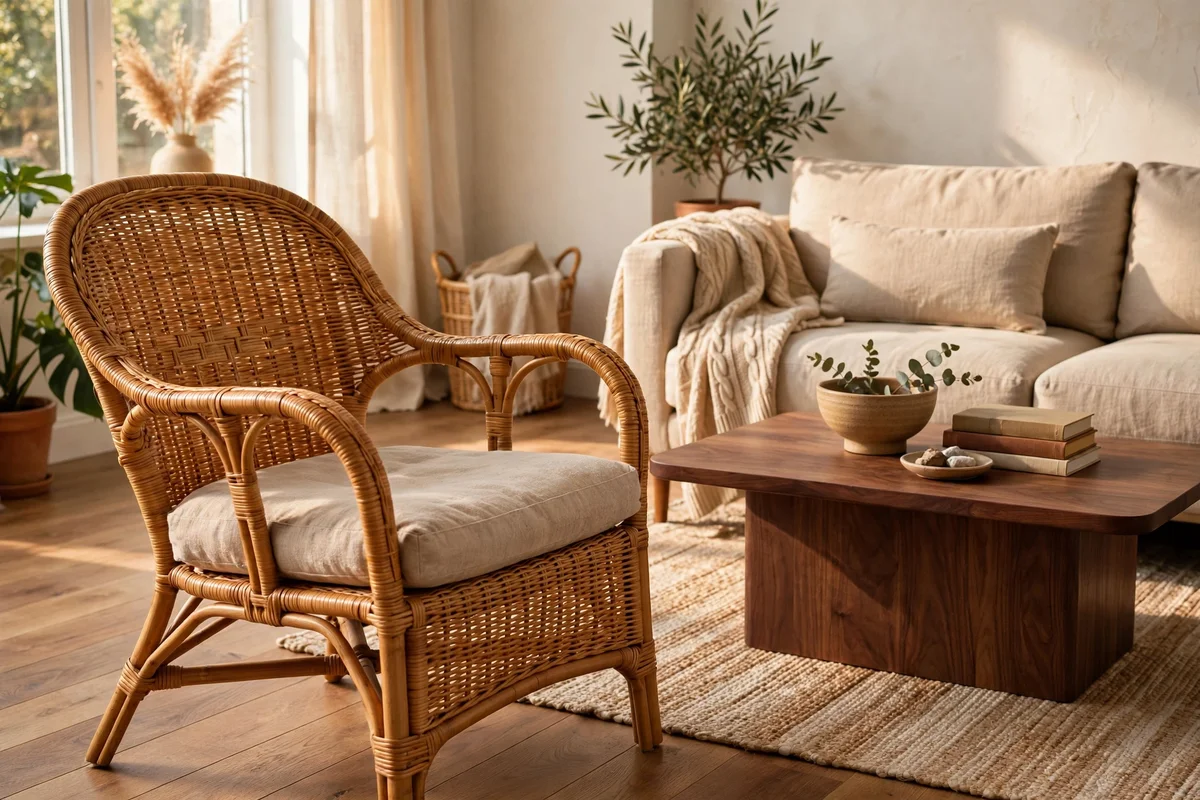
A rattan or cane armchair introduces an open, woven texture that solid upholstery cannot offer, and its honeyed tone sits perfectly inside the earth palette. Place it at a slight angle to the sofa, about 100 to 120 cm away, angled toward the coffee table so conversation flows. One chair is enough in most rooms; two work only in larger spaces where they can face the sofa as a pair. Look for a frame with a proper seat cushion in sand or clay linen.
Vintage rattan chairs from second-hand shops cost 30 to 80 pounds or dollars and often have better joinery than new flat-pack versions. Check that the cane is tight and the frame does not wobble before buying. The mistake to avoid is pairing rattan with a tropical theme the room never promised; keep the chair in the earth tone family with neutral cushions and it reads as timeless craft rather than holiday souvenir. Dust the weave monthly with a soft brush.
8. Set a Travertine Side Table Beside the Sofa
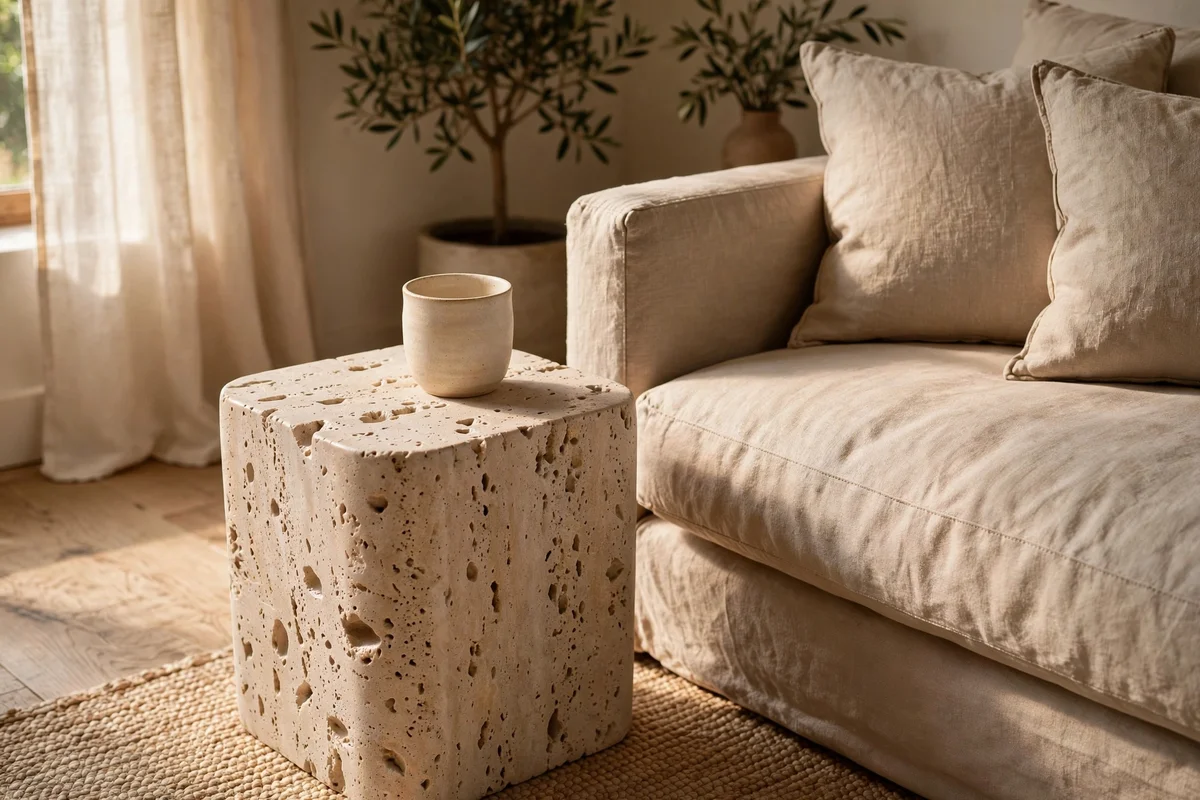
A small travertine or limestone side table, roughly 40 cm square and 50 cm high, brings cool stone into a room of warm textiles and stops the palette from feeling one-note. Place it within arm’s reach of the sofa end, leaving 5 to 10 cm of breathing room between table and upholstery. Stone’s natural pitting and veining give each piece quiet character, so no two tables ever look identical. Seal the surface once a year to protect against tea rings.
Travertine side tables start around 80 pounds or dollars at homeware stores, while solid carved stone pieces climb into investment territory. A budget alternative is a concrete-look composite top on wooden legs, which carries the same visual weight at half the price. The mistake is choosing polished marble with bold veining; in an earth tone room it looks cold and loud. Honed, matte stone in warm beige keeps the serene mood intact.
9. Bring In One Tall Indoor Plant as the Green Note
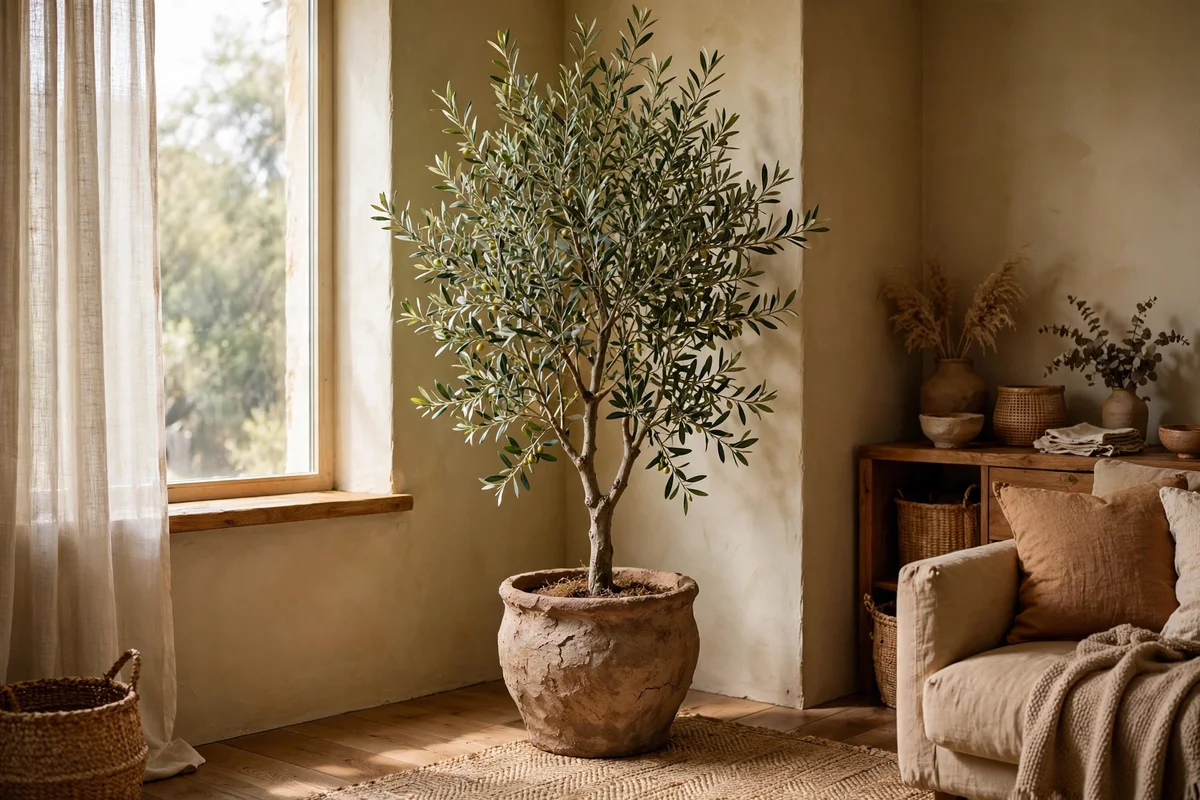
A single tall plant, an olive tree or a fiddle-leaf fig between 120 and 180 cm, provides the living green note that earth tones are built around. Place it in a corner that receives bright indirect light, at least 1 metre from radiators and draughty doors. Pot it in a handmade clay or stoneware planter, 30 to 40 cm in diameter, so the vessel matches the room’s palette instead of fighting it with glossy plastic.
Olive trees suit this palette especially well, their silvery leaves echoing the room’s muted tones while staying genuinely alive. Water only when the top 3 to 5 cm of soil feels dry, and rotate the pot a quarter turn each month for even growth. The mistake to avoid is scattering five small plants on every shelf; one confident specimen reads as design, while a crowd of little pots reads as clutter. Dust large leaves monthly with a damp cloth.
10. Group Handmade Clay Ceramics on the Coffee Table

Three handmade clay vessels of different heights, say 12, 18 and 25 cm, grouped on a wooden tray, bring the potter’s hand into the centre of the room. Keep the glaze palette tight: unglazed terracotta, matte cream and one deep umber piece give variety without noise. Arrange them in a loose triangle with the tallest at the back, leaving half the table surface clear for cups and books. Each piece should feel weighty and slightly irregular, never factory perfect.
Local pottery studios and craft markets sell such pieces for 15 to 40 pounds or dollars each, far less than designer ceramics. The mistake is lining up matching sets in a row; earth tone styling needs the gentle asymmetry of handmade things. Fill one vase with dried grasses and leave the others empty so the clay itself shows. Wipe unglazed terracotta with a dry cloth only, since water leaves marks on raw clay.
11. Hang Woven Wall Baskets Instead of Flat Art
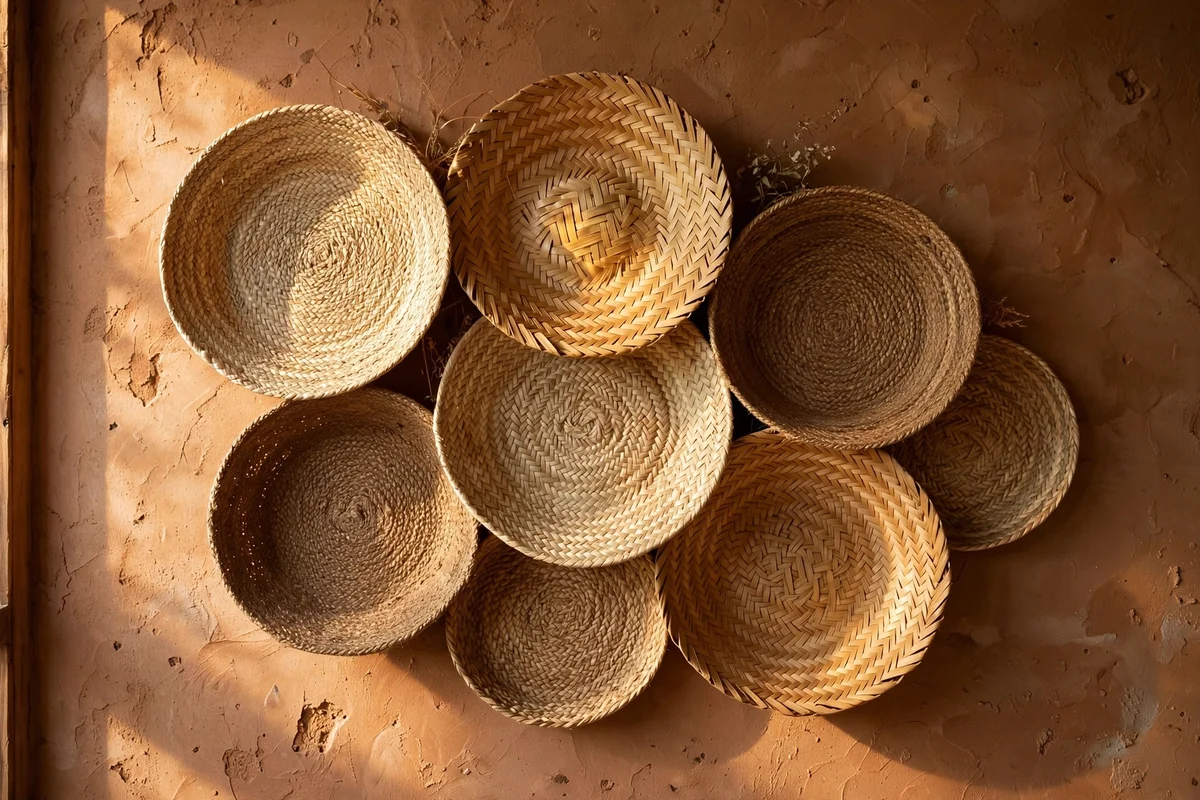
A cluster of three to five shallow woven baskets on the wall above a console or beside the fireplace adds art with depth and shadow, something flat prints cannot do. Choose seagrass, jute and palm baskets in natural tones, ranging from 25 to 45 cm in diameter, and arrange them in an organic cluster with 8 to 10 cm gaps. Hang the largest first, then build outward, stepping back to check the balance after each one.
Woven baskets cost little, often 8 to 20 pounds or dollars each, and they suit renters since each needs only a single small nail or adhesive hook rated for 1 to 2 kg. The mistake is hanging them in a rigid grid; earth tone rooms want the relaxed scatter of a gathered collection. Vary the weave patterns, some tight, some open, so light catches each differently. Dust them with a dry brush twice a year to keep fibres fresh.
12. Filter Daylight Through Unbleached Linen Curtains
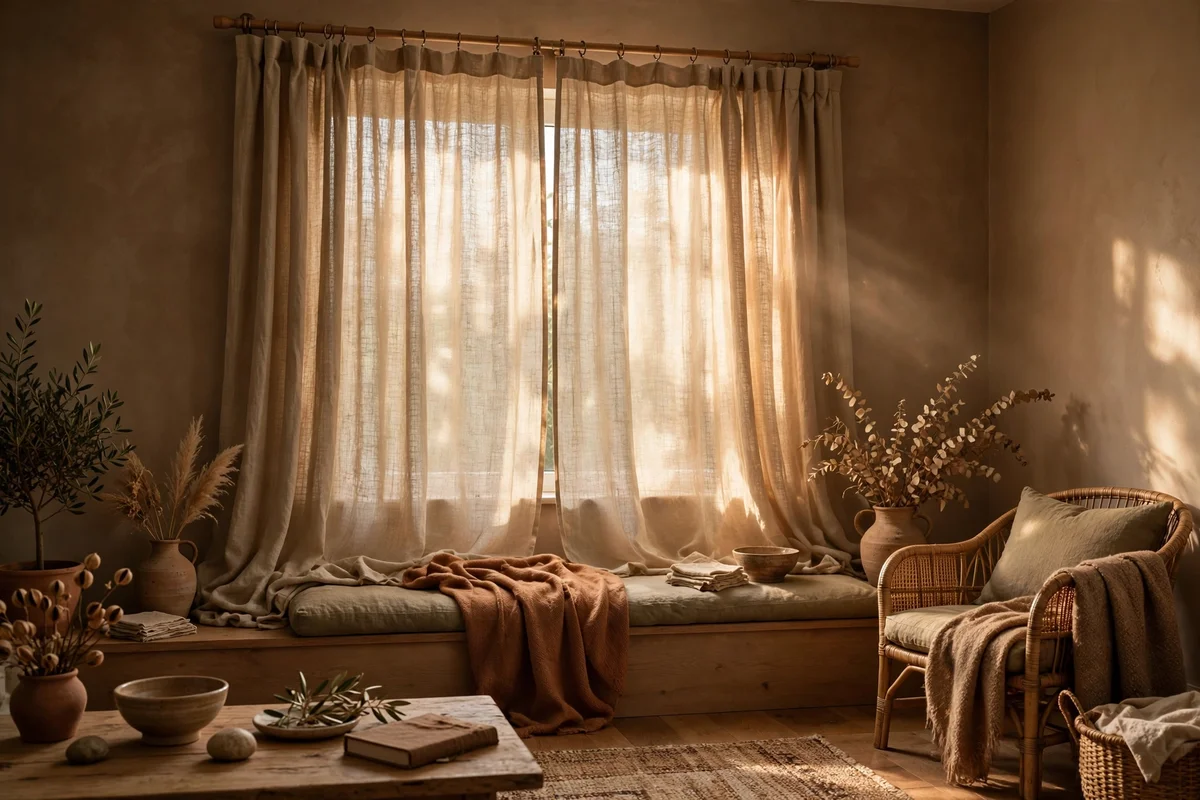
Unbleached linen curtains in a natural flax tone filter daylight into a soft golden wash that makes every earth tone in the room glow. Hang the curtain rod 10 to 15 cm above the window frame and 15 to 20 cm wider on each side, so the fabric stacks back onto the wall and the full window shows. For a 150 cm window, use panels totalling 300 to 375 cm of fabric width for gentle, unforced gathers.
Linen lets in more light than cotton blackout panels, so pair them with a simple roller blind behind if the room faces a street or needs darkness for films. Hem curtains to just kiss the floor, about 1 cm above it, to avoid dust collecting in puddled fabric. The mistake is choosing white curtains with a blue undertone; against clay walls they turn chalky. Warm flax, oat or sand keeps the whole window in the same family.
13. Tuck a Knitted Wool Pouf Beside the Fireplace
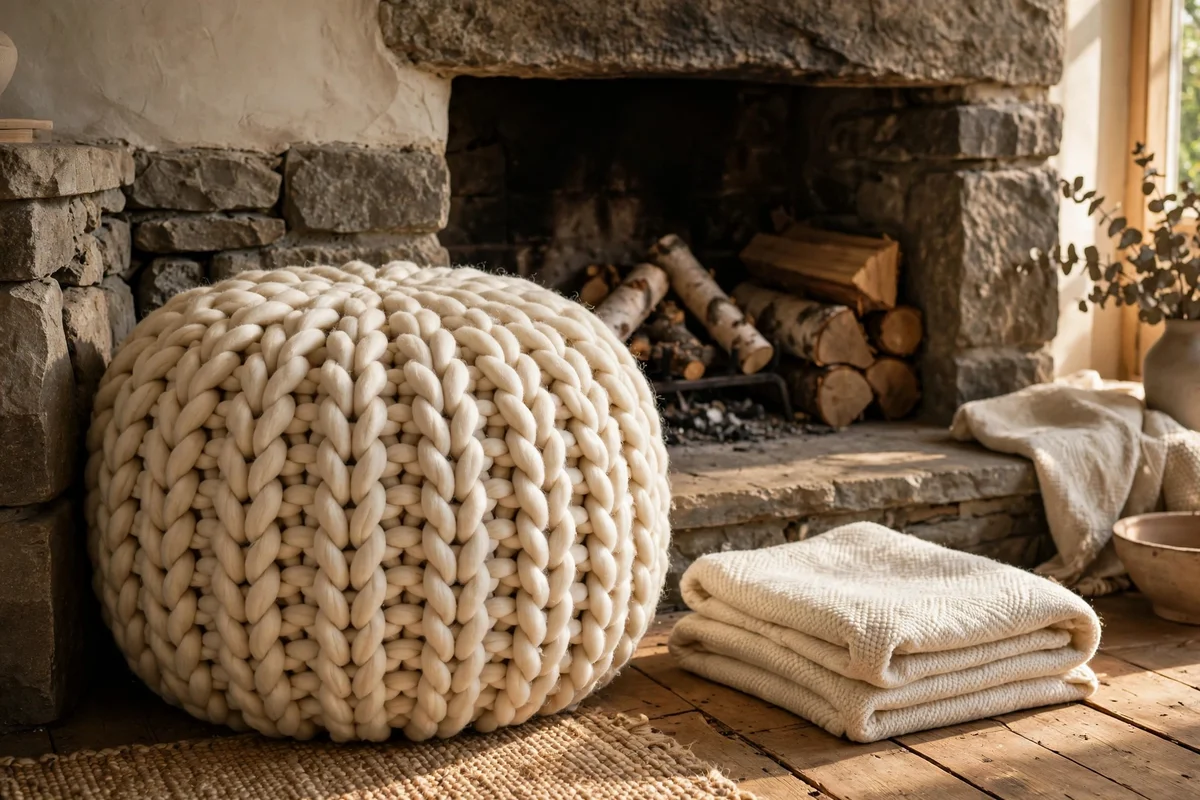
A chunky knitted wool pouf, about 50 cm wide and 35 cm high, tucked beside the fireplace or at the sofa’s open end, adds low, soft seating that children and guests actually use. Choose undyed wool in cream, camel or a soft clay, and pick a tight knit that holds its shape rather than a loose weave that sags within months. Fill with firm foam or recycled textile stuffing so it supports real weight without flattening.
Poufs cost 50 to 120 pounds or dollars handmade, less if you knit one yourself over a few quiet evenings. The mistake is buying a pouf in a bright accent colour; it becomes a visual shout in a quiet room. Keep it inside the palette and it doubles as a footrest or an impromptu side table with a tray on top. Spot clean wool with cool water, never hot, which shrinks the fibres.
14. Set Every Lamp to a Warm 2700K Glow
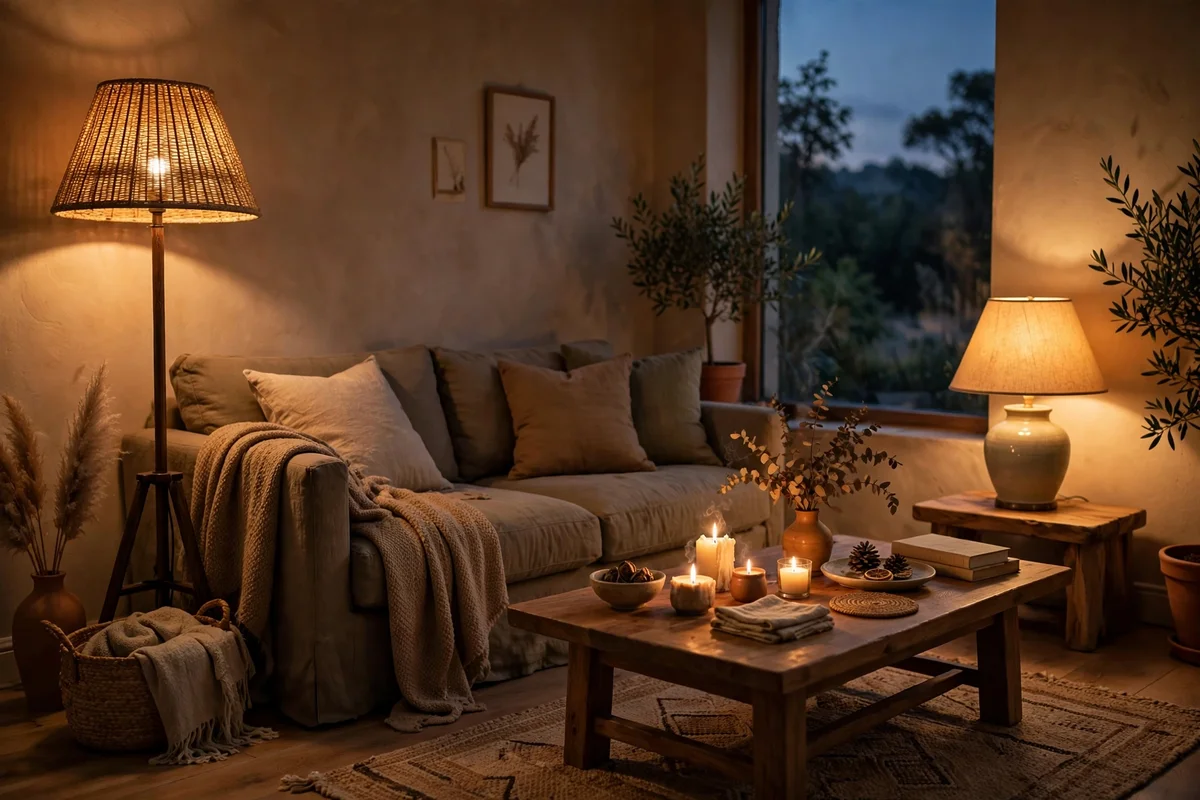
Earth tones only reveal their richness under warm light, so replace every bulb in the living room with 2700K warm white, the colour of late afternoon sun. Use three light sources minimum: a floor lamp arcing over the reading chair, a table lamp on the console, and one low glow such as a candle cluster or a small shaded lamp on the shelf. Aim for 1500 to 2000 total lumens spread across sources rather than one harsh overhead.
Dimmable bulbs let you drop the evening level to a candle-like 2200K feel for film nights and quiet conversation. Avoid daylight 5000K bulbs entirely; they bleach clay to pink-grey and make camel look dull. The mistake is lighting the room from a single ceiling pendant, which flattens every texture into shadowless sameness. Warm pools of light at different heights are what make linen, wool and wood look their best.
15. Ground One Corner With a Dark Wood Bookcase
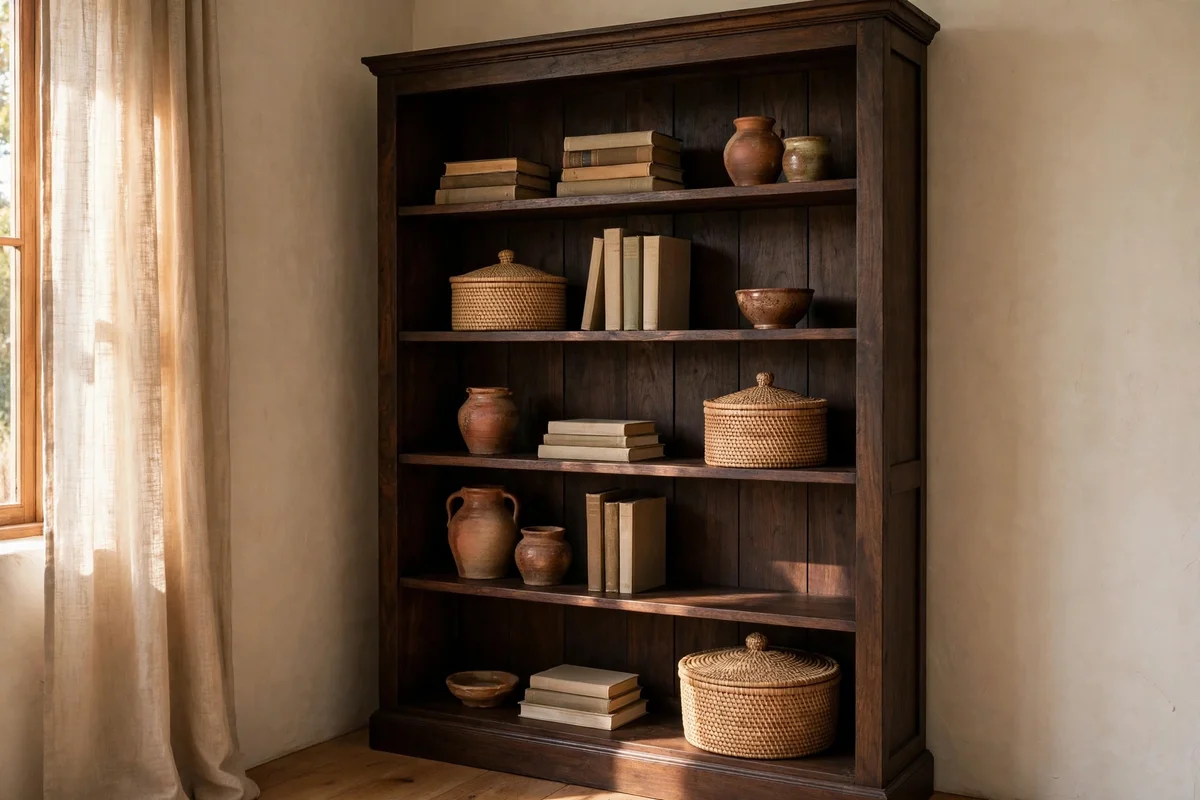
A tall dark wood bookcase, around 180 cm high and 90 cm wide, gives the room its second dark anchor and keeps books, baskets and ceramics in one composed zone. Place it in a corner that feels visually light, so the dark wood balances rather than crowds. Leave 20 to 30 percent of each shelf empty; breathing room is what separates styled shelves from storage. Style the lowest shelf with lidded baskets to hide the less beautiful necessities.
Second-hand solid wood bookcases cost 60 to 150 pounds or dollars and refinish beautifully with a single coat of dark walnut stain. If buying new, check the back panel is solid rather than flimsy card, which warps within a year. The mistake is filling every shelf edge to edge; in an earth tone room, negative space is part of the palette. Alternate horizontal book stacks with vertical rows and one ceramic piece per shelf for rhythm.
16. Stack Three Woven Baskets for Throws and Kindling
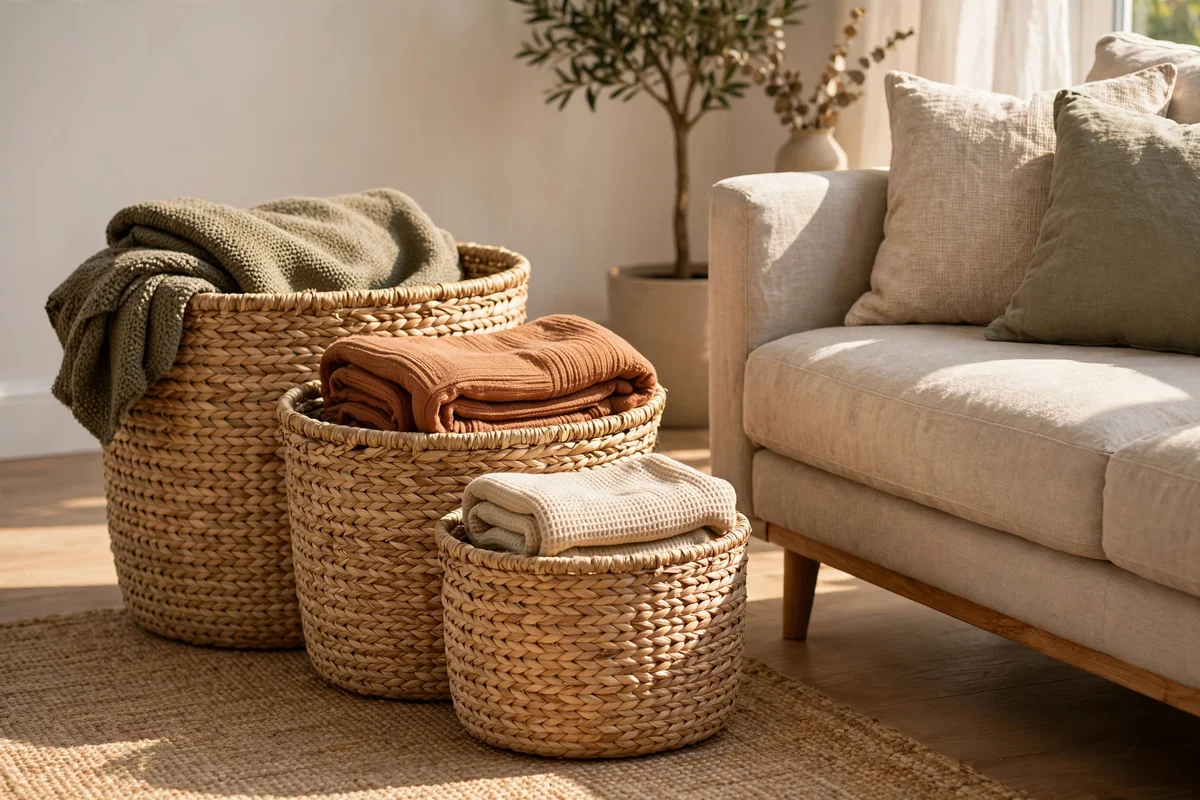
Three woven baskets in descending sizes, the largest about 45 cm tall, nested beside the sofa or fireplace, turn storage into texture. Use the big basket for folded throws, the middle one for kindling or magazines, and the smallest for the remote controls and small clutter that ruins a calm room. Choose seagrass or water hyacinth in natural tones, and line the kindling basket with a canvas sack to catch bark and dust.
Nested basket sets cost 25 to 60 pounds or dollars and suit every corner that gathers mess. The mistake is buying baskets too small to be useful; a basket that cannot hold a folded throw is decoration pretending to be storage. Measure what you need to hide before you shop. Wipe the insides twice a year and keep baskets out of direct sun, which dries natural fibres until they crack.
17. Dress the Mantel With Dried Grasses and Stoneware
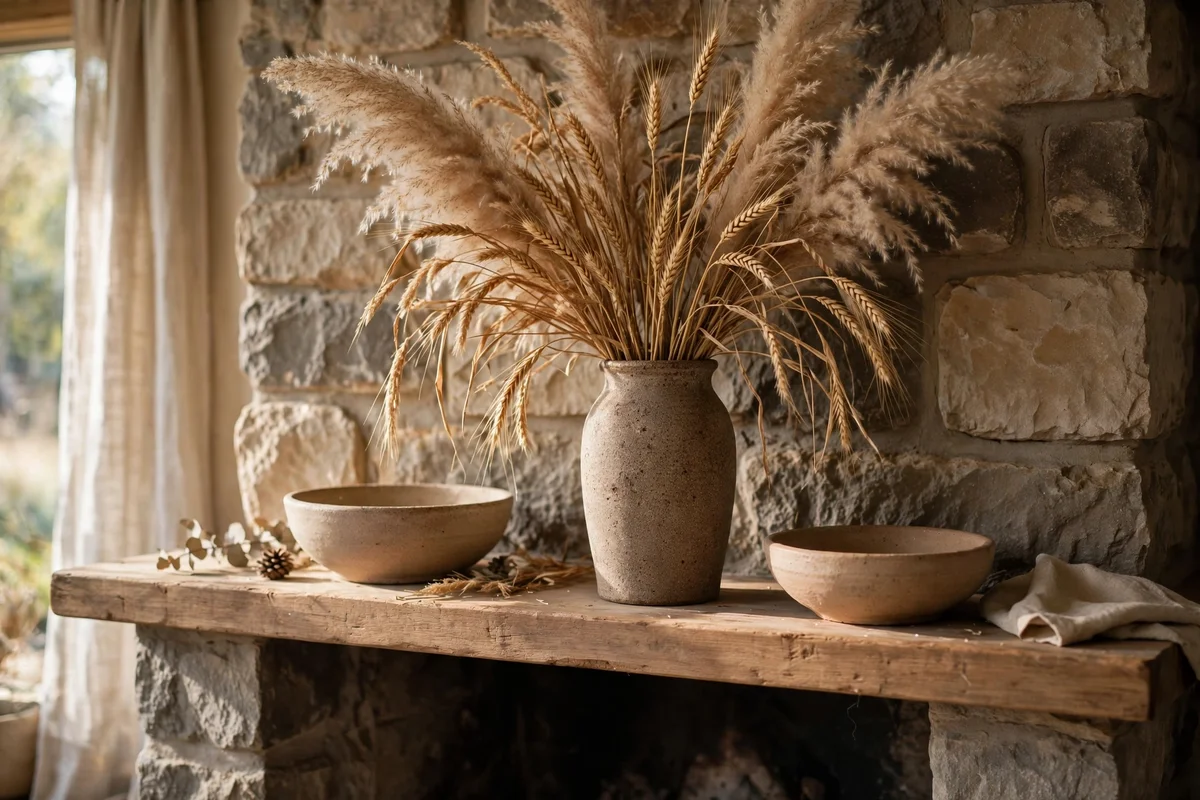
A mantel styled with dried grasses in a tall stoneware vase, flanked by two low ceramic bowls, brings the field indoors without a single fresh flower to maintain. Choose pampas, wheat or bunny tail grasses in their natural beige tones, cut to about 60 to 80 cm so the arrangement rises above the mantel shelf without touching the ceiling. Keep everything to one side if the fireplace is used daily, leaving clear space above the firebox.
Dried grasses cost 10 to 25 pounds or dollars per generous bunch and last two to three years if kept out of direct sun. The mistake is overfilling the vase until it looks like a haystack; seven to nine stems with room to breathe look far more refined. Shake grasses outdoors monthly to release dust, and never place dried stems near an open flame. Swap the arrangement seasonally for eucalyptus in winter months.
18. Add One Olive Accent Chair as a Single Earth Note
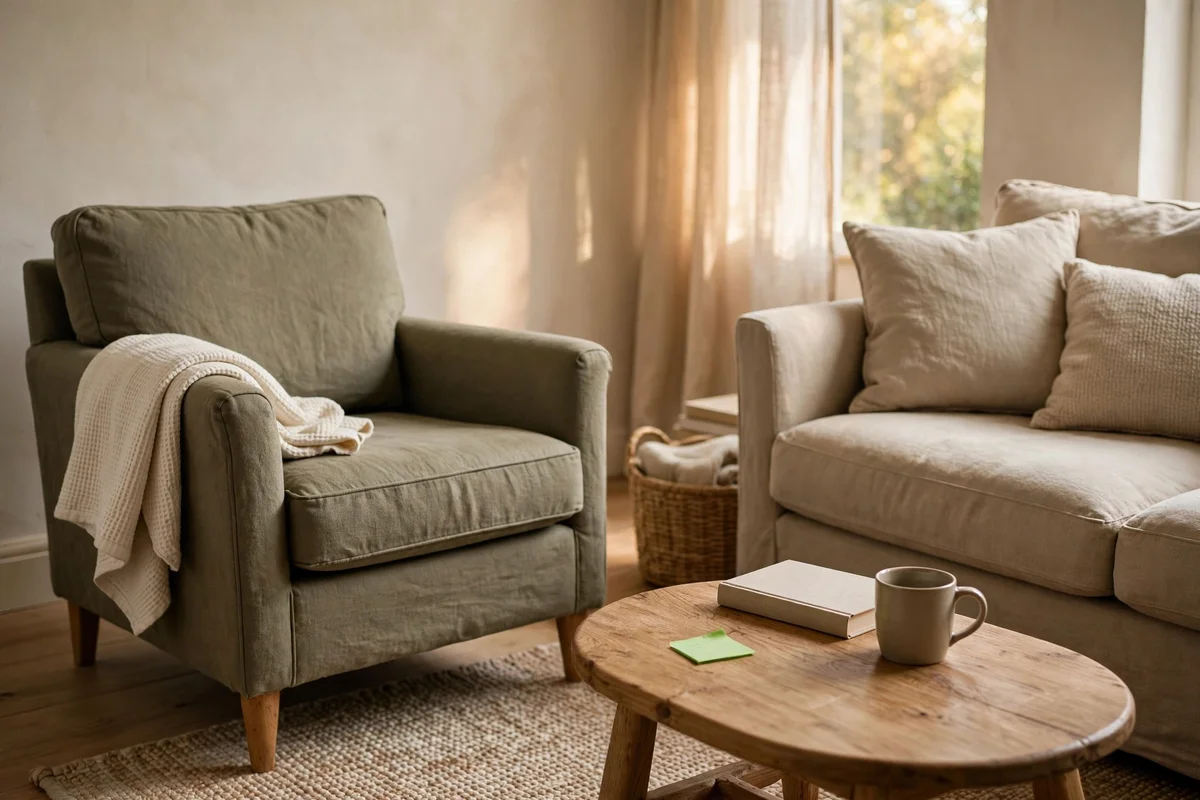
One armchair in muted olive, a greyed green the colour of sage leaves in dry weather, gives the room its cool counterpoint without leaving the earth family. Place it opposite the sofa or angled into a reading corner, and keep every other green in the room to the living plant so the chair stays special. Olive upholstery in linen or velvet both work; linen keeps the look relaxed while velvet adds quiet depth for evening rooms.
Reupholstering a second-hand armchair in olive linen costs 150 to 300 pounds or dollars including fabric, far less than buying new. The mistake is adding olive cushions, olive throws and olive curtains alongside the chair; one olive note is a decision, five is a theme park. Let the chair carry the green alone, and echo it only in the plant’s leaves. Vacuum upholstery monthly with a soft brush head.
19. Keep the Darkest Tone Low and the Lightest Tone High
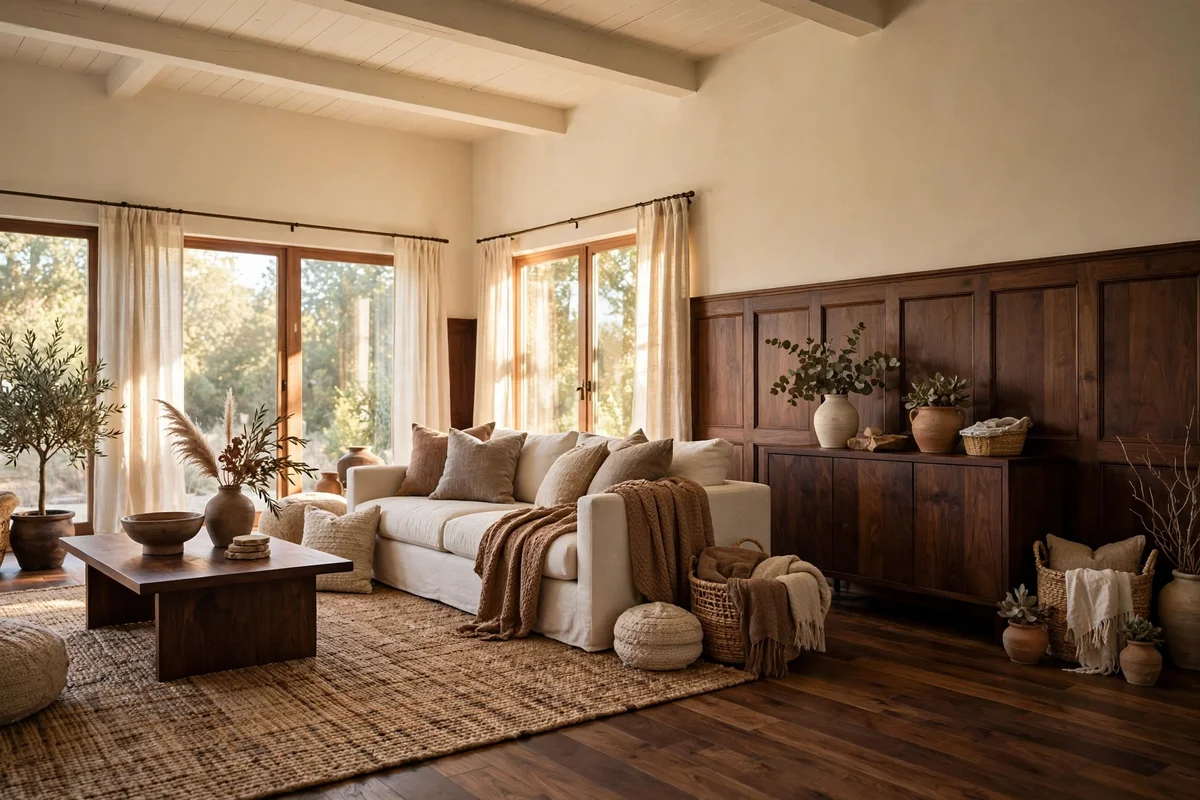
The depth rule that stops earth tones going muddy is simple: place the darkest colours low in the room and the lightest high. Dark walnut tables, umber cushions and low bookcases ground the floor zone, while warm cream ceilings, pale walls and light curtains lift the eye upward. Aim for a clear three-step contrast between floor, middle and ceiling tones, roughly a 30 percent value difference at each step, so the room reads in layers rather than one brown blur.
Test the rule by photographing the room in black and white; if the image shows distinct light, mid and dark bands, the contrast is working. The mistake is a mid-tone everything room, where sofa, walls, rug and curtains all sit in the same value range and the eye finds nowhere to rest. When in doubt, darken one low piece and lighten one high surface, and the whole palette snaps back into focus.
20. Run a Jute Runner From Doorway to Seating Area
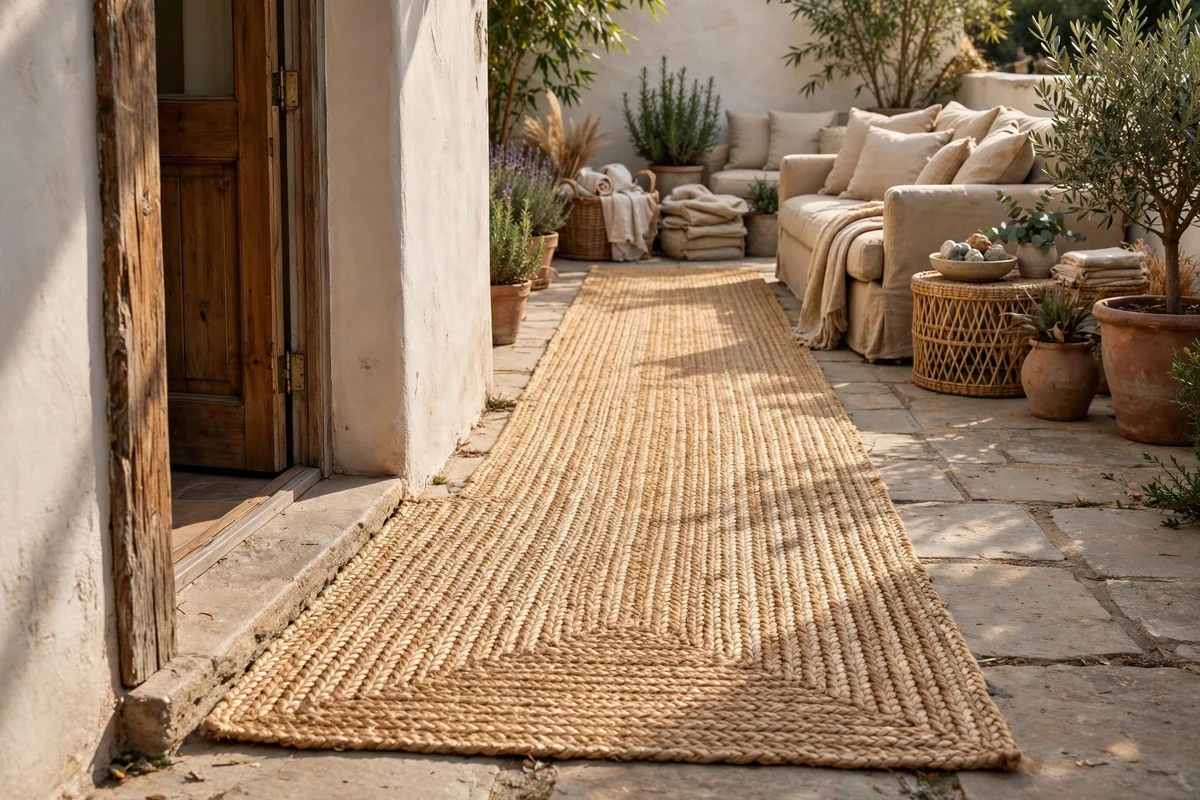
A jute runner, 70 to 80 cm wide and long enough to span the walkway, connects the doorway to the seating area and pulls visitors gently into the room’s palette. Natural jute in its golden tan tone bridges wood floors and the cream rug without competing with either. Lay it flat for a week under furniture legs to settle any curl, and use a thin rug pad beneath on slippery floors to stop it creeping.
Jute runners cost 30 to 70 pounds or dollars and handle heavy foot traffic well, though the coarse weave feels scratchy under bare feet, so keep it to walkways rather than lounging zones. The mistake is a runner that stops halfway across the room, which chops the floor into awkward islands. Measure the full walking line from door to sofa before buying, and choose a length that lands the runner’s end just under the main rug’s edge.
21. Frame a Simple Landscape Print in Raw Oak
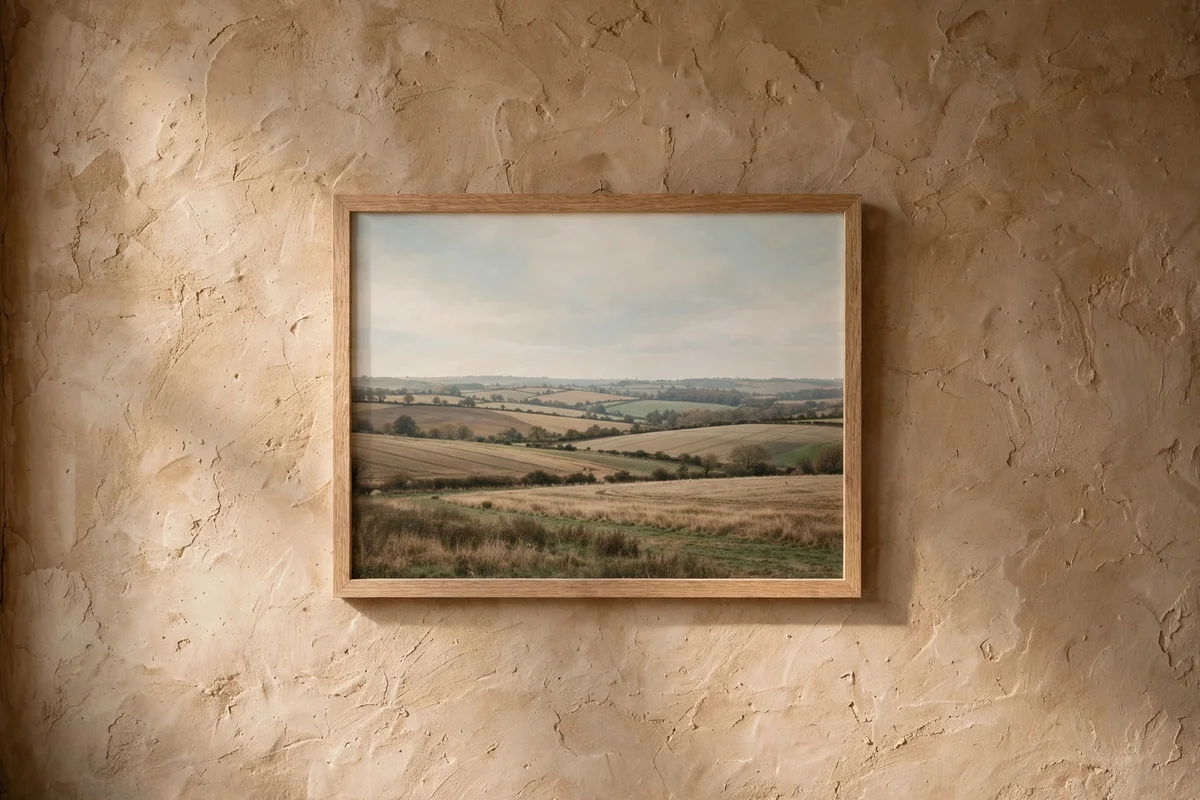
One framed landscape print in raw oak, about 60 by 80 cm, hung with its centre at 145 cm from the floor, gives the eye a quiet view without leaving the room. Choose an image of fields, hills or shoreline in muted earth tones, never bright or saturated, so the art extends the palette rather than interrupting it. A thin oak frame, 2 to 3 cm wide, keeps the focus on the image; chunky frames suit busier art.
Museum shops and independent printmakers sell beautiful landscape prints for 20 to 60 pounds or dollars, and a simple oak frame adds 30 to 50. The mistake is hanging a gallery wall of six mixed frames; in an earth tone room one confident piece beats a busy cluster. Hang it where lamplight grazes the surface in the evening, and keep glass non-reflective so the image stays readable from the sofa.
22. Style Open Shelves With Pottery, Books and Botanicals
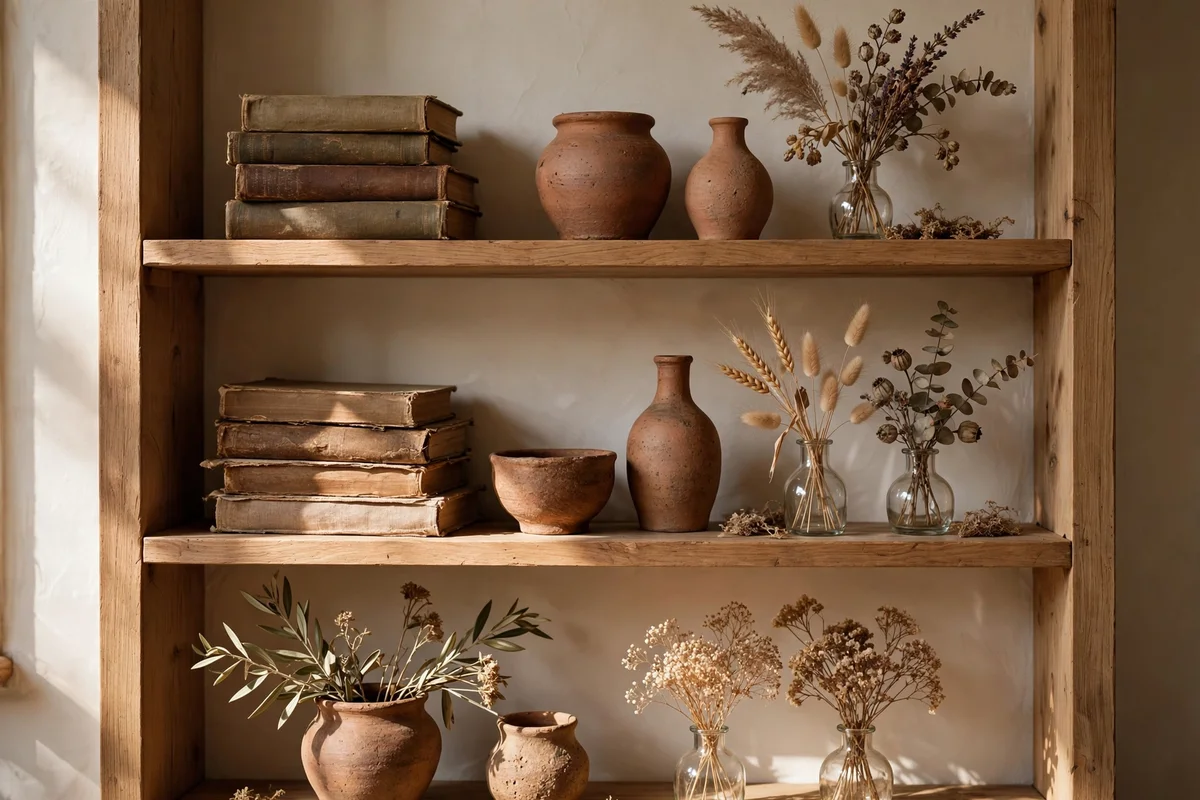
Open shelves styled with pottery, books and dried botanicals act as the room’s slow gallery, changing with the seasons while the furniture stays put. Follow a simple rhythm on each 80 to 100 cm shelf: a stack of three to four books laid flat, one ceramic vessel, and one small trailing-free botanical such as a dried seed head in a bud vase. Repeat the rhythm across shelves with slight variation so the whole unit reads as one composition.
Mount shelves with brackets rated for at least 15 kg each, since books and pottery weigh more than expected; fix into studs or use heavy-duty plaster anchors. The mistake is styling shelves like a shop display with price-tag symmetry; leave gaps, vary heights, and let one shelf hold only a single beautiful bowl. Dust shelves monthly, since open storage collects a fine film that dulls ceramics faster than closed cupboards.
23. Divide a Corner With a Woven Cane Screen
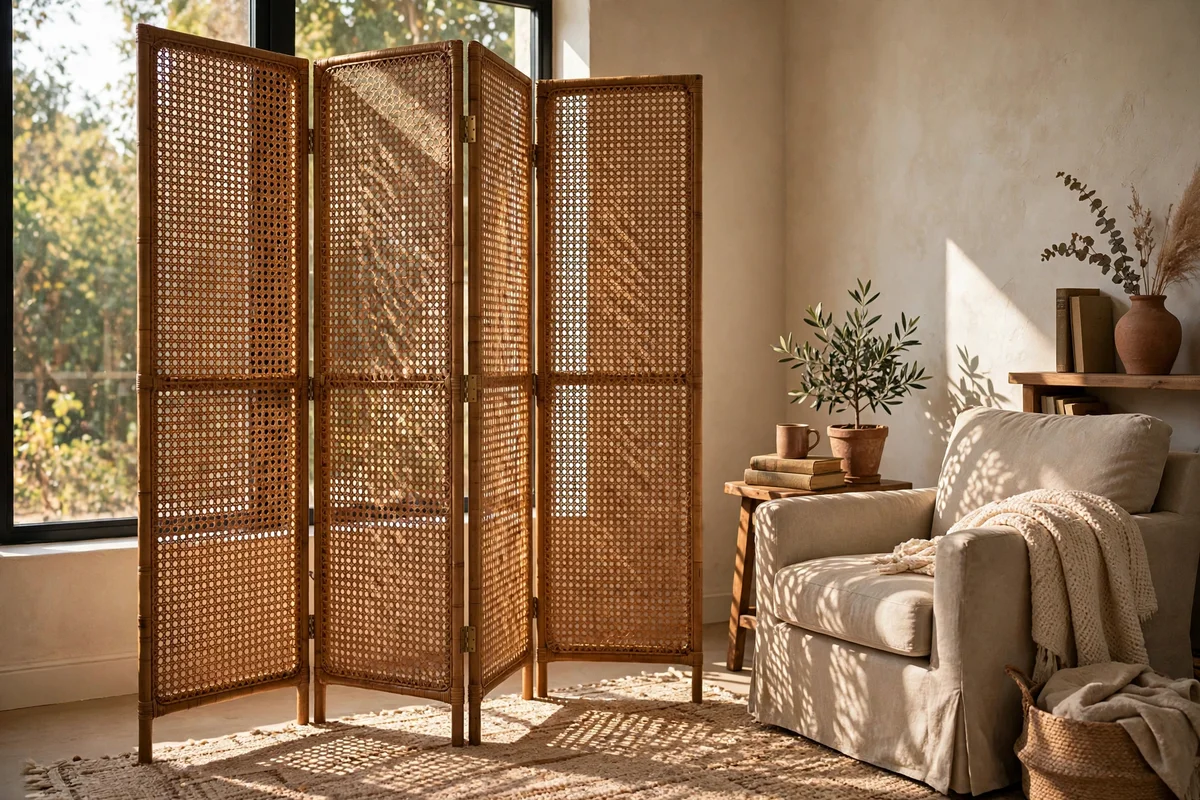
A three-panel woven cane screen, each panel about 45 cm wide and 170 cm tall, softly divides a reading corner or hides a radiator without building a wall. The open cane weave lets light pass through, so the divided corner still feels part of the room rather than shut away. Angle the panels in a gentle zigzag rather than a straight line; the fold gives stability and a more graceful silhouette.
Cane screens cost 80 to 180 pounds or dollars, and vintage ones often have the warmest patina. The mistake is using the screen as a dumping ground for items you do not want to see; a cluttered screen looks worse than no screen. Keep the hidden side tidy with a lidded basket, and dust the cane panels with a soft brush twice a year. Place a small lamp behind the screen for a lovely woven shadow at night.
24. Limit Coffee Table Styling to Three Textures
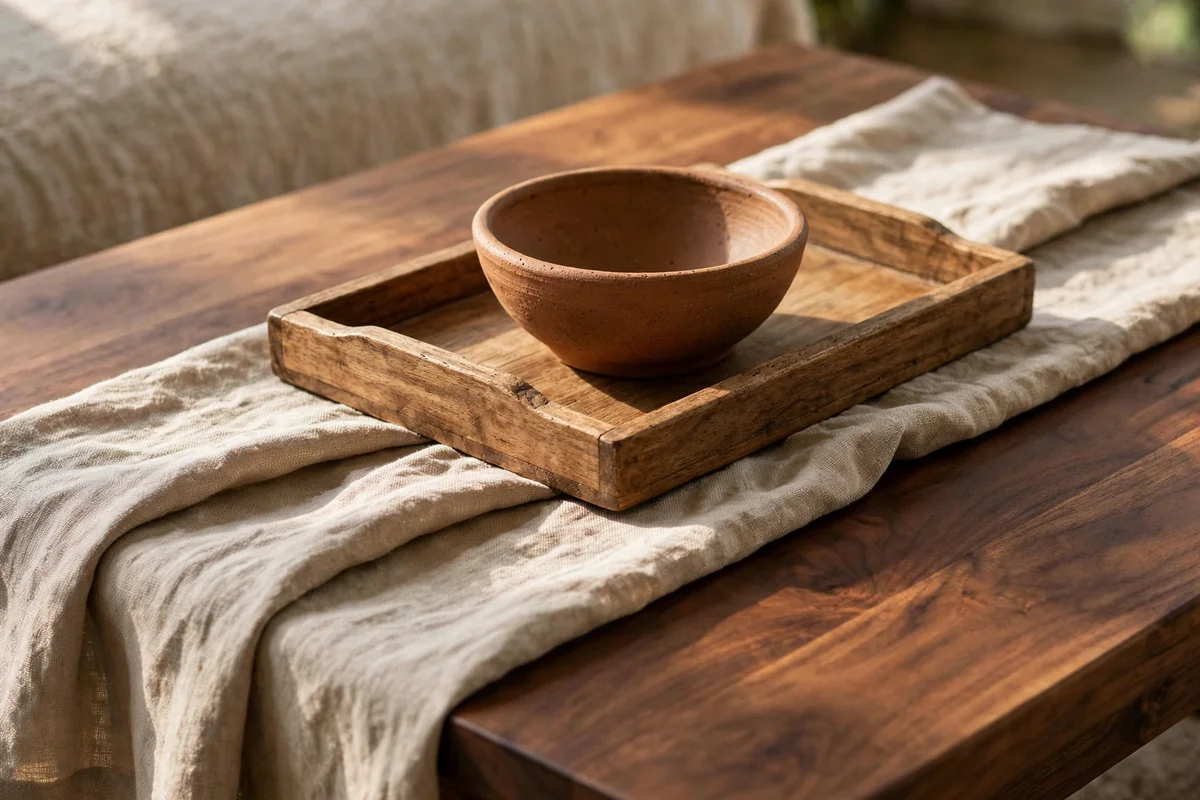
Restraint is the final depth rule: style the coffee table with exactly three textures, for example rough clay, smooth wood and soft linen, and no more than five objects total. A ceramic bowl, a wooden tray and a folded linen runner under a small stack of books covers the formula. Each texture then reads clearly instead of dissolving into visual noise, and the table still has room for two cups of tea.
Edit the table monthly by removing everything and rebuilding from scratch; pieces creep back over time and the calm disappears. The mistake is the overstyled table that cannot hold a cup, which turns a living room into a showroom nobody relaxes in. Function first, beauty second, and earth tones reward the discipline. A tray corral, about 40 by 30 cm, keeps small items grouped and the surface easy to wipe.
25. Finish the Room With a Handmade Umber Lamp Base
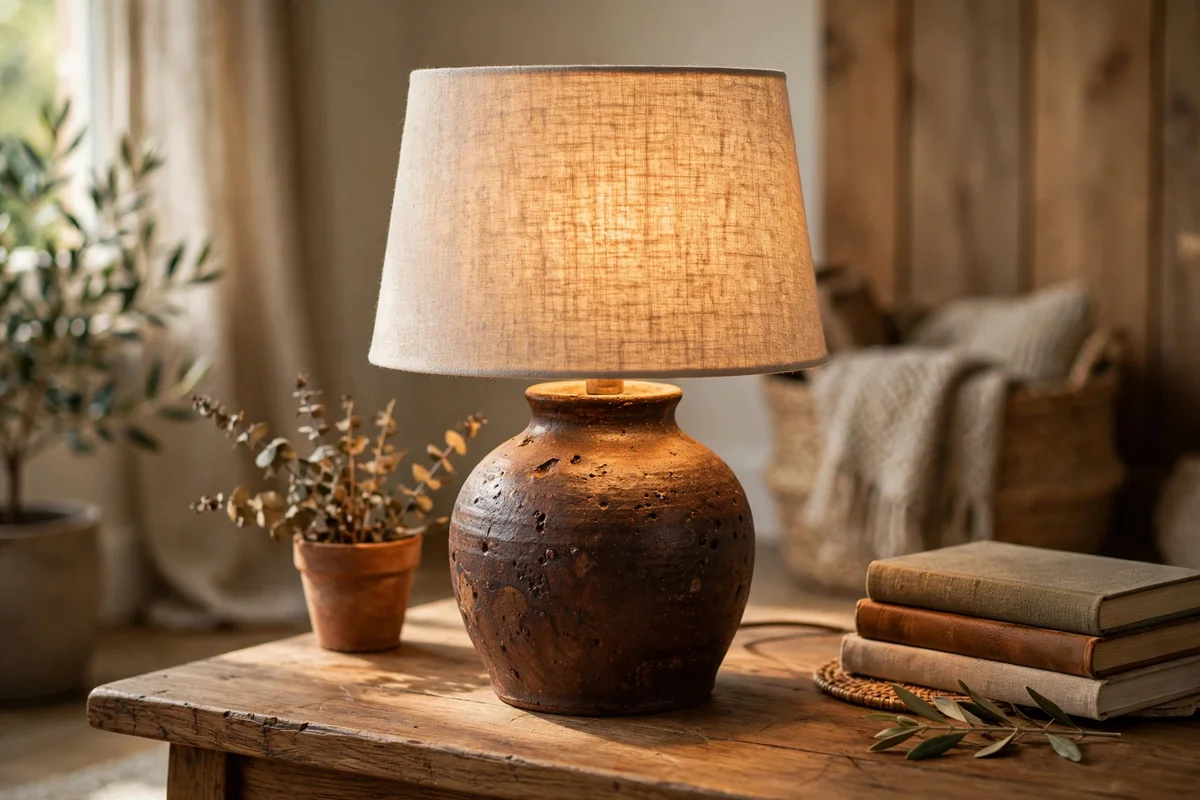
The finishing touch is a table lamp with a handmade ceramic base in deep umber, about 35 to 45 cm tall including the shade, placed where its glow lands on the room’s best textures. Umber reads as the palette’s full stop, the darkest warm note that makes cream walls and sand upholstery look intentional rather than accidental. Pair it with a natural linen shade, 25 to 30 cm in diameter, which softens the bulb into a warm pool of light.
Handmade ceramic lamp bases cost 60 to 140 pounds or dollars from pottery studios, or convert a favourite vase with a 15-pound lamp kit and a drill. The mistake is choosing a shiny glazed base in a bright colour, which fights the room’s matte, muted mood. Keep the glaze matte or unglazed, keep the shade natural linen, and let this one dark, warm object close the composition the way a signature closes a letter.
An earth tone living room is built slowly, one honest material at a time, and that is exactly why it lasts. Clay walls, sand upholstery, walnut wood, woven baskets and a single green plant ask for nothing trendy and give back calm every single day. Keep the contrast clear, the textures varied and the light warm, and the room will feel grounded whether the sun is out or the lamps are on.
This week, try the easiest idea first: swap every bulb in the room to 2700K warm white and drape one linen throw over the sofa arm. The change costs little and takes an afternoon, yet it shifts the whole mood toward warmth immediately. Then choose one bigger step, perhaps the clay walls or the dark walnut table, and let the palette grow around it at your own pace.
Frequently Asked Questions
What colours count as earth tones for a living room?
Clay, terracotta, sand, camel, ochre, olive, umber, warm taupe and cream form the core family. They all share warm undertones taken from soil, stone, straw and bark. Keep the room to four or five of these at most, and let one dark tone such as walnut or umber anchor the lighter ones. Avoid cool greys and bright primaries, which break the natural harmony.
How do I stop an earth tone room looking flat or muddy?
Build clear contrast in three steps: darkest tones low, mid tones in the middle, lightest tones high, with about a 30 percent value jump at each step. Include one dark anchor such as a walnut table, vary textures between linen, wool, rattan and stone, and light everything with warm 2700K bulbs. Photograph the room in black and white; distinct light, mid and dark bands mean the contrast is working.
Can I mix light oak and dark walnut furniture in one room?
Yes, if you keep a clear ratio of roughly 70 percent mid-tone oak to 30 percent dark walnut, and both woods share warm undertones. Let oak floors and larger pieces carry the room while walnut appears in one or two contrast pieces such as the coffee table. Avoid a 50-50 split, which reads as indecision rather than design.
What is the cheapest way to warm up a beige living room?
Start with light and textiles, the two cheapest levers. Swap all bulbs to 2700K warm white, add a camel wool throw and two umber linen cushion covers, and hang unbleached linen curtains. Together these usually cost under 150 pounds or dollars and transform the mood in a weekend. Paint and furniture can follow later, once the warm base is proven.
Which indoor plants suit an earth tone living room best?
Olive trees, fiddle-leaf figs and snake plants suit the palette, their muted greens echoing the room’s natural mood. Choose one tall specimen in a clay or stoneware pot rather than many small plants, and place it where it gets bright indirect light. Water only when the top few centimetres of soil dry out, and dust large leaves monthly.