Kitchen
24 Breakfast Nook Ideas That Make Slow Mornings Feel Like a Daily Ritual
By Anna Wells · · 19 min read
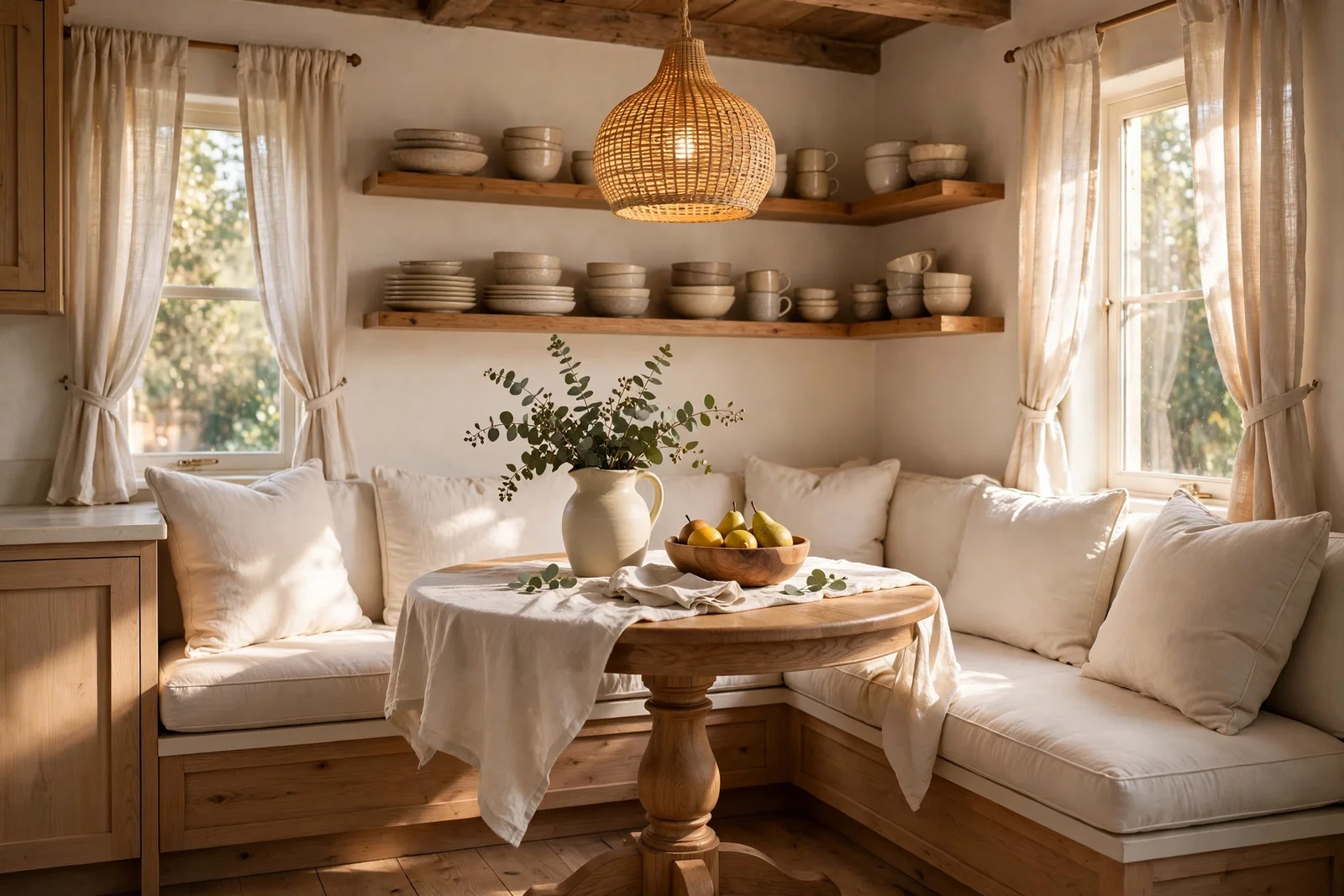
A gentle tour of 24 breakfast nook ideas that turn slow mornings into a daily ritual, from banquettes with hidden storage to soft morning light and simple three-piece table styling.
The kettle clicks off just as the first light reaches the kitchen. Outside, the street is still hushed, and inside, the corner by the window waits with its cushions plumped and yesterday’s crumbs swept away. This is the quiet hour of the day, and a breakfast nook gives it a place to happen.
A nook does not need much space to work its calm. A built-in bench along one wall, a round table that slides in close, a pendant hung low enough to pool light over toast and tea. With the right measurements, even the corner of a galley kitchen can seat two people comfortably.
This guide collects 24 breakfast nook ideas that treat the morning as a ritual worth designing for. You will find banquettes with hidden storage, washable cushions that forgive spills, window treatments that soften glare, and simple ways to style the table between meals so the corner always looks cared for.
Every idea comes with practical detail: sizes, materials, placement distances and budget guidance, plus one mistake to avoid where it matters most. Whether your kitchen is compact or generous, start at the top and build your slow-morning corner one idea at a time.
1. Build an L-Shaped Banquette With Lift-Up Seats for Hidden Storage
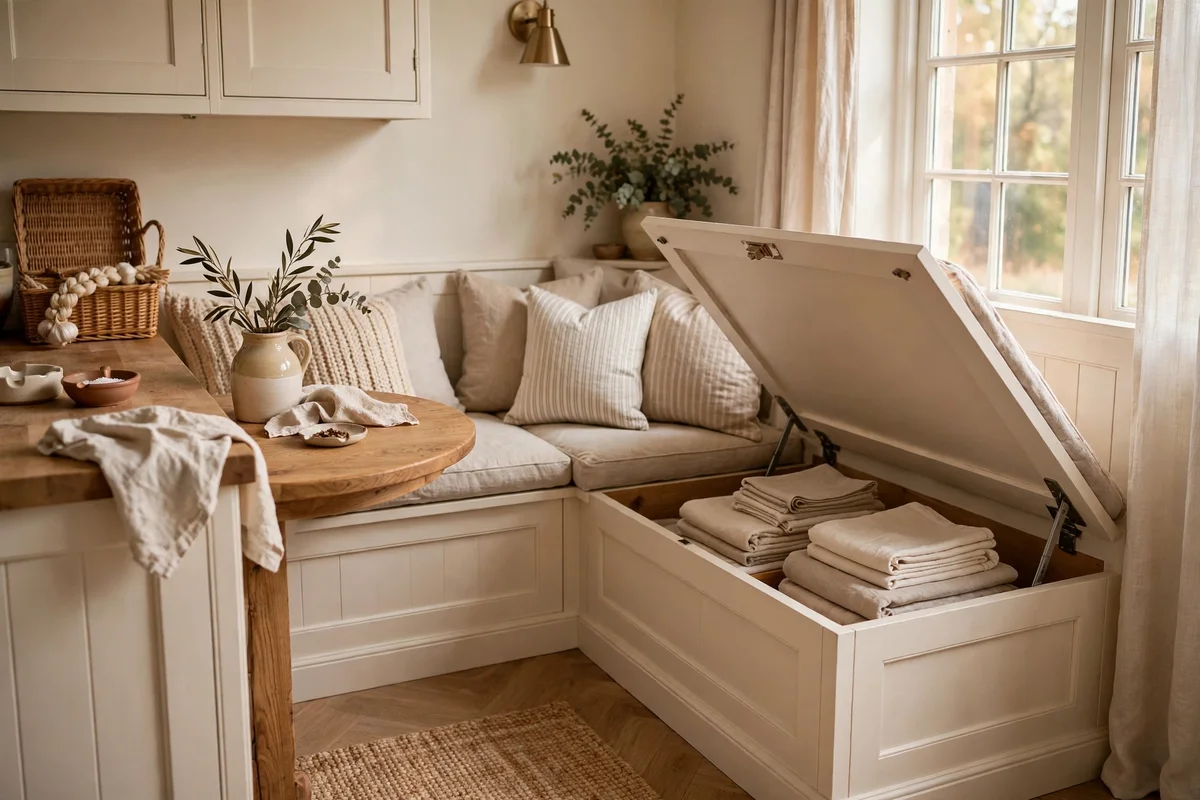
An L-shaped banquette turns an awkward kitchen corner into the most used seat in the house. Build the benches 45 cm high and 50 cm deep so adults sit comfortably without perching, and hinge each seat lid so the base becomes storage for table linens, placemats and spare napkins. A plywood or painted MDF carcass costs far less than cabinetry and takes a confident DIYer one weekend to assemble.
Keep the stored items light and flat, since lifting a lid while seated is awkward. Store folded cloths, paper napkins and the good placemats you save for weekends. Fit soft-close hinges so lids never slam on fingers. The mistake to avoid is building the seat deeper than 55 cm; beyond that, backs press against the wall and feet dangle. Finish raw edges with quarter-round trim painted to match the bench.
2. Choose a Round Table of 90 to 110 cm for Easy Movement
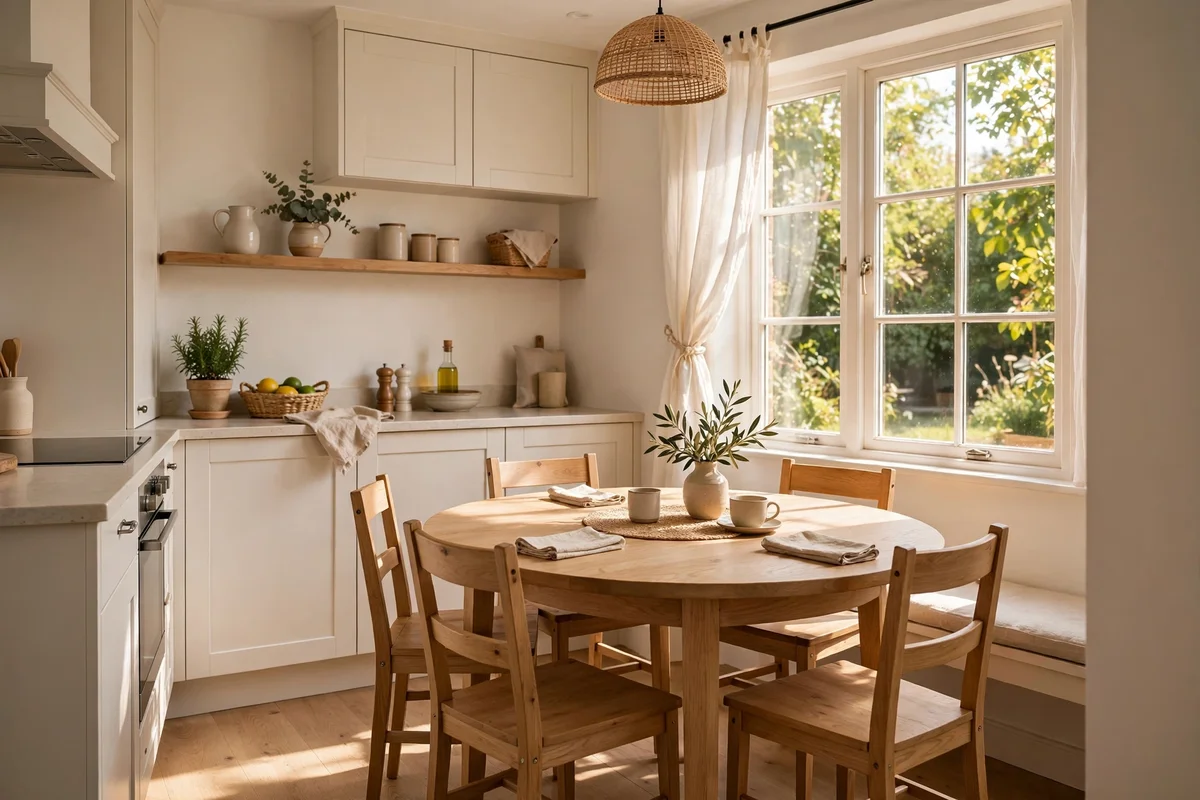
A round table of 90 to 110 cm across seats three or four people without corners to bump in a tight nook. The curved edge lets chairs tuck fully underneath, which frees roughly 15 cm of walkway on every side compared with a square table of the same footprint. Look for a top 72 to 75 cm high so it pairs with standard 45 cm banquette seats, and check that the edge clears knees by at least 20 cm.
Light oak, ash or painted pine tops suit morning light, since pale timber bounces brightness around the corner. The mistake to avoid is buying a table larger than 120 cm for a small nook; it blocks the walkway and forces sideways shuffling past the bench. A 100 cm round top with a pedestal base usually costs between 150 and 400 dollars, and second-hand finds often need only a light sanding and hardwax oil.
3. Hang a Single Pendant 75 cm Above the Table Centre
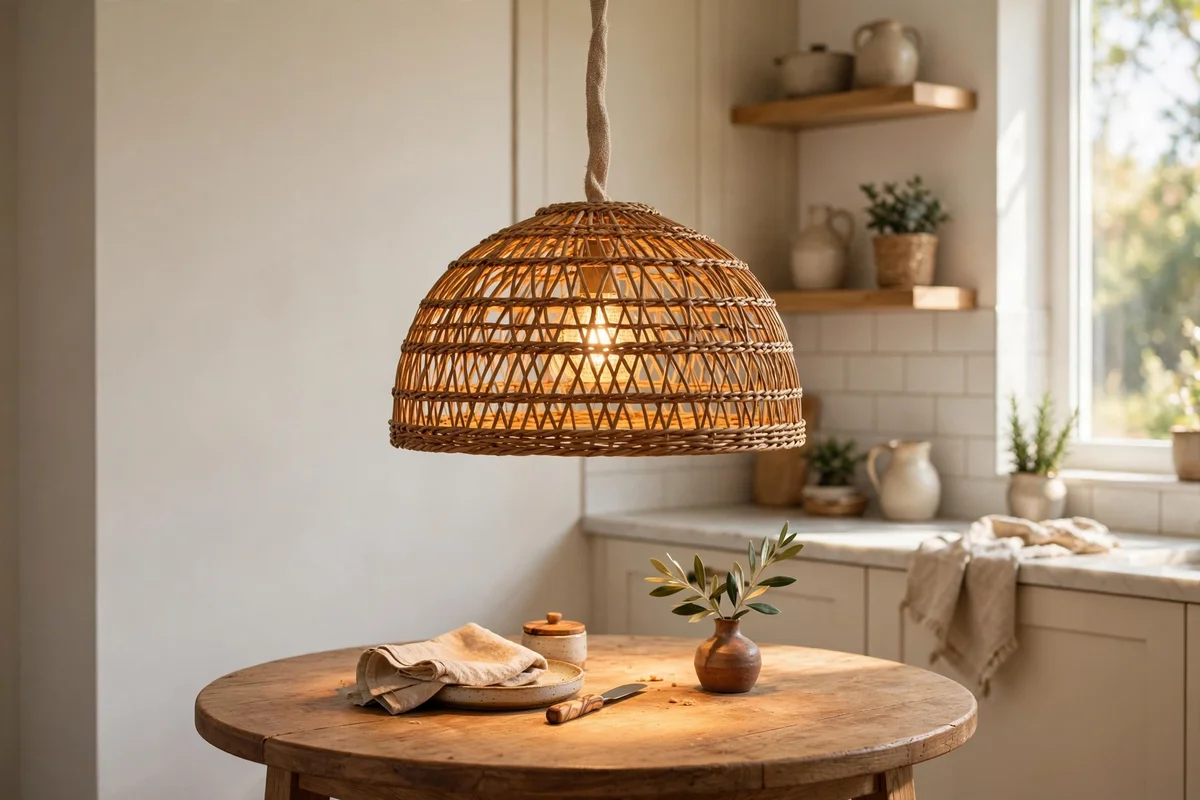
One pendant hung 70 to 80 cm above the tabletop pools light exactly where breakfast happens and leaves sightlines across the table open. Choose a shade 30 to 40 cm wide, like a woven rattan dome or an opal glass globe, so the fitting feels proportionate to a 100 cm round table. A warm 2700K bulb flatters food and faces, and a fabric-covered cord adds a soft, crafted detail.
Centre the pendant over the table, not the room, and shift it when the table moves rather than living with an off-centre glow. If the ceiling junction box sits elsewhere, a ceiling hook with a swag of cord solves it in minutes. The mistake to avoid is hanging the shade above 90 cm, where light spills into the room instead of gathering over the table. Budget pendants start around 40 dollars.
4. Dress the Banquette in Washable Cotton Slipcovers
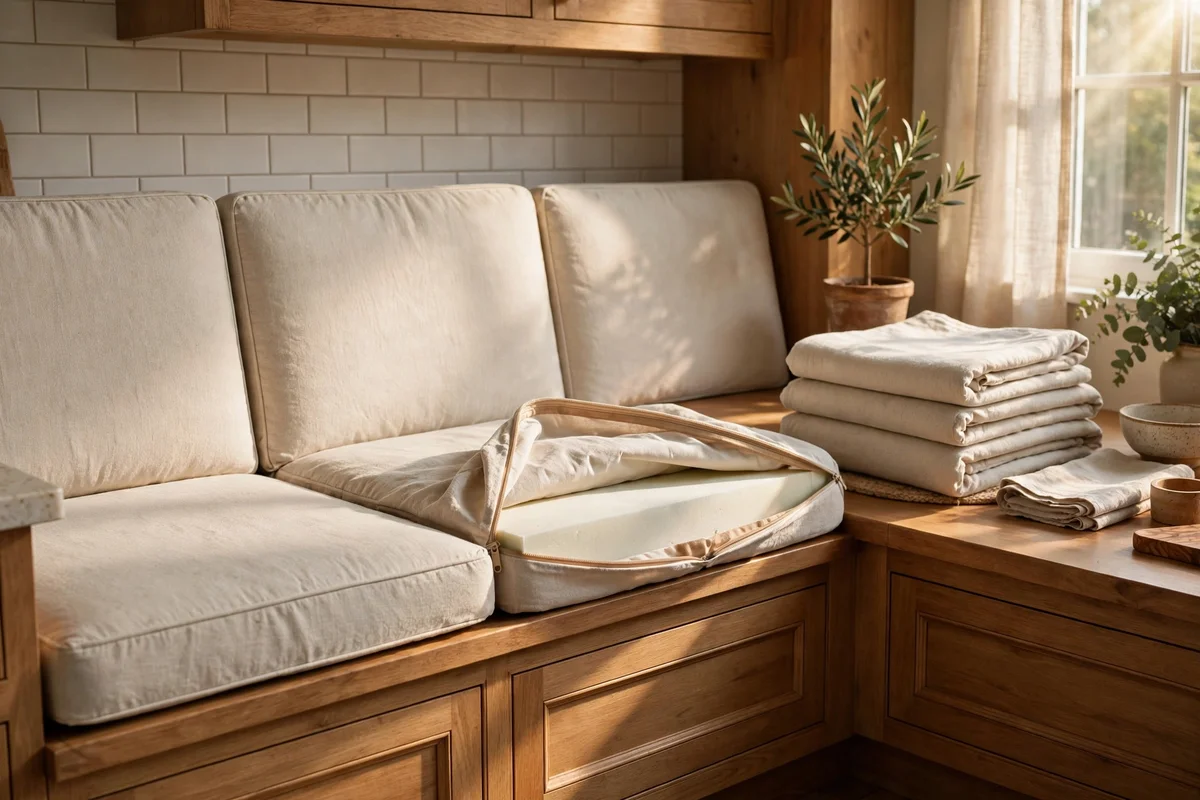
Washable seat cushions are the practical heart of a breakfast nook, because jam, tea and buttered toast will find them. Choose medium-weight cotton or cotton-linen slipcovers with a zip or envelope closure so they come off in seconds. Mid-tone fabrics like oatmeal, sage or warm grey hide small marks between washes far better than white or cream.
Cut foam 8 to 10 cm thick for the seat pad so it stays comfortable through a long, slow breakfast, and wrap it in a washable inner liner to protect the foam itself. Wash covers on a cool cycle and air-dry to avoid shrinkage. The mistake to avoid is choosing dry-clean-only upholstery; it turns every spill into a crisis. Two spare covers cost around 30 to 60 dollars.
5. Hang Cafe Curtains in Washed Linen to Soften Morning Light
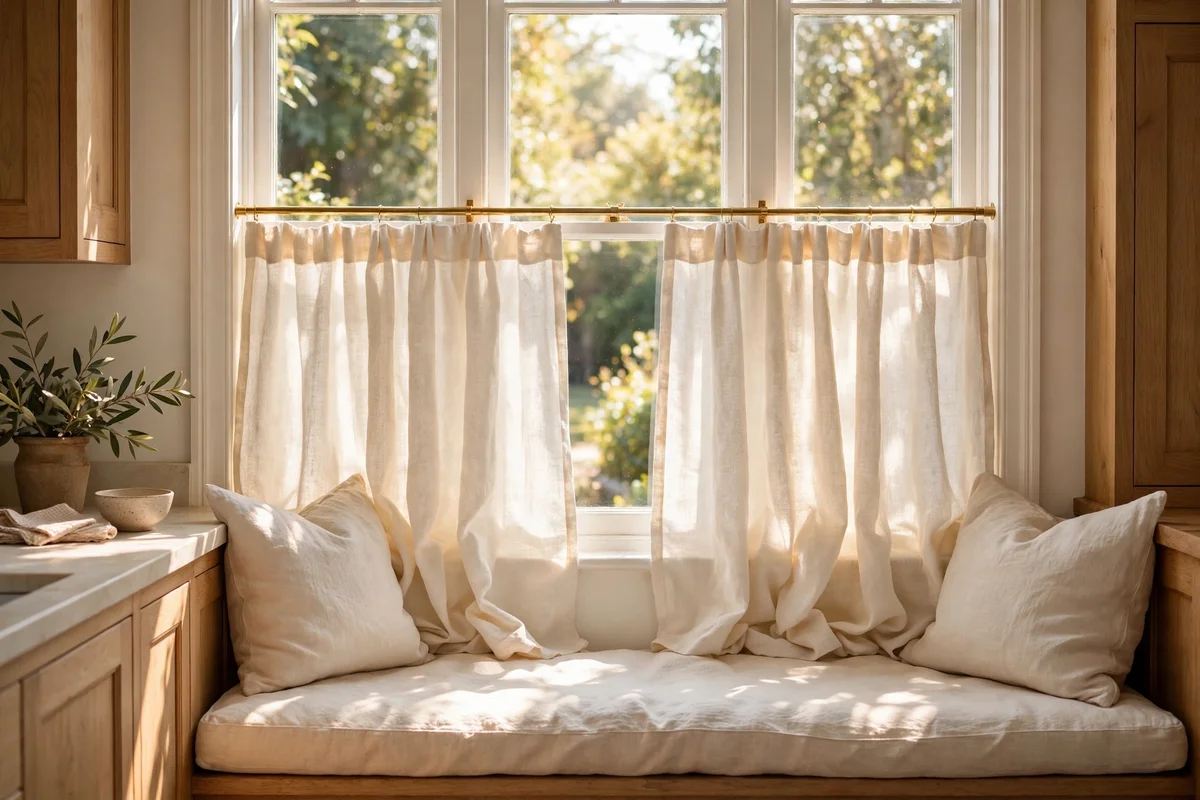
Cafe curtains cover only the lower half of the window, so they soften glare on the table while leaving the upper glass open to the sky. Washed linen in natural, ivory or pale stone filters harsh east light into a gentle glow without darkening the room. Hang the rod at the midpoint of the window frame, and let the panels finish 2 cm below the sill.
A simple tension rod works for renters, while a slim brass rod suits a permanent nook. Gather full-width panels to one and a half times the window width so the folds stay soft rather than flat. The mistake to avoid is using heavy blackout fabric here; it kills the morning light the nook exists for. Linen cafe curtains usually cost 25 to 70 dollars per window.
6. Squeeze a Two-Person Nook Into a Sunny Kitchen Corner
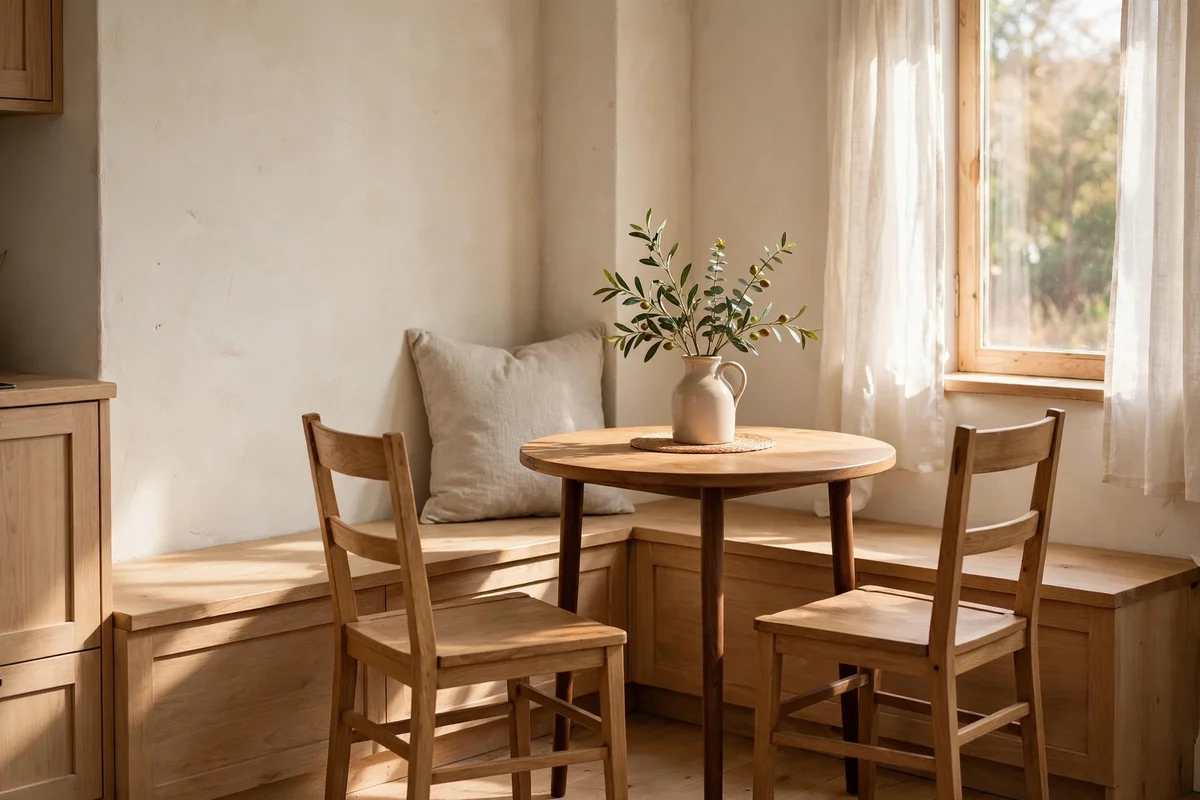
Even a corner measuring 120 by 120 cm can hold a genuine two-person nook. Fix a bench 40 cm deep along one wall, add a 70 cm round cafe table, and place two chairs on the open sides. The bench saves the space a second pair of chairs would need, and the round table keeps elbows and walkways clear in the tight footprint.
Keep the palette pale and the styling minimal so the small corner breathes: one cushion, one small jug of stems, nothing else on the table between meals. Wall-mount the pendant on a plug-in cord to avoid rewiring. The mistake to avoid is squeezing in a four-person set; cramped seating gets abandoned. This micro nook typically costs 200 to 500 dollars with ready-made pieces.
7. Mount Two Open Shelves Above the Banquette for Everyday Dishes
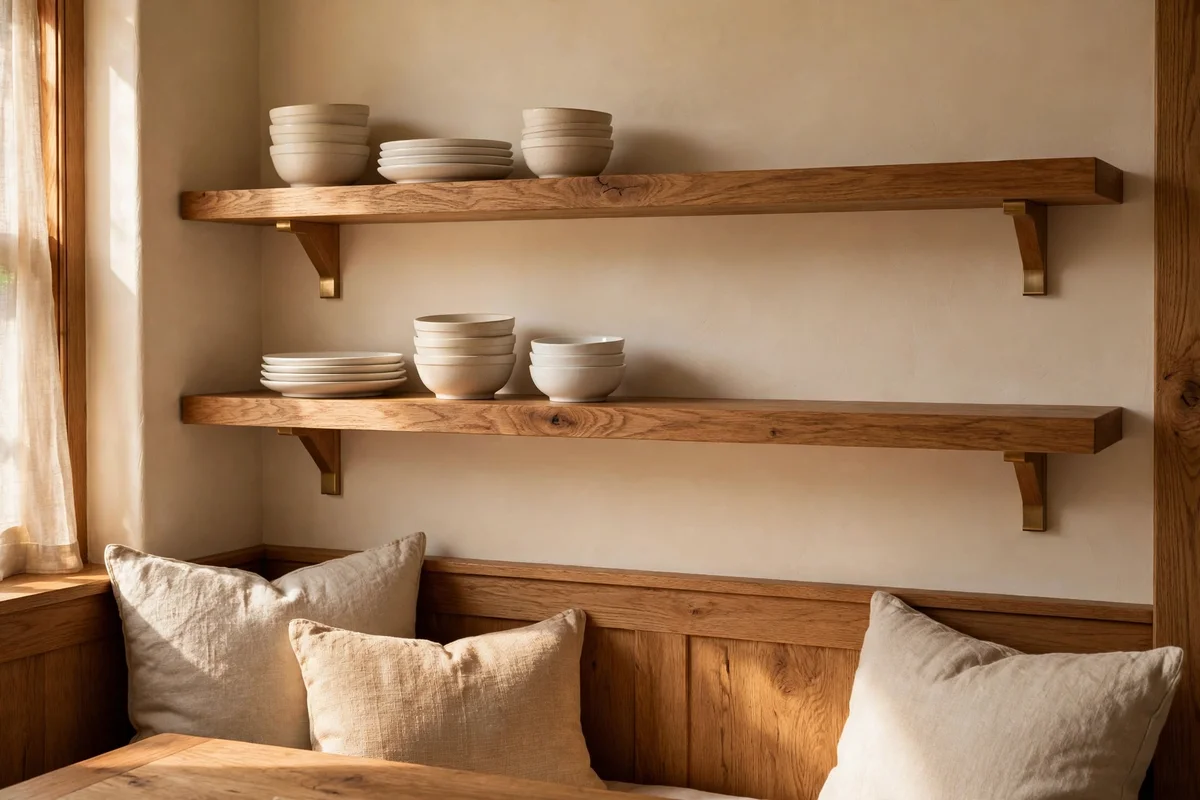
Two open shelves mounted 40 to 50 cm above the banquette back keep everyday dishes within reach and turn them into decor. Stack plain white or stoneware bowls and plates in neat piles of four to six, and leave one third of each shelf empty so the display breathes. Solid oak or pine boards 20 cm deep hold a surprising amount without looking heavy.
Fix shelves into studs or use anchors rated for at least 15 kg per shelf, since stacked stoneware is heavier than it looks. Keep rarely used pieces in closed cupboards so the open shelves stay honest and uncluttered. The mistake to avoid is loading shelves with decorative objects only; a breakfast nook earns its keep when the shelves work. Two shelves with brackets cost 40 to 120 dollars.
8. Style the Table Between Meals With a Cloth, a Jug of Stems and a Fruit Bowl
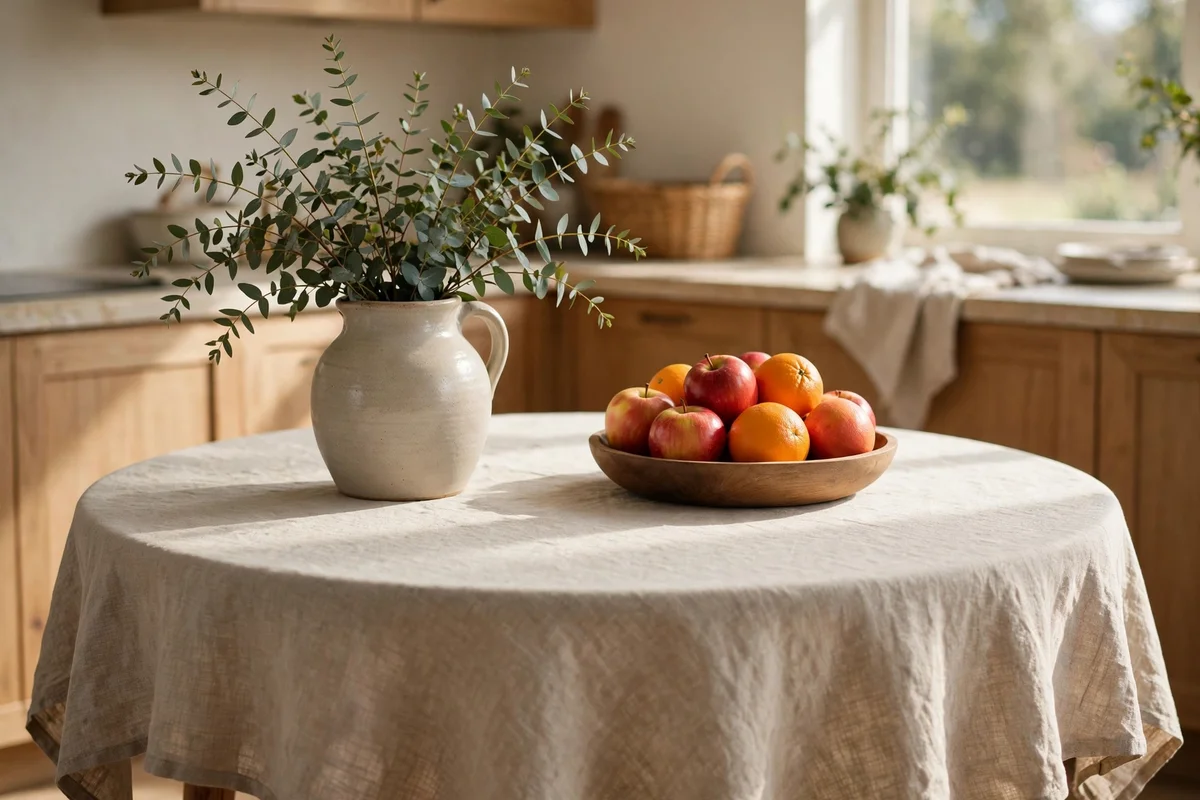
Between meals, dress the table with three simple elements: a linen cloth or runner, a jug of fresh stems, and a low fruit bowl. A 140 cm square cloth suits a 100 cm round table, leaving a 20 cm overhang all round. The stems can be eucalyptus, olive branches or whatever the garden offers, kept to 30 cm above the jug so conversation flows across.
Choose a shallow wooden or ceramic fruit bowl 25 to 30 cm wide and fill it with three to five pieces of seasonal fruit; apples, pears, oranges and dates all read beautifully. Rotate the stems weekly and smooth the cloth flat each morning. The mistake to avoid is adding candles, books and trays on top; a working nook stays clear. This styling costs almost nothing beyond the fruit.
9. Set the Banquette Seat at 45 cm High and 50 cm Deep
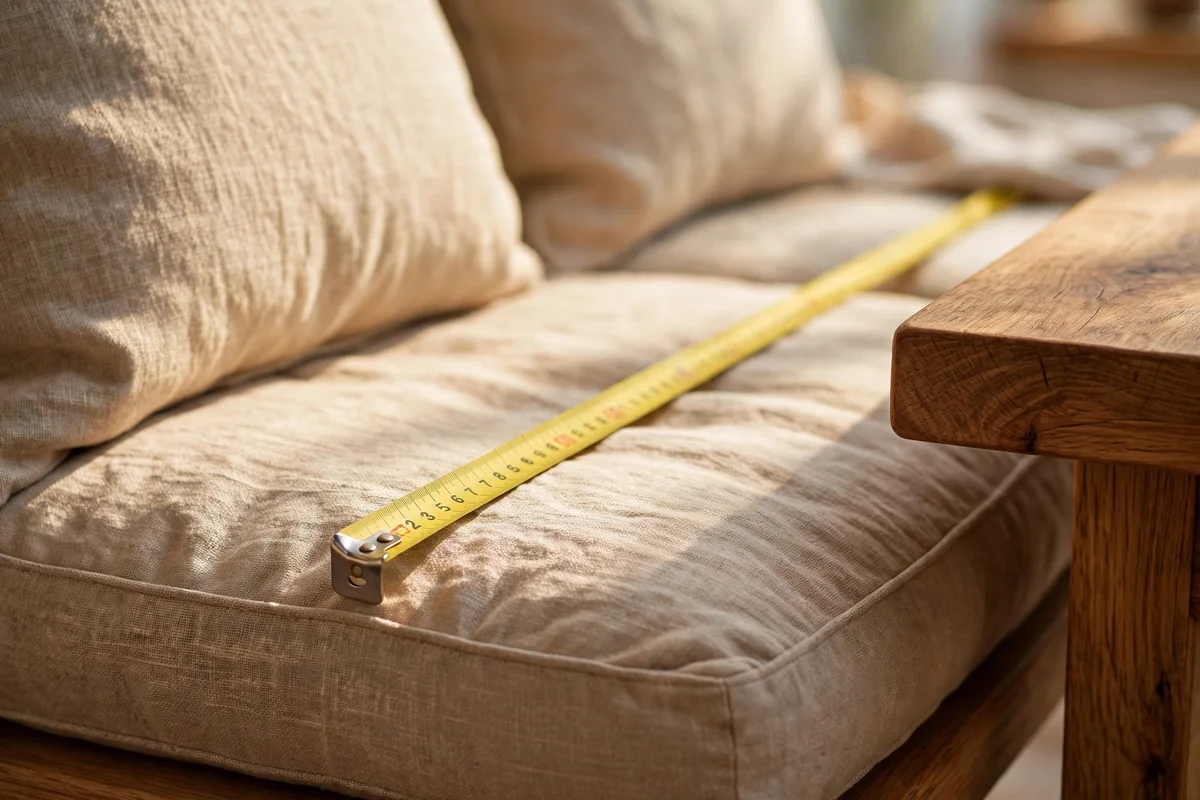
Comfort lives in the measurements. A seat height of 44 to 46 cm lets most adults place feet flat on the floor, matching standard dining chairs, while a seat depth of 48 to 52 cm supports thighs without pushing sitters against the wall. Add a back cushion 10 to 12 cm thick, which brings the effective depth to a cosy 38 to 40 cm.
Leave 20 to 25 cm between the seat top and the table underside for knees, which means a 75 cm table pairs with a 45 cm seat. Test the heights with stacked books before building anything permanent. The mistake to avoid is copying sofa depths of 60 cm or more; deep banquettes force an awkward slouch at a dining table. A tape measure and ten minutes prevent years of discomfort.
10. Curve the Seating Around an Oval Table for a Generous Corner
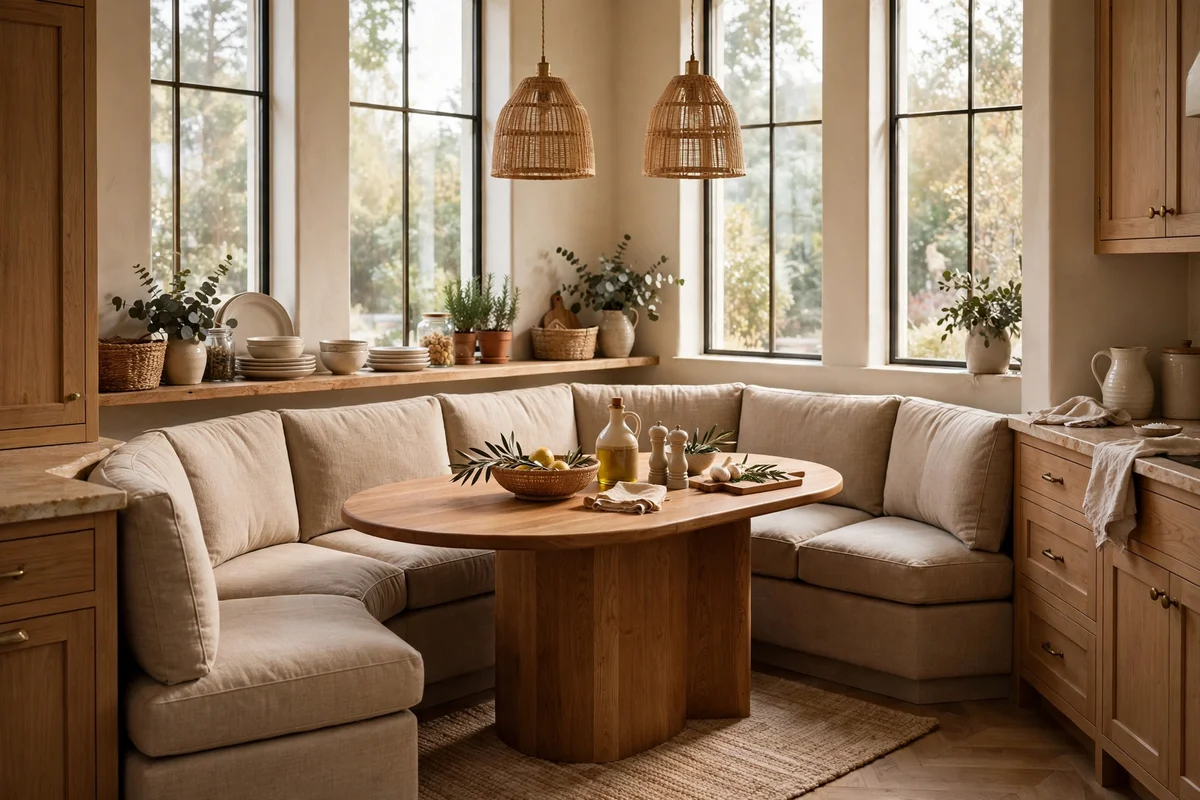
In a generous corner, a U-shaped or curved banquette wrapped around an oval table seats five or six people and feels made for long weekend breakfasts. An oval table 150 cm long and 90 cm wide fits the curve of the bench while keeping every seat within easy reach of the centre. Curve the bench with a 15 cm radius on the corners so cushions bend without bunching.
Build the bench in three straight sections joined at slight angles if a true curve feels too ambitious; cushions in three pieces look intentional and lift off separately for washing. Keep one long side open for easy sliding in and out. The mistake to avoid is fixing the table to the floor before testing the layout; live with it loose for a week. Expect 600 to 1,500 dollars for a built curved banquette.
11. Choose a Pedestal Base So Knees Never Hit Table Legs
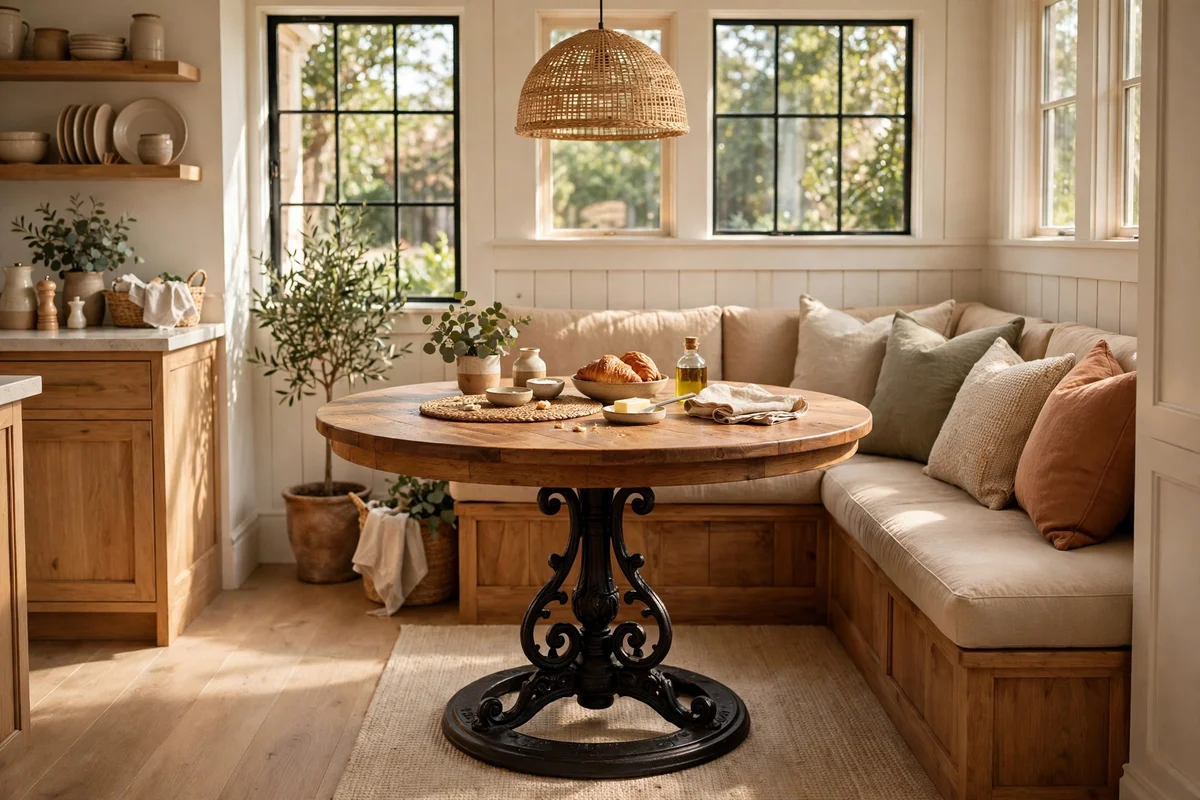
A pedestal base with a single central column frees the entire perimeter of the table, so knees never collide with legs when people slide along a banquette. Look for a base whose footprint is roughly half the table diameter; a 50 cm base steadies a 100 cm top. Cast iron bases add welcome weight, while turned timber columns suit cottage and farmhouse nooks.
Check stability by pressing down firmly on the table edge; a good pedestal should not rock or tip. Add felt pads under the base to protect floors and make the table easy to nudge. The mistake to avoid is pairing a narrow 30 cm base with a wide top, which wobbles every time someone leans. Pedestal tables cost 180 to 500 dollars new, less second-hand.
12. Add a Small Wall Sconce for Dark Winter Mornings
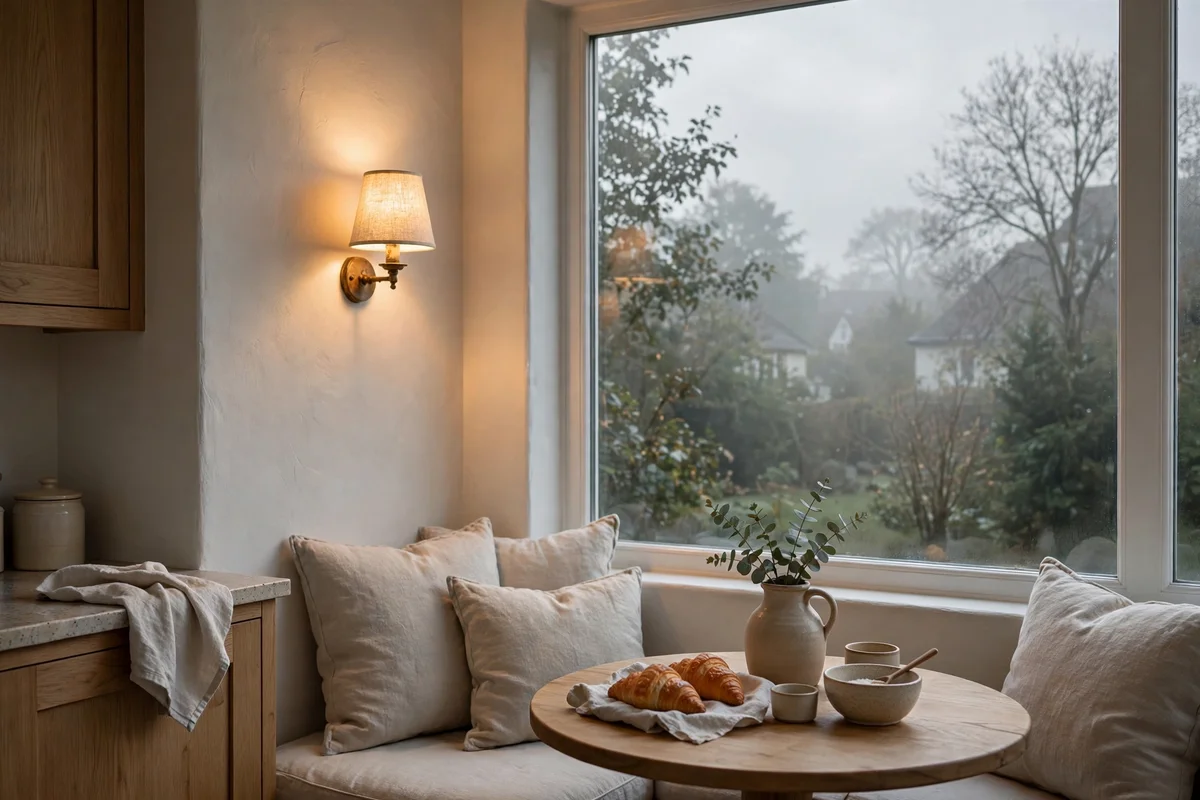
In winter, the nook window can stay grey until well after breakfast, so a small wall sconce beside the window keeps the ritual glowing. Choose a plug-in or rechargeable design to avoid rewiring, mounted 140 to 150 cm from the floor so the light washes the wall softly. A linen or opal shade diffuses the glow and hides the bulb.
Pick a warm 2700K bulb at modest brightness, around 400 lumens, so the sconce complements rather than competes with daylight. Position it on the wall beside the window, not opposite, to avoid glare in seated eyes. The mistake to avoid is installing a harsh cool-white downlight; it flattens the gentle mood entirely. Rechargeable sconces cost 30 to 80 dollars and charge via USB.
13. Top a Low Storage Unit With a Cushion for an Instant Window Seat
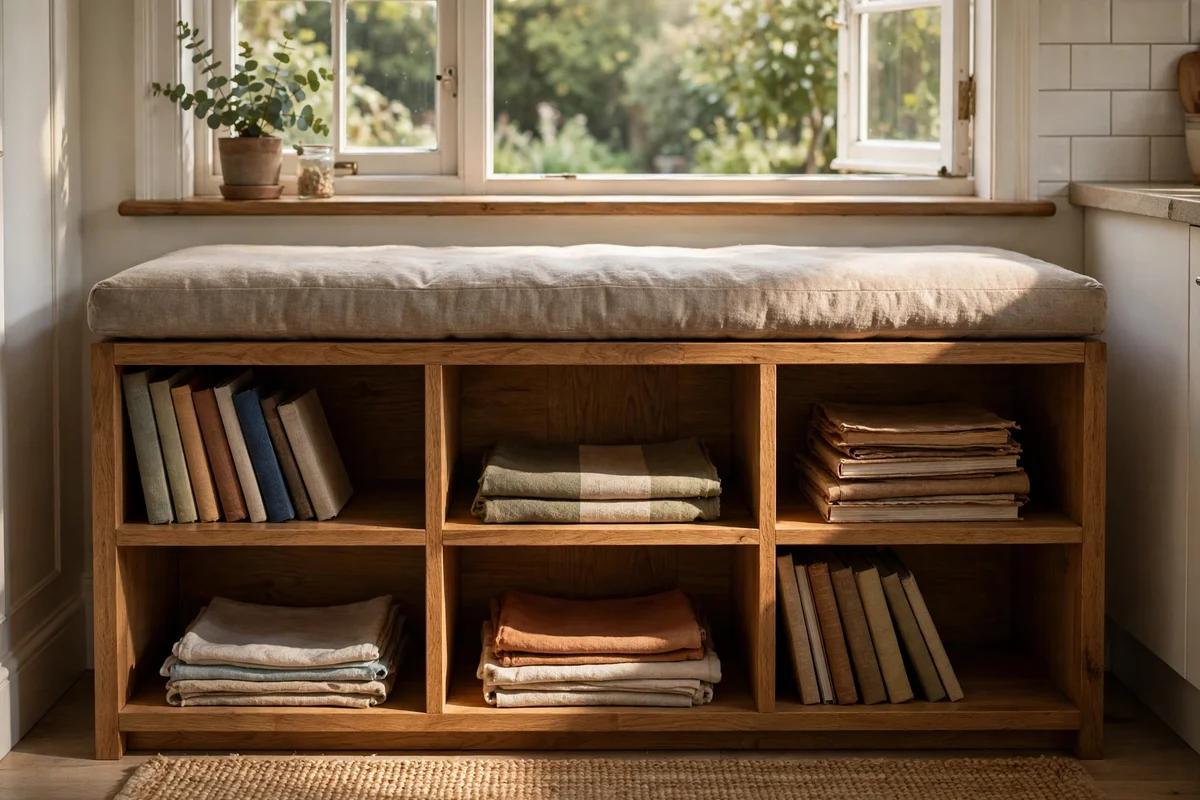
A low bookcase or storage cube unit, 40 to 45 cm high, becomes an instant window seat with a made-to-measure cushion on top. Choose a unit 30 to 35 cm deep so it sits flush under the sill, and order a foam cushion 8 cm thick cut to the exact footprint. The cubbies below hold cookbooks, placemats or small breakfast bowls.
Secure the unit to the wall with anti-tip straps, since children will climb it, and add felt pads underneath for easy cleaning behind. A washable cover in a mid-tone fabric keeps the seat practical. The mistake to avoid is using an unsecured lightweight unit that slides when someone sits; wall fixing takes ten minutes. Units cost 50 to 150 dollars, cushions 40 to 90.
14. Pair a Freestanding Bench With Two Chairs for Flexible Seating
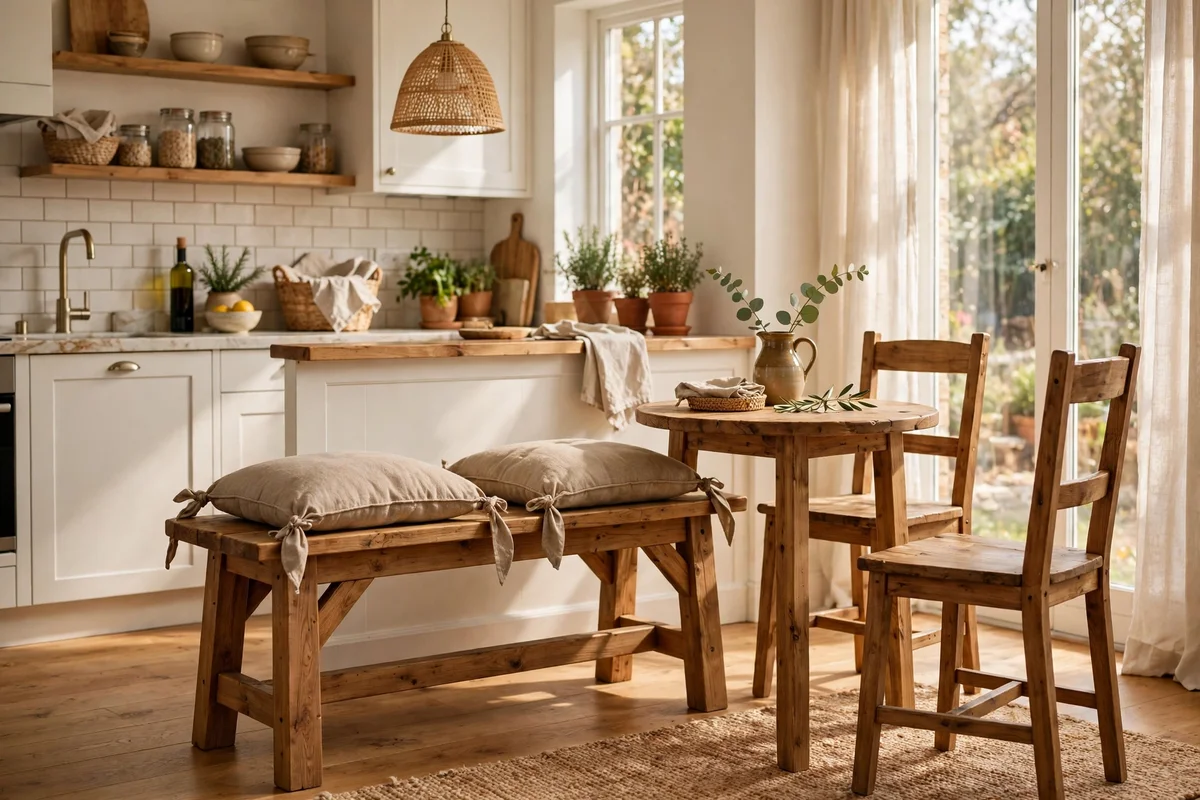
If a built-in banquette feels too permanent, a freestanding bench 120 to 140 cm long paired with two dining chairs seats four with complete flexibility. The bench slides under the table when not in use, and the whole arrangement can move for parties or deep cleaning. Choose a bench 45 cm high to match chair seats so the table line stays level.
Look for benches with a lower stretcher bar; it doubles as a footrest and stiffens the frame. Cushions tied to the bench with fabric ties stay put without sliding. The mistake to avoid is mixing seat heights; even a 3 cm difference makes the table feel wrong. A solid timber bench costs 80 to 200 dollars, and matching the wood tone to the table keeps the set calm.
15. Pick Machine-Washable Cushions in Forgiving Mid-Tones
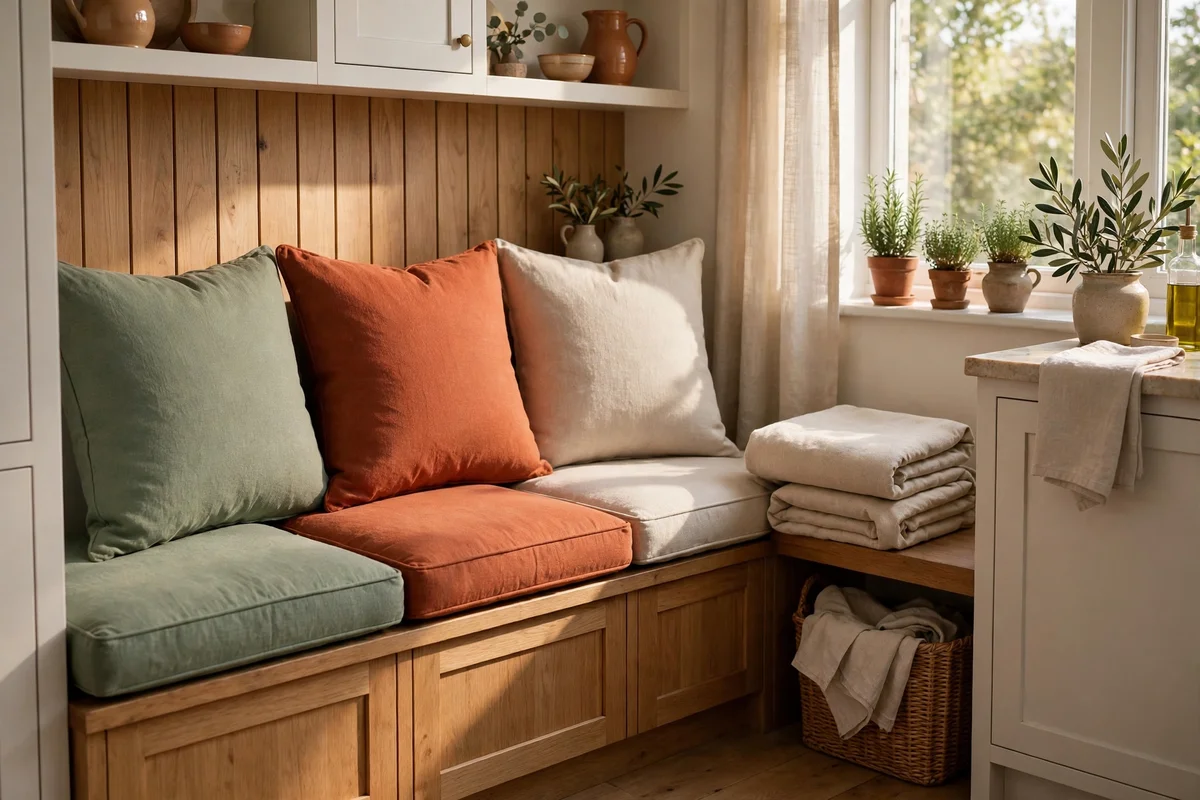
Mid-tone fabrics forgive the daily life of a breakfast nook. Sage green, warm terracotta, dusty blue and oatmeal all hide crumbs and faint stains between washes, while still looking soft and considered in morning light. Choose removable covers with hidden zips in cotton canvas or a cotton-linen blend of at least 200 gsm so they survive weekly washing.
Keep two sets of covers and rotate them on laundry day so the nook never sits bare. Wash on a 30-degree cycle and reshape the foam while damp to keep corners square. The mistake to avoid is falling for white boucle or pale velvet in a breakfast spot; both show every splash within a week. Spare covers typically cost 25 to 50 dollars per cushion.
16. Fit a Sheer Roman Blind That Filters Glare but Keeps the View
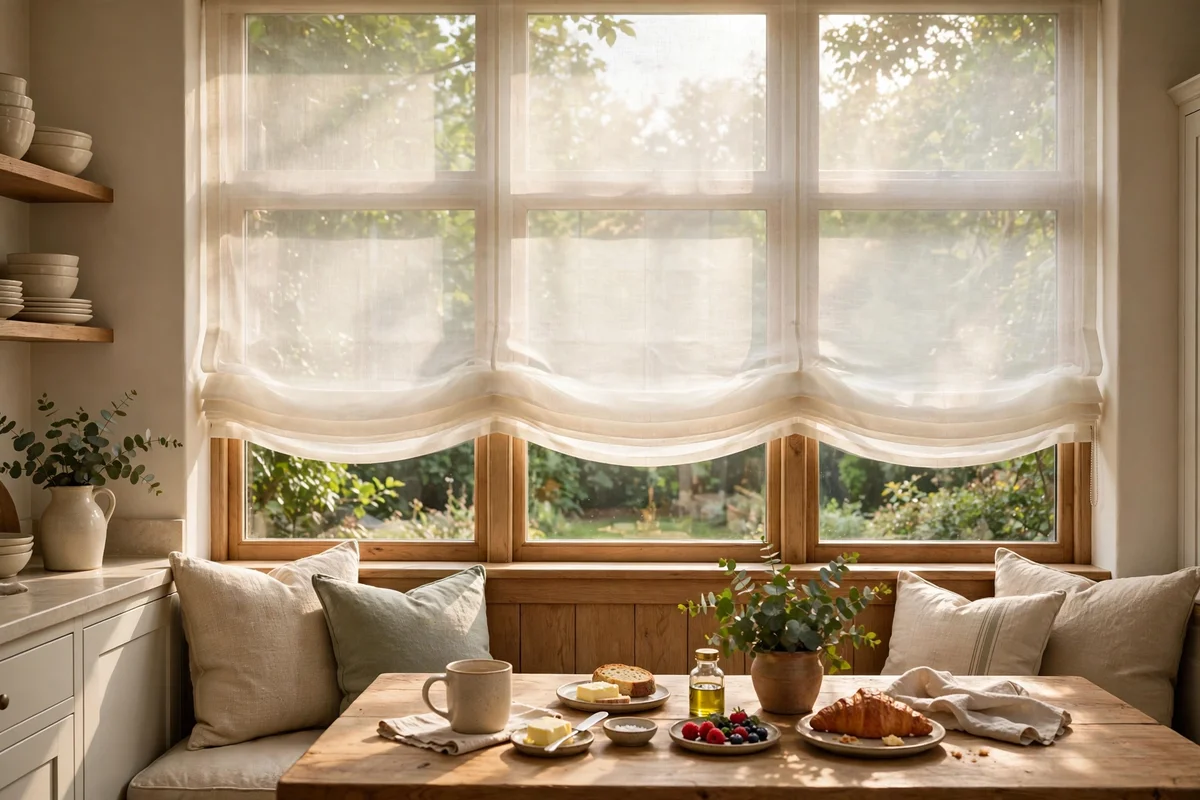
A sheer roman blind in voile or sheer linen cuts the sharp edge off east-facing morning sun while keeping the garden view intact. When lowered, the flat fabric diffuses light evenly across the table; when raised, it stacks into soft folds of 15 to 20 cm at the top of the window. Mount it inside the recess for a clean, tailored look.
Choose a cordless or wand-operated blind for safety and a tidy profile, especially with children climbing onto the banquette. Ivory or pale grey sheers suit most kitchens and never fight the wall colour. The mistake to avoid is choosing a heavy lined blind that must stay half-raised all morning; it defeats the purpose. Sheer roman blinds cost 40 to 110 dollars per window.
17. Slide a Narrow Oval Table Into a Galley Kitchen Nook
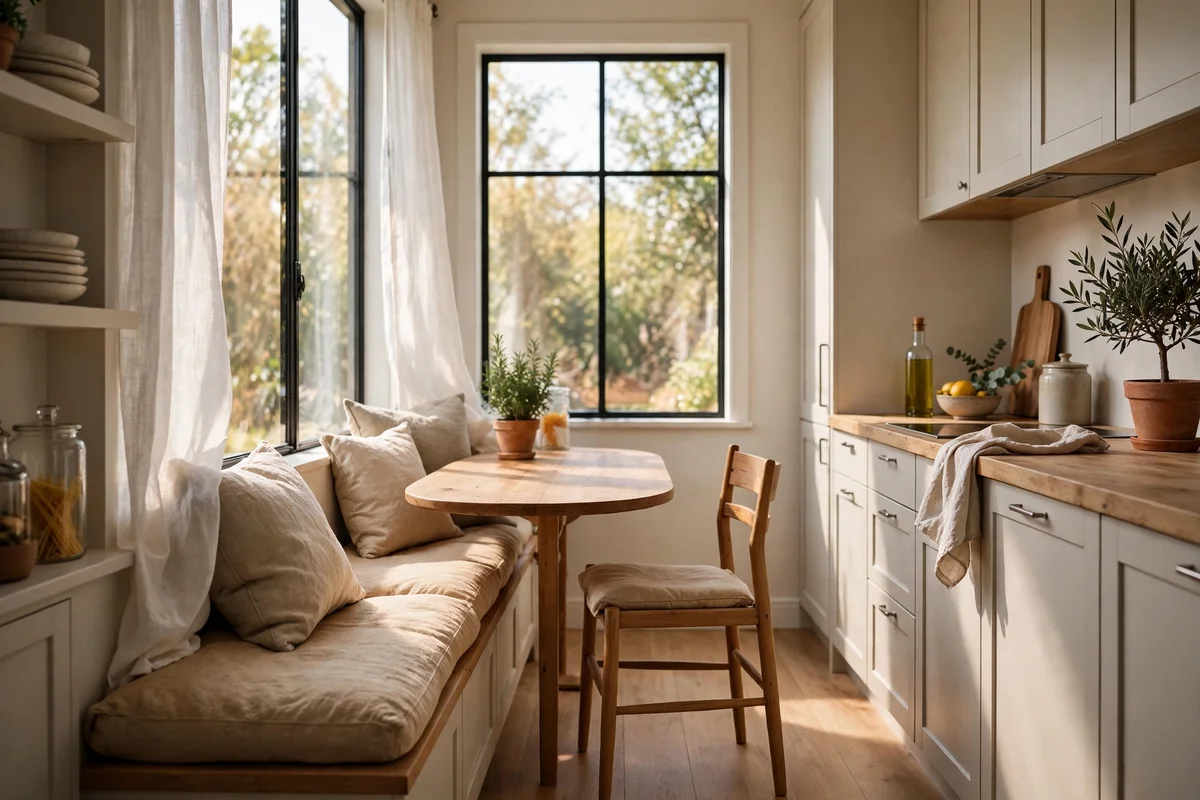
A narrow oval table, 120 cm long and 70 to 75 cm wide, slides into the end of a galley kitchen and seats two face to face without blocking the cooking walkway. The rounded ends need no corner clearance, so the table can sit 10 cm from the wall and still feel generous. Pair it with a bench on the window side and one chair on the aisle side.
Keep at least 75 cm of clear walkway behind the chair so the cook passes without turning sideways. A drop-leaf oval that folds to 60 cm wide doubles the flexibility for very narrow galleys. The mistake to avoid is placing a square table here; its corners snag hips and aprons all day. Narrow ovals cost 120 to 350 dollars new.
18. Keep a Small Shelf for Mugs and a Teapot Within Arm’s Reach
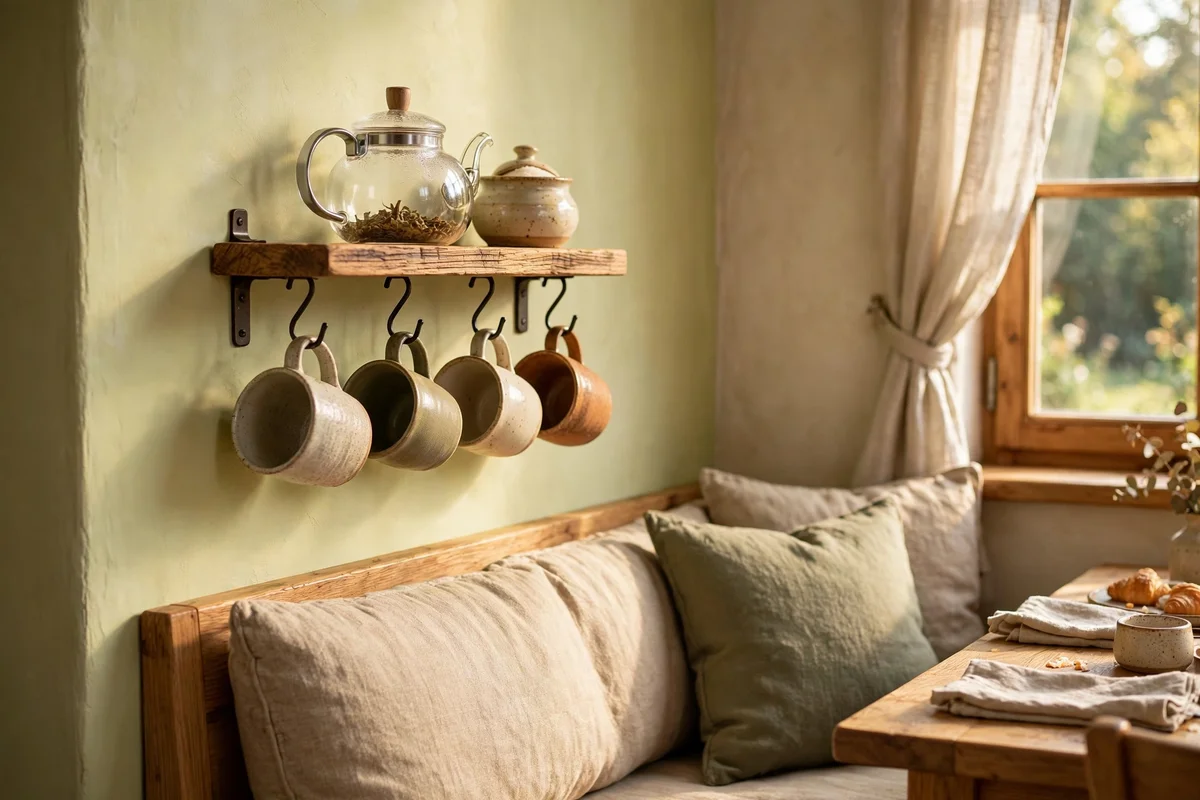
A single small shelf mounted at shoulder height beside the banquette keeps morning essentials within arm’s reach: four to six favourite mugs, a glass teapot, and a sugar bowl. A board 60 cm long and 15 cm deep holds this much without crowding, and two slim brackets keep the look light. Hanging mugs on S-hooks underneath doubles the capacity.
Keep the shelf to daily items only so it earns its place; anything used less than weekly belongs in a cupboard. Wipe the shelf monthly since steam and toast dust settle there. The mistake to avoid is mounting it above head height, which turns a convenience into a stretch. One shelf with brackets costs 15 to 40 dollars and installs in under an hour.
19. Fold a Table Runner Over a Bare Table for Weekday Mornings
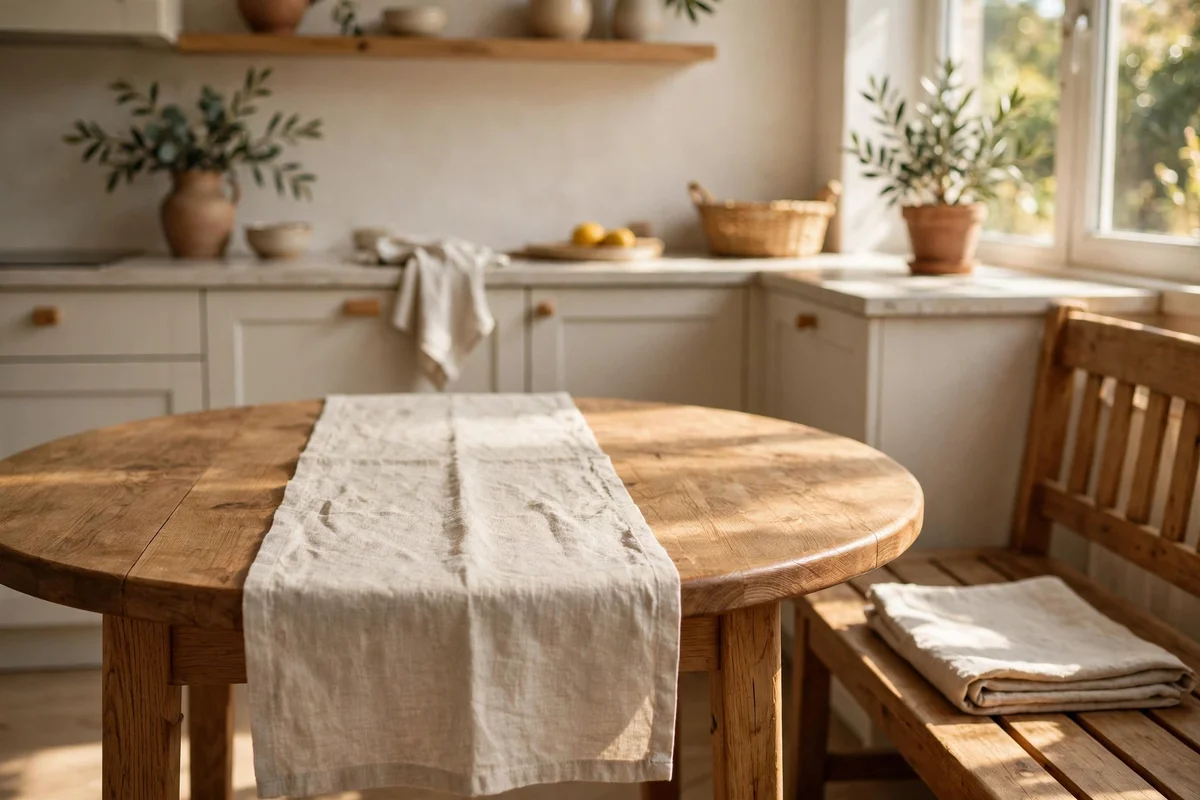
On busy weekdays, a folded table runner protects the table and adds quiet polish in seconds. Choose a runner 35 cm wide and twice the table length plus 30 cm, then fold it in half lengthways so it sits as a neat 17 cm band down the centre. Natural linen, ticking stripe or a simple woven cotton all suit the morning mood.
Keep the runner machine-washable and store a spare folded in the banquette storage for instant swaps after spills. Press it flat with a warm iron monthly so the fold stays crisp. The mistake to avoid is a runner that hangs over the table edge; on a round table it slides and bunches. Good runners cost 15 to 45 dollars.
20. Back the Banquette With Beadboard Panels for Quiet Cottage Charm
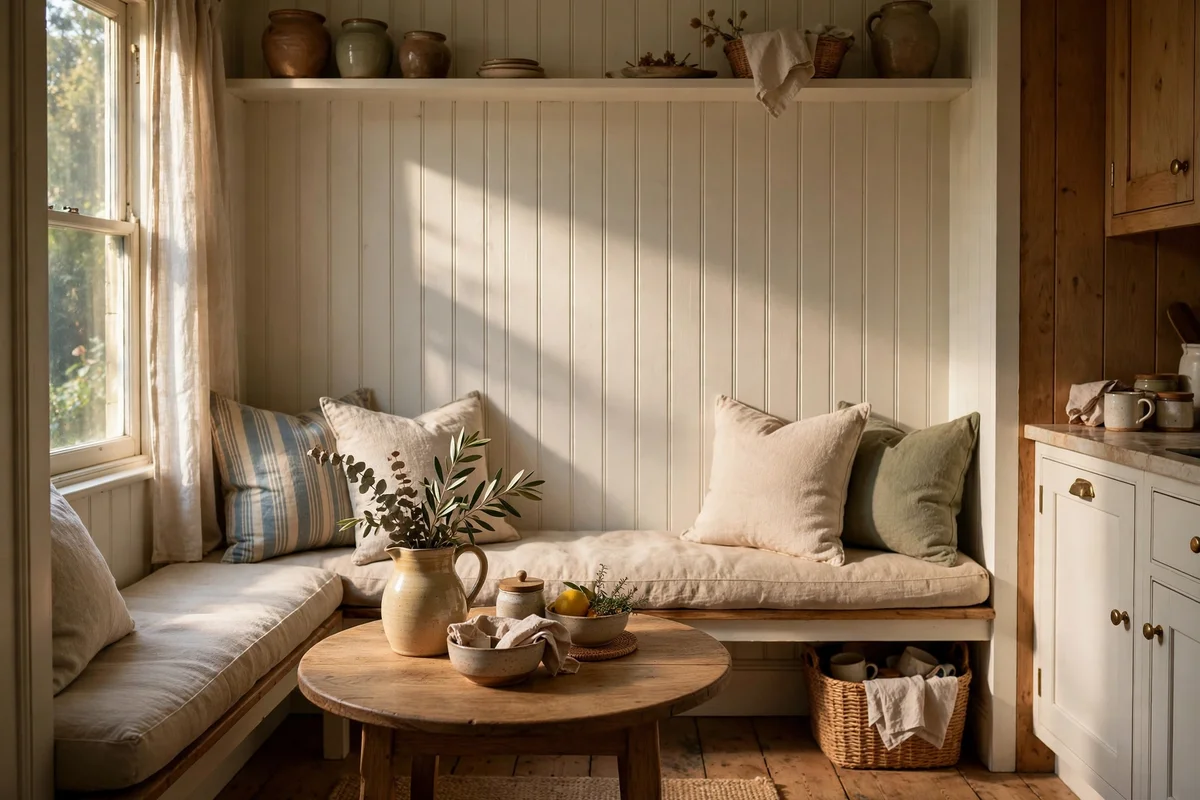
Beadboard panels behind the banquette add texture and a handcrafted feel for very little money. Run vertical boards from the seat top to 90 cm high, or take them to the ceiling behind the shelves for a full cottage backdrop. Paint them the same warm white as the trim so the texture shows in raking morning light rather than the colour.
Use moisture-resistant MDF beadboard sheets in a kitchen, since steam and splashes reach further than expected. Caulk the top edge where panel meets wall for a crisp line. The mistake to avoid is installing raw pine beadboard and leaving it unsealed; it yellows unevenly within a year. Sheets cost 20 to 50 dollars each and cover roughly two square metres.
21. Put the Pendant on a Dimmer for Slow Mornings and Evening Tea
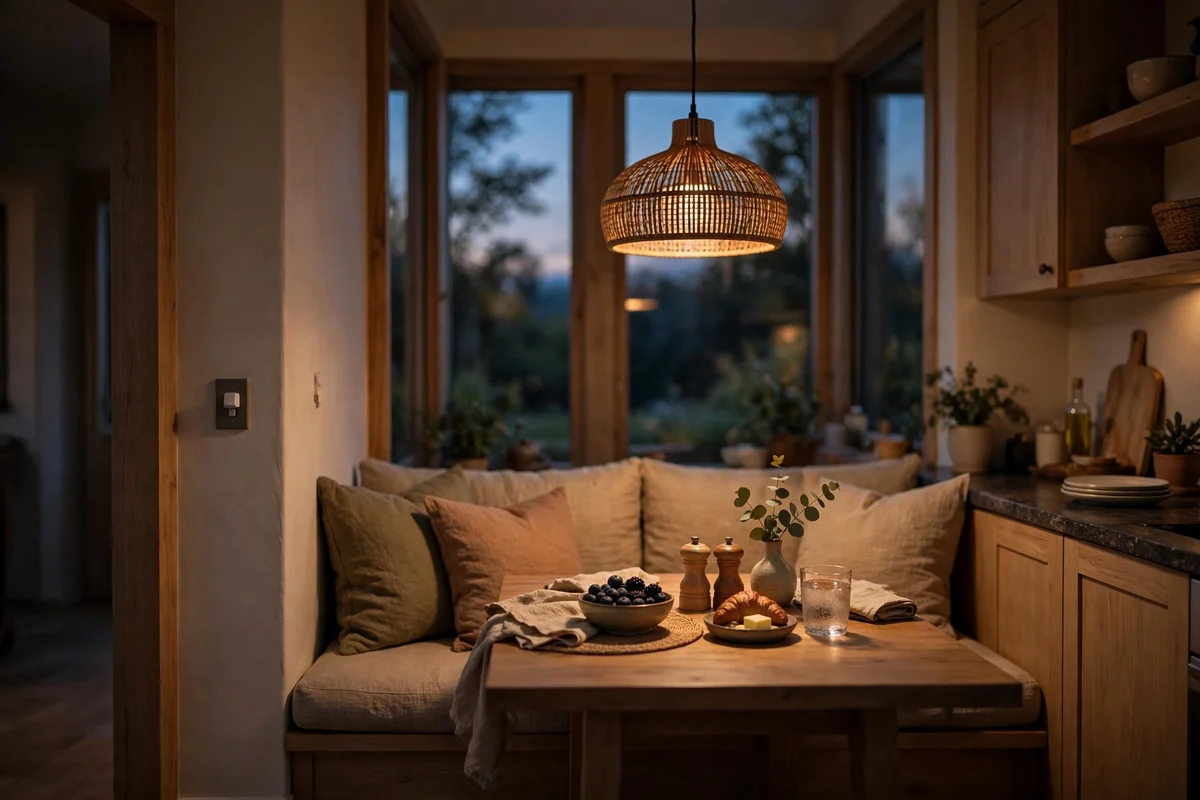
A dimmer on the nook pendant lets one fitting serve two moods: full brightness for grey mornings and homework, and a low warm glow for evening tea. Fit a trailing-edge dimmer matched to LED bulbs to avoid flicker, and choose dimmable 2700K bulbs so the light warms further as it dims. The switch sits best by the nook entrance.
Test the dimmer with the exact bulbs before the electrician leaves, since mismatched pairs buzz or cut out at low levels. Mark a favourite low setting with a small dot of paint on the dial if it helps the household. The mistake to avoid is dimming non-dimmable LEDs, which shortens their life dramatically. A dimmer switch costs 15 to 35 dollars plus fitting.
22. Allow 60 cm of Table Edge Per Person for Comfortable Elbows
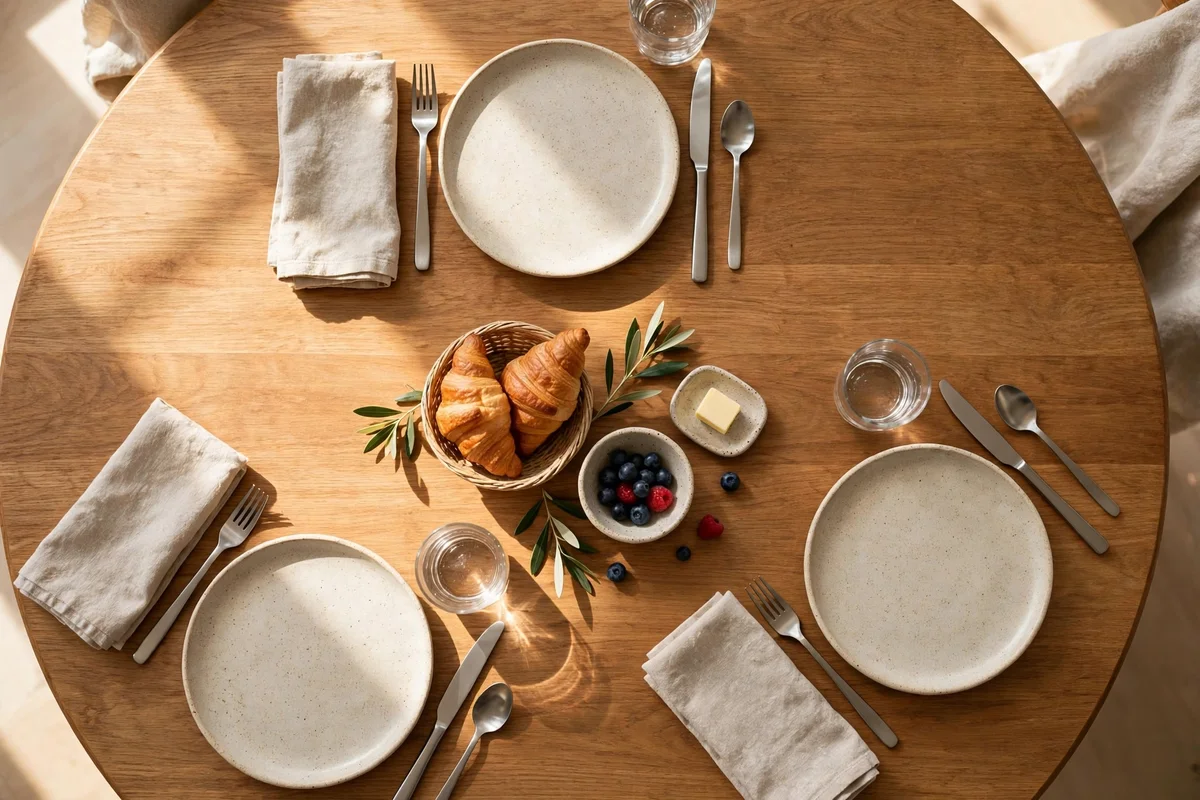
Plan 60 cm of table edge per person as the comfort rule for any nook layout. A 120 cm bench therefore seats two generously, a 150 cm bench seats two with room to spare or three at a squeeze, and a 100 cm round table suits three to four. Sketch the layout on paper with these numbers before buying a single piece of furniture.
Remember that banquette sitters need 45 to 50 cm of knee room between seat edge and table edge to slide in comfortably, which is more than chair sitters need. Measure twice, buy once. The mistake to avoid is trusting showroom arrangements; shops display tables with far more space around them than a home corner allows. Ten minutes with a tape measure saves costly returns.
23. Anchor the Nook With a Low-Pile Rug That Defines the Corner
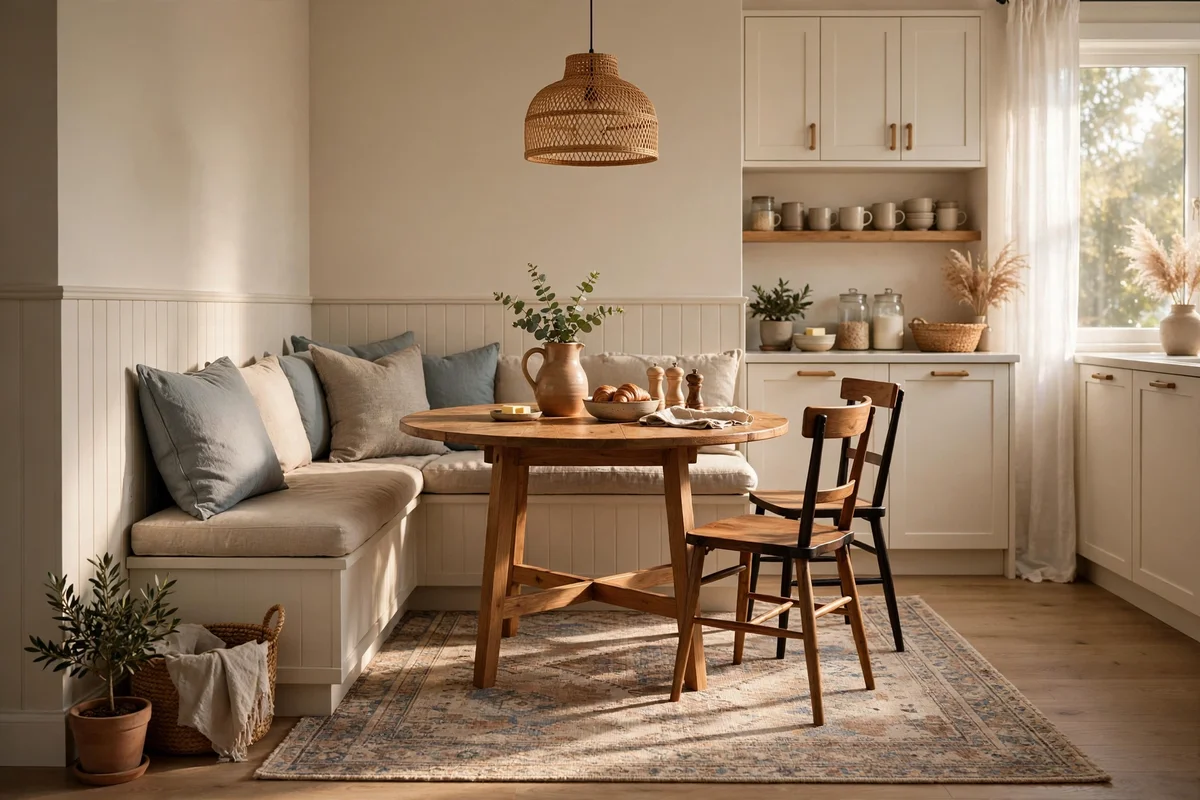
A low-pile rug under the table defines the nook as its own small room within the kitchen. Choose a flatweave or low-pile rug 160 by 230 cm for a four-person nook, so chair legs and bench feet all sit on the rug with 20 cm to spare. Cotton, jute or a washable synthetic all handle crumbs better than deep pile.
Pick a pattern with a busy weave or small motif in mid-tones; it hides the inevitable toast crumbs between vacuums. Shake the rug outside weekly and spot-clean spills the same day. The mistake to avoid is a thick shaggy rug under a dining table; chairs catch, crumbs vanish into it, and it never looks clean. Washable rugs cost 60 to 180 dollars.
24. Refresh the Table Seasonally With a Fruit Bowl and Fresh Stems

The simplest refresh costs nothing beyond the weekly shop: change what sits in the fruit bowl and the stem jug with the seasons. Spring brings blossom branches and citrus, summer stone fruit and wild grasses, autumn pears and dried wheat, winter oranges and evergreen sprigs. The nook feels new four times a year without buying a single decor object.
Keep the vessels constant, one low bowl and one jug, so the change reads as intentional styling rather than clutter. Compost tired stems and fruit promptly; a nook that smells fresh feels calm. The mistake to avoid is adding seasonal ornaments around the bowl; the fruit and stems are the decoration. This ritual takes five minutes and costs nothing extra.
A breakfast nook asks for very little and gives back every morning: a bench at the right height, a table that fits the corner, light pooled low over the food, and cushions that forgive real life. The ideas here share one spirit, designing a small corner around a daily ritual rather than around how it photographs. When the measurements are right and the materials are washable, the nook gets used instead of admired.
This week, try the easiest idea first: clear the table completely, then style it with just a cloth, a jug of stems and a fruit bowl. It takes ten minutes, costs nothing you do not already own, and it changes how the whole kitchen feels at seven in the morning. If that small ritual holds for a week, measure your corner for a bench, because a nook built around slow mornings tends to keep them slow.
Frequently Asked Questions
How much does a built-in breakfast nook banquette cost?
A DIY L-shaped banquette from plywood or painted MDF typically costs 300 to 800 dollars in materials, including foam and washable covers. A carpenter-built banquette runs 1,500 to 4,000 dollars depending on size and finish. Save money by building the base yourself and ordering only the cushions custom made.
What size table fits a small breakfast nook?
A round table 90 to 100 cm across seats three comfortably in a compact corner, while a 70 cm round cafe table suits a two-person nook in a galley kitchen. Allow 75 to 90 cm of walkway on the open sides. Round and oval tops work best in tight spaces because they have no corners to bump.
How deep should a banquette seat be?
Aim for 48 to 52 cm of seat depth before cushions, which leaves 38 to 42 cm once a 10 cm back cushion is added. Shallower than 45 cm feels like perching, and deeper than 55 cm pushes you away from the table. Seat height should be 44 to 46 cm, with 20 to 25 cm of knee clearance under the tabletop.
Are washable cushions really necessary in a breakfast nook?
Yes. Breakfast is the messiest meal of the day, and even careful households spill tea and jam. Removable, machine-washable covers in mid-tone cotton or performance fabric keep the nook looking cared for with a weekly wash. Keep a spare set of covers so the bench never sits bare on laundry day.
Can I create a breakfast nook in a rented kitchen?
Absolutely. Use a freestanding bench and a small round table that need no fixings, hang cafe curtains on a tension rod, and choose a plug-in or rechargeable pendant or wall sconce. A washable rug defines the corner without marking the floor. Every piece can move with you on moving day.